Introduction
Psychotropic drugs (PDs) have limited evidence of efficacy for the treatment of neuropsychiatric symptoms (NPS) in dementia (Selbaek et al., Reference Selbaek, Kirkevold and Engedal2007; Wetzels et al., Reference Wetzels, Zuidema, de Jonghe, Verhey and Koopmans2011) and there is substantial evidence on the risks, side effects, and long-term inefficacy of PDs (Zuidema et al., Reference Zuidema, de Jonghe, Verhey and Koopmans2007a; Reference Zuidema, Derksen, Verhey and Koopmans2007b; Ballard et al., Reference Ballard2009; Bustin, Reference Bustin2009). Antipsychotics, in particular, have been shown to cause adverse events, i.e. extrapyramidal symptoms, somnolence, increased risk of falls, stroke, and mortality (van Iersel et al., Reference van Iersel, Zuidema, Koopmans, Verhey and Olde Rikkert2005; Schneider et al., Reference Schneider, Dagerman and Insel2006; Ballard et al., Reference Ballard2009; Seitz et al., Reference Seitz2013). Anxiolytics and hypnotic drugs are associated with falls (Uzun et al., Reference Uzun, Kozumplik, Jakovljević and Sedić2010). Therefore, the guidelines recommend psychosocial interventions as a first choice for treating NPS in dementia (Smalbrugge et al., Reference Smalbrugge2008).
Despite this (Smalbrugge et al., Reference Smalbrugge2008), PDs are frequently prescribed (Zuidema et al., Reference Zuidema, Derksen, Verhey and Koopmans2007b; Eggermont et al., Reference Eggermont, de Vries and Scherder2009; Wetzels et al., Reference Wetzels, Zuidema, de Jonghe, Verhey and Koopmans2011; Zwijsen et al., Reference Zwijsen2014). This concerns many different PDs, i.e. antipsychotics, anxiolytics, hypnotics, antidepressants, anti-dementia drugs, and antiepileptics, the latter also being prescribed for NPS in dementia in the Netherlands (Smalbrugge et al., Reference Smalbrugge2008).
The frequent use of PDs may raise questions about the appropriateness of prescription. There is some literature available supporting the hypothesis that PDs are used too long (Ruths et al., Reference Ruths, Straand and Nygaard2001; Koopmans et al., Reference Koopmans2007; Gustafsson et al., Reference Gustafsson, Karlsson and Lövheim2013), in duplicate prescription (Wetzels et al., Reference Wetzels, Zuidema, de Jonghe, Verhey and Koopmans2011), and without proper indication (Finkers et al., Reference Finkers, Maring, Boersma and Taxis2007; Lucas et al., Reference Lucas2014). Other aspects relating to a broader concept of appropriateness (Wei et al., Reference Wei2014) are not available for PDs. This is important because appropriateness itself (and not frequency only) was found to be associated with a higher mortality (Wei et al., Reference Wei2014).
Recently, we developed an instrument with seven domains of appropriateness (van der Spek et al., Reference van der Spek2015) that gives us the opportunity to investigate the different domains of appropriateness simultaneously. Exploring appropriateness into more detail is imperative because a high frequency of psychotropic drug use (PDU) does not necessarily imply suboptimal drug therapy; to our knowledge, no studies relate the frequency and appropriateness of PDU.
The aim of this study is to assess the appropriateness of PDU for NPS in nursing home patients with dementia. More specifically, the research questions are: (1) How appropriate is the PDU for NPS in nursing home patients with dementia? (2) Which domains of appropriateness of PDU for NPS contribute the most to appropriate use? (3) Are there differences between PD types in the appropriateness of use? (4) Is there an association between the appropriateness of PDU and the number of PDs used per patient, dementia special care unit (DSCU), and elderly care physician?
Methods
Study design
This study is part of the PROPER I study (PRescription Optimization of PDs in Elderly nuRsing home patients with dementia); a cross-sectional study on the appropriateness of PDU for NPS in nursing home patients with dementia. The study was conducted from January to June 2012 and the data were collected from the medical records of Dutch nursing home patients with dementia residing in DSCUs. Data about PD prescriptions (dosage, drug–drug interactions, drug–disease interactions, duplications, and therapy duration) was derived from the pharmacy part of the medical record; data about indications for the PD prescriptions and evaluation of effect/side effects of PD prescriptions was derived from the physician and nurse medical records in the time period PDs were started. The full study design is described elsewhere (van der Spek et al., Reference van der Spek2013).
In this study, the unit of analysis is the prescribed PDs for NPS in a sample of nursing home patients. We did not include pro re nata use because the rationale for prescription may be different. Analyses were performed for the appropriateness (in general and per domain) of PDU in total, per PD group, and per individual PD. Furthermore, the association of the appropriateness of PDU and the number of PDs used were analyzed by investigating the association of appropriateness of PDU with the number of PDs used.
Assessment of appropriateness
The appropriateness of PDU was extracted from medical records and assessed using the Appropriate Psychotropic drug use In Dementia (APID) index (van der Spek et al., Reference van der Spek2015). The APID index is developed based on the items of the Medication Appropriateness Index (Hanlon et al., Reference Hanlon1992) and is specifically suited for clinical studies evaluating the appropriateness of PDU for NPS in patients with dementia in nursing homes. Only medication administered for behavior associated with dementia, sleep disturbance, and delirium were scored with the APID index. Therefore, PDs that had a clear indication for psychiatric disorders other than dementia in the medical record, i.e. sleep disturbance and delirium, were excluded from scoring. If no clear indication was found in the medical record, it was assumed it was prescribed for NPS (van der Spek et al., Reference van der Spek2015).
The APID index encompasses seven items corresponding with the seven different domains of appropriateness, i.e. indication, evaluation, dosage, drug–drug interactions, drug–disease interactions, duplications, and therapy duration. Recommendations from national (Dutch) and international drug formularies are applied in order to score information about individual PDs; see the Appendix for an example. The response categories of the seven domains are 0, 1, and 2 for fully appropriate, marginally appropriate, and fully inappropriate prescribing. At the time of index development, an expert panel weighted the relative importance of each of the domains on a scale from one to ten. This resulted in different theoretical ranges per domain as follows: indication (range 0–18.8), evaluation (range 0–19.2), dosage (range 0–13.4), drug–drug interactions (range 0–11.6), drug–disease interactions (range 0–13.2), duplication (range 0–14.4), and therapy duration (range 0–12.2). This way, the relative contribution of the domains could be incorporated into a sum score using mean weights. The APID sum score ranges from 0 (fully appropriate) to 102.8 (fully inappropriate) on individual PDs (van der Spek et al., Reference van der Spek2015).
PDs were grouped using the Anatomical Therapeutic Chemical classification (ATC) (Anon, 1990). Different PD groups had different theoretical sum score ranges, considering that antidepressants, as well as anti-dementia drugs, do not have a maximum therapy duration according to drug formularies. Therefore, these PDs cannot score as inappropriate for therapy duration. Moreover, other PD groups do not have a fully inappropriate drug–drug interactions score according to the APID index. This implies that there is a difference between the theoretical maximum sum score ranges of the different PD groups: antiepileptics (0–96.2), antipsychotics (0–102.8), anxiolytics (0–96.2), hypnotics (0–96.2), antidepressants (0–90.6), and anti-dementia drugs (0–84.8) (van der Spek et al., Reference van der Spek2015).
Statistical analyses
First, the appropriateness of PDU in the total sample was determined by calculating the APID indexes mean sum scores (including range) and the percentage of PDs being prescribed fully appropriate (APID sum score = 0).
Second, the mean scores and their standard deviations per PD group and APID domain were calculated. The amount of use per PD group was also determined. The APID domains that contributed the most to the mean inappropriateness in the total sample, thus are the least appropriate, were analyzed; the percentage of fully appropriate scores (score 0) was calculated for all APID domains taken together (APID sum score) and for each of these domains separately.
Third, the different outcomes were ranked using ranking (League) tables (Lemmers et al., Reference Lemmers, Kremer and Borm2007), i.e. outcomes are ranked according to the 95% CI of the mean APID sum score. Within the interval, the minimum ranking and maximum ranking were calculated for the different PD groups and ranked in ascending order. Additionally, per individual PD the amount of use in the total sample, the observed score ranges, and mean APID sum scores were calculated. The percentages of fully appropriate scores were also calculated per individual PD for all domains taken together (APID sum score = 0), and for the least appropriate domains separately.
Fourth, to analyze the association between the appropriateness of PDU and the number of PDs used, the following calculations were performed: the number of PDs used by individual patients, the average number of patients who receive one or more PDs per individual DSCU, and the average number of patients who receive one or more PDs prescribed by individual elderly care physicians. When patients used more than one drug, the APID sum scores were averaged. The association was determined by calculating the two-tailed Pearson correlation coefficient between the average number of use (percentage) and the mean APID sum score on patient, DSCU, and elderly care physician level. A p-value < 0.05 was considered statistically significant.
Descriptive statistics and correlation calculations were performed by using IBM SPSS Statistics version 20.0. Ranking tables were created using Microsoft Excel, 2010 version (Microsoft Corporation, Redmond, WA, USA).
Results
Participants’ characteristics
The sample consisted of 559 patients living in 44 different DSCUs, cared for by 25 different elderly care physicians, of 12 Dutch nursing homes with 21 locations. There were 146 males (26.3%) and 413 females (73.8%) in the sample who had a mean age of 84 years (range 62–100). From the 559 patients, 338 used one or more PDs. These 338 patients used 578 PDs prescribed for NPS in total; three PDs were excluded from the analyses because of an incomplete APID-index score resulting in 575 PDs for the analyses.
-
1. Appropriateness of total PDU
The mean APID sum score for all 575 PDs was 26.6, ranging from 0 to 68.6; 9.6% of the PDs scored fully appropriate on the APID sum score.
-
2. Appropriateness of PDU per domain and PD group
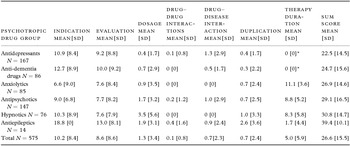
The domains that contribute the most to the mean inappropriateness in the total sample are indication and evaluation for the PD groups antidepressant and anti-dementia drugs; indication, evaluation, and therapy duration for anxiolytics, antipsychotics, and hypnotics; and indication, evaluation, and duplication for antiepileptics (Table 1). The domains indication, evaluation, and therapy duration contributed to 89.5% of the mean inappropriateness, i.e. the APID sum score, in the total sample (not in Table). Therefore, these domains were further explored on their fully appropriate scores (score 0) per PD group and per individual PD.
-
3. Appropriateness of PDU per PD group and per individual PD
Appropriateness of use, defined by APID-scores, per domain, and per psychotropic drug group, higher scores mean that they are less appropriate

SD= standard deviation.
*This psychotropic drug group could only score fully appropriate in this specific domain.
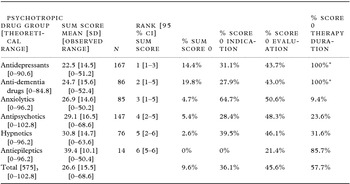
Antidepressants are the most appropriately prescribed (95%CI, rank 1–3) and antiepileptics the most inappropriately (95%CI, rank 5–6) (Table 2). From all PDs, 36.1% had a fully appropriate score for indication, 45.6% a fully appropriate score for evaluation, and 57.7% had a fully appropriate score for therapy duration. Further exploration of the scores showed that in 35.8% of the prescribed PDs no indication and in 52.7% no evaluation were found in the medical records (not in Table). Indications that were not registered accounted for 66.7% of the fully inappropriate indication scores, evaluations that were not registered accounted for 100% of the fully inappropriate evaluation scores (not in Table).
Appropriateness of use, defined by APID-scores, per psychotropic drug group; higher scores mean that they are less appropriate

CI= confidence interval, SD= standard deviation.
*This psychotropic drug group could only score fully appropriate in this specific domain.
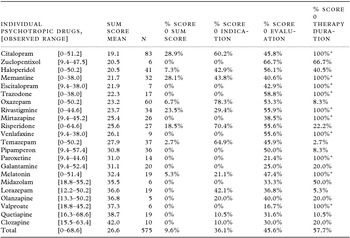
The observed score range and the mean sum score per individual PD are shown in ascending order, only PDs that were used five times or more are shown (Table 3). The prescription of more than half of the shown individual PDs scored not fully appropriate on all domains of appropriateness taken together, i.e. the APID sum score. Almost half of the shown individual PDs did not have a prescription that had a fully appropriate score on indication, i.e. score 0.
-
4. Association of the number of PDs used with the appropriateness of PDU
Appropriateness of individual psychotropic drugs, defined by APID-scores, higher scores mean that they are less appropriate

*This psychotropic drug could only score fully appropriate in this specific domain.
No significant association between the number of PDs used per patient and the mean APID sum score per patient was found (Pearson Correlation −0.016, Sig. (two-tailed) 0.769, N = 338). Furthermore, no significant association was found between the average number of patients on a specific DSCU who received one or more PDs and the mean APID sum score on that DSCU (Pearson Correlation 0.030, Sig. (two-tailed) 0.582, N = 44), nor between the average number of patients of the individual physician who receive one or more PDs and the mean APID sum score for that elderly care physician (Pearson Correlation 0.059, Sig. (two-tailed) 0.283), N = 25).
Discussion
To our knowledge, this is the first study to explore a broad range of relevant domains of appropriateness of PDU for NPS in nursing home patients with dementia.
We found that only 10% of the PDs scored as fully appropriate and that appropriateness was the least for the domains indication, evaluation, and therapy duration. Dosage, drug–drug interactions, drug–disease interaction, and duplications scored more appropriately. A potential explanation for this difference could be that, in Dutch nursing homes, domains such as drug–drug interactions are controlled by computerized processes and domains such as indication are dependent on the physicians’ prescription policy. For instance, it appeared that in more than one-third of the PDs, no indication was found in the medical records. This confirms earlier findings that the majority of the patients in nursing homes have at least one drug prescribed of which the indication was unknown (Finkers et al., Reference Finkers, Maring, Boersma and Taxis2007).
Antidepressants were prescribed the most appropriately, whereas antiepileptics were prescribed the most inappropriately. Another study (Oborne et al., Reference Oborne, Hooper, Li, Swift and Jackson2002) found that 18% of antipsychotics had appropriate indications and evaluations based on the prescription criteria. Our results showed low appropriateness rates regarding indications and evaluation not just for antipsychotics but also for all other PDs.
Furthermore, appropriateness was not associated with the number of PDs used per patient, the percentage of use on the separate units patients resided, nor the percentage of prescription of the individual physicians. Many studies describing the frequency of use (Selbaek et al., Reference Selbaek, Kirkevold and Engedal2007; Wetzels et al., Reference Wetzels, Zuidema, de Jonghe, Verhey and Koopmans2011) and prescription policies (Koopmans et al., Reference Koopmans2007; Lustenberger et al., Reference Lustenberger, Schüpbach, von Gunten and Mosimann2011) focused on reducing PDU (Ruths et al., Reference Ruths, Straand, Nygaard and Aarsland2008). However, our study suggests that the appropriateness and frequency of PDU may be unrelated; high rates of PDU do not necessarily reflect the inappropriate use of individual PDs. Therefore, it seems imperative not only to focus on absolute PDU, but also on its appropriateness. Nevertheless, both concepts are conjoined, two inappropriate prescriptions still add up to less appropriate use than one inappropriate prescription. Implementation of tools that evaluate appropriateness in clinical practice may, therefore, lead to prescriptions that are more appropriate. The appropriateness of prescription might be improved by the implementation of tools such as the APID index in daily practice, which may, next to increased appropriateness, also reduce the frequency of use. Thereto, the APID index could be revised into a (self-) evaluation tool.
The absence of an association between frequency and appropriateness may also imply that the underlying factors of these constructs may differ. Factors related to frequency of use next to patient factors have been studied, e.g. bed capacity, under staffing, mindset, and staff experience (Zuidema et al., Reference Zuidema, de Jonghe, Verhey and Koopmans2011; Smeets et al., Reference Smeets2014). However, little is known about factors related to the appropriateness of PD prescription. This could be subject of further study.
A limitation of this study is that the results are based on medical record research, so that inappropriateness scores partly reflect a lack of reporting. However, as our former study shows, prescribers need good reporting to accurately review their own prescriptions (van der Spek et al., Reference van der Spek2015), which implies that good reporting is a prerequisite for appropriateness and its measurement.
Another limitation of this study could be that the APID index does not detect under-prescription, thus this criterion was not included in our study results.
Conclusion
The appropriateness of the prescription of PDs for NPS in nursing home patients with dementia is rather poor; it should be optimized with a clinical focus on appropriate indications, evaluations, and therapy duration.
Conflict of interest
None.
Descriptions of authors’ roles
All authors declare that they have made a substantial contribution to: (1) conception and design, or acquisition of data, or analysis and interpretation of data; (2) drafting the paper or revising it critically for important intellectual content; and (3) made the final approval of the version to be published.
Acknowledgments
This study was funded by the Netherlands Organization for Health Research and Development (ZonMw).
Supplementary Material
To view supplementary material for this article, please visit http://dx.doi.org/10.1017/S104161021600082X.