Introduction
Chronic fatigue syndrome (CFS) is a highly debilitating condition that most often affects women. It is characterized by persistent fatigue that does not improve with rest and, more specifically, by rapid physical and/or mental fatigability in response to exertion (Fukuda et al. Reference Fukuda, Straus, Hickie, Sharpe, Dobbins and Komaroff1994; Carruthers et al. Reference Carruthers, van de Sande, De Meirleir, Klimas, Broderick, Mitchell, Staines, Powles, Speight, Vallings, Bateman, Baumgarten-Austrheim, Bell, Carlo-Stella, Chia, Darragh, Jo, Lewis, Light, Marshall-Gradisbik, Mena, Mikovits, Miwa, Murovska, Pall and Stevens2011). The majority of CFS patients also suffer from chronic pain (Kanaan et al. Reference Kanaan, Lepine and Wessely2007; Meeus et al. Reference Meeus, Nijs and Meirleir2007; Van Houdenhove et al. Reference Van Houdenhove, Kempke and Luyten2010), and there is good evidence to suggest that CFS shows considerable overlap with fibromyalgia (FM) syndrome (Clauw & Chrousos, Reference Clauw and Chrousos1997; Meeus & Nijs, Reference Meeus and Nijs2007; Yunus, Reference Yunus2007; Van Houdenhove & Luyten, Reference Van Houdenhove and Luyten2009).
Previously, we and others (Van Houdenhove & Luyten, Reference Van Houdenhove and Luyten2008, Reference Van Houdenhove and Luyten2009, Reference Van Houdenhove and Luyten2010; Heim et al. Reference Heim, Nater, Maloney, Boneva, Jones and Reeves2009; Nater et al. Reference Nater, Jones, Lin, Maloney, Reeves and Heim2010; Luyten et al. Reference Luyten, Kempke, Van Wambeke, Claes, Blatt and Van Houdenhove2011) have hypothesized that chronic pain and fatigue disorders may result from an interaction between genetic, neurobiological [i.e. hypothalamic–pituitary–adrenal (HPA) axis dysfunctions] and psychological factors such as maladaptive personality dimensions. One personality dimension that has received considerable attention in this context concerns self-critical or maladaptive perfectionism, which is characterized by a combination of high personal standards and overly critical self-evaluations (Blatt, Reference Blatt2004; Blatt & Luyten, Reference Blatt and Luyten2009). Congruent with a two-factor model of perfectionism (Dunkley et al. Reference Dunkley, Blankstein, Masheb and Grilo2006; Stoeber & Otto, Reference Stoeber and Otto2006; Kempke et al. Reference Kempke, Van Houdenhove, Luyten, Goossens, Bekaert and Van Wambeke2011b), self-critical perfectionism (SCP) can be distinguished from adaptive or normal perfectionism. Whereas SCP mainly reflects self-criticism or self-critical evaluative concerns, adaptive perfectionism refers to positive achievement strivings (Dunkley et al. Reference Dunkley, Blankstein, Masheb and Grilo2006; Kempke et al. Reference Kempke, Van Houdenhove, Luyten, Goossens, Bekaert and Van Wambeke2011b).
SCP and related traits such as ‘persistence’ (i.e. a tendency to persevere despite frustration and fatigue) and ‘action-proneness’ (i.e. a cognitive and behavioural tendency towards direct action and overactivity) have been implicated in CFS (Magnusson et al. Reference Magnusson, Nias and White1996; White & Schweitzer, Reference White and Schweitzer2000; Luyten et al. Reference Luyten, Van Houdenhove, Cosyns and Van den Broeck2006, Reference Luyten, Kempke, Van Wambeke, Claes, Blatt and Van Houdenhove2011; Van Houdenhove et al. Reference Van Houdenhove, Bruyninckx and Luyten2006; Van Campen et al. Reference Van Campen, Van Den Eede, Moorkens, Schotte, Schacht, Sabbe, Cosyns and Claes2009; Deary & Chalder, Reference Deary and Chalder2010; Fukuda et al. Reference Fukuda, Kuratsune, Tajima, Takashima, Yamagutchi, Nishizawa and Watanabe2010; Kempke et al. Reference Kempke, Luyten, Van Houdenhove, Goossens, Bekaert and Van Wambeke2011a,b) and also in chronic pain disorders (Van Houdenhove et al. Reference Van Houdenhove, Stans and Verstraeten1987; Rudich et al. Reference Rudich, Lerman, Gurevich, Weksler and Shahar2008; Lerman et al. Reference Lerman, Rudich and Shahar2010, Reference Lerman, Shahar and Rudich2012). In one of the first studies to examine the role of perfectionism in CFS, Magnusson et al. (Reference Magnusson, Nias and White1996), in a non-clinical sample, showed that maladaptive perfectionism was significantly associated with trait fatigue. White & Schweitzer (Reference White and Schweitzer2000) reported increased levels of maladaptive perfectionism in CFS patients. Luyten et al. (Reference Luyten, Van Houdenhove, Cosyns and Van den Broeck2006), in turn, found that patients with CFS retrospectively reported higher levels of maladaptive perfectionism before onset of the disorder. More recently, Deary & Chalder (Reference Deary and Chalder2010) reported that CFS patients had higher levels of maladaptive, but not adaptive, perfectionism compared to healthy controls. Using structural equation modelling, Kempke et al. (Reference Kempke, Van Houdenhove, Luyten, Goossens, Bekaert and Van Wambeke2011b) demonstrated that maladaptive, but not adaptive, perfectionism was significantly associated with severity of fatigue in CFS. Two studies found a prospective association between maladaptive perfectionism and CFS symptoms. Moss-Morris et al. (Reference Moss-Morris, Spence and Hou2010) reported that maladaptive perfectionism significantly predicted the onset of CFS in patients with glandular fever. In a study of undergraduate students, Dittner et al. (Reference Dittner, Rimes and Thorpe2011) found that maladaptive perfectionism significantly predicted fatigue levels at follow-up (i.e. 16 weeks later). Furthermore, congruent with findings in CFS, Lerman et al. (Reference Lerman, Rudich and Shahar2010, Reference Lerman, Shahar and Rudich2012) demonstrated a significant relationship between SCP and pain intensity in chronic pain patients.
Nevertheless, to date, no studies have focused on the associations among SCP, fatigue and pain symptoms in CFS patients in the daily course of life. Importantly, knowledge about the role of SCP in explaining the course of both fatigue and pain in CFS may carry immediate implications for clinical interventions. In the present study we therefore investigated whether SCP prospectively predicted fatigue and pain levels using a daily diary method procedure. Compared to traditional self-report questionnaires, a diary approach is a more ecologically valid method to capture experiences such as fatigue and pain, as they are studied in the normal flow of daily life (Bolger et al. Reference Bolger, Davis and Rafaeli2003; Shiffman et al. Reference Shiffman, Stone and Hufford2008; Luyten et al. Reference Luyten, Kempke, Van Wambeke, Claes, Blatt and Van Houdenhove2011). We hypothesized that SCP would be related to higher daily fatigue and pain levels over a 14-day period. In addition, because SCP is associated with depression in CFS (Kempke et al. Reference Kempke, Luyten, Van Houdenhove, Goossens, Bekaert and Van Wambeke2011a,b; Luyten et al. Reference Luyten, Kempke, Van Wambeke, Claes, Blatt and Van Houdenhove2011), which in turn has been related to increased fatigue and pain levels (Luyten et al. Reference Luyten, Kempke, Van Wambeke, Claes, Blatt and Van Houdenhove2011), we tested the predictive value of SCP after taking into account the effects of daily mood.
Method
Participants
Participants of this study were 144 consecutive patients who were attending the Chronic Fatigue Syndrome Reference Centre of the University Hospitals Leuven (Belgium). All patients were screened according to the Center for Disease Control and Prevention (CDC) criteria for CFS; that is, persistent fatigue for at least 6 months that cannot be explained by a medical or psychiatric condition accompanied by at least four out of eight characteristic symptoms (Fukuda et al. Reference Fukuda, Straus, Hickie, Sharpe, Dobbins and Komaroff1994). The patients underwent an extensive medical evaluation, including physical examination by a specialist in internal medicine and laboratory tests (blood and urine tests), to rule out medical conditions that can cause similar symptoms. After the medical screening, patients were evaluated by a psychiatrist to exclude primary psychopathology that could explain the presence of chronic fatigue.
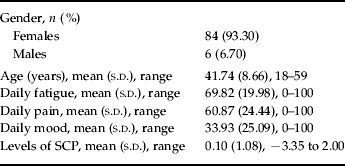
Participants were contacted in person before treatment by a research assistant. Of the 144 patients invited, 15 refused participation (response rate=89.6%). Of those who agreed to participate, 39 (30.2%) had incomplete data (>5% missing values) or completed data outside of the indicated times and were therefore excluded from all further analyses. The total group thus consisted of 90 patients. In line with other studies in CFS (Kempke et al. Reference Kempke, Goossens, Luyten, Bekaert, Van Houdenhove and Van Wambeke2010, Reference Kempke, Luyten, Van Houdenhove, Goossens, Bekaert and Van Wambeke2011a, b), the majority of participants were women (n=84, 93.3%), with an average age of 41.74 years (s.d.=8.66, range 18–59 years) (see Table 1).
Descriptive data of the study sample (n=90)
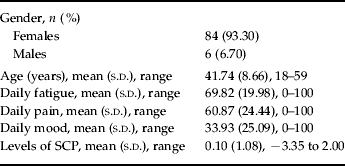
SCP, Self-critical perfectionism; s.d., standard deviation.
Procedure and materials
All patients were assessed before they participated in a multicomponent treatment programme. At the beginning of the study, patients completed a series of self-report questionnaires as part of a larger study. SCP was assessed with the Depressive Experiences Questionnaire (DEQ; Blatt et al. Reference Blatt, D'Afflitti and Quinlan1976), which is a 66-item self-report instrument developed to measure SCP and interpersonal dependency. The questionnaire has good psychometric properties (Blatt, Reference Blatt2004; Luyten et al. Reference Luyten, Sabbe, Blatt, Meganck, Jansen, De Grave, Maes and Corveleyn2007). In this study, only the SCP subscale was used. Next, patients were instructed to complete daily diaries each evening (i.e. shortly before bedtime) for 14 consecutive days. Specifically, patients were asked to rate their average fatigue and pain levels for the day on a Visual Analogue Scale (VAS fatigue/VAS pain) ranging from 0 (not at all fatigued/no pain) to 100 (extremely fatigued/extreme pain). Average fatigue and pain scores were 70 and 61 respectively (see Table 1). Pain and fatigue levels were significantly correlated (r=0.57, p<0.001). Potential covariates were demographics (age and gender) and daily levels of depression, as assessed with a VAS (VAS mood) in response to the question ‘To what extend did you feel down/depressed today?’. Day-to-day test–retest reliability for VAS fatigue, VAS pain and VAS mood was 0.83, 0.94 and 0.89 respectively.
Participants were contacted in person 1 week after enrolment to identify potential problems with completing the diaries and to ensure participation. Patients did not report major difficulties in completing the diaries. They were instructed to return their booklets within 1 month to the CFS centre. After completion of the study, participants received a small incentive (i.e. two free cinema tickets). This study was approved by the Ethics Committee of the University of Leuven (Belgium).
Data analysis strategies
Multilevel analysis (ML) was used as an analysis strategy. ML can be regarded as a special form of regression analysis to analyze data with multiple sources of variation (Hox, Reference Hox2010). There were two sources of variation in the data: over time (level 1) and between individuals (level 2). Following a multilevel analysis strategy, we first fitted an unconditional (null) model with no fixed effects, which provides an estimate of the variances at both levels (Peugh & Enders, Reference Peugh and Enders2005). Next, a fixed model with SCP as a predictor was tested. Additionally, we tested whether SCP still predicted fatigue and pain levels after controlling for demographic characteristics (i.e. age and gender) and daily mood. The model can be expressed as:
 $$\eqalign{ {\rm Fatigue}\sol {\rm pain}_{ij} \equals \tab \beta _{\setnum{0}j} \plus \beta _{\setnum{1}j{\rm GENDER}_{{ij}} } \plus \beta _{\setnum{2}j{\rm AGE}_{{ij}} } \cr \tab \plus \beta _{\setnum{3}j{\rm MOOD}_{{ij}} } \plus \beta _{\setnum{4}j{\rm SC}_{{ij}} } \plus e_{ij}. \cr} \hfill$$
In this equation, β0j is the intercept, β1jGENDERij represents the regression coefficient of the demographic variable gender, β2jAGEij refers to the regression coefficient of the demographic variable age, β3jMOODij is the regression coefficient of the variable mood, β4jSCij refers to the regression coefficient of the predictor variable SCP as measured with the DEQ, and e ij represents the error term.
The improvement in model fit was computed using the χ2 difference statistic. Multilevel analyses were conducted using the SPSS (version 16.0) mixed models procedure (Peugh & Enders, Reference Peugh and Enders2005; West, Reference West2009). A p value of <0.05 was used in all analyses.
Results
Unconditional models
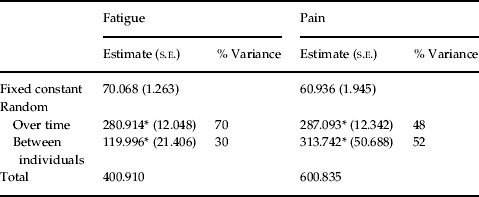
Criteria for ML were met as there was a significant proportion of variance situated at both levels (i.e. time and individuals) for both fatigue and pain (see Table 2). The unconditional model for fatigue showed that 30% of the variance in fatigue was between individuals whereas 70% of the variance could be attributed to the time level (t=55.458, p<0.001). The unconditional model for pain, in turn, showed that 48% of the variance in pain was accounted for by the time level whereas 52% was between individuals (t=31.333, p<0.001). Thus, the results revealed considerable fluctuations in fatigue over the 14 days. By contrast, pain was more stable over time but showed greater variability between patients.
Unconditional models for fatigue and pain (n=90)
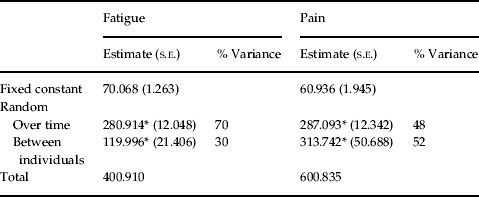
s.e., Standard error.
* p<0.001.
Fixed-effect models
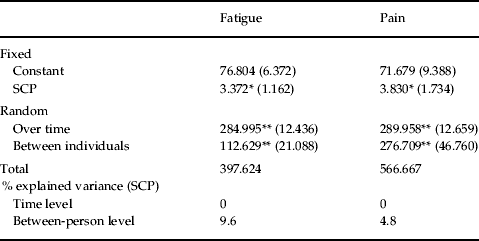
Congruent with expectations, the fixed model showed that SCP significantly predicted daily fatigue (β=3.356, s.e.=1.121, t=2.993, p<0.05) and pain (β=3.907, s.e.=1.765, t=2.214, p<0.05) levels over the 14 days. The model provided a significantly better fit compared to the unconditional model for both fatigue (Δχ2=10.70, Δdf=1, p<0.05) and pain (Δχ2=7.79, Δdf=1, p<0.05). SCP continued to predict fatigue (β=3.372, s.e.=1.162, t=2.902, p<0.05) and pain (β=3.830, s.e.=1.734, t=2.208, p<0.05) even when controlling for demographic characteristics and mood (Table 3), with SCP adding 9.6% and 4.8% in the explanation of the between-person variance in fatigue and pain respectively. Moreover, this model (i.e. with SCP, demographic characteristics and mood as predictors) yielded a better fit than the model with only demographic characteristics and mood for both fatigue (Δχ2=10.25, Δdf=1, p<0.05) and pain (Δχ2=7.73, Δdf=1, p<0.05).
Fixed-effect models for fatigue and pain with self-critical perfectionism (SCP) as predictor after controlling for demographics and mood (n=90)
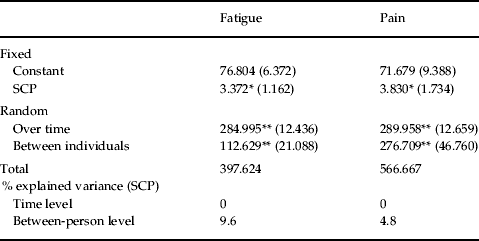
** p<0.001, * p<0.05.
Discussion
To our knowledge, this is the first study to investigate relationships between fatigue, pain and SCP in CFS patients in the daily flow of life. Our results reveal considerable fluctuations in fatigue over the 14-day period, suggesting that fatigue in CFS is less stable than is often assumed (Jones et al. Reference Jones, Gray, Frith and Newton2011). By contrast, pain was relatively stable over time but showed significant inter-individual differences. This is in line with the clinical observation that there is considerable heterogeneity in pain symptoms in CFS patients. Nevertheless, despite this heterogeneity, average pain levels were relatively high and there was a substantial correlation between pain and fatigue symptoms (r=0.57, p<0.001), emphasizing the importance of pain in CFS (Knoop et al. Reference Knoop, Stulemeijer, Prins, van der Meer and Bleijenberg2007; Meeus et al. Reference Meeus, Nijs and Meirleir2007). Taken together, our findings suggest that pain and fatigue are relatively distinct and show a different pattern over time and across individuals in CFS.
Most importantly, the results show that SCP prospectively predicted both daily fatigue and pain levels even after taking into account the effects of depression. Thus, CFS patients with higher levels of SCP tended to experience higher levels of both fatigue and pain across the 14-day period, and these associations remained significant even when controlling for mood. These findings are congruent with studies suggesting that SCP in CFS is related to specific cognitive and behavioural factors that maintain and exacerbate CFS symptoms. First, CFS patients with high levels of SCP may display dysfunctional activity patterns and, more specifically ‘all-or-nothing’ behaviour or a ‘boom-and-bust’ activity pattern, characterized by cycles of overactivity followed by complete rest (Surawy et al. Reference Surawy, Hackmann, Hawton and Sharpe1995; Creed, Reference Creed2007; Harvey et al. Reference Harvey, Wadsworth, Wessely and Hotopf2008; Van Houdenhove & Luyten, Reference Van Houdenhove and Luyten2008; Jason et al. Reference Jason, Benton, Torres-Harding and Muldowney2009; Moss-Morris et al. Reference Moss-Morris, Spence and Hou2010). Patients with high self-critical tendencies may be prone to such a pattern because they may have considerable difficulty tolerating mental or physical inactivity (Moss-Morris et al. Reference Moss-Morris, Spence and Hou2010), congruent with high levels of ‘action-proneness’ (Van Houdenhove et al. Reference Van Houdenhove, Bruyninckx and Luyten2006) and ‘persistence’ (Van Campen et al. Reference Van Campen, Van Den Eede, Moorkens, Schotte, Schacht, Sabbe, Cosyns and Claes2009; Fukuda et al. Reference Fukuda, Kuratsune, Tajima, Takashima, Yamagutchi, Nishizawa and Watanabe2010) that have been observed in at least a subset of CFS patients. Moreover, in these patients, inactivity and rest may be associated with feelings of guilt and worthlessness for not living up to their high personal standards (Luyten et al. Reference Luyten, Kempke, Van Wambeke, Claes, Blatt and Van Houdenhove2011). Second, SCP in CFS has been associated with increased stress sensitivity (Wirtz et al. Reference Wirtz, Elsenbruch, Emini, Rudisuli, Groessbauer and Ehlert2007; Luyten et al. Reference Luyten, Kempke, Van Wambeke, Claes, Blatt and Van Houdenhove2011), mediated by dysfunctions of the HPA axis (Luyten et al. Reference Luyten, Kempke, Van Wambeke, Claes, Blatt and Van Houdenhove2011), in addition to lower levels of self-esteem (Kempke et al. Reference Kempke, Luyten, Van Houdenhove, Goossens, Bekaert and Van Wambeke2011a), leading to a downward spiral of increased levels of fatigue, pain and probably also depression. Third, congruent with cognitive-behavioural models of functional somatic syndromes (Deary et al. Reference Deary, Chalder and Sharpe2007; Turk et al. Reference Turk, Swanson and Tunks2008), CFS patients with highly self-critical tendencies may show maladaptive cognitive and emotional coping strategies, which have been shown to play a central role in the perpetuation of pain (Picavet et al. Reference Picavet, Vlaeyen and Schouten2002; Van Houdenhove & Luyten, Reference Van Houdenhove and Luyten2008; Morlion et al. Reference Morlion, Kempke, Luyten, Coppens and Van Wambeke2011). For instance, studies have demonstrated that CFS patients are less likely to interpret physical symptoms in terms of negative emotional states (Dendy et al. Reference Dendy, Cooper and Sharpe2001), but instead tend to catastrophize somatic sensations (Moss-Morris & Petrie, Reference Moss-Morris and Petrie2001, Reference Moss-Morris and Petrie2003). Recent findings in this context suggest that SCP in CFS is associated with negative beliefs about the experience and expression of emotions (Hambrook et al. Reference Hambrook, Oldershaw, Rimes, Schmidt, Tchanturia, Treasure, Richards and Chalder2011; Rimes & Chalder, Reference Rimes and Chalder2010) and lack of acceptance (Brooks et al. Reference Brooks, Rimes and Chalder2011). Although these findings are promising, further research is needed to unravel the precise mechanisms involved in daily fatigue and pain related to SCP, including neurobiological factors (Luyten et al. Reference Luyten, Kempke, Van Wambeke, Claes, Blatt and Van Houdenhove2011).
Irrespective of whether SCP plays a role in the onset of CFS, the findings of this study clearly suggest that this personality feature may be associated with symptom exacerbation (Kempke et al. Reference Kempke, Van Houdenhove, Luyten, Goossens, Bekaert and Van Wambeke2011b). Hence, treatment of CFS should target SCP and related cognitive-behavioural factors in patients with self-critical features. For instance, clinicians may use specific cognitive-behavioural strategies that have been developed to address maladaptive perfectionistic tendencies (Flett & Hewitt, Reference Flett, Hewitt, Flett and Hewitt2002, Reference Flett and Hewitt2008), which can easily be integrated into existing treatment programmes. In this respect, in another study (Van Houdenhove et al. Reference Van Houdenhove, Bruyninckx and Luyten2006) we have shown that a multidisciplinary cognitive-behavioural therapy (CBT)-based group intervention for patients with CFS was associated with significant reductions in overactive tendencies related to SCP. More recently, we reported that a brief CBT-based psycho-educational group programme was associated with significant and clinically meaningful changes in levels of ‘action-proneness’ in chronic pain patients (Morlion et al. Reference Morlion, Kempke, Luyten, Coppens and Van Wambeke2011). However, it is important to note that there are currently no evidence-based treatments for SCP. Such interventions are urgently needed given that SCP has been shown to impede treatment response in several conditions, including depression (Blatt et al. Reference Blatt, Zuroff, Hawley and Auerbach2010).
The strengths of this study include the relatively large sample size and the use of a daily diary method approach. Despite these strengths, the findings of this study should be interpreted in the context of several limitations. The most important limitation of the study is the absence of a control group. Further controlled research is needed to investigate whether the relationship between SCP and daily symptoms is specific for CFS. A second limitation is related to the fact that participants were assessed only once a day. Further research should therefore use a multiple momentary assessment procedure (i.e. several measures during the day) to more closely capture symptom fluctuations and their relationship to SCP. Furthermore, selection bias may have influenced the results. It could be argued that patients who completed their diaries (i.e. were not excluded from the analysis) might have had higher levels of SCP. Nevertheless, a high response rate was obtained (89.6%) in this study, and about 70% of the participants completed the diaries. Hence, although selection bias may have played a role, in all likelihood this effect will be small. Lastly, although studies have shown that SCP predicts vulnerability to psychopathology over and above neuroticism (Luyten & Blatt, Reference Luyten and Blatt2011), further research is needed to investigate whether this is also the case for CFS symptoms. Despite these limitations, overall this study provides support for the role of SCP in predicting daily symptoms in CFS.
Acknowledgements
This study was supported in part by a grant from the Fund for Scientific Research, Flanders, Belgium (No. 3H080485). We thank the anonymous reviewers for their helpful comments.
Declaration of Interest
None.