Introduction
Warnings about the increased risk of suicidal behaviour associated with the use of antidepressant drug treatment (ADT) have been issued by most drug regulatory agencies in recent years (Gunnell & Ashby, Reference Gunnell and Ashby2004; Lenzer, Reference Lenzer2004). The suspicion that ADT may trigger suicidal behaviour, particularly in young patients, is mainly based on the findings of randomized controlled trials (RCTs). A recent meta-analysis performed by the Federal Drug Administration (FDA) gathering 24 short-term placebo-controlled trials in paediatric patients and 372 placebo-controlled trials in an adult population showed that paediatric and young adult patients administered ADT were twice as likely to present with suicidal behaviour compared to patients treated by placebo (FDA, 2006). However, the impact of ADT has been reported to be neutral in adults and even protective in older people (Zimmerman et al. 2005; Rihmer & Akiskal, Reference Rihmer and Akiskal2006). According to Gunnell et al. (Reference Gunnell, Saperia and Ashby2005), none of the meta-analyses has shown any increased risk of suicide whereas Klein (Reference Klein2006) reported an increased risk of suicidal behaviour mainly involving suicidal ideation.
Suicide is rare and clinical trials are not powered to provide clear evidence of the effect of antidepressants on suicide (Gunnell & Ashby, Reference Gunnell and Ashby2004). Even when collated in stringent meta-analyses, findings from RCTs have to be cautiously extrapolated to real-life settings. Indeed, RCTs are generally carried out over a short time on a relatively small number of subjects selected from the source population by restrictive inclusion and exclusion criteria. Of concern is that subjects with suicidal ideation are generally excluded from these trials (Zimmerman et al. 2005; Rihmer & Akiskal, Reference Rihmer and Akiskal2006).
Hence, studies of subjects treated in naturalistic conditions are of great interest in exploring the safety and effectiveness of ADT (Angst et al. Reference Angst, Angst, Gerber-Werder and Gamma2005; Olfson et al. Reference Olfson, Marcus and Shaffer2006; Tiihonen et al. Reference Tiihonen, Lonnqvist, Wahlbeck, Klaukka, Tanskanen and Haukka2006; Mulder et al. Reference Mulder, Joyce, Frampton and Luty2008; Rahme et al. Reference Rahme, Dasgupta, Turecki, Nedjar and Galbaud du Fort2008). However, drug causation is difficult to establish because of the strong link between suicidal behaviour and depression, which potentially leads to confounding by indication in any observational study attempting to address this issue (Collet & Boivin, Reference Collet, Boivin and Strom2000). Thus, only patients with ADT have been examined in most of these studies, so information is lacking on the comparative risks of ADT versus no treatment in a real-life setting. In addition, the studies have reported conflicting results and provided few details about confounding factors such as co-morbidity and long-term prescription history.
Although population-based studies that examine the link between variations in rates of ADT and the number of suicides provide relevant information regarding this issue (Hall, Reference Hall2006; Baldessarini et al. Reference Baldessarini, Tondo, Strombom, Dominguez, Fawcett, Licinio, Oquendo, Tollefson, Valuck and Tohen2007), their results must be interpreted with caution because of their ecological design, which can lead to spurious associations. It is indeed difficult to distinguish at the population level the effects of ADT from the impact of changes in (other) suicide risk factors.
Despite the growing body of literature on antidepressant safety, the association between ADT and suicidal behaviour remains uncertain. The current situation has major consequences because users have been overwhelmed by information on the risks associated with ADT, and prescribers may have modified their therapeutic strategies following the release of the warnings. Some patients with severe depression requiring ADT may be currently less likely to be treated and are therefore exposed to suicidal risk because of lack of treatment. This paradox results in a public health priority where the impact of ADT on the risk of suicide at the population level must be determined.
In the event of uncertainty due to lack of data, decision analysis is of great use for weighing the benefits and risks of available strategies and hence for selecting the most valuable option (Detsky et al. Reference Detsky, Naglie, Krahn, Naimark and Redelmeier1997). We used a decision analysis approach to assess at the population level whether the prescription of ADT in real-life settings is associated with an increased or a reduced risk of suicide relative to the absence of ADT in depressed patients.
Method
Basic principles of decision analysis
Decision analysis is a modelling method based on a probabilistic Bayesian approach allowing comparison in a target population of the risks and benefits of two or more extreme therapeutic scenarios (in the present model, prescription of ADT versus no ADT in subjects with major depression). The population impact may be estimated by using a virtual randomization of all subjects from the general population between these therapeutic strategies, without being restrained by ethical issues, for example when there is one no-treatment arm as in the present model. Where possible, modelling is based on ‘real’ data and applied to a ‘real’ population. ‘Realistic’ assumptions have to be made when no data are available for some specific estimates. Decision analysis has been used previously in psychiatry, mostly in the context of pharmaco-economic studies (Oh et al. Reference Oh, Iskedjian, Addis, Lanctot and Einarson2001; Palmer et al. Reference Palmer, Brunner, Ruiz-Flores, Paez-Argraz and Revicki2002) or to assess the feasibility of early intervention programmes (Cougnard et al. Reference Cougnard, Salmi, Salamon and Verdoux2005).
In the present study, we extracted data from published studies or available databases and estimated the number of suicides induced/avoided by the two strategies in the French general population.
Decision analysis model
The population of interest was restricted to patients for whom the decision to prescribe an ADT or not for a diagnosed major depressive episode (MDE) (WHO, 1992) had to be made in real-life conditions. Hence, patients with depression who did not seek help, were undiagnosed, or presented with other psychiatric diagnoses that might benefit from ADT were not considered in the present study. Three age groups were defined according to the risk of suicide and the prevalence of depression (Conwell et al. Reference Conwell, Duberstein and Caine2002; WHO, 2002): children and adolescents (10–19 years old), adults (20–64 years old) and the elderly (⩾65 years). Two strategies were compared, (1) no-ADT and (2) ADT, regardless of dosage, pharmacological class, prescriber or setting (out- or in-patient), or the presence of other treatments (psychotherapy or drugs). The adequacy of ADT duration was categorized as: (1) ‘insufficient’ if treatment discontinuation preceded the onset of action (1 day to <1 month); (2) ‘dubious’ (1–6 months) and (3) ‘adequate’ (>6 months) (Anderson et al. Reference Anderson, Nutt and Deakin2000). The outcome of interest was the occurrence of suicide assessed over a 1-year period after the date of diagnosis (Vos et al. Reference Vos, Haby, Barendregt, Kruijshaar, Corry and Andrews2004).
Model structure
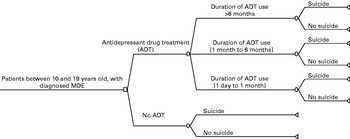
Decision trees were constructed using TreeAge Pro (2005). In brief, once the available decision options and the uncertainties associated with each were defined, a model in the form of a decision tree was displayed graphically on screen. The software calculates the expected value of each scenario to identify the decision maker's optimal strategy. First, the two strategies (no-ADT and ADT) were compared by using distinct decision trees for the three age groups with respect to suicide risk. As an illustration, the tree for children and adolescents is shown in Fig. 1. Second, 12 distinct decision trees were used to explore the impact on the findings of two other characteristics associated with the risk of suicide and depression within these three age groups: (1) gender (WHO, 2002; Mattisson et al. Reference Mattisson, Bogren, Horstmann, Munk-Jorgensen and Nettelbladt2007); and (2) parasuicide history (Harris & Barraclough, Reference Harris and Barraclough1997; Li et al. Reference Li, Phillips, Zhang, Xu and Yang2007).
Decision analysis tree of children and adolescents with diagnosed major depressive episode (MDE).

Data collection
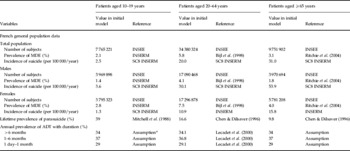
To apply the decision analysis to a real general population, the prevalence of depression and the incidence of suicide by gender in the three age groups were identified through the French health statistics databases. The number of subjects by gender in the three age groups was obtained from the statistics database of the French census (Table 1). The annual prevalence of ADT according to the three durations was obtained from a study conducted on French social security databases (Lecadet et al. Reference Lecadet, Vidal, Baris, Vallier, Fender and Allemand2000). For other data and probabilities we used the findings of studies carried out in other countries (Table 1).
Data and probabilities applied in decision analysis trees

MDE, Major depressive episode; ADT, antidepressant drug treatment; INSEE, Institut National de la Santé et des Etudes Economiques. Census 1999 of the French general population (www.insee.fr). Accessed 27 April 2006; INSERM, Institut National de la Santé et de la Recherche Médicale. Collective expertise of mental health in children (http://ist.inserm.fr/basisrapports/troubles_mentaux/troubles_mentaux_synthese.pdf). Accessed 27 April 2006; SC8 INSERM, Service commun no. 8 INSERM. Department collecting national information on the causes of death, 1999 (http://sc8.vesinet.inserm.fr). Accessed 27 April 2006.
a Assumptions were used when quantitative estimates were lacking (see text).
Model assumptions
Assumptions were made when no information was found in the literature. In fact, despite the large number of studies published on the association between ADT and suicide risk, few data were directly exploitable in the present study because very precise information was required regarding several estimates. For example, to our knowledge, the frequency of ADT with a duration between 1 month and <6 months has never been estimated in subjects from the general population aged 10–19 years with MDE. For all relative risks (RRs), the baseline condition was the annual incidence of suicide in the general population. All the assumptions were derived from an RR of suicide equal to 20 in subjects with MDE, irrespective of the type of treatment (Harris & Barraclough, Reference Harris and Barraclough1997, Reference Harris and Barraclough1998; Abenhaim, Reference Abenhaim2003), and from an RR of suicide equal to 30 in depressed subjects without ADT (Avery & Winokur, Reference Avery and Winokur1976). We made pessimistic assumptions a priori regarding the impact of ADT on suicide risk in subjects with MDE in comparison with subjects from the general population. First, we postulated that depressed subjects with ADT of adequate duration were still at higher risk of suicide compared to those from the general population (RR=5) (although their risk of suicide was reduced sixfold compared to that of depressed subjects with no ADT). We assumed that the risk of suicide was markedly increased (RR=45) in depressed subjects with insufficient duration of ADT (discontinuation prior to the onset of action), and was even higher than that found in depressed subjects without ADT. This assumption was consistent with the fact that the peak incidence of suicide with ADT occurs over the first weeks of treatment (Jick et al. Reference Jick, Kaye and Jick2004; Sondergard et al. Reference Sondergard, Lopez, Andersen and Kessing2007), and with the findings of a recent study (Sondergard et al. Reference Sondergard, Lopez, Andersen and Kessing2007) reporting that the risk of suicide is higher in depressed subjects with only one prescription of ADT (i.e. insufficient duration of ADT) compared to depressed subjects without prescription of ADT or with at least two prescriptions of ADT. Indeed, subjects with insufficient duration of ADT may experience adverse effects (insomnia, anxiety) that increase the risk of suicide. We also postulated that dubious duration of ADT was also associated with an increased risk of suicide (RR=15) compared to adequate duration. Indeed, the risk of suicide decreases as the number of redeemed prescriptions increases, and particularly with the number of redeemed prescriptions ⩾5 irrespective of the type of ADT (Sondergard et al. Reference Sondergard, Lopez, Andersen and Kessing2007). Finally, in the absence of specific data, we assumed that the frequencies of ADT durations were identical irrespective of age, gender or parasuicide history.
Analyses
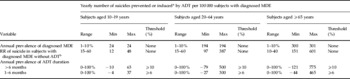
The number of suicides prevented or induced by ADT per 100 000 subjects with diagnosed depression were obtained from the crude differences in the number of suicides associated with each strategy. We used sensitivity analyses to assess the robustness of the model by modifying step by step each probability from the minimal to the maximal values within a range of uncertainty (Table 3). For sensitivity analyses regarding RRs of suicide, when the value of the RR in a specific subpopulation was changed, the values of RRs in the other subpopulations were changed simultaneously to keep the proportionality between the different risks. For example, when the value 15 was entered for the RR of suicide in subjects with diagnosed MDE without ADT, the RR of suicide became equal to 2.5 in subjects with adequate duration of ADT to keep the sixfold reduction compared to subjects without ADT (Table 3). Hence, the RRs of suicide in subjects with adequate and dubious duration of ADT were always less than the RR of suicide in subjects without ADT, and were always greater than the risk of suicide in subjects in the general population. For sensitivity analyses regarding estimates other than RRs, all other values remained fixed when the value of the given estimate was changed. When sensitivity analyses changed the direction of the findings, the threshold values below which no-ADT was more (or less) effective than ADT were calculated (Table 3).
Results
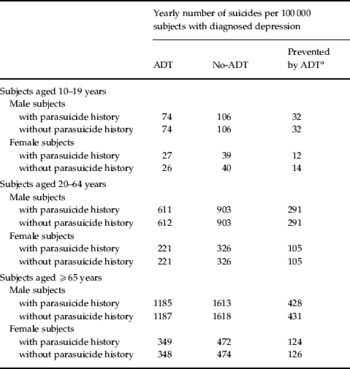
In children and adolescents, ADT would prevent 31.9% of suicide in depressed subjects over 1 year in comparison to no-ADT (n=51/100 000 in ADT; n=75/100 000 in no-ADT). At the general population level, this number of prevented suicides (24/100 000) corresponds to 20% of all suicides related to depression or to other conditions in this age group. In adults, ADT would prevent 32.2% of suicides in depressed subjects over 1 year in comparison to no-ADT (n=406/100 000 in ADT; n=600/100 000 in no-ADT), corresponding to 55% of all suicides in this age group. In the elderly, ADT would prevent 32.3% of suicides in depressed subjects over 1 year in comparison to no-ADT (n=629/100 000 in ADT; n=930/100 000 in no-ADT), corresponding to 30% of all suicides in this age group. The findings remain unchanged when gender or parasuicide history was taken into account (Table 2).
Impact of the two strategies on the number of suicides in subjects with diagnosed major depressive episode (MDE) according to age, gender and parasuicide history

ADT, Antidepressant drug treatment.
a Difference in numbers of suicides between ‘no-ADT’ and ‘ADT’ strategies.
Sensitivity analyses (Table 3) showed that the impact of ADT on the risk of suicide depends on treatment duration. For example, in adults, ADT would be more effective than no-ADT if the proportion of ADT with adequate duration was at least equal to 10%. If the proportion of ADT with adequate duration was equal to 100%, ADT would prevent 500 suicides/100 000 per year in comparison with no-ADT. The results were not sensitive to changes in probabilities other than ADT duration, and remained unchanged when gender and parasuicide history were taken into account (data not shown, available upon request).
Sensitivity analyses

ADT, Antidepressant drug treatment; MDE, major depressive episode; RR, relative risk; Min, number of suicides prevented (positive value) or induced (negative value) by ADT for the minimum estimate of the range; Max, number of suicides prevented (positive value) or induced (negative value) by ADT for the maximum estimate of the range.
a Difference in number of suicides between ‘no-ADT’ and ‘ADT’ strategies.
b When the value of this RR of suicide was changed in this subgroup, the values of RRs of suicide in other subgroups were changed simultaneously to keep the proportionality between the different risks (see text).
Additional analyses were performed to take into account the results of the FDA meta-analysis showing that the increased risk of suicidal behaviour was particularly marked in young patients (Sondergard et al. Reference Sondergard, Lopez, Andersen and Kessing2007). Overpessimistic assumptions were made regarding the impact of ADT on suicide risk in children and adolescents. We postulated that, in comparison to adults, the RR of suicide in children and adolescents was increased twofold for ADT with adequate (RR=10) or dubious duration (RR=30; that is equal to the RR of suicide in children and adolescents with no-ADT) and 1.5-fold for ADT with insufficient duration (RR=60). Using these estimates, we found that, compared to no-ADT, over 1 year ADT would induce nine suicides per 100 000 depressed boys, and two suicides per 100 000 depressed girls, irrespective of parasuicide history. In such a case, ADT would nonetheless reduce the number of suicides compared to no-ADT if the proportion of ADT with adequate duration was at least equal to 40% for boys, regardless of parasuicide history, and for girls without parasuicide history. This proportion was slightly higher (42%) for girls with parasuicide history.
As the estimates of the number of suicidal deaths may not be identical in other settings, we assessed the generalizability of our results to other countries by using the US data on rates of suicides by age groups (CDC, 2005). These analyses showed that in children and adolescents, ADT would prevent 32.3% of suicides in depressed subjects over 1 year in comparison to no-ADT (n=17/100 000 in ADT; n=25/100 000 in no-ADT), corresponding to 4% of all suicides in this age group. In adults, ADT would prevent 32.3% of suicides in depressed subjects over 1 year in comparison to no-ADT (n=64/100 000 in ADT; n=95/100 000 in no-ADT), corresponding to 12% of all suicides in this age group. In the elderly, ADT would prevent 32.3% of suicides in depressed subjects over 1 year (n=79/100 000 in ADT; n=117/100 000 in no-ADT), corresponding to 8% of all suicides in this age group. Hence, the results were in the same direction in the US and the French populations; that is the ADT strategy would prevent more suicides than the no-ADT strategy in all the age groups. As a consequence of the lower incidence rates of suicide in the USA, the number of prevented suicides were lower in the model using the US population data than that found in the model using the French population data.
Discussion
Interpretation of findings
Findings that unambiguously demonstrate the benefit of ADT over no-ADT regarding suicide risk are scarce in the literature. As suicide is a rare event, large sample sizes are required to assess the impact of a therapeutic strategy on this outcome (Hall, Reference Hall2006). The decision analysis method overcomes the limitations linked to the relatively small sample size of observational or controlled studies, and also those inherent in ecological population-based studies. The findings of the present decision analysis, which explores the impact of ADT on the risk of suicide in depressed patients treated in a real-life setting, clearly argue for prescribing ADT to adult patients diagnosed with major depression. From a population perspective, this strategy would markedly reduce the number of suicide deaths, irrespective of the underlying condition. Persistence with ADT (defined as a duration ⩾6 months) was the main characteristic influencing the effectiveness of ADT on suicide risk. Persistence as low as 10% in the population of depressed adult subjects would be sufficient to reduce the number of suicide deaths compared to no-ADT, which is a proportion lower than that reported in observational studies (Lecadet et al. Reference Lecadet, Vidal, Baris, Vallier, Fender and Allemand2000). This proportion should nevertheless be optimized, for example, by developing disease-management programmes to improve medication adherence.
It should be emphasized that the present findings supporting the benefit of ADT were obtained despite several pessimistic assumptions regarding the impact of ADT on the risk of suicide. For example, on the basis of studies showing that the peak incidence of suicide occurs over the first weeks of treatment (Jick et al. Reference Jick, Kaye and Jick2004), we assumed that subjects treated for a short duration presented with a markedly increased risk of suicide in comparison with the risk of suicide in subjects from the general population. We also postulated that subjects with adequate treatment duration were still at higher risk of suicide than members of the general population.
Although less marked in children and adolescents with depression, the benefit of ADT compared to no-ADT would also be notable at the general population level, with one out of five suicide deaths avoided. We had to use overpessimistic assumptions to reverse the risk/benefit balance in this population. For example, we postulated that the risk of suicide was 60-fold higher in children and adolescents using ADT for less than 1 month compared to subjects from the general population, which is rather unrealistic. Even in such a case, ADT would reduce the number of suicides compared to no-ADT if the proportion of ADT with adequate duration were at least equal to 40%. Such a proportion is realistic in naturalistic conditions as it corresponds to that observed in the children and adolescents of Quebec (Tournier et al. Reference Tournier, Moride, Greenfield, Galbaud du Fort and Ducruet2007).
Limitations
The decision analysis approach is not without limitations because its principle is not to represent the world ‘exactly as it is’ but to build a simplified model from its major components (Detsky et al. Reference Detsky, Naglie, Krahn, Naimark and Redelmeier1997). Hence, the choice of considering no intermediate event between the diagnosis of depression and suicide is an oversimplification of the course of treated or untreated depression. For example, the characteristics associated with the decision to prescribe ADT versus another treatment, or the occurrence of adverse effects of ADT such as mood switch, may not be randomly distributed with respect to suicide risk.
The precision of a decision tree mostly depends on the accuracy of the probability estimate for each event in the model (Naglie et al. Reference Naglie, Krahn, Naimark, Redelmeier and Detsky1997). Despite a large number of studies published on ADT and risk of suicide, their results could not be used directly in the present model. Indeed, most specific estimates regarding each age group of the general population and each duration of ADT treatment were not available in published studies. Thus, we had to make assumptions for several probabilities. However, the impact of this uncertainty on the results was controlled by sensitivity analyses showing that the findings were comparable, irrespective of the variations in the probabilities within the range of values.
We only considered duration of ADT irrespective of the type of antidepressant and the dose. However, as several estimates were already unavailable to carry out the present decision analysis model, building more complex trees including these two characteristics would have required an increased number of assumptions. When a large number of estimates are not available, it is recommended to develop decision models as simple as possible (Naglie et al. Reference Naglie, Krahn, Naimark, Redelmeier and Detsky1997). In addition, findings are conflicting with respect to the risk of suicide between different ADTs among patients with depressive disorders (Sondergard et al. Reference Sondergard, Lopez, Andersen and Kessing2007).
Several assumptions were made with respect to the RRs of suicide in the various therapeutic options. Because of the lack of recent studies, some quantitative estimates were drawn from old studies, such as the risk of suicide in depressed subjects without ADT (Avery & Winokur, Reference Avery and Winokur1976), with the limitation that the patients included in this study are unlikely to be comparable to those currently diagnosed as having MDE. However, sensitivity analyses showed that the findings were comparable when a large range of variations in the RR values were tested.
The decision analysis model was applied to the French general population. The estimates of the number of suicidal deaths may not be strictly identical in other settings (Rihmer & Akiskal, Reference Rihmer and Akiskal2006). Complementary analyses using US data on suicide rates showed that the proportion of suicide deaths avoided by ADT was similar in US and French subjects with depression. As a consequence of the lower incidence of suicide in the US population compared to the French one, the absolute number of prevented suicides was lower. Hence, national variations in the rates of suicide do not change the direction of the finding that the ADT strategy prevents more suicides than the no-ADT strategy.
Conclusions
The present study suggests that any public health decision that contributes, directly or indirectly, to reducing the proportion of depressed patients treated with antidepressants is prone to induce a rise in suicides. Although ADT may trigger suicide in vulnerable subgroups of patients, the consequences of publicizing such an adverse effect and reducing the access to ADT should be carefully evaluated at the population level.
Acknowledgements
The research team thanks Ray Cooke for supervising the English in this manuscript. The study was supported in part by funding from the Office Parlementaire des Politiques de Santé (Etude sur le bon usage des médicaments psychotropes Marché 2005-OPEPS-01).
Declaration of Interest
None.