In the oft-quoted final chapter of The General Theory, titled “Concluding Notes on the Social Philosophy Towards Which the General Theory Might Lead,” John Maynard Keynes declared: “The State will have to exercise a guiding influence on the propensity to consume partly through its scheme of taxation, partly by fixing the rate of interest,” and it will have to undertake “a somewhat comprehensive socialisation of investment … though this need not exclude all manner of compromises and of devices by which public authority will co-operate with private initiative.”2
Keynes, General Theory, p. 378.
In composing this passage, Keynes surely had in mind a program by which the state would attempt to moderate the fluctuations of the peacetime macroeconomy, and in that sense his vision went unrealized in Britain and the United States. Once in U.S. history, however, during World War II, Keynes's vision did achieve full-fledged realization. Although economists and historians have studied extensively the wartime tax measures and the wartime interest-rate fixing, the government domination of investment that occurred in the United States from 1941 to 1945 has received much less attention.
Of course, it has not been overlooked entirely. Indeed, among contemporary analysts and early postwar writers, nearly all of whom subscribed to the “miracle of production” interpretation of the government's wartime economic management, the government's wartime takeover of capital formation received considerable, and generally favorable, recognition.
For example, Elberton Smith, author of the impressive official history The Army and Economic Mobilization, in describing the War Department's multifaceted involvement in capital accumulation, remarked that “war plant expansion in the three years ending with 1943 was equal to half the investment in manufacturing facilities during the preceding two decades.”3
In Smith's view, “the American economy in World War II exhibited the greatest capital expansion in its history—an expansion which went far toward guaranteeing the successful outcome of the war.”
4 Speaking with pride of the more than $9 billion dollars that the Defense Plant Corporation (DPC), a Reconstruction Finance Corporation (RFC) subsidiary, had channeled into industrial capital formation during the war, RFC head Jesse Jones noted: “At the close of World War II, Defense Plant Corporation's investment alone embraced 96 per cent of the nation's synthetic rubber capacity, 90 per cent in magnesium metal, 71 per cent in the manufacture of aircraft and their engines, 58 per cent in aluminum metal, and nearly 50 percent of the facilities for fabricating aluminum.”5
Jones, Fifty Billion Dollars, p. 316.
The War Department, the Navy Department, and other government agencies also financed massive industrial investments.
6 Smith, Army, pp. 447, 496–501; Connery, Navy, p. 345; and Smaller War Plants Corporation, Economic Concentration, p. 48.
In 1969 Robert J. Gordon shocked the economics profession by announcing that “$45 billion of U.S. Private Investment Has Been Mislaid.” Of that “mislaid” amount—“an estimate of cumulative 1940–65 U.S. government expenditures on privately operated plant and equipment (in 1958 prices), minus the small portion already included in the official OBE [Office of Business Economics] capital stock data”—some 62.5 percent had been spent from 1940 through 1945.7
Gordon, “$45 Billion,” p. 221; 62.5 percent is my calculation from Gordon's data, ibid., table 4, p. 233.
Gordon argued that “the existence of this vast amount of previously unmeasured capital explains in part how the private American economy produced so much during the war and early postwar years with such a small measured increase in the stock of capital relative to the level of the late 1920's.”
8 Recently, Gordon has refined his earlier estimates of the U.S. capital stock in the nonfarm, nonhousing, private business sector, “changing from fixed to variable retirement, and … adding GOPO [government-owned privately operated] and highway capital.”9
Gordon, “Interpreting,” p. 46.
On the basis of his new estimates of the nonfarm, nonhousing, private business capital stock, he concludes that “instead of declining by 7.4 percent between 1930 and 1944, total capital input actually increases by 28 percent,” a finding that he declares to be important and “highly relevant to the puzzle of how the United States succeeded in producing so much during World War II.”
10 Like Gordon, Alexander J. Field has considered recently how taking properly into account the government's capital formation during World War II might help us to understand better the broad contours of U.S. productivity change in the twentieth century. Field observes: “There remains an unresolved dispute over the usefulness for civilian production of this capital after the war. Some have criticized the transfers to the private sector as sweetheart deals; the valuations reflected in the sales, however, have been defended on the grounds that substantial retrofitting was often required to make them suitable for civilian production.”11
Field, “Most Technologically Progressive Decade,” p. 1405.
The valuation of privatized government-financed plants and equipment is but one issue among many that bears on our understanding of the government's wartime capital formation and its consequences for the performance of the postwar economy. So far, however, students of this topic have overlooked a number of complications that cloud the meaning of the standard data used to study it.
My objective in the present article is to display and discuss the official data that purport to measure the wartime capital formation, to identify several problematic aspects of those data, and to indicate at least the direction, if not the precise magnitude, of some strongly warranted adjustments. The theme of my inquiry is that previous analysts have failed to take fully into account the incomparability of capital formation undertaken by private entrepreneurs and that undertaken by government officials—an incomparability that looms especially large when the latter's projects are dedicated to highly specific military purposes. Here, as in so many other areas of economic analysis, we cannot penetrate to the essence of the matter unless we have a clear understanding of the economic principles that Ludwig von Mises and F. A. Hayek expounded in their contributions to the socialist-calculation debate prior to World War II.12
Mises, “Economic Calculation”; and Hayek, “Present State of the Debate.”
Unfortunately, the analytical insights that I present and the measurement corrections that I propose here may serve only to deepen some of the mysteries that previous analysts believed they had solved by taking into account the government's wartime capital formation.
WARTIME SOCIALIZATION OF INVESTMENT
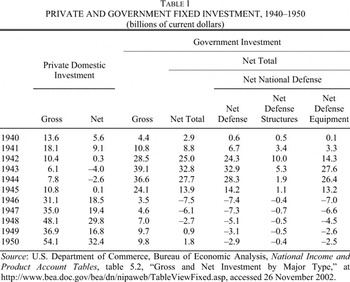
The basic data on which analysis usually rests appear in Table 1. They come from the National Income and Product Accounts (NIPA) produced by the Bureau of Economic Analysis in the U.S. Department of Commerce.13
The values are expressed in current dollars. In due course, I will say something about inflation-adjusted values—an especially tricky matter during the 1940s because of the government's massive military mobilization, direct resource allocations, and price controls that substantially affected the greater part of the decade—but much of what we need to know does not require an attempt to arrive at “real” values.
As the data displayed in Table 1 make clear, a massive shift occurred during the early 1940s in the sources of U.S. investment spending. In 1940 gross private domestic investment amounted to $13.6 billion ($5.6 billion net), whereas gross government investment came to just $4.4 billion ($2.9 billion net), including net national defense investment of an almost negligible $0.6 billion. In contrast, at the peak of the government's investment surge, in 1943, gross private domestic investment had dropped to $6.1 billion (negative $4.0 billion net), whereas gross government investment had soared to $39.1 billion ($32.8 billion net), including net national defense investment of $32.9 billion. Plainly, this tremendous shift illustrates “the socialization of investment” with a vengeance.
For the four years from 1942 through 1945 as a whole, gross private investment fell to such low levels that it failed to compensate for the depreciation of the private capital stock. For that period, net private investment summed to negative $6.2 billion. In U.S. history, the only comparable evaporation of private capital occurred during the early years of the Great Depression.14
For periodized data from 1891 to 1989, see Edelstein, “War,” pp. 390–91.
For those same four war years, however, net government investment summed to $99.4 billion, of which net national defense investment amounted to slightly more than 100 percent (the government did not invest enough in its nondefense capital stock to compensate for its depreciation).
Then, even quicker than the government had displaced private investors during the early 1940s, the latter displaced the government between 1945 and 1946, when net private domestic investment increased from approximately zero to $18.5 billion—an unprecedented amount—setting in motion an investment boom that continued thereafter for many years, restoring genuine prosperity to an economy that had wallowed for 16 years in peacetime depression and wartime privation.15
For an extended analysis of this generally misunderstood macroeconomic experience, see Higgs, “Regime Uncertainty.” On the reconversion miracle itself, see Higgs, “From Central Planning.”
In stark contrast, between 1945 and 1946, gross government investment fell from $24.1 billion to just $3.5 billion (net from $13.9 billion to
negative $7.5 billion), and the national defense capital stock began a sustained decline that extended into the 1950s.
CAPITAL IS CAPITAL?
As I have just shown, during the war the government spent huge amounts of money to purchase durable military and industrial assets, thereby adding substantially to the stock of government “capital.” In the official accounts, no mystery attends the process of capital formation. If the government purchases a durable good, then ipso facto it adds to the gross capital stock, and therefore (given that the value of such purchases exceeds the value deducted as depreciation according to standard accounting formulas) it increases the economy's future potential to produce valuable goods and services. In this so-called “perpetual inventory” method of accounting for capital formation, investment dollars flow like water into a capital-stock bathtub from which at the same time depreciation causes a certain drainage.16
Wasson, Musgrave, and Harkins, “Alternative Estimates,” p. 20.
Just as all drops of water matter equally when one is filling or emptying a tub, so all dollars of investment spending count equally when one is constructing a time series of capital stock. Here, in its official accounting representation, capital becomes something like the “homogeneous mass” imagined by capital theorists such as Frank Knight—a dollar spent for “capital” is a dollar spent for “capital.”
17 Hennings, “Capital,” p. 330.
Whatever virtues this view may have in relation to the economic theory of a market system—and hardly anything has been more hotly disputed by economists than capital theory—it has definite shortcomings in application to government capital formation.18
On capital theory disputes, see ibid., pp. 327–33.
When private entrepreneurs make investments, they hazard their own property or the property that others have entrusted to them. Therefore, they must appraise carefully the prospect that the capital goods they purchase will give rise to an income stream sufficient to justify the present expense, the risks of loss, and the delays they anticipate before they can appropriate future income. Ultimately, the success of any private investment turns on the ability to use capital goods in a way that, directly or indirectly, consumers validate by purchasing final goods in the market.
Government officials follow different stars in making their investment decisions: politics, ideology, and even personal vanity (“empire building”) have a much greater chance of carrying the day. As W. H. Hutt observed, “officials not only cannot have the necessary detailed awareness which market signals provide; but most important, they cannot be caused to lose property through error nor be rewarded by the acquisition of property through success.”19
Hutt, Keynesian Episode, p. 76.
For the government, no consumer-determined bottom line spells the difference between success and failure, because the government has the coercive power to extract taxes from citizens in order to finance the investments initially and to subsidize money-losing projects afterward, in defiance of consumer preferences.
Never does the contrast between the private investor and the government investor loom larger than it does during wartime, especially during a modern “total” war, such as World War II, when perceived military necessity counts heavily with those responsible for making government investments. The wartime investment program in the United States from 1940 through 1945 illustrates the contrast unmistakably. “This unprecedented expansion of industrial capacity was not directed by business executives; nor did dollar-a-year men exercise effective indirect control over it. Rather, it was semiautonomous bureaucrats in pursuit of national security goals and insulated within the increasingly powerful Pentagon who directed this effort.”20
Hooks, Forging the Military-Industrial Complex, p. 140. On the most important of these bureaucrats, Under Secretary of War Robert P. Patterson, see Eiler, Mobilizing America. I do not intend to suggest that civilian demands had no influence on the wartime planners. On the contrary, conflicts raged between civilian interests and military interests throughout the war period; those conflicts are what Hooks was referring to when he subtitled his book “World War II's Battle of the Potomac.” Such conflicts arose with regard to price controls, taxation, materials allocations, rationing, and countless other matters. In addition to the works by Hooks and Eiler, see Polenberg, War; Higgs, Crisis, pp. 196–236, and “Private Profit”; Edelstein, “Size”; and the many primary sources cited in these works. My point here is that regardless of these expressed civilian demands, to which some government officials responded actively, the planners—absent unrestricted private property rights and the relative prices to which trading in such rights gives rise—had no means of making decisions in an economically rational manner. Whatever their desires about the division of outputs between civilians and the military, they had no way to know the true cost of anything. Using “old” prices from the prewar economy was better than using random numbers, but using old prices was scarcely suitable for the achievement of an economically rational outcome, because the old prices could not possibly represent the actual underlying rates of substitution in consumption and production under the radically transformed demand-and-supply conditions of the wartime economy.
If it were possible, as some economists have maintained, for government officials to calculate all the shadow prices needed to operate a centrally planned economy efficiently, and if the officials proceeded to make their decisions on the basis of those shadow prices, then matters would be different; but these conditions have never been established anywhere, and they certainly were not established in the United States during World War II, when the government's “investments” obeyed a different, starkly nonmarket logic. John Cochran has summarized the issues that are most pertinent here:
The concept of capital is not a category of all acting, but only a category of acting in a market economy. Capital is an essential element in entrepreneurial planning. It is an estimate of the market value at a definite date of a particular business plan…. A given business or entrepreneurial plan implies a time structure of production for the individual enterprise—a pattern of inputs (capital goods, labor and natural resources or land) applied at earlier dates followed by a pattern of outputs sold at later dates…. Without private ownership of the means of production, there can be no markets for resources, no money prices for resources, and thus no monetary calculation and no capital.21
Cochran, “Sound Money,” pp. 3–4.
Therefore, whenever government officials undertake a massive investment program, we must expect them always to generate what Mises called “planned chaos.”
22 Thus, in March 1942, two military officers complained to the executive committee of the Army-Navy Munitions Board with regard to the vast industrial construction program then under way:
If we continue as at present, we shall have plants standing useless for lack of equipment or raw materials, or other things. Other plants will be turning scarce materials into items which cannot be used to oppose the enemy because of the lack of other things which should have been made instead. We shall have guns without gun sights, tanks without guns, planes without bomb sights, ships held up for lack of steel plates, planes which we cannot get to the field of battle because of lack of merchant bottoms.23
Quoted in Smith, Army and Economic Mobilization, p. 453.
Of course, a government investment program
may make some sense in relation to the achievement of strictly technological, military, or political objectives—arguably, winning World War II was one such problem that the U.S. government solved for the most part by throwing gigantic amounts of money at it—but in relation to
economic rationality, it remains planned chaos, and its legacies must necessarily bear all the marks of its essential character.
24 On winning the war by throwing money at it, see Novick, Anshen, and Truppner, Wartime Production Controls, p. 9; and Rockoff, “Paradox.”
Although the government planners made continuing adjustments to their planning apparatus throughout the war, and they improved it enough to permit the production of an enormous outpouring of munitions, the essential character of the planning system remained as devoid of
economic logic near the end of the war as it had been at the beginning. Eliot Janeway referred, for example, to “the 1944 production crisis that saddled the war economy with surpluses while leaving it short of critical items,” and he criticized “the fatal weakness in [Donald] Nelson's setup” for operating the War Production Board, the chief planning agency.
25 Janeway, Struggle, p. 353. For details about the continuing foul-ups that plagued wartime economic planning and the production program, see also, among many other sources, U.S. Bureau of the Budget, United States at War; Catton, Warlords; Novick, Anshen, and Truppner, Wartime Production Controls; Lane, Ships; and Eiler, Mobilizing America.
In relation to the U.S. government's capital formation during World War II, the upshot is that many resources were completely wasted from the outset; construction costs were pushed “substantially above normal levels”; and many wartime investments proved to have little or no value after the war, despite the contrary impression we might gain from an official time series of capital stock.26
For striking examples of waste, see Jones, Fifty Billion Dollars, pp. 342–44; Lane, Ships, pp. 627–36; and McCartney, Friends, pp. 56–70. On construction costs, see Smith, Army, p. 502, citing evidence from the Truman Committee hearings; see also Lane, Ships, p. 796.
For example, the Maritime Commission, which spent some $600 million (current dollars) to construct new shipyards, “decided to finance the emergency yards as if they were arsenals” because “it was believed that they would have little or no postwar value,” and in fact at the end of the war “shipyards were a drug on the market,” and “only a few found purchasers willing to pay even 12 per cent of what the yards cost.”
27 Lane, Ships, pp. 108–09, 117.
In addition, the Navy spent some $1.4 billion for shipyards, with similarly little to show for it at the end of the war.
28 Simon Kuznets argued that when the government purchases durable military assets, “their survival beyond the initial year releases capital resources for other purposes, and while their services cannot be considered final product, the capital stock embodied in them, like other types of capital that serve a protective purpose, should be included” in estimates of overall capital formation.29
Kuznets, Capital, p. 470.
It is difficult to see, however, how the mere physical survival of obsolete and permanently mothballed munitions, such as those thousands of otiose propeller-driven warplanes parked forever in the western deserts, “released” anything or contributed in any way to a valuable purpose.
30 Photos in Cohen, V for Victory, p. 405.
To suppose otherwise would seem to entail making a fetish of physical durability at the expense of keeping genuine economic value at the center of our economic analysis.
THE COMPOSITION OF WARTIME GOVERNMENT INVESTMENT
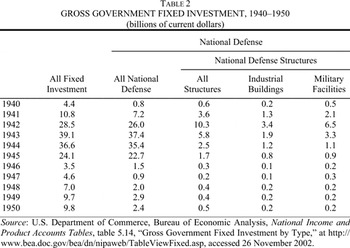
Although economists and historians have focused their analysis of the government's wartime investment on its purchases of industrial plants and equipment, the preponderance of the investment took other forms. As Table 2 shows, outlays to construct strictly military facilities—so-called command installations, as opposed to industrial facilities—gobbled up $13.9 billion from 1941 through 1945, in contrast to $8.6 billion spent on industrial structures. By the end of the war, the War Department alone had invested in 2,996 command facilities.31
These spanned a wide range of uses:
Some idea of the scope of the Army's far-flung empire of command installations in World War II may be inferred from the following partial list of establishments within the zone of interior alone: Army posts, camps, stations, forts, training and maneuvering areas, artillery and other ranges for the Ground Forces; airfields, air bases and stations, bombing and gunnery ranges for the Army Air Forces; storage facilities—from remote ammunition depots to metropolitan warehouses—for all branches of the Army; repair and maintenance stations for all types of equipment; hospitals, convalescent and recreation centers; military police camps, Japanese relocation centers, prisoner of war camps; a network of harbor defenses and other installations throughout the entire country for defense against enemy attack; holding and reconsignment centers, ports of embarkation, staging areas, and related facilities to mount the tremendous overseas expeditions of troops and supplies; local induction centers, radio stations, laundries, market centers, special schools and offices (including the $78 million Pentagon building); and, not to be overlooked, research laboratories, proving grounds, testing centers, and supersecret installations symbolized most completely by the atomic bomb.32
(Elsewhere, Smith also lists another category: 770 national cemeteries, occupying some 2,000 acres of land.)
33 A similar itemization might have been compiled for the Navy, whose bases, depots, repair yards, and other facilities spanned the globe.
Scanning the foregoing summary, one is struck by how many of the command facilities were highly specialized for aiding the operations of the wartime armed forces. Such facilities had little if any value for peacetime uses. Even those that the armed forces retained for strictly military purposes after the war proved grossly excessive in view of the drastic reduction of military personnel strength after 1945. Small wonder that the Pentagon has spent more than half a century fighting (against local politicians and members of Congress, among others) to close bases still remaining from the massive base construction undertaken in the early 1940s to accommodate an armed force that eventually numbered more than 12 million men and women at its peak strength in 1945.34
Twight, “Department of Defense”; and Edelstein, “Size,” pp. 74–75.
Even today base closures continue to be made episodically as political opportunities allow.
Industrial and military structures together account for less than one-fifth ($23.9 billion) of the total gross national defense investment ($128.7 billion) from 1941 through 1945 (see Table 2). Clearly, the big gorilla of the government's wartime investment program consisted of the purchase of equipment (column 7 of Table 1 shows this fact directly as a cumulative net investment of $84.8 billion in equipment during the same years). Again, as we have seen in relation to command facilities, the bulk of this investment (at least 90 percent) took the form of highly specialized military assets—combat airplanes, tanks, warships, guns, ammunition, and other such purely military durable goods—that had little if any value for use in peacetime activities.35
Of the government's total wartime investment (1940–1945) in industrial facilities, $8.8 billion went for structures (data in Table 2, col. 4). Government spending for industrial plants, equipment, and reconversions totaled $17.2 billion (as reported in Smaller War Plants Corporation, Economic Concentration, p. 38, citing War Production Board data). Therefore, no more than $8.4 billion went for industrial equipment. This compares to $105 billion spent for all national defense equipment (calculated from Table 2, cols. 2 and 3).
In the workaday world, there's just not much call for phosgene-filled mortar shells, mustard-gas-filled bombs, and white-phosphorus-filled munitions, not to mention the specialized equipment for producing atomic bombs.
36 Even the strictly military equipment, however, quickly became obsolete. Many readers will recall visiting or seeing photographs of the endless rows of aircraft parked in the western deserts or the scores of ships rusting peacefully at their moorage near the mouth of the Sacramento River in California. According to Kuznets' estimates, annual military capital consumption, which had been nearly negligible before the war, reached $6.35 billion in 1945 (compared to $19.1 billion of depreciation allowed for the economy's entire nonmilitary capital stock), and it continued to rise in the late 1940s, reaching $11.7 billion in 1950, as the wartime stock of munitions wore out, wasted away, or grew obsolete.37
Kuznets, Capital, p. 499. I do not intend to suggest that none of the surplus military equipment left over in 1945 had any usefulness for subsequent military purposes, because some of it clearly did have such usefulness. Derek Leebaert (Fifty-Year Wound, p. 97) reports, for example, that during the Korean War some “ships had to be drawn from the two thousand vessels mothballed between 1946 and 1951” to carry supplies to U.S. troops in Korea. Also, some of the ammunition produced during the war must have been used during the post-1945 decade in military training and in the Korean War. If Kuznets's assumption (Capital, p. 498) of a nine-year life for munitions is accurate, however, the ammunition left over in 1945 must have been lost for the most part to consumption, age, or obsolescence by 1954. Later, during the 1980s, all four Iowa class battleships were recommissioned. Such subsequent usage, however, was definitely the exception to the rule. None of this, of course, has any bearing whatever on the government's wartime contribution to the industrial capital stock, which is the more pertinent matter at issue here.
DISTORTION OF THE CAPITAL STRUCTURE
Notwithstanding the conventions of orthodox macroeconomics and the views of certain capital theorists, the actual capital stock is neither a homogeneous physical putty nor a financial mass of undifferentiated, fungible dollars. In a modern economy with an extensive division of labor and highly articulated roundabout production, the capital stock consists of a vastly heterogeneous, intricately related collection of produced means of production. If the economy is to function effectively, the capital stock must assume a certain structure, so that the “planned chaos” I illustrated earlier does not cripple its operation. In general, whatever the usefulness of the government's wartime investment program for the immediate purpose of gaining military victory, the government investments gave rise to serious distortions of the capital structure, and therefore they had less value for postwar productive purposes than the sheer amounts spent on durable assets during the war might seem to imply.
Even though manufacturing accounted for less than 28 percent of the national income in 1940, approximately nine-tenths of the government's wartime industrial investment flowed into that sector, and within manufacturing, the government investment went predominantly to a handful of industries: “aircraft, engines, and parts; explosives and shell loading; shipbuilding and repair; iron and steel and products; chemicals; nonferrous metals and products; ammunition, shells, bombs, etc.; guns; machinery and electrical equipment; petroleum and coal products; combat and motorized vehicles; machine tools.”38
On manufacturing's percentage of national income, see U.S. Bureau of the Census, Historical Statistics, p. 239. On government's wartime industrial investment, see Gordon, “$45 Billion,” pp. 232–33. Industries listed in quotation from McLaughlin, “Wartime Expansion,” p. 109.
As a contemporary analyst remarked, “In general, the proportion of public financing has been at a maximum for those industries whose expansions have been most disproportionate to probable postwar needs; … specialized war plants … possess questionable peacetime value; … [and] some of the special-purpose machinery will be worthless for peacetime operations.”
39 Ibid., pp. 109, 114, 116.
Some $12.2 billion of the government's total spending for industrial facilities ($17.2 billion), or approximately 71 percent, went into the metals and metal-products industries.
40 Smaller War Plants Corporation, Economic Concentration, p. 38, citing War Production Board data.
According to a 1946 study by an analyst for the Board of Governors of the Federal Reserve System, “Prevailing opinion seems to be that about two-thirds of the Government owned war plants will not be adaptable to postwar production.”
41 Dirks, “Postwar Capital Formation,” p. 14; for a more optimistic judgment, see Smaller War Plants Corporation, Economic Concentration, pp. 39–40.
Before the war, for example, the productive capacity of the aircraft industry had been almost negligible, but after swallowing more than $3 billion of the government's industrial investment outlays, the industry emerged from the war as a giant confronting only a tiny, ill-developed civilian market and a vastly shrunken government market for its products. Ship building and repair experienced a similarly spectacular growth, then a similarly anemic postwar demand for its products.42
U.S. Bureau of the Budget, United States at War, p. 116; Smaller War Plants Corporation, Economic Concentration, pp. 43, 45–46; Lane, Ships, pp. 3–10 and passim; Hooks, Forging the Military-Industrial Complex, pp. 158–60.
Besides producing unsustainable distortions in the sectoral and industrial composition of the capital stock, the government's wartime investment program created distortions in the locational distribution of the stock.43
McLaughlin, “Wartime Expansion,” pp. 110–13.
To some extent these distortions reflected wartime security concerns, as when ordnance facilities were located more than 200 miles from the coast. Some locational distortions emerged “naturally” as reactions to other, unrelated government wartime actions that had brought about localized scarcities of labor, electrical power, or other resources. Some distortions arose from routine political pressures, especially by Roosevelt administration officials and by members of Congress, which continued to be exerted actively during the war.
44 Jones, Fifty Billion Dollars; Eiler, Mobilizing America, p. 181; Lane, Ships, pp. 47, 96–97, 151–60, 190–201.
As Glenn McLaughlin remarked in 1943, “Many war plants throughout the country will be physically appropriate for the manufacture of civilian products but geographically inappropriate.”
45 McLaughlin, “Wartime Expansion,” p. 117.
Because the new industrial capacity the government financed for war purposes did not conform to the locational pattern that would best meet the demands of the postwar market economy, standard accounting methods of computing its postwar value overstate its actual value.
“REAL” VALUES AND INSUFFICIENT DEPRECIATION
At places in the foregoing discussion, I have added the current-dollar values of certain variables for various war years, notwithstanding the fact that the purchasing power of the dollar was falling throughout the war. For the purposes I was trying to serve, not much harm was done to my argument by those summations, but for other purposes, such as the determination of the net result of the government's wartime investment program, the use of current-dollar values will not suffice, and we must attend to the task of deflation. Unfortunately, wartime price indexes in general are unreliable, if indeed they have any validity at all.46
Higgs, “Wartime Prosperity?” pp. 49–52.
Matters are even worse in relation to the deflation of durable munitions, which, as we have seen, accounted for the great bulk of the government's wartime investment, according to the NIPA data. All economic statisticians seem to have recognized the essential futility of trying to construct a reliable price index for munitions output during World War II. Having made such an attempt in his 1945 monograph National Product in Wartime, Kuznets later decided to abandon the effort in his 1961 treatise Capital in the American Economy, remarking: “with the inclusion of additional war and nonwar years, it became exceedingly difficult to adjust the cost of military construction and munitions to levels comparable with normal, peacetime output. Instead, it seemed best to accept the price adjustment used in the Department of Commerce national income accounts.”47
Kuznets, Capital, p. 471.
Unfortunately, the Commerce Department accountants themselves had already admitted that they could not do the job. In 1954 they had confessed that their “method of deflating munitions expenditures” has “severe limitations,” in large part because “the price information relating to munitions is deficient, largely owing to the fact that there are insurmountable obstacles to the compilation of adequate time series on prices (or quantities) in this area which is characterized by extreme product change.”
48 U.S. Department of Commerce, Office of Business Economics, National Income, 1954 Edition, p. 157.
Therefore, the great bulk of the government's official capital formation during the war—its expenditures for durable munitions—cannot be deflated reliably. Because “insurmountable obstacles” cannot be surmounted, we need go no further down this path, except to emphasize the permanent dark cloud that hovers over all data that purport to represent in any way the real value of munitions outputs or stocks over time, especially for periods that include World War II.
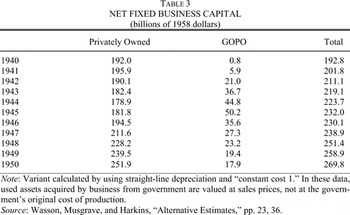
Matters may not be so desperate with respect to the deflation of the government's wartime expenditures for industrial plants and equipment, in particular for the GOPO stock created during the war and, in part, sold to private owners during the immediate postwar years. Table 3 presents the most significant “real” data (expressed here in constant 1958 dollars), which are those pertaining to the private nonfarm business economy. In the Commerce Department report from which these data are drawn, four different estimates are given, based on two different deflators and two different depreciation formulas, but the four series all show essentially the same profile, and one variant will serve our purposes here well enough.
As the table shows, “real” privately owned capital fell from 1941 to 1944, rose slightly in 1945, then grew rapidly in each of the next five years. “Real” GOPO capital mushroomed from near zero in 1940 to a peak of $50.2 billion (in 1958 dollars) in 1945, then began to decline rapidly, losing more than 60 percent of its value by 1949. The total privately operated stock of capital, shown in column 3 of the table, grew steadily from 1940 to 1945, fell slightly in 1946—a decline attributable entirely to the estimated decline of nearly 30 percent in the real value of GOPO capital, a substantial part of that decline representing the transfer of assets to private owners—then grew steadily for the remainder of the decade. From 1940 to 1945, the estimated total stock increased by 20 percent; then, from 1945 to 1950, by 16 percent.
It is almost certain that the Commerce Department figures overstate the increase in the privately operated capital stock during the first half of the 1940s, because the standard formulas for computing depreciation fail to take into account certain extraordinary conditions during the war, especially “the accelerated depreciation resulting from intensive plant use and scarcity of replacement parts.”49
McLaughlin, “Wartime Expansion,” p. 113.
According to a War Production Board report,
plant utilization in the munitions industries increased sharply after Pearl Harbor …. [T]he average utilization of facilities in the metal products industries late in 1944 was about two-thirds above the prewar level, after having reached nearly twice the prewar level in the spring of 1943; the increase in the remaining industries, though smaller, was still substantial…. [T]he increased utilization of existing facilities contributed nearly as much to the increase of total industrial output during the war as did the construction of new facilities; though the contribution made by more intensive utilization was much more important in the earlier part of the period, particularly in 1940 and 1941, than it was in 1943 and 1944.50
U.S. War Production Board, American Industry, p. 7, emphasis added.
Double-shift and even treble-shift operation of plants became much more common during the war.
51 For example, shipyard facilities, which had been worked at most one shift per day before the war, supported three shifts per day during the war.
52 Lane, Ships for Victory, p. 232.
Recently, Lee Ohanian, citing a 1963 study by Murray F. Foss, also has noted that “capital utilization increased substantially during the war.”53
Ohanian, “Macroeconomic Effects,” p. 33.
Foss had reported, among other things, that in a comparison of conditions in 1934–1939 and those in 1940–1944, hours of usage per year increased by 53 percent for railroad freight cars, by 54 percent for freight locomotives, and by 34 percent for passenger locomotives.
54 Foss, “Utilization of Capital,” p. 15.
Hours of usage per year per spindle in the cotton textile industry increased by about two-thirds during the war years.
55 At the same time that the capital stock was being used far more intensively, the lack of replacement parts and repair materials kept producers from doing the normal upkeep on their property. In the housing sector, rent controls induced landlords to forgo ordinary repairs. For apartment houses and small structures, index numbers of repair and maintenance expenditures fell some 20 percent during the war.56
Rockoff, Drastic Measures, p. 156.
The motor-carrier industry during the three peak war years obtained “only 195,000 new trucks and buses,” which amounted to “less than 10 percent of the number it would normally require for replacements and expansions,” while increasing its loads each year and thereby hastening wear and tear on its fleet of vehicles.
57 Director of War Mobilization and Reconversion, Problems of Mobilization, p. 39.
At the beginning of 1945, the Director of War Mobilization and Reconversion confirmed that “wear and tear on [industrial] plants has been far above normal, while repairs and replacements have been below normal.”
58 We can gain a rough idea of the effect of this accelerated wartime depreciation by making some conservative adjustments to the Commerce Department's capital consumption allowances. From the gross and net investment figures shown in Table 1, we can infer that the official allowances for depreciation of the private capital stock during the five wartime production years were as follows, in current dollars: $9.0 billion in 1941, $10.1 billion in 1942, $10.1 billion in 1943, $10.4 billion in 1944, and $10.7 billion in 1945. If we adjust these estimates by adding just 10 percent in 1941, and 20 percent in each year from 1942 through 1945, the total additional depreciation for the entire wartime period comes to $9.1 billion, a far from trivial sum—consider, for example, that it offsets approximately 53 percent of the amount ($17.2 billion) the government spent on new industrial facilities (structures, equipment, and reconversions) from July 1940 through June 1945.59
Smaller War Plants Corporation, Economic Concentration, pp. 37–38, citing War Production Board data.
In addition, we may presume that the official depreciation formulas also failed to capture fully the actual wartime depreciation of government-financed industrial facilities, which were also operated at extraordinary intensity, probably more so than the private capital stock as a whole. Given that more than half of the government's industrial investment had been completed by the end of 1942,
60 an allowance for extra depreciation of the GOPO industrial capital might easily add another $1 billion to the total adjustment for wartime understatement of actual depreciation, bringing that total to more than $10 billion in current dollars, or approximately $20 billion in 1958 dollars.
61 Adjustment for price-level change made here by using the implicit deflator for private nonresidential fixed investment; see U.S. Council of Economic Advisers, Annual Report, p. 180.
If we deduct just half of this amount—$10 billion in 1958 dollars—from the total net fixed (privately operated) business capital estimate shown in Table 3 for 1945 (which represents only part of the nation's total privately operated capital stock), the total falls to $222.0 billion. One implication, then, is that the total net fixed (privately operated) business capital stock increased between 1940 and 1945 not by the 20 percent implied by the official figures, but by just 15 percent. Moreover, given the new figure for 1945 (and a corresponding adjustment of the data for later years), another implication is that the total increased between 1945 and 1950 not by the 16 percent implied by the official figures, but by 17 percent. In my judgment, a complete and precise adjustment—which would require an enormous research effort to produce, if it is possible to produce at all, given the sorts of data that would be required—almost certainly would be greater than my crude, exploratory adjustment here.
By taking into account the undoubted measurement errors in the wartime depreciation allowed in the Commerce Department figures shown in Table 3, which are caused by the inappropriate application of uniform, standard depreciation schedules, we may conclude that the actual drop in the privately owned net stock of capital was even greater than shown during the war years and that the increase in that stock during the second half of the 1940s was greater than shown. For the privately operated capital stock (GOPO capital being incorporated with privately owned capital), as for the economy's real output, the official data have misled us by making the wartime expansion appear bigger than it really was and the postwar expansion smaller than it really was.62
On the overstatement of real output growth during the war, see Higgs, “Wartime Prosperity?” “Regime Uncertainty,” and “From Central Planning.”
CONCLUSION
Contemporaries greatly exaggerated the heroic achievements of the wartime socialization of investment. Their exaggeration reflected, in part, an unwarranted concentration of attention on the manufacturing sector. Although that sector undoubtedly played a central role in the production of munitions, it represented less than a third of the entire prewar economy, and the other two-thirds got very short shrift indeed from the government's wartime investment program. Even within manufacturing, the nonmunitions industries suffered wartime privations of capital formation. Most important, of course, we must recognize that the great bulk (some 83 percent) of the apparent capital formation, as officially recorded (see Tables 1 and 2), consisted not of industrial structures or equipment but of military structures (some 14 percent) and of durable munitions (some 69 percent)—weapons platforms, guns, ammunition, and auxiliary equipment and supplies. To have counted such military output as capital formation was always, at best, an extremely dubious practice, and the justifications for doing so that Kuznets and others have advanced are not convincing. If we take into account only those parts of the wartime capital formation that had value beyond their sheer immediate usefulness in winning the war, and if we give appropriate weight to the significant measurement errors that I have described, then we may conclude with reasonable confidence that, in fact, real capital formation during the first half of the 1940s was not proportionally greater than that during the latter half of the decade; indeed, it was more likely a good deal less. The wartime socialization of investment served a definite purpose in allowing the U.S. military-industrial complex to triumph over the nation's enemies in World War II. Beyond that, its achievements had little if anything to recommend them.
For pointing me toward or helping me lay hands on some of the data analyzed in this article, I am grateful to Robert J. Gordon, Barbara M. Fraumeni, Lee J. Alston, and Andres Gallo. For substantive critical comments on a previous draft, I am indebted to Michael Edelstein, Alexander Field, and Hugh Rockoff.