Introduction
Homocysteine is a non-essential sulfur-containing amino acid associated with folic acid and B12 methylation, and is a risk factor for cardiovascular disease (Homocysteine Studies Collaboration, 2002). In animal models homocysteine has been shown to be neurotoxic (Troen, Reference Troen2005) and there is good evidence for an independent association between raised homocysteine levels and cognitive decline (McCaddon and Regland, Reference McCaddon and Regland2006; van Dam and van Gool, Reference van Dam and van Gool2009). The Rotterdam Study (Kalmijn et al., Reference Kalmijn, Launer, Lindemans, Bots, Hofman and Breteler1999) failed to show an association between baseline homocysteine concentrations and global cognitive decline, over 2.7 years, defined using the Mini-Mental State Examination (MMSE) (Folstein et al., Reference Folstein, Folstein and McHugh1975). However, associations were subsequently reported in the larger cross-sectional Rotterdam Scan Study between increased homocysteine and poorer performance in specific aspects of cognition when using a detailed battery of neuropsychological tests (Prins et al., Reference Prins2002). Factors such as folate and B12 levels are known to modify plasma homocysteine levels. In the MacArthur Study of Successful Aging, low folate rather than elevated homocysteine was associated with decline over seven years using a single composite score from a range of cognitive tests (Kado et al., Reference Kado2005), whereas folate and homocysteine were separately associated with different aspects of cognition in the Veterans Affairs Normative Aging Study (Tucker et al., Reference Tucker, Qiao, Scott, Rosenberg and Spiro Iii2005). In the Framingham Offspring Study, homocysteine concentrations were negatively associated with performance in a broad range of cognitive domains (Elias et al., Reference Elias2005).
We hypothesized that the rate of the cognitive decline in older hypertensives would be independently associated with plasma homocysteine. In a longitudinal study using a detailed assessment of cognitive function in older hypertensives free of dementia, we determined whether plasma homocysteine concentrations were associated with cognitive decline in different domains, independent of plasma folate and vitamin B12 concentrations.
Methods
Participants
At the final follow-up visit of a cognitive substudy of the Study on COgnition and Prognosis in the Elderly (SCOPE), 182 participants underwent measurement of plasma homocysteine, folate and serum B12 concentrations. The main SCOPE trial was a large multicenter, international, prospective, randomized, double-blind, parallel-group study conducted primarily to assess the effect of the angiotensin receptor blocker, candesartan, on major cardiovascular events in older adults (aged 70–89 years) with mild hypertension (defined as SBP 160–179 and/or DBP 90–99 mmHg, untreated or thiazide-treated) (Hansson et al., Reference Hansson1999). Participants in the substudy were recruited to a single center from 10 general practices, as described in detail elsewhere (Saxby et al., Reference Saxby, Harrington, Wesnes, Mckeith and Ford2008). Individuals with possible dementia, defined by an MMSE score <24 or with reported significant decline in cognitive function were not eligible. Ethical approval was granted by the Newcastle Joint Ethics Committee and all participants gave informed, written consent. Participants were randomized to receive 8 mg candesartan or placebo; doubling of study medication, additional hydrochlorothiazide, and further antihypertensive treatment were permitted to achieve target blood pressure. Mean study follow-up was 44 months (SD 12; range 12–60 months). Subjects were not restricted from using vitamins or any other supplements in our study. There is no legal requirement in the UK for folate fortification of any foodstuffs although some cereals do contain added folate and B12.
Cognitive assessments
Cognitive function was assessed annually using a battery of tasks from the Cognitive Drug Research (CDR) computerized assessment system (Simpson et al., Reference Simpson, Surmon, Wesnes and Wilcock1991), presented on a laptop computer, with participants responding via ‘YES’ and ‘NO’ buttons on a two-button response box. A training session was performed before the baseline assessment to reduce practice effects, and alternative, equivalent forms of the tasks were used at each visit to prevent learning effects. The New Adult Reading Test was administered at baseline as a proxy measure of premorbid IQ (Nelson and O'Connell, Reference Nelson and O'Connell1978). Traditional pen-and-paper neuropsychological tests of executive function were also administered: the Trail-Making Test forms A & B (Reitan, Reference Reitan1958) and Verbal Fluency for letter F, A and S, and category of Animals (Spreen and Strauss, Reference Spreen and Strauss1997). The battery took approximately 40 minutes to complete. Formulae derived from a previous principal components analysis (Saxby et al., Reference Saxby, Harrington, Mckeith, Wesnes and Ford2003) were used to combine individual subtest scores into five independent composite cognitive domain scores: speed of cognition, attention, episodic memory, working memory and executive function.
Summary measures were used to reflect change in cognition over time, calculated as the slope of the regression line of each cognitive domain score against time of assessment (months since baseline), for each participant where data from two or more assessments were available a minimum of 12 months apart. The resultant coefficients of decline were used as the main outcome variables of rate of cognitive change. The advantages of the approach are that the slope reflects the rate of progression and maximizes use of data collected at multiple time points, can handle missing data, and accounts for differential length of follow-up due to the rolling recruitment period, providing a more sensitive measure of decline than simply using the start and endpoint. Coefficients were calculated so that negative values represented decline over time for all cognitive domains.
Analysis of homocysteine, folate, B12
Non-fasting blood samples were collected in vacutainers containing EDTA, put on ice immediately and centrifuged within 30 minutes at 4°C and plasma separated. Aliquots of the separated plasma were stored at −80°C. Plasma homocysteine was assayed using the Abbot IMx homocysteine assay system (Abbott Laboratories, Chicago, IL), based upon fluorescence polarization immunoassay (FPIA) technology (Lonati et al., Reference Lonati2004). This method has a 95% limit of agreement of −0.97 to 2.30, an intralaboratory imprecision of less than 5% and showed linearity throughout the 6–50 mol/l range. Plasma folate and B12 were measured by Abbott AxSYM analyzer. The coefficient of variation for folate assay was <10% for all levels (Wilson et al., Reference Wilson1995). B12 was determined by means of a microparticle-based enzyme immunoassay, with a coefficient of variation of <5% for medium or high levels, and <10% for levels of <100 ng/l (Wilson et al., Reference Wilson, Yu, Karian, Kozlowski and O'Reilly1999).
Statistical analyses
Statistical analyses were performed using SPSS v.15 (SPSS Inc., Chicago, IL). Normality of distribution of the main outcome and predictor variables and the residuals were determined using scatter plots and the Kolmogorov-Smirnov test. Correlations between homocysteine, confounding continuous variables and cognitive domains were done using non-parametric Spearman's ρ as homocysteine and B12 had a non-normal distribution. The association between homocysteine and categorical variables was tested by comparing the means. The percentage of annual change and Cohen's d effect sizes were used to compare cognitive decline between the highest and lowest quartile groups of homocysteine. To investigate the independent association with cognition, total plasma homocysteine as the main independent variable was regressed with the slopes in each cognitive domain, including other potential confounding predictive variables of age, creatinine clearance, candesartan or placebo therapy, average systolic and diastolic blood pressures across the study period, and baseline cognition. Analysis was repeated for each domain after adding folate and log-transformed B12 stepwise into the model. A binary logistic regression analysis was also performed between the lower and upper quartiles of cognitive values for each cognitive domain to confirm the results of the above analysis. Homocysteine and B12 were used in regression after normalization by log-transformation. The plots and statistics of the residuals were examined to confirm the validity of regression.
Results
Of the 257 participants randomized in SCOPE at the Newcastle site, 228 had calculable coefficients of decline (Saxby et al., Reference Saxby, Harrington, Wesnes, Mckeith and Ford2008). Of those, 182 gave blood samples for homocysteine analysis at the study close. There were no significant differences in baseline characteristics or baseline cognitive domain scores between the study group (n = 182) and those (n = 46) without homocysteine measurements.
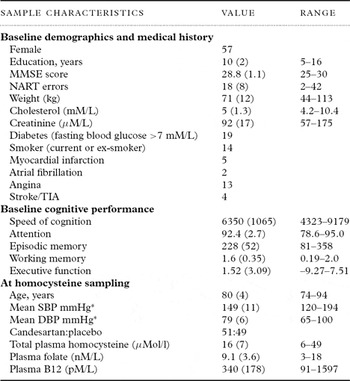
Characteristics of the 182 participants at baseline and time of homocysteine sampling are shown in Table 1. Plasma homocysteine concentrations correlated with age (r = 0.32, p<0.001), serum creatinine (r = 0.26, p<0.001), plasma folate (r = −0.47, p<0.001) and B12 (r = −0.32, p<0.001) but not with gender (p = 0.9), years of education (p = 0.6) systolic (p = 0.11) or diastolic blood pressure (p = 0.24), smoking (p = 0.85) or cholesterol levels (p = 0.75). Homocysteine concentrations were increased in the candesartan group compared to the placebo group (17.1±7.8 versus 14.8±6.8; p = 0.03), and remained so after controlling for creatinine (p = 0.02) and creatinine clearance (p = 0.03).
Sample characteristics of participants at entry to SCOPE, and at homocysteine sampling

Data shown are percentage or mean (SD), and range.
DBP = diastolic blood pressure; MMSE = Mini-Mental State Examination; NART = New Adult Reading Test; SBP = systolic blood pressure; *using blood pressure readings from all post-baseline study visits.
Cognitive decline for the whole group and for the highest and lowest quartile homocysteine groups is shown in Table 2. The high homocysteine group showed significantly greater decline on speed of cognition, episodic memory and executive function, with Cohen's d effect sizes of approximately 0.7 compared to the low homocysteine group.
Comparison of change in cognition between upper (>19 μMol/l) and lower (<11 μMol/l) quartiles of homocysteine levels, measured by coefficients of decline in five cognitive domains

Data shown are mean (SD). Adjusted for age, New Adult Reading Test errors, and baseline performance. Negative values indicate decline in performance over time. Cohen's d represents the effect size of having high homocysteine (upper quartile >19 μMol/l) over low homocysteine (lower quartile <11 μMol/l), based on the pooled SD.
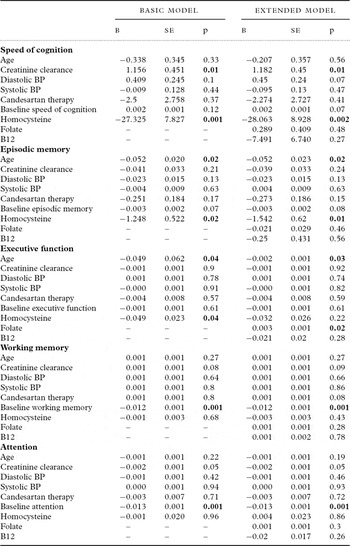
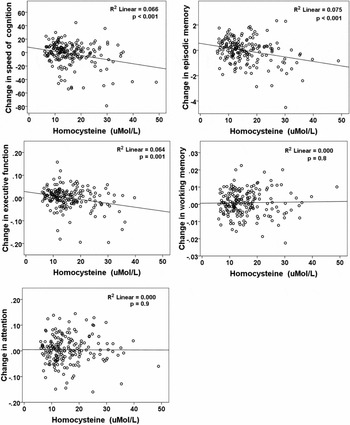
The scatterplots of total plasma homocysteine concentration and coefficients of decline demonstrated a linear relationship between increasing levels of homocysteine and speed of cognition, episodic memory and executive function, but not for working memory and attention (Figure 1). Table 3 shows the results of the multivariate linear regression analyses including other factors known to influence cognitive decline: age, blood pressure, candesartan or placebo therapy, renal function and baseline cognition. The multivariate analyses confirmed an independent association of homocysteine with speed of cognition (β = −27.33, p = 0.001), episodic memory (β = −1.25, p = 0.02) and executive function (β = −0.05, p = 0.04). When folate and B12 were added to this basic homocysteine multivariate model, the association of homocysteine remained significant for speed of cognition (β = −28.06, p = 0.002) and episodic memory (β = −1.54, p = 0.01) but not executive function (p = 0.22). In this model, folate showed a weak association with executive function (β = 0.003, p = 0.02). Using binary logistic regression analysis, the same observations were confirmed for speed of cognition (β = −3.76, p = 0.013), episodic memory (β = −4.97, p = 0.02) and executive function (β = −4.63, p = 0.007), and, as in the linear regression, speed of cognition and episodic memory, but not working memory were still significantly associated with homocysteine after inclusion of B12 and folate into the model.
Multivariate regression analyses of homocysteine with coefficients of decline in five cognitive domains: speed of cognition, episodic memory, executive function, working memory, and attention

Note: The basic model included homocysteine, age, creatinine clearance, average systolic and diastolic BP throughout the study, candesartan therapy, and baseline cognitive score. The extended model additionally included folate and B12.
Significant predictors of cognitive decline at p<0.05 are marked in bold.
BP = blood pressure; B = regression coefficient; SE = standard error.
Total plasma homocysteine concentration and coefficients of decline in five cognitive domains

Discussion
We found that the rate of cognitive decline over 3–5 years in three cognitive domains (speed of cognition, episodic memory, executive function) was significantly associated with increased plasma homocysteine levels. This association was maintained after accounting for baseline cognition, age, blood pressure and candesartan-based antihypertensive therapy, and persisted after including folate and B12 in the multivariate models. No consistent associations were seen between cognitive decline and plasma folate or B12 concentrations, suggesting that homocysteine directly influences cognitive decline in older people. Our observations are consistent with previous cross-sectional studies (Clarke et al., Reference Clarke, Smith, Jobst, Refsum, Sutton and Ueland1998; Budge et al., Reference Budge, De Jager, Hogervorst and Smith2002; McCaddon and Regland, Reference McCaddon and Regland2006) although some studies did not find an independent association of homocysteine with cognition, for instance Mooijaart et al. found that vitamin B12 was a stronger predictor of cognitive decline than homocysteine, while a recent paper by Clarke and colleagues found an association between homocysteine and cross-sectional cognition, but not longitudinal cognitive decline (Mooijaart et al., Reference Mooijaart2005; Clarke et al., Reference Clarke2007).
A strength of our study is the assessment of a range of cognitive domains, using sensitive computerized tests designed for repeated administration, to examine the relationship between homocysteine and change in cognition over time.
A metabolic derangement such as hyperhomocysteinemia might be expected to induce global cerebral dysfunction. However, we found no association between decline in attention and working memory and homocysteine concentrations. We have previously reported mild deficits in working memory associated with hypertension compared to normotensive controls (Saxby et al., Reference Saxby, Harrington, Mckeith, Wesnes and Ford2003), and the attention tasks have identified benefits of antihypertensive treatment (Saxby et al., Reference Saxby, Harrington, Wesnes, Mckeith and Ford2008); therefore, the lack of association is not due to poor sensitivity of the tests themselves. In the multivariate regression analyses, baseline performance was a significant predictor of future decline for both attention and working memory. Thus it is possible that homocysteine has a direct effect on decline in some cognitive domains but not others. Our findings of associations with episodic memory and speed of cognition are in agreement with a previous study showing an association between raise homocysteine and worsening performance on a Stroop test (Garcia et al., Reference Garcia, Haron, Pulman, Hua and Freedman2004), with the Hordaland homocysteine study (Nurk et al., Reference Nurk2005) and also with the FACIT trial (Durga et al., Reference Durga2007), where folic acid supplementation was beneficial in reducing decline over three years in the same cognitive domains, albeit using different cognitive tests.
We found that the association of homocysteine with cognitive change was unaffected by inclusion of folate into the models, except for executive function, which was more strongly associated with folate than homocysteine in the full model. A cross-sectional analysis of the Singapore Longitudinal Ageing Study (Feng et al., Reference Feng, Ng, Chuah, Niti and Kua2006) similarly found an association between folate and Category Verbal Fluency, one of the tests that contributed to the executive function domain in our study. The Baltimore Memory Study also found associations between homocysteine and the tests we used to assess executive function, although they were weaker than with other cognitive domains such as psychomotor speed and memory; however, the possible mediating influence of folate was not determined in the study (Schafer et al., Reference Schafer, Glass, Bolla, Mintz, Jedlicka and Schwartz2005). Low folate levels may influence executive function through its role in neurotransmitter (e.g. serotonin, and dopamine) synthesis as well as homocysteine metabolism. Our findings are consistent with a recent longitudinal study that reported that serum homocysteine levels were associated with an increased risk of developing Alzheimer's disease (Hooshmand et al., Reference Hooshmand2010). Although our study found associations primarily with homocysteine, for future studies we recommend the additional measurement of folate and B12 and the assessment of a range of domains, to explore the differential effects on cognition.
Whether hyperhomocysteinemia is only a surrogate marker for brain injury caused by another mechanism or has a true etiological role in brain injury and degeneration remains unclear (Seshadri, Reference Seshadri2006). A potential weakness of our study is that plasma homocysteine was not measured at the start of the study as well as the study end. However, the timing of homocysteine estimation is unlikely to have had a large influence on the findings in this study. In the OPTIMA longitudinal study (Clarke et al., Reference Clarke, Smith, Jobst, Refsum, Sutton and Ueland1998), homocysteine levels remained stable over a three-year period. The start and end study homocysteine levels in the Framingham longitudinal study, which correlated homocysteine levels with onset of dementia, showed no major significant change over time in individual homocysteine concentrations. It is therefore reasonable to assume that the end of trial homocysteine concentrations (Seshadri et al., Reference Seshadri2002) in our study were representative of homocysteine concentrations throughout the trial.
Candesartan has been reported to increase homocysteine levels in a smaller study of middle-aged hypertensives (Muda et al., Reference Muda2005) and this appears to be due to an effect of candesartan on cellular oxidative stress. Increases in homocysteine concentration due to angiotensin receptor blockers could, in theory, reduce benefits of these agents in reducing the risk of stroke and myocardial infarction. However, the effect is modest and clinical trials of these agents have in general confirmed the benefits in cardiovascular events prevention, as anticipated from the level of blood pressure lowering achieved (ONTARGET Investigators et al., 2008).
In summary, we found plasma homocysteine was independently associated with cognitive decline in an older hypertensive population. Our findings in the context of other studies support the concept that homocysteine is neurotoxic to the aging brain, and the need for further work to understand the potential mechanisms through which elevated homocysteine may impair cognitive function. Recently, there have been contradictory reports on the effects of multi B vitamin (folic acid, B12 and pyridoxine) intervention on cognition in older subjects. In one study this intervention reduced homocysteine levels and the rates of serial brain atrophy on MR over a two-year period (Smith et al., Reference Smith2010). However another study claimed lack of effectiveness of B vitamins to benefit cognitive function in older men (Ford et al., Reference Ford2010). Our observations strongly support the conduct of further interventional studies to clarify the role of lowering homocysteine in preventing cognitive decline and dementia.
Conflict of interest declaration
Dr. Saxby was previously employed by Cognitive Drug Research (CDR) Ltd., commercial provider of computerized cognitive testing services to the pharmaceutical industry. The CDR battery is now owned by United BioSource Corporation (UBC).
Professor Ford has received honoraria for educational and consultancy activities from Astra Zeneca.
Description of authors' roles
Dr. Narayan undertook the study analysis and contributed to the initial draft of the manuscript. Dr. Saxby undertook the cognitive assessments and contributed to the design and analysis of the study and interpretation of the results. Dr. Firbank contributed to the analysis of the study and interpretation of the results. Professor O'Brien contributed to the design of the study and interpretation of the results. Dr. Harrington recruited and assessed patients for the study. Professor McKeith contributed to the design of the study and interpretation of the results. Dr. Hansrani performed the homocysteine assays. Professor Stansby oversaw the homocysteine assays and commented on early drafts of the manuscript. Professor Ford was responsible for overall coordination, design and interpretation of the study and early drafts of the manuscript.
Acknowledgments
The authors thank Dr. Simon Kometa, Statistics Adviser, Information Systems and Services, Newcastle University, for assistance with the statistical analysis; John Davis and Anu Kulkarni, Research Nurses, Freeman Hospital, Newcastle upon Tyne, for assistance with the physiological measurements.
Financial support of the cognitive substudy was provided by the Astra Research Foundation UK and AstraZeneca International. The main SCOPE trial was supported by AstraZeneca International. This work was supported by the NIHR Biomedical Research Centre for Ageing and Age-related disease award to the Newcastle upon Tyne Hospitals NHS Foundation Trust. Professors Ford, O'Brien and McKeith are supported by NIHR Senior Investigator Awards. Dr. Narayan was funded by the British Council through a Commonwealth Scholarship.