In theory, representative democracy is premised on two basic notions: that the positions of representatives should not be at odds with those they represent and that there should be no systematic bias in the consideration of the policy interests of all citizens (Dahl Reference Dahl1971; Pitkin Reference Pitkin1967; Verba Reference Verba2003). Feminist scholarship on political representation often concerns whether the continued underrepresentation of women in political institutions violates these normative ideals.Footnote 1
To ensure the equal representation of interests, many studies of women's representation rest on the assumption that a balance of men and women in politically representative roles, which is reflective of male-to-female ratios in the population, is desirable in modern democratic systems. This is descriptive representation, which suggests that female politicians are best placed to represent policy interests that are of particular salience to women. Thus, increasing women's participation in parliaments facilitates greater substantive representation of issues that affect them directly (Celis Reference Celis2009; Phillips Reference Phillips1995; Pitkin Reference Pitkin1967). Further, the entry into elected office of representatives from historically disadvantaged groups may enhance the quality of political deliberations as well as trust in and legitimacy of the political system (e.g., Dovi Reference Dovi2007, 308; Karp and Banducci Reference Karp and Banducci2008; Mansbridge Reference Mansbridge1999).
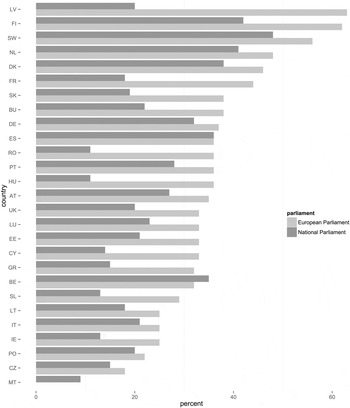
Existing empirical research exploring the relationship between descriptive and substantive representation has shown mixed evidence that gendered differences exist in the case of both voter and representative attitudes across a range of policy issues and specifically in policy areas understood as “women's interests,” such as child care policy, abortion rights, and equality (e.g., Bratton and Ray Reference Bratton and Ray2002; Campbell, Childs, and Lovenduski Reference Campbell, Sarah and Lovenduski2009; Lovenduski and Norris Reference Lovenduski and Norris2003; Swers Reference Swers1998). Further, scholarship has shown that gender can affect the actions of political representatives in office such that a greater number of women in decision-making positions can impact policy outcomes (Bratton and Ray Reference Bratton and Ray2002; Swers Reference Swers1998). However, single-country analyses dominate the literature, and large-N comparative studies are rare (although see Schwindt-Bayer and Mishler Reference Schwindt-Bayer and Mishler2005). Moreover, little is understood about the impact of women's representation in the European Union (EU), which is often overlooked as a site where the descriptive representation of women may occur (Kantola Reference Kantola2009). This is despite the fact that, on average, a greater number of female politicians are returned to the European Parliament (EP) compared to respective national institutions (see Figure 1).
Percentage of women in national and European parliaments, 2009. Source: EES 2009 contextual data and http://www.europarl.europa.eu (accessed September 14, 2014).

This article seeks to address this gap in the literature and considers the descriptive representation of women in the EU through a comparative analysis of the policy attitudes of voters and candidates in member states using the European Election and Candidate Studies 2009. The article considers three core research questions. First, do men and women in EU member states systematically differ in their attitudes across a range of policy areas? Second, are these differences (if any) replicated between male and female politicians competing in the EU space? Third, does greater exposure to female participation in EU politics alter voter attitudes toward women's interest issues, thereby reducing gender bias? The results of this study speak to the question of whether the descriptive representation of women is necessary for the substantive representation of their interests in the EU space.
I begin the next section by outlining the theoretical argument that descriptive representation facilitates the substantive representation of women's policy preferences before turning to the hypotheses exploring women's representation in the EU.
DOES DESCRIPTIVE REPRESENTATION MATTER?
Descriptive representation occurs when political actors are a “mirror image” of those they represent (Pitkin Reference Pitkin1967). The degree to which a representative shares in the contextual characteristics of his or her supporters is thus a key measure. Consequently, a political institution that is descriptively representative is a microcosm of the population on whose behalf it acts and reflects the diversity of the citizenry. The value in having voters and policy makers share contextual characteristics lies in an assumption that, by virtue of group membership, both represented and representative share common preferences and policy priorities (Pitkin Reference Pitkin1967). If women can be considered to have shared interests, then female politicians should be best placed to “act for” female citizens, and more women in parliament should improve the degree of advocacy in favor of a female-friendly policy agenda within governments (Bratton and Ray Reference Bratton and Ray2002; Campbell, Childs, and Lovenduski Reference Campbell, Sarah and Lovenduski2009; Cowell-Meyers and Langbein Reference Cowell-Meyers and Langbein2009; Mansbridge Reference Mansbridge2005). Therefore, descriptive representation is desirable largely because of the link with its substantive variant, where a key test is whether political actors reflect the policy positions of their voters and act in a manner consistent with those preferences.Footnote 2
Thus, the desirability of descriptive representation is premised on several conditions. First, men and women must, at least on certain political issues, systematically differ in their policy preferences. Second, such gendered differences in policy positions, where they are found to exist, must be replicated between male and female politicians in the polity. Third, citizens must vote for female candidates in sufficient numbers that a balanced number of men and women representatives are returned to office. Kanter's (Reference Kanter1977) “critical mass” hypothesis argues that it is important for more than a mere token number of women to be returned to office if women's policy interests are to be prioritized in the policy-making process.Footnote 3 Finally, female representatives should be shown to be more congruent with their female (compared with their male) supporters on policy issues that exhibit gendered differences, and institutional factors (e.g., the party whip) should not systematically restrain female representatives from having these policy positions realized as political outcomes.
Empirical studies provide some mixed evidence of each condition at work. For example, in a study of British politicians, Lovenduski and Norris (Reference Lovenduski and Norris2003) find no systematic differences of opinion on issues such as the economy, moral traditionalism, or Europe but some variation in attitudes toward equality and affirmative action. In a later British study, Campbell, Childs, and Lovenduski (Reference Campbell, Sarah and Lovenduski2009) show differences between men and women (both citizens and representatives) in attitudes to gender equality but also find that this effect varies across age cohorts.
With respect to the latter conditions, some studies have shown links between increased participation rates of women in legislatures and greater attention to women's interest issues in policy making (e.g., Bratton and Ray Reference Bratton and Ray2002; Reingold Reference Reingold2000; Swers Reference Swers2002). However, Thomas (Reference Thomas1994), in a U.S. study, indicates that although policy differences between men and women exist, male and female politicians do not necessarily prioritize policy issues in a differential manner, suggesting that attitudes do not always translate into legislative outputs.
Beyond the substantive representation of issues, the scholarship also suggests that increased female participation in politics may have deliberative effects, impacting voter attitudes and behavior and narrowing the gender gap in attitudes toward policy. Few empirical studies exist that explicitly model the impact of women's descriptive representation on the attitudes of men, but evidence indicates that greater exposure to female leadership alters voter attitudes toward female participation (Beaman et al. Reference Beaman, Chattopadhyay, Duflo, Pande and Topalova2009) and that men's confidence in political institutions are sensitive to the proportionality of men and women in the legislature (Schwindt-Bayer and Mishler Reference Schwindt-Bayer and Mishler2005). Further, the theoretical literature argues that the more women that participate in the legislature, the more likely female attitudes will permeate the system, altering behavior and narrowing the gender gap in attitudes (Bratton Reference Bratton2005; Mansbridge Reference Mansbridge1999; Thomas Reference Thomas1991).
While it is beyond the scope of a single article to address every condition, it is reasonable to assert that if empirical analysis fails to find evidence that men and women, both in the population and among representatives, have systematic differences in policy preferences, then the case for descriptive representation falls at the first hurdle. The aim of this article is to explore these a priori conditions across 27 countries in the EU. The comparative element allows for an assessment of whether a greater number of women in political office is associated with a smaller gender gap in political attitudes.
WOMEN AS AN INTEREST GROUP
In The Politics of Presence, Phillips (Reference Phillips1995) argues that women, because of similarities in life experiences, share a common group identity with respect to political interests such as child care, abortion, and equality. Consequently, only when they are present in the deliberative decision-making processes of legislatures can women have their policy interests realized. However, to identify men and women as fixed groupings rather than as members of interchangeable categories is overly simplistic and does not reflect the diversity of attitudes that may exist in a given policy space (e.g., Dietz Reference Dietz2003; Wängnerud Reference Wängnerud2009). Further, the sex of a candidate may not be important so long as the interests of their constituents are represented in parliament (Mansbridge Reference Mansbridge2003).
Indeed, there are many factors that influence and shape a voter's political attitudes, such as religion, family background, class, party identification, education, wealth; gender is only one. In a classic discussion of societal cleavages, Lipset and Rokkan (Reference Lipset and Rokkan1967) argue that other distinctions within society (e.g., Catholic versus Protestant or workers versus capital) are dominant in structuring party competition and that any residual gendered differences are absorbed by these dominant dimensions. Here, both men and women situate themselves in the policy space according to religion, class, or party identification rather than on the basis of gender. Thus, a nonreligious, left-leaning woman may be closer to an equally nonreligious man in terms of her preferences on abortion compared with a religious, right-leaning woman. Indeed, in a study of the Brazilian Congress, Htun and Power (Reference Htun and Power2006) find that party trumps sex in driving progressive opinions about women's interest policies.
Young (Reference Young2000) takes this argument further, suggesting that although social groups are structured around contextual dimensions such as gender, race, religion, and so on, these groups cannot be defined by similarity of opinion, and therefore women cannot be represented on the basis of interest but only on the basis of the social perspective of the group that derives from their structural position in society.
On the other hand, Phillips (Reference Phillips1995, 68) argues that while the universality of women's interests may be refuted, gendered interests nevertheless exist by virtue of the way in which modern society is constituted. She states that the existence of a variety of preferences among women does not undermine the concept that interests may be gendered. It is sufficient to establish the existence of difference between the interests of men and women, albeit without the universality of opinion among women as a group. Underpinning this argument is the assumption that political preferences are driven largely by rational self-interest, such that if one takes account of other contextual dimensions that may also shape citizen attitudes over policy, women are likely to adopt preferences that serve their self-interest regardless of whether they also stand to serve the interests of men.Footnote 4 For example, one might expect that a woman, within the constraints of her structural position in society (determined by issues such as race, class, religion, etc.), may adopt a more liberal attitude toward abortion policy than a similarly positioned man because it is in her self-interest to do so. Further, one can hypothesize that because women are typical beneficiaries of equality legislation, they are likely to adopt more liberal positions on equality issues in general compared with their male counterparts.
This conceptualization is in line with that of Wängnerud (Reference Wängnerud2000), who understands women's interests to encompass all policy areas that can increase female autonomy and, therefore, may be defined as policies that seek to increase child care, promote equality, improve the welfare state, and support rights to bodily integrity (e.g., issues relating to abortion rights). Indeed, the empirical literature offers some evidence that women tend to adopt more liberal positions on these policy issues compared with men (Campbell, Childs, and Lovenduski Reference Campbell, Sarah and Lovenduski2009; Lovenduski and Norris Reference Lovenduski and Norris2003; Poggione Reference Poggione2004). Therefore, I expect that, even taking account of alternative cleavages that dominate attitude formation, gendered differences in preferences exist in the policy space.
DESCRIPTIVE REPRESENTATION OF WOMEN IN THE EUROPEAN UNION
A key innovation of this study is to examine the political attitudes of men, women, and their representatives in a comparative context by exploring the policy preferences of citizens and candidates competing in the 2009 EP elections across 27 EU member states. Studies on the EU's capacity to serve as an effective representative institution have been dominated by analyses of substantive policy congruence between voters and parties (e.g., Lefkofridi and Casado-Asensio Reference Lefkofridi and Juan Casado-Asensio2011; Mattila and Raunio Reference Mattila and Raunio2006; Schmitt and Thomassen Reference Schmitt and Thomassen2000; Van der Eijk, Van der Brug, and Franklin Reference Van der Eijk, Van der Brug, Franklin, Schmitt and Thomassen1999). Little is known about whether the EU serves as an instrument of descriptive representation.
The EU serves as a useful site for the study of women's participation in elected office and their subsequent representation of interests. Comparatively, more women tend to be elected to the EP than to national parliaments, although the proportion of women elected in each member state varies considerably.Footnote 5 Scholars have highlighted that the style of politics in the EP may be more friendly toward women than other political bodies, as decision making tends to be less confrontational, and, as a relatively new institution, male hegemony is less entrenched than in national parliaments (Footitt Reference Footitt1998, 51; Kantola Reference Kantola2009, 390). Further, it is argued that the EU may be an important arena for advancing women's rights in Europe. As Freedman (Reference Freedman2002, 186) notes, there is evidence that female members of the European Parliament (MEPs) understand that their role as political representatives includes efforts to ensure that women's rights are adequately represented, and, as Kantola (Reference Kantola2009) also notes, the EU has paid much attention to the issue of women's representation since the 1950s.
The foregoing discussion leads to the expectation that if descriptive representation matters in the EU, then attitudes on issues relating to female autonomy such as equality, abortion, and the role of the welfare state should vary across gender. Moreover, these differences should be replicated between male and female politicians competing in the EU space. This leads to the following hypotheses:
H1:
All else being equal, women in the EU have more liberal attitudes on policy issues relating to equality, abortion, and the welfare state than men.
H2:
All else being equal, female MEPs have more liberal attitudes on policy issues relating to equality, abortion, and the welfare state than male MEPs.
It is plausible, of course, that men and women will not exhibit any significant differences on policy if such differences are absorbed by more dominant societal cleavages (Htun and Power Reference Htun and Power2006; Lipset and Rokkan Reference Lipset and Rokkan1967; Young Reference Young2000). Therefore, the empirical analysis controls for class, age, party affiliation, religiosity, and the impact of living in an urban compared to a rural area.
Finally, in order to explore the gendered variation in attitudes across member states, I consider the deliberative impact of descriptive representation in the EU. The foregoing discussion indicates that holding progressive and liberal attitudes may be associated with having more women returned to political office. Consequently, I expect the following:
H3:
Voters and MEPs in member states that return higher levels of women to the European Parliament will have, on average, more liberal attitudes on women's interest policy issues.
Further, because theory suggests that more women in political office may affect the policy attitudes of men as well as women, I expect that having more women returned to the EP will be associated with a smaller gender gap in attitudes over policy. While it is not possible in the current analysis to disentangle the causal direction of these effects—that is, whether progressive states return more female representatives or whether more female representatives alter public attitudes in a liberal direction—evidence of an association provides support for the argument that descriptive representation is important for the representation of women's interests.
DATA
To explore the hypotheses, I draw on data from the European Election Study (EES) and European Election Candidate Study (EECS) 2009. The final datasets comprise observations from 15,013 voters in 27 countries and 1,118 candidates across 15 countries. The smaller subset of countries was chosen for the candidate analysis because of the low response rates in the candidate survey. Investigators for the Comparative Candidate Survey, for example, suggest that return rates below 20% are unacceptable for subsequent analysis, and yet in the EECS, response rates for several member states were below this minimal level. Therefore, member states that yielded less than a 20% response rate for candidates surveyed were excluded from the analysis.Footnote 6
Dependent Variables
The dependent variables are voter and EP candidate attitudes toward policy on same-sex marriage, whether women should cut down on paid work for the sake of family, abortion, and the welfare state.Footnote 7 , Footnote 8 While same-sex marriage cannot be said to directly increase female autonomy, it is expected that women may nevertheless hold more liberal attitudes on equality issues generally, as women often stand to benefit from equality legislation. Further, it is expected that women will hold more liberal attitudes toward the provision of welfare, as they are more likely to be direct beneficiaries of such policies with respect to issues such as child care provision and income.
Finding measures of policy preferences that can be reliably compared between voters and elites is a particular challenge in the context in empirical research since few datasets contain information about specific policy issues for both voters and political actors. However, the EES and EECS 2009 contain a battery of statements on policy issues related to women's interests that use identical wording for both voters and candidates and ask respondents to report the level to which they agree with them. Each item is coded on a scale between 1 and 5, where 1 equals highly liberal responses and 5 equals conservative preferences on policy.
Independent Variables
The key independent variable for the hypotheses is gender, which is coded as a dummy variable such that woman equals 1. Further, because the preceding discussion notes that other contextual factors may shape a person's political attitudes, respondents' religiosity, age, class, whether they live in an urban area, and the party (coded as a series of party family dummies) they voted for in the 2009 EP election are controlled for. Religiosity is coded on a scale of 0 to 10, where 0 equals “not at all religious.” Class, urban, and party affiliation are coded as dummy variables.
To explore variation across countries, the pooled analysis also includes a variable measuring the percentage of female representatives returned to the European Parliament in 2009 from each member state.
Analysis for each of the main hypotheses uses ordered logit regression with robust standard errors clustered by country. The results of the analysis are discussed next.
RESULTS AND DISCUSSION
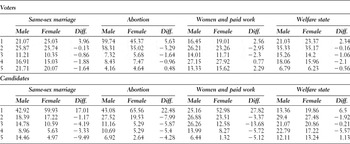
Table 1 reports the descriptive statistics for the dependent variables. The table shows the percentage of men and women reporting liberal to conservative responses in each issue category.
Political attitudes of voters and candidates by sex of respondent (%)

Notes: Figures are percentages of men's and women's responses to policy issues, where 1 = very liberal and 5 = very conservative.
In each area, a larger percentage of women report having a very liberal attitude compared with men. In the case of abortion and women and paid work, women are also more likely than men to report a highly conservative attitude. The results are somewhat replicated between male and female candidates, with more female representatives reporting very liberal attitudes compared with men. The statistics suggest that women are more likely to take extreme positions on these issues. However, differences between men and women voters are small, with the largest difference in attitude (abortion) reaching only 5.63%. Far larger differences are seen in the case of candidates, with a difference of 22.48% on abortion policy. Thus, the descriptive statistics indicate modest differences in overall attitudes between men and women voters, with far larger discrepancies, albeit in the same direction, for candidates.
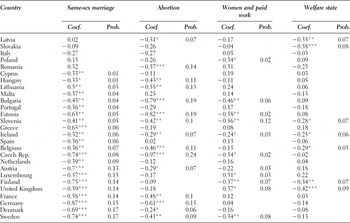
As the previous section indicates, differences in attitudes between men and women may exist within the various contextual groupings but may be masked by reporting only overall attitudes. Thus, Table 2 reports ordered logistic regression estimates for sex, controlling for socioeconomic variables in the model. Significant differences are identified in 26 of the 27 countries, independent of the contextual factors of age, class, living in an urban area, and party affiliation. Further, in all but three cases, women are likely to hold more liberal attitudes on each of the issues under study compared with men. As logit coefficients can be difficult to interpret directly, the impact of being female on the probability of moving from conservative to liberal attitudes is also reported, holding all other variables at the mean. Between issues, the largest differences occur in the Czech Republic, Bulgaria, and Portugal, where the probability of reporting a liberal attitude toward abortion increases by 24%, 19%, and 19%, respectively, when the respondent is female, and in Sweden and Denmark, where the probability of reporting a liberal attitude toward same-sex marriage increases by 17% when the respondent is a woman. Only in Luxembourg, the United Kingdom (on the issue of women and paid work), and Lithuania (on the issue of same-sex marriage) are women more likely to report a conservative attitude, with respective decreases of 3%, 8%, and 3%.
Gender differences in voters' political attitudes by country

Notes: Variables included in the model but not shown: age, class, urban, party voted for in EP election (by party family), and religiosity.
***p < .01; **p < .05; *p < .10.
The analysis also shows variation in gendered differences across issues. Only in Italy do men and women exhibit no gendered differences across policy areas. By contrast, only Ireland and Slovenia exhibit gendered differences across all four categories. Significant differences in attitudes occur most frequently with regard to same-sex marriage (21 countries) and abortion (15 countries) but less frequently with respect to women and paid work (10 countries) and attitudes toward the welfare state (7 countries).
Consequently, gendered differences across countries do exist independent of other cleavages, although the magnitude of these effects varies considerably across countries. Further, in most cases, women are systematically more liberal than men across issues, providing support for H 1 . However, the findings also show considerable variation by country across policy issues as sex differentiation does not exist across every issue in every country.
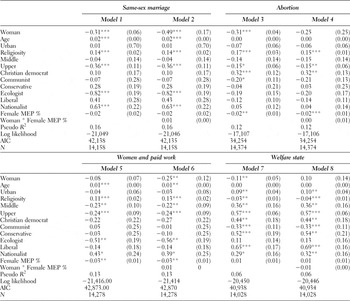
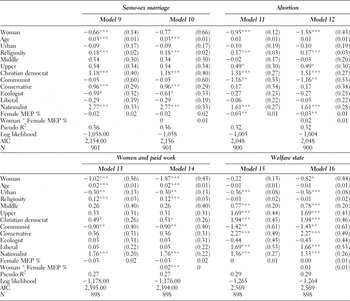
Turning to the pooled analysis, Table 3 reports eight models, two across each of the four issue areas, each of which reports a model with the key variables of interest and a further model including an interaction term between women and the percentage of female MEPs returned in each country in the 2009 election.
Effect of gender on voters' political attitudes

Notes: Robust standard errors are in parentheses, clustered by country.
***p < .01; **p < .05; *p < .10.
The woman variable confirms the findings of the comparative analysis, with women being significantly more likely to report a liberal attitude compared with men with respect to same-sex marriage, abortion, and the welfare state. The women and paid work coefficient is in the expected direction, but it is not significant in the noninteracted model. Converting the estimates to probabilities demonstrates that being a woman increases the probability of reporting a liberal attitude by 6% for same-sex marriage, 9% for abortion, and 3% for the welfare state (based on the interacted models with all other variables held at the mean).
Interestingly, with the possible exception of the welfare state, party affiliation does not appear to have a strong effect on attitudes. For example, in the case of abortion attitudes, only those voting for Christian democrats are likely to report a more conservative attitude compared with those voting for socialist parties. Thus, at the individual level, two factors appear to dominate attitudes across each issue, namely, how religious the respondent is and his or her sex, further confirming H 1 .
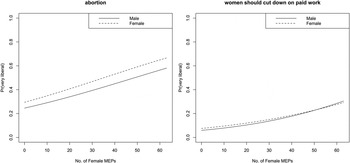
The level of female participation in the EP is significant on just two issues, namely, abortion and women and paid work. Here, respondents are more likely to report liberal attitudes when they come from countries returning higher levels of women to the EP. This result is irrespective of gender, providing support for H 3 and lending weight to the argument that a greater descriptive representation of women in the EP is desirable for the representation of women's interests policies. Table 3 also reports an interaction term between women and the percentage of female MEPs returned from each country. However, the results are not significant in any policy area, which indicates that the impact of having more women participate in political office neither widens nor narrows the gap in gendered differences between men and women. More women in the EP may be associated with more liberal attitudes across women's interest issues, but its impact does not affect men and women in a differential way. Figure 2 illustrates this effect more clearly.
Predicted probabilities for voters reporting very liberal attitudes toward policy issues. Values based on Models 4 and 6 from Table 3. Values vary across gender and percentage of MEPs returned to office. All other variables are held at the mean.

The figure shows that, with all other variables held at the mean, women are consistently more likely to report a very liberal attitude toward abortion compared to men, while in the case of women and paid work, there are no significant gendered differences. The figure also shows that the probability of reporting a liberal attitude increases for both male and female voters as more women are returned to the EP, but this effect does not alter the gender gap.
Thus, the results from the voter analysis illustrate that gender differences do exist, albeit not consistently across countries or issues. The largest gender gap appears on the issue of abortion, while there are few significant gendered differences with respect to attitudes about women and paid work. Moreover, returning more women to the EP is associated with more liberal attitudes on some (but not all) policy issues, creating an interesting effect in the case of abortion policy. On the one hand, the attitudes of both men and women are more progressive, in a manner likely to benefit women, where female participation in the EP is increased. On the other hand, the gap between men and women remains even at high levels of participation. While the causal direction of these effects cannot be confirmed, the results suggest that descriptive representation is important in two ways. First, a proportionate number of male and female representatives may be illustrative of a deliberative process whereby the attitudes of both men and women move in a progressive direction closer to women's policy preferences. Second, because relative gendered differences continue to exist, a balance in the participation of men and women is important to allow for the equal consideration of different attitudes between men and women on this policy issue.
Of course, differences in the attitudes of men and women may mean little if these attitudes are not replicated and represented by policy makers. For descriptive representation to have substantive impact, the variation in attitudes at the voter level should be replicated between male and female candidates in the EP. Table 4 reports the pooled analysis for the candidate results across 15 member states.
Effects of gender on EP candidates' political attitudes

Notes: Robust standard errors are in parentheses, clustered by country.
***p < .01; **p < .05; *p < .10.
The results demonstrate some similarities with the voter models but also some differences. In each case, the woman variable coefficients are in the expected direction and, with respect to abortion and same-sex marriage, are also significant. Converted to probabilities, women are 16% and 21% more likely than men to report very liberal attitudes toward same-sex marriage and abortion policy, respectively, in support of H 2 . However, while voters demonstrate little gendered difference on the issue of women and paid work, EP candidates do show variation, with female candidates 23% more likely than men to adopt a liberal attitude. Arguably, female candidates, in pursuing a high-ranking position in a competitive environment, may be less likely to report conservative attitudes toward reducing paid work for the sake of family than the general population that may have more pluralistic career objectives, which may explain these findings.
Further, female voters are significantly more likely adopt a liberal attitude toward the welfare state compared with men, but no significant effects are found with respect to candidates. Instead, the model shows that party affiliation is a far stronger predictor of welfare state attitudes than gender. For example, with all other variables held at the mean, conservative candidates are 23% more likely to report a conservative attitude on welfare provision compared with candidates from socialist parties. Perhaps unsurprisingly, party affiliation is a stronger predictor of candidate attitudes compared with voter attitudes, and in the case of the welfare state, any residual differences between men and women appear to be absorbed by this cleavage, in contrast with H 2 .
With respect to country-level differences, the proportion of women returned to the EP by each member state is only significant in the case of abortion. Unlike with voters, the percentage of women in the EP appears to have a limited independent effect on candidate attitudes. However, Model 14 demonstrates a significant interactive effect between the women variable and the number of female candidates returned to the EP by each member state on the issue of women and paid work.
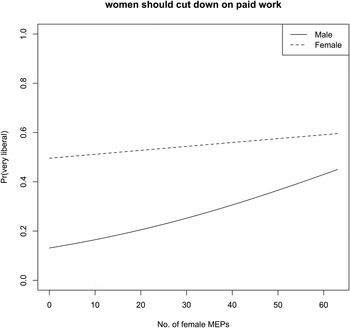
Figure 3 illustrates this effect by reporting the probabilities of male and female candidates holding a very liberal attitude toward women and paid work across each level of female participation in the EP with all other variables held at the mean.
Predicted probabilities for candidates reporting very liberal attitudes toward policy issues. Values based on model 14 from table 3. Values vary across gender and percentage of MEPs returned to office. All other variables are held at the mean.

The figure shows that increasing the number of female MEPs moderately raises the probability of a female candidate reporting a liberal attitude (by approximately 10%) but results in a larger change in the probability that men will hold a liberal attitude (by approximately 32%). This has the effect of narrowing the gender gap in attitudes toward women and paid work as the number of female MEPs increases. Specifically, at low levels of female participation, the probability of male candidates reporting a very liberal attitude is 36% lower than for women, but at high levels of participation, this gap reduces to 14%. Because the candidate study only contains a country N of 15, these findings should be interpreted conservatively. However, the results lend support to earlier research that suggests that exposure to female leadership can facilitate a deliberative process which can alter attitudes and preferences toward women's interest issues (Beaman et al. Reference Beaman, Chattopadhyay, Duflo, Pande and Topalova2009), at least with respect to political representatives.
CONCLUSION
This article set out to explore the a priori conditions necessary to support the claim that the descriptive representation of women matters in the EU. Starting with the premise that descriptive representation is important due to (1) its link with the substantive variant (e.g., Cowell-Meyers and Langbein Reference Cowell-Meyers and Langbein2009) and (2) its function in promoting a deliberative process whereby policy attitudes can be moved in a direction likely to promote women's interests (Mansbridge Reference Mansbridge1999, 643), the article assesses whether men and women voters systematically differ in their policy preferences and whether such differences are replicated among political representatives.
The results demonstrate clear differences between women and men across some issues, and the findings are robust to the inclusion of other contextual factors. This indicates that even within different societal groups, women are more likely to adopt more liberal attitudes on women's interest issues compared with men. However, the comparative approach in this article also shows variation across EU member states, which has an advantage over single-country studies and may be able to account for mixed findings on gender differences within the existing literature. Gendered differences in attitudes do exist, but the magnitude of these differences varies considerably across country. In countries such as Italy and Poland, the effects are small, suggesting that gendered differences may be absorbed by other dominant cleavages. Elsewhere, for example, in Ireland and Slovenia, gendered differences are significant and consistent across issues.
The fact that differences do exist satisfies the first a priori condition and provides empirical support for the claim that increased participation of women in political office is desirable for democracy. However, the findings are mixed with respect to the second condition, that gendered attitudes are replicated by political representatives. On the issues of same-sex marriage and abortion, candidates appear to follow the same patterns as voters, with women more likely than men to adopt liberal attitudes. However, in the case of welfare state attitudes, while female voters are, on average, more liberal than men, female candidates' attitudes are influenced far more by their party affiliation than by their sex. This difference between voters and candidates should not be overstated, however, as gender is a significant predictor of voters' welfare state attitudes in only 7 of the 27 member states. Thus, the second a priori condition is satisfied, albeit with several caveats, and illustrates that female representatives may indeed be better placed to represent the interests of female voters, at least on those issues on which gendered differences are clearly expressed.
The comparative element in this study also allowed for the exploration of the effect of returning more women to the EP on policy attitudes. Voters in countries returning a higher proportion of women to the EP are likely to hold more liberal attitudes toward women's interest policies in general, but the effects only hold for abortion and women and paid work. Further, returning more women to political office does not appear to narrow the gender gap. In the case of abortion, men are more likely to hold liberal attitudes in countries where female political participation is high, but women hold more liberal attitudes still. Elsewhere, returning more women to the EP appears to have little substantive effect. Although these results need to be the subject of further research on female participation to clarify the causal direction of these effects and to consider the issues with respect to the multilevel governance structure of EU politics, the findings here speak to the argument that increasing female participation in political office can foster more progressive attitudes toward women's interest issues, at least across some policy areas.
One final finding in the results points to a potential deliberative effect among candidates in the EP. In asking candidates whether women should be asked to cut down on paid work for the sake of family, male candidates adopt increasingly more liberal positions in countries that return more female MEPs to office. The small sample size for the candidate analysis suggests that the effects should be interpreted conservatively, but the findings point to a potential deliberative effect whereby male candidates may pay greater attention to women's interest issues the more they are exposed to female leadership.
To conclude, the findings here indicate that descriptive representation in the EU does matter but also offer a more nuanced account of the issue. While gendered differences exist, they do not do so systematically across issues or even across countries. Therefore, the value of descriptive representation is also likely to vary across these lines. Moreover, the results of this analysis cannot conclude that descriptive representation of women in the EU de facto translates into the substantive representation of interests. For example, party discipline and other institutional restrictions within the polity may prevent the full realization of policy outcomes. MEPs are often described as agents with two principals, and their dual necessity to satisfy both their European party group and their national party may create restrictions on female candidates to pursue a “female-friendly” policy agenda, even when they recognize the representation of women as part of their political role. Moreover, the study raises but does not address further questions of how voters and candidates may prioritize issues in a differential manner. Nor does the analysis consider several other policy areas such as child care, paternal leave, and gender quotas, where gendered differences may be found. These limitations pave the way for further comparative research to yield a clearer picture of exactly how and where descriptive representation matters for the representation of women's interests.
SUPPLEMENTARY MATERIAL
To view supplementary material for this article, please visit http://dx.doi.org/10.1017/S1743923X16000118
Sources: For party positions: European Election Candidate Survey 2009; for voter preferences: European Election Studies Voter Survey 2009.