


In 2002, the United States Supreme Court ruled that candidates for judicial offices, including incumbent judges, have free-speech rights that allow them to make policy statements during their campaigns (Republican Party of Minnesota v. White, 2002; see also the subsequent Court of Appeals decision: Republican Party of Minnesota v. White, 2005). This decision has caused considerable consternation within the legal community, including among many legal scholars, based on the fear that this newly announced judicial right will undermine perceptions within the public at large of the fairness and impartiality of courts. The assumption seems to be that what candidates for judicial offices say during their campaigns can cause fundamental disruptions in how citizens view and evaluate judicial institutions. If so, then this is a very high price to pay for extending these speech rights to judicial candidates. As the dissenters in the Supreme Court argued:
Prohibiting a judicial candidate from pledging or promising certain results if elected directly promotes the State's interest in preserving public faith in the bench. When a candidate makes such a promise during a campaign, the public will no doubt perceive that she is doing so in the hope of garnering votes. And the public will in turn likely conclude that when the candidate decides an issue in accord with that promise, she does so at least in part to discharge her undertaking to the voters in the previous election and to prevent voter abandonment in the next. The perception of that unseemly quid pro quo—judicial candidates' promises on issues in return for the electorate's votes at the polls—inevitably diminishes the public's faith in the ability of judges to administer the law without regard to personal or political self-interest. (Ginsberg dissent, joined by Stevens, Souter, and Breyer, footnotes omitted, 536 U.S. 16–17)
Although judicial candidates are not now permitted every type of speech (promises about how one would rule in specific cases are legitimately proscribed, at least at the moment), this Supreme Court decision has opened the door to freewheeling discussions of policy issues by both incumbents and challengers for judicial offices. Consequently, many believe that judicial elections now focus on judges' ideologies and judicial policy making to a far greater degree than in the past.
At the same time, interest groups and legal activists have become increasingly desirous of influencing the outcomes of state judicial elections. Their interest in state courts stems partly from the relative inactivity of the U.S. Supreme Court (which now issues fewer than 100 full opinions per year) and partly from the realization that policies made by state courts can have enormous economic, political, and social consequences (e.g., so-called tort reform). As a result, we have witnessed in the last few years an unprecedented injection of money into state judicial elections (see the activism of the U.S. Chamber of Commerce and the Trial Lawyers Associations; see also Echeverria Reference Echeverria2000, and, for a quite useful review of the relevant literature on judicial campaigns, see Baum Reference Baum2003). The confluence of broadened freedom for judges to speak out on issues, the increasing importance of state judicial policies, and the infusion of money into judicial campaigns have produced what may be described as the “Perfect Storm” of judicial elections. This storm is radically reshaping the atmosphere of state judicial elections, as it gathers strength and spreads throughout the nation.
No better illustration of this phenomenon can be found than in the judicial elections of 2004. According to the Brennan Center at New York University Law School, candidates spent an all-time high of $24 million on advertising in state supreme court elections in 2004, a dramatic increase of almost 20% compared with 2000 (Goldberg et al. Reference Goldberg, Samis, Bender and Weiss2005). A total of 180 ads was produced, with 42,249 airings in 15 states. This sort of campaign effort seems to be becoming increasingly common in the American states.
With this new style of free-for-all judicial elections has come a blizzard of commentaries on the likelihood of dire consequences flowing from the politicization of state courts (on the politicization of judiciaries worldwide, see Tate and Vallinder Reference Tate and Vallinder1995). Many commentators fear the worst, arguing that the very legitimacy of the legal system may be eroded as people come to see law and courts as little more than ordinary political institutions and therefore worthy of their contempt and disrespect.Footnote 1 Indeed, the original justification for Minnesota's prohibition on campaign speech was precisely the state's desire to protect the legitimacy of its judiciary (but see Dimino Reference Dimino2003). Minnesota contended that legitimacy requires the appearance of impartiality, that the appearance of partiality can undermine the confidence citizens have in their courts (legitimacy), and that legitimacy is crucial to the effective functioning of courts (see Brief and Appendix for Respondents 2002; see also Schultz Reference Schultz2006). Alarm bells are being sounded throughout the United States, announcing the imminent demise of legitimacy in the country's elected state courts.
To date, however, no rigorous evidence has been produced (one way or the other) on whether policy statements made during campaigns actually have any consequences at all for perceptions of judicial impartiality. Voters who want to vote on the basis of issues, for instance, are unlikely to be off-put by hearing about the policy views of judicial candidates. Others may distinguish between general statements of policy preferences and specific prejudgments of individual cases. Indeed, permitting policy debates may have useful consequences, such as allowing citizens to base their voting decisions on more rational criteria (rather than on what analysts generally assume to be dicey attributes, such as the candidates' genders or inferred ethnicities; see, for example, Baum and Hojnacki Reference Baum and Hojnacki1992, and McDermott, Reference McDermott1997; but see also Hall Reference Hall2001). And whatever diminished impartiality courts and judges may suffer from today may be due to factors other than policy commitments, such as the use of attack ads and conflicts of interests generated by campaign contributions from litigants, or both. We simply do not know what effect the Supreme Court's ruling will have on elected judiciaries.
We do, however, know something about how citizens perceive judicial impartiality and, more generally, procedural fairness. This well-developed body of theory has demonstrated that impartiality is a crucial component of perceived fairness. According to Tyler (Reference Tyler, Jost and Major2001, 422; see also Tyler Reference Tyler2006), when people assess the procedural fairness of institutions, they are “especially influenced by evidence of even-handedness, factuality, and the lack of bias or favoritism (neutrality)”—in short, by impartiality. Moreover, Hibbing and Theiss-Morse (Reference Hibbing and Theiss-Morse2002) claim that it is precisely the perception that members of Congress make their political decisions on the basis of partial (e.g., self-interested) criteria that threatens the legitimacy of that institution. In the judicial case, it seems highly likely that campaign contributions from those who litigate cases before a judge generate at least the appearance of self-interested partiality and procedural unfairness. Declaring a policy view in a campaign statement may also impugn procedural fairness by implying ideological bias and the unwillingness to judge each case on its own merits. Even the use of so-called attack ads can threaten perceived impartiality by portraying candidates for judicial offices as nothing more than ordinary politicians—in bed with special interest groups, supremely self-interested, and motivated by politics and partisanship, not law and legality. Thus, the current debate over the campaign tactics of judges maps neatly onto theories addressing institutional legitimacy, impartiality, and procedural justice, and the effects of campaigns on the attitudes, beliefs, and expectations of ordinary people.
My purpose here is therefore to investigate the impact of campaign activity on the perceived impartiality of courts. I do so because impartiality is a key source of judicial legitimacy. I focus on judicial races in the state of Kentucky, where a representative sample of that state's citizens was surveyed by telephone in the summer of 2006. During the interview, an experimental vignette was put to the respondents. The hypotheses tested by the manipulations in that vignette address the effects of campaign contributions, candidates' policy promises, and attack ads on the perceived impartiality of the justices and the Kentucky Supreme Court. Because it is always revealing to compare courts with other political institutions, half of the respondents were told a story about a candidate for the Kentucky Supreme Court; the other half, about a candidate for the Kentucky State Senate. Before turning to the empirical findings of the experiment, it is useful to review the theory ascribing political significance to the legitimacy of judicial institutions.
THEORIES OF LEGITIMACY AND IMPARTIALITY
Social scientists have long been concerned with understanding the legitimacy of all political institutions, but of courts in particular. Every institution needs political capital to be effective, to get its decisions accepted by others, and to be successfully implemented. Because courts are typically thought to be weak institutions—having neither the power of the “purse” (control of the treasury) nor the “sword” (control over agents of state coercion)—their political capital must be grounded in resources other than finances and force. For courts, political capital can be indexed by institutional legitimacy.Footnote 2
Legitimacy Theory is one of the most important frameworks we have for understanding the effectiveness of courts in democratic societies. Fortunately, considerable agreement exists among social scientists and legal scholars on the major contours of the theory. For instance, most agree that legitimacy is a normative concept, having something to do with the right—moral and legal—to make decisions. “Authority” is sometimes used as a synonym for legitimacy. Institutions perceived to be legitimate are those with a widely accepted mandate to render judgments for a political community. “Basically, when people say that laws are ‘legitimate,’ they mean that there is something rightful about the way the laws came about. . .the legitimacy of law rests on the way it comes to be: if that is legitimate, then so are the results, at least most of the time” (Friedman Reference Friedman1998, 256).
Courts derive their legitimacy, at least in part, by differentiating themselves from other political institutions: Citizens do not naturally distinguish between the judiciary and the other branches of government. That courts are special and different must be learned. Thus, those most ignorant about politics—and with little exposure to judicial politics—are likely to hold views of courts and other political institutions that are quite similar: Courts are not seen as special and unique.
Exposure to legitimizing judicial symbols reinforces the process of distinguishing courts from other political institutions. The message of these powerful symbols is that “courts are different,” and owing to these differences, courts are worthy of more respect, deference, and obedience—in short, legitimacy. Because courts use nonpolitical processes of decision making (and because the American people do not necessarily approve of the decision-making procedures common to democratic political institutions; Hibbing and Theiss-Morse Reference Hibbing and Theiss-Morse1995), and because judicial institutions associate themselves with symbols of impartiality and insulation from ordinary political pressures, those more exposed to courts come to accept the “myth of legality.” This process of social learning explains why citizens who are more aware of and knowledgeable about courts tend to adopt less realistic views of how these institutions make decisions and operate (e.g., Scheb and Lyons Reference Scheb and Lyons2000).Footnote 3 Thus, courts profit greatly from the perception that they are not like ordinary political institutions. They are different owing primarily to their decision-making processes. Judges are not perceived as self-interested; rather, they are impartial.
The threat of politicized judicial campaigns is that electioneering activity may undermine the belief that courts are essentially nonpolitical institutions. Citizens may learn that courts are quite like other political institutions if that is the message to which people are exposed during elections. Indeed, precisely the most worrisome consequence of the politicized style of judicial elections is that, to the extent that campaigning takes on the characteristics of “normal” political elections, courts will be seen as not special and different, with the consequence that their legitimacy may be undermined. At the most general level, I hypothesize that those who become aware of and attuned to campaigns in politicized judicial elections will judge courts and other political institutions similarly and will therefore extend less legitimacy to the judiciary. The specific campaign activity I consider here includes: (1) the use of attack ads, (2) the receipt of campaign contributions by candidates, and (3) statements of policy positions given by candidates for office.
Attack Ads
A voluminous literature addressing the effects of negative campaigns on citizens exists, even if little consensus has been reached.Footnote 4 Ansolabehere and Iyengar (Reference Ansolabehere and Iyengar1995) and others document a significant drop in voter turnout associated with negative ads (presumably due to “tuning out” the electoral process). Challenges to this conclusion, however, are many (e.g., Finkel and Geer Reference Finkel and Geer1998; Geer Reference Geer2006) and growing (e.g., Brooks Reference Brooks2006). Nonetheless, it seems transparently obvious that candidates for political office believe such campaigns to be effective (as do the critics of negative advertising). Yet, in a very important meta-analysis of the research literature, Lau et al. (Reference Lau, Sigelman, Heldman and Babbitt1999) conclude that negative campaign ads have few consequences, although they acknowledge that virtually no research examines the long-term implications of such ads (860), as in the consequences for broader institutional legitimacy (see also Lau and Pomper Reference Lau and Pomper2002). From the perspective of research on institutional legitimacy, not much of the extant literature on negative campaigning is relevant, because no studies have examined judicial campaigns and because quite different dependent variables are typically analyzed.Footnote 5
Moreover, courts most likely differ from other political institutions, if for no other reason than that the use of attack ads in judicial elections is a relatively new phenomenon. Anyone accustomed to viewing advertisements touting the legal qualifications of candidates for judicial office will surely take notice of an ad like the one run for Gordon Maag in the 2004 Supreme Court race in Illinois:
[Announcer]: Multi-national corporations, HMOs, and the insurance industry are spending millions to buy Lloyd Karmeier a seat on the Supreme Court. [At this point in the advertisement, the logos of Pfizer, Allstate, Honeywell, and other corporations are shown on the screen.] They know Lloyd Karmeier will continue to support them as they outsource American jobs and eliminate healthcare for workers and retirees. Law enforcement, teachers and working families choose Gordon Maag because they know Maag can't be bought. Gordon Maag: Making the law work for working families. [PFB]: Justice for all PAC
Such ads portray judicial candidates as little different from any other political figure, thereby potentially undermining the distinctiveness of the judiciary, and thus contributing to the loss of judicial legitimacy.Footnote 6
Campaign Contributions
Scholars have become interested in the influence of campaign contributions on state judiciaries.Footnote 7 For instance, research has shown that campaign contributors in fact appear in courts before judges to whom they have given campaign contributions (e.g., Dubois Reference Dubois1986; Hansen Reference Hansen1991). Furthermore, anecdotal evidence discovers a relationship between such contributions and individual court decisions (e.g., Banner Reference Banner1988; Champagne Reference Champagne1988). Some rigorous evidence suggests a connection between contributions and decisions (e.g., Ware Reference Ware1999), but contrary findings also exist (e.g., on the Wisconsin Supreme Court, see Cann Reference Cann2002). No clear conclusions emerge from this literature on whether contributions actually affect decisions.
In some respects, however, it matters little if in fact contributions and votes are closely connected; what people believe about the connection may be of greater significance for the legitimacy of courts. Poll data suggest that many see a relationship between contributions and decisions (e.g., Jackson and Riddlesperger Reference Jackson and Riddlesperger1991; Texas Office of Court Administration 1998). It is not clear, however, how widespread this perception is, and the research findings are also difficult to square with evidence that the vast majority of Americans express considerable confidence in their state courts. Even Texas' scandal-ridden courts are fairly positively evaluated by ordinary Texans (Cheek and Champagne Reference Cheek and Champagne2004, 174–76).
The question of whether campaign contributions corrupt office holders—or whether such contributions contribute to the perception of corruption—is central in contemporary research on campaign finance. For example, the litigation over campaign contributions focuses on whether the current system adds to the appearance of corruption in American politics, thereby undermining American democracy.Footnote 8 In the litigation on the Bi-Partisan Campaign Reform Act (BCRA), public-opinion experts directly addressed this question (e.g., Shapiro Reference Shapiro, Corrado, Mann and Potter2003). But in what is perhaps the definitive study on the issue, Persily and Lammie (Reference Persily and Lammie2004) conclude that although Americans view campaign contributions as tending to corrupt legislators, the causal nexus between campaign contributions and perceptions of corruption has not been established; instead, they strongly argue that observed correlations do not necessarily imply causation and that perceptions of corruption more likely reflect generalized attitudes and propensities. They also “note the irony that the share of the population perceiving corruption declined even as soft money sky-rocketed and that the share increased after passage of the soft money ban” (2004, 123). Primo (Reference Primo2002) expresses the same concern about the issue of causality and argues pointedly that: “The claim that money drives cynicism toward politics on a macro, historical level is simply false” (Reference Primo2002, 217). He then goes on to draw the same conclusion from micro-level evidence (see also Coleman and Manna Reference Coleman and Manna2000, who find no effect on trust or efficacy from campaign spending in the 1994 and 1996 U.S. House elections). Thus, although many Americans perceive governmental corruption, and an even larger proportion favor campaign-finance reform, the evidence to date that contributions cause perceptions of corruption is ambiguous.
Nonetheless, one might still hypothesize that, in the judicial case, campaign contributions have a particularly corrosive influence on perceptions of impartiality. When contributions come from the very law firms and corporations that litigate before the judges whom they help elect, then the generally tawdry aura of contributions takes on an even more unseemly and sinister tint. Therefore, I expect that accepting campaign contributions threatens the legitimacy of both institutions and their office holders.
Policy Commitments and Prejudgments
Of the factors considered here, the influence of policy commitments is least well understood, in large part owing to the recency of the Supreme Court decision and the different role policy pronouncements play in campaigns for courts and other political institutions. As I have noted, the theory of the states that prohibited judicial candidates from making policy commitments is that judges will be perceived to be biased and unable to evaluate future cases solely on the merits of the individual dispute. So far as I am aware, no extant empirical research has ever investigated this hypothesis.
RESEARCH DESIGN
This research is based on an experiment embedded within a representative survey of the residents of Kentucky, conducted in the summer of 2006. The larger purpose of the National Science Foundation-funded project is to examine the consequences of election activity on state supreme court legitimacy. The survey under analysis here is the first interview in a three-wave panel study. The initial questionnaire was subjected to a formal evaluation, and on the basis of the results of the pretest, was significantly revised. The survey was conducted by Schulman, Ronca, and Bucuvalas, Inc. using Computer-Assisted Telephone Interviewing (CATI). Within households, the respondents were selected randomly. The interviews averaged just over 20 minutes. A total of 20,078 telephone numbers was used in the survey, with a resulting American Association for Public Opinion Research (AAPOR) Cooperation Rate #3 of 38.7% and an AAPOR Response Rate # 3 of 28.7% (see AAPOR 2000). The final data set was subjected to some relatively minor post-stratification and was also weighted by the size of the respondent's household. A detailed technical report on the fieldwork is available from the author.
Why Kentucky and what limits on generalizability flow from this research design? The optimal design for a study of the impact of campaigning on judicial legitimacy would be longitudinal, tracing change in public attitudes over a period of time as new types of campaign tactics are introduced within a state. Such a study is prohibitively expensive to implement, and no such effort has ever been fielded.
An alternative strategy would be to focus on a state in which politicized campaigns are relatively new but not unheard of, and then to track the impact of campaigns on legitimacy. That is the design of this research. At this point in history, states like Ohio and Texas are not particularly revealing because citizens of those states have long witnessed highly politicized campaigning for judicial office. At the other end of the continuum, some states have been immune to politicization. For instance, in the high court elections of 2004, all of the candidates in 10 states reported raising no contributions as part of their campaigns for a seat on the state court of last resort (Goldberg et al. Reference Goldberg, Samis, Bender and Weiss2005, 14).
Kentucky lies between the extremes on this continuum. For instance, in the election of 2004, the candidates were Janet Stumbo and Will Scott, and together they raised nearly one-half million dollars in campaign contributions (Goldberg et al. Reference Goldberg, Samis, Bender and Weiss2005, 14). By all accounts, the campaign of 2004 was fairly politicized, with candidate Scott running attack ads and candidate Stumbo running ads contrasting the two candidates (Goldberg et al. Reference Goldberg, Samis, Bender and Weiss2005, 48). Among the 21 states in which judicial candidates raised at least some contributions in 2004, Kentucky defined the median, with candidates in 10 states raising less than $239,317 and candidates in 10 raising more than this figure. Moreover, also in 2004, abortion-related questionnaires were distributed by interest groups to judicial candidates in Kentucky. Some candidates refused to answer the questionnaires, which promoted a well-publicized lawsuit by the Family Trust Foundation challenging legal and ethical constraints on speech that appears to commit a candidate to a position that might come before the courts. The Family Trust Foundation was successful in its litigation. Thus, in terms of the prior judicial election and the political context to which these respondents had most recently been exposed, some but perhaps not a very high degree of politicization existed. Because the interviews on which this experiment are based took place prior to the general election season, the effects I observe from the experiment are uncontaminated by actual campaign events in 2006. So although statistical theory provides little basis for generalizing these findings to other state judiciaries, I can identify no obvious reasons why they cannot be generalized, and, on the contrary, Kentucky satisfies a number of design criteria that makes it a useful state for an inquiry such as this.
EXPERIMENTAL VIGNETTES AND TESTING CAUSAL HYPOTHESES
One of the most telling critiques of using survey data to test hypotheses is that causal inferences are suspect, especially when the independent and dependent variables are measured at the same time. But when experiments are embedded within representative surveys, not only are findings generalizable to the larger population from which the sample is drawn (external validity), but great confidence can also be placed in causal inferences (internal validity).Footnote 9 With random assignment of respondents to vignette versions, the proverbial “all else” can indeed be considered equal.
Consequently, I included within the survey an experimental vignette on campaigning and judicial legitimacy. Vignettes are a particularly useful means of incorporating the context of judicial campaigns within survey research. These short stories can reveal processes of reasoning perhaps not even directly accessible to the respondents themselves (Robinson and Darley Reference Robinson and Darley1998, 417) and have been used widely in the past (e.g., Gibson and Gouws Reference Gibson and Gouws1999). For the purposes of the questions addressed in this article, experimental vignettes—especially when embedded in representative surveys—provide an optimal methodology (on experimentation in political science, see Kinder and Palfrey Reference Kinder and Palfrey1993).
The campaigning experiment is structured around a story about candidates for public office. The story manipulates various aspects of the campaign (e.g., the use of attack ads) in an effort to estimate the effects of such activity. At the end of the vignette, the respondents are asked a series of questions about the impartiality of the office holders (the candidate in the story is always said to be elected to office) and the institution itself. Stories such as these have the virtue of mundane realism through verisimilitude, in the sense that they depict a set of circumstances that are concrete and easily understood by the respondents.Footnote 10
The Experimental Manipulations and Hypotheses
Technically, this experiment is a between-subjects 2×3×3×2 fully crossed factorial design. As such, each respondent was told only one version of the vignette. The respondents were randomly assigned to 1 of the 36 vignette versions (by the CATI program). With less-than-perfect response rates, minor imperfections inevitably creep into survey experiments, and the number of respondents per version varies from 42 to 78. Because the experimental manipulations are orthogonal to each other, the sets of dummy variables used to represent the interventions are themselves unrelated.
The Institution
The tendency to study judicial institutions in isolation, without comparison to other comparable political institutions, has long impeded our understanding of courts. Exceptions exist (e.g., Bonneau Reference Bonneau2005), and no one has shown us better than Hall (Reference Hall2001) the value of cross-institutional analysis in thinking about judicial elections and politics (see also Gibson and Caldeira Reference Gibson and Caldeira1998).
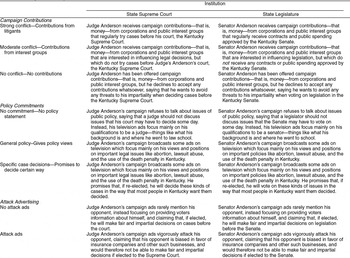
Many of the criticisms directed against judicial elections in fact are generic to all low-salience elections (e.g., McDermott Reference McDermott1997). Indeed, nearly all of the complaints about state judicial elections (e.g., low turnout) probably apply with equal force to state legislative elections, even though few serious observers propose that state legislators should be freed of electoral accountability. In the analysis that follows, it is useful, therefore, to compare the impact of these campaign activities on both judges and state legislators. The experiment consequently began with a random assignment of the respondent to either a story about the Kentucky Supreme Court or the Kentucky State Legislature. (See Table 1 for the text of each of the elements of the vignettes.) The overarching hypothesis of the vignette is that the judgments and evaluations of people vary across institutional contexts.
Vignette Manipulations and Versions

Campaign Contributions
The first substantive manipulation in the experiment has to do with campaign contributions. I sought to vary contributions by the degree to which a conflict of interest is implied. Rejecting all contributions is the condition under which no conflicts can occur; the opposite extreme involves accepting contributions from parties who do business directly before the institution, and an intermediate position involves contributors without direct business with the institution but who seek to shape public policy more generally. I hypothesize a monotonic relationship between the degree of conflict of interest and institutional legitimacy, and I suspect the relationship will deviate from linearity because the refusal to accept campaign contributions will most likely have a disproportionate effect on the protection of institutional legitimacy.Footnote 11
Policy Prejudgments
Policy prejudgments—to the extent they suggest to citizens that judges are deciding cases not on their individual merits, but rather on preexisting ideological preferences—may also impugn legitimacy. The judicial and legislative versions of this vignette posit equivalent variability in the degree to which the candidate for public office commits in advance to a particular policy position, with the range defined by the old judicial rules (no policy statements allowed) to the current rules (only general policy statements allowed) to a position beyond that which is generally deemed appropriate today (specific policy pledges are made; see Table 1).Footnote 12 Obviously, I hypothesize that the stronger the policy precommitment, the less the judge and the institution will be thought to be impartial and legitimate.
Attack Ads
Finally, a third issue for judicial campaigns has to do with styles of campaigning and, in particular, the use of so-called attack ads. This manipulation is a dichotomy, varying from innocuous campaign statements to vigorous attacks on the impartiality and fairness of the opponent.Footnote 13
The Dependent Variables
At the conceptual level, the overarching dependent variable for the vignette is the perception of whether the political actor can serve as a fair and impartial governmental policy maker. This analysis focuses on two types of measures: perceptions of the individual candidate/office holder and perceptions of the institution itself. Regarding the individual, the respondents were asked whether the office holder “can serve as a fair and impartial” judge/senator. The question focused on the institution posits that all judges/senators are selected in the same way as Judge/Senator Anderson and then asks directly about the perceived legitimacy of the institution. Finally, the respondents were asked whether they would accept the decisions he made as legitimate. The full text of these questions is reported in the Appendix.
The vignette was highly successful in generating variability in the perceived impartiality of the office holder (the winning candidate for judicial/legislative office). For example, within the judicial context, the percentages asserting that Judge Anderson can be fair and impartial range from 31.4% to 88.0%; in the legislative context, the percentages vary from 33.4% to 84.0%. Thus, the vignettes seem to have captured factors that are indeed meaningful to the respondents.
One limitation of many vignette-based studies is that the dependent variable is poorly measured, often with a single-item indicator (e.g., Gibson Reference Gibson2002). The advantage of such an approach is that substantive research findings can be clearly and simply reported; but low reliability has, of course, many highly undesirable consequences for statistical analysis. Consequently, in the hypothesis testing here, I focus for illustrative purposes on the specific items (especially the question about whether the judge/senator can be fair and impartial), but for statistical purposes, I employ a continuous indicator of reactions to the vignette. This variable is a factor score derived from a Common Factor Analysis of the three vignette judgments. For both the judicial and legislative analyses, the results reveal strongly unidimensional structures.Footnote 14 For the Supreme Court, the factor loadings on the first unrotated factor are:

This set of items is extremely reliable: alpha =.80. For the State Senate, the factor structure is similar:
Cronbach's alpha for the set of items is .78. Thus, the dependent variables for the statistical analysis of the vignette are quite valid and highly reliable.Footnote 15
Manipulation Checks
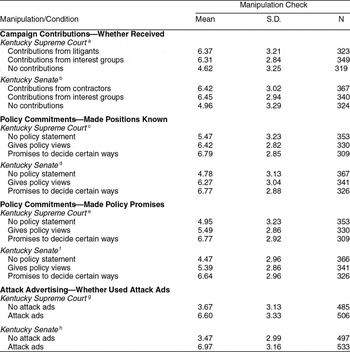
In experimental studies such as this, the manipulations are not always perceived as they are intended (for a classic example, see Gibson and Gouws Reference Gibson and Gouws2001). Thus, it is necessary to assess empirically how the respondents reacted to the elements of the stories they heard. Table 2 reports data relevant to checking the effectiveness of the manipulations. As is conventional with manipulation checks, the questions asked assess the degree to which the respondents heard and understood the attributes of the stories (see the Appendix for the text of the items used to check the manipulations).
Manipulation Checks

Note: The manipulation checks are as follows (see also the Appendix):
In all instances, the response set varies from 1 to 10 (very certain).
a Difference of means test: p < .000, η = .25.
b Difference of means test: p < .000, η = .22.
c Difference of means test: p < .000, η = .19.
d Difference of means test: p < .000, η = .27.
e Difference of means test: p < .000, η = .24.
f Difference of means test: p < .000, η = .29.
g Difference of means test: p < .000, η = .41.
h Difference of means test: p < .000, η = .50.
The results of checking the manipulations are both methodologically and substantively revealing. Consider campaign contributions first. In the story versions in which contributions were given, most respondents perceived the contributions accurately, and practically no differences exist in perceptions of the vignette according to whether the story depicted a judge or a senator.Footnote 16 Perhaps reflecting some degree of cynicism, roughly one-third of the respondents who were told that the judge rejected campaign contributions nonetheless were certain to some degree that he in fact had received some. The results for the senate version of the vignette are similar. Nonetheless, this manipulation was generally correctly perceived by a significant majority of the respondents.Footnote 17
As with the policy commitment manipulations, when the candidate was depicted as making policy promises, the respondents were substantially more certain that such promises were made (see “Made Policy Promises” in Table 2). It is perhaps noteworthy that only marginal differences are found on the “Made Positions Known” manipulation check between the expression of policy views and the making of policy promises. The former seems, to many respondents, to imply the latter. Nonetheless, this manipulation was also accurately perceived by the respondents. Finally, the attack ad manipulation was extremely successful in both the judicial and legislative contexts, with the vast majority of respondents able to recall correctly whether such ads were used.
In general, the vignettes succeeded in the sense that the respondents perceived correctly the various manipulations. It remains then to consider whether these manipulations in fact influenced perceptions of impartiality and legitimacy.
MULTIVARIATE RESULTS
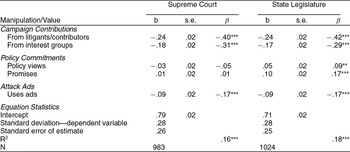
The most efficient means of assessing these hypotheses is to create dummy variables from the manipulations and then regress the legitimacy factor scores on these indicators.Footnote 18 In that analysis, the excluded category for the campaign contribution manipulation is the scenario of no contributions; for policy commitments, it is the condition of expressing no policy views. Table 3 reports the results. So that the institutional hypothesis can be readily assessed, I report the judicial and legislative results in the same table.Footnote 19
Multivariate Analysis of the Consequences of Campaigning for Institutional Legitimacy

Note: All the independent variables are dichotomies, scored at 0 or 1. The dependent variables also vary for 0 to 1. Standardized regression coefficients (β): ***p < .001, **p < .01, *p < .05
The first observation about Table 3 is that institutional legitimacy is reasonably well predicted (see the R2 statistics), especially because each of the independent variables is nothing more than a dichotomy. Second, in general, the equations produce remarkably similar coefficients, indicating that cross-institutional differences, with one important exception, are largely trivial. How people evaluate the court does not differ much from how they assess the legislature.
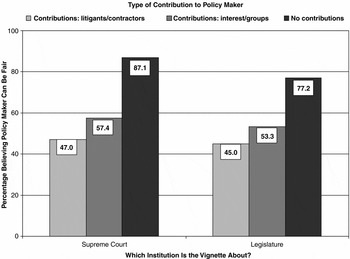
Third, the strongest effects on institutional legitimacy come from campaign contributions. When groups with direct connections to the decision maker give contributions, legitimacy suffers substantially. Furthermore, there appears to be nothing at all idiosyncratic about courts: Campaign contributions have nearly identical consequences for judicial and legislative legitimacy. One can see in both contexts the particularly damaging consequences of contributions from parties having direct business with the institution (litigants/contributors), an effect that significantly exceeds that of ordinary policy-oriented interest groups. In the absence of campaign contributions, the legitimacy of both institutions is high (see the intercepts, which of course also reflect the conditions of no policy commitments and no attack ads). Figure 1 depicts the bivariate relationship within each institution, using the individual item about whether the policy maker can be fair (because the manipulation variables are by definition orthogonal to each other, bivariate and multivariate conclusions are identical). The effect of campaign contributions on institutional legitimacy is highly significant, statistically and substantively, and, with each type of contributor, differs little across institution. When contributions are given by parties having a direct stake in the decisions of the office holder, fewer than one-half of the people believe that the policy maker can be fair.
The Impact of Campaign Contributions on Perceptions of Fair and Impartial Policy Making

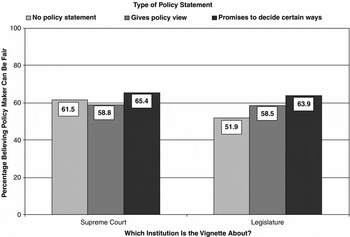
In contrast to the findings on campaign contributions, policy commitments have no impact whatsoever on the legitimacy of the Supreme Court, even while having a positive influence on the legitimacy of the state legislature. These relationships are depicted in Table 3 in the OLS analysis, and in Figure 2 for the specific question about institutional legitimacy. For the legislature, promises to make specific decisions influence legitimacy more than do general policy statements, a finding presumably grounded in the popular expectation that legislators should make and honor campaign promises. But for the judicial candidates, even promises to decide cases in specific ways have no consequences at all for the legitimacy of the institution. This is an important finding that may indicate that people recognize that judges make policy and that, in a democracy, some degree of political accountability ought to be imposed on policy makers. It also seems as if people are thinking in terms of policy, not necessarily individual cases. When they think about issues like the right to abortion, they are probably not focusing on the specific individual seeking an abortion (or those who would prohibit it) but rather on legal policy about whether (and when) abortions can be had. Given the widespread debates in American society about judicial philosophies and ideologies, it would be perhaps surprising were this otherwise. The data are striking and compelling in revealing that making policy statements during campaigns does not seem to render a judge unable to make fair and impartial decisions on the bench, at least in the eyes of ordinary people.
The Impact of Policy Commitments on Perceptions of Fair and Impartial Policy Making

The contrast between the judicial and legislative findings is especially striking. Conventional wisdom holds that if judges express policy views in campaigns, institutional legitimacy will suffer, because the function of courts (based on minoritarianism and independence, e.g., McGuire Reference McGuire2004) is different from the function of legislatures (majoritarianism and accountability). These findings indicate that courts are indeed different—judicial legitimacy does not profit from explicit position assertions: courts are not mirror images of legislatures in the sense that policy commitments do not have the opposite effect of undermining institutional legitimacy. Elites may expect judicial independence and see policy commitments as a threat to independence and impartiality, but these data suggest that ordinary people are not similarly worried about judicial candidates making policy statements during campaigns. The judicial coefficients in Table 3 strongly challenge the assertions of the dissenters in Republican Party of Minnesota v. White 2002.
Between the strong impact of campaign contributions and the nonexistent influence of policy commitments lies the moderate influence of the use of attack ads. When candidates for office, judicial or legislative, use attack ads, legitimacy suffers. This effect is moderate and is not nearly as large as the effect of campaign contributions; and it is virtually identical within both the judicial and legislative contexts. Of course, this experiment cannot demonstrate one way or the other whether the negative consequences of attack ads persist over time; but, in this context, attacking one's opponent, judicial or legislative, detracts from the appearance of impartiality and fairness.
Finally, these findings demonstrate the value of cross-institutional analysis. At least with regard to campaign contributions and attack ads, the data reveal little about courts that is unique. To the extent that campaigning affects the legitimacy of institutions, it does so similarly for courts and legislatures.
Conditional Analysis
Experiments have the invaluable asset of being self-contained sets of hypotheses. Nonetheless, conditional effects may still be present—the experimental stimuli may be received differently by different people. Consequently, one further analytical step can shed important additional insight into the consequences of politicized judicial campaigns.
Two obvious conditional hypotheses occur. First, general support for a court may cause people to perceive the experimental stimuli differently, with those more loyal toward the judiciary being more offended by politicized campaign practices. This hypothesis is grounded in the theory of positivity bias, advanced by Gibson and colleagues (e.g., Gibson, Caldeira, and Spence Reference Gibson, Caldeira and Spence2003; Gibson and Caldeira Reference Gibson and Caldeira2006): Those with high loyalty toward courts tend to see them as unique, relatively nonpolitical institutions (even if these citizens do not necessarily accept naive theories of mechanical jurisprudence). Consequently, politicized campaigning is likely to be considered a threat to judicial legitimacy.
Second, knowledge may moderate these relationships: Just as with institutional support, those who are more knowledgeable about courts are more likely to view them as distinctive institutions, with nonpolitical characteristics. They therefore are more likely to be negatively influenced by politicized campaigning, judging such activity as inappropriate for courts and judges.
Thus, the hypotheses predict that the negative effects of campaign contributions, attack ads, and policy promises are greater among those more knowledgeable and who express greater support for the court, and therefore the interactive coefficients are expected to be negative (exacerbating the undermining influence on judicial legitimacy of the campaign stimuli). Given the limits of the survey, these hypotheses can only be tested for those respondents who heard the vignette about the Supreme Court. The measures of both institutional support and knowledge of the Kentucky judiciary are discussed in the Appendix.
Consider first the impact of institutional support (which varies from 0 to 8). When the interaction terms are added to the equation reported in Table 3, including of course the direct effect of institutional support, the only significant interactive effect is between support and policy promises—no effect is observed for campaign contributions or for the use of attack ads.Footnote 20 When support is at its lowest (0), the effect of policy promises on legitimacy is significantly positive (b = .14): promises enhance perceived judicial legitimacy. As support for the court increases, the effect of promises declines (b = -.04), so that at the highest level of institutional support (8), the coefficient for policy promises is -.21. This coefficient is substantial, achieving roughly the magnitude of the effect of campaign contributions from policy-minded groups (although smaller than the effect of contributions from those litigating before the court; see Table 3). As citizens become more supportive of the Kentucky Supreme Court, the effect of policy promises becomes corrosive.
However, two important caveats must be attached to this finding. First, the number of citizens at the highest level of support for the court is small (about 3% of the sample), so that for most citizens of Kentucky, policy promises have few meaningful consequences for institutional legitimacy. Second, I observe no interactive effect whatsoever between institutional support and the simple expression of policy views (in contrast to policy promises). Even among the most supportive citizens, this sort of campaign activity has no negative consequences at all. Thus, the hypothesis of an interaction between institutional legitimacy and campaign activity is supported, but only for the most extreme form of policy promises and only among a fairly rare slice of the total population.
The hypothesized interaction between knowledge and campaign activity receives even weaker support. The only significant interaction is between knowledge and the expression of policy views (not policy promises). But contrary to the hypothesis, as knowledge of the courts increases, the negative effect of policy statements weakens (b = .06), so that at the highest level of knowledge, the coefficient for policy statements is +.08. Although this effect is statistically significant, it is relatively small, and, to reiterate, no such effect is observed on the impact of policy promises. Thus, the prudent conclusion is that the effect of campaign activity varies little according to levels of knowledge of the Kentucky judiciary.Footnote 21
Perhaps the most important conclusion emerging from this analysis has to do with variability across the three types of campaign practices. The detrimental effects on institutional legitimacy of campaign contributions are substantial and uniform across various subgroups in the total population. The same can be said of the influence of attack ads (except that the influence is considerably weaker than that of contributions). Some evidence suggests that explicit policy promises undermine legitimacy among those already most supportive of the Court, but this is a small portion of the population, and the effect is not observed under the condition of general policy statements by candidates. Thus, it appears that there is a consensus of expectations regarding the undesirability of campaign contributions and attack ads, but with more disagreement about whether explicit policy promises are appropriate. In general, the results of this conditional analysis are illuminating but change little the overall conclusions from the experiment.Footnote 22
DISCUSSION AND CONCLUDING COMMENTS
This analysis does not purport to be a comprehensive account of all factors affecting the legitimacy of judicial institutions. No doubt legitimacy is influenced by momentous court decisions and many other factors. The contribution of experiments is never to test complete theories. (Of course, it is the random assignment of individuals to orthogonal vignette versions that renders these incomplete models not mis-specified.) Instead, experiments allow us to take processes apart and to focus on testing hypotheses concerning individual components of complex causal models.
I have limited my attention in this analysis to the influence of campaigns on perceptions of judicial impartiality and institutional legitimacy. One of the most perplexing questions arising from earlier research has to do with the causal nexus between campaigns and institutions. The strength of experiments lies in the degree of confidence one can have in causal inferences. Given the research design employed in this analysis, I am entitled to conclude with considerable certitude that when candidates for public office receive campaign contributions from those with direct business interests before the institution, many (if not most) citizens perceive policy making as biased and partial and the policy-making institution as illegitimate. Similarly, the use of attack ads causes many to question institutional legitimacy. Just as certain are my conclusions that policy pronouncements by judicial candidates cause little harm to courts, and that the same sort of policy pronouncements enhance the legitimacy of legislatures. Owing to the structure of the experiment and the survey, both the internal and external validity of these conclusions is unusually robust.
Many judicial analysts seem to believe that campaigns present unique problems for courts. That position is decidedly not supported by this analysis. Those who worry about the corrosive effects of campaign contributions and attack ads on courts would do well to expand their concern to legislatures (and, most likely, other political institutions as well). Indeed, it is remarkable how similar these findings are for both the court and the legislature.
When it comes to policy pronouncements, the judiciary does seem to differ from the legislature, but not in the way ordinarily assumed. Perhaps the single most important finding of this article is that candidates for judicial office can engage in policy debates with their opponents without undermining the legitimacy of courts and judges. I have speculated that this finding reflects the sophistication of the American mass public in recognizing that judges do (and perhaps must) make public policy, that on broad policy issues some degree of accountability is desirable, and that the expression of policy views does not prejudice the rights of individual litigants to fair and impartial hearings before a court. To the extent that the state judiciaries are threatened today by campaign activity it is not because the U.S. Supreme Court awarded judicial candidates free speech rights in its 2002 decision.
What I cannot conclude from this analysis, however, is whether the legitimacy-threatening effects of campaign contributions and attack ads will persist over time. Grosskopf and Mondak (Reference Grosskopf and Mondak1998) have suggested, for instance, that the half-life of the effects of exogenous events can be quite short (see also Hoekstra Reference Hoekstra2003). Citizens may be offput by campaign activity, but we do not know whether their displeasure endures. One possibility is that there are so many other legitimizing symbols associated with courts that the effects of campaigning quickly dissolve (i.e., the so-called positivity bias asserted by Gibson and Caldeira Reference Gibson and Caldeira2006). Obviously, the connection between cause and effect (the manipulation and the response) is highly compressed in this experiment (as in all experiments); no single survey can ever document that changes that occur during the interview in fact are obdurate. Further research on this issue is certainly necessary.
Nonetheless, it seems clear that perceptions of institutional legitimacy are shaped to some degree by exogenous events: campaign activity matters to institutions. Loyalty toward institutions is not unalterable, even if it is relatively insensitive to policy debates among judges. Those concerned about threats to the legitimacy of elected state courts would do well to turn their attention away from substantive policy pronouncements and focus instead on the corrosive effects of politicized campaigning, and especially campaign contributions from those having business before the bench.
Finally, it is worth reiterating that much more research is necessary to confirm the generalizability of these findings. Given the hypothetical nature of the vignette, I doubt there is much that is “Kentucky-specific” in these findings, but I could easily be wrong. Perhaps in highly partisan and politicized states, citizens have come to accept the inevitability of campaign contributions and therefore their effect is muted. Perhaps in “virgin” states, policy pronouncements are more eye catching and have more deleterious consequences. It would not be entirely surprising to find that the effects of all types of campaign activities are strongly conditioned by the expectations citizens hold of candidates and institutions. Thus, future research should consider whether these findings of the “high, medium, and low” implications of contributions, attack ads, and policy pronouncements, respectively, are peculiar to certain types of state judicial systems or constitute a more general phenomenon.
APPENDIX: QUESTION WORDING
Because the Supreme Court and State Senate questions differed in entirely minor ways, and because my primary focus in this article is on the legitimacy of state courts of last resort, I report here only the questions used in the Supreme Court version of the vignette.
Measures of Legitimacy
Do you strongly believe Judge Anderson can serve as a fair and impartial judge for Kentucky, somewhat believe he can be fair and impartial, somewhat believe he cannot be fair and impartial, or strongly believe he cannot be fair and impartial?
Assume for the moment that all judges on the Kentucky Supreme Court were selected in the same way as Judge Anderson. Would you consider the Kentucky Supreme Court as a very legitimate institution, a somewhat legitimate institution, not a very legitimate institution, or not legitimate at all?
How likely are you to accept decisions made by Judge Anderson as impartial, fair, and legitimate? Are you very likely, somewhat likely, not too likely, or not at all likely?
Manipulation Checks
Judge Anderson accepted financial contributions to his election campaign?
Judge Anderson received campaign contributions—that is, money—from corporations and public interest groups that regularly try cases before the Kentucky Supreme Court.
Judge Anderson received campaign contributions—that is, money—from corporations and public interest groups, who do not have cases that will come before the Kentucky Supreme Court but who seek to influence legal policies.
Judge Anderson made his policy positions known to people through his campaign ads.
Judge Anderson made promises about how he would decide cases if elected to the Kentucky Supreme Court.
Judge Anderson attacked his opponent during the campaign with charges of bias and inability to make fair and impartial decisions.
Institutional Loyalty
We measured loyalty toward the Kentucky Supreme Court with reactions (collected on a five-point Likert response set) to the following statements:
If the Kentucky Supreme Court started making a lot of decisions that most people disagree with, it might be better to do away with the Supreme Court altogether.
The right of the Kentucky Supreme Court to decide certain types of controversial issues should be reduced.
The Kentucky Supreme Court can usually be trusted to make decisions that are right for the state as a whole.
Judges of the Kentucky Supreme Court who consistently make decisions at odds with what a majority of the people in the state want should be removed from their position as judge.
It is inevitable that the Kentucky Supreme Court gets mixed up in politics; therefore, we ought to have stronger means of controlling the actions of the Kentucky Supreme Court.
The Kentucky Supreme Court may have its ideas about what the constitution means, but more important is what the majority of people think the constitution means.
The Kentucky Supreme Court gets too mixed up in politics.
The Kentucky Supreme Court ought to be made less independent so that it listens a lot more to what the people want.
The index of court support is simply the number of statements to which the respondents gave supportive replies.
Knowledge of the Kentucky Supreme Court
The questions we asked and the percentages of respondents answering correctly are:
• Whether the justices are elected or not—24.0% correct
• Whether the justices serve a life or fixed term—32.9% correct
• Whether the justices have the “last say” on the meaning of the constitution—45.6% correct
Across all three items, the average number of correct answers is 1.0, with fully one-third of the respondents getting none of the test items correct and only 7.3% answering accurately to all three.



Comments
No Comments have been published for this article.