Introduction
Perceived purpose in life (PIL) refers to the extent to which an individual’s life is guided by valued goals and life aims (Irving et al., Reference Irving, Davis and Collier2017). Several studies (Irving et al., Reference Irving, Davis and Collier2017; Nakamura et al., Reference Nakamura, Chen, VanderWeele and Kim2022) have found that PIL is directly associated with several indicators of physical health in older adults, such as cognitive functioning and cardiovascular health (Irving et al., Reference Irving, Davis and Collier2017). Research has also shown that PIL is directly associated with reduced risk of incident disability and mortality in older adults (Boyle et al., Reference Boyle, Barnes, Buchman and Bennett2009; Boyle et al., Reference Boyle, Buchman and Bennett2010) and inversely associated with several indices of mental health, including depressive (Irving et al., Reference Irving, Davis and Collier2017; Nakamura et al., Reference Nakamura, Chen, VanderWeele and Kim2022) and posttraumatic stress (Fischer et al., Reference Fischer, Tsai, Harpaz-Rotem, McCutcheon, Schulenberg and Pietrzak2022) symptoms. Moreover, there is evidence to suggest that the search for PIL is more strongly linked to deficits in well-being in older adulthood than in other life stages (Steger et al., Reference Steger, Oishi and Kashdan2009). In light of these findings and evidence that bolstering PIL can reduce distress and delay physical and cognitive decline (Boyle et al., Reference Boyle, Wang, Yu, Barnes, Wilson and Bennett2022; Vos et al., Reference Vos, Craig and Cooper2015), identification of factors that are independently associated with PIL in older adults may help inform “upstream” targets for treatment and prevention. Indeed, helping older adults to establish or augment a sense of PIL may help improve their overall health and quality of life (Cloitre et al., Reference Cloitre2019; Czekierda et al., Reference Czekierda, Banik, Park and Luszczynska2017; Owen et al., Reference Owen, Berry and Brown2022).
Despite evidence that several factors (e.g. age; physical health) are associated with PIL (Irving et al., Reference Irving, Davis and Collier2017), only two studies (Mei et al., Reference Mei2021; Nakamura et al., Reference Nakamura, Chen, VanderWeele and Kim2022) have evaluated whether these factors are uniquely associated with PIL after accounting for shared variance. Mei and colleagues (Mei et al., Reference Mei2021) analyzed data from 1839 older adults and used an elastic net analysis to identify significant correlates of PIL. Loneliness was identified as the strongest correlate of PIL (β = −0.11), followed by harm avoidance (β = −0.06), age (β = −0.05), perceived social support (β = 0.04), and depressive symptoms (β = −0.03). Nakamura et al. (Reference Nakamura, Chen, VanderWeele and Kim2022) analyzed data from 13,771 adults over 50 years of age using linear regression with a lagged-exposure wide approach and found that physical activity (β = 0.14), physical health conditions (e.g. stroke; β = −0.25), and depression (β = −0.21) were among the variables most strongly associated with changes in PIL over time.
While these studies provide critical insight into key correlates of PIL, there is need to replicate and extend these results in populations at heightened risk for adverse health outcomes. One such group is US military veterans, who are an average 20 years older than non-veterans and have higher rates of mental, cognitive, and physical disorders (Pietrzak et al., Reference Pietrzak, Levy, Tsai and Southwick2021). Prior work from our group has demonstrated that low PIL is prevalent among veterans and strongly associated with a broad range of adverse mental health outcomes (Fischer et al., Reference Fischer, Tsai, Harpaz-Rotem, McCutcheon, Schulenberg and Pietrzak2022). However, no studies of which we are aware have identified correlates of PIL in military veterans. To address these gaps, we analyzed data from a large, nationally representative veteran cohort to evaluate the following aims: 1) identify a broad range of bivariate sociodemographic, military, health, personality, and psychosocial correlates of PIL; 2) examine the unique associations of significant correlates on PIL; and 3) quantify factors that are most strongly associated with PIL.
Methods
Sample
Data were analyzed from the National Health and Resilience in Veterans Study (NHRVS), a nationally representative survey of 4069 US veterans. The NHRVS was administered between 11/18/19 and 3/8/20, and all participants completed an anonymous, 50-minute, web-based survey. An overview of how our sample was ascertained, along with information related to the post-stratification procedure that permits generalizability to the population of US veterans, is available elsewhere (Fischer et al., Reference Fischer, Tsai, Harpaz-Rotem, McCutcheon, Schulenberg and Pietrzak2022). All participants provided informed consent, and the study was approved by the Human Subjects Committee of the VA Connecticut Healthcare System.
Measures
Perceived PIL was operationalized using the four-item Purpose in Life Test-Short Form (PIL-SF; see Supplemental Table 1). Items are assessed using a 7-point Likert-type scale, and total scores range from 4 to 28 (Cronbach’s α = 0.89). A broad range of variables was examined in relation to PIL (see Supplemental Table 1). Variables were chosen empirically based on previous studies and meta-analyses of correlates of PIL (Fischer et al., Reference Fischer, Tsai, Harpaz-Rotem, McCutcheon, Schulenberg and Pietrzak2022; Irving et al., Reference Irving, Davis and Collier2017; Mei et al., Reference Mei2021; Nakamura et al., Reference Nakamura, Chen, VanderWeele and Kim2022; Pinquart, Reference Pinquart2002). We also included variables not examined in previous studies, such as years of military service and religiosity/spirituality, which are relevant to our population and have been linked to PIL (Park, Reference Park2013).
Data analysis
For Aim 1, we computed Spearman’s correlations between potential correlates and PIL-SF scores. Following Mei et al. (Reference Mei2021), a liberal alpha of p < 0.10 was used to maximize the number of potentially informative variables that might be entered into the multivariable model. All variables except employment status were significant at this threshold and subsequently included in a multivariable model (rs ranged from 0.07 to 0.55). For Aim 2, using the CATREG function in SPSS (version 28), significant correlates were added into an elastic net model, which harnesses the benefits of lasso and ridge regression by adding penalty terms, reducing concerns about over or underfitting the regression model (Zou and Hastie, Reference Zou and Hastie2005). In this analysis, standardized coefficients (betas) were considered significant at p < 0.05. After presenting the beta weights of the model to quantify effect sizes (i.e. the standard deviation unit change in PIL-SF scores associated with a 1 standard deviation change in a continuous independent variable), we also provide an interpretation of the magnitude of these effects. For Aim 3, we conducted a relative importance analysis to identify the relative variance in PIL-SF scores explained by each variable that was significant in the elastic net analysis. Relative importance analyses (Tonidandel and LeBreton, Reference Tonidandel and LeBreton2011) partition the explained variance in a dependent variable while accounting for intercorrelations among independent variables. In doing so, they provide a quantification of the amount of explained variance that is accounted for by each independent variable. Relative importance analyses also generate 95% confidence intervals that can be used to assess the relative strength of the variables (i.e. whether one is stronger than another).
Results
Participants were predominantly older (M age = 62.2 years; SD = 15.7; range = 22–99) and male (N =3564, weighted 90.2%) and identified as non-Hispanic White (N = 3318, weighted 78.1%). The remainder identified as either non-Hispanic Black (N = 296, weighted 11.2%), Hispanic (N = 307, weighted 6.6%), or non-Hispanic other race (N = 51, weighted 2.7%) or non-Hispanic 2+ races (N = 97, weighted 1.4%).
The mean PIL-SF score was 21.2 (SD = 4.6, range = 4–28). The elastic net model explained 58.3% of the variance in PIL-SF scores and identified 10 significant correlates of PIL. In descending order of magnitude, the standardized coefficients were resilience (β = 0.21; M = 39.1; SD = 6.8; range = 10–50), gratitude (β = 0.19; M = 6.2; SD = 1.2; range = 1–7), optimism (β = 0.14; M = 5.0; SD = 1.5; range = 1–7), depressive symptoms (β = −0.12; M = 0.7; SD = 1.3; range = 0–6), loneliness (β = −0.12; M = 4.7; SD = 1.9; range = 3–9), community integration (β = 0.12; M = 4.1; SD = 1.8; range = 1–7), conscientiousness (β = 0.08; M = 5.7; SD = 1.2; range = 1–7), social support received (β = 0.05; M = 18.6; SD = 5.2; range = 5–25), intrinsic religiosity (β = 0.04; M = 9.6; SD = 4.1; range = 3–15), and openness to experience (β = 0.04; M = 4.8; SD = 1.2; range = 1–7). Of note, using Acock’s (Reference Acock2014) interpretation of β < 0.2 being a weak association, 0.2 < β < 0.5 a moderate association, and β > 0.5 a strong association, all of these associations were small with the exception of resilience, which was moderate.
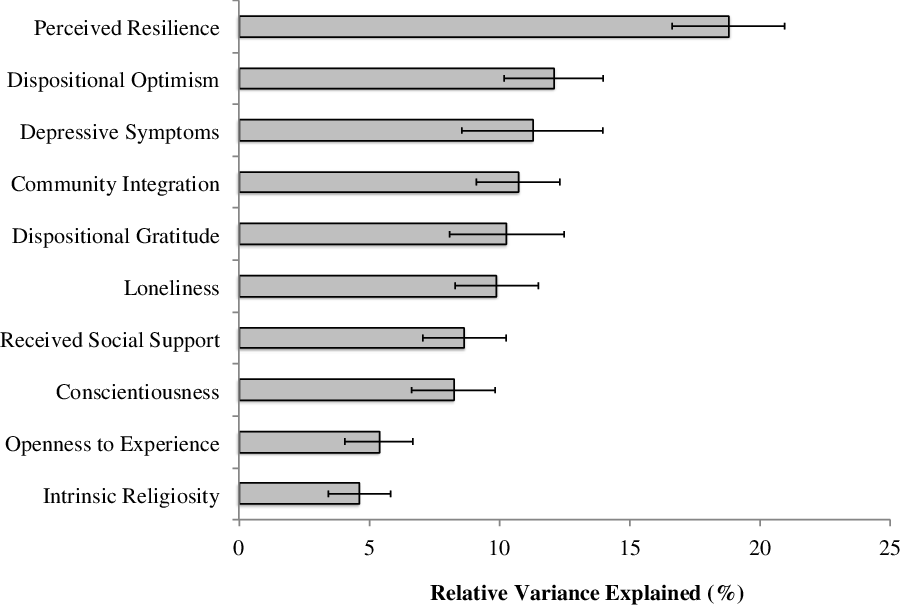
As shown in Figure 1, a relative importance analysis revealed that resilience explained the most variance in PIL-SF scores (18.7% RVE), followed by optimism (12.1% RVE), depressive symptoms (11.3% RVE), community integration (10.7% RVE), gratitude (10.2% RVE), loneliness (9.8% RVE), received social support (8.6% RVE), conscientiousness (8.5% RVE), openness to experience (5.4% RVE), and intrinsic religiosity (4.7% RVE). Inspection of 95% confidence intervals indicated that the association between resilience and PIL was larger than that of all other associations. Further, optimism was more strongly related to PIL than conscientiousness, openness to experience, and intrinsic religiosity. Intrinsic religiosity had a smaller association with PIL relative to other variables. Notably, the associations between PIL and optimism, depressive symptoms, community integration, gratitude, loneliness, and received social support all overlapped, indicating they did not differ in relative strength of association.
Results of a relative importance analysis examining significant correlates of perceived purpose in life (PIL) in US military veterans (N = 4069). Note. Numbers on the x-axis refer to percentage of variance explained in PIL. Error bars represent 95% confidence intervals.

Discussion
To our knowledge, this is the first study to identify significant correlates of PIL in a predominantly older cohort of US military veterans. While additional studies are required to elucidate the temporality/causality of these associations, results suggest several modifiable targets that may help increase PIL in this population. Of note, while the overall variance in PIL-SF explained by the identified correlates was 58.3%, nearly all of the observed associations were small in magnitude (β < 0.2), suggesting that several factors may contribute collectively to greater PIL.
Our study replicates previous findings (Irving et al., Reference Irving, Davis and Collier2017; Nakamura et al., Reference Nakamura, Chen, VanderWeele and Kim2022; Steger et al., Reference Steger, Oishi and Kashdan2009) that individuals who report higher levels of community integration and social support also report higher levels of PIL, and that those who report higher PIL also endorse fewer symptoms of loneliness and depression. Regular social interaction may help facilitate PIL by providing opportunities to engage in valued activities, such as helping others. In contrast, heightened symptoms of loneliness or depression (e.g. feeling lethargic or left out) might erode PIL by interfering with goal pursuits or discouraging social interaction. Higher PIL may also help mitigate symptoms of loneliness or depression, both directly and indirectly, by regulating the stress response (Schaefer et al., Reference Schaefer2013) and promoting healthy behaviors, such as exercise (Irving et al., Reference Irving, Davis and Collier2017), which can positively affect mental health. One way to increase PIL in older veterans may be through the use of technology-based interventions that have proven effective in reducing loneliness and promoting social support (Czaja et al., Reference Czaja, Boot, Charness, Rogers and Sharit2018). These interventions may be ideal for aging populations in which worsening health and mobility might interfere with more traditional, in-person care.
Our study also expands on previous work by demonstrating that PIL is associated with several other indicators of well-being, specifically, resilience, optimism, and gratitude. Though it may not be surprising to find associations between similarly valenced positive constructs, the finding that resilience was most strongly associated with PIL may provide insight into how to bolster PIL. Resilience refers to individuals’ perception that they are able to tolerate, and overcome, a variety of difficult experiences, such as illness, failure, and painful feelings (Campbell-Sills and Stein, Reference Campbell-Sills and Stein2007). Higher levels of resilience may help facilitate PIL by making the pursuit of valued goals seem more likely, suggesting that interventions shown to increase resilience in older adults may also help increase PIL (Treichler et al., Reference Treichler, Glorioso and Lee2020). Interventions such as reminiscence and life review (Butler, Reference Butler1963; Westerhof and Bohlmeijer, Reference Westerhof and Bohlmeijer2014) may also promote resilience and PIL by helping older adults to identify strengths, reflect on past successes and challenges, and develop a greater sense of identity and meaning in life. Similarly, interventions such as Dignity Therapy, which help individuals who are dealing with serious illness or moving toward the end of life reaffirm a sense of meaning and purpose, may help to promote overall well-being in older adults (Chochinov et al., Reference Chochinov, Hack, Hassard, Kristjanson, McClement and Harlos2005; Fitchett et al., Reference Fitchett, Emanuel, Handzo, Boyken and Wilkie2015).
Having a clearer sense of goals and life aims (i.e. high PIL) may help facilitate engagement in adaptive coping strategies and the motivation to persevere through life challenges (Irving et al., Reference Irving, Davis and Collier2017). This suggests that interventions shown to increase PIL in older adults may also promote resilience (Ho et al., Reference Ho, Yeung and Kwok2014). High PIL may be especially adaptive in late-life when role transitions (e.g. retirement; loss of a spouse) become more frequent and previously enjoyed activities (e.g. engagement in sports) may become less tenable. Individuals with a more clearly defined PIL may be better equipped to seek out alternative activities that provide them with a sense of joy or fulfillment (Haase et al., Reference Haase, Singer, Silbereisen, Heckhausen and Wrosch2021). Thus, clinicians working with older adults with low PIL may find it useful to help them identify prosocial activities that they are interested in pursuing, such as volunteering or mentorship, which have shown to improve well-being (Owen et al., Reference Owen, Berry and Brown2022).
Limitations of this study must be mentioned. First, as noted above, the cross-sectional study design prohibits inferences of causality or directionality. Second, while our sample was large and nationally representative of US veterans, it is also comprised primarily of older, White, male veterans; appropriate caution should be used when generalizing to other, more diverse veteran subsamples. Third, while we considered a large range of potential correlates of PIL, it is possible we missed other important candidates. Related to this, some of our variables may be conceptually similar to PIL, which could have inflated the associations. Finally, the use of a liberal alpha of (p < 0.10) to identify potential correlates of PIL for inclusion in a multivariable model could have generated spurious associations.
Notwithstanding these limitations, results of this study extend prior work (Mei et al., Reference Mei2021; Nakamura et al., Reference Nakamura, Chen, VanderWeele and Kim2022) and provide new insight into modifiable factors associated with PIL in US military veterans. Targeting these correlates (e.g. resilience; community integration) may help increase PIL, which may also improve overall mental health (Boyle et al., Reference Boyle, Barnes, Buchman and Bennett2009). Further research is needed to determine temporal associations among these variables and PIL, as well as mechanisms that link them. Research is also needed to examine the efficacy of interventions to bolster these PIL correlates and whether they increase PIL and mitigate risk for adverse health outcomes.
Conflicts of interest
None of the authors report any relevant conflicts of interest.
Description of author(s)’ roles
ICF drafted primary manuscript, conceived of study aims, conducted the statistical analyses, and contributed to interpretation of findings. RHP acquired the data, conceived of study aims, conducted the statistical analyses, interpreted the data, and edited the manuscript. All authors contributed and approved of the final manuscript.
Data statement
The US Department of Veterans Affairs National Center for PTSD, which supported preparation of this report, had no role in the design, analysis, or interpretation of this study. The data have not been previously presented orally or by poster at scientific meetings.
Supplementary material
To view supplementary material for this article, please visit https://doi.org/10.1017/S1041610222001223