Jim Jarmusch's films seem to float in thin air. His characters, whether drifters, pimps, or gamblers, public cleaners, rock musicians, or casting agents, gangster-types or professional hitmen on a mission, spend a great deal of their screen life drinking coffee or playing cards, dozing off or smoking cigarettes, on train journeys or taxi rides. In one such instance, the short film Int. Trailer. Night (2002), smoking and dozing is accompanied by the music of J. S. Bach. As a one-off occurrence in a little known, almost plotless short film, Jarmusch's borrowing of Bach could be brushed off as a peripheral instance in the afterlife of Western art music, an event of minimal cultural consequence, if it weren't for the great significance that the peripheral and the minimal have in the director's poetics. This dialectical relationship between the peripheral and the significant is reflected at the level of the films as cultural products. The focus on ordinary, everyday moments has become Jarmusch's trademark,Footnote 1 the index of an alternative approach to film-making, independent of the industrial and narrative economy of Hollywood, that has granted the director a place in the cinematic marketplace. The director himself has explicitly defined his subjects against the grain of commercial cinema:
Whenever I see a new commercial American movie, and I figure out how the story is structured, I would like to see those pieces that they left out of the movie, more than those they put in. I'm more interested in the moments in between […] I'm always more interested in the small, ordinary things, and that's why I guess I have a tendency to write the kind of scenes which would be left out in a more conventional or commercial or transparent style.Footnote 2
This comment brings into focus a link between a notion of the everyday as something eluding representation – too vague or simply too trivial to enter dominant texts – and the politics of cultural production of American independent cinema: of artists and artefacts that are defined on the basis of their relative distance from a dominant cultural practice.Footnote 3
In a broader sense, Jarmusch's negative definition of his ‘moments between’ taps into a major trope about the everyday.Footnote 4 The concern with finding adequate forms to bring overlooked elements of daily life into visibility has been a prominent thread through many experimental artistic practices of the twentieth century, from surrealism to assemblage, topographic photography, and pop art.Footnote 5 It is along these lines that Juan Suarez, one of the writers who has most eloquently articulated Jarmusch's interest in the everyday, has suggested that his cinema should be aligned with ‘one of the main projects of twentieth-century experimental culture’, ‘a project at once aesthetic and political that consists in venturing into the margins of experience to enlarge the scope of representation and the available repertoire of concepts and sensibilities’.Footnote 6
In entering Jarmusch's cinema, Bach engages in this broader discourse about the everyday. Precisely because of its seeming inconspicuousness, Int. Trailer. Night thus stands as an intriguing document of the music's twentieth-century reception. It provides us with an opportunity to explore the way in which so-called ‘classical music’ can assist a cinematic language that constructs its forms and cultural identity around the pleasure of attending to the smallest, most elusive aspects of lived experience. In what follows I want to explore both sides of this cultural appropriation: on the one hand, the way in which Bach's music is channelled into the characteristic political, commercial, aesthetic, and dramatic strategies of Jarmusch's ‘moments between’; on the other, the way in which, in the process of thus using Bach, Jarmusch puts forward a particular image of the music's twentieth-century identity.
Int. Trailer. Night features in a portmanteau collection called Ten Minutes Older, in which fifteen renowned directors (including Godard, Herzog, Wenders, and the older Bertolucci) were each commissioned to create a ten-minute piece about time that would be representative of their cinematic style.Footnote 7 The theme and author-based conception of Ten Minutes Older is clearly presented to the viewer via what, after Genette, we might call the film's ‘paratext’:Footnote 8 a subtitle (‘visions of time’) promises artistic insights into the nature of time; a quotation from one of Marcus Aurelius's ‘Meditations’ elaborates on the metaphor of time as a river (‘the irresistible flow of all created things’); and each short film is preceded by a white on black signature of the director cross-fading with images of water.
Shot in the high-contrast black and white characteristic of many of his films, Jarmusch's episode starts with the view of a trailer positioned at the edge of parkland at night, in the middle of a sparsely built-up area. The camera pans slowly, left to right, along a street illuminated by numerous lamp posts. Traces of slushy, discoloured snow are visible on the grass and alongside the pavements. A man is cleaning up around rubbish bins, the chink of glass resonating inside a refuse box. Further along the pavement we see a table-stand on which are large kettles. Two men hold steamy drinks in paper cups; another rubs his hands energetically. They wear bobble hats and layers of jumpers. Three people walk into the frame and towards the trailer, the camera following. One of them is talking into a walkie-talkie. She is an assistant director or production manager, taking a young actress (Chloe Sevigny) to her trailer for a ten-minute break (‘just relax and we'll tell you when we need you’). The film unfolds in real time, without temporal elisions, and from here onwards unravels entirely inside the trailer. The first view of the interior is a reverse shot of the actress seeing a man on the floor, groping his way to ‘a damned heater-switch’ situated beneath one of two old sofas tightly fitted in the room. His awkward fumbling introduces us to the restricted dimensions of the locale and to its basic, makeshift fittings: the noisy, defective electric heater, the non-matching pair of sofas taking most of the available space, a boom box surrounded by a few caseless CDs, Venetian blinds that shake heavily as he closes the door on his way out. Apart from a plant on a corner table and a couple of polaroids pinned to a wall, the trailer is unadorned.
Once alone, the actress gets a cigarette from her pocket and drops her coat on the floor, remaining in her character clothes: a sleeveless, 1920s-looking silk dress fringed with tassles. She is bejewelled: a tiara, bracelets, and earrings. She looks through the CDs on the sofa and flicks through a CD holder. Just as she is about to play what looks like a home-burned disc, the production manager looks in to remind her that she has ‘ten minutes’ to relax, but please to ‘stay picture-ready’, keeping shoes and jewellery on. As the manager leaves the trailer, the music begins. We hear the start of the opening Aria from Bach's Goldberg Variations (BWV 988) as the actress looks around for a box of matches. It is Glenn Gould's second (1981) recording. She sits on the sofa and, after a glance at the door, having made sure that no one is coming, takes off her shoes. She lights the cigarette, blowing out the match with the first puff. As the Aria approaches the end of the first strain, her boyfriend calls on her mobile. The conversation wanders. She pokes fun at his inquisitiveness about the background music (‘Oh, it's a CD, I've got a boom box in my trailer. [Pause] No, there's some guy here, serenading me, in my trailer’); she talks about what she will do when she gets home (‘wash my hair, sleep for a few hours, get up, and go back to work’); she half mentions something she needs to do for work which ‘gives her the creeps’, ‘a stupid publicity thing’ about which she doesn't want to talk. In the meantime, the Aria has been followed, out of sequence, by Variation 15, the G minor inverted canon at the fifth, which fills the film's remaining four and a half minutes.
During this time, members of the crew come into the trailer to check make-up and microphones. Demands on her overlap in the middle of the film: while a man is checking her microware, exploring the back of her dress and down the front of it, the assistant director comes in to tell her that a runner will bring some food. And all this happens while she's still on the phone to her boyfriend, whose phone call interrupted her listening to Bach. The irony of this piling up of interruptions is increased by the fact that, just as the sound technician has his hands down the actress's blouse, fiddling with her sound receiver, her boyfriend is suspiciously enquiring about her whereabouts on the night before. When the production manager and the technician leave, the actress tries to counter her boyfriend's insistent jealousy (‘I did too tell you I was with Ernesto … Yes I did … I did so … Oh you're such a freak’). The conversation thus ends on an exhausted, slightly bitter note, which is then partially alleviated by goodbye kisses.
The music returns to the fore. The runner brings something to eat, but before she has a chance to finish her cigarette or touch the food, the production manager calls her back on set. She stubs the cigarette out in the food and exits the trailer, leaving the stereo on and her coat on the floor. The runner comes back, picks up the coat, and leaves with it. There is a long pause on the empty room. Variation 15 comes to an end, and so does the film.
In keeping with the nature of the film's commission, with its insistence on ‘time’ and on the director as auteur, Jarmusch provides us with an emblematic example of one of his ‘moments between’. Int. Trailer. Night does not just concern itself with ‘the kind of scenes which would be left out’ of a more conventional movie but focuses literally on the ‘in-between’ times on a cinema set. In this way it thematizes Jarmusch's interest in uneventful, seemingly anti-cinematic ‘intervals’, with the film's title, a script shorthand for indicating shooting locations, highlighting the film's playful doubling of levels of fictionality. The downplaying of plot and the spatiotemporal limitations show the influence of European art cinema and its characteristic ‘boundary-situation’ stories;Footnote 9 but the film avoids any suggestion of the intellectual weight of those models. Its focus is not motivated by psychological or existential tension. The protagonists lack the characteristic eloquence of their European counterparts, and the dialogue seems to offer little ground for higher-level interpretations, pointing rather to the influence of the deadpan and minimalism of 1960s avant-garde film-making on his cinematic language.Footnote 10
The film's sparse reviews bring into focus its particular interpretative challenges. However rich their cultural genealogy, for some reviewers the film's limitations simply translated into a poor cinematic experience. Compared with the rest of Ten Minutes Older, Jarmusch's contribution was variously judged ‘unimaginative and uneventful’,Footnote 11 or a B side thrown into a ‘Best Of …’ album, or at best a ‘breather’ from the ‘brio on display elsewhere’; in other words, an ‘interval’ for the audience too.Footnote 12 Others, though, hailed the film as one of Jarmusch's finest achievements: reading its lack of events in realist terms, one critic praised its ability to create ‘a credible portrait of the actress's role in a production’ and to deglamourize ‘the myth of the celebrity trailer’.Footnote 13
The tendency to project a low-key, ordinary quality onto the characters and contexts usually glamourized by Hollywood is well established in American independent cinema.Footnote 14 It is a trope that, as Geoff King has argued, is part of a wider claim to ‘the status of something more closely approximating the reality of the lives of most people’, and particularly those who live on the sociocultural margins.Footnote 15 In keeping with the broader role played by verisimilitude in the critical discourse of ‘indie’ cinema, Jarmusch has often been praised for his ability to uncover ‘the essential ordinariness […] of characters’Footnote 16 and capture a ‘more honest’, ‘more real’Footnote 17 view of late twentieth-century America, focusing on ‘the small, important things […] that are really the basic fabric of our lives’.Footnote 18 Yet if Jarmusch's intervals attempt to approximate the rhythms and texture of everyday life, what on earth is Bach doing there, in the middle of his post-industrial American landscape?
Strange to meet you: the place of Western art music in Jarmusch's cinema
Oh, and btw: I don't believe that any young actress listens to classical music; was Jarmusch trying to be surreal?Footnote 19
The opening of Int. Trailer. Night, framing the trailer in the middle of an urban no-man's land, is as strong an authorial mark as the white on black signature that precedes it. Since Stranger than Paradise (1984), a sui generis road movie that brought American independent cinema to international attention, Jarmusch has tended to view people on the move. He has shunned representations of America either as a pristine Western landscape or as an urban leisure heaven to concentrate on rusty parks, street corners, motels, and parking lots: an architecture of the everyday often desolate and damaged, as well as generic and nondescript.Footnote 20 Drawing on Marc Augé's influential ethnography of modernity, Suarez has written of Jarmusch's settings as ‘non-places’.Footnote 21 Augé traces a simple distinction:
if a place can be defined as relational, historical, and concerned with identity, then a space which cannot be defined as relational, or historical, or concerned with identity will be a non-place.Footnote 22
The notion of non-place is tied to a familiar description of late modernity as an age of advanced capitalism, globalization, and mediatization, producing conditions of sociality that are increasingly characterized by displacement and disembedding – where, as Augé puts it, ‘solitudes coexist without creating any social bond’. Whereas Augé's analysis focuses on those ‘spaces of circulation, communication, and consumption’ that embody the increasing connectivity and visual excess of his ‘supermodernity’,Footnote 23 Jarmusch's transitional locations tend to be marginal to such flows of consumption. In many ways they are the waste product of the socioeconomic transformation described by Augé: redundant industrial sites and forgotten urban spaces defined, negatively, by their unclear meaning and value.Footnote 24 Jarmusch's representations often perform the conceptual slippage between that which is ordinary (in the basic sense of being part of a routine) and that which is disused and run-down, making it difficult to provide a coherent theoretical definition of the director's interest in the everyday. In Int. Trailer. Night the opening tracking shot deliberately confuses the places of film-making with the conditions of life at the socioeconomic margins. The trailer functions as a pivot between the iconography of the film industry and that of the most destitute parts of American society,Footnote 25 with the film crew providing a (self-referential) variation on the director's long-standing fascination with ‘ethnoscapes’: drifters, travellers, and immigrants.Footnote 26 The qualities of the larger setting, sparse and discontinuous, are then replicated by the trailer's interior, which, far from being a hub of celebrity lifestyle, appears to be a nondescript place of transition, almost completely lacking personal traces.Footnote 27
At first sight, then, Bach seems to have nothing to do with the film's context, its iconography of exiled urban zones and disused industrial sites, the cultural milieu of the people on screen, and the artistic practices that have typically documented these once unrepresented spaces.Footnote 28 Given the paradoxical identity of the non-place, however, this unrelatedness soon turns into the source of a relationship. For one thing, since Bach's presence in the parkland is a function of the actress's temporary stay in the trailer, the music's out-of-placeness can amplify her own contingent relationship to the environment, pointing to the non-place as a site of transition and adding to the film's broader representation of film-making as characterized by displacement. The actress's own relationship to the music, however, is undetermined. In this sense, as well as highlighting the disjuncture between the actress and her immediate environment, the music does not situate her within a recognizable lifestyle or cultural trend. Bach not only takes us further away from the mainstream iconography of celebrity lifestyle, but also does nothing to glamourize the makeshift qualities of the scene, failing to tap into an alternative iconography of low-fi, underground film-making. The music is thus part of Jarmusch's ‘negative’ sculpting of character as well as place, a stripping off of familiar associations. To the extent that Bach's music removes the character from any available collective identity, it can assist the notion of a lack of communal belonging latent in the imagery of the non-place: one that seems to infiltrate the very quality of the interactions between the actress, the film crew, and her distant boyfriend, which are formulaic and mistimed, giving us a glimpse of the deadening routine that she laments.
These disjunctions between people, places, and music are typical of Jarmusch's films. A brief list of his protagonists would include: a sixteen-year-old drifter in 1980s New York who fashions himself on Charlie Parker's looks and music (Permanent Vacation, 1980); a Hungarian girl who travels through America with a tape of Screaming Jay Hawkins (Stranger than Paradise, 1984); a Japanese couple on pilgrimage from Yokohama to Memphis, the land of Rockabilly (Mystery Train, 1987); and a retired American executive who searches for a potential son while listening to a compilation CD of 1960s Ethiopian jazz (Broken Flowers, 2005).
In all of these instances musical affiliations are less the manifestation of large discursive categories than the result of idiosyncratic trajectories whose circumstances and nature are irretrievable. They place characters at a relative distance from the commercial mainstream and somehow at odds with the ‘American way of life’. At the same time they fail to crystallize into any alternative form of communal identity. As many have noted, Jarmusch's characters all tend to be ‘alien to the American mainstream’,Footnote 29 ‘strangers in the land’Footnote 30 who travel through a society depleted of community.Footnote 31 In this sense they reflect what Suarez has labelled a ‘distillation of the counterculture’, a tendency towards the dispersion of radical social objectives into a plethora of taste cultures and niche markets, a post-1960s repackaging of ‘youth culture as private style’ that was part of the rise of American independent cinema in the 1980s and 90s. From this perspective their taste and styles point to social fragmentation and political disempowerment.Footnote 32
Yet the sheer singularity of their musical affiliations hosts the possibility of a different reading. While failing to crystallize into an explicit oppositional or countercultural position, musical taste offers a basic resistance, almost a form of inertia which, however little conceptualized and seemingly apolitical, stands in the way of homogenization and stereotyping. This is a resistance which, as Ben Highmore has shown, is indigenous to the limited scope of the everyday. It is a notion not synonymous with ‘oppositional’ culture, but ‘closer to the use of the term in electronics and psychoanalysis: it is what hinders and dissipates the energy flow of domination, it is what resists representation’.Footnote 33
Western art music, thanks to its relative distance from the commercial centre, from the trends of popular culture, and from the very notion of youth culture, provides Jarmusch with material that can take this dialectic of fragmentation and heterogeneity to extreme consequences. Indeed, since Int. Trailer. Night the placing of Western art music in the non-place has become a trope in Jarmusch's musical borrowing. Coffee and Cigarettes (2003), a collection of short films revolving around the enjoyment of and addiction to caffeine and tobacco, uses Mahler in circumstances strikingly similar to those of Bach in Int. Trailer. Night. The final episode (‘Champagne’) features Bill Rice and Taylor Mead, cult figures from Andy Warhol's Factory, as two elderly janitors on their coffee break, sitting in a dimly lit SoHo bar late at night – a pared down, rather abstract locale of which we see only a single, central table, piled-up chairs in the corner, and someone cleaning in the background. The scene starts with Taylor telling Bill that he has lost touch with the world, a remark that brings to his mind Mahler's song ‘Ich bin der Welt abhanden gekommen’, ‘one of the most beautiful, saddest songs ever written’. ‘I can almost hear it now’, he says, bringing a hand to his ear. From an unspecified location off-stage the song emerges. It starts quietly, little more than a whisper, rises in volume, and – to Taylor's great disappointment – quickly disappears. ‘Oh, it's gone now, did you hear it?’. ‘I think so’, answers Bill, deadpan. Then, via a sequence of non-sequiturs, the two mention Nikola Tesla's scientific theories, 1920s Paris, and 1970s New York.
In The Limits of Control (2009) the decontextualization of Western art music is part of a construction of the ‘lone man’, in this case an unnamed hitman with the secret agenda of liberating the world from a transnational corporation that exerts control over art and imagination. In keeping with the hitman's manifesto of creative freedom, the film writes against generic conventions, focusing on small events in highly stylized and regimented routines.Footnote 34 We see him practising Tai-chi, drinking double espresso in separate cups, paying daily visits to Spain's museum of modern art, and repeatedly listening to a CD of Schubert's String Quintet in C major. These habits are coupled with a particular code of practice: the lone man uses no guns or knives and refrains from alcohol and sex. The most obvious display of the man's and the film's restraint, in the face of carnal temptation and of the selling points of crime movies, is his relationship with a ‘Bond girl’, who throughout the film walks around his hotel apartment naked and untouched. After the girl's promise of two days of passion, we see them sitting on the hotel sofa listening to the Adagio from Schubert's Quintet. The film rolls on for a couple of minutes in almost complete stillness and silence. The girl, naked as always, says that she loves Schubert; the lone man, always dressed, keeps listening.
In all these instances Western art music sounds outside the frameworks that often motivate its diegetic presence in cinema. It cannot be explained with reference to the characters' age, class, or nationality, and is displaced from its most familiar geographies (Europe and urban, cosmopolitan America) and interiors (official receptions, churches, exclusive restaurants, wealthy homes).Footnote 35 As in Int. Trailer. Night, the music's undetermined relationship to its listeners and playback space feeds into the construction of a contingent relationship between the characters, their immediate physical environment and broader social identities. Listening to Schubert becomes part of a bizarre scenario opposing mysterious controlling forces and a man's power of imagination. The memory of Mahler, with the music's entry from an unknown, possibly imaginary location, dramatizes the character's sense of profound divorce from the world. Yet the presence of Western art music also instils these scenes with a sense of potential. As well as marking a lack, it provides an element that cannot be easily normalized. What is crucial is the way the music's cultural difference is set within the flow of everyday life. Coupled with the smoking of a cigarette, playing a Bach CD is presented as the matter of routine. Mahler's fleeting, unexplained appearance does not surprise the characters, who continue sipping coffee from their paper cups. Listening to Schubert is a narrative non-sequitur (an unlikely segue from the promise of sexual consummation) which is nevertheless fully consistent with the rules of the film's diegetic world: its strangeness lies precisely in the fact that the lone man's habits (and the film's logic) are unperturbed by the girl's presence. In each instance, by presenting the strangeness of the music's presence as normal within the filmic space, these acts of listening can engender forms of magical or poetic realism, in which the everyday is presented as ‘already strange’.Footnote 36 This takes a different quality in each example, ranging from a subtle defamiliarization in Int. Trailer. Night to the absurdist exchange in Coffee and Cigarettes, to a bizarre juxtaposition in The Limits of Control.
In this way Jarmusch's Western art music is part of an attitude to the everyday characterized by a double orientation: towards exposing its limitations, its constraints and negative values, and towards highlighting its potential to engender new and unexpected configurations.Footnote 37 It contributes to demystifying dominant representations (of the extraordinary lifestyle of film-making, of the taste and eloquence of people at the sociocultural margins, of the conventions of crime movies) and generates mystery in the process. It both reinforces the non-place's identity as a location with no embedded community and no authentic music, and teases out its qualities as a hybrid, liminal ground where surprising mixtures can take place.Footnote 38 The non-place infused with Western art music can thus stand both as the emblematic topography of a sociality characterized by displacement and lack of a ‘social feeling’, as Augé puts it, and as a pocket of difference – a figurative repository for materials and people that gravitate away from the commercial centre. Western art music, in other words, provides Jarmusch with a suitable material for a ‘poetics’ of the everyday, in the etymological sense that it enables the invention of singular yet unimagined cultural identities which, precisely because of their strangeness, can approximate the complexity of the social texture.Footnote 39
This use of music has a bearing on the cultural identity of Jarmusch's cinema. Of all labels, that of ‘independent’ is particularly problematic in that it imposes a degree of homogeneity over film-makers who define themselves precisely on the grounds of offering individual, ‘alternative’ perspectives, ‘visions of society not usually found in the mainstream’, as King puts it.Footnote 40 What is more, the label speaks of the crystallization of ‘indie’ cinema into a marketing category, something at odds with the films' alleged resistance to the model of commercial cinema. The way in which Jarmusch's cinema has been held as both ‘uncategorizably new’Footnote 41 and as one of the ‘dominant styles’Footnote 42 of independent cinema is emblematic of this conundrum, and of his successful negotiation of it.Footnote 43 In this sense, precisely because of its paradoxical flavour, the label ‘independent’ does indeed capture something of the way in which Jarmusch's cinema has defined its identity by eluding categories: keeping its ‘independent’ credentials by avoiding incorporation into the mainstream.
Music has always played an important role in these complex strategies of cultural production. Historically, the rise of independent cinema has proceeded hand in hand with an allegiance to popular music, particularly its more vernacular, street-level manifestations. This has been a natural consequence of similar attitudes to cultural production (a low budget, DIY attitude to artistic expression) and has proved a successful way for independent film-makers and musicians to tap into each others' audiences and consolidate their following. Yet precisely because of its success as a marketing tool, the ‘synergetic’ fit between the demographics, topics, and fashions of ‘indie’ cinema and music has also been one of the aspects most readily taken over by Hollywood, and thus potentially a threat to a film's ‘independent’ status.Footnote 44 This is attested by the way in which, within certain critical quarters, distinctions have been traced between ‘modish’ and ‘truly independent’ on the basis of their compiled soundtracks and (more or less affirmative) stance in relation to popular culture.Footnote 45
From the beginning Jarmusch proved sensitive to the role music could play in shaping the cultural identity of his films. His early work emerged in late 1970s downtown New York, in which there was a particularly strong relationship between underground film-making and so-called punk or ‘new wave’ music, featuring now famous acts such as the Ramones, Talking Heads, Television, and Blondie. However, Jarmusch's films deliberately avoided musical references that would tap into this ‘new wave’ trend.Footnote 46 This applies to both diegetic and non-diegetic music: Jarmusch's notable displacements extend to the films' underscores. His debut film, Permanent Vacation, combined 1950s bebop with slowed-down gamelan music. In Stranger than Paradise John Lurie of the jazz group Lounge Lizards added slow, fragmented string quartet sonorities.Footnote 47 Overall, Jarmusch's undermining of any link between the repertoire and its traditional contexts, as well as complicating the cultural placement of his characters, has the effect of undermining any straightforward commercial synergy. His musical borrowings deliberately fail to crystallize into coherent subcultural identities, to outline definable trends: they tend to pluralize and confuse rather than reinforce and clarify the film's cultural genealogy.Footnote 48
In this oblique sense, precisely because it seems alien to Jarmusch's milieu and to the long-standing affiliation between independent cinema and popular music, the use of Bach is in keeping with the way in which the films negotiate their cultural placement. It is part not just of the construction of characters who resist reduction to types, but also of the construction of Jarmusch's cinema as one made by and for ‘outsiders’,Footnote 49 a cinema that does not sit comfortably in its own categories. The music's cultural difference at once locates otherness at the core of the everyday, and makes the films themselves instances of unexpected cultural syncresis. Thus, as part of a broad overlap between the film's politics of representation and their strategies of cultural production, there is a homology between what the music does at the level of plot and of the film as product. Similar to what happens at plot level, the seeming lack of a relationship gives way to two logics: a ‘negative’ one, in which the music relates to the film precisely on the grounds of their unrelatedness (thus playing into the way Jarmusch's films define themselves by avoiding categorization); and a ‘positive’ one, in which the music and the film share a degree of distance from the commercial mainstream and thus, in this sense, form an assemblage with a potential for commercial synergy.
Inside the trailer: minimal variations
I love variations. It's an old formal ploy in literature like Chaucer and Boccaccio, or Bach, or people like Andy Warhol. I like it as a formal exercise.Footnote 50
From considering the significance of presenting the music's strangeness as ordinary, we might now turn to the aesthetic consequences of granting unusual attention to a common mode of listening. Immediately followed by the search for a box of matches and the removal of her shoes, playing the CD is the first action in a routine the actress performs to compose herself and establish her relationship to the locale.Footnote 51 While the choice of Bach as a cultural object plays into the sense of a disconnection between character and place, the act of listening is also part of how the actress makes herself at home in the trailer. The scene thus evokes one of the modes in which music, to quote Michael Bull, is employed daily to transform and modulate our experience of the ‘“in-between” times’, to ‘inhabit’ the places we move through, particularly in situations characterized by a potential feeling of detachment and anonymity.Footnote 52
Despite, or rather precisely because of, their familiarity, these everyday listening activities rarely take centre stage in cinema. While it might well be, as scholars have suggested,Footnote 53 that cinema has had a cultural and technological impact on the way in which we use music to mediate our everyday experiences, cinema's stories usually have little time for such ordinary musical practices. A survey of the cinematic appropriation of Bach would show the act of listening to be usually motivated by pointed meanings or emotionally marked circumstances.Footnote 54 In those instances when the music seems to be associated merely with the regulation of mood and energy levels, it typically unfolds within the background of other, narratively more salient operations.Footnote 55 What is unusual in Int. Trailer. Night is not so much the narrative space allowed to the act of listening, nor its implicit use as part of a routine of relaxation, but rather the combination of the two.
i) Everyday aesthetics: the Aria and the cigarette
I tried to make it mean nothing really, and I like it a lot.Footnote 56
In a way, the actress does nothing more than choose a plausible prop for relaxation. The very name of Bach's collection tells a story of music as a resource for self-modulation: the ‘sweetly lyrical Aria’, as Peter Williams suggests, seems to justify the apocryphal therapeutic credentials of the Goldberg Variations.Footnote 57 From its incipit, reduced in texture and lacking any preparatory gesture, the Aria is characterized by unemphatic rhetoric, economy of means, and an unhurried pace. What is more, Gould's recording plays up these qualities. Writing about his late recordings, including the 1981 Goldberg Variations, Kevin Bazzana tries to pin down the mysterious clarity of Gould's sound, noting the achievement of textures where ‘each individual note seems to occupy its own acoustical space’:
The background of silence, of stillness, is palpable ‘between the cracks’ in Gould's non-legato playing, especially in his superslow performances; one ‘hears’ the open space surrounding the sounds. […] Gould was not concerned that ‘clarity could be an enemy of mystery’; in his non-legato playing, at least, clarity was in fact the source of mystery. Gould's was certainly a distinctive sort of piano poetry: no shimmering kaleidoscope of pedalled sonorities, but instead the bracing clarity of tones cleanly etched against a background of vast open spaces. (A poetry of the North, one is tempted to say.) […] so deeply (albeit strangely) expressive.Footnote 58
With its very deliberate tempo and closely miked, extremely exposed articulation, this recording of the Goldberg Aria is exemplary of the ‘poetry of the north’ evoked by Bazzana. Magnifying each note both temporally and acoustically, Gould's performance puts in relief the smallest components of the Aria, making its texture diaphanous. The two-bar phrasing and the sarabande template, with its long second beats and repeated crotchets, generate melodic arches characterized by a regular ebb and flow in rhythmic density. In Gould's rendition the spaces between repeated crotchets and melodic phrases become particularly conspicuous, with the duration of the minims stretched to the point that we can hear the note fading away. The level of pianistic expressivity is redefined as a matter of closely controlled attack and natural decay.
The effect of the music on the actress's experience of her ‘interval’ is seen indirectly. By playing music and lighting the cigarette, the actress introduces two elements that can shape the quality of time, as well being indexes of its passage. Indeed, the Aria seems to set the tempo and style of action in the very act of lighting the cigarette. The gesture of blowing the match out with the first puff of the cigarette is performed at a deliberate pace and finds its logic in aesthetic considerations: in the ‘economic’ and smooth fusion of two movements into one. The actress's modulation of her body also revolves around the untying of her shoes. As she sits on the sofa, the camera moves close to her, its proximity made palpable by tilting up and down along her body, following her movements as she bends to untie her shoes. The intimacy of this gesture is emphasized by the actress's glance at the door, a reminder of the fact that she was asked to keep her shoes on and stay ‘picture ready’. Its clandestine quality makes it a minimal tactic of self-affirmation in a context in which her clothing, location, and movements lie mostly beyond her control.Footnote 59
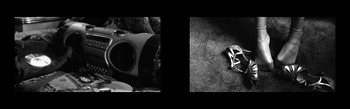
The act of listening is, then, punctuated by close-ups of the portable stereo surrounded by the upside-down CDs, and again of the actress's feet, now rubbing against the trailer's carpet. By isolating the feet, the camerawork draws attention to the distinctive tactile quality of the stockings against the thick pile of the moquette. Similarly, the close-up of the stereo, very loosely cued in by a glance in its direction, is conspicuous for its textural qualities. In the high-contrast, black-and-white photography, the CDs stand out as luminous objects, reflecting the light of the lamp in the corner (see Figure 1).
Listening to the Aria; juxtaposed close-ups of the stereo and the actress's feet foregrounding texture and pictorial qualities.

Listening to the Aria is thus accompanied by a magnification of tiny modulations in the way the actress composes her body, and by a mode of viewing that seems to linger on the surface of the mise-en-scène in seeming excess of its narrative function. In part, the emergence of these details is a consequence of the focus on listening, which further reduces the narrative drive of the scene and becomes a frame for otherwise negligible gestures and materials that come to the fore. Together with the undramatic qualities of listening, the choice of the Aria plays into this perceptual style. Bach's economy and distended temporality make it more than merely a plausible prop for relaxation; they allow it to intersect with the film as a formal system. By combining sparseness and low goal-orientation with a rich, ‘molecular’ texture and timbre, Gould's recording of the Aria contributes to the construction of a rarefied environment within which minimal details can acquire unusual phenomenological weight. As well as providing a detailed musical texture, the Aria is mixed at a level that allows it to be crisp and clear without obscuring the naturalistic background noise. Through its stretched texture we can hear the hum of the electric heater and the murmur of walkie-talkies coming from just outside: sounds that remind us of the basic protection offered by the trailer from the inhospitable outer environment. Overall, the soundscape solicits a form of aural attention that is in keeping with the film's approach to visual information, contributing to redefining the scene's level of significant detail.
In this sense the routine quality of the act of listening, along with the functional equivalence that is established between the Aria and the cigarette, unlocks the music's power. The coupling of smoking and listening promotes a blurring of the difference between the aesthetic and the everyday. On the one hand listening to Bach is framed in terms of ordinary functions: it is not categorically different from actions such as smoking or taking off one's shoes in that it serves to seek out ‘goods’ such as space and relaxation. On the other hand these ordinary actions are now reconceived as broadly ‘aesthetic’ in nature, at least to the extent that their principal aim is to shape the actress's experience of the time and space of transition.Footnote 60 By means of integrating the music into the actress's routine, allowing the Aria to become one of the central elements of the scene without charging it with higher-level meanings, the scene can thus represent the everyday itself as the (immanent) locus of aesthetic and sensual pleasures.
This representation of listening to the Aria has important implications also for the nature of the cinematic experience offered by Int. Trailer. Night. Various critics have noted the way in which Jarmusch's films attempt to ‘free some of the basic materials of cinema […] from the restraints of narrative’,Footnote 61 a desire often labelled as ‘minimalist’ because it recalls a concern with formal reductionism and ‘literalism’ characteristic of minimalism in art.Footnote 62 In Int. Trailer. Night the diluted narrative drive allows the patterns in framing and editing to emerge as significant, with the juxtaposed close-ups and the visual refrain of the actress's feet imposing their own rhythm.Footnote 63 The stereo, the moquette, and the music signify the ‘lyric’ sense of materiality inside the trailer by drawing attention to their materiality as signifiers. In this sense the music and the film mediate each other's perception. On the one hand, by not using the music as a cultural marker or as the marker of a moment of explicit psychological or existential significance, the film allows a relatively non-prescriptive kind of listening, discouraging us from moving too quickly to reading the music as ‘meaning’. On the other, by standing in excess of its signifying functions, the music encourages an engagement with the sheer aural, haptic, and pictorial qualities of the film as an aesthetic object.
Theoretically, any film allows this spectatorial posture. Drawing on Roland Barthes's semiotics, film theorists have explained the ways in which the cinematic medium, by its very nature, allows the viewer to read against the grain of even the most prescriptive of narratives, to ‘play with the materiality of the signifiers’,Footnote 64 to linger on ‘that which is other than the focal image’,Footnote 65 ‘to resist the congruity forced on images by the continuity system’.Footnote 66 This alternative mode of viewing has a political potential, at least to the extent that, as Roger Cardinal puts it, to attend to the peripheral is to adopt a posture of ‘refusal to the dominant rhetorical codes which structure that message’.Footnote 67 The act of listening to Bach in this sense caters for a type of cinematic pleasure that would be vicarious in mainstream narrative cinema. It stands as a slice of cinematic time that allows an alternative spectatorial posture and its purportedly political dimension.
ii) Miniature dramas: the cigarette and the canon
Variations are at the heart of human expression. Bach is a master of varying things […] and then of course Warhol, fashion, architecture, popular music, everything.Footnote 68
Bach's role in conveying the aesthetic texture of the scene changes when the actress's choreography of the break is suspended by her boyfriend's phone call and conclusively spoiled by the piling up of interruptions. After the sound man and the production manager have left, the way in which the scene is gradually reduced again to the actress, the cigarette, and the music confers on the film a symmetrical, arch-like structure, something emphasized by the fact that the actress (who stood up to have her microphones checked) now transfers to the sofa on the right-hand side of the screen.
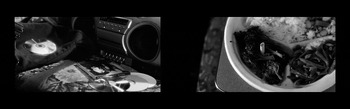
With the resurfacing of the music both acoustically and narratively also returns an attention to the way in which the actress composes her body and to a mode of viewing that magnifies peripheral gestures and details. Now we see the stereo, the flowers in the corner, the actress adjusting her stockings after the sound technician has been fiddling with the microware, the plastic plate with rice, beans, and spinach. The last detail to be singled out is the cigarette pressed against the food as the production manager calls her back on set (see Figure 2).
Listening to the canon; return of the stereo shot and close-up of the cigarette stub.

Across this symmetrical structure the music contributes to the tracing of a minimal dramatic trajectory. To an extent, the progress from the Aria to the canon produces a soundtrack characterized by a broad continuity in texture and tempo – a level of homogeneity that is in keeping with the actress's use of Bach as part of a practice of relaxation. In this sense, at plot level, and to a viewer familiar with the Goldberg Variations, the fact that the canon follows out of sequence can suggest the possibility that the actress is listening to a selection of variations deliberately chosen for their suitability to function as ‘mood music’ – an interpretative possibility opened up by the fact that the music comes from what looked like a home-burned CD.Footnote 69 Yet skipping from the Aria to Variation 15 also creates a meaningful discontinuity. With a move to the minor mode, increasing chromaticism, and dense counterpoint, the leap to Variation 15 builds into the film a subtle rise in expressive intensity. The regular melodic arches of the Aria give way to a texture pervaded by a sigh motif, in direct and contrary motion. In a manner typical of his performance of the Goldberg canons, Gould differentiates the repeats by means of bringing out the bass line the second time around, in this case by applying a dry staccato. In a rendition characteristically devoid of conventional pianistic expression, this injection of contrapuntal disparity, as Bazzana notices, becomes in itself an expressive device, the element of a ‘little dialectical drama’.Footnote 70 To these changes in articulation Gould adds significant dynamic variation. A harsher attack characterizes the opening of the second half of the canon, Gould fleetingly instilling a sense of tonal drama by placing emphasis on a cadential movement to the submediant. In this sense, in a scene that is emphatically represented as unfolding in real time, playing the Goldberg out of sequence also betrays a directorial ‘intrusion’ – Jarmusch's intention to use music to dramatize the ‘interval’.
The change in affect and the more aggressively articulated performance of the canon serves as a backdrop against which the shifting affective qualities of the actress's recurring gestures and details can be appreciated.Footnote 71 The move from the Aria to the canon highlights the trajectory of the phone conversation, from the actress's playful reference to the ‘serenading’ Aria to later responses to the boyfriend's jealousy, which acquire a tone of exasperation. It also underpins the shifting connotations of the actress's modulation of her body, from the intimate gesture of feeling the carpet to adjusting her stockings after her personal space has been so casually violated by the sound man. It marks the fate of the cigarette, from its lighting up, smooth and ‘economical’, set to the ebb and flow of the Aria, to its stubbing out in the spinach, embedded in a chain of unfolding appoggiaturas, a small act of protest that takes much of the actress's frustration with the constant interruptions.
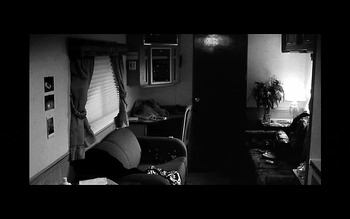
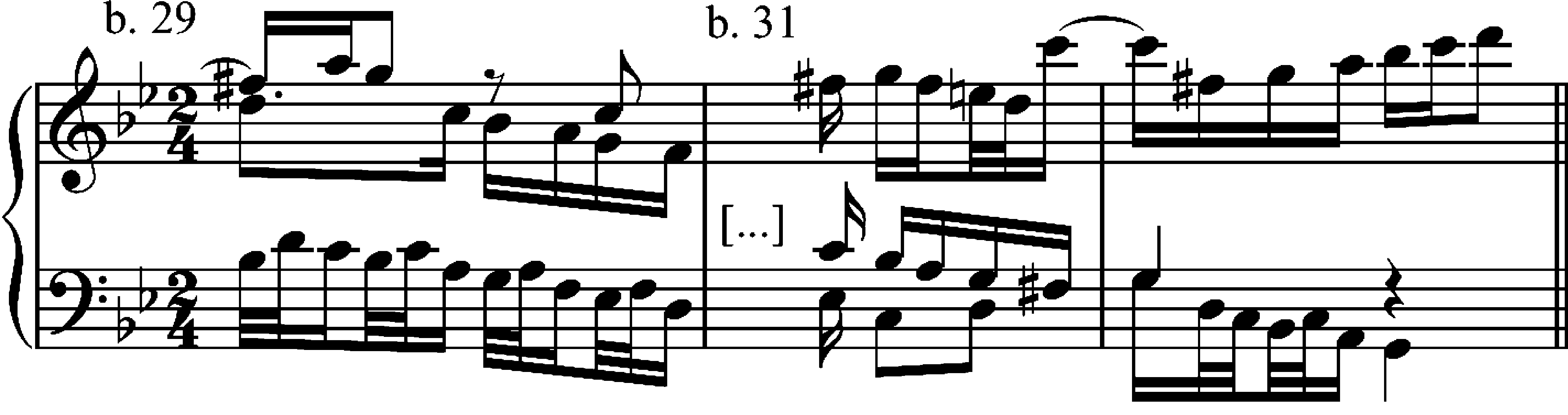
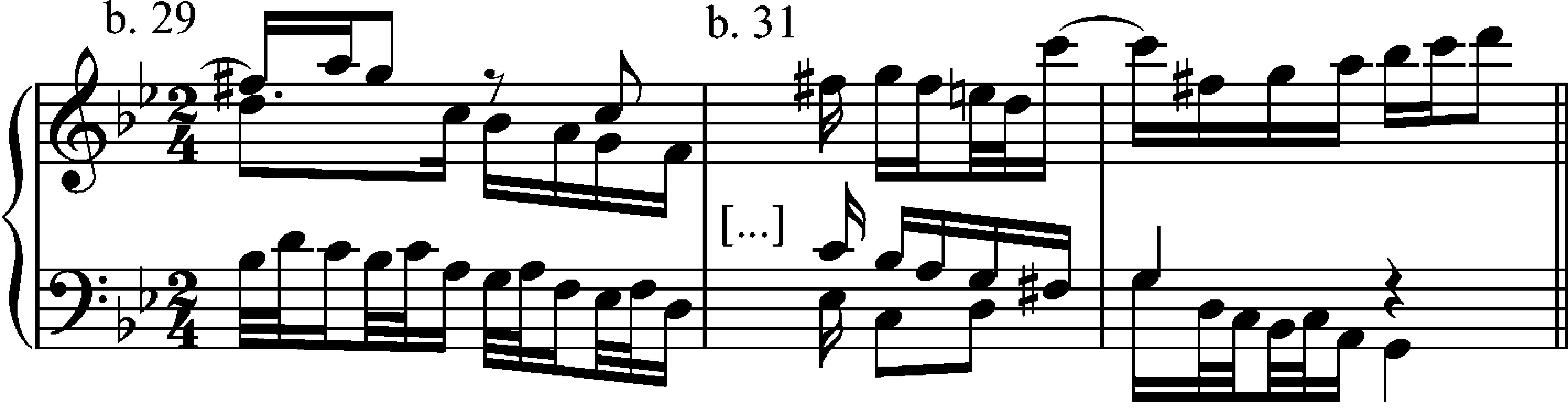
Variation 15 is also used to mark the actress's exit. As she leaves, the camera cuts back to the master shot of the trailer (see Figure 3). The runner pops back to pick up the coat she left behind, the door slams one last time, and the shot keeps rolling while the canon moves to its close. Bar 30 and two beats of bar 31 are cut, discreetly, presumably to fit the music to the length of the shot and exactly coordinate their endings. The music's texture thins out, with the lower canonic voice, the dux, terminating on the first beat. While the bass line reaches its lowest note, the upper voice ascends to its peak. The canon ends on an open fifth, G and d′′′, four octaves apart (see Example 1).Footnote 72 The empty trailer and the music thus provide a short coda to the scene, a kind of ‘afterimage’ whose function seems analogous to Jarmusch's frequent use of black leader to punctuate the end of sections in his films, a practice which, as he puts it, serves to ‘give the audience a moment to think, to digest the scene they have just been watching, even if it is so simple that it doesn't have to be digested intellectually’.Footnote 73
Closing temps mort; the emptied trailer underscored by the end of variation 15 (see Example 1).

J. S. Bach, Goldberg Variations, variation 15, bars 29–32 (contracted) as heard at the end of Int. Trailer. Night.
This emptying of the locale has a rich iconography in international art cinema. Film scholars have used the term temps mort to describe scenes that linger on vacated spaces, typically dramatizing trajectories of loss and departure. The continuation of the music after the listener has left is in keeping with the visual logic of this trope: it is a presence meant to mark an absence. What is more, the specific qualities of the music's closure play into these meanings. Formally the moment is marked by the convergence of two closing gestures (the cadence and the empty shot), both of which lack strong syntactical closure. On a thematic level the striking inconclusiveness of the music's ending, made all the more evanescent by the fact that Gould applies an extreme rallentando, resonates with the elusive qualities of the interval: with the way in which the actress's time in the trailer elapses in the midst of mistimings and interruptions; with the scene's overall emotional drift; and with the ontology of Jarmusch's moments ‘between’, which are determined, ‘negatively’, by a lack of actions with explicit meaning and value. Of course this ending, precisely by thematizing the elusive affect and meaning of the interval, fixes it into a more marked moment of emotion and meaning. The canon subtly ‘rises’ to a non-diegetic level to provide us with the most explicit emotional cue of the film and with an epigrammatic image of the nature of Jarmusch's intervals, the ‘vision of time’ promised by the entire Ten Minutes Older collection.Footnote 74
The canon is thus used to bring to the fore an emotional realm characterized precisely by its muted, amorphous qualities. Its suitability to articulate this realm is both a result of the fact that the music can function as expressive cue while remaining diegetically motivated, and of the fact that the canon, even as it takes on some of the paradigmatic functions of the underscore, remains stylistically distant from mainstream cinematic scoring. In this way the affective texture of the interval can be expressed without compromising the elusiveness that characterizes it: as with the stubbing of the cigarette, what is important is not just the heightening of tension but also its minimal proportions. Like the cigarette, the music draws a trajectory from being ‘constitutive’ of the actress's experience of the interval to being expressive of her failure to make herself at home in the trailer. In this sense the move from the Aria to the canon dramatizes the basic dynamic of inhabiting and vacating the place of transition, imparting the simple act of dwelling with qualities of intimacy and loss.
In Jarmusch's use of Bach we thus see two distinct conceptions of minimalism at work. The first one, as noted, relates to the historical meaning of the term as a style characterized by formal reductionism and an emphasis on perception as the bottom line of aesthetic experience. The second one has to do with the common use of the term, as film theorist Greg Smith has explained, to label films that avoid being emotionally prescriptive. Smith looks at Jarmusch's Stranger than Paradise as an example of this ‘minimalist appeal’, and the use of Bach in Int. Trailer. Night confers on the film exactly the kind of emotional pacing Smith finds at work in that earlier film, in which, as he puts it, we move from a ‘sparsely informative framework’ to ‘increased goal orientation and a more straightforward emotional appeal at the end, encouraging the viewer to respond more strongly at the film's climax’.Footnote 75 This, as Smith suggests, allows into the film ‘a highly marked emotional moment while still maintaining our conception of the film as a subtle work’. Along these same lines we can see that, in the process of shaping the qualities of the actress's act of dwelling, the music modulates the very nature of the filmic text and of its cinematic pleasures. The representation of listening to Bach both allows counter-narrative spectatorial postures and reinscribes into the text a more traditional narrative economy of intensification and culmination. The music's ultimate inability, at the level of plot, to secure the actress's symbolic appropriation of the place is, in other words, turned into the music's ability, at the meta-level, to secure the film's understated climax.
Int. Trailer. Night thus offers a concrete document of cinema's power to promote the merging of contemporary discourses and past musical materials. From the strange entry of the Aria to the open ending of the canon, Bach is woven into the cultural and aesthetic identity of Jarmusch's cinema. The film engages with the Goldberg Variations at various levels, using its broad cultural placement and its particular gestures to bring into focus dialectical and dynamic qualities of a random sample from the fabric of the everyday. If Bach's seeming unrelatedness to the context produces a dialectical image of the social texture, the music's suitability to be cast in the terms of minimalism serves to develop a form of microscopic attention that can register an aesthetic and affective realm normally unheeded. On a further dialectical level, by means of projecting this image of the everyday, the music also contributes to making a small, seemingly trivial interval a significant subject for a cinema which, in a lineage going back to underground and international art cinema, defines its identity in relation to the cultivation of surprising cultural syncresis and of a non-prescriptive narrative style.
In turn, the film puts forward a particular version of classical music's twentieth-century image, showing how the music's cinematic use and representation is dependent on the mode of production of the artistic practice from which such a representation originates. At the level of cultural product, as at that of plot, Western art music finds a space in Jarmusch's cinema not because of its connection with official culture or the economic élite but thanks to its peripheral place in relation to the commercial mainstream. In keeping with the way in which independent cinema defines itself, Jarmusch's borrowings downplay the significance of the high/low divide as a criterion for differentiating cultural products, and instead invest with significance the difference between the centre and the margins, aligning Bach with démodé, ‘once popular’ popular music, street-level creativity, and the experimental end of contemporary rock.
This relativization of the music's difference is reflected in how the film, both at plot and meta-level, engages with the notion of the aesthetic. The actress seems to use the music to access the aesthetic texture of the everyday, but this notion is never ‘pure’, never divorced from a function: the stylization of her gestures and the emerging sense of a lyrical materiality are part of a process of self-regulation, integral to her (failed) symbolic appropriation of the place of transition. The relationship between the pre-existing musical object and the system of representation also articulates a nuanced attitude to the aesthetic. In the process of shaping the cinematic experience, the boundaries of the pre-existing musical object are blurred: if the Aria was part of the film's aesthetic texture by means of exceeding its signifying function, the canon eventually crystallizes into film music, is cut to the film's length, and ends up underscoring a temps mort, a trope that normalizes its presence as the music of art cinema.
The music's meaning, cultural status, and aesthetic identity are therefore negotiated in the process of being used to negotiate the film's own meaning, status, and identity. Jarmusch's borrowing of the Goldberg Variations and the actress's own practice of appropriation put Bach to use without radicalizing its difference, providing a miniature example of how, thus conceived, the Western music canon can be channelled into a poetics of everyday life.