INTRODUCTION
Global environmental change proceeds at a rapid if uneven pace and biodiversity conservation has emerged as a set of practices that interact with a proliferation of bottom-up participatory approaches, many under the broad definition of community-based natural resource management (CBNRM). Since the United Nations Conference on Environment and Development (UNCED) in Rio de Janeiro in 1992 (UNCED 1992), and the Convention on Biological Diversity (United Nations Environment Programme 1992), what was previously all of ‘nature’ and its ‘conservation’ has been reduced in the scientific literature to ‘biodiversity’. Global conservation organizations refer to ‘biodiversity’ as if there is a universal meaning for the word (Dore Reference Dore and Collinson1996; FFI [Flora and Fauna International] 2000). Its specific characteristics are rarely defined at a local level despite local people being expected to manage their landscapes for these internationally established values (FFI 2000; UNDP [United Nations Development Programme]/GEF [Global Environment Facility] 2003; Brockington et al. Reference Brockington, Duffy and Igoe2008). Global biodiversity is implicitly framed by wealthier nations and many conservation non-governmental organizations (NGOs). As such, it becomes a kind of global commodity, even while this would be the antithesis of what many conservation scientists intend (Jepson & Canney Reference Jepson and Canney2003). Invoking community participation to protect global biodiversity through conservation programmes that are specific to place, creates the bizarre situation of decontextualizing the meaning of local with the imposition of cultural expectations and values focused on specific species rather than landscapes (West Reference West2006). This is transformed by well-intentioned promoters as a ‘new’ or ‘better’ way for local people to manage their landscapes.
The Cardamom Mountains are the largest and highest upland area in Cambodia, peaking at Phnom Aural (1813 m). The mountains contain the largest tract of intact forest in mainland South-East Asia and are a biodiversity ‘hotspot’. FFI (2001) reported that a range of globally threatened species, including tiger (Panthera tigris), Asian elephant (Elephas maximus), crocodile (Crocodylus siamensis) and tortoise (Indotestudo elongata) were present (IIED [International Institute for Environment and Development] Reference Grieg-Gran, De la Harpe, McGinley, MacGregor and Bond2008).
CBNRM in Cambodia is intended to promote biodiversity conservation and local community development. The community is understood as an appropriate vehicle for resource management because of local knowledge, ownership and expertise (Blaikie Reference Blaikie2006). Theoretically CBNRM increases equity and representation (Uphoff Reference Uphoff1998; Agrawal Reference Agrawal1999), and this is tied to the development of more sustainable natural resource management (NRM) practices (Borrini-Feyerabend et al. Reference Borrini-Feyerabend, Farvar, Nguinguiri and Ndangang1997). The application of CBNRM projects identifies alternate livelihood options that spare the target conservation object from harvest or mitigate the way its habitat and landscape can be used (Dore Reference Dore and Collinson1996). To gain access and promote these ideas, NGOs and governments, often with financial assistance of bilateral aid programmes, ‘invite’ local communities to participate in the organization and planning of CBNRM projects. However, there is an increasing body of literature that questions the inherent assumptions of participatory democracy leading to sustainable resource use and biodiversity conservation (O'Riordan 2002; Virtanen Reference Virtanen2003; Ribot Reference Ribot2004). The scientific discourse around biodiversity conservation at national and international levels and between the powerful NGO community and national implementing agencies may have little relevance for communities living with particular environmental, social and political histories (Blaikie Reference Blaikie2006; West Reference West2006). The concept that community beliefs and livelihood concerns are vitally important to the success of protected areas (Agrawal Reference Agrawal1999; Blaikie Reference Blaikie2006; Brockington et al. Reference Brockington, Duffy and Igoe2008) does not define the process for incorporating history or the everyday reality of survival for local people.
Cambodia's population reflects the consequences of war and political instability. It is estimated that between 1–3 million people died during the rule of the Khmer Rouge between 1975 to 1979. Fifty per cent of population is under 22 and 42% of Cambodians live in extreme poverty, with the rural poor accounting for >90% of the national total (World Bank Group 1985). Many Cambodians experience ‘alarming or extremely alarming’ levels of hunger (IFPRI [International Food Policy Research Institute] Reference Von Grebmer, Nestorova, Quisumbing, Fertziger, Fritschel, Pandya-Lorch and Yohannes2009). The Khmer Rouge was still in control of Pursat (the study area) in 1996; >9600 children under five years old died here 1995–2000, an under five mortality rate of one in eight children This region has recently experienced heightened human pressure on the area's resources with new road access facilitating a rapid increase in migrants and illegal logging.
This is the complex social and ecological landscape that has lead to a regional stalemate in CBNRM. The Cardamom Mountains Wildlife Sanctuaries Project (CMWSP) is focused on two areas in the Cardamom Mountains range, namely Phnom Samkos and Phnom Aural. We focused our study on the community forest (CF) project in Phnom Samkos Wildlife Sanctuary (PSWS). This project is supported by NGOs and government, and is described as linking community development programmes with biodiversity conservation. The field study explored all four CF sites established by the Cambodian Department of Environment (DoE) as CBNRM projects in this area c. mid-2003.
We provide detailed analysis of the way in which different villages assessed the implications for landscape change associated with their access and management. We aim to illustrate the complex reality of an understudied region, highlighting these complexities across gender, power and politics. We identify problems surrounding the issue of conservation and the ethical implications of engaging for the global good without a clear understanding of what this means in the local context.
METHODS
Study area
PSWS is subject to high levels of immigration from surrounding provinces, leading to increased land clearance and reducing the possibility of consensus on the physical demarcation of boundaries. There are substantial economic pressures, as inhabitants are some of the poorest in the country.
In mid-2003, the provincial DoE, located in Pursat (Cambodia), initiated four CF sites within the PSWS. An NGO (hereafter identified as NGO1 owing to the continuing sensitive political situation in Cambodia) supported the DoE in Pursat in this endeavour, as did the Royal Government of Cambodia's decentralization programme, Seila (UNDP/CARERE [Cambodia Area Rehabilitation and Reconciliation] 1999; CARERE2 2001). We studied all four of the forest villages with newly initiated CF programmes, to monitor and evaluate. At the time of study, the term CF was used by the initiating NGOs as a particular CBNRM approach. Community members used the terms CF project and CBNRM interchangeably.
In Pursat, our study area encompassed two communes, including three villages in Commune A and one village in Commune B. Two of the four villages were involved in CF projects initiated by Seila. The other two were involved in CF projects initiated by a second NGO (hereafter NGO2.)
The chief of a commune is theoretically elected, but in most cases this is accomplished by de facto appointment by government (Communities Advisor, CMWSP, NGO1, Cambodia, personal communication 2003). The commune chief appoints the village chief. The commune and village chiefs hold positions with a great deal of power in rural communities, which exist almost autonomously owing to their physical isolation.
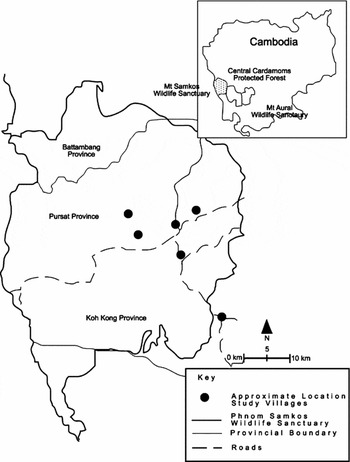
To further investigate resource related issues such as access and availability, we conducted a meeting in a third village from commune B. To compare CBNRM approaches, a third commune, commune C, was included, located in an already functioning NRM project, operating at a commune-level within the Central Cardamoms Protected Forest Project (CCPFP). Not managed by the DoE in Pursat, this project was initiated by a third NGO (NGO3), independent of the CMWSP (Communities Advisor, CMWSP, NGO1, Cambodia, personal communication 2003). In total, our study encompassed the four CF study villages and in the two additional villages; forest agreements provided the official committee structure and CF area boundaries (Fig. 1). The forest agreements provided the basis for reported and observed verbal contracts between community members and the DoE in Pursat. Project documentation (in Khmer) was translated into English.
Map of geographical location of the Cardamoms and the protected area. Village and commune locations have not been identified due to the political situation in the study area. Adapted from a compilation of maps provided by NGO1 documents and redrawn by A. Lo Cascio.

Data collection
The participatory rural appraisal (PRA) techniques in this study were adopted from Cambodia's participatory land use planning (PLUP) (Christ Reference Christ1999) process and the Asia Forest Network (AFN) guidelines (Poffenberger et al. Reference Poffenberger, McGean, Ravindranath and Gadgil1992), with secondary reference to Pretty et al. (Reference Pretty, Guit, Scoones and Thompson1995), Petheram (Reference Petheram2000) and Chambers (Reference Chambers2002). PRA is flexible to local design and adaptive to the local context (Chambers Reference Chambers2002). The AFN outlines three main categories for data collection techniques, which were combined in this study, namely interviewing, mapping and ranking (Poffenberger et al. Reference Poffenberger, McGean, Ravindranath and Gadgil1992).
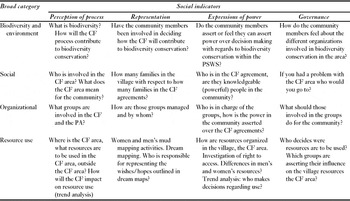
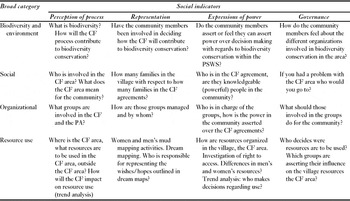
A list of social indicators provided a framework for the study (Hart Reference Hart1999). The guide questions were tested and further developed through consultation with the Phnom Samkos rangers and members of the Phnom Samkos community team (employed by the CMWSP) (Table 1).
Categories of social indicators used to develop guide questions.
Amanda Lo Cascio and a local research assistant trained in participatory processes were granted permission by respective commune and village chiefs to conduct the research study. They collected field data from six community meetings, community mud maps, trend analyses and ranking exercises. In total 52 full days were spent collecting field data, resulting in over 300 hours of transcribed data (equivalent to 60 in-depth interviews), 12 community-generated resource maps and six community-generated resource lists. Ethnographic data were also collected on customs, access to food and medicines and food resource use, community relationships and power relations between the communities and perceived outsiders as a result of increasing pressure to protect the Sanctuary. Each village meeting took a minimum of five days’ field preparation. Amanda Lo Cascio lived in the study villages. During that time, she made detailed drawings of the villages and community forest layout and location, transcribed conversations with commune, village chiefs, community forest committee members and local rangers, and photographed local resource use and harvesting. She also attended commune- and national-level community forestry meetings in Siem Reap, interviewed provincial-level government staff and relevant staff members from NGO1, NGO2 and NGO3, and visited three other PAs in Cambodia in an effort to compare previous government and NGO responses to conservation in the light of the newly emerging CBNRM projects. A further month was spent collecting secondary resources while living and teaching in an ‘underprivileged’ rural university, and volunteering for NGO1. The university position provided further insight into some of the root causes for immigration into places like the Cardamom Mountains and a better understanding of the harsh realities faced by the rural community in Cambodia. Community meeting sessions were held in all the four case study villages and in the two additional villages (Fig. 1).
While reliance on cross-community participatory workshops as the primary method of data collection was not ideal, one-on-one interview sessions were politically untenable for local participants. It became clear that it is customary for such an approach to be met with ‘coached’ responses. The social vulnerability of locals in the study was accepted, and data collection was adapted to suit these realities. The afternoon sessions focused on mapping and trend analysis activities, which were developed using the respondents’ answers from the communal in-depth interview sessions.
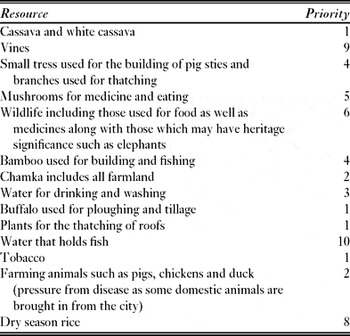
Villagers were first asked to draw the location of ‘markers’ like roads, rivers, houses, bridges and important buildings such as schools and hospitals on a large piece of plastic film. This generated the ‘mud map’ (Poffenberger et al. Reference Poffenberger, McGean, Ravindranath and Gadgil1992; Christ Reference Christ1999). Villagers indicated what types of resource were located in their villages, such as rice, timber, non timber forest products (NTFPs), fruit, medicine, drinking water and animals for eating. A list of these resources was made by the translator (most of the village members were illiterate) and explanation of different types of resources was discussed. For example, under the heading of tree resources, villagers listed the different purposes for which they used particular species. Symbols and pictures were negotiated and drawn alongside the names of resources. Following this, the villagers were asked to place the resources on the base map, one by one. These resources were then ranked by the participants according to their importance (Table 2).
Villagers’ ranking of importance of resources.

Villagers explained that priorities are seasonally dependent. Interviews were held at the beginning of the wet season, when most of the rice stores had been used and cassava was regarded as more important.
‘Dream mapping’ (Poffenberger et al. Reference Poffenberger, McGean, Ravindranath and Gadgil1992; Christ Reference Christ1999) followed the initial mud mapping, assisting locals to identify their vision of their villages and suggest future changes. It allowed identification of what needed to happen in management terms. Current land use options were discussed alongside everyday NRM practices. Trend analysis (Poffenberger et al. Reference Poffenberger, McGean, Ravindranath and Gadgil1992; Christ Reference Christ1999; UNDP 2004) assisted the villagers to identify perceived near future changes to current use scenarios as a consequence of the newly-created CF project and the protection of biodiversity resources.
We used content analysis to derive categories and identify patterns in the transcribed data. Mapping session information was integrated into these categories. Notes based on participant observation were added to the overall data and coded. Triangulation and integration of the various data sets was practicable (Web et al. Reference Web, Campbell, Schawrtz and Sechrest1966; Blaikie Reference Blaikie2000). We obtained further ecological and social baseline data from the CMWSP and by collecting secondary data sources within Cambodia.
RESULTS
We draw on two villages in commune A (within PSWS) that represent the greatest physical differences between the village communities we studied with respect to their proximity to outside resources and influences, including financial exposure.
Village 1 is located at the centre of two logging roads into the Cardamom Mountains and is easily accessible by road. It is a central location for commune meetings; visitors are frequent and migration is high owing to its accessibility. There is a cash economy in the village. The DoE initiated the community forest agreement (CFA) here in June 2003. To date, there are 91 families (190 males, 212 females) included in the village's CFA. During the study, there were significant disputes as to whether the CFA included all families in this village, as there were approximately 190 families in the village.
Village 2 is much more isolated; at the time of field investigations the use of cash for the buying of goods was new. Times of food shortage were frequent and outside resources such as food and medicine were not easily accessed. The DoE initiated the CFA here in August 2003. At the time of our study there were c. 51 families (105 males, 96 females) represented in the agreement; this included all the village's families.
Both of the villages were inhabited by subsistence farmers. Houses tended to be located in small groups either side of a track or road providing access to the village; most houses were grouped around square blocks cleared by burning the villagers’ used slash and burn agriculture. Each house was surrounded by harvestable fruit trees and saleable crops such as corn, sesame and pumpkin. Commune and village chiefs decided village rice paddy location.
In addition to subsistence farming, some community members travelled to Pursat or to other villages in the area to sell forest products such as fruit, mushrooms, resin, perfume, wildlife and medicine. Rice shortages occurred for 2–6 months of the year, and consequently many families were in debt to a moneylender as they borrowed money during lean periods to buy rice and other foods. In some cases, rice was shared between families from year to year. When rice was not available it was substituted by different species of cassava, forest fruit and vegetables. The average diet consisted of a staple of rice, supplemented by fish, fruit and vegetables, and sometimes chicken, pork and beef. Villagers explained that rice was sometimes the only thing eaten, especially at the end of the dry season and the beginning of the wet season.
Both villages experienced extended periods of hunger. Village 2 estimated that their hunger period lasted for up to 6 months, much longer than Village 1. Both villages said that the harvest of wild foods and wildlife became particularly important during such times. Alternatives to direct harvesting of food resources are working and earning money through the illegal timber and wildlife trade.
Community forest initiation
Both villages had established CF committees as part of the CFA, to represent them in the CFA, establish the location of the CF area in collaboration with the village and commune chiefs, collaborate with authorities and share information with village members. The CF committee was responsible for organizing patrols and protecting the CF area. NGO1 and government officers described these committees as being elected, but community members explained that, ‘We only vote because we have been told, we already know who the members should be’ (Villager 5, commune A, village 2).
We undertook a thematic analysis of the data to gain an understanding of the communities’ views concerning CF initiation by NGO1and NGO3 within their respective areas, and whether communities saw themselves as managing the CF as a CBNRM or influencing the process. With regard to the physical demarcation of the PA by government, the communities understood that NGO1 had considerable influence in this matter. There was significant confusion as to how inhabitants were to manage and engage with the CF area and how it was expected to contribute to community livelihood and to biodiversity conservation. Community members generally thought they had yet to be included in the decision-making process and therefore were hesitant to accept responsibility for management of the PA. Villagers indicated that the responsibility for the management of the PA should be with formal levels of government. Locals did not necessarily seek power in decision-making: generally this concept was feared, as community members did not want to be held accountable for what they foresaw as the likely failure of the CF or the PA. Most community members recognized that the CF had a role to play in livelihood improvement. The idea of livelihood improvement through diversification was a concept that was actively workshopped in both communities by NGO1 along with alternative and supporting farming practices aligned with the reduction of slash and burn agriculture.
Both villages recognized options for livelihood improvement, however they did not understand the CF areas function with regard to biodiversity conservation, as outlined by the objectives of the CMWSP. The priority of the communities was to locally manage and protect those areas which provided them with resources, and they did not distinguish these resources as being for biodiversity or for livelihood, these areas were defined by them as occurring mostly within the CF area. This had important implications for how the PSWS was perceived, as community members proposed that timber and resource extraction should occur outside the CF, in the PA. The idea that resources should be used in the PSWS and not the CF was supported by the communities’ perception of the inadequate provision of land for their daily needs, when compared to how much was being protected in the PSWS. For example, statements included, ‘For now, the CF is for the harvest of NTFP. . . timber for housing can be cut outside the CF (in the PSWS). There are enough resources now to use outside the CF‘(Village Chief commune A, village 1) and ‘We want to protect inside the CF, and outside we want the right to protect and use’ (Villager 2, commune A, village 2).
During the resource mapping and ranking exercises, the communities described the PSWS as having diverse resources of differing importance, based on the time of year or a particular situation. The concept of ‘biodiversity’ was aligned with variation of resource availability throughout the year. The proposed management structure had placed most of these areas as core or conservation zones under state control. This would allow harvest of these resources within the sustainable use zones (community managed on a lease basis from the state) and the community protected areas (understood by the communities to be CF).
In Village 2, the study was particularly effective in identifying resource use areas and problems associated with access, and therefore management, due to the designation of a PA. The mapping session revealed a marked decrease in resource abundance close to the village, particularly NTFPs traditionally collected by women, such as resin, mushrooms, vines for building and weaving, firewood and some medicines. Women from village 2 said they also collected small wildlife for medicinal purposes. The women said they were frightened to travel far from their homes because of wild animals, and they would not travel to the CF area. NTFP collection was traditionally done closer to their homes and, as the area immediately around their homes was becoming depleted, this would need to occur in the PA. It was particularly evident in the dream mapping sessions that the women recognized that their current levels of harvest were too high to sustain, but they also said they were in competition with other families and they felt that without harvesting the current amounts they would not be able to support their needs. This was not the case for all resources; medicines for example were particularly revered, possibly as a result of isolation and, as such, only small amounts were collected on each occasion in an effort to ensure sustained harvest.
Both the villagers and NGO1 said that the importance of NTFPs had not been covered adequately in the present CF agreements. The interviews indicated that the external valuation of biodiversity was in conflict with the villagers’ actual use of these resources; for example, the small wildlife that was traditionally used by them for medicinal purposes.
DISCUSSION
The PSWS PAs are highly contested places that are earmarked for biodiversity conservation despite the serious difficulties such programmes may create for local people. The devolution of power to the local community for the management of biodiversity resources through management projects put forward as CBNRM is understood within these villages and the implications this has for longer term biodiversity conservation and livelihood support. This creates tension between CBNRM and ideas about biodiversity conservation promoted by international conservation groups.
The Draft Protected Areas Law in the Cardamoms had strategic input from the international development community through donor funding and the holding of workshops (World Bank Group 2000; Smith Reference Smith2001). The global and Cambodian conservation community has made important contributions to the elaboration of government (Bryant Reference Bryant2002) and exercised significant pressure on the progress of development models to align these with their concerns about global biodiversity protection (Wells & Brandon Reference Wells and Brandon1992; Solano Reference Solano2003). Consequently, the expected results of PSWS management were intended to satisfy the aims of the conservation groups and international donor organizations, contributing to the transference of burden (Ribot Reference Ribot2004; Zakri Reference Zakri2000), through local management of global values (Virtanen Reference Virtanen2003). This leaves little room for bottom-up approaches to CBNRM, even though the rhetoric of community-based control and management is invoked. The struggle to effectively delineate and then implement the boundaries of the PA in Phnom Samkos testifies to how clearly the local people saw the consequences of the international process impacting on their daily lives.
An important component of the proposed management structure for PSWS was the involvement of local community in the management of local resources (FFI 2000). The village members identified the initiation of the CFA as originating from outside their communities. Power relations within the communities were maintained as villagers ‘elected’ the usual heads as their representatives. While post-communist states may have structures that appear to facilitate participation, in this case participation promoted by outsiders was regarded with mistrust, evoking memories of a coerced collectivism under the Khmer Rouge.
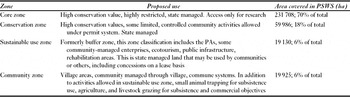
For the local agencies and people, the partitioning of landscapes and resources is understood as imposed territorialism, with important consequences. The initiating bodies expected locals would participate in community areas through the village commune system, and play an active role in sustainable resource use through the establishment of a CPA. These expectations were based on ideas about participation embedded in CBNRM theory. In reality, this complex web of zones is difficult to maintain across the everyday landscape of the villagers. Community members understood that the initiation of CF areas would be inside the sustainable use zones (Table 3). They recognized that the majority of land was to be protected and that the PAs were mainly a response to high immigration rates, illegal logging and, importantly, as a result of the biodiversity interests of the conservation groups working in the area.
Description of the PA draft law proposed management zones for Phnom Samkos (Source: IIED Reference Grieg-Gran, De la Harpe, McGinley, MacGregor and Bond2008).

The implementation of the CF areas within the PSWS were facilitated by the mobilization of several environment groups and fiscal support originating largely from donor funds distributed through Seila. These management areas exemplify the complex relationships between and within the institutional bodies that are actively involved in its management and /or protection. The community members recognized that their institutions were being mobilized to facilitate the CF areas but that the impetus was coming from outside their communities. While others have recognized the importance of NFTP in creating alternatives for livelihood options and for recognizing the role of women in production systems (Kusters et. al. Reference Kusters, Achdiawan, Belcher and Ruiz Pérez.2006) the villagers understood that their local harvest practices (such as NFTP collection) were secondary to the protection of resources for biodiversity, such as timber.
While the PSWS was perceived by community members as an attempt to restrict access to land, the CF agreement was considered as a way for the villagers to regain some control over resource use. Both study villages welcomed recognition in the form of involvement in meetings, other more formal activities such as voting, and the perceived exclusive power to sanction access to the PA. The villagers commented on the confusion they experienced in being consulted about their needs, but then recognizing some of their needs were being prioritized second to the needs of animals and their habitat. There was an expectation that the government would lose interest in biodiversity as it needed to respond to current problems rather than the future.
As Kusters et al. (Reference Kusters, De Foresta, Ekadinata and Van Noordwijk2007) noted, community members established and legitimated their own claim that they knew how to protect the CF by exercising their power to control access, exclude outsiders, have management control and prepare fire breaks. The creation of fire breaks was considered important in all of the communities visited. Burning is the preferred method of land clearing for chamka (farming land) and housing. One villager stated, ‘If we help protect (the CF area) we can keep out outsiders, and have the right to use resources, and we will raise money to patrol and prepare a fire break’ (Commune B villager 5, village 2). Another said, ‘The CF area will be protected from the outside public who will not be allowed’ (Villager 5, commune A, village 2).
The idea that communities could decide who had a right to use resources was an exciting prospect. This was also the first time for many, that they had been approached by members of government and asked to contribute to discussions about conservation values. They were ready to take on management tasks that aligned with their understanding of the resource. One villager said, ‘It is good they ask us, we can do a better job than NGO3 in protecting the forest, we live here and know where the resources and illegal activities are. . .’ (Villager 6, commune A, village 2).
The power to exclude outsiders was a concept actively solicited by villagers, with on-site help from rangers and financial support from the DoE office. Community members were familiar with patrols and the rangers were part of their community. In contrast, decisions concerning CF management and its role with respect to the PA were perceived by community members as occurring at the provincial level between the DoE and the commune chiefs. Here, local power over decision-making was deemed ineffectual.
There was ongoing concern over the legality of past tenure arrangements with government, and the continuing illegal sale of land. Most community members believed that even if they did not own the land they were using, they had a right to occupy and use it. It was not owned by anyone else. Introducing ranger patrols changed the situation as villagers interpreted these patrols as evidence that the government now owned the land, and that the commune could not protect the right of local villagers to occupy it. This was associated with the international conservation groups having attributed conservation values to the land surrounding their villages, and so drawing interest from the national and international governments. One villager commented, ‘. . .before the land was not owned, but now that NGO1 and NGO3 (rangers) have a policy to protect, we must ask for land and resources’ (Villager 1, commune A, village 2). Consequently village leaders were becoming increasingly unsure of their role and apprehensive of land promises made in the CF agreements, as illustrated this remark by a village chief, ‘I am not clear of the intentions of the government to protect. I have called this meeting so that we can all discuss CF and what it means for us’ (Village chief, commune A, village 1). Villagers believed that the government was to blame for the restriction on access to land and therefore the harvest of resources but decided that although the governing role of the commune had been challenged, it was still the responsibility of the village elders to represent the people in asking for more access to land. One villager reflected, ‘If we do not have enough land, the village chief will ask the commune chief and they will ask for more’ (Villager 3, commune A, village 1).
At a local level, the approach adopted in supporting the DoE in implementing CBNRM projects within the PSWS are in line with ideas about the importance of deliberative democracy (Dryzek Reference Dryzek1997) in harnessing participatory processes. The protection of biodiversity has focused attention on particular landscapes as being more important and even ‘hotspots’ of biodiverse interest. Global conservation practice, while developing alternative approaches that recognize the role of people in the creation and management of landscape, such as biosphere reserves, are also oblivious to the critique of the ‘crown jewels’ approach within PA management (Pressey Reference Pressey1995). Conservation science is extremely powerful in underwriting which species and habitats are targeted. The imposition of these external influences has significant impact on Cardamom life.
The decentralization of NRM to the community level requires that local communities accept responsibility, and are held accountable for the decisions they make (Ribot Reference Ribot2004). For these villagers, the management of biodiversity as a resource for the global ‘good’ has little relevance. Community members were hesitant to accept responsibility for the CF area or biodiversity as a global conservation resource within the PA. Rather, they incorporated ideas about biodiversity as a normal resource. This points to the significance of the negotiation process, where discussion of PA management needs to build shared values.
Misinformation and misunderstanding as to the complete purpose of the CF in relation to the PA caused both villagers and leaders to question their role as CBNRM managers in the CF process and mistrust the intentions of government. Further, distrust, combined with insecurity of land tenure arrangements, led villagers to focus on the acquisition of more land and resources, rather than a more equitable or sustainable practice of land and resources distribution and access in areas already being used for production. Community livelihood associated with the CF area did not link directly to their management for biodiversity conservation, and yet the local discussion with the agencies and forest personnel equated the two.
CONCLUSIONS
This study explored the implementation of CBNRM as a management strategy in achieving the objectives of global biodiversity conservation at the local level. The basic mismatch between intention and outcome on both the part of international sponsors and local people creates an opportunity to pause and rethink the proposed formulas. The villagers considered the PA and its offshoot, the CF, as a burden of responsibility. In both villages the focus on income generation capabilities in the CF area coupled with the perceived restriction of livelihood opportunities resulted in community members focusing on investment outcomes, such as the development of the much wanted schools and roads. The significant devolution of power to local communities for the management of these sites means that in the long term, the actual definitions of PAs, biodiversity and sustainable management representing a more integrated approach will have to be locally negotiated, including both production and conservation systems.
Otherwise, the transfer of demands from the centre to local sites for resource management will be a superficial transfer of tasks and a kind of indentured labour, with little scope for long-term viability. Long-term conservation of the resources and biodiversity within the PSWS cannot assume that there is a difference between what are ‘resources’ and what is designated for ‘conservation’. Conservationists may argue that project objectives represent an international imperative that overrides local realities. The questionable morality of this undermines the urgent need for planetary conservation values that reflect these local realities. Currently confined by the values of conservation or development institutions, CBNRM can only achieve sustainable resource use or biodiversity conservation in the short term. More poignantly, in its current manifestation, it will only succeed in promoting a shift from resource management to people management, hardly the radical alternative prophesized for CBNRM or required for effectively integrating conservation and production needs across the landscape of the Cardamoms.
ACKNOWLEDGEMENTS
We thank the inhabitants of the study region for their willingness to participate in this study, and we are grateful for the support of various NGO personnel, local translators (in particular Seang Sothea) and government workers who assisted. Owing to the sensitive political situation, the names of the villages and key personnel have been removed.