1. Introduction
Previous crosslinguistic research on multi-word verbal constructions has highlighted the productivity of verbo-nominal combinations with so-called light verbs.Footnote 1 This term was first used by Jespersen (Reference Jespersen1942) to describe semantically low-content verbs in English such as get, make, take, have, and give, which, when combined with an NP complement, may form a complex predicate (CP) whose meaning can be expressed by a corresponding simplex verb. Following Brinton & Akimoto Reference Brinton and Akimoto1999, I assume that the combination of a light verb and its complement is a type of CP—a general term used to refer to multi-word verbal expressions including phrasal verbs (to turn over), verb + PP combinations (to set in motion) or verb + AP expressions (to make clear). Discussion in this study is limited to verbo-nominal CPs (light verb + NPs) with transitive (both mono-transitive and ditransitive) verbs. I refer to this subgroup of CPs as light verb constructions, or LVCs.Footnote 2
All Germanic languages exhibit LVCs similar to those found in English. Consider the Swedish example in 1a, with the light verb giva ‘give’ combined with the object svar ‘answer’, in comparison to sentence 1b, with the simplex verb svara ‘answer’.Footnote 3
(1)


As Butt (Reference Butt, Amberber, Baker and Harvey2010:1) points out, a light verb in a CP expresses a generic meaning rather than the meaning of its full verb counterpart. In other words, the light verb ge in 1a does not predicate fully like ge in the phrase ge pengar (till banken) ‘give money (to the bank)’, although the light verb is syntactically and semantically necessary for the CP to be grammatical and meaningful as a whole.
The diachrony of the LVCs has been a prevalent topic in historical linguistic research, but most empirical studies have focused on the history of English (Brinton & Akimoto Reference Brinton and Akimoto1999, Claridge Reference Claridge2000, Ronan Reference Ronan2012, Elenbaas Reference Elenbaas2013). The current study provides comparative data from Old Swedish texts written in the 13th to 15th centuries. Consider examples below from the 15th century: In 2a, the light verb gifwa ‘give’ is paired with the complement hiälp ‘help’, whereas in 2b, the simplex verb hiälpa ‘help’ occurs by itself.
(2)

Much diachronic research on LVCs has focused on two main areas of interest, namely, the increased frequency and diversity of new light verb + NP pairings and the possibility that light verbs have become grammaticalized. The steady increase in frequency of LVCs and the increase in the number of unique NPs in LVCs in earlier English, for instance, has fueled the debate over what might have brought about their expansion in Middle English (Traugott Reference Traugott1999). Possible explanations range from language contact (Ronan Reference Ronan2012, Reference Ronan, Davidse, Gentens, Ghesquière and Vandelanotte2014) to a general drift toward analyticity (Hiltunen Reference Hiltunen1999) or the rise in the use of indefinite articles (Brinton Reference Brinton, Seoane and López-Couso2008, Elenbaas Reference Elenbaas2013). The majority of recent historical syntactic research focuses on the possibility that CPs with light verbs have been grammaticalized to express aspectual subtleties: In phrases such as take a bath versus to bathe, for instance, the LVC as a whole is claimed to express boundedness (Brinton & Traugott Reference Brinton and Traugott2005). Because of other characteristics that are typical signs of grammaticalization—for example, increased type-token frequency and semantic bleaching—several studies have suggested that light verbs are becoming more auxiliary-like and that they belong to an intermediate stage between full verbs and auxiliaries (Hopper & Traugott Reference Hopper and Traugott2003). Others, like Bowern (Reference Bowern2008), Butt (Reference Butt, Amberber, Baker and Harvey2010), Butt & Lahiri (Reference Butt and Lahiri2013), and Elenbaas (Reference Elenbaas2013), provide counterarguments showing that light verbs have not undergone grammaticalization; instead, they are simply semantically-deficient versions of their full verb counterparts, but they show no signs of becoming functional grammatical markers.
The current study aims to fill several gaps in diachronic research in these two areas by examining the frequency, range, and diachronic development of LVCs in Old Swedish texts from the 13th, 14th, and 15th centuries. Most previous empirical studies on the diachrony of CPs with light verbs focus solely on the history of English, while the current analysis provides comparative data with another Germanic language.Footnote 4 Because of the availability of large-scale parsed corpora of Old, Middle, and Early Modern English, diachronic research on light verbs has been limited to historical English data (Brinton & Akimoto Reference Brinton and Akimoto1999, Claridge Reference Claridge2000, Elenbaas Reference Elenbaas2013). However, more recently, part-of-speech tagging and lemmatization of early Scandinavian texts have facilitated the investigation of similar aspects of LVCs in the history of Icelandic, Danish, Norwegian, and Swedish.Footnote 5 The Swedish corpus in particular allows for comparative analysis of texts from different genres across an extended period of time. Moreover, because of the similarities between Swedish and English in the Germanic language family, one is better able to test hypotheses that have been proposed regarding the reasons for an increased use of light verbs over time: If language contact plays a role, for instance, then it is useful to compare similar languages such as Swedish and English that have different language contact scenarios. Lastly, because of the diversity of texts available in the Swedish corpus, one is able to examine the role that text type plays in shaping the frequency and variety of LVCs in different genres. By examining differences in texts from various categories, one is better able to understand the role of external linguistic factors and separate them from internal linguistic factors that might have a distributional effect on LVCs.
The three main research questions of the paper are the following:
(i) How frequent are LVCs in Old Swedish?
(ii) How diverse are the light verb + NP pairings in Old Swedish?
(iii) What are possible causes for changes in the frequency and diversity of LVCs in Old Swedish?
In section 2, I provide background on terminology and classification of LVCs in previous synchronic and diachronic studies, followed by an overview of research on light verbs in Swedish. Section 3 addresses the data collection procedures and text selection. Section 4 is a presentation of the empirical results of the study. The discussion in section 5 addresses some of the external and internal linguistic factors that may have affected the use of LVCs in Old Swedish. Conclusions and implications for future research are provided in section 6.
2. Background
A wide variety of characteristics common to LVCs has been discussed in previous empirical research—in both synchronic and diachronic studies—yet there is little agreement on terminology. Following Brinton & Akimoto Reference Brinton and Akimoto1999, I classify light verb + NP pairings as a specific type of CP, a term that aptly describes the predicative aspects of these expressions while highlighting the greater complexity of verbo-nominal combinations compared to synonymous simplex verbs.Footnote 6 Because of the lack of agreement on terminology, it is difficult to compare the results of different studies. This section will provide background on terminology, and section 3 will address how LVCs are classified in the present study.
2.1. Classification of LVCs
Three main issues have emerged in discussion on the classification of LVCs: the syntactic and semantic relationship between the light verb and its complement, the characteristics of NP complements in LVCs, and the categorization of light verbs themselves. Regarding the first issue, most scholars agree that LVCs consist of multiple elements that jointly contribute to the overall meaning of the phrase (van Pottelberge Reference Pottelberge2001). Butt (Reference Butt, Amberber, Baker and Harvey2010:49) states that a CP with a light verb “involves two or more predicational elements (e.g., nouns, verbs, and adjectives) which predicate as a single unit, i.e., their arguments map onto a monoclausal syntactic structure.” In many accounts, such as Quirk et al. Reference Quirk, Greenbaum, Leech and Svartvik1985, Claridge Reference Claridge2000, or Ronan Reference Ronan2012, the importance of the verb's complement is emphasized: The NP carries the semantic weight of the phrase and expresses the verbal action, while the semantically-deficient light verb functions merely as a marker of inflection. However, previous studies agree that the light verb and NP function in tandem, and both are essential to the syntax and semantics of the CP.
Regarding the second issue—that is, the characteristics that define the NP complement in LVCs—there has been little consensus. One strand of research assumes a narrow definition by only including those examples with zero-derivations, such as drink in to have a drink (Nickel Reference Nickel1968, Wierzbicka Reference Wierzbicka1982), or only those with NPs that have a morphologically-related simplex verb, such as decide > decision in to make a decision (Hoffman Reference Hoffman1972, Live Reference Live1973, Dixon Reference Dixon1992, Algeo Reference Algeo, Aarts and Meyer1995). However, others, such as Claridge (Reference Claridge2000) and Ronan (Reference Ronan2012, Reference Ronan, Davidse, Gentens, Ghesquière and Vandelanotte2014), use a broader definition for the NP complement in LVCs to include any abstract or action nouns. According to Quirk et al. Reference Quirk, Greenbaum, Leech and Svartvik1985, some nouns, such as effort in to make an effort, do not have a simplex-verb equivalent (*to effort) but are often considered part of LVCs because of their abstractness and frequent occurrence in collocations with typical light verbs. As pointed out by Ronan (Reference Ronan, Davidse, Gentens, Ghesquière and Vandelanotte2014), diachronic studies often face an additional complication when dealing with the requirement that the light verb + NP combination must have a simplex verb equivalent to be considered an LVC. In some cases, the simplex verb no longer exists in the language, as in take (a) wife (compare Old English wīfian), while in others, the simplex verb arose much later, after the first attestations of the relevant light verb + NP pairing, for example, to battle (Ronan Reference Ronan, Davidse, Gentens, Ghesquière and Vandelanotte2014:20).
An additional characteristic of NP complements is the degree of their modification. As Claridge (Reference Claridge2000) points out, the general group of verbo-nominal combinations in English includes both simple light verb + NP pairings, such as take place, and light verb + NP + PP combinations, such as run the risk of or make use of, in which a PP is a postnominal modifier; many synchronic and diachronic analyses do not make this distinction (Claridge Reference Claridge2000:70–71). The most common type of modification discussed in the LVC literature, however, is the addition of indefinite or definite articles, quantifiers, possessors, or adjectives to the NP. As Brinton (Reference Brinton, Seoane and López-Couso2008) points out, lack of modification to the NP is a result of the idiomaticity of certain CPs: For instance, some English LVCs are fixed expressions that may not contain an article (lose *a/*the sight of) or an adjective (lose quick (?) sight of), or they can only contain one type of article (give a/*the shove). In contrast, other LVCs that are less idiomatic allow nominal modification or even require it. For example, LVCs such as take a (quick) look at allow adjectival modification, whereas others, such as take a look at or give the slip to, require an (in)definite article (*take look at or *give slip to; Brinton Reference Brinton, Seoane and López-Couso2008:34). As has been pointed out in studies of English, the presence of an article contributes to aspectual meaning, expressing boundedness (Rensky Reference Rensky1964, Stein Reference Stein1991) or telicity (Prince Reference Prince and Plötz1972).
One last issue often discussed in the LVC literature relates to the classification of light verbs. There is general agreement that light verbs are in some way different from full verbs; they have been described as “semantically deficient” versions of full verbs (Bowern Reference Bowern2008:163) that have “lost some of their semantic content” (Butt Reference Butt, Aygen, Bowern and Quinn2003:1) or “have a rather general meaning and are semantically more lightweight than the same verb would have been in a normal context” (Allerton Reference Allerton2002:172). However, the notion of lightness is a matter of degree, as can be seen in several different light verb + NP pairings. Hanks et al. (Reference Hanks, Urbschat and Gehweiler2006:441) point out that the light verb in take place is very light, as indicated by several syntactic tests: The verb take makes no contribution to the meaning of the CP; the phrase cannot be passivized (*place was taken); no synonymous NP can convey the same meaning (*take location). However, in other CPs, such as take a picture, the verb seems to carry more meaning and behave differently: It can be passivized, as in a picture was taken, and the NP can be replaced by a synonym, as in take a photo (Hanks et al. Reference Hanks, Urbschat and Gehweiler2006:441). Quirk et al. (Reference Quirk, Greenbaum, Leech and Svartvik1985) and Stein (Reference Stein1991) also point out that light verbs are not completely void of meaning, noting that the same NP can be paired with different light verbs and have a slightly different meaning in each context (from Quirk et al. Reference Quirk, Greenbaum, Leech and Svartvik1985, as cited in Elenbaas Reference Elenbaas2013:49):
(3)

As indicated in the examples in 3, the choice of a light verb contributes subtle differences in meaning. In other words, although the light version of the verb is semantically lighter than its full counterpart, it is also not entirely semantically empty.
In attempts to categorize light verbs in synchronic and diachronic studies, there is general agreement that they make up a small class of highly frequent verbs. In studies of English, this class includes make, take, give, have, and do. Footnote 7 Traugott (Reference Traugott1999:243) points out that although the rankings of the five verbs change slightly between Old English and Present Day English, remarkably, the same five remain at the top of the list of verbs in CPs throughout each historical period. Brinton (Reference Brinton, Seoane and López-Couso2008:46) takes note of the continuity of this class of verbs, citing the stability as a sign of grammaticalization. Empirical studies in other Germanic languages do not limit themselves to this closed class, although equivalents to these same five light verbs in English are mentioned. In von Polenz's (Reference Polenz1963, Reference Polenz1987) description of Funktionsverbgefüge in German, for example, he lists machen ‘make, do’, haben ‘have’, and geben ‘give’, but also includes others, such as bringen ‘bring’, leisten ‘achieve, accomplish’, and bewirken ‘bring about’, whose equivalents are not in the small group of English verbs.
In previous empirical studies, what constitutes a light verb largely depends on whether one follows a more theory-driven, top-down procedure in searching for light verb + NP collocations in corpora, or a methodology-driven, bottom-up procedure for selection. In top-down studies, one establishes various criteria for identification of light verbs, searches a corpus accordingly, and finds a wide variety of verbs that fit those criteria with a broad range of NPs. In bottom-up studies, one selects only a few light verbs, limits the search to NPs that are paired with those few verbs, and finds a narrow range of frequent collocations. Many diachronic studies of early English corpora follow the bottom-up procedure and discuss one or more of the five typical light verbs (make, take, give, have, and do), as do the studies in Brinton & Akimoto Reference Brinton and Akimoto1999, as well as Iglesias-Rábade Reference Iglesias-Rábade2001, Gárate Reference Gárate2003, and Elenbaas Reference Elenbaas2013. The top-down approach has become more common in recent studies of Present Day English, however, including Allerton's (Reference Allerton2002) compre-hensive analysis of thin verbs and Ronan & Schneider Reference Ronan and Schneider2015. With a broader definition of light verbs in mind, Allerton discusses high frequency verbs that include the usual five light verbs, medium-frequency light verbs, such as feel, find, grant, and receive, among others, and those with a low frequency, including add, lodge, or launch. Footnote 8 This kind of top-down search procedure is followed by Claridge (Reference Claridge2000) and Ronan (Reference Ronan2012, Reference Ronan, Davidse, Gentens, Ghesquière and Vandelanotte2014) in their historical linguistic studies.
2.2. LVCs in Swedish
There are fewer analyses of LVCs in Swedish compared to English, although the topic has not gone unnoticed. In earlier research on CPs in Modern Swedish, for example, Ekberg (Reference Ekberg1989) discusses so-called abstrakta övergångsfraser ‘abstract transitional phrases’, such as falla i sömn ‘fall asleep’ or gå till anfall ‘attack’, which can also be expressed by simplex verbs (somna or anfalla). She points out that the verb in such expressions (falla ‘fall’ or gå ‘go’) is often a high-frequency verb in Swedish that conveys a more general meaning when it co-occurs with a PP in a collocation than when it occurs on its own (Ekberg Reference Ekberg1989:19). Her analysis is limited to the action verbs falla ‘fall’, råka ‘happen’, gå ‘go’, and komma ‘come’ that occur in CPs with PPs. In her 1993 study, Ekberg focuses more specifically on the verb ta ‘take’, including examples with NP complements, such as ta (ett) beslut ‘make a decision’.
Dura (Reference Dura1997) builds on Ekberg's analysis of collocations with semantically light verbs, focusing on phrases with so-called stödverb ‘support verbs’ and their NP complements. Her brief study is the first empirical analysis of Swedish that analyzes verbo-nominal combinations using a large database of dictionaries (Svensk Ordbok [the Swedish Dictionary] and Nationalencyklopediens ordbok [the National Encyclopedic Dictionary]). One of the goals of her analysis was to determine the frequency of lexfraser ‘lexicalized phrases’ (Anward & Linell Reference Anward and Linell1975), or fixed idiomatic expressions with verbs and nouns in their base form, here defined as an NP without an indefinite or definite article. Thus, Dura (Reference Dura1997) conducted her search for pairings that contain a transitive verb and a bare NP, as in byta namn ‘change name, rename’, ha fest ‘have (a) party’ along with NPs with postnominal PPs, such as ha samband med ‘be related to’ and ta intryck av ‘be influenced by’. She presents shortened lists of examples based on 15,595 combinations of lemmatized forms of verbs and bare NPs found in the lexical database, 3,784 of which occur with high frequency and contain 72 different verbs and 341 nouns. Dura (Reference Dura1997) points to the need for more extensive Swedish lexical resources to mark clearly the differences between light verbs and full verbs.
Subsequent corpus linguistic research on Modern Swedish has focused on individual verbs that function as light verbs in a handful of collocations. Most recently, Reference CinkováCinková (2009a, Reference CinkováCinková 2009b) examines CPs with light verbs from a Czech–Swedish contrastive perspective for the purpose of developing a machine-readable lexicon for advanced Czech learners of Swedish. Using Viberg's (Reference Viberg1990) profile of word frequency distribution in Swedish, Reference CinkováCinková (2009a, Reference Cinková2009b) takes the 20 most frequent verbs in Swedish as a starting point, excludes copular and modal verbs, and arrives at a list of lexical verbs that is the basis for further analysis of collocations. Following Viberg Reference Viberg1990, she highlights these so-called basic verbs, such as göra ‘make/do’ or ta ‘take’, among others, citing their simple phonological form, high frequency, broad crosslinguistic distribution, and the fact that they often have “secondary meanings” that differ from the full verbs’ meanings (Reference CinkováCinková 2009b:122). Cinková identifies phrases with basic verbs, develops a way to search large corpora for collocations with light verbs, and investigates more closely a few, including komma att ‘come to’ as a future marker, hålla på ‘be busy’ (lit. ‘to hold on’), and pseudo-coordination with ta ‘take’, ligga ‘lie’, sitta ‘sit’, and stå ‘stand’. Others, such as Ekberg (Reference Ekberg1993) and Asplund (Reference Asplund2012), take a bottom-up approach, limiting their searches to individual verbs or examining other types of CPs, such as phrasal verbs and light verb + PP expressions outside the category of verbo-nominal constructions.Footnote 9
LVCs in earlier stages of Swedish have received even less attention than their counterparts in Modern Swedish. Although Delsing's (Reference Delsing, Durme and Schløser1998) study of support verbs is mainly synchronic, he provides useful data on some historical aspects of LVCs in Old Swedish. As background for his analysis of Modern Swedish, he lists three subgroups of support verbs (Delsing Reference Delsing, Durme and Schløser1998:63):Footnote 10
(4)

The expressions in 4a may be replaced by a simplex verb (behöva ‘need’, samtala ‘converse’) related to the predicate noun, while those in 4b can be paraphrased by an unrelated verb (tycka om ‘like’, berätta ‘tell’; Delsing Reference Delsing, Durme and Schløser1998).Footnote 11 The expressions in 4c, although similar in many ways to those in 4a,b, cannot be paraphrased easily by a single verb. Much like Dura (Reference Dura1997), Delsing defines support verb constructions as those that contain bare NPs—without NP-modification through indefinite or definite articles, quantifiers, and adjectives. Moreover, Delsing includes in his examples those that contain a PP complement to the noun, as indicated by the phrases in 4. After describing the differences between support verbs and full verbs with respect to argument structure, he provides interesting data from Old Swedish on the tendency of many support verb constructions to contain a genitive pronoun (thes), as in 5 (examples from Delsing Reference Delsing, Durme and Schløser1998:84, with original sources).
(5)

As these examples indicate, Delsing's definition of support verb constructions in Old Swedish is strictly limited to CPs with a light verb and a bare NP. Support verb constructions with NP modification included in his analysis are those in 5, with the genitive form of thes (orthographic variants: thæs/thäs) in a position before the noun. As a result of this strict definition, the data in Delsing Reference Delsing, Durme and Schløser1998 represent only a subset of the examples in the current study.
Other diachronic studies of Swedish that deal with LVCs include Malmgren Reference Malmgren2002 and Hilpert & Koops Reference Hilpert and Koops2008. Hilpert & Koops (Reference Hilpert and Koops2008) focus on pseudo-coordination with sitta ‘sit’, as in Old Swedish example 6a or Modern Swedish example 6b (from Hilpert & Koops Reference Hilpert and Koops2008:243):
(6)

In their analysis of texts written between 1300 and the present day, Hilpert & Koops (Reference Hilpert and Koops2008) found that sitta ‘sit’ functions as a light verb in early Swedish. They suggest that it is grammaticalized to express aspect related to the second verb in the pseudo-coordinated phrase. In terms of direct comparison with the current study, Hilpert & Koops Reference Hilpert and Koops2008 is rather limited. Their analysis focuses only on sitta and does not examine other examples with verbo-nominal combinations, as is discussed in the current study.Footnote 13
Malmgren (Reference Malmgren2002) also examines light verbs diachronically, focusing on developments in some phrases from the 19th and 20th centuries. He situates his study in an LFG framework, examining a wide variety of Ekberg's abstrakta övergångsfraser ‘abstract transitional phrases’ in earlier Modern Swedish texts, such as gå till aktion ‘take action’. However, he also examines a category that he refers to as abstrakta förstaaktantsverb ‘abstract first action verbs’, such as begå självmord ‘commit suicide’ and bjuda motstånd ‘offer resistance’. Such constructions involve a verb connected to an NP object's “deep subject”—an animate agent, which is associated with an object noun but is the subject of the collocation's verb (Malmgren Reference Malmgren2002:16). Malmgren found approximately 50 different verbs in these expressions that he refers to as kollokatorverb ‘collocational verbs’, all of which are highly frequent light verbs that have been discussed thoroughly in studies of German and English. In terms of diachronic development, Malmgren notes that these verbs appear in both groups of collocations (abstrakta övergångsfraser and abstrakta förstaaktantsverb) well before 1800. There are just a few collocations, in which a verb begins to appear after this date, such as genomföra ‘implement’ (Malmgren Reference Malmgren2002:44); in other examples, a verb begins to decrease in frequency as a partner to a predicate noun. For the most part, however, there is stability among the class of collocational verbs and an increase in the number of different verbs that occur with particular NP complements.
3. Methodology
3.1. Corpus
Nine texts were selected for analysis in this study. Five texts, written prior to 1375, come from the period of Swedish traditionally known as äldre fornsvenska ‘Older Early Swedish’ (OSw1); four texts, written between 1375 and 1526, come from the yngre fornsvenska period, ‘Younger Early Swedish’ (OSw2; see the data sources section for a list of texts and word lengths; dates are provided in table 3 in section 4).Footnote 14 Magnusson (Reference Magnusson2007) addresses the need to use a wide variety of genres in any empirical analysis of early Swedish corpora, selecting texts that range from religious prose and formal texts to secular informal texts, translations into Swedish along with the originals, public documents and private letters. However, as Håkansson (Reference Håkansson2008:16) and Höder (Reference Brandtler, Delsing, Byrman, Gustafsson and Rahm2010:100) point out, the Old Swedish material from this earliest period available today poses a number of challenges for the creation of a balanced and representative corpus. In selecting Old Swedish texts, I considered four main factors in order to minimize these difficulties: genre, foreign influence/translation, date of the manuscript/composition of the text, and the total number of words available in the texts for each of the two periods under investigation.
The nine texts represent two broadly-defined genres, namely, legal documents and nonlegal prose.Footnote 15 Most of the earliest texts from the 13th century are legal treatises from different regions of Sweden. The three legal documents from OSw1 analyzed in this study, Skånelagen ‘The Law of Scania’, Äldre Västgötalagen ‘The Early Westrogothic Law’, and Upplandslagen ‘The Law of Uppland’, represent typical legislative documents from the earliest period. However, around the 14th and 15th century, a shift occurred in the composition of the corpus: Fewer legal documents and more religious and secular prose became available for linguistic analysis. My aim was to achieve a more balanced represen-tation of genres in the two periods, and so I selected an additional legal text from OSw2, Kristoffers landslag ‘The Country Law of Christopher’, to counter-balance the heavier representation of legal texts in OSw1.Footnote 16 I also aimed for a similar distribution of nonlegal texts from this period by selecting two lengthy religious prose texts from each period: Pentateuchparafrasen ‘Pentateuch Paraphrasis’ and Fornsvenska legendariet ‘The Old Swedish Legendary’ from OSw1 and Birgittas uppenbarelser ‘The Revelations of St. Bridget of Sweden’ and Själens tröst ‘Comfort of the Soul’ from OSw2. Another problem in establishing representativeness and balance in an Old Swedish corpus is that there are few secular prose texts available in OSw1, despite the growing body of texts of this type in OSw2, such as Barlaam och Josaphat. However, given what is available from the 13th and 14th centuries, and other parameters of text selection taken into consideration here, this imbalance is unavoidable.Footnote 17
Another challenge in developing a balanced and representative corpus of Old Swedish is that many texts from the 14th and 15th century exhibit considerable influence from other languages. In particular, this concerns translations. As Höder (Reference Höder2010) points out, Swedish translations in general are influenced by the original: Foreign language influence is reflected in syntax, word choice, and various scribal practices. The extent of this influence varies from text to text, and so the data in an empirical study may be skewed. Yet, as discussed in the introduction, one of the issues addressed in this paper is the extent to which foreign influence plays a role in the frequency and variety of light verb + NP pairings. To be able to address this issue I selected and analyzed several texts that were originally written in Latin or Low German and then translated into Swedish—for example, Pentateuchparafrasen and Fornsvenska legendariet from the OSw1 period, and Birgittas uppenbarelser and Själens tröst from the OSw2 period. To ensure a balanced representation of texts with and without the signs of foreign influence across genres and periods, original Swedish texts from each period were selected as well.
The last two factors in text selection were date and text length. In some cases, it is difficult to establish an exact date of the texts, since the date of composition and the date of the manuscript are not always the same, nor are these dates always easy to determine. For instance, Birgittas uppenbarelser has a long textual history: The version of the text used here (Codex Holm A 33) is from a 15th-century manuscript that contains a Swedish retranslation of the Latin version of Birgitta's revelations, which, in turn, were based on the original Swedish auto-graphed texts written by Birgitta herself around 1367, of which only a portion remains.Footnote 18 Considering this lengthy textual transmission and the approximate date of the retranslation, I follow traditional dating in Fornsvenska textbanken of Birgittas uppenbarelser, which places this version in the early part of the yngre fornsvenska period (OSw2). In other instances, such as Pentateuchparafrasen, the original text was probably written down around 1330, although the only extant manu-scripts are from the 15th (Codex Thott) and 16th centuries (Codex Holm A 1). I consider this text to belong to OSw1, following dating established in other empirical analyses that refer to its language as being more indicative of the 14th century (see Delsing Reference Delsing1999, Höder Reference Höder2010).
In general, the grouping of texts according to one of the two periods is meant to provide relative dating of earlier versus later texts for chronological comparison rather than to establish exact dating of each text. Moreover, I have also attempted to include texts whose length allows for an appropriate mixture of genre and foreign influence, as well as for a similar-sized collection of texts from each of the two periods. As a result, the word counts for the texts from OSw1 and OSw2 are similar (349,977 and 334,138 words, respectively). When individual texts are analyzed, I normalized all frequency measurements in order to take into account the varying lengths of texts.
3.2. Selection of LVCs in Old Swedish
The issues regarding the classification of LVCs discussed in section 2 were taken into consideration when selecting light verbs and their corresponding NP objects. Following a bottom-up search procedure, as discussed in Traugott Reference Traugott1999 and Elenbaas Reference Elenbaas2013, I limited my analysis of Old Swedish LVCs to five common transitive verbs in verbo-nominal expressions: fa ‘get/receive’, giva ‘give’, göra ‘do/make’, hava ‘have’, and taka ‘take’.Footnote 19 Moreover, I make the following three assumptions in selecting relevant light verb + NP pairings for empirical analysis:
(i) LVCs contain a verb with low semantic specificity and an NP complement, both of which are conceptualized as one action and form a single, meaningful phrasal unit.
(ii) LVCs contain an NP complement (for example, an action or abstract noun) with or without modification (for example, indefinite or definite articles, quantifiers, adjectives, or postnominal PPs).
(iii) The light verb is a semantically lighter version of a full, transitive verb that only contributes meaning to the phrase when it combines with an NP complement.
Following Claridge (Reference Claridge2000) and Ronan (Reference Ronan, Davidse, Gentens, Ghesquière and Vandelanotte2014) among others in their diachronic analyses, I assume that the NP in an LVC contains a deverbal noun or a noun that, at some point in the language's history, could be paraphrased by a single verb similar in meaning to the light verb + NP combination. I do not rule out possible pairings and parallel simplex verbs that occur at different stages in the language's history. Moreover, I also follow other less strict criteria for CPs, similar to those proposed by Quirk et al. (Reference Quirk, Greenbaum, Leech and Svartvik1985) and Delsing (Reference Delsing, Durme and Schløser1998) for Swedish, or more recently by Claridge (Reference Claridge2000), who points out that not all pairings can be easily paraphrased by a single verb (for example, make an effort). The main criterion for inclusion of certain light verb + NP pairings is that the verb is semantically lighter than a full verb, and, as Claridge (Reference Claridge2000:81) states, “does not override the importance of the noun.” Finally, in the interest of tracking the frequency of modification to the NP phrase, I include examples with a wide range of NP-types, for example, bare NPs, definite NPs, indefinite NPs, etc., as outlined below. As a result of this bottom-up search methodology, there is a greater variety of light verb + NP pairings, allowing for more objective comparison across the two periods. For the purpose of comparison, one additional verb (bära ‘bear’), which is considered a light verb in some studies, is also included in the empirical analysis and discussion in section 5.
3.3. Data Collection Procedure
To search for LVCs in the Old Swedish texts, I used the concordance tool Korp (version 5.05) of Spraakbanken (the Swedish Language Bank). As a first step, I selected the Old Swedish collection and chose all 12 of the corpora in Fornsvenska textbanken, limiting my analysis to the nine texts discussed in section 3.1. I searched for all instances of each of the five light verbs (fa, giva, göra, hava, and taka) in these texts, looking for any sentences with abstract nouns that formed LVCs. Korp allows the user to search by “Similar Lemgram”, a process whereby one can search for different inflected forms of the same lemma. For instance, one can search for all inflected forms and all variant spellings of the verb göra ‘do, make’, and find examples with giordhe (3rd person singular preterite) as well as gør (3rd person singular present), in addition to the infinitive and every form associated with it. It was also necessary to double-check all alternative spellings and inflected forms of each verb. After using these different strategies to find relevant sentences with light verbs, I manually went through the list of tokens to identify and discard any nonrelevant instances.
Every sentence in which one of the five light verbs occurred with an NP object that fit the selection criteria was entered into a database for further analysis. For example, the search for the verb give yielded the examples in 7. However, only 7a, with the NP radh, was included in the analysis.
(7)

The NP object in 7b, þrer marcher ‘three marks’, is a concrete noun; when it appears as a complement of giva, it does not fit the LVC criteria outlined above. In other words, giva functions as a full verb in 7b, but as a light verb in 7a, where it makes less semantic contribution to the CP when paired with the abstract noun radh.
In addition to searching Korp for the forms of each light verb, I conducted a cross-checking search for nominal objects. Consider the examples in 8.
(8)

After the initial search for examples with the verb göra yielded the NP object dom ‘judgment’, I searched for similar lemgrams of dom and found that it also occurs with giva in other contexts, as in 8b.Footnote 20 As a result of these different search strategies, I was able to find the largest possible number of examples of light verb + NP pairings.
The last step in collecting data was to enter the information manually into a database. Each example was labeled by verb, noun, and type of modification within the NP, if any, in addition to the information on the text and the date of the text's manuscript or composition. Some types of modification to the NP that were considered include indefinite articles, as in 9a, possessives, as in 9b, and quantifiers, as in 9c.
(9)

Other types of NP-internal modifiers that were considered include adjectives, demonstratives, definite articles, and post-nominal PPs.
4. Results
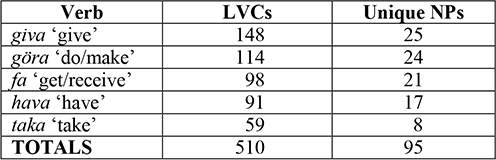
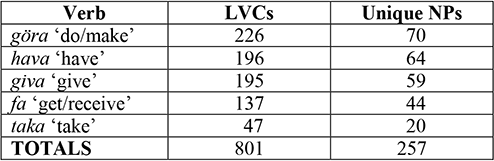
For all nine of the Old Swedish texts, I gathered data on the frequency of LVCs and the number of unique NPs in each LVC using the selection criteria outlined in section 3.2. The texts were divided into groups based on the two genres and two time periods, as discussed in section 3.1. Following the practice of measuring LVC frequency and diversity in recent diachronic studies (Brinton & Akimoto Reference Brinton and Akimoto1999, Kytö Reference Kytö1999, Elenbaas Reference Elenbaas2013), I first collected data on light verb + NP pairings for each light verb in the aggregate for the corpus as a whole. A general comparison of the two different periods (table 1 versus table 2) indicates that the overall frequency and diversity of LVCs increased during the period in question.
OSw 1 (ca. 1200–1375; 340,977 words). LVCs and unique NPs for each light verb.

OSw 2 (1375–1526; 334,138 words). LVCs and unique NPs for each light verb.

The ranking of the light verbs changes from OSw1 to OSw2; one exception is the verb taka, which remains the least common of the five verbs in both periods. The frequency of LVCs with verbs giva, göra, fa, and hava increases from OSw1 to OSw2, while pairings with taka decrease. Lastly, the number of unique NPs paired up with light verbs goes up from OSw1 to OSw2 for all five verbs.
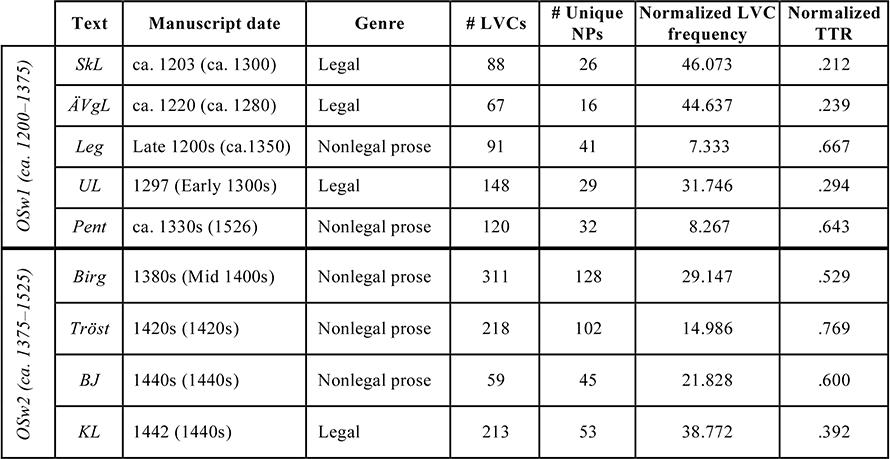
When the data are further broken down by individual text, several interesting patterns emerge that reveal the extent to which genre and time period are significant factors. The first step in the process of calculating statistical significance is to account for the different lengths of texts by normalizing the data for frequency of tokens (that is, the number of LVCs) and type-token ratio (that is, the ratio of unique NPs to the number of LVCs; TTR). In this way, lengthy texts such as Tröst (145,473 words) do not skew the data compared to shorter texts such as BJ (27,029 words). In the case of token frequency, I calculated the rate of LVCs per 10,000 words for each text. For TTR, a normalized ratio was calculated by using the number of words in the shortest text in the corpus as the basis (here, ÄVgL, with 15,010 words); only LVCs from a passage of 15,010 continuous words in each text were included in this measurement. Although such a truncated dataset for each text exhibits an overall less diverse set of unique NPs paired with light verbs, the normalized TTR provides a better basis for comparison that removes the skewing effects of text length. Table 3 provides for each Old Swedish text its approximate date, genre, the number of LVCs, unique NPs, as well as normalized frequency (per 10,000 words) and diversity of light verb + NP pairings (over 15,010 continuous words of text).
LVCs in Old Swedish texts.

An examination of the normalized LVC frequency in each text reveals that this rate varies across the two periods and two genres. Two-tailed Independent Samples T-Tests on the normalized LVC frequency were used to establish whether or not there is a significant difference in frequency between OSw1 and OSw2 texts or between legal and nonlegal texts.Footnote 21 The T-Test shows that there is no significant difference in frequency between texts from the two periods at the .05-level of significance. The same test indicates, however, that there is a significant difference between the two genres: The normalized LVC frequency is significantly higher in the four legal texts than in the nonlegal texts, where p<.05 (t-value=4.365, p-value=.003). Although the frequency figures in table 3 show several ups and downs over time, including wide variation among texts within the same period (for example, 7.333 in Leg versus 46.073 in SkL) or slightly declining frequency among the legal texts (46.073 in SkL to 38.772 in KL), there is a consistent trend related to genre irrespective of time period. The average normalized LVC frequency per 10,000 words for legal texts is 40.307, while the legal texts have a frequency of only 16.312, and this difference is apparent throughout both periods.
When time period and genre are considered at the same time in the evaluation of LVC frequency, additional quantitative measures reveal interaction effects between the two variables. A Chi-Square Test of Independence confirms that there is interaction between period and genre at a significant level (Pearson Chi-Square=70.088, df=1, asymptotic 2-sided, where significance is p<.000). Individual two-tailed T-Tests and effect size measurements indicate more specifically where this difference exists among the texts of one type over time. When one compares nonlegal prose texts from OSw1 with those in OSw2, one finds that there is a difference in LVC frequency between the earlier and later texts (t-value =−2.283, p-value=.075): The frequency is higher in the second period than the first. Although the p-value is not less than the .05-level of significance, it is clear in calculating effect size that there is a notable difference between the earlier and later nonlegal texts (Cohen's d=0.824).Footnote 22
Similar statistical measurements can be applied to the normalized TTR of each text to determine the significance of period or genre. Again, two-tailed Independent Samples T-Tests of TTR for all nine texts reveal that genre rather than period has the greatest effect on the number of unique NPs paired with light verbs. While the T-Test provides no evidence of a significant difference in TTR between texts from OSw1 versus OSw2 at the .05-level, there is a significant difference between the legal and nonlegal texts (t-value=−6.287, p-value <.000). The nonlegal texts have a consistently higher TTR than legal texts, regardless of the period. In general, the TTR of texts of the same genre vary over time. There is no consistent trend among the nonlegal texts over time, and there is a steady but only slight increase in TTR among the legal texts from OSw1 to OSw2.
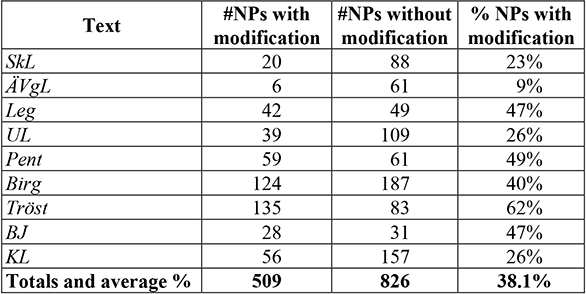
One last area of empirical analysis deals with the degree of modification to NPs. Table 4 shows frequency of LVCs with modifi-cation to the NP complement according to text, the number of NPs with and without modification, and the overall percentage of NPs with modification.
Frequency of LVCs.

Recall that NP modification was defined as the use of indefinite or definite articles, demonstrative pronouns, (possessive) adjectives, and quantifiers. In general, the legal texts have a higher number of bare NPs without modification. Texts such as ÄVgL or KL fall below the average for all texts, while the nonlegal prose texts, such as Tröst or Pent, exhibit an above-average percentage frequency of NPs with modification. A two-tailed Independent Samples T-Test confirms that there is a significant difference in the overall degree of NP modification between legal and nonlegal texts (t-value=−5.17152; p=.001). While genre plays a significant role in the amount of modification in each text, time does not: A T-Test shows that there is no significant difference in NP modification between texts from OSw1 versus OSw2.
According to previous research on NP modification in LVCs, including Brinton Reference Brinton, Seoane and López-Couso2008 and Elenbaas Reference Elenbaas2013, it is particularly important to examine the frequency of NPs with an indefinite article, given the role that the indefinite article plays in conveying aspect in the historical development of LVCs. In general, indefinite articles in LVCs are only sparsely distributed throughout the two Old Swedish periods. Only one text, Tröst from the 15th century (OSw2), exhibits a larger number of NPs with an indefinite article, as in the examples in 10.Footnote 23
(10)

In summary, the data on frequency, TTR, and NP modification highlight several important factors that shape the development of LVCs. The aggregate data on the five light verbs split up according to two time periods indicate that the number and diversity of LVCs increase in Old Swedish as a whole, with the exception of the LVC with taka, whose frequency decreases over time. However, closer analysis of genre (legal versus nonlegal texts) and period (OSw1 versus OSw2) shows that genre is a significant factor: Legal texts have a higher number of LVCs and nonlegal texts have a higher number of TTR. In other words, LVCs are more common in legal texts yet more diverse in secular and religious prose. Additional statistical analysis reveals that genre and period interact with each other on a significant level; the frequency of LVCs in nonlegal texts increases from the early period to the later period. Lastly, there is no significant change in the degree of NP modification over time, although it was determined that legal texts tend to exhibit fewer modified NPs than religious or secular prose texts. One text from OSw2 (Tröst) does exhibit a slightly higher number of LVCs that contain NPs with an indefinite article, but there is no discernable increase in general from OSw1 to OSw2.
5. Discussion
General findings on five common light verbs in Old Swedish as well as frequency data from the nonlegal texts corroborate the results of several other diachronic studies, such as Brinton Reference Brinton, Seoane and López-Couso2008, Elenbaas Reference Elenbaas2013, and Ronan Reference Ronan, Davidse, Gentens, Ghesquière and Vandelanotte2014, that find that LVCs are highly productive and increase in frequency over several centuries in a language's history. However, data on individual texts suggest that any empirical analysis of LVCs must also take into account genre when data are considered in the aggregate for a whole period. Previous research has focused on factors that may play a role in changes in frequency or in the diversity of unique light verb + NP pairings over time (Traugott Reference Traugott1999). In the following section, I address some internal and external linguistic explanations for changes in the use of LVCs and highlight the need to consider multiple factors in any diachronic analysis.
5.1. External Linguistic Factors that May Affect the Use of LVCs
Recent historical studies provide evidence that differences in LVC frequency may be attributable to genre. Kytö (Reference Kytö1999) analyzed differences in LVC use among texts in the Helsinki Corpus of historical English and determined that certain text types, such as autobiographies and official letters, have the highest rates of LVCs compared to other types, such as fiction, sermons, and handbooks (p. 177). In addition, as Tanabe's (Reference Tanabe1999) analysis of the Early Modern English Paston letters shows, LVCs are more frequently used in more informal and personal writing, such as diaries and personal letters. However, both Kytö (Reference Kytö1999) and Claridge (Reference Claridge2000) point out that the informal versus formal distinction is not always consistent: Some texts that might be considered more formal, such as legal texts and official correspondence, show more frequent use of LVCs in some corpora (Kytö Reference Kytö1999:178). Iglesias-Rabade (Reference Iglesias-Rábade2001:154) found that the category Romance and Fiction in Middle English exhibits the highest rate of LVC use compared to texts from other types, such as Technical, History, and Religion. Although the categories and text type labels vary from study to study, there is general consensus that the frequency of LVCs may be related in some ways to genre.
Old Swedish light verb data support this point. As the results in section 4 show, there are statistically significant differences between genres: LVCs are more frequent in legal documents and more diverse in secular and religious prose texts. Moreover, genre is consistently a more influential factor in shaping the use of LVCs than the period in which the texts are written. For example, SkL, a legal text and the earliest one in the corpus, exhibits the highest rate of LVC. In contrast, Tröst, a nonlegal later text, exhibits one of the lowest LVC rates in OSw2. In a similar way, Leg, an earlier nonlegal prose text with a high rate of TTR, contrasts with KL, a later legal text with a lower TTR rate. Although the nonlegal texts in no way represent a homogenous genre, they do exhibit significantly different patterns of LVC use throughout the 13th to 15th centuries compared to legal texts. Clearly, the religious and secular prose texts show an overall wider variety of LVCs and a lower rate of their use.
In addition, the nonlegal texts exhibit an increase in frequency of LVCs over time. Recall that there is a notable difference between the earliest set of nonlegal texts and those from the later period, as captured by the calculation of effect sizes—a difference that is not statistically significant among the legal texts. This difference is reflected in the lower rates in Leg and Pent (7.33 and 8.27, respectively) in comparison to higher rates in Birg, Tröst, and BJ (29.15, 14.99, and 21.83, respectively), when frequency is calculated per 10,000 words.
In the case of the nine texts in this study, the issue of genre is closely related to the possibility of foreign language influence. While all five texts in the nonlegal category are translations of religious and secular prose originally written in Latin or German, the four legal texts are all written in the vernacular. In the case of translations, there are various explanations that take into account how other languages may bring about an increase in the frequency of LVCs. For instance, one possibility is that certain LVCs are calques, that is, they are direct translations of the original light verb + NP pairing. Another possibility is that certain light verbs or their NP objects may be transferred into the language to make new innovative LVCs. Such innovations might not be direct translations from the original text, but borrowings in the recipient language that took place during periods of language contact.
These two possibilities have been addressed in diachronic studies on the influence of the source language on the LVC frequency in the target language.Footnote 24 Akimoto & Brinton (Reference Akimoto and Brinton1999:27) and Iglesias-Rabade (Reference Iglesias-Rábade2001:155) provide examples of Latin calques in Old English, such as missas facere > mæssesong don ‘do/conduct mass’, or French calques in Middle English, such as prendre commencement > taken beginning. Brinton (Reference Brinton, Seoane and López-Couso2008:38) notes that, of the seven most common NPs in LVCs according to Bergs Reference Bergs2005, four have Romance origins. Traugott (Reference Traugott1999) and Brinton (Reference Brinton, Seoane and López-Couso2008) also point out that CPs in Old English and Middle English become more common as a result of influence from Scandinavian, as evidenced by the increase of collocations with take and get, whose origins can be traced to the period of contact with Old Norse. Ronan (Reference Ronan, Davidse, Gentens, Ghesquière and Vandelanotte2014:31) suggests that language contact plays a role in the increase of LVC frequency in Middle English as well, since the number of LVCs substantially increased during the period of French–English contact. She cites the example of the French-influenced LVC have (an) opinion in Chaucer, pointing out the fact that the verb opinion does not appear by itself until after Chaucer's time. Despite these arguments in favor of foreign influence on the use of LVCs, however, others, such as Traugott (Reference Traugott1999) and Matsumoto (Reference Matsumoto1999), are quick to point out that many LVCs are native to English and that one should be cautious when attributing too many of them to other languages.
The effects of foreign influence on syntactic change have been the subject of recent historical linguistic research on Old Swedish. Höder (Reference Höder2010) studies multilingualism and syntactic change in 14th- and 15th-century religious and secular prose texts. Although Höder does not discuss LVCs specifically, his study provides a general framework for discussing the possibility that differences in syntactic patterns across genres in Old Swedish can be attributed to foreign influence. Höder's analysis is situated in Heine & Kuteva's (Reference Heine and Kuteva2003, Reference Heine and Kuteva2005) framework of contact-induced grammaticalization—a specific type of grammaticali-zation in which pre-existing grammatical elements (that is, forms, meanings, form–meaning units, or syntactic relations) are transferred from the model language into a replica language (Heine & Kuteva Reference Heine and Kuteva2003:530). Following a construction-based approach in line with Croft Reference Croft2001, Höder suggests that such grammatical replication takes place in Old Swedish at the level of the individual and is fueled by individual speakers’ creative behavior as they “establish interlingual equivalence relations between constructions in different languages” (p. 295). Swedish society during the 14th to 16th centuries was multilingual, Höder points out, and included a small elite class of speakers, who were extensively familiar with Swedish, Latin, and Low German and who were responsible for the increased text production during this period (p. 293). Although in their speech, scribes may have used primarily vernacular Swedish, they were highly skilled experts in written Latin and Low German and transferred characteristics of syntax and vocabulary to their writing.
Important to consider here is the fact that Höder follows an approach similar to the one adopted in the current study, analyzing syntactic patterns as the product of foreign influence that become more evident in certain text types. In particular, he analyzes texts influenced by another language (exclusively Latin in his study) in comparison to those that were originally written in Swedish. Results indicate that there are fundamental differences in the use of certain syntactic constructions between the original legal texts he analyzed and the foreign-influenced texts. According to Höder (Reference Brandtler, Delsing, Byrman, Gustafsson and Rahm2010:296), these differences indicate that in the administrative, urban, and religious/monastic sociocultural context a new distinct written variety of Swedish emerged.
In the case of LVCs in Old Swedish, more detailed analysis of each LVC would shed light on the extent and nature of influence of contact languages such as Latin or Low German. Following Höder's assumptions that the texts were written by highly skilled speakers of multiple foreign languages, one would conclude that grammatical and lexical transfer is at work; alternatively, following Heine & Kuteva's (Reference Heine and Kuteva2003) assumption, one could propose that there is replication of form–meaning units from a model language into the replica language. Although such an examination is beyond the scope of the present paper, it would be useful to consider individual light verb + NP combinations in the Old Swedish translations and compare them directly with their counterparts in the source texts (when available) to determine whether there is interference from the source language. Similarly, it would be revealing to assess the presence of LVCs in other German or Latin texts at the time. Comparison across a wider spectrum of earlier and later Swedish texts would establish when certain LVCs begin to occur; it would also determine whether specific light verb + NP pairings may be considered borrowings or whether they are only attested in texts of certain types. Such fine-grained analysis would help define more precisely the role of grammatical transfer in the development of LVCs; in the case of nonlegal texts, this analysis would help determine the degree of innovation in translations at the time of increased multilingualism.
Even without this type of in-depth analysis, it is clear that native Swedish legal texts differ in fundamental ways from foreign-influenced secular and religious prose. These differences are reflected in the lower frequency of LVCs, the higher diversity of light verb + NP pairings, and in the significant increase in the use of this construction over time exclusively among the Old Swedish translations of Latin and Low German in the 14th and 15th centuries. Further analysis might also uncover the role that different subgenres play within the broad genre of nonlegal texts, as seen in studies on early stages of English (Kytö Reference Kytö1999, Iglesias-Rabade Reference Iglesias-Rábade2001), or uncover the effects of different source languages (for example, Latin versus Low German). However, the present study shows that the use of LVCs in texts with considerable foreign influence is significantly different and that these patterns of use change over time.
5.2. Internal Linguistic Factors that May Affect the Use of LVCs
Previous diachronic studies of LVCs in other languages address possible internal linguistic factors that affect their productivity. Hiltunen (Reference Hiltunen1983), for example, suggests that external forces such as direct borrowing from French might play a role in the rise of LVCs during the Middle English period, but that the overall expansion might also be attributable to an increase in analyticity and the loss of verbal prefixes. Traugott (Reference Traugott1999:247), however, points out that the use of LVCs increases in Middle English but expands more slowly in subsequent periods. This uneven pattern of change is difficult to explain if one assumes that the overall rise of LVCs is related to the rise of alternative analytic constructions.
Any analysis claiming that a syntactic change—such as the increase in the use of LVCs—is due to an increase in analytic structures runs into the difficulty of pinpointing exactly when such a change might have taken place.Footnote 25 An increase in analyticity is so gradual that it may take many centuries in multiple grammatical contexts before it runs its course. In the case of Old Swedish, however, the increase in use and diversity of LVCs from OSw1 to OSw2 indicates that these changes take place in a short period of time around the 15th century. Moreover, the normalized frequency data from OSw1, for instance, suggest that LVCs were quite common already in the early legal texts and remained highly frequent during the following period. Also, the argument in favor of increased analyticity cannot explain why some genres (for example, nonlegal texts) exhibit a higher TTR, while others (for example, legal texts) have high LVC frequency, regardless of time period.
The most widely addressed topic related to internal linguistic changes in the use of LVCs involves grammaticalization.Footnote 26 Brinton & Akimoto (Reference Brinton and Akimoto1999) and Brinton (Reference Brinton, Seoane and López-Couso2008) suggest that the increased use of the indefinite pronoun allows for wider range of functions of CPs, including new expressions of limited duration (Wierzbicka Reference Wierzbicka1982) and telicity (Prince Reference Prince and Plötz1972). Thus, by the Late Modern English period, CPs with light verbs and indefinite NPs, such as to make a joke (versus to joke), become more frequent in a wider variety of contexts, expressing subtle aspectual nuances, which was not possible during the Old English period before the rise of the indefinite article (Traugott Reference Traugott1999:246). Some view LVCs as the result of a process of aspectogenesis in which light verbs themselves become aspectual markers (Hook Reference Hook1991, Reference Hook and Verma1993; Huddleston & Pullum Reference Huddleston and Pullum2002). Brinton (Reference Brinton, Seoane and López-Couso2008:48–49) points out that CPs come to express telicity, as in the history of English after the rise of the indefinite article. LVCs such as have a dance or take a walk convey subtleties of meaning that the full verbs dance or walk do not, namely, that the action is bounded and complete.
The extent to which LVCs exhibit typical characteristics of grammaticalization has been well documented in these previous studies. More specifically, LVCs show signs of desemanticization (Heine & Kuteva Reference Heine and Kuteva2002), since the meaning of light verbs is bleached, and the verb may become associated with a specific grammatical feature such as telicity. They also exhibit extension, or the increase in type and type-token frequencies in a greater range of contexts. Hopper & Traugott note in their comparative analysis of two languages that “the sheer textual frequency is prima facie evidence of degree of grammaticalization” of light verbs (Reference Hopper and Traugott2003:110). Butt (Reference Butt, Aygen, Bowern and Quinn2003, Reference Butt, Amberber, Baker and Harvey2010), Bowern (Reference Bowern2008), Butt & Lahiri (Reference Butt and Lahiri2013), and Elenbaas (Reference Elenbaas2013) among others, however, claim that LVCs are not involved in grammaticalization at all, citing fundamental differences between light verbs and auxiliaries and the fact that light verbs do not diminish in form (that is, become affixes) or undergo phonological erosion.
There are, indeed, some general characteristics of grammaticalization of Old Swedish LVCs, if one considers CP as a whole. For instance, all five light verbs analyzed here show signs of desemanticization to varying degrees. Consider the examples in 11.
(11)

In 11, the light verb giva coupled with the nouns andzswa or hedhir has a similar meaning to the full verb giva: There is an agent that transfers an object to a recipient. However, because of the abstract nature of the object in both sentences, the act of giving is less transparent and the semantic contribution of the verb less bound to the concrete meaning of the full verb. The notion that light verbs have undergone deseman-ticization is inherent in their definition as lighter versions of the full verb, as discussed above using the example of take place in English. The meaning of the light verb take contributes less semantic content than the full verb in another context, for example, take the ball. Moreover, the LVCs in Old Swedish clearly exhibit extension to a wider range of contexts. I demonstrated in section 4 that there is an increase in token frequency among four of the five light verbs from OSw1 to OSw2. This rise takes place in tandem with an increase in TTR for all five verbs. These trends are tied to genre, but the general expansion to new contexts over time is clear, especially considering the large variety of LVCs in Modern Swedish listed in Dura Reference Dura1997 and Malmgren Reference Malmgren2002.
However, other than these more general characteristics, there is little evidence that Old Swedish LVCs involve grammaticalization. As was discussed in section 2.1, the presence of an indefinite article is crucial in the development of aspectual nuances in LVCs (Brinton & Traugott Reference Brinton and Traugott2005), and, as Brandtler & Delsing (Reference Brandtler, Delsing, Byrman, Gustafsson and Rahm2010) note, the indefinite article begins to occur in specific contexts around 1300 before expanding to nonspecific referential contexts by the beginning of the 16th century. Skrzypek (Reference Skrzypek2013, Reference Skrzypek, Bylin, Falk and Riad2014) also notes the parallel development of the indefinite and definite articles, pointing out expansion of ett/en ‘a(n)’ from its use as a numeral to a presentative marker of new information by the 1400s. In other words, the indefinite article begins to become more frequent and expand to new functions in late Old Swedish. However, recall from section 4 that the indefinite article is rare in LVCs in this corpus; the large portion of objects in LVCs are unmodified bare NPs in Old Swedish. Only one text, namely, the translation of the Low German Själens tröst ‘Comfort of the Soul’, contains a number of examples with an indefinite article in LVCs. Thus, although the indefinite article may begin to rise in new contexts at this point, its use as a part of LVCs is still rare, and any aspectual function is ruled out. A more detailed analysis of subsequent stages of Early Modern Swedish would reveal more about the role of the indefinite article. However, for Old Swedish at least, one is unable to determine the extent to which LVCs convey aspect at all, given the paucity of relevant examples with indefinite articles. In the history of English, the situation is similar: The indefinite article a(n) is not common until Middle English, after which it begins to expand functionally. However, not until the Late Modern English period does it begin to express boundedness in LVCs (Brinton Reference Brinton, Seoane and López-Couso2008:48).
In addition, the relatively few examples of LVCs with an indefinite article indicate that the light verb itself does not convey telicity. Following the suggestions in Elenbaas Reference Elenbaas2013, I searched for LVCs that contain an object NP and an indefinite article with interchangeable light verbs. Consider the following sentences:
(12)

In both instances, the nominal object tekn ‘sign’ occurs with the indefinite article and a light verb (göra and giva). Regardless of the light verb, the limited duration of the event (for example, the giving of a sign) is expressed by the article eeth with the nominal object. As Elenbaas (Reference Elenbaas2013:64) notes, the boundedness of the event is the same, whether one is giving, having, doing, or taking an action. In other words, the telicity of the event is expressed by the indefinite NP and not the verb itself, which can vary depending on the context. In terms of grammaticalization then, it appears that the light verbs themselves do not play the most crucial role in marking aspect, contrary to what Brinton & Traugott (Reference Brinton and Traugott2005:131) claim: “the verb has clearly identifiable (i.e. aspectual or dynamic/stative) function.” Instead, a nominal object with an indefinite article is the main source of the bounded interpretation of the CP as a whole.
Given that LVCs cannot receive a straightforward account in terms of grammaticalization, Brinton & Traugott (Reference Brinton and Traugott2005) suggest that it may be more appropriate to treat at least some of them as a result of lexicalization instead. CPs in English, such as lose sight of or pay tribute to, are more idiomatic phrases that contain a light verb and nominal object. Brinton (Reference Brinton, Seoane and López-Couso2008) notes that this type of LVC is often a fixed expression that allows little to no modification through articles, adjectives, or quantifiers, and it occurs with a wide variety of verbs outside the restricted class of highly frequent light verbs. Brinton & Traugott (Reference Brinton and Traugott2005:96) define lexicalization as follows:
The change whereby in certain linguistic contexts speakers use a syntactic construction or word formation as a new contentful form with formal and semantic properties that are not completely derivable or predictable from the constituents of the construction or the word formation pattern.
In other words, CPs of this type are noncompositional and idiomatic. Instead of becoming more grammatical, they have gone in the other direction to become fixed, nonproductive phrases that disallow any modification to the nominal object. As Kytö (Reference Kytö1999:186) suggests, such “zero modification is the strong-hold of idiom formation.” Following Himmelmann (Reference Himmelmann, Bisang, Himmelmann and Wiemer2004), Brinton (Reference Brinton, Seoane and López-Couso2008) also points out that lexicalization often involves a decrease in productivity and a drop in token frequency.
The Old Swedish data lend support to the claim that it may be appropriate to classify some LVCs as the product of lexicalization. The legal texts in particular exhibit a high number of fixed expressions that lack NP modification. Consider the following examples:
(13)

Naturally, legal texts contain a large number of legal terms as set phrases, such as those in 13: giva sak, göra drap, and göra scada. In fact, the simultaneously high frequency of LVCs yet low TTR in legal texts is indication that there is more frequent repetition of certain phrases but a lower lexical richness in general. The data on modification to NPs support this claim: The four legal texts exhibit the lowest degree of modification of all nine texts (9% of all nominal objects in ÄVgL, 23% in SkL, and 26% in UL and KL). As Brinton (Reference Brinton, Seoane and López-Couso2008:44) notes, a lower amount of NP modification is typical of lexicalized phrases that are more fixed and idiomatic.
These more fixed expressions with light verbs are common outside of legal texts as well. According to Brinton (Reference Brinton, Seoane and López-Couso2008:45), another one of the hallmarks of lexicalization of CPs in English is that they often contain verbs outside of the five typical light verbs (do, give, have, make, take). For instance, she mentions CPs such as lose sight of or others with light verbs such as bear, catch, cross, fall, grab, leave, lose, and show, among many others, that are highly specific, lack modification to the noun, and are not productive (Brinton Reference Brinton, Seoane and López-Couso2008:45). To test this hypothesis, I analyzed the Old Swedish verb bära ‘bear’ as an additional verb outside the five light verbs. Consider the following examples:
(14)

The frequency data for bära in LVCs for both periods are included in table 5, which shows LVCs with the verb bära ‘bear’ in OSw1 and OSw2, Types (unique NPs), Tokens, TTR, and Normalized Frequency (per 10,000 words).
LVCs with the verb bära ‘bear’ in OSw1 and OSw2.

The verb bära is certainly not as frequent as the five common light verbs in the corpus, as evidenced by its low normalized frequency and relatively low TTR in both periods. Moreover, unlike the other verbs, bära decreases in frequency from OSw1 to OSw2. There are several nominals that occur with it, which often lack modification to the noun. In addition to those in 11b and 12a, there are also pairings such as bära plict ‘bear duty’, bära skam ‘bear shame’, and bära synd ‘bear sin’, which occur almost exclusively without an article or adjective. In other words, these phrases appear to be highly specific and more idiomatic than the more productive CPs that contain the five common light verbs and exhibit frequent NP modification.
In sum, while the Old Swedish data provide little evidence that LVCs or light verbs on their own have undergone grammaticalization, the results do support the claim that some LVCs may be the result of lexicalization. Evidence against grammaticalization includes the lack of indefinite articles in LVCs at this point in the history of Swedish. As has been pointed out in studies on the history of English CPs, the indefinite article plays a crucial role in the eventual development of LVCs as expressions that convey telicity (Brinton Reference Brinton, Seoane and López-Couso2008). Much like Middle English, Old Swedish has an underdeveloped article system in which the indefinite article is only beginning to take on the functions that it has in subsequent stages. Following a proposal by Brinton & Traugott (Reference Brinton and Traugott2005) and Brinton (Reference Brinton, Seoane and López-Couso2008), it is suggested here that a small group of LVCs are fixed expressions with no modification to the NP, and they may occur with verbs outside the restricted class of frequent light verbs. CPs such as bära vitn ‘bear witness’ or göra scada ‘do damage’ occur frequently and reflect the more specialized use of certain idiomatic LVCs. These expressions, while frequent in some contexts, are not as productive as LVCs that occur more frequently with the five common light verbs and a wide range of NP modification throughout the Old Swedish corpus.
6. Conclusion
Despite their prevalence in a wide variety of languages, light verbs remain a challenging phenomenon to classify and describe, and their diachronic development is often difficult to track and explain. As Algeo (Reference Algeo, Aarts and Meyer1995:2003) notes, light verbs are “somewhere near the middle of the magnetic field of language … where grammar and lexis meet.” Butt (Reference Butt, Aygen, Bowern and Quinn2003:4) adds that “light verbs straddle the divide between the functional and lexical in that they are essentially lexical elements but do not predicate like main verbs.” The current study further brings to light the challenges one faces in dealing with constructions such as LVCs which, over time, exhibit an interesting interplay between the lexicon and grammar.
This analysis of Old Swedish verbo-nominal combinations adds to the growing body of research on variation and change in CPs in general and light verbs in particular. The results of the study indicate that LVCs are common in the earliest Old Swedish texts of the 13th century, where their frequency is high despite the relatively narrow range of nominal objects. Four of the five of the most frequent light verbs in early Swedish (fa, giva, göra, hava) increased in frequency, and the diversity of the nominal objects in LVCs continued to grow throughout the 14th and 15th centuries. Data indicate that the frequency and diversity are dependent on genre: Legal texts have a high frequency but lower range of light verb + NP combinations, while religious and secular prose texts exhibit a much greater diversity despite the lower overall frequency of LVCs. The degree to which NP objects in LVCs are modified by articles, quantifiers, and adjectives, for instance, varies from text to text, although the legal texts tend to have more examples with bare NPs in combination with light verbs. Overall, the examples here reflect the underdeveloped functional capacity of the indefinite article at that stage of Old Swedish.
The findings shed light on two main questions that have come up in diachronic research, namely, the reason for the increased use of LVCs and the possibility that they exhibit characteristics of grammaticalization. Data on genre indicate that the increase in frequency and in the range of light verb + NP combinations is related to genre differences and foreign language influence. Religious and secular prose texts in both OSw1 and OSw2 are translations from Latin or Low German, and the greater diversity of LVCs and their increasing frequency relate to influence of the source languages either directly through translation or indirectly through the multilingual environment of the writers/speakers. This conclusion provides additional support for Höder's (Reference Brandtler, Delsing, Byrman, Gustafsson and Rahm2010) argument that Old Swedish written language differs from the spoken vernacular and is a product of the sociolinguistic environment in which it was created: Scribes were often members of an elite class of literate clergymen with expertise in Latin or Low German, and the syntax and vocabulary of the written language reflects this influence. Although other diachronic studies have argued that light verbs or CPs with light verbs are involved in the grammaticalization process, there is a lack of evidence from the Old Swedish corpus to support this claim. Data from the frequency of modification to nominal objects indicate that the indefinite article is rare in LVCs in Old Swedish, providing little support to the view that light verbs are on their way to becoming grammatical aspectual markers. Instead, it was suggested that some LVCs have undergone lexicalization. These phrases are often fixed, idiomatic expressions, for example, bära vitn ‘bear witness’, in which verbs outside the productive class of common light verbs occur with a wide range of nominal objects without modification.
This study emphasizes the importance of comparative data in diachronic studies of CPs and highlights the usefulness of bottom-up search methods in corpus research on light verbs. LVCs are common in a wide variety of languages, but there has been little consensus over the origins and driving forces behind the diachronic development of this type of CP. Additional data from earlier Swedish allow for more direct comparison with other Germanic languages that have been analyzed diachronically in the past, including English or German. Such comparative analysis would provide a broader picture of the interaction between grammar and lexis crosslinguistically within and beyond the Germanic language family. In particular, data from early Swedish provide a new testing ground for hypotheses regarding the role of language contact and the direct or indirect influence from other languages. Moreover, because of the differences in text types, one is able to evaluate the role of genre and tease apart the effects of time versus internal linguistic factors that shape variation and change. In light of the extensive corpus of searchable, lemmatized texts in Old Swedish, the current study underlines the importance of searching narrowly for unique light verb + NP combinations that might otherwise be difficult to uncover. By limiting the search to the most common light verbs and tracking their frequencies more carefully, it is possible to gain both breadth and depth in understanding changes to the distribution of CPs over time.
Future studies on LVCs might fill in other gaps in this research area. In particular, it would be useful to analyze texts from subsequent periods in Swedish language history, including those in a 16th- and 17th-century corpus. By analyzing the data from this period one could determine whether LVCs with indefinite articles increased in frequency and/or showed signs of grammaticalization becoming aspectual markers. Moreover, an expanded corpus that includes texts from later periods would allow for broader yet deeper statistical analysis of LVC frequency to ascertain the degree of expansion or decline of light verb + NP pairings. Including texts from a third or fourth period in the language's history would also allow for interesting comparison across a broader time frame. Furthermore, now that there are data from the five common Old Swedish light verbs available for comparison, a more top-down approach to light verbs could yield interesting results. By examining a wider variety of light verbs, one would be in a better position to consider idiomatic expressions created during the process of lexicalization. Lastly, the inclusion of additional texts would allow one to test hypotheses regarding internal linguistic factors that affect LVCs in addition to external ones, including genre and foreign language influence.