Between September 2007 and April 2010, Kelly “The Ghost” Pavlik reigned as the world middleweight boxing champion.Footnote 1 Within his hometown of Youngstown, Ohio, Pavlik became the focus of intense media coverage and the subject of various forms of representation. Central to the cultural significance of fighters are the stories told about them. In the absence of a tale of family struggle or personal trauma, Pavlik was cast within a collective story, held up both locally and nationally as fighting on behalf of Youngstown. However, while it was agreed that Pavlik in some way captured the essence of the city, the nature of his relationship with Youngstown and the reasons for this were a source of conflict and contestation. As in other manufacturing centers across the North American “Rust Belt” and beyond, deindustrialization not only threatened the economic viability of communities like Youngstown, but also prompted profound questions about the very nature of place and place-based identity. For some, the city's steelmaking heritage was to be maintained and celebrated, continuing to offer a sense of local identity and pride moving forward; others, however, believed that a reluctance to disassociate from what they saw as the city's past was preventing the adoption of more culturally and economically “progressive” images. Pavlik, then, was pitched into the middle of this social, cultural, and political debate.
As the son of a former steelworker engaged in an iconographic form of blue-collar labor, Pavlik provided, for many, an avenue through which the city's industrial past could be remembered and commemorated, and its “working-class” identity reasserted. For some, however, Pavlik was the poster child for the emergence of a new dynamic generation and the reinvention of the city and its symbolic economy in the “post-industrial” present. Drawing on archival research and interviews with city residents and officials, this article examines the tensions that have manifested themselves within the various representations surrounding Pavlik. More broadly, the paper raises questions about the impact of deindustrialization upon place and popular culture, calling for a need to rethink the relationship between past, present, and future. It argues that rather than representing a complete break from the industrial past, the symbolic uses of Pavlik represent a more complex interaction of space and time as aspects of the past are alternately disavowed, recovered, rearticulated, and reconstructed in relation to shifting economic, social, and cultural contexts.
Deindustrialization and the Transformation of Place
In the 1950s, Youngstown, known as “Steeltown USA,” thrived. It was the nation's third largest steel producer, behind only Pittsburgh and Chicago. However, from the 1950s on, the industry found it increasingly hard to compete. Heightened competition from foreign markets, a lack of investment in order to modernize industrial processes and facilities, and the increasing mobility of capital in search of cheaper labor markets and greater profit margins, resulted in the steel industry's collapse during the late 1970s and early 1980s. The wave of mass shutdowns that swept across the industrial Midwest reached Youngstown on September 19, 1977—what has come to be remembered as “Black Monday”—with the closure of the Youngstown Sheet and Tube Campbell Works. That day five thousand steelworkers arrived at the plant only to find the gates locked shut. They all lost their jobs. That year, plant closings displaced a total of 40,000 steelworkers across the United States.Footnote 2 By 1985, the steel industry had completed a wholesale retreat from Youngstown; the decade following Black Monday saw the city lose more than 30,000 manufacturing jobs. This was reflective of national trends, as traditional manufacturing industries collapsed. This did not impact the entire country to the same degree; the industrial Midwest bore the brunt of the losses. Across Ohio, Michigan, Indiana, Illinois, and Wisconsin, manufacturing fell by more than 19 percent between 1979 and 1986, leading to a loss of 990,500 full-time jobs within the region.Footnote 3
The story of deindustrialization, however, is not simply an economic one. Industry not only provided material resources: It was also the crux of constructions of place and identity. Single-industry cities such as Youngstown were defined by what they produced—be it automobiles in Detroit and Flint or rubber in Akron. This association between a location and its main industry was arguably strongest where steel was produced. As Sharon Zukin observes,
No industry has a more powerful image than steel. Its symbolic weight in the national economy reflects a host of material factors: the brute force required to make steel, the volume of capital investment in a mill, the size of the work force … and the omnipresence of steel in all modern structures. … Steel has power because it has been the lifeline of industrial society.Footnote 4
This is revealed in the centrality of steel to the identities of Homestead and Pittsburgh in Pennsylvania and of Gary, Indiana, as well as of Sheffield in the United Kingdom. As Sherry Lee Linkon and John Russo point out, the industry “was so central to the community's economy and day-to-day life that Youngstown could not be imagined as anything but a steel town.” The closure of the mills led to new debates about the future of the city: “For the first time, Youngstown and its workers had to ask themselves what their community and their lives might mean without the steel mills.” Emerging from the loss of the industry were “questions of how to define Youngstown and what it meant to be a steelworker, both in the past and the present, when the job no longer existed. While economic struggle was at the heart of deindustrialization, a parallel struggle emerged over representation itself.”Footnote 5
Deindustrialization, then, must be understood not simply as an economic process, but as a social and cultural phenomenon that reshapes places and identities.Footnote 6 As Kathryn Dudley observed in response to the demise of the automotive industry in Kenosha, Wisconsin, “Industrial change of the type we are witnessing today is a profound disruption not just of individual lives, but of the values that have long shaped the cultural identity of manufacturing communities throughout the United States.”Footnote 7 These cultural values were inscribed in the landscapes of industrial cities such as Youngstown—landscapes transformed through deindustrialization. Dudley adds that, “As economic restructuring alters our roles in the marketplace, it also reorganizes our sense of ‘place’ as it transforms the character of specific places.”Footnote 8 Indeed, the loss of industry led to a reconstruction of both the material and symbolic landscapes of formerly industrial cities. Remnants of the industry that had dominated cities such as Youngstown for approximately a century came to be widely cast as unsightly reminders of a bygone era, signifiers of decay and decline that marked these locations and their inhabitants as being on the wrong side of an irreversible (and often irresistible) march toward a “post-industrial society.” Where smokestacks had long stood as markers of industry and prosperity—identifying cities as industrial and “working-class”—their closure and demolition saw the marginalization of industry and industrial workers within both the material and symbolic constructions of place.Footnote 9 In the wake of deindustrialization, Youngstown had come to be seen alternatively as the “rust belt city par excellence”Footnote 10 or as the “poster child for deindustrialization,”Footnote 11 and the city was constructed within the national imagination as a site of loss, abandonment, and failure.Footnote 12 Once renowned as a steel-producing power, the productive history of the region was largely erased in the decades following deindustrialization; instead, it was typically represented in terms of illness, decay, and even death. Abandoned industrial sites came to dominate visual depictions of the city. These changed conditions reflected a new urban aesthetic in which, “Cities with more positive imagery are associated with the postindustrial era, the future, the new, the clean, the high-tech, the economically upbeat and the socially progressive.”Footnote 13 As Steven High and David Lewis argue, within a shifting social, economic, and cultural terrain, “the Industrial Midwest of the United States came to be re-envisioned as a no man's land between fading smokestack industries and the ascendant post-industrial economy.”Footnote 14
In light of these changes, Youngstown experienced its share of place reorientation. On January 29, 1997, the Jeannette Blast Furnace, the former heart of the Youngstown Sheet and Tube Brier Hill Works, immortalized in song by Bruce Springsteen, was razed to the ground. The way in which this was seen as marking a cultural as well as a physical transformation was highlighted by Bill Lawson, trustee and secretary of the Jeanette Blast Furnace Preservation Society (JBFPA), as he argued, “It will be hard for future generations to understand the scale of the industry and how important it was to the community.” For him, the demolition of the “Jenny” threatened the very identity of Youngstown, as “that plant gave the whole aura of the industrial town. By losing the mills we've lost an aesthetic component of the area—not to mention jobs.”Footnote 15 While the razing of the “Jenny” had its opponents, city leaders pressed forward, arguing that it was necessary for the economic development of the region. Rufus Hudson of the Youngstown State University's Cushwa Center for Entrepreneurship stated, “We've been on a twenty-year pity party. As long as we keep looking backward, we'll never keep going forward.”Footnote 16 This debate represents part of the cultural contestation that deindustrialization elicits, as variously positioned groups and actors seek to advance their own visions and understandings of the nature and character of specific places. As Dudley states, places represent the central sites in which the material and cultural shifts brought about by deindustrialization are played out.Footnote 17 The types of changes imposed upon material landscapes reflect shifts in economic, political, and cultural power. Of course, there are uneven distributions of resources that both constrain and enable the advancement of particular material and symbolic projects, as exhibited in the erasure of the “Jenny.” For High and Lewis, “the cultural meaning of deindustrialization is embedded in these universalized images of falling smokestacks and imploding factories.”Footnote 18 Such actions represent, “secular rituals that dramatize North America's transition from industrialism to post-industrialism.”Footnote 19 They operate as “declarations against indeterminacy and serve to hide troubles, conflicts, and uncertainties,” which “naturalize” the economic changes associated with deindustrialization and the apparent advent of the “post-industrial society.”Footnote 20 Youngstown's local newspaper certainly saw the demolition of the “Jenny” as marking such a transformation and as alleviating the indeterminacy High and Lewis identify. The paper declared, “Nearly eighty years of Valley history disappeared in three seconds and a cloud of red dust.”Footnote 21
However, while there has been a dramatic material and symbolic reorientation of place in cities such as Youngstown, the “indeterminacy” brought about by deindustrialization has not been resolved. The material landscapes of manufacturing communities may have been transformed, but the sociocultural legacies of industry have proven to be much more permeable, as is particularly evident within the realm of popular culture. As Carlo Rotella astutely observes, “culture … is not always as liquid as capital,”Footnote 22 and the sense of place and identity forged in the crucible of industrial culture continues to prompt, punctuate, and shape the contemporary landscape. There is a danger, then, to overstate the ability of processes of industrial demolition and plant closures to erase and control the nature and significance of the past. Writing in the midst of the deindustrialization of Wisconsin, Dudley stated that, “The nation's industrial past plays no part in our vision of the future, and the artifacts of this vanishing culture carry no special meaning in the present.”Footnote 23 For her, the replacement or neglect of industrial landscapes sends a message “not just about the inevitability of change, but also about the obsolescence of the past.”Footnote 24 While deindustrialization certainly marks a profound social and cultural shift, this represents a simplification of the complex nature of places and the role that the past plays in their continuing reconstruction. Dudley appears to overstate this by framing the shift from “industrial” to “post-industrial” as a fait accompli. It is the reconstruction rather than the destruction of the past that makes places so complex, marked by their relation not just to other spaces but other temporalities. Dudley's view is reminiscent of the widespread tendency, identified by Mike Wallace, “of seeing the past as something that is over and done with, and of merely nostalgic, academic or entertainment value.”Footnote 25 As the papers in this issue argue, the danger in dismissing the ongoing engagement and fascination with the industrial past as simply “smokestack nostalgia” is that it ignores its continuing significance. As Doreen Massey reminds us, “The identity of a place is not to be seen as inevitably destroyed by new importations … identity is always, and always has been, in the process of formation: it is in a sense forever unachieved.” Indeed, the “claims and counter-claims about the present character of a place, depend in almost all cases on particular, rival interpretations of its past.”Footnote 26 Various aspects of the past are disavowed, recovered, rearticulated, and reconstructed in relation to shifting economic, social, and cultural contexts.
The representations surrounding Kelly Pavlik offer an insight into the complex ways in which notions of past, present, and future are synthesized within imaginings of place. While deindustrialization has marked the marginalization of the industrial past and of industrial workers and their claims to certain places, there has not been a complete erasure. What can be seen in Youngstown is how various groups seek to find forms of continuity as well as change, pointing to a more complex process of disavowal, incorporation, and accommodation. More than fifteen years after the demolition of the “Jenny,” and thirty years on from the precipitous decline of the steel industry, communities such as Youngstown reveal how the specter of the industrial past still illuminates contemporary landscapes and constructions of place. However, the role this plays is a source of intense contestation as cities seek to reorient themselves in relation to emerging social, economic, and cultural realities, pointing to the complex temporal and spatial correlates of which place is both mediator and product. Between 2008 and 2010 qualitative interviews were conducted with city residents and officials selected through a combination of purposive and snowball sampling. Reflecting to a large degree the nature of the support for Pavlik, the interviewees were disproportionately white males, either still employed in, formerly employed in, or with family connections to industrial labor. The interviews also attempted to capture those figures occupying central positions in the types of representations that surrounded the fighter—artists, trainers, and city boosters. The interview data are supplemented by archival research collating local and national media articles covering Pavlik during his reign as middleweight champion from September 2007 to April 2010.
Reengaging the Past: “It'll Always Be a Blue-Collar Town…”
Despite the erosion of many of the social, economic, and cultural institutions forged within the crucible of twentieth-century industrial urbanism, the importance of Youngstown's industrial heritage remains. As Rotella observes,
The manufacturing economy may no longer provide the primary material basis of working-class life in places like Brockton, as it did from the latter part of the nineteenth century until the latter part of the twentieth, but that era's legacy still gives meaning to the landscape, daily life, and struggles to determine what happens after the mills close.Footnote 27
Three decades after the initial steel mill closures in Youngstown, the image of the city as a “steel town” or a “blue-collar town” still carries local and national significance. However, as the economic has become less an arena in which such cultural identity is expressed and reproduced, the field of popular culture, and particularly sports, represents an increasingly important site where the city's industrial heritage and its “blue-collar” identity and practices can be commemorated and reasserted. In Youngstown, boxing, in particular, has historically occupied a privileged position within local popular culture.
Kelly Pavlik's attainment of the middleweight crown made him the city's fifth world boxing champion and its first since 1991. The city's first champion—and one of its favorite sons—Ray “Boom Boom” Mancini, ascended to the lightweight world championship in 1982. Fighting in the midst of the steel mill closures, Mancini was cast as an inspirational figure, representing the spirit and resiliency of Youngstown-area residents caught in the midst of the relentless and devastating dispossessions of deindustrialization. Mancini and Pavlik are both products of the area's rich boxing tradition, which extends back to the last decades of the nineteenth century. Indeed, in the postwar period, paralleling the city's reputation as “Steel Town” was its designation as “Fight Town,” as Youngstown-area boxers such as Tony Janiro, Tommy Bell, Joey Carkido, and Sonny Horne all became regular fixtures at Madison Square Garden in New York, the mecca of US boxing during the 1940s and 1950s. Boxing at that time, in Youngstown and in the nation, enjoyed a cultural affinity with manufacturing, and it was industrial cities such as Erie, Pittsburgh, Brockton, Grand Rapids, Detroit, and Cleveland that produced many of the fighters and much of the audience for the sport. As Rotella argues, the trajectory and popularity of boxing as a form of popular entertainment has been closely tied to the vagaries of industrial production; “the institutional arrangements of industrial labor and boxing—two forms of skilled body work—fit together like hand and glove, and the precipitous contraction of the fight network in the industrial heartland has paralleled the contraction of factory work in the last fifty years.”Footnote 28
Pavlik's rise to prominence occurred within a changed social, economic, and cultural context: The sport and the success of local fighters were no longer cultural corollaries to the dominance of manufacturing industries and the mutual values they were seen to inculcate. Instead, Pavlik occupied a more ambiguous position, coming to be seen as reminiscent of a bygone industrial era and a set of increasingly scarce cultural values and practices as well as a testament to their enduring worth and relevancy. As the son of a steelworker who put in nineteen years at Republic Steel before being laid off in the 1980s, Pavlik, like many others in Youngstown, has a personal biography that intimately ties him to the steel industry. Beyond this, his position as a white male boxer cements this connection. If, as Zukin suggests, steel is the lifeblood of industrial society, then the figure of the white male skilled manual laborer has historically been its embodiment, appointed as the archetypal realization of the values of strength, tenacity, honor, and masculinity upon which idealized representations of industrial urbanism were founded. In the racialized, classed, and gendered material and symbolic project of industrial capitalism, it was the white male who was privileged. Closely related to the white steelworker was the white male boxer, as both came to embody “power, coordination and domination.”Footnote 29 As Massey states, places come to be associated with particular forms of gendered, raced, and classed identity.Footnote 30 In Youngstown, as elsewhere, traditionally “blue-collar” towns have been overwhelmingly conceived of as white, masculine, working-class spaces within the local and national imaginary. It was this that was reflected in the representations that cast Pavlik as the embodiment of the city.
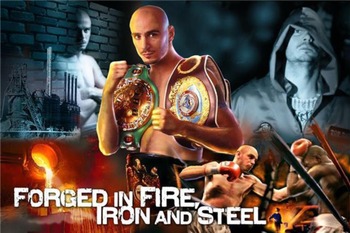
In May 2008, local artist Ray Simon's portrait of Pavlik was displayed at the city's Butler Institute of American Art. Entitled, “Forged in Fire, Iron and Steel,” the painting depicted Pavlik as the living embodiment of the city's industrial heritage: Images of the fighter and the knockout punches that secured his world-title victory coexist amid historic images of the “Jenny,” and the process of steelmaking and the pouring of molten steel (see Figure 1 above). Alongside the painting, the accompanying text written by Simon states, “Borne from the archives of history, a ghost from the past, out of an industrial giant great fighters amass.” Simon presents Pavlik as a figure within which the legacies of the city's industrial heritage and the forms of cultural identity it shaped reside. Lou Zona, the director of the Butler, declared how, “I love the way [Simon] has tied Kelly's strength, tenacity and will to win to the Valley and our steelmaking past … this particular work honoring Kelly and our industrial past, speaks sections for the area.”Footnote 31 As Simon himself explained in an interview with the author in June 2008, Pavlik—through his masculine toughness, his dedication, work ethic, and physical strength—reminded people both of Youngstown's industrial might and its importance to the nation:
[Pavlik] represents the city … The city of Youngstown was the third largest steel-producing city. This city made the iron balls for the Revolutionary War, the Civil War, World War One, World War Two. Really, Kelly's a product of this area. I mean Kelly was forged in fire. He was forged in this Valley, forged from his father.
Ray Simon's 2008 painting, Forged in Fire, Iron and Steel.

Similarly, Jim, a white male in his early forties who works as a fitness instructor, suggested the source of the fighter's popularity was located in the connections he conjured to the city's industrial past,
Because [Pavlik's] the way it used to be, like half of my buddies' dads, you shake their hands and there's fingers missing, just tough human beings. Hard-working guys who would just work. I mean, this bridge [Center Street Bridge, which previously ran across the Youngstown Sheet and Tube Campbell Works], we used to stand on it and watch the melting pot, this big huge pot of molten steel—you could see it from the bridge. My dad, my grandfather, everyone worked there.
Simon's portrait and the quote from Jim, above, demonstrate the symbolic significance assigned to Pavlik, revealing the enduring importance of Youngstown's industrial heritage. These associations inspired Youngstown residents, particularly older males who remained connected to manufacturing work through either contemporary employment, past employment, or familial connections, to use Pavlik to reassert the centrality of industry to the city. John, a white autoworker in his late thirties, felt that Pavlik was particularly important for an older generation whose role in Youngstown had been deemphasized, in his view. Here John identified a sense of generational discord, as the pride in Youngstown that steelmaking had engendered had failed to be reproduced over the years and decades. “Young people don't realize what this place was and there's no pride,” he said. “There's no motivation to be proud and I think that's hurting us [in the Youngstown area]…” John saw Pavlik as a way of recapturing the past and the city's productive roots, and of reclaiming a sense of pride:
I think [Pavlik] represents the hard work, determination to get somewhere, whereas the young kids just look at him as this great boxer, just awestruck at this professional boxer from Youngstown. They don't realize what he symbolizes. To them, he just symbolizes somebody famous who they might actually run into any day of the week. He actually symbolizes what this town stands for.
Pavlik's trainer, Jack Loew, a former teamster and asphalt sealer, also saw his fighter as connecting to the city's productive history, tying him to a tradition and a set of values that he feared were being lost. When asked by the author in 2010 why he thought boxing was so popular in Youngstown, Loew replied,
Because it's all about hard work. Boxing's a lot of hard work, you know, and that's what these people had to do, [that's] the way they lived. The steelworkers—hard work, the factories—hard work, and I think everybody appreciates a kid that goes in there and trains … Back then, the dads [of fighters], they all worked, they were all at the steel mills and General Motors, it's just that younger generation, we let them go.
The way these accounts articulate Pavlik's ability to capture the essence of the city reveals the way types of social and cultural identities, produced through industrial capitalism, continue to shape the contemporary nature of the city amidst rapid social, economic, and cultural change. The boxer—as embodied by Pavlik—is a malleable symbol, forged through the intimate relationship between the sport and industrial labor, of both the past and the present, simultaneously. As Rotella states, “The identity between boxing and work … persists in the bodies of fighters and the traditional training regimens that produced them. Fighters in training do exercises that still betray origins in precise, repetitive labor.”Footnote 32 He adds that boxing maintains “the system of values and meaning that evolved around the sweat and shop-floor cooperation of industrial body work.” Indeed, much has been made of Pavlik's training methods, which have involved swinging sledgehammers, rolling truck tires, and pushing cars. Similarly, Pavlik's come-forward, aggressive fighting style, coupled with his spectacular knockout power, captured the physicality and the brutality of industrial labor. Here, then, Pavlik served as a way of revalidating the importance of the city's past, and its enduring significance, identified by many as a “throwback.” For an older generation, Pavlik served as a reminder of a set of cultural values and practices that—while threatened by processes of deindustrialization, economic restructuring, and shifting material and symbolic values assigned to such cultural forms—remained. Rotella observes that in Brockton, for industrial workers, “especially men of a certain age, discussions of Marciano and his kind keep finding their way back to carrying hod, digging ditches, or working on the line in a factory—to the forms and meanings of working-class life in industrial Brockton, or Toledo, or places like them.”Footnote 33 Here, boxing is an arena in which these values—both locally and nationally—continue to be respected and prized. It offered a sense of continuity, in which masculine values of toughness, strength, and hard work could still be seen as constitutive of Youngstown's identity.
To see these forms of representation solely through the lens of “nostalgia,” however, ignores how Pavlik's appeal is grounded not only in the way he reminds people of Youngstown's past, but also in its present. Indeed, the very invocation of the past is also, always, a comment on the present. As Massey states, “Traditions do not exist only in the past. They are actively built in the present also. The concept of tradition which sees in it only nostalgia understands it as something already completed which can now only be maintained or lost.”Footnote 34 For a younger generation, at a time when the occupational base upon which such conceptions had historically been founded were dramatically diminished, sports, and boxing in particular, offer individuals a chance to inhabit these cultural identities and practices. Indeed, Pavlik—born into a generation for whom the steel mills had all but disappeared, but inculcated into the occupational cultures that the industrial era produced, nevertheless—placed himself within this tradition:
The people of Youngstown have been through it all … Even going back to the early steel days, people of all ethnic backgrounds came to the United States to look for work and find a better life and they came here to Youngstown. It's a melting pot of people who worked hard and didn't want any handouts. That's what we're all about here. We don't want anything given to us, because we'll work for it. That's what Youngstown means to me.Footnote 35
The comments made by Pavlik illustrate how “industrial structures of feeling” continue to persist in the deindustrialized present.Footnote 36 Drawing on Raymond Williams' notion of “structures of feeling,” and “residual cultures,” Byrne observes how traces of “residual cultures” forged within the industrial era persist but their significance changes as “the centrality of that past experience recedes in contrast with contemporary experience.”Footnote 37 Pavlik offered a figure around which these forms of culture could be reassembled and reasserted within the contemporary period.
For both older and younger city residents, Pavlik and the qualities he was seen to embody—physical strength and toughness, hard work, and determination—were drawn upon not only as a way of connecting to the city's past but also of asserting its continuing “blue-collar” character. As Kelly's father, Mike Pavlik, Sr., told the author in June 2008, the city's sporting and boxing success was a way of reaffirming this:
Youngstown was a big boxing town. You know, for years, we've had boxing champions; small town, lot of champs. You know, Kelly is the fifth world champ. They can fight here, they can fight in Youngstown, there must be something in the water … we've got a lot of people that come out of here that are big in sports … I mean you've got so many coaches in major college and professional football, and boxing. It's just a lot of good athletes come out of Youngstown, working-class people, hard-working people, and probably, you know, they get to the top because they know how to work hard.
Indeed, as the economic tenets upon which attempts to construct places as “blue-collar” have eroded, sports, especially tough, physical sports such as boxing and football, have become increasingly important cultural markers for those who continue to represent the city as “working-class.” This was important for those males who identified as “blue-collar,” particularly those still involved in manual labor. John, for instance, drew upon his own occupation within manufacturing, his familial biography within the steel mills, as well as Pavlik's success, to make such claims about Youngstown:
Youngstown itself, it is a blue-collar town, it's not more of a rich area, there's not a lot of money coming into town … It's more, they call it a “shot and a beer town”… It's a hard eight-to-ten hour workday. You come home, your hands are dirty and you're tired. Have a shot and a beer, enjoy your family and get ready for the next work day. It's not the tennis clubs, you know what I mean, and all the country clubs. Some people try to make it that and I guess in certain areas you'll have that, but for the most part it's a hard-nosed, “no pain, no gain” type of town.
For some then, particularly those still engaged in manual labor that fiercely defended the city's “blue-collar” identity, Pavlik's ability to embody prized cultural values produced within the city's steel mills and working-class communities meant the fighter could be used to posit a form of continuity with the past. Pavlik's image also enabled a version of place-identity marginalized through deindustrialization to escape its peripheral symbolic positioning. However, as John's quote above reveals when he claims that “some people try to make [Youngstown],” a town of “tennis clubs” and “country clubs,” there was also a recognition that this “blue-collar” identity was under threat. Similarly, while Kelly's father asserted that “it's a blue-collar town, it'll always be a blue-collar town, you know, it'll never be a white-collar town,” he quickly modified his position, suggesting this would be the case only “until all the baby-boomers are gone and then it might turn over to a white-collar town.” As the next section will demonstrate, for those with more distant connections and affinities to manufacturing and the steel industry, Pavlik was represented differently. For them, he was employed as a means of transcending the city's past, pointing to a renewal or a rebirth led by a younger generation within the city, unencumbered by the legacy of the steel industry. In their view, Youngstown could not be accurately described as “blue-collar” any longer.
Transcending the Past
In the wake of the steel mill closures of the late 1970s and early 1980s, Youngstown came to be represented as an anachronism. Various representations sought to construct the city as a site of decay, illness, and even death. As in the case of other “Rust Belt” cities, the media focused repeatedly on abandoned and collapsed structures, and these landscapes of disinvestment were frequently articulated as possessing an otherworldly quality. Cities such as Youngstown, and their residents, were represented as remnants of a backward and outdated era, ill-equipped to meet the new demands of the “post-industrial” present. As argued above, such views were brought to bear in the decision to demolish the “Jenny,” as attempts were made to transform the material and symbolic landscapes of Youngstown. In the decades following the steel mill closures, as fellow “Rust Belt” cities such as Pittsburgh, Milwaukee, and, to a lesser extent, Cleveland were seen as reinventing themselves, Youngstown was excluded from the logs of “Rust Belt” renewal stories; instead it was seen as a city too intimately bound both to the steel industry and its decrepit physical legacy to change. In 2002, for instance, Richard Florida listed Youngstown, along with Enid, Oklahoma, as one of two “hopeless places,” which he described as “small places with huge working-class backgrounds, or places that are service-class centers that aren't tourist destinations. They're all at the bottom of my lists. They're the places that are just being completely left behind.”Footnote 38 After decades of symbolic and material denigration, the city desperately sought to construct more positive forms of representation. It was perhaps ironic that the figure of Pavlik provided this—a figure so closely tied to a legacy that many had been imploring Youngstown to disavow for decades.
Pavlik's world-title victory, and the manner in which he had weathered a second-round knockdown and then spectacularly defeated his opponent in the seventh round, was broadly and vociferously articulated as symbolic of Youngstown's story—a story of resilience and, ultimately, revival. Following Pavlik's victory, the city's thirty-five-year-old African-American Mayor, Jay Williams, was keen to align the trajectories of the fighter and his hometown:
When people ask me what Youngstown is about, what Youngstown is going through, I say look at Kelly Pavlik. A lot of people didn't think he had what it took … For Pavlik to survive that [second] round, and how he was able to stumble, get back up and keep his footing [says a lot about Youngstown]. For the city, the chapter of us ultimately winning has not been written yet, but we are on our way to the seventh round.Footnote 39
The local newspaper ran regular features on Pavlik in the wake of his triumph, even dedicating a section of its website to the fighter. In the days following his world-title victory, the Vindicator stated that Pavlik had become “a symbol for Youngstown, meaning that if he can bounce back to win then Youngstown can also do the same thing towards its rebirth as a first-class city.”Footnote 40 Another local publication declared, “Kelly Pavlik's ‘Rocky-like’ rise to success is the very story an entire region has been waiting decades to tell.”Footnote 41 The rise of Pavlik coincided with more concerted efforts to transform the city and its image. This was driven not only by the typical assortment of city and business leaders, but also by a younger generation of Youngstown residents keen to initiate change. These various groups and individuals offered differing perspectives on the future direction of the city and the role that the past could and should play. The result was that Pavlik's image and story were deployed within differing regimes of representation.
In 2006, city resident Phil Kidd launched his Defend Youngstown movement in an attempt to promote the city in a positive manner and encourage a sense of civic pride. Driven by this desire, Kidd devised a series of t-shirts that encouraged residents to “Defend Youngstown.” More recently, in 2012, Kidd opened a store called “Youngstown Nation,” which sells nostalgic forms of memorabilia and invests the profits in neighborhood projects. The logo of the movement features a white, male laborer with hardhat and overalls holding a sledgehammer. In an interview with the author in 2008, Kidd explained the thinking behind his use of imagery: “I didn't want to use a steelworker per se, and then glorify the days that are the past … I wanted a laborer in general and to me the symbol is of a laborer with a sledgehammer looking into the sky, into the future.” The movement began to gather momentum at the same time Pavlik's local profile was escalating. As Kidd began to provide official merchandise for Team Pavlik and Kelly was photographed wearing the “Defend Youngstown” shirt, the boxer became synonymous with the movement. For Kidd, this link with Pavlik was particularly important, as he recognized the ability of the fighter to connect the past, present, and also the future of the area. As a member of a generation whose experiences of the city had been forged following the decline of the steel mills, Pavlik was a link both to a “past” generation, but also to the emergence of a younger group, born following “Black Monday” and the decline of the steel industry. As Kidd explained to the author in 2008,
I think [Pavlik] represents a little bit of both [past and future] and that's why I think he's such a well-received figure—because his personality embodies, it resembles, what we would deem as “us,” an ideal citizen from here—humble, hard-working, excellent at what they do. But at the same time, he's young enough to represent, you know, the future, the change, something we can be proud about in a new era. But also at the same time [he] still represents the steel mills and the blue-collar values, because our DNA, it will always be blue-collar DNA here.
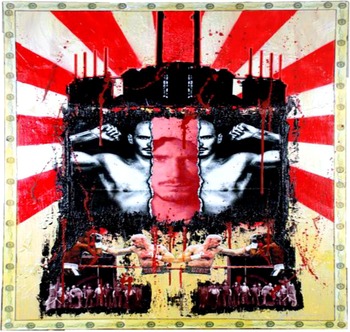
Like Kidd, who—as the grandson of a foreman from Weirton Steel—strongly identified with the city's steelmaking past, local artist Tony Nicholas, a white male in his forties who works as an ironworker as well as a digital artist and photographer, was also eager to present Pavlik as a source of both continuity and revival. His portrait of Pavlik (see Figure 2 below), produced in 2008, differed from the one produced by Ray Simon. While both sought to synthesize images of Pavlik with the Jeanette Blast Furnace, they tell qualitatively different stories about the nature of Youngstown and its relationship to the past. When interviewed by the author in 2009, Nicholas explained:
I wanted to do something that communicates the rebirth, the rising, of Youngstown I guess, through [Pavlik] in a sense, one small aspect. And the bottom image … is of steelworkers here in Youngstown … and to me that's the foundation. And then the fighting spirit gives rise to a new king and to me this [the “Jenny”] is kind of like a crown. I saw this as the crown, not so much that [Pavlik]'s the king, but that he's the symbol of the regeneration of the area … the sunrise, the sunburst of a new beginning more or less.
Portrait of Kelly Pavlik by Tony Nicholas.

While Nicholas noted the importance of the city's past, both he and Kidd were keen to ensure that the emphasis was placed on the contemporary nature of the city and how Pavlik represented the emergence of a new generation. As Nicholas added, although it was important to remember the city's heritage, “[Pavlik]'s a younger guy, and I think at least in some part he should be attached to what's going on now because he brings a lot of attention. I think they should focus on the next generation.” Evident in Nicholas's comments is a tendency to invoke the industrial past while simultaneously historicizing it. Nicholas's linear depiction of the history of Youngstown shows a city ultimately transcending its past, with manufacturing and its ability to define the city consigned to the archives of history, present only as a haunting after effect of a previous era. This is not a unique perspective. Indeed, for some, the imagery Kidd used to promote the Defend Youngstown campaign was just too reminiscent of the past. As Ray, a white professional in his early thirties from a self-identified “working-class” background stated,
The imagery [of Defend Youngstown] … the steel mill worker with the sledgehammer, I thought it was harking back to a city that no longer exists. I don't think Youngstown now is that Youngstown. I do feel that we need to carry our past with us and into the future so that we know where we came from, but … it seems to me a call to arms for people who are no longer here. Who is this guy? I don't identify with him at all.
Here, there is an erasure of the very people for whom Pavlik was such a powerful figure and who drew upon him to revalorize the past as well as the city's contemporary “working-class” identity. While the way in which Youngstown's history resonated within the figure of Pavlik was important for many amongst a new, younger generation in Youngstown, many also held Pavlik up as emblematic of a new phase in the city's history. For a younger generation, whose formative experiences in the city had been shaped not by the presence of the steel industry, but by its absence and the accompanying symbolic and material degradation, Pavlik was seen as marking a new era. As Eric, a white professional in his early thirties, told the author in 2008, for his generation, despite family histories within the mills (including his own summer work in a rolling mill), the sense of steel as a defining feature of Youngstown was derived solely from historical accounts and forms of contemporary culture:
It's mostly through the institutionalism, in the names—here there is the Steelhounds, they're the hockey team—so it's more the historical component, you know, the stories of driving through the streets and seeing the glow of the mills or the snow being gray because of the soot. I have no concept of that whatsoever.
For this group, Pavlik was emblematic of a new generation stamping its mark on the city and its identity. As Eric stated, “I want contemporary Youngstown to show that it's still a dynamic place with those steel-producing people and notions and new forms of culture and you have to respect the old but also the new.” Within this tension the figure of the boxer rested often uneasily, particularly for those who saw Pavlik's occupation as tying him to an outdated past. Take Ray, for example, who said,
For me, [Pavlik]'s the steel mill worker on Defend Youngstown, he's not new. We've always had a history of boxing here so, for me, he's from the past. He's a throwback of what Youngstown used to be and what he's reinvigorating is this old idea of Youngstown. I don't want Youngstown to be what it was, when it was an industrial city with pollutants and that prides brawn and brutal athleticism as opposed to people who are driven by ideas and creative pursuits.
For him, rather than the industrial past being something to be celebrated, it was instead something to be transcended. Ray stated that “it's important to know the history, but for me the importance of that history comes more from knowing how taken advantage of this community was, and I don't think people look at it that way … I think most people think of steel as a heritage. I look at it as, in many ways, what kept a lot of people here in a servile mentality in a certain way.” He added,
I don't want it to be a blue-collar town, I want it to be more diverse, you know, blue-collar but also where arts flourish and where things like technology centers can grow as well. To diversify, to be a diverse community, not to be this, “Oh it's a blue-collar town and it'll always be that way.” No, it can be both.
There was certainly a sense among both younger and older residents and city leaders—particularly those enjoying higher class positions and higher levels of educational attainment—that, in the wake of deindustrialization, Youngstown's inability to shake its “blue-collar” image had been a barrier to new economic development and the adoption of more “progressive” and contemporary place-images. As Dudley states, in a social, cultural, and economic context, in which the “cultures of the mind” are privileged over the “cultures of the hands,”Footnote 42 there existed a degree of ambivalence and tension over Pavlik's ability to define the city. This became particularly apparent in relation to the ways in which the national media sought to present the city in its coverage of the fighter. The media—in constructing Pavlik's “authenticity” as a “blue-collar hero”—drew heavily on tropes that constructed Youngstown as a relic of a bygone era, featuring a stock set of images of abandoned buildings, factories, and scenes of urban decay. Stewart, for instance, described Youngstown as “mostly a hollowed-out shell of its former self. Huge, empty steel mills, with broken-down brick facades, are rusted-out skeletons that serve as nothing more than the memories of what this thriving steel town used to be.”Footnote 43 This seriously frustrated city residents, particularly those involved in attempts at urban revitalization. Phil Kidd saw as a sign of progress, for instance, the way in which residents were now rejecting such representations of the city. Similarly, the local newspaper bemoaned how the media often focused on “the easy, cheap, down-and-out clichés” that “bite on the easy target of closed mills, boarded-up homes, chained businesses and whatever else makes for a great Hollywood backdrop.”Footnote 44 Such depictions became even more prevalent in the wake of Pavlik losing his world title in April 2010. At that point, for many, both Pavlik and Youngstown came to be seen as lacking the tools to compete in both contemporary boxing and the material economy. As Springs Toledo stated,
Youngstown had Black Monday; Pavlik, Bloody Saturday. A local historian might suggest to us that he made the same mistake that his city made decades ago. City and champion stuck with what they knew in an expanding market and ended up losing what they had. Youngstown, like its favorite son, has been struggling in a ruthlessly progressive world that left it brooding by broken windows.Footnote 45
The media's tendency to represent “authentically blue-collar” places through the tropes of abandonment, vacancy, decay, and anachronism reveals how deindustrialization has been accompanied by a material and symbolic denigration of communities such as Youngstown and also helps to explain why city leaders have been keen to steer the city's image in a different direction over the past three decades. Pavlik's association with the industrial past was something many in the city sought to carefully manage. Writing about the symbolic uses of Rocky Marciano in Brockton, Rotella observed a tension between those who saw the fighter's legacy as a way of emphasizing elements of cultural continuity at a time of rapid social and economic change, and those for whom
Marciano might be part of the problem to the extent that an aggressively orthodox insistence on the industrial past and its legacies contributes to Brockton's failure to come to terms with a new urban era. The city's new-order boosters feel that Brockton needs a new identity … In their view, Brockton must shed or denature its traditionally foreboding aura of working-class toughness, especially because over the last couple of generations that aura has modulated into a dead-end reputation typical of depressed Rust Belt cities.Footnote 46
This was a view shared by people in Youngstown. In a letter to the local newspaper in 2009—on the eve of Pavlik's world-title defense in his hometown—city resident Margaret Bidinotto stated that while she could “appreciate Mr. Pavlik's athletic achievement,” he “is viewed not so much as an individual who has carved out his own niche in the world, but as a symbol of all the people who have lost jobs and want to beat on someone.” She added, “A prize fight is not an event to showcase a city trying to look forward; it is an event that sadly confirms a city stuck in the long dead past.”Footnote 47 This comment has to be located within the wider urban context at a time when the city was attempting to rebrand itself as a center for high-tech industries, led by the Youngstown Business Incubator (YBI), which has also received widespread media attention.
Such views and anxieties regarding the appropriateness of Pavlik as a symbolic figure for a city moving forward did not, however, lead to a rejection of his value, particularly when, as the cases of Pittsburgh in the US and Manchester in the UK demonstrate, success in sports can play an important role in reinforcing ideas of urban regeneration and renewal. Rather, it led to a series of local representational strategies, where certain aspects of Pavlik's image were emphasized and deemphasized. Pavlik's association with the past was subordinated to the ways in which he could be used to promote a new postindustrial present. For instance, an editorial in the local newspaper stated,
Pavlik is good news we can all get around in some way or form. It's good news that puts us on a national map … He's a good face for Youngstown. A perfect face? No. But a damn good one. There are 100+ cities above us in the various rankings of top cities. There's not a city … that wouldn't take the Pavlik story as their hometown tale … That [he]'s a sports figure should not be measured over the reality of a positive story.Footnote 48
Rather than focus on Pavlik's toughness and idealized masculinity, like many of those with more intimate attachments to “blue-collar” identifications, what is emphasized here is Pavlik as a figure of rebirth or revitalization; his work ethic and ambition are what is being celebrated. For instance, a female city official in her forties explained that Pavlik's appeal lay in the fact that he succeeded “against the odds,” adding, “really that's what Youngstown is all about: get[ting] back up, revitalizing yourself, and when everyone thought you were dying out you're back up.” Similarly, Ray said what he takes from Pavlik is that “you can get back up. You can rebuild no matter what situation you are in and I like that.” He added, “The thing that I liked about him when his story became visible is that he was someone who was driven, and that he was going to achieve what he wanted to … That's what I see in him.” Here, Pavlik is cast within a linear narrative of decline and rebirth, which imposes a neat vision of time, relegating manufacturing industries and industrial workers to the past.
Within these forms of representation, aspects of Pavlik's identity as a successful boxer were disavowed, while others were celebrated. For instance, his perceived indefatigable qualities of sprit, determination, and work ethic were promoted rather than the physicality and toughness of the labor he was engaged in. An article in the local newspaper in 2008 proclaimed, “The fighter's work ethic is a model for the Valley.”Footnote 49 Similarly, in a brochure produced by the Youngstown and Warren Regional Chamber in 2010, aimed at attracting new business, the final page focused on Youngstown's boxing history and its record of world champions. The text posed the question of whether the success of Pavlik and his fellow boxing champions could be attributed to an inherent masculine toughness that typified the area; in the end, it concluded, “it's because the hard-working people of the Mahoning Valley have just the right temperament and dedication to become champions.”Footnote 50 This was done to promote the idea that a strong work ethic was intrinsic to the area and its residents while downplaying the city's tough reputation. This tendency has been identified elsewhere. Research conducted by Tim Strangleman and colleagues in a number of former mining towns in the UK revealed that city leaders engaged in economic development were keen to simultaneously distance themselves from the legacy of coal, but also to maintain the idea that such areas possessed a distinctive work ethic—a form of contemporary commodification to aid them in attracting investment.Footnote 51 We see similar engagements with the past in Youngstown.
Among city leaders and many members of the younger generation of city residents, particularly those in more educated and affluent positions, we see how the favored representations of Pavlik are those that meet the demands of the new economy and new urban aesthetic. Here, rather than seeing a wholesale casting aside of the industrial past, representations of Pavlik suggest a more complex, nuanced process of recovery, disavowal, and incorporation, as notions of individual agency, resiliency of spirit, ambition, and strong work ethic are promoted. It is interesting that the local media and city leaders rarely, if ever, sought to connect the fighter to the industrial past. Instead, he was employed as a means of distancing the city from it. However, as Byrne observes, forms of “dominant” culture do not seek a complete rupture from the industrial past; rather, within the “phase shift,” which he sees deindustrialization as marking, elements of the past exist simultaneously in antagonistic but also complementary ways with the demands of the present.Footnote 52 It is clear that the aspects of Pavlik that were emphasized were dictated by a city agenda that sought to transcend the past, even as it drew on the city's historic work ethic and resiliency forged through its industrial culture. We see in Youngstown what Crinson and Tyrer have observed in Manchester: that “memory must be seen to be respected, but only providing it presents no contradictory or resistant elements to change.”Footnote 53
Conclusion
The representations surrounding Kelly Pavlik reveal the complex way in which the past is negotiated in relation to both the present and an imagined future. This discussion has demonstrated how, rather than marking a complete rupture from the industrial past, we instead see in the uses of Pavlik's image a more ambiguous process of disavowal, deemphasis, invocation, and accommodation. For those more intimately bound to the city's “blue-collar” heritage by virtue of occupation, education, gender, and class position, Pavlik offered a means through which such forms of identification could be recovered and reasserted. It is clear that in Youngstown, as the social, economic, and cultural institutions that supported the production of localized occupational cultures has been eroded, popular culture—particularly boxing—has become an important site for enabling the city to continue to be defined as “blue-collar” or “working-class” in its composition. In this way, a racialized, classed, and gendered understanding of the industrial past is reasserted, and the importance of toughness, dedication, and hard physical work is reinscribed into the city. For a younger generation, although it continued to acknowledge the importance of the “past,” the legacy of the steel industry was historicized. For them, Pavlik was cast as emblematic of a dynamic new generation seeking the revitalization of Youngstown and—despite deference to it—a transcendence of the industrial past. However, this did not rely on a complete erasure of the past but, instead, on emphasizing abstract qualities such as spirit, ambition, agency, and work ethic and downplaying the brutally physical and classed nature of the boxer and his labor.
For Massey, any attempts to impose a particular, singular reading of a place can never entirely succeed, as “any claim to establish the identity of a place depends upon presenting a particular reading of … history.” In Youngstown, the representations surrounding Pavlik reveal “a contestation of claims, each of which is trying to stabilize the meaning, not just of a particular place-on-a-map as a slice through time,” but as an “envelope of space-time.” Places should be seen as “constantly shifting articulations of social relations through time” as well as space.Footnote 54 What became clear during Pavlik's three-year reign as world champion was that popular culture could serve as an arena in which meanings over history, place, and Youngstown's future were contested. The Pavlik example also reveals the extent to which, in the wake of deindustrialization, different groups have differing resources and forms of recognition at their disposal in advancing their claims. Both “working-class” communities and workers have seen their ability to impose their own understandings of place diminish as the economic, social, and cultural institutions upon which such assertions were founded have become eroded. As High and Lewis observe, “plant closings and their demolition put workers in their place: that ‘place’ being on the margins of local, regional, national, and global culture.”Footnote 55 However, the case of Pavlik reveals how the realm of popular culture becomes an important site within which claims to the industrial past and its related cultural forms are reasserted and reproduced; there, increased material and symbolic marginality is challenged, and attempts to relocate such cultural practices and identities at the symbolic center of place are advanced.
Such contestations are occurring as a broader set of economic, social, and cultural transformations, connecting Youngstown to regional, national, and global forces, continually reshape forms of culture and identity. Here the radical remaking of “blue-collar” communities as traditionally conceived is constructed as a necessary precondition for contemporary projects of renewal and revitalization of place. The tendency to cast communities such as Youngstown as relics lead these cities to promote their contemporary relevancy in what is often imputed to be the “postindustrial present.” Here, the past is never completely rejected, but rather aspects deemed recoverable are synthesized into contemporary constructions of place-based identities. However, even as this occurs, both the legacy of manufacturing and its continuing relevance remain. The growing investment in the Marcellus gas and shale industry has again raised questions about how Youngstown should be thought about and defined. The emphasis placed on high-tech industries over the last decade has been destabilized by the specter of a reindustrialization of the city and region. However, as with the legacies of the industrial past, it is unclear what role Pavlik will play in this. Due to his loss of the world title in 2010 and a well-documented lapse into alcoholism, Pavlik's career has faltered, and his symbolic value has declined. He is no longer really seen as embodying the essence of Youngstown, either by those seeking a form of cultural identity and continuity rooted in the hard, physical labor of the industrial era and its associated qualities, or for those seeking a revitalized city, free of both the industrial past and the symbolic and material denigration that accompanies deindustrialization. The legacies of both the steel industry and Pavlik's world championship reign will continue to be assigned roles within Youngstown's identity, and the forms of representation in which they will be cast will continue unfolding as places and their pasts are made and remade both in city landscapes and plural sociocultural forms.