Introduction
Earwigs (Dermaptera) are important components of some terrestrial ecosystems because of their locally high abundance and their omnivorous feeding behaviour. Earwigs occur in a variety of mostly damp habitats on the ground and also on herbs, shrubs, and trees (Kočárek et al., Reference Kočárek, Holuša and Vidlička2005). The species diversity of earwigs in Central Europe is considered to be low, with seven species documented in the Czech Republic. The biology and ecology of earwig species in the Czech Republic have been studied, e.g., by Kočárek (Reference Kočárek1998, Reference Kočárek2001) and Dvořák & Těťál (Reference Dvořák and Těťál2013).
In our previous study (Kirstová et al., Reference Kirstová, Pyszko, Šipoš, Drozd and Kočárek2017), we found that earwigs can be abundant in a temperate forest. Using a mobile aerial lift platform, we collected more than 700 specimens of earwigs on a 0.2 ha representative plot in a hardwood floodplain forest near Lanžhot (Czech Republic). This indicated that earwigs represented a substantial part of the macrofaunal biomass in the floodplain forest and that earwigs might affect co-habiting organisms. That earlier study, however, focused on guilds of herbivorous insects and their enemies, and therefore used collection methods that were not aimed at earwigs. Only the canopy was sampled, and part of the sampling was performed in a season when earwig numbers were likely to be low. We therefore suspect that the real earwig density in the studied plot was substantially higher than the density detected and reported.
Most earwig species have a low degree of diet specialization, and only a few species are strictly phytophagous or carnivorous (Rentz & Kevan, Reference Rentz, Kevan, Naumann, Came, Lawrence, Nielsen, Spradbery, Taylor, Whitten and Littlejohn1991). As insectivores, earwigs have been considered key biological control agents for some important pests (e.g., Strandberg, Reference Strandberg1981; Caroll & Hoyt, Reference Caroll and Hoyt1984). As herbivores, they can harm plants by feeding on soft fruits and vegetative tissue (e.g., Santini & Caroli, Reference Santini and Caroli1992; Kocarek et al., Reference Kocarek, Dvorak and Kirstova2015). The prevailing role of earwigs in food chains is not well understood, but they tend to feed on animals when they are easily accessible (e.g., Mueller et al., Reference Mueller, Blommers and Mols1988; Asante, Reference Asante1995; Horne & Edward, Reference Horne and Edward1995). Despite their abundance in some habitats, the ecological roles of earwigs (especially their feeding strategies and diet compositions) remain unclear.
Most research on earwigs has focused on the European earwig Forficula auricularia Linnaeus, 1758, and other economically important species (e.g., Caroli et al., Reference Caroli, Perri and Santini1993; Romeu-Dalmau et al., Reference Romeu-Dalmau, Espadaler and Piñol2011). But it is still unclear whether F. auricularia should be considered a pest or beneficial predator. In our previous study (Kirstová et al., Reference Kirstová, Pyszko, Šipoš, Drozd and Kočárek2017), F. auricularia constituted a very small percentage of the collected specimens whereas Apterygida media (Hagenbach, 1822) was the dominant earwig species in the floodplain forest. Another species, Chelidurella acanthopygia (Genè, 1832), was also collected in low numbers. The ecological roles of A. media and C. acanthopygia remain unknown. Even though A. media is abundant, we do not know whether it is predominantly herbivorous (causing leaf damage) or carnivorous (consuming aphids and other small herbivores and thus potentially protecting plants). Therefore, the present study had three objectives:
(1) To determine the densities of earwig species on particular tree species in a hardwood floodplain forest;
(2) To identify properties of tree species associated with differences in earwig densities;
(3) To determine the diet composition of earwigs and properties of the tree species that are associated with the observed diet.
Materials and methods
Study site
The study was conducted in a floodplain hardwood forest (Fraxino pannonicae-Ulmetum vegetation type) near the town Lanžhot (48°41′21″N, 16°56′38″E; 178 m a.s.l) in southern Moravia, the Czech Republic. Earwigs were collected during September 2016, which is when the numbers of adult earwigs peak in the canopy layer of the studied forest (unpublished observation). We also collected earwigs at a second site, which was located outside the forest and adjacent to the Kyjovka River (48°41′55″N, 16°57′25″E, 154 m a.s.l). The second site, which was only 1 km from the first site, was included because it was outside the forest and contained tree species that are important components of floodplain forests but that were absent from the first site.
Sampling
We collected earwigs during September from ten tree species that are dominant in floodplain forests in Central Europe. In the first study site, four patches, each about 2 ha, were selected and sampled; all four patches contained the following seven tree species: Acer campestre L., Carpinus betulus L., Fraxinus angustifolia subsp. danubialis Pouzar, Quercus robur L., Tilia cordata Mill., Ulmus laevis Pallas and Crataegus monogyna Jacq. In the second study site, three patches, each about 1 ha, were selected and sampled; all three patches included the following three tree species: Salix sp. L., Populus alba L. and Prunus spinosa L. The patches within each study site were similar with respect to the proportions of the indicated tree species.
Earwigs were collected by sweeping the trees up to 2.5 m from ground level. At least 50 sweeps were made for each tree species in each patch so that at least 200 sweeps were made for each tree species at each site. The main aim (and also the ‘stopping rule’) was to collect at least ten individuals of each sex of A. media on every tree species. C. acanthopygia and F. auricularia were also collected. Part of the specimens were immediately stored in 90% ethanol to stop digestion within the digestive tract in order to determine the diet composition. We also measured the following seven tree factors that are known to influence insect community structure and that could possibly influence earwig abundance: leaf hairiness, herbivory damage, leaf area (LA), specific leaf area (SLA), fungal coverage of the leaves, lichen coverage of trunks and branches, and light exposure of the trees (Southwood, Reference Southwood, Juniper and Southwood1986; Stubbs, Reference Stubbs1989; Peeters, Reference Peeters2002; Ulyshen, Reference Ulyshen2011). To assess these seven factors, we removed 20 circular disks (20 mm diameter) from 20 randomly sampled leaves for each tree species in each patch. We then photographed five randomly selected areas on the lower surface and five randomly selected areas on the upper surface of each disk. The captured images were assessed using ImageJ 1.50i software (Rasband, Reference Rasband1997–2016). Leaf hairiness was indicated by average number of trichomes on the upper and lower surfaces multiplied by the weighted average of their length. To quantify herbivory damage, we randomly selected 30 leaves from each tree species in each patch photographed them on 1 × 1 m white square and processed in ImageJ software. We also measured the weight of each dried leaf disk to determine its SLA, i.e., its ratio of LA to leaf dry weight. Fungal coverage on each of 100 randomly selected leaves per tree species per patch was assessed using a 0–4 scale, where 0 = no fungal coverage and 4 = leaves fully covered by fungi. Lichen coverage on the tree trunk and branches was also rated in a 0–4 scale, where 0 = no lichens present and 4 = trunk and branches fully covered by lichens. Finally, we estimated light exposure of the trees on a 0–10 scale, where 0 = complete shading and 10 = no shading.
Gastrointestinal tract analysis
The method described by Kocarek et al. (Reference Kocarek, Dvorak and Kirstova2015) was used to determine diet composition. We removed the gastrointestinal tract of up to ten specimens of each earwig species and sex from each tree species. The dissected digestive tracts were permanently mounted in Hoyer's solution on glass microscope slides (Anderson, Reference Anderson1954). We photographed ten randomly selected areas of each preparation at 100× magnification using a microscope and attached CANON D1000 camera. The food fragments (animal, plant and fungal) were visually identified in each micrograph. The fragments were manually coloured, and their relative biomass was calculated with image analysis software (BaDra 2.0, Cardware licensing program, © Peter Lucacs, Frenštát pod Radhoštěm, Czech Republic, batex@email.cz).
Statistical analyses
Earwig population density was expressed as the number of collected earwigs per 100 sweeps. To determine whether earwig distribution was even, random or clumped, we used the index of dispersion validated by the χ2 test. To assess the similarity of earwig species composition (i.e., earwig assemblage composition) on tree species and patches, we used a permutational multivariate analysis of variance (MANOVA) with 1999 permutations based on Bray–Curtis distances between samples. To compare the densities of earwig species on particular tree species, we used a permutational linear model with specified interaction between earwig species and tree species. We also took into account the sex of each individual. To identify tree properties associated with differences in earwig densities, we tested the effects of earwig species, leaf hairiness, LA, SLA, herbivory damage, fungal coverage of the leaves, lichens coverage, tree exposure and their interactions on earwig density with a permutational linear model with 4999 permutations and using backward selection to simplify the full model.
To compare diets (foraging strategies) among earwig species, we used a permutational MANOVA with 1999 permutations. The model also included the effects of the tree species, earwig sex and their interaction with earwig species. Subsequently, we performed a redundancy analysis (RDA) with 1999 permutations and with tree species as a covariate. Using RDA, we determined whether some properties of trees were associated with diet composition. We used an RDA with study area as a covariate and 1999 permutations to test the effects of overall diet amount, earwig density, leaf hairiness, LA, SLA, herbivory damage, fungal coverage of the leaves, lichen coverage and the light exposure of trees on the diet composition of A. media. We also attempted to describe the selectiveness or randomness of diet composition for the earwig species. We created an index of diet dispersion, which was numerically similar to the original index of dispersion, in which the variance in all three types of diet was divided by 1/3 (average from proportions of three diet types). This index, which ranged from 0 to 1, showed the balance of the individual diet components. A value near 1 indicated that one component prevailed. A value near 0 indicated that the diet was balanced among the three components. All analyses were performed using R software 3.3.1 (R Core Team, 2014) and several packages: lmPerm (Wheeler & Torchiano, Reference Wheeler and Torchiano2016), sciplot (Morales, Reference Morales2012) and vegan (Oksanen et al., Reference Oksanen, Blanchet, Kindt, Legendre, Minchin, O'hara, Simpson, Solymos, Stevens and Wagner2015).
Results
Earwig densities
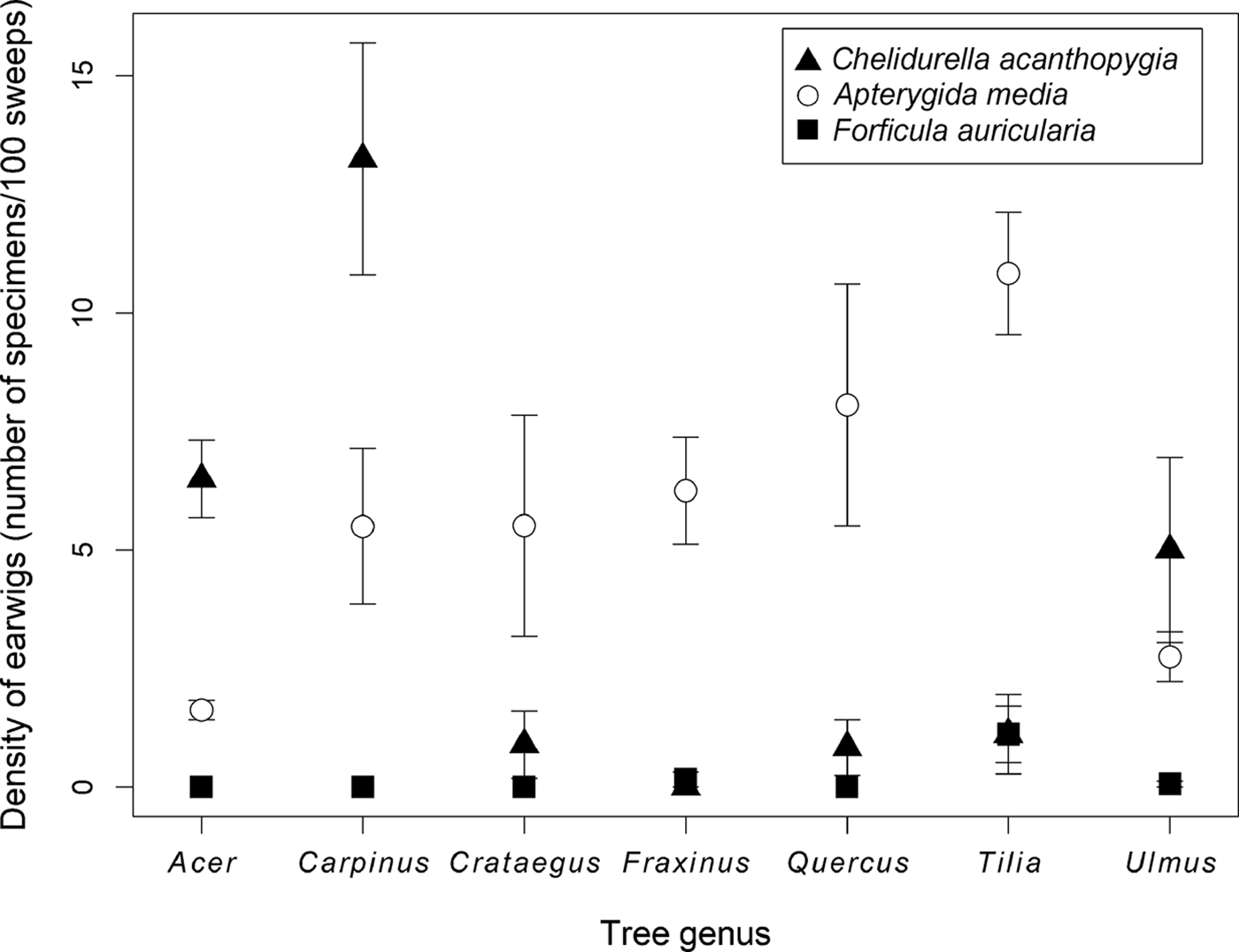
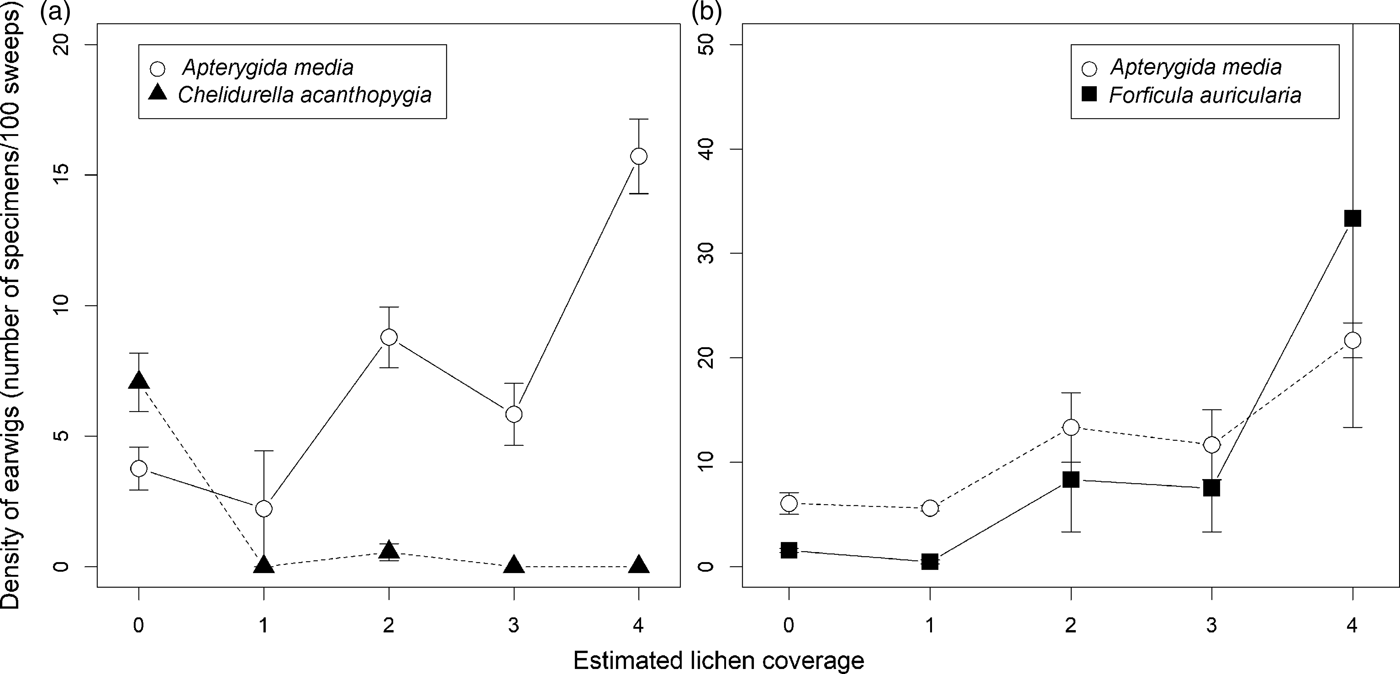
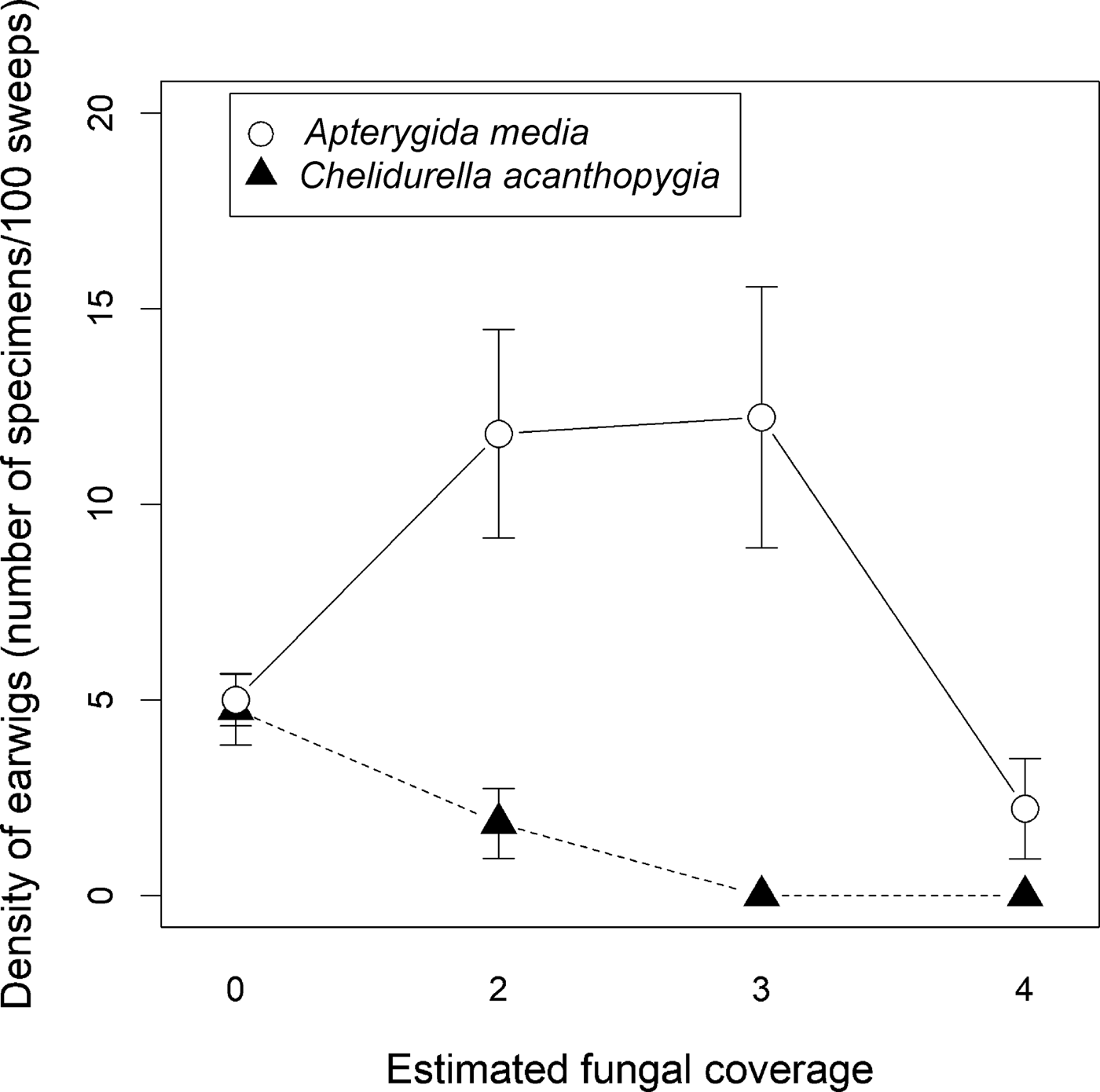
Overall, we collected 562 specimens with 3250 sweeps, i.e., slightly fewer than six sweeps were required to collect one specimen. At the first study site, which was located in the forest, we collected a total of 196 specimens of A. media (97 males and 99 females), 198 specimens of C. acanthopygia (114 males and 84 females) and six specimens of F. auricularia (one male and five females). The distribution was clumped for A. media (index of dispersion = 2.01, df = 9, χ2 = 190.94, Z = 5.79, P < 0.0001) and was even more so for C. acanthopygia (index of dispersion = 3.94, df = 10, χ2 = 374.59, Z = 13.62, P < 0.0001). MANOVA indicated that earwig assemblage composition (i.e., ratio of A. media to C. acanthopygia densities) differed significantly among tree species (df = 9, F = 5.35, R 2 = 0.605, P = 0.015). F. auricularia was excluded from the analysis because there were too few data for that species. The permutational linear model for earwig densities showed that (1) A. media reached higher densities than C. acanthopygia (df = 98, F = 5.658, P = 0.008), (2) A. media and C. acanthopygia densities differed among tree species (df = 98, F = 4.601, P < 0.001), and (3) there were different densities of A. media and C. acanthopygia on particular trees (df = 98, F = 10.730, P < 0.001). Sex and the interaction with sex were not significant factors and were excluded from the model during backward selection. A. media was collected on all seven tree species in accordance with the stopping rule (ten individuals of each sex on each tree species). C. acanthopygia was collected on six tree species (it was not collected on F. angustifolia), and F. auricularia was collected on three (F. angustifolia, T. cordata and U. laevis). A. media densities were highest on T. cordata and Q. robur, and were the lowest on A. campestre and U. laevis. C. acanthopygia densities were highest on C. betulus and A. campestre, and as noted earlier, this species was not detected on F. angustifolia (fig. 1). By backward selection (reduction) of the full model, we determined which of the seven measured tree factors (leaf hairiness, SLA, LA, herbivory damage, fungal coverage, lichens coverage and light exposure) were associated with earwig densities at the first site. The final model included earwig species, lichen coverage, fungal coverage and the interactions between those factors. Although total earwig density was not significantly associated with lichen coverage (df = 106, F = 0.367, P = 0.745) or fungal coverage (df = 106, F = 0.901, P = 0.151), the interactions between these factors and earwig species were highly significant (df = 106, F = 34.05, P < 0.001; df = 106, F = 7.002, P = 0.002, respectively). A. media density was positively related to lichen coverage, but the opposite was true for C. acanthopygia (fig. 2a). A similar pattern was evident for fungi, although neither species was abundant on very mouldy leaves (fig. 3).
Population densities (number of specimens per 100 sweeps) of three earwig species on the indicated trees in a lowland floodplain forest in the Czech Republic.

Relationships between lichen coverage of the tree trunk and branches and the population densities (number of specimens per 100 performed sweeps) of three earwig species inside (a) and outside (b) the lowland forest. Only six specimens of Forficula auricularia were collected inside the forest, and zero specimens of C helidurella acanthopygia were collected outside the forest.

Relationships between fungal coverage on the leaves and the population densities (number of specimens per 100 sweeps) of two species of earwigs on trees inside the lowland forest.

At the second study site, which was located outside the forest, we collected 114 specimens of A. media (45 males and 69 females), zero specimens of C. acanthopygia, and 48 specimens of F. auricularia (13 males and 35 females). The distribution was clumped for F. auricularia (index of dispersion = 6.22, df = 5, χ2 = 205.3, Z = 12.2, P < 0.0001) but was random for A. media (index of dispersion = 1.18, df = 7, χ2 = 39.03, Z = 0.773, P = 0.54). According to a MANOVA, earwig assemblage composition (i.e., ratio of A. media to F. auricularia densities) did not differ significantly among tree species (df = 5, F = 3.90, R 2 = 0.459, P = 0.2). A permutational linear model for tree species, earwig species and their sexes indicated that A. media and F. auricularia densities differed among tree species (df = 32, F = 10.91, P < 0.0001). The densities of both earwig species were highest on P. spinosa. The earwig densities on individual tree species differed between sexes (df = 32, F = 4.082, P = 0.026), because P. spinosa supported large numbers of F. auricularia females. The density of both species increased significantly as lichen coverage increased (df = 34, F = 14.35, P < 0.0001) (fig. 2b). Fungal coverage was not included in the model because the leaves at the second site lacked fungi.
Diet composition
In total, we analysed the digestive tract contents from 118 specimens of A. media (57 males and 61 females), 42 of C. acanthopygia and 31 of F. auricularia. The A. media diet was significantly unbalanced at the first study site (df = 1, χ2 = 4.76, adj.P = 0.029) and at the second study site (df = 1, χ2 = 16.03, adj.P < 0.001), with one diet type prevailing (see next paragraph). The hypothesis of a random diet composition could not be rejected for C. acanthopygia or F. auricularia (df = 1, χ2 = 0.857, adj.P = 0.355; df = 1, χ2 = 0.03, adj.P = 0.856, respectively).
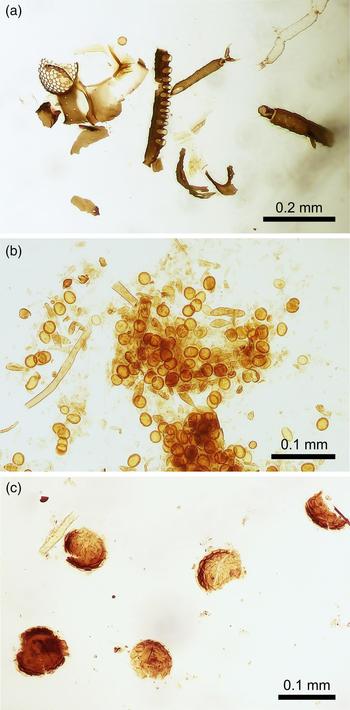
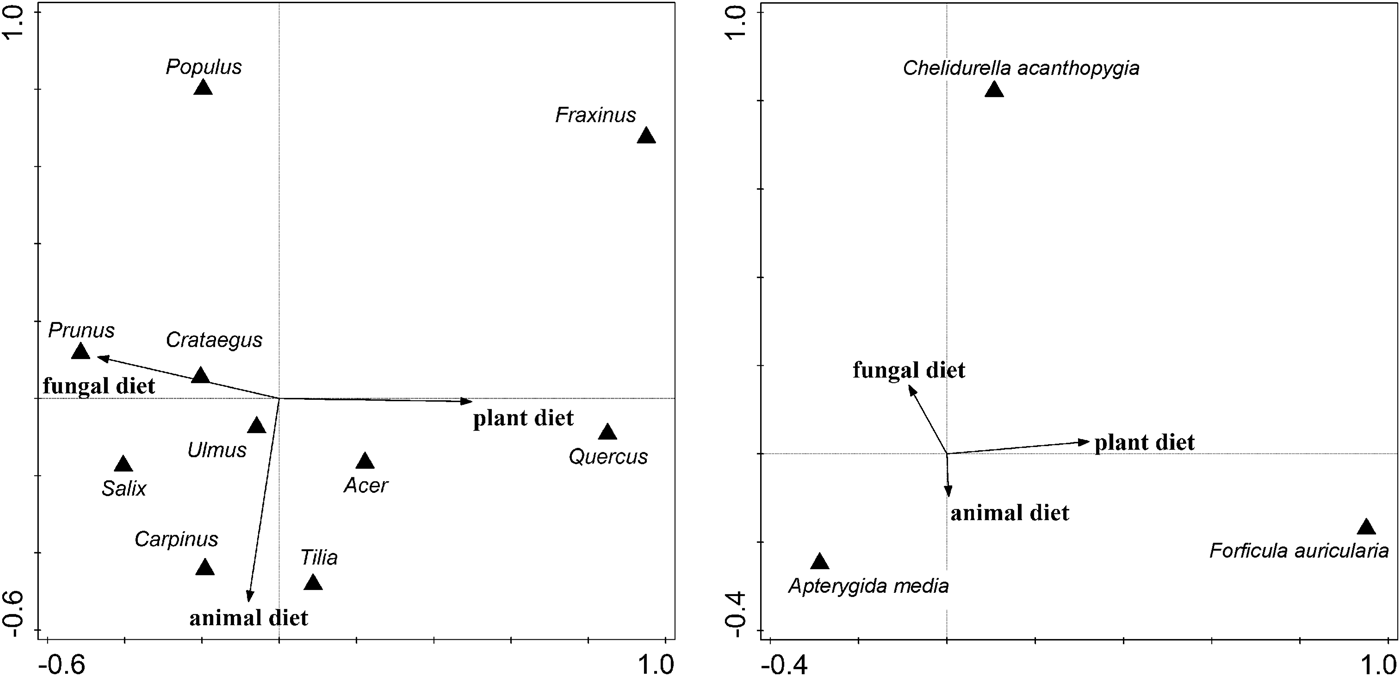
The most frequently detected component in the digestive tract of A. media was animal material (fig. 4a); animal material in the form of insect cuticle fragments was detected in 78% of the dissected specimens. For C. acanthopygia, the most frequently detected component in the digestive tract was fungal material (fig. 4b); fungal material in the form of spores and hyphal and fruiting body fragments was detected in 90% of the dissected specimens. For F. auricularia, the most frequently detected component was plant material (fig. 4c); plant material in the form of plant tissue fragments and fern spores was detected in 81% of the dissected specimens. According to the permutational MANOVA, the diet composition of earwigs significantly differed among tree species (df = 178, F = 7.334, R 2 = 0.252, P = 0.0005) and earwig species (df = 178, F = 8.148, R 2 = 0.062, P = 0.0005). Substantially more of the variability was explained by tree species than by earwig species. The effect of sex was not significant (df = 178, F = 1.3000, R 2 = 0.005, P = 0.2900). A subsequent RDA with tree species as the covariate and earwig species as the explanatory variable, and vice versa, confirmed the results of the permutational MANOVA either for the tree species effect (df = 180, adj. R 2 = 0.249, pseudo-F = 7.9, P = 0.0005) or for the earwig species effect (df = 180, adj.R 2 = 0.061, pseudoF = 6.8, P = 0.0005) (fig. 5).
Micrographs of the digestive tract contents in earwigs. Fragments of animal (a), plant (b) and fungal (c) material.

Partial redundancy analysis plot showing that the diet composition of earwigs was significantly related to tree species (a) and earwig species (b).

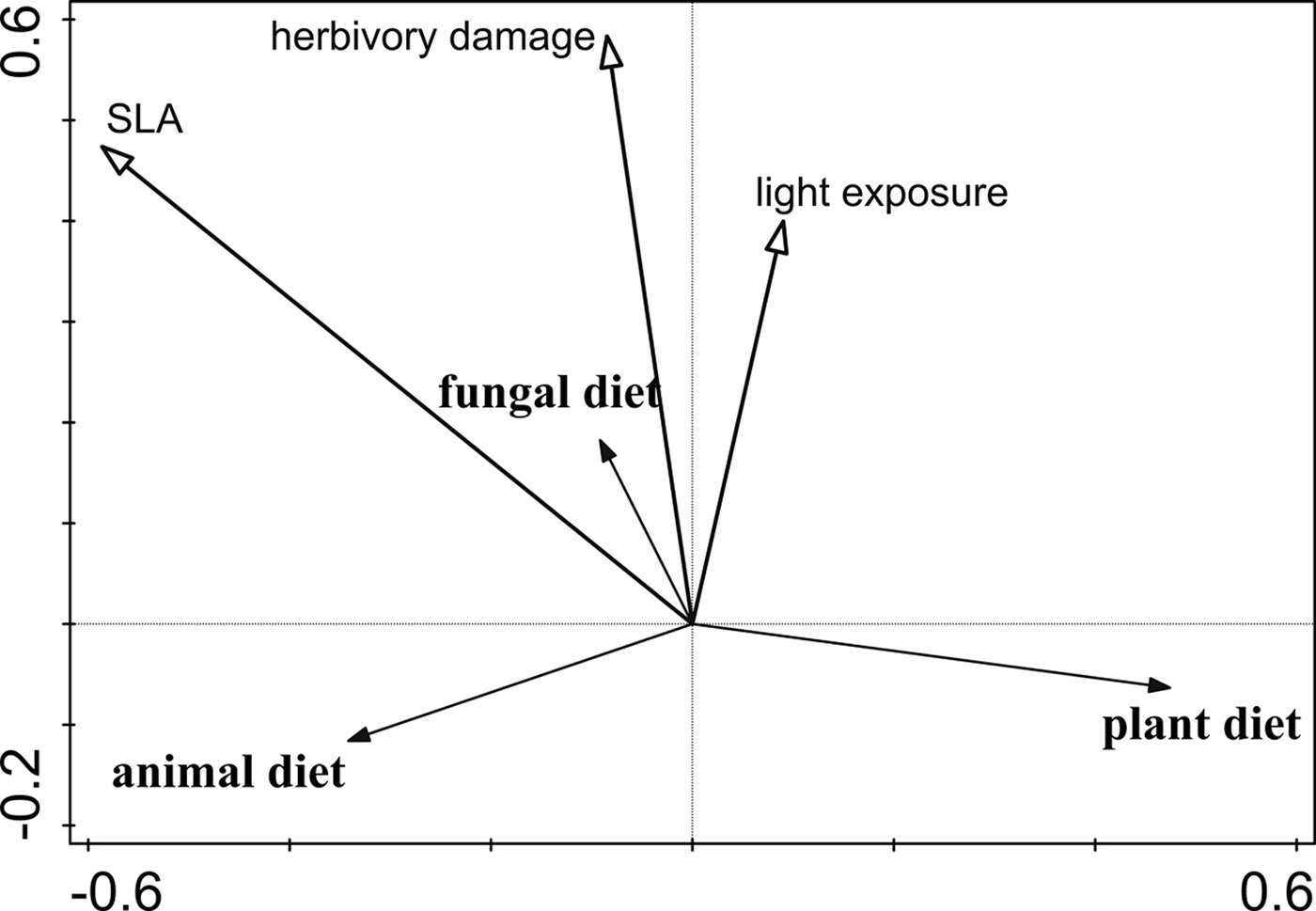
The remaining results relate only to A. media because this was the only earwig species collected in substantial numbers at both study sites, in order for the analysis to be conducted. A Wilcoxon rank-sum test indicated that diet consumption tended to be higher for females than males (W = 2096.5, P = 0.054). The RDA with interactive forward selection indicated that the diet composition was best explained by the differences between study sites (df = 117, adj.R 2 = 0.119, pseudo.F = 16.8, P = 0.0005). A. media consumed more animal and plant material on the trees inside the forest (the first site) than outside the forest (the second site). To understand diet composition, we therefore used a partial RDA with study site (inside or outside the forest) as a covariate and with forward selection; the RDA included all tree factors used in models for A. media density (leaf hairiness, herbivory damage, LA, SLA, lichens coverage, fungal coverage of the leaves and light exposure) and additional factors (total earwig density, diet amount, index of diet dispersion and sex). The effect of SLA was significant (df = 114, adj.R 2 = 0.083, pseudo-F = 10.4, adj.P = 0.005). Herbivory damage and light exposure were nearly significant (df = 114, adj.R 2 = 0.034, pseudo-F = 4.4, adj.P = 0.054; df = 114, adj.R 2 = 0.035, pseudo-F = 4.7, adj.P = 0.051, respectively). As SLA increased, the amount of animal and fungal material consumed increased, and the amount of plant material consumed decreased. As herbivory damage increased, the amount of fungal material consumed increased. As light exposure increased, the amount of animal material consumed decreased, and the amount of fungal material consumed increased (fig. 6).
Partial redundancy analysis plot showing the relationship between the diet composition of A. media and explanatory variables of the trees on which the earwigs were collected.

Discussion
The main aims of the present study were to determine the densities and diet compositions of earwigs in a lowland forest. This information could help us understand how the earwigs affect the trees, i.e., the degree to which they act as herbivores or as consumers of herbivores. We detected three earwig species belonging to the family Forficulidae: A.media, C. acanthopygia (Genè, 1832) and F. auricularia Linné, 1758. A. media is a flightless species that lives in tree and shrub layers in moist habitats in Central Europe (Kočárek, Reference Kočárek2001). C. acanthopygia is a European species with rudimentary tegmina; it occurs under the bark of trees, in leaf litter and also in tree and shrub layers (Irmler & Hingst, Reference Irmler and Hingst1993; Kirstová et al., Reference Kirstová, Pyszko, Šipoš, Drozd and Kočárek2017). F. auricularia has a secondary worldwide distribution and occurs in many habitats; it is fully winged but rarely flies (Haes & Harding, Reference Haes and Harding1997).
Overall, we collected about one earwig per six sweeps, which indicates that the population densities of earwigs were substantial at the study sites. A. media and C. acanthopygia densities were comparable inside the forest (the first site), but only A. media was abundant outside the forest (the second site). C. acanthopygia did not occur on the trees outside the forest because of its strong association with forest habitats (Kočárek et al., Reference Kočárek, Holuša and Vidlička2005). In the study of Kirstová et al. (Reference Kirstová, Pyszko, Šipoš, Drozd and Kočárek2017), C. acanthopygia was sporadically collected even in high parts of the canopy layer. This finding did not agree with the previous observations (Franke, Reference Franke1985; Irmler & Hingst, Reference Irmler and Hingst1993) that this species exclusively inhabits leaf litter and the shrub layer. Contrarily, A. media is abundant in high parts of the canopy layer (Kirstová et al., Reference Kirstová, Pyszko, Šipoš, Drozd and Kočárek2017). Previous and current findings confirm that the habitats of C. acanthopygia and A. media are not identical – A. media is abundant in canopy (Kirstová et al., Reference Kirstová, Pyszko, Šipoš, Drozd and Kočárek2017), C. acanthopygia is abundant in leaf litter (e.g., Irmler & Hingst, Reference Irmler and Hingst1993) and both species are abundant in lower tree layer and their habitats mutually overlap there. F. auricularia densities were low at both sites because this species tends to occupy herbal rather than tree layers (Haes & Harding, Reference Haes and Harding1997). Considering the results of the previous study (Kirstová et al., Reference Kirstová, Pyszko, Šipoš, Drozd and Kočárek2017) and the present study, we conclude that A. media density is significant along the whole height of trees in a lowland floodplain forest and may therefore substantially affect sympatric organisms.
The distribution of F. auricularia was clumped, which is consistent with other studies (e.g., Sauphanor & Sureau, Reference Sauphanor and Sureau1993). The distributions of A. media and C. acanthopygia were also clumped inside the forest, but the distribution of A. media was random outside the forest. A clumped distribution is the most frequent type of population distribution because animals aggregate in places with suitable habitat and resources, which tend to be spatially clumped. When suitable habitats and resources are widespread, animals may be distributed randomly. We infer that the distribution of suitable habitats and resources for A. media are clumped inside the forest but random outside the forest.
Earwig densities differed among tree species. This could be explained by many factors such as tree architecture (i.e., foliage complexity, leave and bark structure, hiding refugia), food sources, interspecific interactions, etc. The environment under the trees can also be important because earwigs lay their eggs in the soil; thereafter, the second instar nymphs spread in horizontal and vertical directions (Rentz & Kevan, Reference Rentz, Kevan, Naumann, Came, Lawrence, Nielsen, Spradbery, Taylor, Whitten and Littlejohn1991). A. media density inside the forest was high on tree species with low C. acanthopygia density and was low on tree species with high C. acanthopygia density (fig. 1). This suggests interspecific interactions between the two species. Outside the forest, A. media and F. auricularia densities were highest on P. spinosa. The abundance of the latter two earwig species on P. spinosa can probably be explained by the damp and shady microclimate created by the dense twigs of this tree; this microclimate is probably important for earwigs in an otherwise open terrain.
We measured seven tree factors that are known to influence insect community structure and that could also influence earwig densities: leaf hairiness, herbivory damage, LA, SLA, fungal coverage of the leaves, lichen coverage of trunks and branches, and light exposure of the trees. Leaf hairiness is important for the movement and attachment of insects and thus can affect insect densities (Southwood, Reference Southwood, Juniper and Southwood1986). Several studies have shown that plant characteristics, such as leaf structure and trichome density, influence the natural enemies of herbivorous insects (Keller, Reference Keller1987; Hare, Reference Hare, Tscharntke and Hawkins2002). Because the leaf damage caused by insect herbivores reflects their abundance, we considered herbivory damage as a factor that could directly and/or indirectly reflect earwig densities. LA and SLA are known to greatly affect the density of herbivorous insect guilds (Peeters, Reference Peeters2002). Fungi can be components of earwig diets (Skuhravý, Reference Skuhravý1960; Chen et al., Reference Chen, Zhang, Liu and Sun2014). Regarding lichens, many studies have shown that lichens and other epiphytes provide food, shelter, hunting grounds and camouflage for diverse invertebrates (e.g., Seyd & Seaward, Reference Seyd and Seaward1984; Stubbs, Reference Stubbs1989). Light exposure can be important because earwigs usually prefer shady places (Kočárek et al., Reference Kočárek, Holuša and Vidlička2005). Among these seven factors, lichen coverage, fungal coverage and their interactions were the most closely associated with earwig densities. A. media evidently benefits from lichens in that its density increased as lichen coverage increased both inside and outside the forest (fig. 2). The same was true for F. auricularia outside the forest (fig. 2b). Perhaps lichen provides food and hiding places for these two species. The density of C. acanthopygia, in contrast, declined as lichen coverage increased (fig. 2a); we suspect that C. acanthopygia may prefer other, darker hiding places because it commonly occurs in leaf litter and under the bark of rotting trees (Irmler & Hingst, Reference Irmler and Hingst1993). As was the case with lichen coverage, the relationship between fungal coverage and earwig density was positive for A. media and negative for C. acanthopygia. Even though fungal material was the most frequent component found in C. acanthopygia digestive tracts, the consumed material did not evidently include the fungi on leave surfaces.
The dietary preferences differed among the three recorded earwig species (fig. 5b). Animal material was the most frequent component of the A. media diet. Its diet was unbalanced, i.e., its diet was in most cases dominated by one of the three diet types (animal, fungal or plant). We conclude that A. media is a food opportunist, i.e., it prefers the most available food resource. C. acanthopygia and F. auricularia had balanced diets, i.e., we usually found two or all three diet types in the same digestive tract.
The diet composition of all three earwig species was most influenced by tree species. Each tree species probably provided a variety of foods. Moreover, the diet composition of A. media differed between study sites, i.e., the A. media diet was dominated by animal and plant material inside the forest but by fungal material outside the forest. Inside the forest, e.g., 84% of the A. media diet on F. angustifolia was composed of plant tissue, and 78% of the A. media diet on C. betulus was composed of animal material. Outside the forest, fungal material represented 91% of the diet on P. alba and 77% on P. spinosa. We did not observe any fungal coverage on P. spinosa leaves, but lichen coverage on P. spinosa leaves was substantial. A. media on P. spinosa apparently consumed lichens and/or fungi on the tree trunk and branches. However, because of the different composition of tree species on the two study sites, the effect of ‘locality’ cannot be completely separated from the effect of ‘tree species’. In 20% of the A. media digestive tracts, we found parts of sap-sucking insects (simple wing venation, sucking mouthparts and siphunculi). Earwigs prefer to prey on soft-bodied insects because they can readily hold such insects with their forceps (Horne & Edward, Reference Horne and Edward1995). It follows that sap-sucking insects such as aphids are suitable prey. When given a choice between aphids, plant material and fungal material in the laboratory, 90% of A. media adults preferentially consumed aphids, and plant and fungal material were usually consumed only after aphids were no longer available (Kirstová, unpublished data). The diet composition of A. media did not differ between sexes, but females consumed more material than males. This is understandable because females need more energy to produce eggs (Thornhill, Reference Thornhill1976).
As SLA increased, the amount of animal and fungal material in the A. media diet increased, whereas the amount of plant material decreased. Like the current study, many studies have reported a positive association between SLA and herbivory damage (e.g., Schädler et al., Reference Schädler, Jung, Auge and Brandl2003; Caldwell et al., Reference Caldwell, Read and Sanson2016). Fungi that infect leaves can use wounds caused by herbivores to enter the plant (Hatcher, Reference Hatcher1995). As herbivory damage increased, the amount of fungal material in the A. media diet increased. A. media probably preferred to consume insect herbivores and fungi associated with wounds caused by herbivores rather than plant material. In the present study, most of the fungal material found in earwig digestive tracts consisted of spores and hyphae. In addition to consuming fungal spores and hyphae, earwigs may increase the spread of fungal structures. Many insects also feed on secretions produced by foliar fungi, and such secretion may increase the probability that insects vector spores and hyphal fragments (Agrios, Reference Agrios, Harris and Maramorosch1980).
Conclusions
The population densities of three earwig species (A. media, C. acanthopygia and F. auricularia) were determined on ten commonly found tree species inside and outside a temperate floodplain forest in southern Moravia (CR). The presence and density of each species differed among the tree species. The distribution of all three species was clumped inside the forest, but the distribution of A. media was random outside the forest. A. media density was positively associated with lichen coverage both inside and outside the forest. The same was true for F. auricularia outside the forest perhaps because lichens represent a food source and provide moist hiding places. C. acanthopygia density, in contrast, was negatively associated with lichen coverage. Its high population density suggests that A. media may significantly affect other organisms in the lowland floodplain. The diet composition of all three earwig species was most closely associated with tree species. The most frequent component in the A. media diet was animal material, which was detected in 78% of the digestive tracts and which consisted of fragments of insect cuticle. The most frequent component in the C. acanthopygia diet was fungal material, which was detected in 90% of the digestive tracts and which consisted of spores and fragments of hyphae and fruiting bodies. The most frequent component in the F. auricularia diet was plant material, which was detected in 81% of the digestive tracts and which consisted of fragments of plant tissue and fern spores. Differences in the diet compositions of earwigs on different tree species were associated with SLA, herbivory damage to the leaves and the light exposure of the trees. We conclude that the dominant species, A. media, is food opportunist: it consumes the most available food resource. A. media probably prefers to consume insect herbivores and fungi rather than plant material. A. media could reduce the population densities of soft-bodied pests of forest trees; on the other hand, it seems to be insignificant for causing leaf damage. Additional research is needed to determine the effects of A. media on soft-bodied, herbivorous insects in temperate floodplain forests.
Acknowledgements
This research was supported by an Institutional Research Support Grant from the University of Ostrava (reg. no. SGS20/PřF/2016 and SGS15/PřF/2017), by project CZ.1.05/2.1.00/19.0388 of EU structural funding Operational Programme Research and Development for Innovation, and by project LO1208 of the National Feasibility Programme I of the Czech Republic. The authors thank Michaela Drgová for the help with specimen collection.