Atrioventricular nodal reentrant tachycardia is the most common form of reentrant supraventricular tachycardia encountered in adults. It is common in adolescents, but is rare in infants. In addition, there are clear developmentally-determined characteristics that serve to distinguish atrioventricular nodal reentrant tachycardia as seen in children when compared to adults.1 Patients who have undergone either the Mustard or Senning procedure for surgical correction of concordant atrioventricular and discordant ventriculo-arterial connections are, for the most part, now adults or adolescents. While such patients commonly suffer from sinus nodal dysfunction,2–4 along with intraatrial reentry tachycardia,5–8 it is not surprising that some of these patients will develop atrioventricular nodal reentrant tachycardia as they age.
The surgical manoeuvres involved in redirecting the venous pathways in either the Mustard or the Senning procedures have profound electrophysiologic consequences that predispose patients to sinus nodal dysfunction and intraatrial reentry.2, 9–14 The baffles created by the surgeon, nonetheless, also produce technical challenges for those who might attempt catheter ablation, specifically because, after the redirection procedures, the critical morphologically right atrial structures that are the target of the electrophysiologist are situated on the pulmonary venous side of the heart. We report here our experience, at three tertiary centres undertaking electrophysiology, the investigation and catheter ablation of patients with atrioventricular nodal reentrant tachycardia after either a Mustard or Senning repair.
Methods
Review of records
We searched our files at three institutions, namely the University of California at San Francisco Children's Hospital, Lucile Packard Children's Hospital at Stanford University, and Green Lane Hospital in Auckland, New Zealand, to identify patients with an electrophysiologically confirmed diagnosis of atrioventricular nodal reentry tachycardia in the setting of a history of either a Mustard or Senning repair. When available, original tracings were reviewed and re-measured.
Diagnostic criterions
Prior to inclusion in our study, records were reviewed to confirm the diagnosis of atrioventricular nodal reentry tachycardia. The diagnostic criterions used were:
- tachycardia terminated from the ventricle without changing the interval between atrial signals, thereby ruling out atrial tachycardia;
- supraventricular tachycardia continuing despite transient atrioventricular block;
- supraventricular tachycardia terminated by adenosine;
- presence of dual atrioventricular nodal physiology;
- ventriculo-atrial time, or retrograde conduction time, measured in the region of the His bundle electrogram of less than 50 milliseconds.
Results
Characteristics of the patients
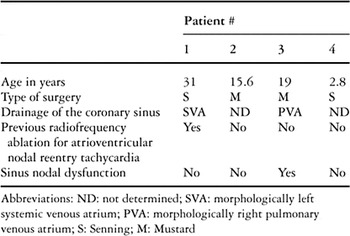
We had conducted electrophysiological studies in our 3 centres in 18 patients with concordant atrioventricular and discordant ventriculo-arterial connections (transposition), with or without a ventricular septal defect, over the period extending from 1989 through 2001. Of these, four were confirmed to have atrioventricular nodal reentry tachycardia, and catheter ablation had been attempted in three of them. In one patient, ablation had been attempted previously, but the patient had suffered a recurrence of the tachycardia. The patients did not have their surgical procedures performed at the same institutions. We did not attempt radiofrequency ablation in the youngest patient. The three patients in whom ablation was attempted were all over 14 years of age. We were able to determine the surgical anatomy of the venous drainage to the coronary sinus prior to the electrophysiologic study (Table 1). Of the four patients, 3 had other atrial arrhythmias, including intra-atrial reentrant tachycardia and atrial tachycardia. Only one patient was diagnosed with sinus nodal dysfunction (Table 1).
Table 1. Characteristics of the patients.

Electrophysiologic characteristics
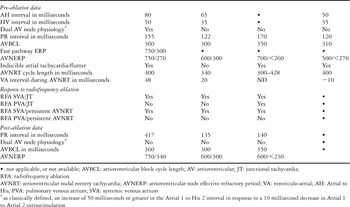
In only one of the patients had we been able to establish unequivocal evidence of dual atrioventricular nodal physiology as classically defined, that is with an increase of greater than fifty milliseconds in conduction time through the atrioventricular node in response to a ten millisecond decrease in the coupling interval of the premature atrial stimulus. The other three patients did, however, have other evidence for the presence of functionally discrete pathways into the atrioventricular node. The first patient, who was the one undergoing previous ablation for atrioventricular nodal reentrant tachycardia, which had recurred, had two retrograde jumps between the ventricle and the His bundle. In the second patient, we repeatedly demonstrated double responses from the same atrial beat. A previous oesophageal study had previously demonstrated clear dual nodal physiology in the third patient, but this was not seen during the invasive electrophysiologic study. During sinus rhythm, and at baseline, in all of the patients, we failed to observe any prolonged P wave to R wave intervals, or atrial to His intervals. The cycle length of atrioventricular block was normal in the three patients in whom it was measured.
Approach for ablation and results
For all three patients in whom ablation was attempted, success required entry into the morphologically right pulmonary venous atrium. Ablation had been attempted first in the morphologically left systemic venous atrium in all three patients, and junctional tachycardia was consistently seen. The nodal tachycardia, nonetheless, remained inducible in all three patients despite the appearance of junctional tachycardia during the application of radiofrequency energy in the systemic venous atrium. Subsequent radiofrequency energy applications were then applied in the pulmonary venous atrium. This was achieved by entering the femoral artery, and passing the ablation catheter in retrograde fashion into the right ventricle, retroflexing it through the morphologically tricuspid valve, and thence to the morphologically right pulmonary venous atrium. In this position, it then proved possible to locate typical potentials of the slow pathway (Fig. 1). Ablations were then performed, but junctional tachycardia was seen in only one of the three patients. In none of these three patients, however, did it prove possible to induce further atrioventricular nodal reentry tachycardia after ablation in the pulmonary venous atrium.

Figure 1. Intracardiac electrograms from our first patient, showing typical potentials recorded from the ablation catheter in the region of the slow pathway, reached using a retrograde approach via the femoral artery, the morphologically right ventricle, and the tricuspid valve. Dis: distal; Prx: proximal; RA: right atrium; SVA: systemic venous atrium; LV: left ventricle; Abl: ablation catheter.
The interval from the P wave to the R wave changed in all three patients following ablation, but not in a consistent fashion. In the first patient, the one who had undergone previous ablation, there was a marked prolongation of the interval from the P wave to the R wave, suggesting some damage to the fast pathway into the atrioventricular node. In the second patient, the interval from the P wave to the R wave prolonged slightly, whereas in the third patient, the interval shortened significantly (Table 2).
Discussion
Our study, describing our electrophysiological experience in a limited number of patients who have undergone extensive atrial surgery for surgical repair of transposition, may be somewhat atypical. Thus, despite the fact that dual atrioventricular nodal physiology as classically defined may not be present, our experience shows that atrioventricular nodal reentry tachycardia can certainly occur in this setting. Most importantly, despite the occurrence of junctional accelerated rhythm after the application of ablations on the systemic venous side of the baffle, in other words in the morphologically left atrium, successful ablation required ablation in the morphologically right pulmonary venous atrium, which we accessed in retrograde fashion (Figs 2 and 3).

Figure 2. An example of the right antero-oblique flouroscopic view of a patient, not in this series, who has had a Mustard procedure. The ablation catheter is passed retrograde from the aorta and retroflexed across the tricuspid valve.

Figure 3. An example of the left antero-oblique flouroscopic view of a patient, not in this series, who has had a Mustard procedure. The ablation catheter is passed retrograde from the aorta and retroflexed across the tricuspid valve.
The substrates for electrophysiological disturbances after the Senning or Mustard procedures are interesting and unique. Intra-atrial reentrant tachycardia, also referred to as atrial flutter, is a common arrhythmia in populations of patients subsequent to these procedures.12 We noted that three out of four patients with atrioventricular nodal reentry tachycardia also had atrial flutter or atrial tachycardia (Table 2). It is well known that a majority of patients who have undergone an atrial redirection procedure, even if they do not develop tachyarrhythmias, experience a loss of sinus rhythm as they age.5, 7, 9 The sinus nodal dysfunction, and loss of sinus rhythm, were thought to be secondary to either direct damage to the node, or to the artery supplying the node, during the surgical procedures, so that initial surgical techniques were modified.15 Kanter et al.16 reported that 2 out of 11 patients who underwent ablation for intra-atrial reentry tachycardia developed second or third degree heart block during their ablations. Their 3 patients who also had ablations for atrioventricular nodal reentry tachycardia, however, did not develop heart block. The risk of creating heart block when ablating atrioventricular nodal reentry tachycardia exists in any patient. Indeed, the patient in our series who had undergone a previous ablation for atrioventricular nodal reentry tachycardia developed a very prolonged interval between the P and R waves after the second procedure. Cryotherapy may prove to be a useful alternative modality for these these patients in the future.
Table 2. Electrophysiologic measurements and results of ablation.

In the Mustard operation as initially described, the coronary sinus was widely incised, and sutures were placed directly into its mouth. This manoeuvre leaves the venous return through the coronary sinus draining into the morphologically left systemic venous atrium, but leaves the oversewn orifice of the coronary sinus itself in the morphologically left pulmonary venous atrium. The revision of the Mustard operation included protection of the sinus node and its artery, as well as a change in handling of the coronary sinus. It was no longer incised, and might be left to drain into either the pulmonary venous or the systemic venous atrium.17, 18 In both the modified Mustard and the Senning procedures, nonetheless, a suture line lies very close to the inferior aspect of the mouth of the coronary sinus, and across the triangle of Koch. The area of the atrial septum superior and anterior to the atrioventricular node may be removed in the Mustard procedure, and is repositioned in the Senning procedure. It seems likely that both the fast and the slow pathways could become damaged during either of these procedures. Indeed, the loss of retrograde conduction in some patients has been thought to be evidence for damage to the fast pathway.16
The physiological substrate for typical atrioventricular nodal reentrant tachycardia is thought to involve dual pathways into and through the atrioventricular node, with a discrepancy between refractory periods of the superior or fast pathway, and the inferior or slow pathway. In this setting, conduction over the slow pathway, if there is enough conduction delay, is then able to utilize the fast pathway for retrograde conduction.19 The location of the slow pathway has been shown to be anterior to the orifice of the coronary sinus, or in the inferior third of Koch's triangle, in patients in structurally normal hearts.20 This location is inferior to the compact atrioventricular node and the bundle of His, and potentials thought to represent the slow pathway can be found in this location,21 serving to demarcate the areas for delivery of radiofrequency energy so as to modify the slow pathway. When applied in this area, the application of radio frequency energy produces transient junctional rhythm, and usually rids the patient of further episodes of atrioventricular nodal reentry tachycardia.22 The mouth of the coronary sinus, therefore, is a critical structure in locating the slow pathway. In patients who have undergone the Mustard or Senning procedure, however, this structure is usually located within the pulmonary venous atrium.13, 23 This poses technical challenges for achieving successful ablation.
As a result of the surgical incisions, and the changes in intra-atrial architecture, it might be expected that the usual evidence for dual atrioventricular nodal physiology would not be seen. Areas of slow conduction have been well documented in the morphologically right atrium, most of which becomes the pulmonary venous atrium in both forms of atrial redirection surgery.4, 12, 24 It is likely that these areas of slow conduction allow for the development of macro-reentrant circuits, and that incisions create lines of conduction block which act as critical barriers.25 In patients who have undergone these atrial redirection procedures, the inferior cavo-tricuspid isthmus remains intact, and therefore intraatrial reentrant tachycardia often uses the typical circuit of atrial flutter.26
In some ways, it is surprising that patients who have undergone the Mustard or Senning procedures are able to develop atrioventricular nodal reentry tachycardia. The suture lines in both procedures are very close to, or within, the mouth of the coronary sinus. The atrial septum is removed or re-aligned in both procedures. It might be expected that both the slow and fast pathways would be surgically disrupted. If there were damage to the fast pathway, a prolonged interval from the atrial signal to the His potential might be anticipated at baseline, it might not prove possible to induce atrioventricular nodal reentry tachycardia. In our limited number of patients, however, we did not see such prolongation of the interval between the atrial and the His potentials at baseline. If the slow pathway only were disrupted, a shorter atrial to His interval might be anticipated, as well as lack of inducibility. It is possible, therefore, that the patients who were able to develop atrioventricular nodal reentry tachycardia had only partial disruption of their fast and/or slow pathways. In patients without structural heart disease, atrioventricular nodal reentry tachycardia is easily dealt with by radiofrequency ablation. As described, the procedure typically requires very few lesions placed in the area of the slow pathway or the inferior extent of the atrioventricular node.21, 27 In older patients who have undergone the Mustard or Senning procedures, the orifice of the coronary sinus, and hence the slow pathway, as we have already discussed, may be in either the pulmonary or systemic venous atrium. Mild systemic desaturation may suggest a right-to-left shunt secondary to venous blood draining to the coronary sinus entering the pulmonary venous atrium. If the coronary sinus has been widely excised and sutured into the systemic venous atrium during the Mustard procedure, it may not be easily entered. We had established the location of the mouth of the coronary sinus in only two of our four patients, but we could enter it in only one. In all three patients in whom ablation was attempted, nonetheless, it was ultimately successful. In all three, it required placement of the ablation catheter in what would be the usual location for modification of the slow pathway or the inferior part of the atrioventricular node in patients with structurally normal hearts. This is no more than expected, since the essence of transposition is the presence of concordant atrioventricular connections, so the atrioventricular node is located in its regular position.