Introduction
The accuracy of the reflector surface is an important criterion to evaluate the performance of reflector antennas. It will directly affect the efficiency of the antenna for the high-frequency observation, thus it is necessary to measure and correct the surface distortion to obtain a better antenna radiation performance. The main causes of the surface distortions are gravity, temperature gradient, wind load, and panels’ assembly precision. There are two main difficulties in the measurement for the reflector surface distortions. The first one is that the surface deformation of the antenna caused by gravity varies with the elevation of the antenna. The second one is that the surface distortions caused by the temperature gradient and the wind load have the quasi-real-time performance. Therefore, it is rather challenging to realize the surface diagnosis of large reflector antennas.
This paper focuses on the phase retrieval algorithm for surface reconstruction of reflector antennas. It is one of the microwave holography techniques, which is the most widely used and effective surface measurement technique for large reflector antennas [Reference Misell1]. Due to the advantages of high precision, unlimited measuring elevation and azimuth, and low cost, phase retrieval has been applied to many large reflector antennas, such as GBT-110 m, TM-65 m, and UDSC-64 m [Reference Morris, Davis and Mayer2–Reference Bach4]. Phase retrieval aims at reconstructing the phase distribution of electrical field in aperture plane through the easily measured far-field intensity pattern, so as to reconstruct the surface deformations of large reflector antennas.
However, as the phase retrieval problem is underdetermined, the classical iterative algorithms based on alternating projection usually stagnate at local minima. To solve the local stagnation, we recently proposed a hybrid global algorithm named CMAES-HIO, which is based on Zernike parameterization [Reference Xu, Ye and Hoorfar5]. In this algorithm, the covariance matrix adaptation evolution strategy (CMA-ES) acts as the preliminary solver to find a near global solution and the hybrid-input-output (HIO) algorithm acts as the posterior solver to approach the optimal solution.
In the optimization process of CMA-ES, to decrease the number of the optimized variables, we first utilize the Zernike polynomials to parameterize the phase estimation in the aperture plane. In this paper, we focus on the Zernike order used in the phase parameterization process. The influence of the Zernike order on the algorithm performance is investigated, and to better quantify the algorithm performance, a hybrid evaluation parameter combining algorithm accuracy and time consumption is introduced. To find the optimal Zernike order under an unknown distortion, we utilize the Monte-Carlo method to simulate different random continuous distortions and calculate the corresponding hybrid evaluation parameters. By repeating the simulation for a large number of times, we can find the optimum Zernike order for an unknown distortion with a high probability.
This paper is organized as follows. In Section “Problem formulation”, we review the theory of phase retrieval problem and the proposed global CMAES-HIO phase retrieval algorithm. Section “Numerical simulation” describes the detailed Monte-Carlo method to reveal the effect of Zernike order on the algorithm performance and to find the optimal Zernike order under an unknown surface distortion. Simulation and analysis are also presented in Section “Numerical simulation”. The conclusions are presented in Section “Conclusion”.
Problem formulation
Phase retrieval problem
Microwave holography is the most widely used technique to reconstruct the surface error of antennas. It can be divided into two classes of techniques: phase coherent holography (PCH) and phase retrieval holography (PRH). As PCH needs an accurate phase measurement for the surface reconstruction, which is difficult to realize in high frequency, it is more suitable for low-frequency range. Unlike PCH, PRH is aimed at reconstructing the phase information in aperture plane only from the far-field amplitude, which can be easily measured in high-frequency ranges. Moreover, PRH does not need any additional equipment such as a reference antenna and/or a phase-sensitive receiver. Due to those advantages, PRH is widely applied in the surface reconstruction for large reflector antennas working in high-frequency ranges [Reference Y.6].
According to physical optics, the electrical field distribution $F\lpar u\comma\; v\rpar$ in the small angle far-field region is the 2-D Fourier transform of the aperture distribution $f\lpar x\comma\; y\rpar$
 .

where $\phi \lpar u\comma\; v\rpar$ is the phase distribution of the far-field, and $\varphi \lpar x\comma\; y\rpar$
 is the phase distribution of the aperture plane. Phase retrieval problem is a class of problem to reconstruct the aperture phase distribution $\varphi \lpar x\comma\; y\rpar$
 from the only measured far-field amplitude $\vert F\lpar u\comma\; v\rpar \vert$
 . We note that phase retrieval is also commonly applied in some other synthesis problems, such as astronomy, electron microscopy, X-ray crystallography, lensless imaging, etc.
CMAES-HIO algorithm
To solve the phase retrieval problem, Gerchberg and Saxton first proposed the Gerchberg–Saxton (GS) algorithm, which iterates back and forth between the spatial domain and the Fourier domain [Reference Gerchberg7]. It requires the accurate amplitude measurements of the spatial domain and the Fourier domain, which is difficult to realize in antenna problems. In 1980s, Fienup proposed a class of the modified GS algorithms to improve the convergent characteristics of the traditional GS algorithm. Among these algorithms, HIO algorithm obviously accelerates the convergent rate of the GS algorithm by adding a negative feedback in the iterative process according to the support constraints [Reference Fienup8, Reference Fienup9]. However, as it is still a greedy algorithm, which does not solve the issue of the underdetermination of the phase retrieval problem, the algorithm's results are still sensitive to the initial guesses and can easily stagnate at a local minimum.
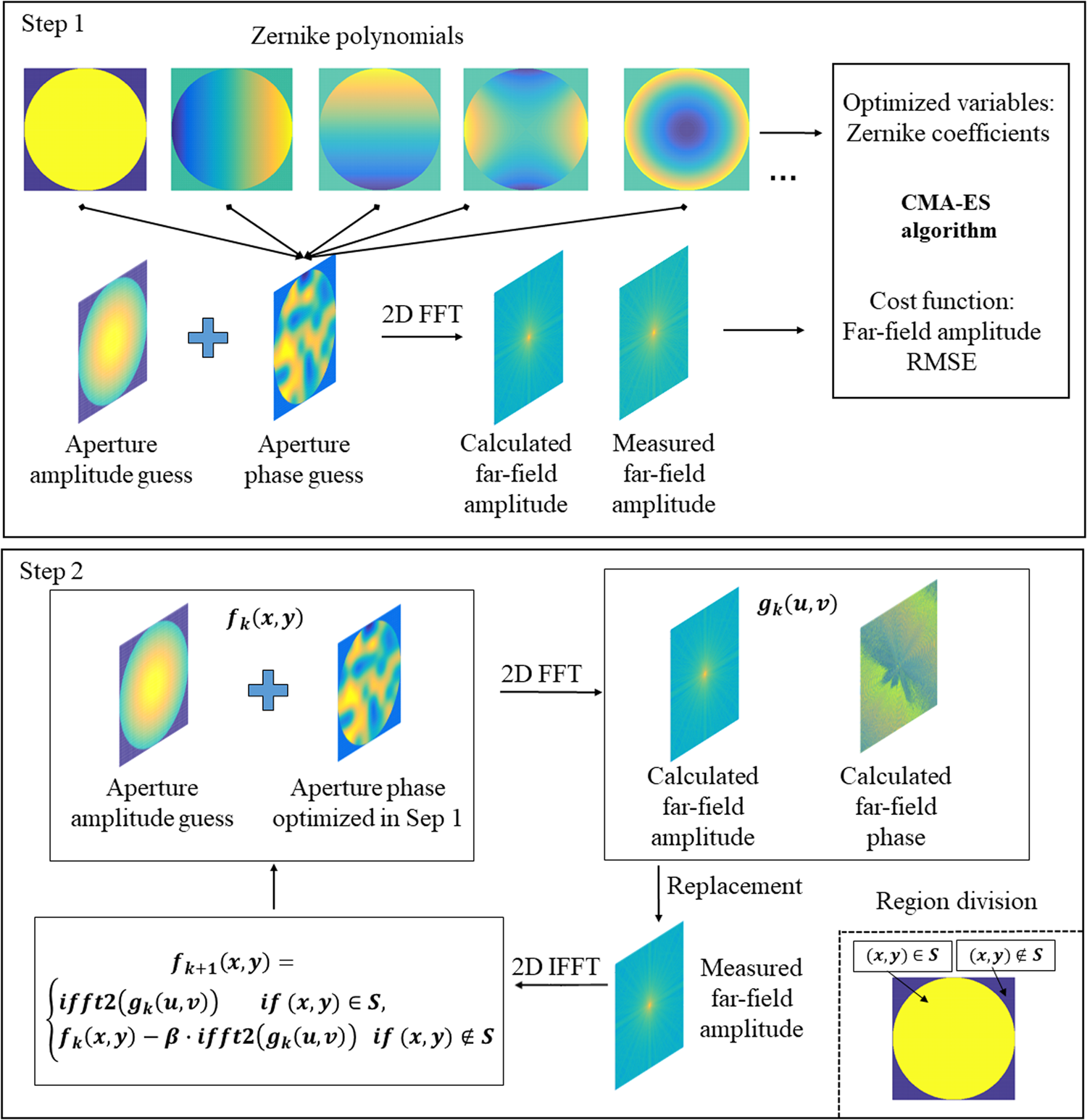
To cope with the local stagnation problem, a hybrid global phase retrieval algorithm named CMAES-HIO, which is a combination of the hybrid-input-output (HIO) algorithm and covariance matrix adaptation evolution strategy (CMA-ES), was proposed in Xu et al. [Reference Xu, Ye and Hoorfar5]. The schematic diagram of the CMAES-HIO algorithm is shown in Fig. 1. In step 1, we first utilize a phase parameterization process to decrease the optimized variables and then apply the CMA-ES algorithm, which is an evolutionary algorithm for difficult non-linear non-convex black-box optimization problems in continuous domain [Reference BouDaher and Hoorfar10], to obtain a near-global phase guess parameterized by the Zernike polynomials. Then, in step 2, we set the optimized phase guess as the initial phase of the one-plane HIO algorithm and utilize the HIO algorithm to iterate back and forth between the aperture and the far-field until it satisfies the convergence criterion.
Diagram of different steps in CMAES-HIO algorithm.

Zernike parameterization
The Zernike polynomials are a sequence of orthogonal polynomials on the unit circle. They are widely used in problems such as astronomy, optics, and optometry to describe functions on a circular domain [Reference Wang and Silva11]. In CMAES-HIO algorithm, we utilize the Zernike polynomials to parameterize the aperture initial phase guess in order to decrease the number of the optimized variables. It will effectively accelerate the convergent rate of the CMA-ES algorithm. The detailed Zernike parametrization is defined as follows:


where ${Z_{n\comma m}}\lpar r\comma\; \theta \rpar$ is the Zernike polynomials, $a_{n\comma m}$
 is the Zernike coefficients $m$
 and $n$
 that are non-negative integers with $n-\vert m\vert = {\rm even}$
 , $n\ge {m}$
 , $\theta$
 is the azimuthal angle, and $r$
 is the radial distance $0\le {r}\le {1}$
 . In the parameterization, the maximum $n$
 is defined as the Zernike order $n^\prime$
 , thus the number of the Zernike coefficients is equal to ${\lpar n^\prime + 1\rpar \lpar n^\prime + 2\rpar }/{2}$
 .
Numerical simulation
Monte-Carlo method
Monte-Carlo method is a broad class of computational algorithms that utilizes repeated random sampling to obtain numerical results. To obtain the optimal Zernike order used in the Zernike parameterization, we investigate the effect of the Zernike order on the algorithm performance and utilize the Monte-Carlo method to simulate the random surface distortions in order to find the optimal Zernike order under an unknown distortion.
We introduce a hybrid evaluation parameter combining algorithm accuracy and the required CPU time to quantify the algorithm performance, which is defined as below.

where $a_i$ , defined in (7), is the global success rate of the CMAES-HIO under $N_0$
 trials for Zernike order $i$
 , $t_i$
 is the time cost, and $\omega _1$
 and $\omega _2$
 are weight factors with $\omega _1 + \omega _2 = 1$
 .

where $\sigma$ is a given threshold value and $RMSE\lpar phase\rpar$
 is the Root Mean Square Error of the retrieved aperture phase.
In this paper, we consider the simulation of Shanghai Sheshan TM-65 m Cassegrain telescope at the frequency of 3 GHz in S band. The surface distortions are simulated as random continuous distortions. The beam amplitude distribution is given as a Gaussian type with a $-16$ dB edge taper. For each simulated distortion, we utilize the CMAES-HIO algorithm to retrieve the distortion under different given Zernike orders. For each Zernike order, we apply several trials of random aperture phase initialization to obtain the time cost and the algorithm's global success rate, which is defined in (7). Then, we calculate the hybrid evaluation parameter $P$
 defined in (6) for the given Zernike order. By repeating the simulation of the CMAES-HIO algorithm under different random distortions, we can reveal the hybrid algorithm performance of the CMAES-HIO algorithm under different Zernike orders for an unknown distortion. Finally, we obtain the optimal Zernike order which we should utilize when we aim to reconstruct an unknown surface distortion.
Simulation results
In this work, we simulated 100 types of random continuous distortions. The search range of the Zernike order to be optimized in this paper is set from $1$ to $10$
 . For each Zernike order, the trials of random aperture phase initialization is set to 100. The success threshold value is set as 0.1rad, and the weight factors $\omega _1$
 , $\omega _2$
 are both set as 0.5 to consider the effect of the algorithm accuracy and time cost simultaneously.
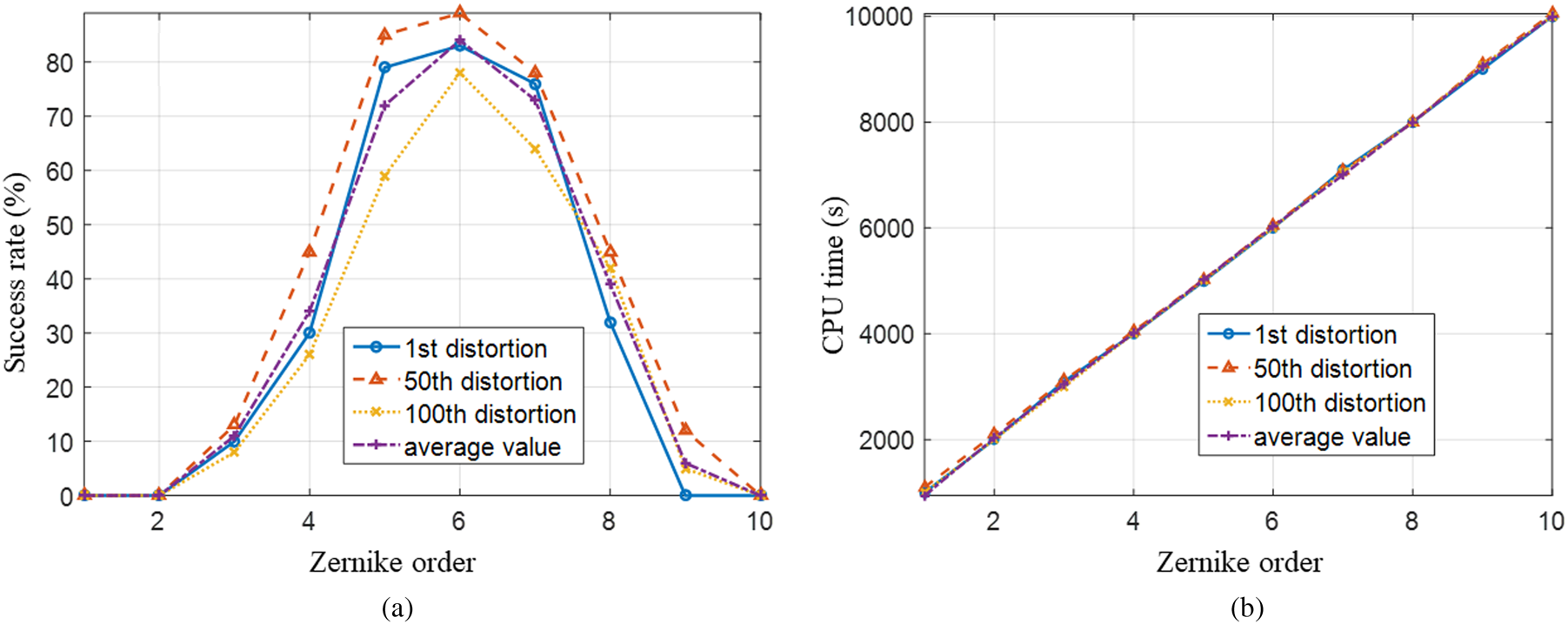
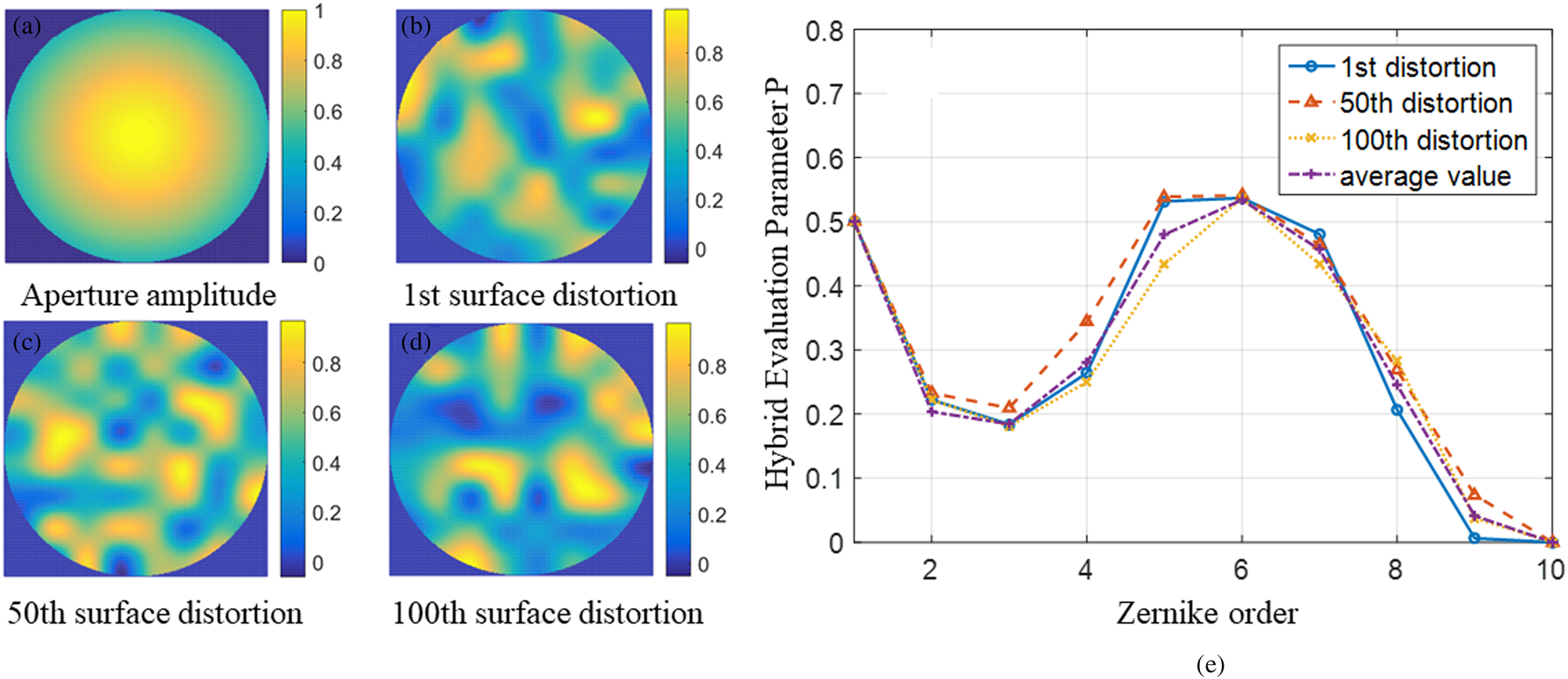
Plots of success rate and time cost versus Zernike orders for the 1st, 50th, 100th random distortions and the average curves are shown in Fig. 2, and plots of the parameter $P$ versus Zernike orders for the 1st,50th, 100th random distortions and the average curves are shown in Fig. 3(e). The simulated aperture amplitude is shown in Fig. 3(a). The distributions of the 1st, 50th, and 100th distortions are shown in Figs 3(b)–(d). The results of Fig. 2 illustrate that a Zernike order in the range of 5 or 6 can obtain the highest global success rate, and a larger Zernike order will increase the time cost. The results of Fig. 3 illustrate that the value of 5 and 6 also correspond to the maximum of the hybrid evaluation parameter $P$
 for random continuous distortions. The presented numerical results clearly demonstrate that in order to obtain the optimal comprehensive algorithm performance of CMAES-HIO technique in the surface reconstruction of large reflector antennas for an unknown surface distortion, the Zernike order should be set to a value of 5 or 6.
Plots of success rate and time cost versus Zernike orders.

(a) Simulated aperture amplitude; (b, c, d) distributions of the 1st, 50th, and 100th simulated surface distortions; (e) plots of the parameter $P$ versus Zernike orders.

Conclusion
The effect of the Zernike order on the performance of the CMAES-HIO algorithm for phase retrieval of large reflectors was studied in this paper. To better quantify the algorithm comprehensive performance in terms of the accuracy and time cost, we introduced a hybrid evaluation parameter and utilized a Monte-Carlo simulation method to search the optimal Zernike order under different random distortions. By comparing the values of the evaluation parameters for different Zernike orders under different distortions, it was shown that for an arbitrary surface distortion, the optimal Zernike parametrization corresponds to polynomials of orders of 5 or 6.
Acknowledgments
The work in this paper is part of the project U1931137 supported by National Natural Science Foundation of China. The authors would like to thank the teachers and postgraduate students in the research group.
 Qian Ye received his Ph.D. in 2002 from Harbin Institute of Technology. He became an associate researcher in Shanghai Jiao Tong University in 2009. His main research interests are microwave holography, phase retrieval algorithm, reflector surface measurement, and large-scale electromechanical system control.
 Yueshu Xu received his bachelor degree in mechanical engineering from the Shanghai Jiao Tong University in 2015 and started his Ph.D. research in the School of Mechanical Engineering, Shanghai Jiao Tong University in September 2015. His main research interests are microwave holography, phase retrieval algorithm, and reflector surface measurement.
 Ahamd Hoorfar is a professor of electrical and computer engineering, director of the Antenna Research Laboratory, and director of the ECE department's graduate studies at Villanova University. He received his Ph.D. degree in electrical engineering from the University of Colorado at Boulder in 1984. His current research interests include electromagnetic field theory, low-profile antennas, metamaterials, inverse-scattering, microwave sensing and imaging, radar systems, and evolutionary computational methods.