


The Portable Antiquities Scheme (PAS) was established in 1997 as an initiative to record archaeological objects found by members of the public. Following a pilot phase, it was extended to all of England and Wales from 2003 onwards.Footnote 1 Since 2004 surveys of Roman period finds documented by the PAS have been published in Britannia. This twenty-third annual summary outlines the general character of Roman finds reported in 2025 and reports significant individual artefact discoveries recorded by Finds Liaison Officers (FLOs).Footnote 2
Overview
In 2025 29,540 objects of Roman date were documented by the PAS within 16,247 object records. The number of objects exceeds the number of records since a single record may document more than one item, especially in instances of coin hoards as well as in assemblages of ceramics or building materials. As in 2023 and 2024, the quantities of both objects and records compiled in 2025 continue to show the trend of overall increased discovery, reporting and documentation following decreased activity during the Covid pandemic, albeit with a somewhat smaller number of Roman objects recorded in 2025 than in the immediately preceding years.Footnote 3 The spatial distribution of finds reported in 2025 also follows that previously reported; again the highest numbers of objects and records occur in eastern and central southern counties in England.Footnote 4 The lowest numbers were again in northern England, the westernmost counties of south-west England and in Wales, as well as in conurbations (except for London’s Thames foreshore).Footnote 5 The causes of this uneven distribution of artefact reporting remain as previously noted, i.e. regional variability in the circulation and deposition of metal objects in the Roman period, in historic and current land-use, especially agricultural practice and urbanisation, and in constraints on metal-detecting, the predominant mode of discovery of objects reported to the PAS.Footnote 6
As in previous years, documented discoveries of coins in 2025 massively outnumbered those of all other Roman artefacts. 11,841 coins were recorded in 11,549 records (i.e. as ‘coin’ entries on the PAS database) and approximately a further 10,906 in 110 ‘coin hoards’ and ‘hoards’. As a percentage of all objects discovered (77%), this is slightly lower than is typical, but further coins as well as other objects, especially ceramic sherds, were also recorded among the 980 objects in the 30 ‘assemblage’ records. Including the examples recorded in 2025, as quantified by these annual summaries, c. 505,000 Roman coins have now been recorded by the PAS. This number reflects the preponderance of coins among objects discovered and the emphasis placed by the PAS on recording Roman assemblages in toto.Footnote 7 The distribution of coins mirrors the distribution of all finds, the highest numbers being from the same counties as noted above and the smallest in northern and western England and Wales, a long-noted disparity that also applies to other datasets.Footnote 8 As for brooches, c. 43,400 examples have been documented by the Scheme since 2003, including a further 2,265 in 2025. These totals include brooches dated to the period from the last decades of the Iron Age to Late Antiquity. The distribution of brooches reported in 2025 corresponds to the overall distribution of PAS records, i.e. being more frequent discoveries in eastern and central English counties, noting also this year a high number in North Yorkshire (105), i.e. in the northern part of the arable region where so many metal-detected finds concentrate. The noted regional disparity in the ratio of Roman period brooch to coin finds continued to apply in 2025, this ratio being higher in Wales, some neighbouring English counties and northern England than elsewhere.Footnote 9 Occasionally noted in other contexts, this disparity deserves further analysis.Footnote 10
Artefact descriptions
The entries below publish a sample of significant objects among the finds made or recorded in 2025 by PAS staff and the Treasure Department at the British Museum and their research collaborators.Footnote 11 They are selected for their contribution to the study of the material and visual culture of Roman Britain, in particular where they advance comprehension of object forms, typological and decorative variability and/or their distribution. They are reported in approximate geographical sequence, beginning in northern England. The alphanumeric reference number given for each find identifies the individual object record on the PAS database (www.finds.org.uk) and where relevant also the Treasure case designation number (20XX/TXX).Footnote 12
The copper-alloy and precious metal artefacts presented here illustrate the variety of function and decoration documented among portable metal objects dated to the period between the first century b.c. and fifth century a.d. They include artefacts belonging to similar functional categories as presented in previous years, including vehicle and harness fittings, belt-fittings, bow and plate brooches, rings, a pendant and necklace clasp, cosmetic equipment, statue fragments and figurines, sceptre terminals, vessels, a miniature knife and a steelyard weight in figural form.
Northumberland
(1) Chollerton (NCL-CA5E5C) (Fig. 1)Footnote 13 A near-complete copper-alloy cosmetic set comprising tools and the bar-and-shackle from which they were suspended, 77.4 mm long (including tools), 33 mm wide and weighing 22.7 g. The sub-rectangular bar carries chequerboard red and yellow enamel inlay on one face, the other is plain, with broken suspension loop. Lugs projecting from the bar ends house an axis from which four tools are suspended, all with bead and reel mouldings. The three preserving their blades include an ear scoop, nail cleaner and tweezers, these names being a matter of archaeological convention rather than definitive function, which might be cosmetic or medical.
Chollerton, chatelaine (No. 1) Scale 2:3 (Photo: H. Morris; © Tyne and Wear Museums).

Several hundred toilet instruments are now documented by the Portable Antiquities Scheme, mostly individual tools, especially nail cleaners and ear scoops which are more straightforwardly dated by type to the later Iron Age and Roman periods.Footnote 14 Approximately 65 examples of the chatelaines and bar-and-shackle suspension elements have also been recorded, the former more numerous than the simpler rectangular plates documented in this case. The decorative scheme is simpler in this case than most, with more complex configuration of enamelled cells in alternating triangles more often preferred.Footnote 15 A find near Sleaford, Lincs, offers an exceptionally well-preserved example of the enamelling scheme.Footnote 16
This is a rare example of a near-complete set of toilet instruments documented by the PAS.Footnote 17 Its findspot, close to documented Roman period rural settlement in the North Tyne valley c. 3 km north of Hadrian’s Wall, as well as that of another chatelaine from Warkworth, Northumberland (NCL-B79326), are the most northerly known from Britain. Alongside occasional isolated finds of individual instruments, these discoveries hint at the sharing of the symbolically laden grooming practices better documented further south.Footnote 18
Lancashire
(2) Nether Kellet (LANCUM-02BA26/2025T1216) (Fig. 2)Footnote 19 A complete silver coin-set finger ring, the orange staining likely derived from its depositional environment. The keeled ring measures 25 mm at its widest and weighs 15.3 g. Its octagonal bezel, with solid circular rim and plain sides, accommodates a denarius of Geta. Its visible obverse shows his draped, bare-headed bust facing right, with accompanying legend (P SEPT GETA CAES [PONT]). The hoop, formed by curved segments, tapers from broad triangular shoulders. Both the latter carry decorative notches forming a double V at the junction with the bezel.
Nether Kellet, coin ring (No. 2) Scale 1:1 (Photo: T. Muscillo; The Portable Antiquities Scheme).

The coin obverse corresponds to that of denarii minted at Rome in Geta’s name from c. a.d. 199–204, i.e. in the first phase of his joint reign as junior emperor with his father Septimius Severus and brother Caracalla. The ring form is widely attested in the third century, but Geta’s murder and damnatio memoriae in a.d. 211 give a likely terminus ante quem for this example’s making, It joins a handful of coin rings from Roman Britain, amplified by finds reported to the PAS, including a similar ring from Spetisbury, Dorset, set with a coin of Elagabalus (a.d. 218–222).Footnote 20 As elsewhere in the Roman empire, coin rings dated to the third and fourth centuries a.d. are more numerous in Britain, many being emblems of fides to ill-fated third-century rulers and their family members.Footnote 21
Cheshire
(3) Malpas (LVPL-0002E4/2025 T1548) (Fig. 3)Footnote 22 A gold filigree finger-ring with a nicolo intaglio, slightly distorted, measuring 18.1 mm wide, with a narrow hoop (4 mm) and weighing 3.63 g. The hoop is formed by a central twisted band bordered on both sides by wires which fold back on themselves where they meet the bezel, widening the ring’s shoulders, each terminating in a bead at each corner of the raised oval box bezel. The setting is carved with a standing figure, facing right, wearing a broad-brimmed traveller’s hat and chlamys, i.e. Bonus Eventus, a personification of abundance. His extended left hand holds a vessel, the right stylised ears of grain. The figure is widely documented on intaglios from Britain, especially on military sites, though the most spectacular instance is set in a ring from the Snape boat burial, Suffolk. An example from London, dated to the second century a.d., shares an especially strong resemblance.Footnote 23 A very substantial corpus of gold finger-rings of Roman date is now documented by the PAS, with almost 250 examples found across eastern and central England. This ring form is classified from the box bezel and the beads at the shoulders as a Henig IV/Guiraud 4c.Footnote 24 Martin Henig notes a now lost ring with very similar hoop form from Ribchester, likely from the same workshop, set with a hexagonal inscribed gem.Footnote 25 The PAS has documented a growing corpus of elaborate gold rings of this kind, some dated later than this example to the third and fourth centuries a.d.Footnote 26
Malpas, ring (no. 3) Scale 2:1 (Photo: H. Beeton; © National Museums Liverpool).

(4) Stanthorne (WREX-8C7F72) (Fig. 4)Footnote 27 An incomplete copper-alloy circular harness fitting or ‘fob dangler’, 51.8 mm in diameter and weighing 30.8 g, with a dark brown patina and some corrosion and wear. The flat ring frames an openwork triskele. Each of the triskele’s members comprises an extended ‘neck’ and a head with flaring mouth. Each eye carries a larger ring-and-dot motif, as does the centre of the triskele. The triskele itself and ring carry a continuous line of smaller punched dots. All decoration appears on one side only.
Stanthorne, harness fitting (no. 4) Scale 3:4 (Photo: S. White; © National Museum Wales).

The purpose of these fittings is uncertain. Like this example, most are openwork, probably suspended from human apparel or horse harness. Thanks to metal-detected finds many more are now documented (over 90) than the 20 or so recorded by Jope and Macgregor.Footnote 28 In the absence of many stratified examples, the suggested date range remains broad, i.e. from c. 200 b.c. to a.d. 200. The expanded dataset reveals the strongly regional character of fobs’ distribution, focused on the west and south-west Midlands, Yorkshire and East Anglia. The variety of triskeles is near infinite, whether in their overall shape, either circular, trefoil, quatrefoil or triangular, or in the arrangement of their members — triskele or whirligig/swastika — or the form of those members, either curved, straight or zig-zagged, equal-sized or unequal.Footnote 29 Ring-and-dot motifs decorate a small number of other examples, most strikingly on a fob from Streatley, West Berks.Footnote 30 Others are heavily bossed.Footnote 31 The Streatley fob is also the most striking in terms of zoomorphic decoration; the stylised water birds on each of its members remains exceptional, but like the Stanthorne fob some other examples also see triskele members transform into animal heads where they join the frame.Footnote 32
North Yorkshire
(5) Raskelf (SWYOR-D9D7DE) (Fig. 5)Footnote 33 A zoomorphic brooch fragment in canine form, modelled in three dimensions, with a dark brown patina, 24.3 mm long and weighing 7.21 g. The slender head of a greyhound-type dog faces right with a large eye formed by a groove encircling possible white metal inlay and folded ears. The narrow neck twists sharply so that the dog looks back across its body, the powerful chest and shoulders tapering to slender hind-quarters, the latter mostly lost to breakage with part of the front leg. Shallow striations on the body hint at schematised ribs. On the concave reverse a lug behind the shoulder may be part of the catch plate.
Raskelf, greyhound brooch (No. 5) Scale 1:1 (Photo: I. Whitehead; © West Yorkshire Archaeology Advisory Service).

A more complete example from Fulbeck, Lincs, offers a very close parallel to the Raskelf brooch details, while a greyhound catching a hare on a brooch from Giggleswick shares its three-dimensionality.Footnote 34 The feeling for sculptural forms dwindles on plate brooches where greyhounds are occasionally translated to two-dimensional forms. One of these, the dog reserved on a rectangular plate against an enamelled background, has a strongly regional focus around the Solent.Footnote 35 The other is so stylised that it can be hard to distinguish from its hare prey, though the latter is a more common brooch subject, despite the myriad dogs in other monumental and portable media.Footnote 36
Doncaster
(6) Hatfield (SWYOR-A8F7D3) (Fig. 6)Footnote 37 A copper-alloy probable harness fitting in two near joining pieces with a light green patina, dating c. 100 b.c.–a.d. 200. Together the two elements form a fitting 69.6 mm long, a maximum of 27.8 mm wide, up to 14.5 mm thick and weighing 32.2 g. The fitting comprises two arms which meet at an expanded lozenge-shaped centre in which a deep channel frames a central boss. One arm is broken, perhaps missing a small fragment at the junction between the surviving pieces. At their ends the arms expand into a triple-collared hoop. The latter might enable a cord or thong to be threaded along the back of the fitting.
Hatfield, harness fitting (No. 6) Scale 3:4 (Photo: P. Holmes; © West Yorkshire Archaeology Advisory Service).

In general size and form the fitting has a passing affinity to bridle cheekpieces and toggles, for example from Carleton Rode, Norfolk (NMS-5983B3), but does not share their function. The central feature echoes the boss-and-petal decorative motifs on metalwork such as harness fittings, for example from Northumberland (NCL-74DE87). Fraser Hunter (pers. comm.) notes a resemblance to the similar-sized elongated strap junctions (so-called) with bowed profiles of which examples are documented in the legionary fortress at Inchtuthil (enamelled), in the Middlebie hoard (Dumfries), and a pit within a roundhouse in the hillfort at Broxmouth (East Lothian), the latter two being ‘boss and trumpet’ style, similar but not identical to the present example.Footnote 38 The central ‘boss and petal’ design can be paralleled in Wild type III button and loop fasteners and in strap slides, for example from Misson, Notts (YORYM-D76783), which are roughly contemporary in date.Footnote 39 The present example’s find spot lies in a region where both strap slides and Type III fasteners are heavily concentrated (Yorkshire and surrounding counties), perhaps suggesting a common regional origin and style. It is possible that this object may form a part of a cavesson, i.e. a form of adjustable bitless bridle, this piece forming the bridge across the animal’s nose which is often padded. This is suggested by the slight curve of the object which would accommodate the nose’s natural curve, while the circular loops would attach to the side fittings of the bridle and the fabric padding. A more complete iron example from Newstead is different in style, but shares the same flared middle, also seen on Roman hackamores.Footnote 40
Derbyshire
(7) Kniveton (WMID-7C901E) (Fig. 7)Footnote 41 A copper-alloy circular fitting, with a mid-green patina, 53 mm in diameter, 17.5 mm high and with walls 4.1 mm thick. It weighs 52.1 g. The fitting has a thicker collar, enamelled on the outside, and a thinner short ‘sleeve’ with a broken edge. From the latter three rivets extend inwards. The decoration comprises triangular cells of alternating red and blue enamel, the latter often discoloured or lost. It is hard confidently to identify the object from which this fitting derives. It has a passing resemblance to other enamelled copper-alloy objects, for example tall Biebrich-type cylindrical inkwells and necks of copper-alloy bottles, but at present it joins fittings whose purpose future discoveries may illuminate.Footnote 42
Kniveton, vessel element? (No. 7) Scale 2:3 (Photo: T. Gilmore; © Birmingham Museums Trust).

Lincolnshire
(8) East Kirkby (DUR-B42FB9) (Fig. 8)Footnote 43 A copper-alloy likely candlestick leg, 50.9 mm long and weighing 31.5 g with a green/brown patina and with much detail lost to wear. The leg is decorated with two faces, a larger above and a smaller below. The larger is an idealised youthful male face, round and framed by thick clumps of hair, with two recesses for the eyes, perhaps once with a setting; traces of a triangular nose and slotted mouth. The hollow back likely housed an element to connect to the rest of the object. The smaller head is feline, the surviving modelling including the ears, recesses for eyes and perforations on the sides and front of the head to render the mouth. The leg terminates in a paw-like foot, with incised chevrons on its sides rendering stylised fur.
East Kirkby, tripod leg (No. 8) Scale 1:1 (Photo: H. Morris; © Durham County Council).

Legs of varying size in zoomorphic (felines above all, also griffins) and human form are common supporting members for Roman candles, lampstands, tripods, stools and tables. As a motif in its own right, this trapezophoric form is also ‘borrowed’ for other objects, especially knife handles, transcending its primary function. The translation of full-sized legs from stone, bronze and shale furniture into a confusing variety of miniaturised copper-alloy forms complicates identifying the specific function of fragmentary and isolated examples like this.Footnote 44 The numbers of these documented by the PAS significantly augment the existing corpus.Footnote 45 In order to put the present item in context, the following paragraph therefore outlines the variety among the smaller zoomorphic and human trapezophoric supports for lighting equipment, using these new examples.
The commonest supports are the legs of tripod pricket candlesticks, a widespread mid-imperial object type occasionally documented in near-complete form, with elegant examples attested in the Bavay hoard, elsewhere in France, and from Merida and Banasa.Footnote 46 These share very slender legs below a stylised feline or griffin head and a clawed or cloven foot. PAS examples only survive as single legs, the best preserved from Collingham (Notts) surviving to its full length.Footnote 47 New similar-sized variants are documented among PAS examples. One group is distinctively modelled in the form of a griffin with a snake’s body, documented at Thwing Roman villa (E. Yorks) and from near Wellingore, Lincs.Footnote 48 Another combines the animal head translated into a stylised beaked mouth and curving chest with a human leg rather than animal claw as support.Footnote 49 Similar objects in the form of straight human legs are also documented.Footnote 50 Similar, but thicker-legged, are the animal-leg supports for small braziers perhaps used as incense burners.Footnote 51 Another form terminates above the animal head in a slotted sphere which articulates with another element, the latter attested in the Kirkby Lonsdale example by a corroded iron stub surviving in the slot.Footnote 52 These have some affinities with the miniature tripods known from the Bavay hoard, but are not similar enough to share their function.Footnote 53 The leg from Pidley cum Fenton, Cambs, is similar, albeit exceptional for the modelling of stylised animal detail, but articulates with connecting members in a different way.Footnote 54 The hoofed leg from Buriton, Hants, is likely to be part of a longer candelabrum, as is the trapezophoric foot from Leyburn, though as a vertical member on a large splayed paw it may be a tripod foot instead.Footnote 55
Given its similarities with the candle feet outlined above, the East Kirkby leg shares a likely function as a lighting support. However, its distinctive two-headed form does not align it closely with any of these variants. Other supports which also combine a large human face with a leg offer partial parallels, but stand differently.Footnote 56 This new decorative variant is a further example of the widening use of artificial lighting that these PAS finds collectively represent. Their decoration is conventional, the feline forms lending themselves to the easy otium in a Bacchic neverland that much interior decoration evoked. But like the other beautiful boys who hold the lights in this company, the East Kirkby youth’s supporting labour reifies enslavement as a natural order of things, underpinning the comfort of a few.Footnote 57
(9) Bracebridge (LIN-37DDD1/2025 T128) (Fig. 9)Footnote 58 A large silver finger-ring, with some surface wear and damage, set with a red carnelian intaglio, with maximum external diameter of 28.3 mm, and broad hoop (14.5 mm wide), weighing 20.9 g. The finger-ring is D-shaped in cross-section, with an oval bezel for the intaglio and broad shoulders gradually tapering into the hoop. The intaglio is carved with a bust of Jupiter Serapis in profile with modius above an eagle framed by standards.
Bracebridge, ring (No. 9) Scale 1:1 (Photo: R. Trevaskus; © Lincolnshire County Council).

The corpus of silver finger-rings once or still carrying intaglios documented by the PAS now numbers more than 150.Footnote 59 This ring joins a notable concentration of silver rings with intaglios in Lincolnshire; in particular a group with figural motifs carved in carnelian gems, including the example under discussion, cluster to the north and south of Lincoln.Footnote 60 Close parallels to the image combining Serapis, eagle and standards are known from Sussex and (a sard) from Beckford, Worcs, allowing it be dated more closely to the late second to early third century a.d.Footnote 61 As a device the eagle is a common subject for Roman finger-rings and in military contexts had a likely protective potency for soldiers.Footnote 62 Given this example’s date to the first to early-third centuries and its findspot close to Lincoln, a connection to the legionary community is not impossible.Footnote 63
(10) Blyton (LIN-BE2D99/2025 T404 (Fig. 10)Footnote 64 A gold pendant and attached fragment of chain, the former 24.3 mm long, the latter c. 15 mm long, in total weighing 1.3 g.Footnote 65 Of the chain three gold-wire loops survive, albeit bent and misshapen, circular in cross-section and connected by a figure-of-eight loop-in-loop construction with each link turned by 90 degrees.Footnote 66 The upper attachment loop is lost, but at the other end the chain connects with a final loop to a drop-shaped pendant, over and around a hoop formed from the latter’s back plate. A beaded border, soldered onto the pendant’s surface, frames a single applied globule at the damaged narrow end. The pendant carries a crude repoussé design, perhaps a face, but difficult to identify.
Blyton, chain and pendant (No. 10) Scale 2:1 (Photo: M. Preece; © The Portable Antiquities Scheme).

The loop-in-loop chain form is widely paralleled across the empire, including instances from Britain, for example in necklaces from Snettisham, Norfolk, or Backworth, Tyne and Wear.Footnote 67 A similar drop- or leaf-shaped pendant is recorded from Wheathampstead, Herts, but two complete examples of chain and pendant are known from Britain, one a plain pendant from Byfield, Northants, c. 18 cm long and the other, c. 23 cm long with a pendant carrying a similar repoussé design of a possible mask, from the c. a.d. 300 hoard from Godmanchester, Cambridgeshire. The latter’s suspension loop was separated by a bar from the rest of the chain.Footnote 68 The silver chains suspended from paired brooches with similar pendants in the form of stylised ivy leaves from the Pitt-Rivers collection offers a partial parallel.Footnote 69 The Roman examples prefigure their proliferation in Byzantine ceremonial dress; for example in their mid-sixth-century mosaic portraits in S. Vitale, Ravenna, Justinian and Theodora wear pendants suspended from brooch (Justinian), collar and headdress (Theodora).Footnote 70
Leicestershire
(11) Harborough (LEIC-AB7A67) (Fig. 11)Footnote 71 A complete copper-alloy belt mount in Trompetenmuster style with intertwined trumpet motifs, 37 mm in length, 25 mm wide and weighing 15.3 g. The design comprises S-forms with flared trumpet terminals. Four of these form two intertwined pairs that join at their terminals to frame a central opening. On opposed sides of this opening are roundels formed of a central boss framed by a narrow gully. Where each pair of S-forms crosses is a smaller opening that may have accommodated a rivet; however, it is possible they are part of the openwork design, mirroring the inner roundels. Two worn stubs on the reverse of the mount are probably the remains of the original integral rivets.
Harborough, Trompetenmuster mount (No.11) Scale 1:1 (Photo: M. Harvey; © Derby Museums Trust).

The design of this mount is unusual, though Trompetenmuster mounts in themselves are not uncommon with 126 examples known from Britain and 215 internationally. Another striking example of a Trompetenmuster fitting was also documented by the PAS in 2025 from near Abbess Roding, Essex.Footnote 72 In Britain they are concentrated across the areas north of the Thames and south of Lincoln, and east of the Pennines into southern Scotland. On the continent they are found along the Rhine and Danubian limites but outlier clusters are also known in Morocco and at Dura Europos, Syria. This distribution suggests a strong connection to the Roman armies, particularly on the frontiers. The Trompetenmuster style seems to have developed in the early Antonine period and remained in use until at least the a.d. 230s.Footnote 73 The apparent higher concentration in Britain is misleading since PAS finds account for a substantial percentage of the data. Where Portable Antiquities of the Netherlands offers a comparable dataset because of its documentation of metal-detected material, the density of finds suggests a widespread use of the motif on mounts. When this data bias is accounted for, the strongest concentration of the mount form is perhaps along the Upper Danube in southern Germany and Austria.Footnote 74
Hertfordshire
(12) Stanstead Abbots (BH-06DFB6) (Fig. 12)Footnote 75 A copper-alloy belt buckle of likely continental origin with a studded profile and a plate with punched decoration, worn with an even mid-green patina, 74 mm long, up to 41.1 mm wide and weighing 23.9 g. An angled pin bar, narrowing where the lost pin hinged, divides the D-form buckle into two zones, one smaller adjacent to the plate, the other larger and omega-shaped. Short projections stud both pin bar and buckle frame, plain on the former, grooved on the latter. Two such projections frame the pin-rest. The folded sheet for the rectangular buckle plate is joined by rivets at each corner. Where it folds around the buckle frame the plate has an aperture for the lost pin. It carries a repoussé swastika with pellets in each angle, framed by parallel lines of punched dots along the plate’s margins edges.
Stanstead Abbots, belt fitting (No. 12) Scale 3:4 (Photo: M. Fittock; © The Portable Antiquities Scheme).

A very large number (almost 800) of Late Roman belt fittings has been documented via the PAS. Many can be accommodated within the existing typologies developed for such finds from continental Europe and Britain.Footnote 76 This belt buckle has some affinities with other types, especially continental examples from the later fourth and fifth centuries. The use of separate bars to hinge the pin and connect to the buckle plate is a widely documented as a form of c. a.d. 350–425, the ‘Teba’ type, to use the most recent typological designator. The same feature is used to assign a type within the Hawkes and Dunning scheme for Late Roman belt buckles in Britain, albeit represented by examples which are not very typical of the wider type.Footnote 77 However, the studded frame finds parallels in other forms too, including those of later date.Footnote 78 Punched decoration for central motifs and border devices is also widely applied to diverse belt plates.Footnote 79 The similarities in one such group from Ickham, Kent, illustrates a possible shared maker.Footnote 80 As a solar motif widely deployed for its apotropaic value, for example as an openwork brooch form, the swastika is documented on other buckle plates and strap ends of similar late-fourth- to early-fifth-century dates.Footnote 81
(13) Sarratt (BH-7940E9) (Fig. 13)Footnote 82 A small, solid-cast copper-alloy figurine in the form of a triple-horned bull, worn and corroded, especially on more prominent areas. The figurine is 48.3 mm long, 38.3 mm high and weighs 79.9 g. Thick-necked and squat-bodied, the bull stands with wedge-shaped head turned to the right. Three horns, worn and rounded, project from the head which otherwise preserves limited detail, save the left ear and rounded muzzle with traces of nostrils and mouth. A prominent dewlap sags from the ridged neck. Powerful shoulders, rump and upper legs are well defined. The right front leg and back left leg are bent, as if the animal is in motion, but lower legs are lost. A short tail curls back over the rump. Genitals are fully modelled, the scrotal sac hanging prominently between the hind legs.
Sarratt, bull figurine (No. 13) Scale 3:4 (Photo: M. Fittock; © The Portable Antiquities Scheme).

This example joins a small corpus of similar figurines from Roman Britain, including a recumbent example from Hertfordshire also documented in 2025.Footnote 83 The British examples are outliers of a wider north-western provincial distribution centred on Burgundy, where dated from first- to third-century a.d. contexts. Here larger figurines, notably a finely modelled bull from Avrigney, Haute Saône, present a similarly muscular body and thick, ridged dewlap, interspersed among many small bronzes more like the present example.Footnote 84 The figures otherwise show the same diversity as two horned examples (seated, standing, sometimes with dorsuale etc.) but their third horn likely manifests divine qualities such as superlative fecundity or strength, even ‘a symbolic energy born of paradox’.Footnote 85
Norfolk
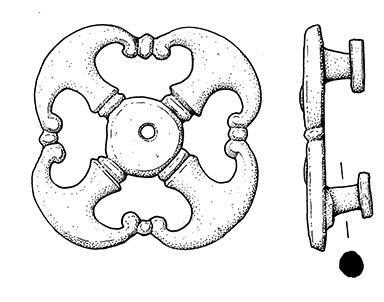
(14) Shouldham (NMS-61238A) (Fig. 14)Footnote 86 A complete copper-alloy openwork cruciform (probable) harness fitting with mid-green patina, dating to c. a.d. 150–250, 29.2 mm long by 28.6 mm wide, 7.5 mm thick (plate and rivet) and weighing 5.5 g. The fitting is formed by four peltas projecting from a central disc, each joined to the next by their terminals and separated from the centre by a collar. The central disc has an off-centre perforation, which with the rivets projecting beneath each pelta enabled attachment to harness straps.
Shouldham, harness fitting (No.14) Scale 3:4 (Drawing: J. Gibbons; © Norfolk County Council).

Parallels for this mount are widely documented, if of uncertain function, with varying attachment methods and sizes.Footnote 87 To take but a small range of examples, an example from Hatert (Nijmegen) is listed among horse fittings, while larger comparable examples from Viminacium and Apulum are identified as baldric phalerae.Footnote 88 On similar phalerae the peltas are inverted, butting against the hub at the centre.Footnote 89 The same configuration (cruciform with four peltas) is also adapted for openwork brooches, very closely on an example from the Ravensworth area, Co. Durham, and more generally in a larger third-century a.d. group from frontier settings.Footnote 90 Footnote 91 Reminiscent of Trompetenmuster-form mounts, this fitting likely dates from the Antonine period to the earlier third century. As a harness fitting it would be difficult to assign it specifically to either military or civilian use as by the mid-imperial period most types of harness furniture are in widespread use. As a baldric fitting, an identification that the central piercing might support, then a military association is stronger.
Suffolk
(15) Hawkedon (SF-D85FE7) (Fig. 15)Footnote 92 An incomplete copper-alloy figurine of Minerva, with worn and corroded surface detail, 74.5 mm tall, weighing 60.4 g. The figurine shares the canonical features of the standing goddess. Beneath a large, crested helmet are traces of curls which frame the face; the large eyes, nose and slot mouth are a little better preserved. The goddess wears a cloak, its heavy folds angled across her left shoulder and down her back. The aegis is visible as a small disc on her chest. The tunic beneath reaches the floor, swathing her feet, with the figure terminating in a flat base. Her left arm rests against her side, holding a circular bossed shield, while her right forearm is raised, reaching outwards with a now missing hand to hold a spear.
Hawkedon, Minerva figurine (No. 15) Scale 3:4 (Drawing: K. Howard; © The Portable Antiquities Scheme).

The god is documented in this and similar forms in many surviving copper-alloy figurines from Britain. Durham lists 31 examples mainly from eastern and southern England, though only one — a lead figurine in an aedicula from Greyhound Yard, Dorchester — has been closely dated from its stratified context, in this case to the late fourth century a.d.Footnote 93 At least ten further examples have since been documented by the PAS, as well as numerous mounts and steelyard weights in Minerva form.Footnote 94
Essex
(16) Near Harlow (ESS-8AC18A/2025T310) (Fig. 16)Footnote 95 A copper-alloy vehicle fitting, 114 mm long, 100 mm high, 43 mm wide and weighing 116.2 g, with a light green patina. The object takes the form of a thick-bodied female leopard, modelled in the round on one side and hollow on the other, its forelimbs resting on a human head. Turning its head towards the viewer, the leopard squats on its hind quarters, tail tucked beneath its body and extending onto the narrow base, the latter hatched on three sides. Anatomical detail is both modelled in the round and incision, the latter giving stylised accentuation to muscles on haunch and shoulder. Incised circles on rump and neck prompt identification as a leopard. The feline head too combines three-dimensional modelling of the muzzle and incision of whiskers; the eyes take a distinctive lentoid form, with lids, eyeball and pupil clearly modelled. On the human head parallel striations form cap-like hair; a slot mouth is framed by a similar moustache and long beard, the latter extending onto the base. Further details include short parallel diagonal mouldings over the right orbit, likely brows, and curving shallow grooves above both eyes, perhaps a furrowed temple. Coiffure and beard identify this as a barbarian; his closed eyes suggest his death. On the back the animal body’s green patina gives way to a recess with rough edges and interior surfaces, both with extensive traces of a lighter colour metal, perhaps solder. Iron traces by the legs and through the base are likely remnants of nails fixing the fitting in place.
Near Harlow, vehicle fitting (No.16) Scale 1:3 (Photo: L. Rogerson; © Colchester and Ipswich Museum Service).

This object’s closest affinities are with vehicle fittings, rare finds in Britain, much better documented in central Europe where wagon burial reveals a rich array of decorative metalwork.Footnote 96 One parallel takes the form of a female feline, modelled on one side only. Of varying sizes and modes of attachment, pairs of these figures at the front of a vehicle sometimes framed a central group, usually divinities, illustrated by the fittings on the restored vehicle in the Römisch-Germanisches Museum in Cologne, based on an excavated example from Salonika.Footnote 97 A larger tigress figurine found near Great Dunham, Norfolk, is a rare example of this type from Britain, with a slot on the back for attachment to a vehicle body.Footnote 98
In its size and in the presence of a motif beneath the animal’s front paw, the Harlow mount also resembles the yoke-end fittings for enabling attachment of draught animal collars; these comprise paired felines set symmetrically on either side of a horseshoe-shaped fitting, with a rod connecting the two medallions on which the animals rest their paws. Many have been identified in central Europe, dated to the first and second centuries a.d.Footnote 99 Rare examples from Britain include a distinctive fitting from Colchester, where a female panther rests its paw on a medallion carrying a Jupiter Ammon head and another from the Claudian-phase deposits at the river harbour in London.Footnote 100 However, the similarity is limited as such figures are fully modelled in the round. The Harlow fitting’s interior with its traces of metal filling or solder resembles other mounts, for example like the bull figurine from Calbourne, Isle of Wight.Footnote 101
Large felines, including panthers, leopards and tigers, are decorative motifs associated with Bacchus and his retinue (thiasos). The same reasons which explain their proliferation on household objects also account for their presence on vehicles, i.e. tokens of prosperity and abundance associated with the god.Footnote 102 Separate ‘barbarian’ figures do feature among vehicle fittings, for example hooks enabling suspension of vehicle bodies, but the resting of the leopard’s paw on a severed barbarian head is, however, not easily matched.Footnote 103 This pairing evocatively combines beings from imperial peripheries, fierce human and animal ‘others’ tamed. The stylisation of some features, for example the animal’s musculature, or the dead man’s cap-like mass of hair, recalling that of bound captives and similar figures from Britain, may suggest local making.Footnote 104 A similar style choice is noted for the Regis house fitting.Footnote 105
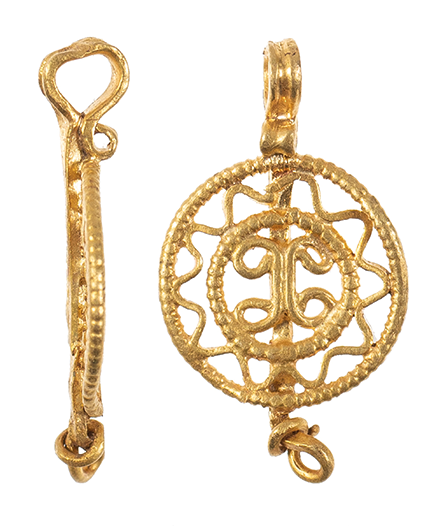
(17) Near Brentwood ESS-466663/2025T1038) (Fig. 17)Footnote 106 A complete gold necklace clasp, 25.3 mm long and weighing 2.2 g. The clasp comprises a circular openwork wheel formed by two beaded rings, the larger outer being connected to the smaller inner ring by a plain wire bent into a scrolling wave. Within the inner ring two opposed peltas are set back-to-back on a bar made in two parts, perhaps because of repair. This bar forms a loop at both ends, one bent back, the other twisted.
Near Brentwood, necklace clasp (No. 17) Scale 3:2 (Photo: L. Rogerson; © Colchester and Ipswich Museum Service).

This form is widely documented as both clasp and pendant for gold jewellery in the Roman empire, albeit more commonly in spoked form and sometimes more elegantly realised.Footnote 107 Parallels from Britain include necklace clasps from the mid-second-century hoards from Backworth, Northumberland, Dolaucothi, Carmarthenshire and (in three silver-gilt examples) Snettisham, Norfolk.Footnote 108
Oxfordshire
(18) Newington (OXON-13E521) (Fig. 18)Footnote 109 A small copper-alloy broad-bladed knife with a mid-green/brown patina and some surface pitting, 76.7 mm long and weighing 16.2 g. The handle, sub-circular in section and expanding as it nears the blade, carries incised chevrons on all sides and ends in a small suspension loop. The blade is approximately triangular, with a straight upper edge continuing decoration from the handle, changing angle to curve towards the now blunt and rounded point and a curving lower edge.
Newington, knife (No. 18) Scale 3:4 (Photo: L. Smith; © Oxfordshire County Council).

Similar knives interpreted as razors of Roman date have been documented by the PAS across East Anglia and central southern Britain.Footnote 110 Alternatively it might be a miniature version of the iron knives classified by Manning under Types 23–24 with curved back and broad blade, i.e. Iron Age forms continuing in use into the first and second centuries a.d. These, however, curve to an upturned tip and lack the abrupt change between straight and curved back seen in this case. The blade’s proportions give it some affinity in miniature with the cleavers attested among surviving ironwork and as a common motif on altars, but in practice such blades are usually socketed.Footnote 111 The size in this and other cases suggests that the knife may have been a possible votive model rather than a functioning item.
Surrey
(19) Woldingham (SUR-BE686A) (Fig. 19)Footnote 112 An incomplete copper-alloy winged brooch with strongly articulated form and distinctive decoration. The brooch is 80 mm long, 14.5 mm wide and weighs 21 g. Its curving oval head carries a ring-and-dot motif within an incised triangle, with further incision along the edges. On its underside is a remnant of the integrally cast spring, now largely lost with the pin. The bow is sharply angled. It first takes triangular form, at more than 90 degrees to the head, carrying the same decoration. A second sharp change of angle follows, with the bow’s two facets carrying the same ring-and-dot motif in eye-like configuration above the first of a pair of projecting triangular ‘wings’ or petals; these curve inwards towards a prominent disc. Beyond this the strongly ridged bow curves gently to the foot. The catchplate beneath is formed by the widening of the pronounced midline flange on the bow’s underside.
Woldingham, brooch (No. 19) Scale 3:4 (Photo: S. Maslin; © Surrey County Council).

This brooch has a close affinity with ‘fibules à ailettes’ (Flügelfibeln), widely documented in Gaul, especially central-eastern France, and dated to the later first century b.c. and early first century a.d., exemplified by finds from the Titelberg oppidum (type 9).Footnote 113 The prominence of the central disc and associated ‘wings’ is shared with a variant documented in smaller numbers at Mont Beuvray and much further south at Montagnac (Hérault).Footnote 114 However, the distinctive ‘eyes’ are not paralleled in this type. The latter recall, albeit distantly, the eponymous features of Augenfibeln from lower Germany.Footnote 115 Alternatively they are testimony of insular adaptation of a continental form.
Hampshire
(20) Overton (SUR-0B07ED) (Fig. 20)Footnote 116 An enamelled copper-alloy plate brooch in the form of a hexagonal shield, 30 mm long, 15 mm wide and weighing 2.8 g. Small projections occur at each vertex and one on the top and bottom edges. Of the six triangular cells, four are inlaid with red enamel. These frame two of dark enamel and an empty central circular cell as a diminutive boss. The reverse carries the remnants of hinge lugs and catchplate. Brooches of this second- to early-third-century type, similar in form with varying enamel colours, come mainly from southern British findspots, including other instances close to Winchester, but with at least one outlier at Straubing, Bavaria.Footnote 117 Different variants are also documented elsewhere.Footnote 118 As a shield it is a protective device par excellence for a plate brooch; its form echoes the hexagonal shields sometimes feature in captured weapons on tropaia.Footnote 119
Overton, plate brooch (No. 20) Scale 1:1 (Photo: S. Maslin; © Surrey County Council).

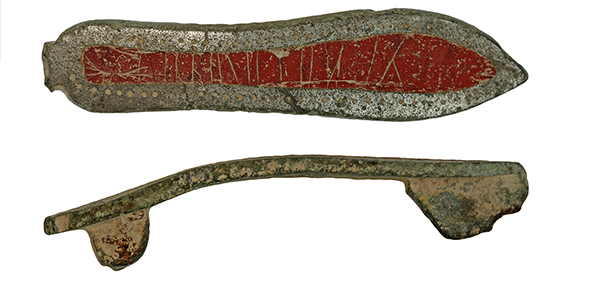
(21) Buckholt (DOR-16581A) (Fig. 21)Footnote 120 An incomplete enamelled copper-alloy plate brooch, slightly bent, in the form of a narrow right shoe sole with rounded heel and pointed toe, 37.5 mm long, 8.8 mm wide, weighing 3.1 g. The brooch carries a recess filled with red enamel and framed by reserved metal carrying small punched dots. Incised into the enamel is a possible female personal name.Footnote 121 A stub of a loop to attach a chain is visible at the heel. A double lug to hold the axis bar for the pin survives at the heel end and an incomplete catchplate at the toe.
Buckholt, plate brooch (No.21) Scale 1:1 (Photo: C. Hayward Trevarthen; © The Portable Antiquities Scheme).

Plate brooches in shoe sole form, the most popular skeuomorphic type, dated from the late first to third centuries a.d., are documented in more than 60 examples from the PAS. The Buckholt brooch is of the ‘wide border’ or second most popular type, framing a narrow enamel field in a common colour. Left and right soles are equally well represented in the 238 examples recently documented.Footnote 122 The distribution of PAS examples, spanning the typological range refined by Shaw, extends from East Yorkshire south across eastern and central southern England. The occurrence of a scratched name is exceptional; the only other inscribed examples carry love mottoes.Footnote 123
Kent
(22) Otterden (KENT-123FE8/KENT-11714C/KENT-2152B4/KENT-12307C/KENT-123904) (Fig. 22)Footnote 124 Fragments of five copper-alloy digits, mainly solid fingertips, from a larger than life-size statue. The breaks are as corroded and patinated as the other surfaces, indicating fragmentation in antiquity. Altogether they weigh 308.7 g. The longest fragment is 56 mm, the shortest 30.4 mm, while the width varies, four fragments being between 17 and 17.5 mm wide and one 20.5 mm. They derive from different sections of the finger. One fragment (KENT-123904) likely comprises parts of proximal and medial phalanges, bent at the first joint; another (KENT-123FE8) has the medial and part of the distal phalanges, while the other three include the tip, distal phalanx (KENT-11714C, KENT-123904), and in one case (KENT-E4EC2C) also part of the medial phalanx. The phalange length demonstrates the superhuman dimensions. One fragment ((KENT-E4EC2C) is significantly thicker than the others (even without the wider parts of the digit surviving) and it is perhaps a thumb rather than a fingertip (KENT-11714C). KENT-123FE8, thinner than the others where it narrows on the distal phalange, is a possible little finger.
Otterden, statue fragments, to scale in suggested approximate position (No. 22) Scale 2:3 (Photo: composite from images by I. Diggle; © The Portable Antiquities Scheme).

The solid character of the digit tips is typical of Roman bronze statuary, an artefact of metal flow in casting. The short-trimmed nails and cuticles suggest high-quality work, in tandem with careful modelled phalanx form and proportions. The shared condition, quality of modelling and identification of a possible thumb fragment hint at likely derivation from a single hand; the bending of the finger at the only fragment where the first joint is preserved may better support the light flexing of some digits rather than the gripping of an object. This can be paralleled in other examples, for instance larger than life-size bronzes at Caerleon.Footnote 125 They contrast with much more flexed hands from London.Footnote 126 The Otterden fragments join numerous others from monumental bronze statues documented by the PAS.Footnote 127 Their fragmented condition typically frustrates identification of subjects, human or divine, and in this case context offers little further help, being some distance from known sanctuaries or urban settings which might have housed a statue on this scale. The same factors make it impossible to decide between breakage for procuring a valuable metal resource or for enabling distribution of objects with continued symbolic potency.Footnote 128
West Sussex
(23) Stonham (SUSS-97ED42) (Fig. 23)Footnote 129 A terminal from an axle linchpin of late Iron Age to early Roman date, 61.8 mm long, at the widest 58.2 mm, weighing 105 g. The copper-alloy crescentic head carries enamelling and incision on one side and is plain on the other, with a mid-green patina. Its socket houses the surviving end of the iron shank, with lugs on either side housing an axis bar surviving in situ.
Stonham, linch pin (no. 23) Scale 2:3 (Photo: J. Clark; © The Portable Antiquities Scheme).

On its decorated side the head is divided into crescentic panels separated by reserved metal, a smaller panel being framed by a larger. Decoration within each panel is organised symmetrically, interlocking reserved metal and coloured champlevé enamel inlay. The larger panel is organised around a lyre loop in reserved metal, framing cells with yellow inlay; it extends on either side in S-coils, narrowing then flaring and bounded by red inlay. Where the S-coils thicken into lobes at the terminal edge they frame yellow-inlaid cells. At the centre of the smaller panel is an inverted trumpet framing a hemispherical cell with yellow inlay; to either side are red inlay cells whose tips extend to the margins of the crescent and onto the junction with the socket. The latter carries a roundel, also with red and yellow inlay. Decoration on the reserved metal adds further intricacy, with incisions both following the metal’s outline and subdividing it into further zones, some of which carry punched stippling.
Linchpins served to fasten axles to wheel hubs. Among the more than 180 examples of Iron Age and Roman date now recorded by the PAS are c. 20 examples like this, characteristic of Spratling’s Group II, i.e. ‘crescent-headed’ linchpins. Several combine curvilinear enamelled inlay and reserved metal, amplifying the decorative repertoire identified by Spratling.Footnote 130 In arrangement and motif this decoration closely resembles that on terrets of crescentic form, also documented through many more PAS examples.Footnote 131 The enamel inlay colours may date this linchpin, like the terrets, to the early first century a.d.Footnote 132 The application of curvilinear motifs to complex geometric effect is testament to investment in vehicle decoration predating the figural repertoire introduced by Roman conquest (cf. no. 16).
East Sussex
(24) Near Eastbourne (SUSS-009B37) (Fig. 24)Footnote 133 A small cylindrical copper-alloy mount or sceptre-head, 37.2 mm high, 15.9 mm wide at the base, and weighing 15.4 g. The mount has a dark patina and traces of gilding in the recesses of neck and head as well as in the socket’s grooves. With some small losses to damage and wear, the slightly tapering socket carries iron staining on its inner surface. Just below the junction with the long-necked head which tops the mount two grooves run around its circumference. The wear to the head obscures the nature of the headgear, which includes a thick band ringing the head from brow to neck and a brim broadening at the back, perhaps a helmet. Rows of short diagonal lines decorate the back and sides of the head, rendering details of helmet or hair, while a patch of iron corrosion is preserved on the top. Wear has erased detail on the clean-shaven face; outsize eyes frame a broad nose, above a narrow mouth and rounded chin. The hair is rendered in rope-like strands on either side of the face and in moulded curls low on the neck. A moulding at the base of the neck carrying short diagonal grooves with a double projection at the front is a likely torc with prominent terminals. A further collar moulding forms the junction with the socket.
Near Eastbourne, sceptre terminal (No. 23) Scale 3:4 (Photo: J. Clark; © Sussex Archaeological Society).

This is a likely head of a sceptre, i.e. a short staff carried to express religious(?) authority. Of these only the metallic fittings, i.e. terminals and bindings, typically survive as metal-detected and excavated examples.Footnote 134 The traces of iron corrosion may be residues from an iron core within the staff to which the mount was attached, attested in the second-century burial from Brough on Humber, E. Yorks, which contained elements of two sceptres including terminals in the form of Mars, shaft elements and sockets containing such cores.Footnote 135 As a helmeted figure this terminal may be another representation of Mars, as attested in sceptre-heads recorded by the PAS from Lincolnshire.Footnote 136
Gloucestershire
(25) Withington (GLO-2F7D7D) (Fig. 25)Footnote 137 A copper-alloy circular plate brooch with a worn sheet-metal applique and gilding, 28 mm in diameter, weighing 15.1 g with partial preservation of decorative detail. Over the copper-alloy plate is a c. 6 mm thick central disc overlain by a thin white metal appliqué. This carries a human face in high relief and framing elements. From a central parting the hair is drawn outwards and downwards in thick strands on either side of the face. Beneath a prominent brow the eyes are lenticular, with raised edges for their lids and a circular pupil; they frame a triangular nose above a slot-like mouth and smooth chin. Much detail is lost but the head was framed by punched circles and a scrolling motif, better preserved beneath the chin, and an outer gilded edge. On the underside of the brooch part of the catchplate and a double lug housing part of the pin survive.
Withington, brooch (No. 25) Scale 1:1 (Photo: K. Adams; © Bristol City Council).

This brooch has affinities with two plate brooch forms known from continental Europe. It recalls the so-called Kapselfibel/Dosenfibel plate brooches which take their name from their box-like central medallion in the form of a female head with similar framing motifs. These are found across continental Europe with a concentration in transfrontier Hungary in graves of third-century date.Footnote 138 Snake-like hair allows some of these faces to be identified as those of gorgons. Unlike this example, however, the portrait on these brooches is typically added as a cast glass medallion. The Withington brooch also recalls examples from a mixed group of brooches of first-century a.d. date with a sheet-metal appliqué in portrait form at the centre.Footnote 139 However, the slightly closer affinities with the first type may indicate a similar date for the Withington brooch.
Bath and North-east Somerset
(26) West Harptree (WILT-BFF9E2) (Fig. 26)Footnote 140 A copper-alloy lion protome, re-used as a steelyard weight, 95.8 mm long and 67.5 mm wide, weighing 948 g, corroded on the right side with a lighter patina than on the head and left. Facial features and mane are rendered in detail, with prominent brows and wide-open large eyes above a muzzle on which whiskery detail is reproduced with close-set lines. The mane rises in thick clumps on head and neck, with parallel striations for individual strands of fur; these continue onto the body and upper legs. The latter stretch forward, paws splayed. The lion clasps a broken ring in the right side of its mouth with a small copper-alloy loop. The body ends in a copper-alloy plate, extending on both sides and incised with crudely rendered lines, very approximately parallel; some of these frame sequences of punched dots. This plate forms the junction with a sub-hemispherical lump of lead, added to repurpose the handle as a steelyard weight. The attachment method is not clear and there is little space for any further element of the handle or shank surviving in the lead mass.
West Harptree, steelyard weight (No. 26) Scale 1:2 (Photo: S. Hawke; © Salisbury and South Wiltshire Museum).

The likeliest original use of the lion protome is as a key handle, these being widely documented across the Roman provinces: for example, more than ten are previously recorded by the PAS.Footnote 141 A similar lion is documented from Augst.Footnote 142 Roman steelyard weights sometimes take figural forms, often purpose-made in anthropomorphic form, comprising busts or heads of gods, emperors and empresses, youths, athletes and so on.Footnote 143 These are occasionally documented among PAS finds.Footnote 144 However, more relevant to the present case are the weights which commonly re-use figural elements, especially from furniture, including the decorative appliqués from couch fulcra, with a repertoire including Bacchic figures and animals.Footnote 145 The present example is a very distinctive instance of re-use, joining other examples from Britain which are more consistent with this wider practice of re-using Bacchic thiasos figures. From Britain, the mounts with busts of a maenad (Nursling), Diana (Great Chesterford), Silenus (Richborough) and a youth (Cupid?, Rampisham) are further instances of the same phenomenon, with lead masses and sometimes surviving suspension loops from their afterlife as weights.Footnote 146 All these figures are also documented among re-used mounts from fulcra elsewhere.Footnote 147
Swindon
(27) Near Swindon (WILT-BD4B5F) (Fig. 27a–f)Footnote 148 A group of four copper-alloy vessels, comprising a Hemmoor bucket, two cups and a spouted jug. The cups, one inside the other, were placed within the bucket and the jug was laid on its side above them. After reporting in 2022 with the vessels and soil fill still within it, the bucket and its contents were subsequently X-rayed, clarifying the positions of the vessels (Figs 27a–b). Excavation and conservation followed at Historic England before display at Swindon Museum.Footnote 149
Vessel group near Swindon: (a) before excavation; (b) X-ray; (c) Hemmoor bucket before excavation and conservation; (d–f) flagon, wider and narrower cups after conservation and cleaning (No. 27) (a, d–f: Photos, Carola del Mese; © Carola del Mese/Historic England; b: photo, Karla Graham; © Karla Graham/Historic England; c: photo R. Trevaskus; © Salisbury and South Wiltshire Museum).

The bucket is largely complete but fragile with some detached fragments, 135 mm in height with a diameter of 240–245 mm. Its concave base is heavily patched. A low narrow pedestal supports the vessel, with a corroded mass of likely solder between it and the body (Fig. 27c). Thin straight sides (c. 1 mm thick) flare slightly at the rim, from which triangular lugs rise to enable the attachment of the cast handle, still in place. The flat-bottomed and broad-bellied jug is 190 mm tall from base to spout and 140 mm in diameter at its widest on the lathe-turmed body, the latter dented and holed (Fig. 27d). The two cups, both lathe-spun, of similar form and height (120 mm), swell from the base to a wide belly and taper to the rim (Figs 27e–f). One is much narrower than the other (90 mm versus 120 mm in diameter), allowing it to be placed inside the larger. Mineralised traces of plant packing survive on the surface of the jug and one cup.
The bucket is a squat version of the ‘Hemmoor’ type, produced from c. a.d. 160–170 to the mid-third century. This example’s size lies in the centre of the documented range.Footnote 150 Its findspot lies at the western extremity of the type’s distribution, which extends eastwards across Europe to Scandinavia and Ukraine.Footnote 151 Within Roman frontiers such buckets occur commonly within structured deposits, as here, or as fragments in settlement assemblages. They are rare finds in Britain, including two examples in the Drapers Garden vessel group from London, one containing a coin hoard from Beachy Head and burnt fragments from third-century burials at Brougham, Cumbria.Footnote 152 There are also occasional metal-detected fragments documented from East Anglia.Footnote 153
Spouted sheet bronze jugs are also widely found in north-western Europe, within and beyond Rome’s frontiers, including complete examples from burial and river finds. With a handle, mouth and spout made as a single entity, this second-century type was used for water heating, attested by the lime scale often found on the interior.Footnote 154
The cups are harder to parallel, there being few in copper alloy of any type. The closest parallels are silver, especially the well-preserved smaller cups in the Chaourse hoard, respectively 8.4 cm high and 8.75 cm high.Footnote 155 Their form also echoes the forms of some late Roman ceramic beakers, for example a group probably made in Trier.Footnote 156
Hemmoor buckets occur in varied combinations with other copper-alloy vessels, often in much larger structured deposits, some of which connect to wine preparation and consumption.Footnote 157 Here the assemblage is specific to that purpose, comprising vessels for heating water, mixing it with wine and drinking. This co-occurrence is occasionally paralleled in other structured deposits, for example the jug, bucket and beakers with other copper-alloy vessels buried in a cauldron in a late-third- to fourth-century a.d. context from Argentomagus (Indre), where residue analysis supports the use of the vessels for wine preparation.Footnote 158 Rather astonishingly this combination of beakers, spouted jug and buckets is exactly paralleled in the vessels stacked in the tableau of domestic luxury carved on the interior of the late-third- or early-fourth-century sarcophagus from Simpelveld (Limburg, Netherlands).Footnote 159 While the vessel combination evokes Roman-specific drinking styles, the careful deposition of used vessels echoes long-lived local practice linked to collective consumption, its scarp slope findspot being only a few kilometres east of the Chiseldon cauldrons buried 600 years or so before.Footnote 160








 Open access

