


1. INTRODUCTION
There is growing interest in generating high-intensity and tunable terahertz (THz) radiations to fill the frequency gap ranging from 0.1 to 30 THz due to their enormous applications in chemical and security identification (Shen et al., Reference Shen, Today, Cole, Tribe and Kemp2005; Zheng et al., Reference Zheng, Sanchez and Zhang2006), explosive and concealed weapon detection (Appleby & Wallace, Reference Appleby and Wallace2007), pharmaceutical quality control and medicine (Zeitler & Gladden, Reference Zeitler and Gladden2008), material characterization, imaging, topography, remote sensing (Ferguson & Zhang, Reference Ferguson and Zhang2002), etc. The increasing availability of high-intensity THz fields is even capable of facilitating the study of nonlinear phenomena (Leinß et al., Reference Leinß, Kampfrath, Volkmann, Wolf, Steiner, Kira, Koch, Leitenstorfer and Huber2008; Hoffmann et al., Reference Hoffmann, Hebling, Hwang, Yeh and Nelson2009; Hirori et al., Reference Hirori, Nagai and Tanaka2010). Considerable efforts have been made by both the laser community (Köhler et al., Reference Köhler, Tredicucci, Beltram, Beere, Linfield, Davies, Ritchie, Iotti and Rossi2002; Breunig et al., Reference Breunig, Kiessling, Sowade, Knabe and Buse2008) and the accelerator community (Krafft, Reference Krafft2004; Byrd et al., Reference Byrd, Hao, Martin, Robin, Sannibale, Schoenlein, Zholents and Zolotorev2006; Shen et al., Reference Shen, Watanabe, Arena, Kao, Murphy, Tsang, Wang and Carr2007; Neumann et al., Reference Neumann, Fiorito, O'shea, Loos, Sheehy, Shen and Wu2009) to fill this gap. The use of lasers to generate THz radiation has an advantage of being compact, but it gives limited peak power. The accelerator-based THz sources are capable of providing intense THz radiation with Mega Watt (MW) peak power and are particularly suited for nonlinear optical phenomena and nonlinear spectroscopic measurements (Shen et al., Reference Shen, Watanabe, Arena, Kao, Murphy, Tsang, Wang and Carr2007).
Different types of schemes such as THz radiations by super-luminous laser pulse interaction with large band-gap semiconductors and electro-optic crystals (Faure et al., Reference Faure, Tilborg, Kaindl and Leemans2004; Jiang et al., Reference Jiang, Li, Ding and Zotova2011) have been proposed to obtain intense and efficient THz sources. The other routes for the THz radiation generation include synchrotron radiation from bunched electrons, transition radiation from electron beams, and THz generations from air plasma filaments (Hamster et al., Reference Hamster, Sullivan, Gordon and Falcone1994; Loffler et al., Reference Loffler, Jacob and Roskos2000; Carr et al., Reference Carr, Martin, Mckinney, Jordan, Neil and Williams2002; Leemans et al., Reference Leemans, Geddes, Faure, Tóth, Tilborg, Schroeder, Esarey, Fubiani, Auerbach, Marcelis, Carnahan, Kaindl, Byrd and Martin2003; Dai et al., Reference Dai, Xie and Zhang2006; Thomson et al., Reference Thomson, Kreß, Loffler and Roskos2007). It has been reported that the efficiency of THz generation can be enhanced if two-color laser pulses are used to create the plasma (Chen et al., Reference Chen, Yamaguchi, Wang and Zhang2007). This effect has been attributed to four-wave mixing (Bartel et al., Reference Bartel, Gaal, Reimann, Woerner and Elsacsser2005; Thomson et al., Reference Thomson, Blank and Roskos2010) or temporal asymmetries in the E fields of the pulses (Wang et al., Reference Wang, Li, Sheng, Lu and Zhang2013). Weiss et al. (Reference Weiss, Wallenstein and Beigang2000) have demonstrated continuous increase in THz power from semiconductors such as GaAs and InAs with increasing magnetic field. Malik et al. (Reference Malik, Malik and Kawata2010; Reference Malik, Malik and Stroth2012) have reported the THz generation in the process of tunnel ionization of a gas jet by femtosecond laser pulses and laser beating in plasmas. A corrugated plasma channel has been proposed for better phase-matched THz radiation generation by the ponderomotive force of a laser pulse (Antonsen et al., Reference Antonsen, Palastra and Milchberg2007; Verma & Sharma, Reference Verma and Sharma2009; Varshney et al., Reference Varshney, Sajal, Chauhan, Kumar and Sharma2014). In most of the schemes, the magnetic field has proved to be effective for enhancing the field of emitted radiations (McLaughlin et al., Reference Mclaughlin, Corchia, Johnston, Chen, Ciesla, Arnone, Jones, Linfield, Davies and Pepper2000; Weiss et al., Reference Weiss, Wallenstein and Beigang2000; Wu et al., Reference Wu, Sheng, Dong, Xu and Zhang2007).
It can be observed that most of the THz radiation generation schemes produce either lower average output power (sensitivity) or emit poorly focused radiations. Actually tunable and intense THz radiation with its optimal focusing and collimation has not been realized so far. In the present paper, we show that all these properties can be achieved simultaneously if we generate such radiations through nonlinear frequency-mixing of super-Gaussian (spatial) lasers and employ an external DC magnetic field in a corrugated (density) plasma. Owing to the higher index of the lasers and hence, an enhancement in the steepness in their spatial intensity gradient, a stronger transverse ponderomotive force is realized which drives a very high nonlinear current. This strong, controllable nonlinear oscillatory current is the source for generating THz radiation with tunable frequency, power and focusing properties.
The organization of the paper is as follows. In Section 2, we give analytical results of the electric field and efficiency of the emitted radiation due to nonlinear oscillatory current developed as a result of frequency-mixing of two super-Gaussian lasers of frequencies ω1, ω2 and wave numbers k 1, k 2 (profile index p > 2). Results and discussion are given in Section 3. Conclusions of the present paper are encapsulated in Section 4.
2. THz RADIATION FIELD AND EFFICIENCY
Figure 1 shows the schematic for the THz generation scheme in the corrugated plasma. We consider frequency-mixing of two super-Gaussian lasers (beam width w 0 and the generalized profile index p) with frequencies ω1 and ω2 and wave vectors k 1 and k 2, linearly polarized along the y-direction [pump fields profile  ${{{\vec E}_j} = \hat y{E_{0j}}\,{e^{\left( {{{{y^{2p}}} / {{w_0}^{2p}}}} \right)}}\,{e^{i\left( {{k_j}x - {{\rm \omega} _j}t} \right)}}}$ together with j = 1, 2], and co-propagating along the x-direction in a corrugated plasma having density n = n 0 + n′ (n′ = n αei αx together with n α as the amplitude and α as the wave number of the corrugation) under the effect of magnetic field
 ${B_0}\hat z$.
Schematic representation for the THz generation in the corrugated plasma.

The spatial gradient in the laser intensities offers a strong nonlinear ponderomotive force (Malik & Malik, Reference Malik and Malik2013; Malik et al., Reference Malik, Singh and Sajal2014) to the plasma electrons at frequency ω′ = ω1 − ω2 and wave number k′ = k 1 − k 2, which is obtained as
 $$\eqalign{{\vec f_{{\rm \omega ^{\prime}}}}^{{\rm NL}} & =- \displaystyle{{{e^2}} \over {2{m_{\rm e}}{{\rm \omega }_1}{{\rm \omega }_2}}}(\nabla{\vec E_1} \cdot {\vec E_2})^ \ast \cr & =- \displaystyle{{{e^2}{E_{01}}{E_{02}}} \over {2{m_{\rm e}}{{\rm \omega }_1}{{\rm \omega }_2}}}\left[ {\hat xik^{\prime} - \hat y\displaystyle{{4p{y^{2p - 1}}} \over {w_0^{2p} }}} \right] \cr & \times {e^{({ - {{(2{y^{2p}}} / {{w_0}^{2p} )}}} )}}{e^{i({k^{\prime}x - {\rm \omega^{\prime}}t} )}},}$$
where m e is the mass of electron. In the presence of a nonlinear ponderomotive force  ${\vec f_{{\rm \omega}^{\prime}}}^{{\rm NL}} $ and the static magnetic field
 ${B_0}\hat z$, we (Malik et al., Reference Malik, Singh and Sajal2014) calculate nonlinear density perturbation (say,
 ${n_{{\rm \omega}^{\prime}}}^{{\rm NL}} $) using equation of continuity and equation of motion as
 $${n_{{\rm \omega ^{\prime}}}}^{{\rm NL}}=\displaystyle{{{m_{\rm e}}{c^2}{n_0}} \over {i{\rm \omega ^{\prime}}({m_{\rm e}^2 {c^2}{{{\rm \omega^{\prime}}}^2} - {e^2}B_0^2 } )}}\left[ {i{\rm \omega^{\prime}}\vec \nabla \cdot {{\vec f}_{{\rm \omega^{\prime}}}}^{{\rm NL}}+\vec \nabla \cdot \left( {{{\vec f}_{{\rm \omega^{\prime}}}}^{{\rm NL}} \times \displaystyle{{e{B_0}} \over {{m_{\rm e}}c}}\hat z} \right)} \right].$$
This nonlinear density perturbation produces a self-consistent space-charge potential ϕ that leads to a linear density perturbation  ${n_{{\rm \omega }^{\prime}}}^{\rm L} $ using which we calculate using Piosson's equation as
 $${n_{{\rm \omega}^{\prime}}}^{\rm L} = \displaystyle{{m_{\rm e}^2 {c^2}{\rm \omega} _p^2 \vec \nabla \cdot \left( {\vec \nabla {{\rm \phi} _{{\rm \omega '}}}} \right)} \over {4{\rm \pi} e\left( {m_{\rm e}^2 {c^2}{{{\rm \omega }^{\prime}}^2} - {e^2}B_0^2} \right)}}.$$
Using equation of motion as  ${m_{\rm e}}\partial {\vec v_{{\rm \omega }^{\prime}}}^{{\rm NL}} /\partial t = {\vec f_{{\rm \omega }^{\prime}}}^{{\rm NL}} + {\vec f_{{\rm \omega}^{\prime}}}^{\rm L} - e\left( {{{\vec v}_{{\rm \omega^{\prime}}}}^{{\rm NL}} \times {{\vec B}_0}} \right)$ under the combined effect of
 ${\vec f_{{\rm \omega}^{\prime}}}^{{\rm NL}} $,
 ${\vec f_{{\rm \omega}^{\prime}}}^{\rm L} = e\vec \nabla {{\rm \phi} _{{\rm \omega}^{\prime}}}$ and magnetic field
 ${B_0}\hat z$, we calculate the nonlinear velocity of the electrons
 ${\vec v_{{\rm \omega}^{\prime}}}^{{\rm NL}} $ as
 $${\vec v_{{\rm \omega ^{\prime}}}}^{{\rm NL}}=- \displaystyle{{{e^2}{E_{01}}{E_{02}}\,{e^{({ - ({{2{y^{2p}}} / {{w_0}^{2p} }})} )}}[{{T_1}\hat x+{T_2}\hat y} ]{e^{i({k^{\prime}x - {\rm \omega^{\prime}}t} )}}} \over {2m_{\rm e}^2 {{\rm \omega }_1}{{\rm \omega }_2}({{{{\rm \omega^{\prime}}}^2} - {\rm \omega }_c^2 } )({{{{\rm \omega^{\prime}}}^2} - {\rm \omega }_{\rm H}^2 } )}},$$
where ωc = eB 0/m ec,
 $${T_1} = \left[ {\displaystyle{{{{{\rm \omega}^{\prime}}^2}\left( {{{{\rm \omega}^{\prime}}^2} - {\rm \omega} _c^2} \right) + {\rm \omega} _c^2 {\rm \omega} _p^2} \over c} + \displaystyle{{4p{y^{2p - 1}}{{\rm \omega} _c}\left( {{{{\rm \omega}^{\prime}}^2} + {\rm \omega} _p^2 - {\rm \omega} _c^2} \right)} \over {w_0^{2p}}}} \right]$$
and
 $${T_2} = \left[ {\displaystyle{{i{\rm \omega}^{\prime}{{\rm \omega} _c}\left( {{{{\rm \omega}^{\prime}}^2} + {\rm \omega} _p^2 - {\rm \omega} _c^2} \right)} \over c} - \displaystyle{{4p{y^{2p - 1}}{{{\rm \omega '}}^2}\left( {{{{\rm \omega}^{\prime}}^2} - {\rm \omega} _c^2} \right) + {\rm \omega} _c^2 {\rm \omega} _p^2} \over {i{\rm \omega}^{\prime}{w_0}^{2p}}}} \right],$$
together with 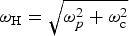 ${{\rm \omega} _{\rm H}} = \sqrt {{\rm \omega} _p^2 + {\rm \omega} _{\rm c}^2} $. The nonlinear current
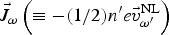 ${\vec J_{\rm \omega}} \left( { \equiv - (1/2)n^{\prime}e{{\vec v}_{{\rm \omega '}}}^{{\rm NL}}} \right)$ comprises the contribution from nonlinear perturbations in the electron density
 ${n_{{\rm \omega}^{\prime}}}^{{\rm NL}} $ and linear density perturbation
 ${n_{{\rm \omega}^{\prime}}}^{\rm L} $ due to the self-consistent space-charge potential ϕ produced by
 ${n_{{\rm \omega}^{\prime}}}^{{\rm NL}} $. Hence, the current density
 ${\vec J_{\rm \omega }}$ is obtained as
 $$\eqalign{{\vec J_{\rm \omega }} & = - \displaystyle{{{n_{\rm \alpha }}{e^3}{E_{01}}{E_{02}}} \over {4m_{\rm e}^2 {{\rm \omega }_1}{{\rm \omega }_2}({{{{\rm \omega^{\prime}}}^2} - {\rm \omega }_c^2 } )({{{{\rm \omega}}^2} - {\rm \omega }_{\rm H}^2 } )}}{e^{ - ({{2{y^{2p}}} / {{w_0}^{2p} }})}} \cr & \times\{{\hat x{T_1} - i\hat y{T_2}} \}\,{e^{i({kx - {\rm \omega }t} )}}.} $$
Here ω ≡ ω′ = ω1 − ω2 and  $\vec k={\vec k_1} - {\vec k_2}+{\rm \vec \alpha }$.
We calculate the THz field using Maxwell's equations along with the current  ${\vec J_{\rm \omega }}$ as
 $$\vec \nabla (\vec \nabla \cdot \vec E) + \displaystyle{{4{\rm \pi }i{\rm \omega }} \over {{c^2}}}{\vec J_{\rm \omega }} - \displaystyle{{{{\rm \omega }^2}} \over {{c^2}}}\bar {\bar {\rm \varepsilon}}\vec E - {\nabla ^2}\vec E = 0.$$
In the presence of magnetic field, the electric permittivity of the plasma evolves into a tensor quantity  $\bar {\bar {\rm \varepsilon}} $ with its components as
 $${{{\rm \varepsilon} _{xx}} = {{\rm \varepsilon} _{yy}} = {\rm 1} - \displaystyle{{{\rm \omega} _p^2} \over {{\rm (}{{\rm \omega} ^{\rm 2}} - {\rm \omega} _c^2 {\rm )}}}},$$
 $${{{\rm \varepsilon} _{yx}} = - {{\rm \varepsilon} _{xy}} = \displaystyle{{i{{\rm \omega} _c}{\rm \omega} _p^2} \over {{\rm \omega (}{{\rm \omega} ^{\rm 2}} - {\rm \omega} _c^2 {\rm )}}}},$$
 $${{{\rm \varepsilon} _{zz}} = {\rm 1} - \displaystyle{{{\rm \omega} _p^2} \over {{{\rm \omega} ^{\rm 2}}}}},$$
and εxz = εzx = εzy = εyz = 0. Equation (5) governs the THz radiation emission. Assuming fast phase variation of the field  $\vec E$, we put
 $\vec E={\vec E_0}(x,y)\,{e^{i(kx - {\rm \omega }t)}}$ in Eq. (5) and separate out the x-and y-components of
 $\vec E$. The normalized transverse component of
 $\vec E$ gives the THz field E 0y as
 $$\eqalign{& \displaystyle{{{\partial ^2}{E_{0y}}} \over {\partial {x^2}}} + 2ik\displaystyle{{\partial {E_{0y}}} \over {\partial x}} + \left\{ {\displaystyle{{{{\rm \omega} ^{\rm 2}}} \over {{c^2}}}\left( {{{\rm \varepsilon} _{yy}} + \displaystyle{{{\rm \varepsilon} _{xy}^2} \over {{{\rm \varepsilon} _{xx}}}}} \right) - {k^2}} \right\}{E_{0y}} \cr & = \left[ \matrix{\left\{ {\displaystyle{{i{n_{\rm \alpha}} e{\rm \omega} _p^2 {E_{02}}\left[ {{{\rm \omega} ^2}({{\rm \omega} ^2} - {\rm \omega} _c^2 ) + {\rm \omega} _c^2 {\rm \omega} _p^2} \right]} \over {4{n_0}{m_{\rm e}}{c^2} {{\rm \omega} _1}{{\rm \omega} _2}({{\rm \omega} ^2} - {\rm \omega} _{\rm H}^2 )\left[ {{{\rm \omega} ^2} - {\rm \omega} _c^2} \right]}}} \right\}\left[ {\displaystyle{{4p{y^{\,p - 1}}} \over {{w_0}^p}} - \displaystyle{{{{\rm \omega} _c}{\rm \omega} _p^2} \over {c({{\rm \omega} ^2} - {\rm \omega} _{\rm H}^2 )}}} \right] \hfill \cr + \left\{ {\displaystyle{{i{n_{\rm \alpha}} e{E_{02}}{{\rm \omega} _c} _p^2 \left( {{{\rm \omega} ^2} + {\rm \omega} _p^2 - {\rm \omega} _c^2} \right)} \over {4{n_0}{m_{\rm e}}{c^2}{{\rm \omega} _1}{{\rm \omega} _2}({{\rm \omega} ^2} - {\rm \omega} _{\rm H}^2 )\left[ {{{\rm \omega} ^2} - {\rm \omega} _c^2} \right]}}} \right\}\left[ {\displaystyle{{\rm \omega} \over c} - \displaystyle{{4p{y^{\,p - 1}}{{\rm \omega} _c}{\rm \omega} _p^2} \over {{w_0}^p {\rm \omega} ({{\rm \omega} ^2} - {\rm \omega} _{\rm H}^2 )}}} \right] \hfill} \right] \cr &\quad\quad \times\quad {e^{\left( { - {{2{y^{2p}}} / {{w_0}^{2q}}}} \right)}}} $$
In order to solve Eq. (6), we neglect second-order term and put
 $$\left\{ {\displaystyle{{{\omega ^2}} \over {{c^2}}}\left( {{{\rm \varepsilon} _{yy}} + \displaystyle{{{{\rm \varepsilon} _{xy}}^2} \over {{{\rm \varepsilon} _{xx}}}}} \right) - {k^2}} \right\} = 0.$$
 $$\eqalign{&\left\vert {\displaystyle{{{E_{0y}}} \over {{E_0}_1}}} \right\vert \cr &= \left\vert {\displaystyle{x \over {2k}}\left[ \matrix{\left\{ {\displaystyle{{i{n_{\rm \alpha}} e{\rm \omega} _p^2 {E_{02}}\left[ {{{\rm \omega} ^2}({{\rm \omega} ^2} - {\rm \omega} _c^2 ) + {{\rm \omega} _c}^2 {\rm \omega} _p^2} \right]} \over {4{n_0}{m_{\rm e}}{c^2} {{\rm \omega} _1}{{\rm \omega} _2}({{\rm \omega} ^2} - {\rm \omega} _{\rm H}^2 )\left[ {{{\rm \omega} ^2} - {\rm \omega} _c^2} \right]}}} \right\}\left[ {\displaystyle{{4p{y^{\,p - 1}}} \over {{w_0}^p}} \!\!-\!\! \displaystyle{{{{\rm \omega} _c}{\rm \omega} _p^2} \over {c({{\rm \omega} ^2} - {\rm \omega} _{\rm H}^2 )}}} \right] \hfill \cr + \left\{ {\displaystyle{{i{n_{\rm \alpha}} e{E_{02}}{{\rm \omega} _c}{\rm \omega \omega} _p^2 \left( {{{\rm \omega} ^2} + {\rm \omega} _p^2 - {\rm \omega} _c^2} \right)} \over {4{n_0}{m_{\rm e}}{c^2}{{\rm \omega} _1}{{\rm \omega} _2}({{\rm \omega} ^2} - {\rm \omega} _{\rm H}^2 )\left[ {{{\rm \omega} ^2} - {\rm \omega} _c^2} \right]}}} \right\}\left[ {\displaystyle{{\rm \omega} \over c} \!\!-\!\! \displaystyle{{4p{y^{\,p - 1}}{{\rm \omega} _c}{\rm \omega} _p^2} \over {{w_0}^p {\rm \omega} ({{\rm \omega} ^2} - {\rm \omega} _{\rm H}^2 )}}} \right] \hfill} \right]} \right\vert\,\cr & \times\hskip4pt {e^{\left( { - {{2{y^{2p}}} / {{w_0}^{2q}}}} \right)}}.}$$
Here
 $$\left\{ {\displaystyle{{{{\rm \omega} ^2}} \over {{c^2}}}\left( {{{\rm \varepsilon} _{yy}} + \displaystyle{{{{\rm \varepsilon} _{xy}}^2} \over {{{\rm \varepsilon} _{xx}}}}} \right) - {k^2}} \right\} = 0$$
is a required phase-matching condition for maximum momentum transfer from the lasers to the plasma electrons. From Eq. (7), it is observed that the resonant emission of THz radiations is achieved at 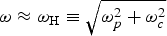 ${\rm \omega} \approx {{\rm \omega} _{\rm H}} \equiv \sqrt {{\rm \omega} _p^2 + {\rm \omega} _c^2} $. Since k THz ≠ k′, a proper tuning of these wave numbers is also required for the resonant excitation of the THz radiation. This tuning is achieved with the help of corrugation (wave number α) in the plasma density (as
 $\vec k={\rm \vec \alpha }+\vec k^{\prime}$), periodicity (repetition) of which can be obtained from the phase matching condition as
 $$\left\vert {{{\rm \lambda} _{{\rm corru}}}} \right\vert = \left\vert {\displaystyle{{2{\rm \pi}} \over {\rm \alpha}}} \right\vert = \displaystyle{{2{\rm \pi} c} \over {\left\{ {{\rm \omega} - \sqrt {\displaystyle{{{{\left( {{{\rm \omega} ^2} - {\rm \omega} _p^2} \right)}^2} - {{\rm \omega} ^2}{\rm \omega} _c^2} \over {{{\rm \omega} ^2} - {\rm \omega} _p^2 - {\rm \omega} _c^2}}}} \right\}}}.$$
The dependence of λcorru on ωc reveals that the magnetic field plays a vital role in realizing the resonant/phase-matched excitation of the THz radiation at the frequency ω ≅ ωH by photo-mixing of the lasers.
Finally, we calculate ηω as the ratio of average energy densities of the emitted THz radiation to that of the input lasers and that of the emitted THz radiation as follows (Rothwell & Cloud, Reference Rothwell and Cloud2009):
 $${\eta _{\rm \omega}} { = \displaystyle{{\,p{x^2}{2^{({1 / {2p}})}}{\Re _1}^2} \over {4{k^2}\Gamma (1/2p)}}\left[ {\displaystyle{{8p{\Re _2}^{\rm 2}} \over {{w_{\rm 0}}^2 {2^{(4 - 1/p)}}}}\Gamma (2 - 1/2p) + \displaystyle{{{{\rm \omega} ^{\rm 2}}{\Re _3}^{\rm 2}} \over {{\rm 4p}{{\rm c}^{\rm 2}}{2^{\displaystyle{1 \over {2p}}}}}}\Gamma (1/2p)} \right]},$$
where
 $${\Re _1} = \displaystyle{{{n_{\rm \alpha}} e{\rm \omega \omega} _p^2 {E_{02}}} \over {4{n_0}m{c^2}{{\rm \omega} _1}{{\rm \omega} _2}({{\rm \omega} ^2} - {\rm \omega} _{\rm H}^2 )\left[ {{{\rm \omega} ^2} - {\rm \omega} _c^2} \right]}},$$
 $${\Re _2} = \displaystyle{{\left[ {{{\rm \omega} ^2}({{\rm \omega} ^2} - {\rm \omega} _c^2 ) + {\rm \omega} _c^2 {\rm \omega} _p^2} \right]} \over {\rm \omega}} + \displaystyle{{{\rm \omega} _c^2 {\rm \omega} _p^2 \left( {{{\rm \omega} ^2} + {\rm \omega} _p^2 - {\rm \omega} _c^2} \right)} \over {{\rm \omega} \left( {{{\rm \omega} ^2} - {\rm \omega} _{\rm H}^2} \right)}},$$
and
 $${\Re _3} = \displaystyle{{{{\rm \omega} _c}{\rm \omega} _p^2 \left[ {{{\rm \omega} ^2}({{\rm \omega} ^2} - {\rm \omega} _c^2 ) + {\rm \omega} _c^2 {\rm \omega} _p^2} \right]} \over {{{\rm \omega} ^2}\left( {{{\rm \omega} ^2} - {\rm \omega} _{\rm H}^2} \right)}} - {{\rm \omega} _c}\left( {{{\rm \omega} ^2} + {\rm \omega} _p^2 - {\rm \omega} _c^2} \right),$$
where Γ is the usual gamma function.
3. RESULTS AND DISCUSSION
The steep corrugations in the density that are constituted at closer distances are suggested for obtaining strong THz radiation (Antonsen et al., Reference Antonsen, Palastra and Milchberg2007). Equation (7) shows that the radiation with larger field is obtained for the case of higher amplitude corrugation (higher n α). This is attributed to the more number of electrons which contribute to excitation of the strong nonlinear current  ${\vec J_{\rm \omega }}$.
Figure 2 shows that the THz amplitude is highest for ω/ωP ≈ 1.3, that is, near the resonance condition ω ≈ ωH. Moreover, the role of index (parameter p) of super-Gaussian lasers in getting stronger radiation is evident from the figure, where higher THz field amplitude is obtained for the higher index. Actually for the higher index lasers, a stronger nonlinear current  ${\vec J_{\rm \omega }}$ is realized due to the stronger force
 ${\vec f_{{\rm \omega '}}}^{{\rm NL}} $ in the presence of sharp gradient in the lasers’ intensity. This gradient is higher in the case of lasers with smaller beamwidth (w 0). Hence, the THz field of higher amplitude is achieved when the lasers of smaller w 0 are used (Fig. 2). A point to be noted in the present scheme is that the THz field ~107 V/cm for the laser intensity ~1014 W/cm2 is higher than the field obtained in other schemes (Hamster et al., Reference Hamster, Sullivan, Gordon and Falcone1994; Loffler et al., Reference Loffler, Jacob and Roskos2000; Jiang et al., Reference Jiang, Li, Ding and Zotova2011; Malik & Malik, Reference Malik and Malik2011; Carr et al., Reference Carr, Martin, Mckinney, Jordan, Neil and Williams2002; Leemans et al., Reference Leemans, Geddes, Faure, Tóth, Tilborg, Schroeder, Esarey, Fubiani, Auerbach, Marcelis, Carnahan, Kaindl, Byrd and Martin2003; Dai et al., Reference Dai, Xie and Zhang2006; Chen et al., Reference Chen, Yamaguchi, Wang and Zhang2007; Thomson et al., Reference Thomson, Kreß, Loffler and Roskos2007; Wu et al., Reference Wu, Sheng, Dong, Xu and Zhang2007; Reference Wu, Sheng and Zhang2008; Kim et al., Reference Kim, Taylor, Glownia and Rodriguez2008).
Variation of the normalized peak THz electric field with index (parameter p) of the lasers and beamwidth (w 0), when x = 100c/ωp, ω1 = 2.4 × 10¹⁴ rad/s, ωp = 2 × 10¹³ rad/s, ωc/ωp = 0.2, n α/n 0 = 0.2, y/w 0 ≈ 0.7, and  $\left\vert {{{\vec v}_2}^ * } \right\vert = 0.3c$.

The most striking feature of the proposed photo-mixing scheme is the tuning of power and focus (transverse profile: y/w 0) of the emitted THz radiation with the help of index of the lasers and magnetic field. In this regard, it is clear from Figure 3 shows that the THz field amplitude attains a maximum value at a particular value of y/w 0. For example, the THz radiation is focused at y/w 0 = 0.72 in the case of super-Gaussian lasers of index 2 (p = 2), at y/w 0 = 0.84 in the case of lasers of index 3 and at y/w 0 = 0.89 in the case of lasers of index 4. Moreover, the transverse profile becomes more symmetrical about the y-axis for the case of higher index lasers and peak value of the THz field amplitude is increased with laser index p. The peak field and the collimation of the emitted radiation are further enhanced by increasing magnetic field. The effect of magnetic field becomes more important for the higher index lasers, where we can obtain the radiation of highest intensity at a desired position by changing the index. This is attributed to the higher cyclotron motion of the electrons in the presence of stronger magnetic field.
Transverse profile (y/w 0) of the THz radiation with as a function of magnetic field (B 0) and the index of laser beams, when w 0 = 0.05 mm, x = 100c/ωp, ω1 = 2.4 × 10¹⁴ rad/s, ωp = 2 × 10¹³ rad/s, n α/n 0 = 0.1, ω/ωp = 1.45, and  $\left\vert {{{\vec v}_2}^ * } \right\vert = 0.3c$.

Equation (8) shows that the present scheme of frequency-mixing of two super-Gaussian lasers is very effective, where the efficiency of about 0.25 can be obtained (Fig. 4) if a combination of the lasers of higher index and a strong magnetic field is used. It can be inferred from the comparison of Figure 4 with Figures 2 and 3 that in the situation of higher efficiency, the THz radiation field is stronger and more focused. This is evident from all the figures that unlike other investigators (Carr et al., Reference Carr, Martin, Mckinney, Jordan, Neil and Williams2002; Wu et al., Reference Wu, Sheng, Dong, Xu and Zhang2007; Reference Wu, Sheng and Zhang2008; Kim et al., Reference Kim, Taylor, Glownia and Rodriguez2008), we can get the THz radiation at a desired position along with its tunable power and frequency with the application of an external magnetic field and proper choice of index of the super-Gaussian lasers. Jiang et al. (Reference Jiang, Li, Ding and Zotova2011) demonstrated a scheme of THz generation scheme based on difference frequency generation by stacking the GaP plates. In their scheme, the conversion efficiency is comparable with our model, but the emitted THz field is much lower than the emitted field in the proposed model. Wu et al. reported a scheme of THz generation from the laser wake-field in the inhomogeneous magnetized plasma in which conversion efficiency of the THz radiation is proportional to the laser intensity when it is less than 1018 W/cm2 and it reaches about 10−5 when the intensity of the laser is approximately 1019 W/cm2 (Wu et al., Reference Wu, Sheng, Dong, Xu and Zhang2007). Kim et al. reported generation of THz super-continuum radiation by irradiating different gases with a symmetry-broken laser field composed of the fundamental and second-harmonic laser pulses. The conversion efficiency in their scheme is of the order of ~0.0001 (Kim et al., Reference Kim, Taylor, Glownia and Rodriguez2008). Hence, it can be seen that the efficiency (say ηω = 0.25) of the present scheme is larger than the previously reported schemes (Wu et al., Reference Wu, Sheng, Dong, Xu and Zhang2007; Kim et al., Reference Kim, Taylor, Glownia and Rodriguez2008).
Efficiency of the THz radiation scheme as a function of magnetic field (B 0) and the index of laser beams for the same parameters as in Fig. 2.

4. CONCLUSION
Our analytical calculations show that frequency-mixing of the super-Gaussian lasers in preformed plasma under the effect of magnetic field is a very significant technique for getting efficient THz radiation, where the resonance (phase matching) is easy to achieve by optimizing ripples in the plasma density and the DC magnetic field. The resonance for THz generation is observed at ω ≅ ωH, which depends on both the plasma frequency and electron cyclotron frequency; therefore resonance frequency ω ≅ ωH can shift with the change in magnetic field and hence tuning of the THz frequency from ωp to 1.8ωp can be achieved. Since the power depends on resonance condition, it can also be tuned with the help of magnetic field. The magnetic field also helps getting more collimated radiations and enhanced efficiency of the scheme, which can be further increased with proper choice of index of the lasers.
ACKNOWLEDGEMENTS
The author, Anil K. Malik acknowledges UGC support for providing Raman Post Doctoral Fellowship to conduct the research at the Institute of Optics, University of Rochester, Rochester, USA.



