Our dynasty does not increase the land tax for all eternity. We collect the regular land tax only within the limits of established precedent and grant tax remissions and deferrals during draughts and floods … This is because by reducing the state to the benefit of the people, their delight will know no limits. Safeguarding the property of the multitude is the foundation of preserving the dynasty.
– Edict of the Jiaqing Emperor, 1815Footnote 1I
In early 1799, just days after assuming personal rule following the death of his officially retired father Qianlong (r. 1736–95), the fifth emperor of the Qing dynasty (1644–1911) Jiaqing (r. 1796–1820) announced that the White Lotus Rebellion – an uprising in the highlands of central China which began in 1796 and was not suppressed until 1804 – had its roots in the rapacious exploitation of the people by the officialdom. The announcement initiated a fight against bureaucratic corruption that was reminiscent of the rhetorical battle against ‘Old Corruption’ that raged in Britain at almost the same time. The two discourses had similar elements: an unbearable tax burden, cronyism, an excess of sinecures and extravagant spending; all created by a gigantic war machine (the Napoleonic War and the White Lotus Rebellion). Also, each had a public enemy: William Pitt the Younger and Heshen, Qianlong's crony (Yamada Reference Yamada2001; Wang Reference Wang2014, p. 31; McMahon Reference Mcmahon2015, p. 4; Harling Reference Harling1995).Footnote 2
However, despite superficial similarities, the British and Chinese fights against corruption could not have been more different. The British battle against Old Corruption was led by the opposition. In contrast, the new Qing emperor took personal leadership in a highly moralized push to rectify the bureaucracy. The British monarchy and other European rulers continued to grow their fiscal and administrative capacities through the nineteenth century (Tilly Reference Tilly1990; Harling Reference Harling1996; Bonney Reference Bonney1999), but in China fiscal expansion stalled. Among Jiaqing's first moves following the arrest of Heshen were substantial tax cuts, spearheaded symbolically by a reduction of the surplus quotas (yingyu) of the customs tariffs which largely benefited the Imperial Household Department (the Privy Purse) under the control of Heshen (the regular quota – zheng'e – was earmarked for the government's Board of Revenue) (Wang Reference Wang2014, pp. 193–4). Subsequently, Jiaqing repeatedly rebutted demands for more revenue from his officials with words like ‘you seem to assume that We are not a wise ruler and regard Us as a money-grabbing sovereign’.Footnote 3
In recent years, a new generation of scholars has re-evaluated Jiaqing's dismantling of Heshen's corrupt patronage network as an energetic reform movement dubbed the ‘Xianyu Reforms (1799–1805)’, citing the emperor's benign slogan ‘Let them renew themselves’ (Chin. xian yu wei xin).Footnote 4 While the reforms ‘did not yield a systematic renovation of imperial institutions or fashion a new vision of the dynasty’ (McMahon Reference Mcmahon2015, p. 8), they are believed to have resolved the crisis in two ways: first, by adjusting military and civil field administration and shifting some responsibility for defense from government troops to local militia, Jiaqing pacified the White Lotus rebels and restored the troubled peripheries in south-central China and along the Guangdong coast. Secondly, Jiaqing's bureaucratic rectification and push for frugality and retrenchment restored state legitimacy among the elites. The expansion of the capital appeals system, which allowed commoners to bring forward allegations against corrupt officials, channeled popular grievances into peaceful legal procedures. These measures cemented an implicit social contract between the literati and the Qing state which Kuhn has called the new ‘constitutional agenda’ of nineteenth-century Imperial China, thus laying the foundations for ‘sustainable political development’ (Bartlett Reference Bartlett1991, pp. 231–52; Kuhn Reference Kuhn2002; Rowe Reference Rowe2011; Hung Reference Hung2011; Wang Reference Wang2014, pp. 6–9; McMahon Reference Mcmahon2008 and Reference Mcmahon2015).
This assessment is in contrast to the common perception that, following a century of ‘efflorescence’ under the three great emperors Kangxi, Yongzheng and Qianlong (Goldstone Reference Goldstone2002; also Pomeranz Reference Pomeranz2001; Will and Wong Reference Will and Wong1991), the nineteenth century represented a period of secular decline during which the Qing Empire appeared helpless in the face of the economic and military encroachment by Western imperialist powers – epitomized by the Opium Wars – and continuing waves of rebellions, from the Taiping and other rebellions of the 1850s to 1870s to the Boxer Rebellion of 1900. Social and economic historians mostly offer long-term structural explanations for this sudden reversal of fortunes. Rapid population growth during the flourishing eighteenth century overstretched the physical limits of the agrarian empire, leading to ecological disaster, the collapse of the empire-wide markets due to import substitution in former immigration frontiers, and social conflict (e.g. Mann Jones and Kuhn Reference Mann Jones, Kuhn and Fairbank1978; Pomeranz Reference Pomeranz2002). At the same time, the Qing's Confucian patronage of the landed elites limited the extractive capacities of the state and reduced the government's ability to respond to these structural crises (Brandt et al. Reference Brandt, MA and RAWSKI2014, pp. 79–80). Although military historians such as Perdue (Reference Perdue2005, pp. 548–51) have dated the beginning of Qing retrenchment as late as the 1760s and coinciding with the end of Qing frontier wars, economic historians usually trace the origins of this self-imposed commitment to small government and limited extraction back to the very ideological foundations of the empire or at least to Kangxi's (r. 1661–1722) 1713 edict which froze the poll (capitation) tax in perpetuity (Will and Wong Reference Will and Wong1991, pp. 75–92; Deng Reference Deng2007, pp. 87–121; Wong Reference Wong, Yun-Casalilla and O'Brien2012; Ma Reference Ma2013; von Glahn Reference Von Glahn2016).
How then can we reconcile the observation of long-term economic decline and self-imposed limits to state capacity made by economists with the discourse of dynastic renewal argued by political historians? How contingent were policy decisions concerning public finance made by individual rulers? More importantly, how influential were they? Did Jiaqing make a difference, after all? Did his policies help to arrest dynastic decline as claimed, at least for a while, or did they rather contribute to further eroding the Qing's ability to respond to crises?
In fact, while the Confucian doctrine of benevolent government and low taxes collected according to fixed quotas had been a cornerstone of legitimacy for the alien Manchu rulers from the beginning (Wong Reference Wong, Yun-Casalilla and O'Brien2012), this doctrine was not static but underwent subtle changes as part of a political struggle. To describe this development I somewhat flexibly adopt the terms ‘quota finance’ (seigaku zaisei, Chin. zheng'e caizheng) and ‘quota-ism’ (gengaku shugi, Chin. yuan'e zhuyi) developed by Japanese scholars. Iwai Shigeki (Reference Iwai2004, pp. 23–4, n. 19) has observed that while the new Manchu Qing dynasty had inherited a system of fixed revenue quotas from the Ming dynasty, it would be too simple to assume that these quotas were unchanging. I define quota finance as a tendency of the fiscal system to raise revenues by fixed quotas, without excluding the possibility that these quotas may be adjusted from time to time or that parts of the fiscal system may be exempt from quotas (jin shou jin jie ‘deliverable as collected’). In contrast, quota-ism is defined as an ideology that tries to freeze the revenue quotas in perpetuity and therefore needs to cut expenditures, as revenues can no longer be adjusted to the rising costs of governance. This, in fact, constitutes a politics of austerity. Jiaqing's policies represented the full realization of quota-ism. They did not simply emerge as a response to the White Lotus crisis but as the result of ideological struggles under the late Qianlong.
Section ii will show that some crucial shifts towards quota-ism had already happened in the latter half of the eighteenth century, as an ideological backlash against the expansionist fiscal reforms of the Yonzheng Emperor (r. 1722–35). This included a push to strengthen bureaucratic control over static revenue and expenditure quotas, exemplified by the bureaucratization of military finance. However, there remained pockets of quota-free fiscal operations, most importantly in the Imperial Household Department, which was under Heshen. Section iii argues that it was under Jiaqing and his successor Daoguang (r. 1821–50) that quota-ism became locked in. The purge of Heshen brought with it the ascendancy in public finance of Han Chinese fiscal conservatives, who sought moral and disciplinary rather than institutional and economic solutions for the problems of government finance. As a result, as Tanii Toshii (Reference Tanii and Shigeki2004) has argued, the fixation on treating fiscal performance (i.e. adherence to the quota) as a matter of personal merit or failure prevented the development of public finance from a subfield of personnel management into a domain of independent expertise.
The impact of this policy on the fiscal system is shown in Sections iv to vi. Jiaqing's push for austerity was effective in reducing revenue but could not keep runaway expenditures in check. The system of treasury finance, which banned borrowing for interest and made treasury reserves the only means to pay for emergencies, became unsustainable. Deprived of the option to raise more revenue, the government found it increasingly difficult to pay for what I call the three major sovereign tasks of the Qing Empire – warfare (security), river conservancy and famine relief. Deficits were growing in spite of disciplinary sanctions against officials who failed to maintain a balanced budget. The perception of universal corruption that pervades both contemporary discourses and later scholarship was a direct product of the fiscal ideology of quota-ism rather than an aberration. The almost religious adherence to fixed quotas produced many of the bureaucratic behaviors that were interpreted as corrupt (Zelin Reference Zelin1984, pp. 286–7, 301; Yamamoto Reference Yamamoto2002; Iwai Reference Iwai2004). For the court, the only way to restore some balance to the depleted treasury reserves was to greatly expand the selling of rank and public office, which reached unprecedented heights in the early 1900s. Polachek (Reference Polachek1992, p. 52) has observed the extraordinarily narrow conceptual framework of early nineteenth-century fiscal thought, which ‘never seriously discussed the possibility that more, not less, government might be necessary’. In fact, such voices, though feeble, did exist, but their proposals were ignored. As a result, on the eve of the Opium War, the Qing Empire was already bankrupt (Section vii).
II
Although the new Manchu dynasty had inherited the system of quota finance from the Ming dynasty, it hardened into quota-ism only gradually in the process of political responses to various internal developments, including the expansionist fiscal reforms of Yongzheng (r. 1723–35), the rising costs of government and warfare caused by the price inflation of the eighteenth century, and the competition between the Board of Revenue and the Imperial Household Department for control over revenues. The land tax quotas inherited from the Ming were allotted to counties. Due to the devastations of the dynastic transition, the Qing initially rolled them over to a much-diminished population. It was not before the early eighteenth century that actual revenue reached the old quota. Kangxi's famous edict of 1713 only imposed a moratorium on the poll (capitation) tax, but as soon as Yongzheng's fiscal reform folded the now stagnant poll tax quotas into the land tax, people started to interpret the moratorium as encompassing the latter (Wang Reference Wang1973, pp. 20–30; Bastid Reference Bastid and Schram1985; He Reference He1998, pp. 2–25). Notwithstanding, the Yongzheng Emperor during his relatively short reign pursued radical fiscal expansion, simply by inventing new quotas in excess of the regular ones. Previously illicit surcharges on the land tax were legalized as ‘meltage fee’ (huohao), salt licenses in the monopoly trade were augmented by ‘excess licenses’ (yuyin), and ‘customs surplus’ (guanshui yingyu) was collected in excess of the fixed customs quotas. The new revenues provided for a substantial salary increase for civil bureaucrats dubbed ‘integrity allowance’ (yanglianyin), improved local government services, and funded local and provincial treasury reserves for emergencies (Chen Reference Chen1988, 82–3; Wang Reference Wang1961, pp. 56–62; P. Huang Reference Huang1974, pp. 245–72; Zelin Reference Zelin1984).
As Dunstan (Reference Dunstan2006) has shown, Qianlong's fiscal policies emerged under the influence of an intense political pushback against Yongzheng's state expansionism. Qianlong did not abruptly break with Yongzheng's policies. In 1781, he expanded the integrity allowance to military officers in order to somewhat alleviate the huge pay gap between civil and military officials and fill the vacant rosters which had previously served to supplement officers’ incomes (Chao Reference Chao1980, pp. 255–68). However, in order to stave off criticism, Qianlong put an end to the liberal expansion of revenue, for example by reducing the meltage fee quotas (Zelin Reference Zelin1984, pp. 269–72). He also greatly expanded the ritual of universal tax holidays first introduced by Kangxi but discontinued under Yongzheng, and declared five universal land tax remissions and three tribute grain remissions during his 60 years’ reign (Chen Reference Chen2008b; Dunstan Reference Dunstan2014).
The greatest victory of quota-ism under Qianlong's reign was the creation of spending caps for emergency government expenditures – mostly related to the sovereign tasks of empire – which were hardest to accommodate within a fixed-quota system. Compared to contemporary Europe Qing warfare was modest, while river conservancy and famine relief became major problems only in the nineteenth century. Thus, during the eighteenth century, cost increases were mainly caused by rising prices due to the growth in both population and money supply (von Glahn Reference Von Glahn2016, p. 330). Instead of expanding revenue or at least adjusting revenue to the price inflation, Qianlong's bureaucrats sought to solve the problem by setting strict spending caps for purchases, services and salaries.
To take military spending as an example, the Qing dynasty had early on established its legitimacy by banning the practice of levying war taxes, which was common in the late Ming (Lin Meiling Reference Lin2006; Tseng Reference Tseng2013; see also R. Huang Reference Huang1974, pp. 286–94). Although they resurfaced during the suppression of the White Lotus Rebellion in the guise of monetized corvée, as local levies these remained outside the control of the Board of Revenue (Wei Reference Wei1984, p. 485; Chen Reference Chen1992, pp. 293–310; Theobald, Reference Theobald2013, pp. 105–11; Yamamoto Reference Yamamoto1994, pp. 1282–302). This left the accumulation of treasury reserves and current tax revenues as the primary way to finance military campaigns. Ulrich Theobald's detailed study of the Second Jinchuan War (1771–6) shows that during the eighteenth century the Qing was perfectly capable of financing and managing a five-year border conflict from treasury reserves and current revenue. Of the total expense for the war, 46 percent came from the treasury of the Board of Revenue in Beijing and 41 percent was paid from the revenues of several provinces (Theobald Reference Theobald2013, p. 122; see also Dai Reference Dai and Di Cosmo2009b). Even as the war consumed 150 percent of the total annual government revenue of the empire, it did not bankrupt the treasury, which continued to grow its surpluses until the 1790s. Nonetheless, the staggering costs of the war became the pretext for the civil bureaucracy to assume control of the military supply chain. Theobald correctly describes the Military Expenditure Code (Junxu Zeli) in 1785 as the ‘watershed between the perfect age of Qianlong, who fulfilled the historical mission of the Manchus as a conquering people, and his successors who were overburdened with the attempt of homogenizing a society that had substantially changed since the days when the Manchus had first conquered China’ (Theobald Reference Theobald2013, p. 24). The Code's very detailed statutory prices for military procurement remained in force until the Taiping Rebellion 70 years later without being adjusted to inflation, rising price levels or new technologies.
As Yingcong Dai (Reference Dai2009a) has shown, the system aimed at military cost-cutting spectacularly backfired during the White Lotus Rebellion. The inability to adjust the pay scales to rising price levels created a rift between the military and the civil administration. Officers worked to prolong the war in order to collect the more generous wartime allowances. Provincial command centers used cost-cutting as an argument to hire staggering numbers of local auxiliaries – according to Wensheng Wang they totaled almost 1 million in 1798. This made the suppression of the rebellion, costing approximately 150 million tls, the most expensive war ever fought by the Qing (Wang Reference Wang2014, p. 142–3; Dai Reference Dai2009a, p. 154; Chen Reference Chen1992, pp. 266–8). The manpower numbers were almost certainly inflated, but it would be too simple to regard them exclusively as a symptom of the corruption that was soon to be fought by the Jiaqing Emperor. Under the Expenditure Code, inflating expenditures (or understaffing statutory ranks) was not always an indication of official greed but often a necessity to cover real costs.
Many legitimate expenses were not covered by the Code, and generally only between 70 and 90 percent of all reported expenses were approved by the account auditors (Chen Reference Chen1992, pp. 273–5). Rejected accounts meant that the Board of Revenue would try to find responsible officials, mostly the civil bureaucrats who ran the logistics system, to personally refund the difference. If no single responsible person could be found, the complete officialdom of a province was sentenced to pay cuts. In Henan, half of the integrity allowance of all provincial officials was confiscated to pay for unapproved military expenditures (including some incurred during the White Lotus Rebellion), but 4.49 million tls were still unpaid when an amnesty was finally declared in 1822. Logistics officers and provincial administrators had good reason to collude with the military in inflating numbers in order to create a cushion against such incidences (Suzuki Reference Suzuki1958, p. 246; Ni Reference Ni2013, p. 179, 379; Wang Reference Wang2014, p. 142; Wei Reference Wei1984, pp. 488–9). The same austere spending restrictions increasingly pervaded all areas of government spending, with similar results.
However, by the end of the eighteenth century there were still pockets of quota-free fiscal administration in Qing China, the most important of which was the Privy Purse. Qianlong defended the independence of the Imperial Household Department against the assault of a growing ideological push towards quota-ism. The Department profited most from the increase in foreign trade since it controlled a substantial share of the customs surplus, which did not have a fixed quota before Jiaqing's reform. Instead, a three-year rolling average applied, and officials (mostly imperial bondsmen) who failed to meet the results of previous years had to make up the difference from personal income. Even as the meltage fee quotas for the customs revenue were cut by Qianlong at the beginning of his reign, the throne continued to approve a host of fees and surcharges to cover the rising costs of tax collection. After the Department came under the control of Heshen in the 1770s, its treasury was also filled by hefty penitence fees imposed on high-level provincial administrators and Manchu officials (including the wealthy customs supervisors) for cases of negligence or bureaucratic oversight. By the late Qianlong period, the funds of the Imperial Household Department were so abundant that it not only ceased to receive annual transfers from the Board of Revenue, but started to allocate surplus funds to the Board for public expenditures (Torbert Reference Torbert1977, pp. 98–9; Zhang Reference Zhang2010; Lai Reference Lai2014, pp. 109–64). In her study of the Privy Purse, Lai Huimin (Reference Lai2014, pp. 111–12) argues that Qianlong still fits Douglass North's definition of a revenue-maximizing ruler. Jiaqing would set out to change this.
III
When Jiaqing assumed personal rule in 1799 after three years at the whim of the officially retired Qianlong and his crony Heshen, he famously proclaimed that ‘officials had forced the subjects to rebel’ (guan bi min fan). Under the pressure of extortions from Heshen's corrupt patronage network, Jiaqing explained, local officials had been forced to engage in illicit and exploitative practices of revenue extraction that alienated the people. The only way to rectify the situation was to start from the top and eliminate Heshen.Footnote 5 Chinese and Japanese scholars have denied that excessive taxation was the true cause of the White Lotus crisis. Rather, the argument served Jiaqing as a pretext to purge Heshen as part of a bureaucratic pushback against the penitence fees and the exuberance of the Imperial Household Department (Li Reference Li1993; Yamada Reference Yamada2001; see, however, McMahon Reference Mcmahon2015, p. 4).Footnote 6
The power struggle between the fiscal conservatives and Heshen deepened after Qianlong's retirement, when he allegedly tried to gain direct control over the Board of Revenue and thwarted Jiaqing's attempt to appoint his teacher Zhu Gui (1731–1806), a critic of his fiscal policies, to the Grand Council (Nivison Reference Nivison, Nivison and Wright1959, pp. 240–1; Yoon Reference Yoon2012, pp. 514, 520–2). Once on the throne, the new emperor recalled many critics of Qianlong's policies into central court positions, among them Zhu Gui as well as Yin Zhuangtu (1738–1808) who had attacked the penitence fees and pointed out treasury deficits in 1790, only to leave office one year later in disgrace when no deficits could be found.Footnote 7 There is no doubt that Jiaqing's so-called Xianyu Reforms unfolded under the influence of these advisers, but their economic and fiscal consequences are not so clear (Nivison Reference Nivison, Nivison and Wright1959, pp. 234–5; Bartlett Reference Bartlett1991, pp. 251–2; Guan Reference Guan1993, pp. 16–18, 86–8; Zhang Reference Zhang2010, pp. 54–5; Wang Reference Wang2014, pp. 128–9). In fact, the fiscal motivation for the purge of Heshen was to rein in the relatively free spirit of fiscal extraction exhibited by the Privy Purse and submit it to the doctrine of quota-ism that ruled supreme in the bureaucratic arm of government.
Wensheng Wang (Reference Wang2014, pp. 161–2) has characterized Zhu Gui as ‘reformist yet conservative’, but in terms of fiscal policy his position can better be described as a hardline advocate of quota-ism and austerity. His fundamental economic belief was that limiting consumption alone (with the throne setting an example for everyone else) could solve all fiscal problems, while keeping taxes low. During his seven-year term as president of the Board of Revenue (1799–1805) Zhu became notorious for his unrelenting opposition to any policy that looked similar to a tax increase.Footnote 8 Jiaqing fully embraced the theory of trickle-down parsimony. Among his first fiscal measures were the abolition of the penitence fees, a ban on tribute gifts to the emperor, an end to the expensive imperial southern tours, a moratorium on all repairs of imperial palaces, and the setting of quotas for the customs surplus – all policies that directly affected the income of the Imperial Household Department (Guan Reference Guan1993, pp. 92–5; Zhang 1996; Ni Reference Ni2010, pp. 5–10, 15–16; Wang Reference Wang2014, pp. 193–4). At the same time, he relieved the financial burden of his officials by ordering a stop to cuts of the integrity allowance, banning tribute gifts to higher-ranking superiors, and setting the customs surplus quotas based on moderate revenue estimates (to minimize the risk to officials of falling short of the quota).Footnote 9 Low-level administrators were in turn controlled by an expanded capital appeals system that gave priority to tax grievances in order to limit their ability to levy illicit surcharges and fees that had given rise to allegations of rapacious exploitation by the state (Iwai Reference Iwai2004, pp. 50–2; Ni Reference Ni2013, p. 198; Liu Reference Liu2013, pp. 129–30; Ocko Reference Ocko1988; Hung Reference Hung2011, ch. 5). Imperial pronouncements began to interpret Kangxi's edict as a taboo against increasing any tax. The quote in the beginning of this article is the first mention in the Veritable Records of ‘never increase the land tax’ (yong bu jia fu) without its original reference to the poll tax.
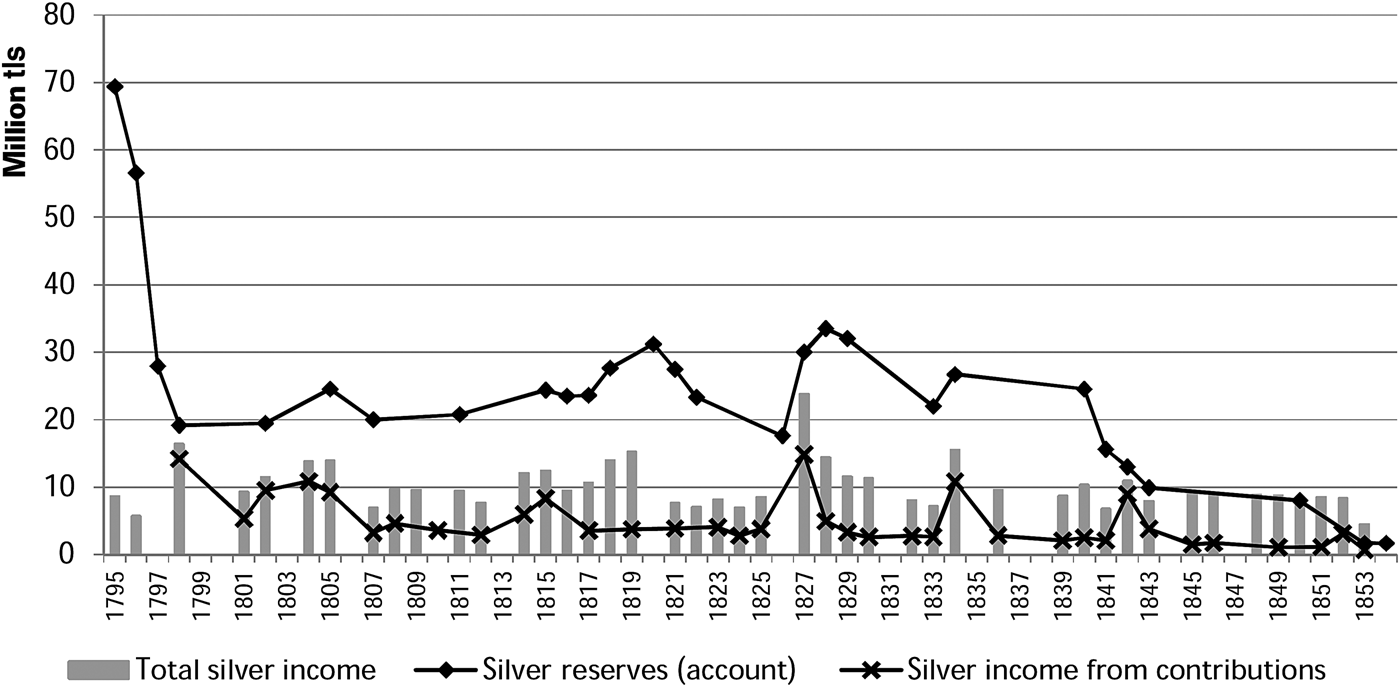
The most important contribution of Jiaqing's reign was the renewed attempt, once thwarted by Qianlong, to keep provincial and local treasury deficits under control and restore the system of sound treasury finance. Some of his reforms resembled Yongzheng's policy of bureaucratic centralization. Contrary to his image as a retrenchment emperor, Jiaqing stepped up efforts to collect the full tax quotas. Universal tax holidays stopped. To be sure, Jiaqing was by no means opposed to these tax remissions and refused to set institutional limits to his own power to grant them.Footnote 10 But his fiscal bureaucrats probably made clear that such imperial munificence, to use Dunstan's (Reference Dunstan2014) term, was no longer feasible. Qianlong's last two tax remissions were a grain tribute remission announced in 1795 on the occasion of a solar and lunar eclipse in the same Chinese month (21 January and 4 February according to the solar calendar) and a universal land tax remission in 1796 for Qianlong's official retirement. Since provincial participation was staggered over three and five years, Jiaqing started the first three years of his de jure reign with a shortfall of about 20 percent of statutory revenue (Dunstan Reference Dunstan2006, p. 445; Xiao Reference Xiao1986, vol. 2, pp. 8–9; DQHDSL, chs. 266–7, vol. 802, pp. 259–63; Ni Reference Ni2013, pp. 80–1, 97–8). The tax holidays coincided with a large Miao Rebellion that had started in 1795 in Hunan, followed by the White Lotus Rebellion in central China, and very likely contributed to the precipitous fall of treasury reserves during the war (see Figure 2 below). Critics of universal tax holidays also pointed out that they did not benefit the poor because the tax-paying landlords were not forced to pass on the tax remission to their tenants (Wei Reference Wei1984, p. 552; Xiao Reference Xiao1986, pp. 2, 223, 272–3; Suzuki Reference Suzuki1948, p. 121).
Regular audits of the provincial treasuries attempted to reduce deficits.Footnote 11 Unlike the 1791 tax audit, the one in 1800 revealed substantial deficits, not least because provincial contributions to the war effort had depleted reserves. Tax audits became a regular institution thereafter and were conducted every four to five years (during the Jiaqing reign this was in 1800, 1804, 1809, 1810/11, 1814) (Zhu Reference Zhu and Chengru2002; Liu Reference Liu2013).
With the treasury rectification quota-ism received its full institutional expression. Tanii Toshihito (Reference Tanii and Shigeki2004) has argued that adherence to quotas became quota-ism only with administrative changes that subordinated fiscal decisions completely under the principles of personnel management by pegging performance measurement to the fulfillment of quotas. It probably was no accident that a new method for revenue accounting was invented in 1793, when anxiety about treasury deficits started to spread among the scholar-official elites. The new formula improved the measuring of tax collection against the statutory quotas as a tool for personnel evaluations. The method spread quickly and a reprint of the book was made in 1814, the year of the most high-profile treasury audit under Jiaqing (QGBY; Suzuki Reference Suzuki1958, pp. 206–7; Will Reference Will1999, pp. 853–4; Tanii Reference Tanii and Shigeki2004). As Li Guangwei has recently shown, tax exemptions during harvest failures also became rare under Jiaqing. They were replaced by tax deferrals, a practice that had been on the rise since the 1790s. Unpaid taxes were converted into a tax debt to be repaid in installments over the following years. This became much easier thanks to the new formula (Li Reference Li2013, pp. 38–44, figure 1 on p. 39; Chen Reference Chen2008b, p. 131). The question is whether these measures were successful in restoring sound treasuries and preparing the Qing state for the challenges ahead.
Revenue, expenditure and fiscal surplus

IV
Many scholars have argued that the Qing government does not appear to have experienced a serious fiscal imbalance prior to the 1830s when a deflationary crisis gripped China in the run-up to the Opium War (Suzuki Reference Suzuki1958, p. 201; Zhou Reference Zhou2000, p. 30; Lin Man-Houng Reference Lin2006; Li Reference Li2013; Ni Reference Ni2013, pp. 86–139). However, in the midst of the Opium War, Wei Yuan, in his landmark military history of the Qing Dynasty A Record of August Military Achievements (1842), held a different view when he posed the central question that has yet to be sufficiently answered by scholars: how to explain the sudden downturn of the dynasty's fortunes following the turn of the nineteenth century.
During the forty years since the Jiaqing reign only the White Lotus campaigns cost more than 100 million tls, but considering that 70 million tls were collected by several contribution campaigns the [real] expenditures did not even reach the sum spent on the Zunghar and Second Jinchuan War [under Qianlong]. As to river conservancy, tax exemptions, and famine relief, these were not absent during the Qianlong era. As to the growing population of banner people, their military rosters have fixed quotas, so salaries do not increase with population growth. As to the outflow of silver and the increasing price of bullion, this only burdens the officials and people but does not affect tax revenue. However, [even though our efforts] to cut expenditures have doubled, [the instances] when our revenue officials declare insolvency have also doubled. Why is this the case? (Wei Reference Wei1984, p. 474)
Wei offers a few explanations: an increase in the army rolls, the proliferation of imperial clansmen and a decline in tax compliance, which he mainly blames on the practice of regular tax debt amnesties rather than the high silver price (cf. Lin Man-Houng Reference Lin2006, pp. 134–5). But he does not provide a conclusive answer.
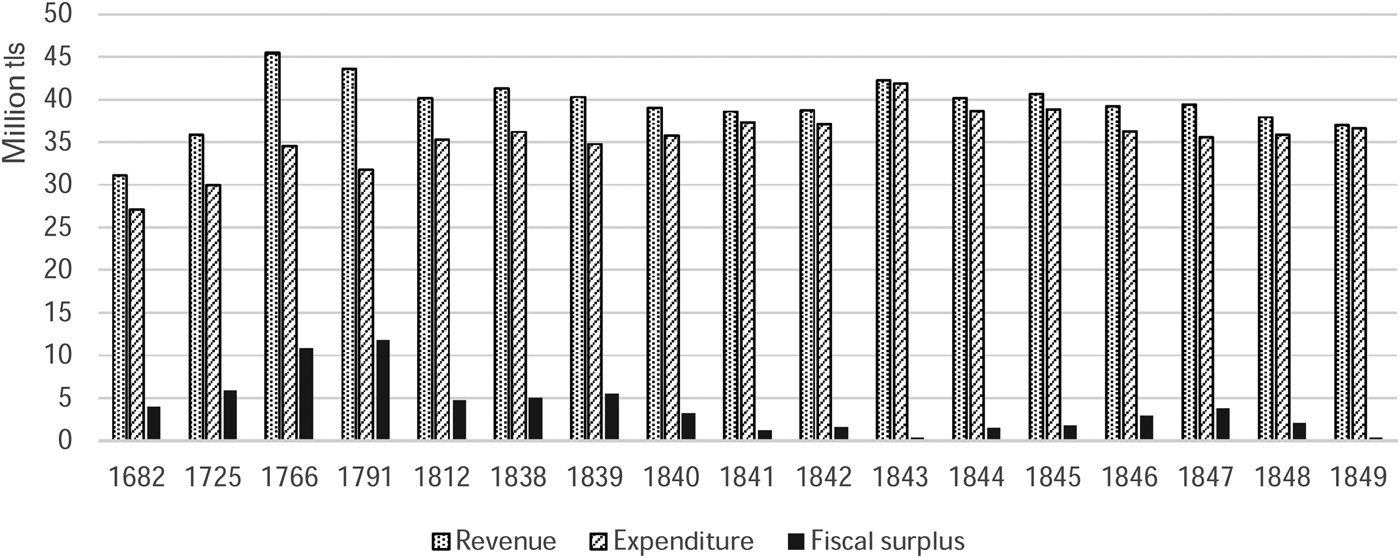
Despite limited data, it becomes clear that the belt-tightening reforms of the early Jiaqing reign arrested revenues but were unable to rein in spending. Between 1682 and 1766, nominal government revenue (statutory revenue only) increased by 46 percent and stabilized thereafter at about 40 million tls, but real revenue (adjusted to rising price levels) declined sharply after 1791 (Iwai Reference Iwai2004, p. 37; Ma Reference Ma2013, p. 488; see Figure 1).
Data on government expenditure are even less reliable than on revenue due to the uncoordinated nature of government spending. But there is evidence for large increases in areas that directly concerned the central government treasury, military spending and river conservancy.
The Jiaqing Emperor is often celebrated for his military retrenchment. Extraordinary expenditures for incidents of warfare indeed decreased after the White Lotus Rebellion, even if the Opium War is included.Footnote 12 However, the Green Standard Army's functions as local police force were more necessary than ever. As indicated by Wei Yuan, neither the expansion of army rosters in the wake of Qianlong's 1781 reforms and White Lotus nor the integrity allowance for officers could be reversed. As a result, peacetime military expenditures increased even as the fighting ability of the standing armies continued to be eroded by severe spending caps on salaries and military equipment (Wang Reference Wang1967, pp. 192–212; Chao Reference Chao1980; Zhao Reference Zhao1999). During the Opium War, Wei Yuan estimated that the regular Green Standard forces maintained only one-third of their statutory manpower and suggested that the Qing reduce the force in order to raise the pay and efficiency of the soldiers to British levels. Ten years later, Thomas Wade concluded that the statutory salary costs alone for the standing armies in 1825 must have been over 30 million tls, significantly more than Chen Feng's already high estimate of 26 million tls.Footnote 13 He also reported abuses: ranks were not fully staffed; officers pilfered the pay of their subordinates; audit accounts were falsified (Wei Reference Wei1984, pp. 417, 552; Wade Reference Wade1851, pp. 413–16, 420–1).
Incidents of flooding increased in the early nineteenth century.Footnote 14 Accounting for river conservancy followed the same bureaucratic rules as military spending with similar outcomes. By 1806, the statutory prices for building materials for regular repairs covered only 30 percent of the actual costs. In Henan, a local tax surcharge to cover the deficit had been abolished in 1792. The burden was rolled over to the integrity allowance of the officials who helped themselves by inflating measurements and amounts. Jiaqing agreed to a rise in prices, which increased the regular annual costs for river conservancy from less than 3 million tls per year to over 4 million, not counting various emergency repairs, but he did not assign new revenue.Footnote 15 In a separate essay written during the Opium War, Wei Yuan warned of the imminent fiscal bankruptcy of the empire and identified river conservancy as the worst fiscal drain. He attributed the problem not to natural causes but instead to a misguided policy of financing and conducting dyke construction. Since funds for regular repairs were insufficient the focus had shifted to emergency repairs that left behind a patchwork of inadequately fortified dykes and compounded the problems rather than solving them. Only a guided change of the course of the Yellow River could prevent a larger catastrophe (Wei Reference Wei1976, p. 365). His vision proved prophetic. The river indeed changed course in 1851, the same year when the Taiping Rebellion started in southwest China's Guangxi province (Amelung Reference Amelung2000).
V
For a fiscal regime that met extraordinary sovereign expenditures by mobilizing treasury reserves it was crucial to maintain a healthy fiscal surplus, but the difference between a fiscal surplus and a treasury surplus was not widely acknowledged among Qing officials. One of the characteristics of treasury finance was that it put an emphasis on maintaining a positive balance in each of the multiple treasuries, which makes it difficult to produce aggregate data (Wei Reference Wei1984, pp. 472, 476; Xiao Reference Xiao1986, vol. 2, pp. 234–5; Dunstan Reference Dunstan2014, pp. 168–9). Nonetheless, new research on the government treasuries shows that symptoms of fiscal strain were, in fact, visible from the lowest (the county) to the highest level (the Board of Revenue) of the treasury hierarchy.
Despite the stepped-up bureaucratic control under Jiaqing, provincial and local treasury deficits increased with every audit, as Zhu Chengru (Reference Zhu and Chengru2002) and Liu Fengyun (Reference Ma2013) have shown. The revenue singled out to balance treasury accounts – surpluses from the regular meltage fee surcharge (haoxian yingyu) – did not really exist. In 1808, the throne reinstituted cuts to the integrity allowances of local administrators (which was the main use of the meltage fee revenue) to refund deficits. However, as shown above, the bulk of these funds was already committed to pay for unauthorized expenditures that could not be covered by the regular tax quota (Chen Reference Chen2008b, p. 136; Zelin Reference Zelin1984, pp. 266–88; Suzuki Reference Suzuki1958, pp. 208, 246). In 1814, following a spike in expenditures due to a Yellow River dyke break and the Eight Trigram uprising (Naquin Reference Naquin1976) in the previous year, the Board of Revenue pushed through harsh penalties for administrators who incurred new treasury deficits. In Shandong, several officials reportedly died in jail. Only five years later, Jiaqing declared a general amnesty on tax arrears (Suzuki Reference Suzuki1958, pp. 200, 208–9, 260; Li Reference Li2013, pp. 44–5; Liu Reference Liu2013, pp. 135–6). From then on, similar tax debt amnesties replaced Qianlong's tax remissions and became a regular occurrence every four to ten years until the end of the dynasty. It was widely believed that local officials found ways to hide at least part of their treasury deficits within the tax debts of their subjects that were reported for amnesty. When critics listed the symptoms of growing corruption among officials, one item was that they were no longer afraid of large treasury deficits (He Reference He1998, p. 292; Ni Reference Ni2013, p. 378). According to Wei Yuan, this obstinacy played no small role in the growth of such deficits since the late Jiaqing era.
At the same time, cuts to the integrity allowance for balancing treasury deficits continued despite renewed bans in 1820 and 1837 (Suzuki Reference Suzuki1958, pp. 246–7; Liu Reference Li2013, pp. 132–3; Ni Reference Ni2013, p. 336; Zhou Reference Zhou2012). Such cuts and the practice of making incumbents responsible for repaying deficits of their predecessors forced local officials into behaviors that were widely regarded as corrupt. One such practice was ‘unapproved borrowing’ (nuoyi), which Tanii (Reference Tanii and Shigeki2004, p. 46) has described as part and parcel of the system of quota-ism. Since all revenues were earmarked for specific purposes, urgent extraordinary expenditures or shortfalls of revenue flows were made up by temporarily advancing (called ‘dian’ if approved) funds originally earmarked for other purposes. This set in motion complicated chains of internal borrowing which often ended in a treasury deficit (kuikong) as soon as one of the funds in the chain became unaccounted for. Deprived of the integrity allowance, local administrators also had to become inventive in order to secure both local funding and a personal income at a level that they (though not necessarily the censors in Beijing) deemed appropriate for their standing; these strategies included illicit fees (lougui), the monetization of corvée obligations, and manipulations of weights and currencies during tax collection. Proposals to ban or regularize such fees were fiercely resisted, not least by the officials themselves who feared the grabbing hand of the central government. Recurring edicts testify to the futility of such attempts (Iwai Reference Iwai2004, pp. 53–4; Yamamoto Reference Yamamoto2002, p. 143; Ni Reference Ni2013, pp. 285, 336–88, 377–8; Zelin Reference Zelin1984, pp. 292–3, 301). As a result, the extra-statutory and thus illegal character of such manipulations created tensions between local society and the local state which could easily undermine social peace, especially when rising silver prices burdened taxpayers in the 1830s and 1840s (e.g. Sasaki Reference Sasaki1963; Kaske Reference Kaske and Depeyrot2013; Hung Reference Hung2011, pp. 135–67).
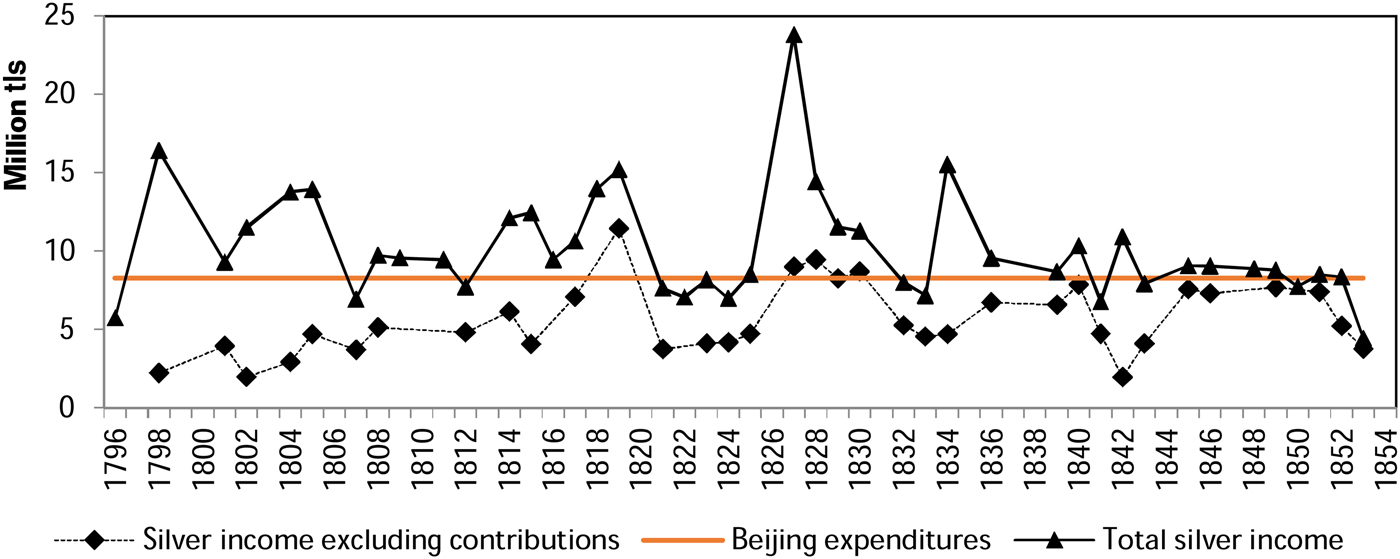
Figures 2 and 3, compiled from often-cited data, reveal a similar picture from the perspective of the treasury of the Board of Revenue. Figure 2 shows that treasury reserves dropped steeply during the White Lotus Rebellion. This has been ascribed to the high costs of the war, although part of the loss was probably also due to Qianlong's last tax remission (for 1745 see Dunstan Reference Dunstan2014, p. 171). After he assumed personal rule in 1799, Jiaqing was able to arrest the decline and stabilize reserves at or above 20 million tls. The reserves were maintained at this level until the Opium War, a fact that is usually seen as a fiscal success. However, this is contradicted by a closer look at the data collected in Figure 1 above. Chen Feng (Reference Chen2008a, pp. 412–13) has shown that the 1812 data represent only provincial revenue and expenditure, but do not include the capital, which received most of its revenue from the provinces. If the 5 million tls represent the annual surplus of the provinces that was remitted to Beijing, then this surplus would not suffice to cover the metropolitan expenditures. The Qing government in fact operated at a fiscal deficit.
Treasury reserves and contributions

The Board of Revenue as Beijing's treasury

This is also shown in Figure 3. The treasury of the Board of Revenue had a dual function, serving both as Beijing's local treasury and as a reserve to settle deficits in the general balance of accounts in the empire. Given that the statutory expenditure quota for Beijing alone was 8,276,837 tls (with total annual expenses closer to 9.45 million) (Wang Reference Wang1967, pp. 310–11; Han Reference Han2012, p. 49; Zhou Reference Zhou2000, p. 67), it becomes clear from the chart that revenues shipped from the provinces (‘silver income excluding contributions’) almost never sufficed for the maintenance of the metropolitan bureaucracy. In a system of ossified quotas, the Board treasury was vulnerable, because, oddly enough, in its function as Beijing's treasury it was not entitled to a statutory revenue quota apart from 1.2 million tls (Iwai Reference Iwai2004, p. 90). Provincial tax funds were divided into those to be retained by the provinces (cunliu) and those under the control of the Board of Revenue (qiyun) to be shipped to the capital or wherever they were urgently needed to fulfill the sovereign tasks of empire. This latter case increasingly took over, and the Board of Revenue made up the resulting gap in its income entirely by contributions, the Chinese version of the venalité des offices of Old Regime France.
The use of contributions to such an extent as the exclusive anti-deficit tool was unprecedented. For context, it is important to understand that the Qing system of venalité distinguished between office-selling (i.e. eligibility for a specific government position, not the position itself) and rank-selling (degrees, brevet rank, honorific titles). In 1745, the latter had been made a permanent revenue stream of the Board of Revenue in order make up for the revenue shortfall caused by Qianlong's first universal tax remission (Dunstan Reference Dunstan2014, p. 209; Xu Reference Xu1974, pp. 84–9). In contrast, office-selling campaigns were conducted only sporadically during the eighteenth century, for the last time during the Second Jinchuan War in the 1770s, since Qianlong was quite opposed to the venalization of office-holding (Theobald Reference Theobald2013, pp. 142–7). This changed with the Sichuan Hunan Reconstruction Contribution approved in 1798 to pay for the suppression of the White Lotus Rebellion. Subsequently, office-selling became almost permanent with campaigns being held in 24 out of 52 years between 1798 and 1850 (1798–1801, 1801–2, 1803–4, 1808–10, 1814, 1819–20, 1827–8, 1833–4, 1841–5, 1849) (Xu Reference Xu1974, pp. 43–5, 47–59).
Office-selling contributions were closely related to the Qing idea of sovereignty, and each campaign had to be specifically earmarked and named for one of the three sovereign purposes of security, river conservancy or famine relief. They now increasingly became a regular means to balance treasury accounts. Already by 1800, provinces were allowed to sell Imperial Academy degrees for the purpose of replenishing provincial treasury reserves. By 1827, anti-deficit office-selling became visible in the names of the campaigns. The highly successful 1827–8 campaign was called ‘Revised Permanent Statutes’, the 1833–4 campaign simply ‘Finance Statutes’. In both cases, the funds were devoted to making up the gap between income and expenditure in the Board treasury. These campaigns have been described elsewhere (Kaske Reference Kaske2011). The question we need to ask here is how the turn toward office-selling was related to the policy of austerity under Jiaqing and Daoguang and what the consequences were for the Qing fiscal system.
VI
The decision to rely exclusively on contributions to make up the mismatch between revenues and expenditures needs to be seen in conjunction with the decision to freeze tax quotas and shift to what Wong (Reference Wong, Yun-Casalilla and O'Brien2012) has called ‘campaign-style’ governance. Contributions differed from a tax in that they were temporary; limited in amount; earmarked solely for the purpose of covering the deficit caused by a specific extraordinary expenditure; and, most importantly, that they were rewarded. They were construed as voluntary payments of the wealthy which required a reciprocal action of ‘consideration’ (yixu) by the imperial state, usually in the form of rank or office. At the same time, a difference was made between what I call ‘retail contributions’ targeting the literati class with its economic base in landed wealth and office-holding and ‘gratitude contributions’ (baoxiao 報效) which targeted certain privileged groups including incumbent officials and holders of government trade monopolies like the salt trade syndicates.
Occasional rhetoric about the undesirability of office-selling (e.g. Will Reference Will2008, pp. 139–40) aside, retail contributions were greatly expanded. The expansion of office-selling may have played an active role in promoting political stability as it relieved the intense competition for social advancement in a society without hereditary aristocracy where access to meritocratic– ‘gentry’ – status was severely limited by the restrictive quota of the civil service examinations (Mann Jones and Kuhn Reference Mann Jones, Kuhn and Fairbank1978, pp. 110–11). This explains the enormous popularity of contribution campaigns. The Reconstruction Contribution of 1798, which followed a long hiatus in office-selling, was oversubscribed and yielded a total of 30 million tls, equivalent to the annual quota for all land tax in the empire (Wei Reference Wei1984, p. 474; Zhang Reference Zhang2010, pp. 67–75). Riding this wave of success, Jiaqing continued to rely on contributions despite warnings that they provided no permanent solution for the fiscal deficit. When during the 1814 crisis, a censor requested another contribution campaign, the proposal met an enthusiastic response from the highest-ranking officials of the Grand Council and Board of Revenue. The only dissenter, Yinghe (1771–1840), calculated that 10 million tls in extraordinary expenditures were needed, while the treasury was left with only 12.4 million tls in reserves. The treasury, Yinghe argued, could continue to operate for the time being, but this was not a sustainable plan. In order to secure a stable budget the throne needed to ensure that revenue was continuously larger than expenditure in order to have a surplus every year. In other words, Yinghe demanded a healthy fiscal surplus, not just a treasury surplus. However, except for the above-mentioned reversal of Qianlong's 1781 expansion of military rolls, Jiaqing rejected Yinghe's proposals and, a rhetorical nod toward the undesirability of office-selling notwithstanding, approved the contribution campaign.Footnote 16
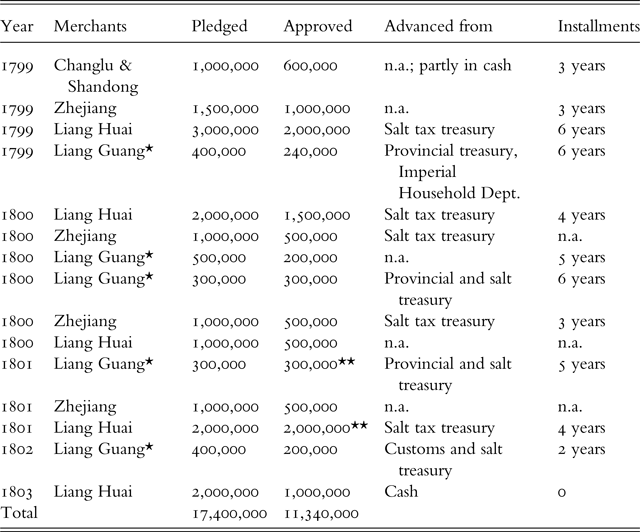
In gratitude contributions, too, the throne would collect what the market could bear. However, these contributions underwent a subtle shift that made them more onerous and similar to a tax, especially in the case of the salt merchants. The hereditary salt syndicates were the closest institution we can find in Qing China to something like ‘financiers’ of the throne. The Imperial Household Department directly invested in the salt monopoly with low-interest loans, while state funds were deposited with the syndicates to yield interest rates closer to the market rates (Kwan Reference Kwan2001, pp. 40–1; Zhou Reference Zhou2007, p. 24). During the White Lotus Rebellion, syndicated salt merchants pledged about 10 million tls in so-called ‘public contributions’ (gongjuan) as part of their obligation to show gratitude for the trade privileges they received from the dynasty (see Table 1).
Contributions by the salt syndicates during the White Lotus Rebellion

* Joint pledge by salt merchants and foreign trade merchants; table lists only salt merchants’ share. ** Partly used for flood relief on the Yongding River, totaling 1.1 million tls.
Source: QYFZ, chs. 33, 72, 153–6, 186, 240, 270.
These contributions followed a ritualized pattern established first under the Qianlong Emperor. They often involved polite ‘barter’ in which the merchant side disavowed any expectation of reward and the court accepted only half to two-thirds of the sum originally pledged. The merchants would then ask the throne to accept the full sum, a request that was rarely granted. Once the amount of the contribution was settled, the throne would finally order the Board of Revenue to immediately apportion individual rewards on the basis of the pledged sums, even though the contributions were to be paid in installments ranging from four to ten years (Kwan Reference Kwan2001, p. 42; Zhou Reference Zhou2007, p. 21; Theobald Reference Theobald2013, pp. 142–7).Footnote 17 The salt merchants were well known for coveting the lifestyle and privileges that came with official rank and even government office. Ping-ti Ho and others have argued that office purchase worked to dilute the wealth of the merchants, not only by draining capital from more productive purposes, but also by draining manpower from merchant families who invested in government offices for their sons rather than sticking to the trade (Ho Reference Ho1954, pp. 130–68; Chen Reference Chen1988, pp. 238–40). This explains the eagerness of the syndicates to contribute to the war effort, especially since the Reconstruction Contribution provided unprecedented opportunity for actual office purchase rather than mere promotion in brevet rank, which previously had often been the only choice when the syndicates were asked to make gratitude contributions.
After the end of the White Lotus Rebellion, the syndicates continued to pledge contributions, now mostly for river conservancy. However, the nature of contributions underwent a subtle shift. In a recent dissertation, Jiang Xiaocheng (Reference Jiang2017, pp. 178–82) has collected evidence for contribution pledges from salt syndicates amounting to 53.34 million tls during the Jiaqing reign alone, far more than under the much longer Qianlong reign (38.7 million). The vast bulk of these pledges (40.4 million) came from the Liang Huai merchants.Footnote 18 Interestingly, most of these contributions no longer appeared in the official salt histories, which listed only 26.6 million tls (Chen Feng Reference Chen1988, pp. 219–21). This may indicate that these contributions more and more assumed the character of a tax. A report from 1819 shows that rewards were no longer granted for pledges but only after the full sum had been paid up. Polite bartering had stopped. Moreover, pledges were taken for installment plans that started years after the event. For example, the Liang Huai merchants pledged 1 million tls in military expenses for the suppression of the Eight Trigram uprising in 1813 and a total of 4 million for dyke construction on the Yellow River in 1814, but the payment schedule for the nine-year installment plan would not start before 1823 (JDSYD, 24, 552–5; for Changlu merchants, see Wang Reference Wang2012: 84–5). At the same time, the government in 1809 also directly turned to temporary salt price increases earmarked for specific emergencies, even though these increases contradicted Jiaqing's self-imposed tax moratorium and were originally rejected (LHYFZ, ch. 2, pp. 25b–27b; QYFZ, ch. 3, p. 6b; ch. 21, pp. 4a–b).
The expansion of gratitude contributions by the salt syndicates may have compounded the troubles of the salt tax. Salt tax quotas were set on the basis of a fixed amount of salt that was sold in a limited market area at government-set prices. When the merchants could not sell the full quota, they would naturally fail to make the full tax quota. Tax arrears had become chronic by the late eighteenth century and, according to contemporary criticism, were only aggravated by the contributions. The syndicate leaders pledged contributions and would reap most of the rewards. However, they would not spend their own money, but would instead roll over the amount to the smaller salt traders under their supervision as a surcharge on their sales quota. Regular taxes, installments on past tax arrears, and contribution installments could easily pile up to make fulfilling the tax quota even harder (QYFZ, ch. 240; Chen Reference Chen1988, pp. 235–40; Kwan Reference Kwan2001, p. 44). After 1821, under the new Daoguang Emperor, public contributions by salt syndicates stopped while individual contributions by salt merchants continued. At the same time, the crisis of the salt tax revenue deepened, and by the 1840s, the accumulated tax debt had ballooned to 23 million tls in Changlu and as much as 60 million tls in Liang Huai (Kwan Reference Kwan2001, pp. 44–5; Metzger Reference Metzger and Willmott1972, p. 41; Chen Reference Chen1988, pp. 258, 264). In 1831, the governor-general responsible for the Liang Huai administration solved the problem of tax arrears with one stroke by handing out shipping licenses to non-syndicated traders, but the reform remained confined to the smaller northern part (Metzger Reference Metzger1962). As in other areas of heavy government involvement that showed ‘increasing difficulty’ or even ‘signs of breakdown’ in the early 1900s, as for example the grain tribute shipping on the Grand Canal, the Qing government found it difficult to overcome the bureaucratic inertia of established precedent and to tackle the vested interests in the trade.Footnote 19 Not until 1849 did the government start to expand the experiment, but it was only after the Taiping Rebellion that the old syndicates finally gave way to new salt merchant elites (Rowe, Reference Rowe1984, pp. 92, 105–6; Chen Reference Chen1988, pp. 163, 265–6).
VII
By the time of the Opium War, the Qing Empire was bankrupt. Equivalent in cost to a little more than one year of government revenue, the Opium War was not the most expensive war in Qing history. However, by the end of 1841 the Board of Revenue reported that provincial treasury reserves – the statutory quota was 8–10 million tls in total – were completely depleted and all current tax revenue was spent. Revenues had to be appropriated as soon as they were collected, while the tasks for which these funds were originally earmarked could not be financed (Mao Reference Mao1996, p. 56; Wei Reference Wei1984, p. 559. Oda Reference Oda1905, vol. 6, pp. 306–11). In a departure from previous practice, the throne had authorized provincial governments to directly recoup the costs of military engagement by selling offices, a privilege hitherto reserved to the Board of Revenue. On average, 23 percent of expenditures were paid from contribution revenue, but 9 percent still came from salary cuts (Mao Reference Mao1996).
The share paid by the central government is hard to ascertain. Shi Zhihong has estimated that between 1840 and 1843 the treasury of the Board of Revenue lost 14.6 million tls of its nominal reserves. Given the continuous troubles with the Yellow River dykes, perhaps half of these funds were spent on the war (Shi Reference Shi2008, pp. 80–1; Zhou Reference Zhou2000, pp. 79–81; Dodgen Reference Dodgen2001, pp. 108–43; Peng Reference Peng1983, pp. 3–23). In the spring of 1843 it was discovered that 9.2 million tls, two-thirds of the funds on account, were missing from the vault of the treasury. Unlike the provincial treasuries, the Board had not been subjected to a treasury audit since Yongzheng's reign. As usual, the throne, instead of exploring the deeper reasons for the deficit, treated the case as malfeasance of individual bureaucrats and demanded compensation from 321 officials who had served rotating terms at the treasury since 1801 (or from their families if the official had died). Only about 3.64 million tls were recovered in this way (ZJHZ, vol. 2, pp. 165–6; Shi Reference Shi2008, p. 110; Han Reference Han2012; Polacheck Reference Polachek1992, pp. 212–13; Wang Reference Wang1961, pp. 55–9; He Reference He1998, pp. 26–8).
The Opium War, described by Mao Haijian (Reference Mao1995) as the ‘collapse of the Heavenly Dynasty’, threw the empire into a deep recession. Zhou Yumin has estimated that during the 1840s, central and provincial treasuries ran up a combined fiscal deficit of over 95 million tls. Office-selling recouped about 46 percent. In the end, there remained a deficit of almost 10 million tls. The treasury system never recovered from the bankruptcy. On the eve of the Taiping Rebellion in 1850, reserves at the Board of Revenue were down to 1.87 million tls and provincial treasuries to 1.3 million tls (Zhou Reference Zhou2000, pp. 71–4). The Taiping Rebellion finally ended the late eighteenth-century fiscal regime of frozen revenue quotas and inflexible expenditure categories and introduced the concept of government debt.
VIII
In conclusion, the Chinese case runs contrary to the observed tendency in Europe in which rulers stepped up revenue extraction in times of war. Jiaqing's Xianyu Reforms appear more like a capitulation to the vested interests of the wealthy elites who preferred purchasing office to being taxed, more similar to the French Old Regime than to the expansion of state capacities in nineteenth-century Europe. There is no doubt that the purge of Heshen and the policy of fiscal retrenchment were popular among the scholar-official elites (Mann Jones Reference Mann Jones1972, pp. 157–8; Xiao Reference Xiao1986, pp. 2, 272–3; Wang Reference Wang2014, pp. 159–62). However, the revisionist telling of the story that the Qing state under the late Qianlong had been rotting from the top and could be simply delivered from corruption by the forceful intervention of the new emperor is too simplistic. Jiaqing's bureaucratic rectification followed a hardline version of Confucian economic doctrine which had evolved in the latter half of the eighteenth century in response to Yongzheng's state expansion. This ideology had a strong bias against tax increases and looked for moral and bureaucratic rather than economic solutions to the problems of government finance. As a result of austerity and retrenchment, the state was barely able to live up to its traditional standards of governance, especially in fulfilling the sovereign tasks of empire (warfare, river conservancy and famine relief) not to mention tackling new challenges.
So, were there any alternatives? In fact, the era was bustling with reform proposals and even some successful experiments, such as the above-mentioned salt tax reform (Metzger Reference Metzger1962; Leonard Reference Leonard1996; McMahon Reference Mcmahon2015, pp. 158–65; Rowe Reference Rowe2012). However, before the Opium War successful experiences were not communicated, experiments were discontinued, and many new ideas were not implemented. A most salient example of the power of fiscal conservatives to prevent economic and fiscal development was their successful resistance against mining. During much of the Qing dynasty, private mining for precious metals was banned and government mining was rare, except in the far southwestern borderlands where monetary metals were mined under heavy government control. While Qianlong showed a more relaxed attitude and left it to the provincial governors to regulate mines within their jurisdiction, Jiaqing reaffirmed the ban in 1799 when he assumed personal rule (Ma Reference Ma2015; Rowe Reference Rowe2001, pp. 243–5; Cao Reference Cao2012, pp. 46–57).
Zhang Guoji (Reference Zhang2005, pp. 125–6) has counted over 60 requests for opening mines published in the Veritable Records between 1800 and 1840, one of them from the above-mentioned Yinghe who cited mining tax revenue as an alternative to office-selling contributions. But all such requests were rejected, and the claimants often punished. Only after the Opium War were the reformers heard, and the ban was finally lifted in 1848 as part of a broader reform package to raise more revenue (Xiao Reference Xiao1986, 2.889–90; Xu and Wu Reference Xu and Wu2000, p. 253; QSL, DG 24.4.9, ch. 404, pp. 57–8; DG 28.11.15, ch. 461, pp. 821–3). But it was too late. When the Board of Revenue found the treasury empty two years later, the ministers claimed that the recent turn to mining had not brought fast enough relief and requested yet another office-selling campaign, dubbed ‘Statutes for Raising Military Funds’. This move would make office-selling a permanent institution until the end of the dynasty in 1911 (ZJHZ, vol. 2, pp. 170–2; Kaske Reference Kaske2011).
In 1827, Zhang Jixin recorded in his diary a conversation with the Daoguang Emperor in which the latter compared the state to a house in which small cracks and leaks have to be constantly repaired in order to avoid large-scale construction (Zhang Reference Zhang1981, DG 27.8.22; Ni Yuping Reference Ni2013, p. 381; Will Reference Will2008, p. 143). Wensheng Wang (Reference Wang2014, p. 195), perhaps unconsciously, alludes to the modern-day American political slogan of ‘putting the fiscal house in order’ when he lauds ‘Jiaqing's withdrawal from unsustainable fiscal extraction and military spending’ as ‘putting the imperial court in order’. By that time, the roof of the Qing house was already seriously leaking, while the empire, having deprived itself of the capacity to tax, could no longer afford extensive repairs.