Introduction
There is a dearth of information on best practices for growing in urban environments where growers often face unique biophysical constraints and competition with many other land uses that yield higher returns. One of the most fundamental constraints is not being able to grow directly in the soil. Urban soils are frequently contaminated with heavy metals and raised-bed garden production is a common and recommended practice 1 , 2 intended to reduce exposure to these contaminantsReference Clark, Hausladen and Brabander 3 .
Many cities in the USA have seen an expansion of urban agricultureReference Lovell 4 . Even an expensive, densely populated city, such as New York, is home to the nation's largest community gardening program 5 and urban farms are proliferating. There are a number of recent initiatives in New York assessing the availability and potential of vacant land and roofs for agricultural production 6 and advocating to expand land area dedicated for community gardening (596 Acres, GreenThumb, the New York Restoration Project, GrowNYC, Five Borough Farm). These initiatives believe that the expansion of the city's gardens is a means to improve access to produce, enhance community members’ health and quality of life, and provide new avenues for people to connect with their food system.
There is currently a rich discussion among policymakers, academicians and practitioners regarding food production in cities across the USA. Claims have been made that putting urban land into agricultural production has the potential to produce significant amounts of produce 6 , Reference McClintock, Cooper and Khandeshi 7 and provide ecosystem services, such as carbon storage, increased infiltration and mediation of urban heat island effects 6 , Reference Evanylo, Sherony, Spargo, Stamer, Brosius and Haering 8 . There is also widespread recognition that presently there is not adequate data to assess these potential benefits, to address the significant constraints of urban landscapes, and to provide scientific expertise to advise the rapidly growing community of urban gardeners and farmersReference Lovell 4 , Reference Wortman and Lovell 9 .
Given soil contamination issues, urban gardeners cultivating on the ground frequently are forced to practice container gardening. Without good drainage, plants may experience root stress and fail to thrive. Soils for containers need to be well aerated and well drained while still being able to retain enough moisture for plant growthReference Pennessi, Clay and Lewis 10 . Achieving these lightweight, well-aerated soils requires either amending topsoil or using a potting mix or a soilless growing medium.
Subirrigated planters (SIPs), or self-watering planters, are any type of planter where the water is introduced to the plants’ roots via a subsoil reservoir. Water is then pulled up from the subsoil reservoir via capillary action, leaving the reservoir empty in between watering. A wide variety of SIP designs can be found, ranging from commercial models, such as the EarthBox® 11 to do-it-yourself instructions for converting everyday materials, such as 5 gallon buckets, storage totes or soda bottles. These planters are prevalent in urban settings, where space constraints mean that growing is often very intensive, and for small-scale gardening. Effective capillary action requires a lightweight (and typically more expensive) soil mixReference Klock-Moore and Broschat 12 . SIPs are popular with gardeners and their proponents who find them to require less frequent watering and to be highly productive 11 .
Subirrigation as a management practice is also utilized in large-scale agricultural production, usually in greenhouses for ornamental or horticulture crops. The results of evaluations in this context have been promising but mixedReference Dole, Cole and Von Broembsen 13 – Reference Incrocci, Malorgio, Della Bartola and Pardossi 15 . Variations on this practice have been found to increase crop performance for the production of ornamentalsReference Dole, Cole and Von Broembsen 13 . Zucchini crops were of higher quality and had higher water-use efficiency but yields were lower, particularly when irrigated with lower-quality irrigation water in soilless greenhouse productionReference Rouphael, Cardarelli, Rea, Battistelli and Colla 14 . Water use was decreased in soilless greenhouse tomato production, but yield increases were not significantReference Incrocci, Malorgio, Della Bartola and Pardossi 15 . Soybean yields under subirrigation were greater when compared to rainfed soybean field productionReference Cooper, Fausey and Streeter 16 . The practice needs further assessment and has not been evaluated in the form in which it is being used by individual gardeners.
The principle objectives of this study are to provide a rigorous evaluation of these raised-bed designs based on four outcomes critical to both urban farms and urban gardeners: (1) the yields of three common garden crops, (2) their capital cost (fixed cost of initial investment) and benefits (revenue), (3) labor easement and (4) crop quality based on marketability and flavor profile.
Study Site
A small urban farm, Feedback Farms, in Brooklyn, NY (40°40′57.72″N 73°58′49.22″W) established the experimental trial. Annual precipitation in 2012 was 1152.14 millimeters (mm) 17 . The farm was in its first year of operations and is located within a community garden established in 2012 on three adjacent vacant lots, with an area totaling 557.42 square meters (m2). Fences divide each of the lots and the farm was located in the middle lot. Light is constrained by several large maple and black locust trees on the southeastern edge of the space, and by the neighboring buildings on the northeastern edge of the space. Light variability is common in the small spaces available in New York City, and the farm and the trial are located in the area of the garden with the best light for vegetable production. The garden is just north of South Brooklyn's industrial corridor and had been vacant since the late 1960s when the three brownstones on the lots burnt to the ground. Like many gardens in urban areas, soil tests revealed extensive heavy metal contamination (992 parts per million (ppm) of lead and 387 ppm of zinc) making growing food crops in the ground unsafe 18 . Soil for growing was trucked in, all gardening took place in raised beds, and exposed soil in the gardens was covered with a thick layer of mulch to minimize recontaminationReference Clark, Hausladen and Brabander 3 .
Methods
We conducted an on-farm experiment over one season in one location using a randomized complete block design with eight replicates to evaluate how three crops (cayenne pepper (Capsicum annuum), sungold cherry tomatoes (Solanum lycopersicum) and lacinato kale (Brassica oleracea)) commonly grown in urban gardensReference Gittleman, Jordan and Brelsford 19 performed when planted in five different raised-bed styles with two growing media (Table 1).
Descriptions, fixed costs for bed construction (US$ m−2), and bulk density (g cm−3) (mean (standard error), n=15) of the five raised-bed treatments evaluated in the trial.

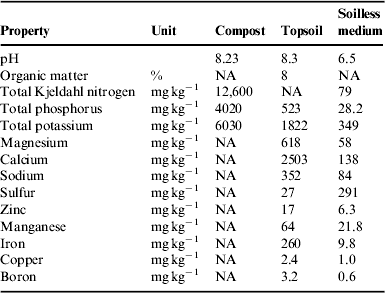
Standard-sized containers were constructed and filled with either a topsoil (2/3) and compost (1/3) blend or a certified organic potting mix that is comparable to conventional soilless growing media without the synthetic nutrient charge. The soilless growing medium is a lightweight blend of compost, peat and perlite. Table 2 contains soil physical and chemical properties for the three components of the growing media. Initial nutrient concentrations differ across the topsoil and potting mix, with the topsoil generally having higher concentrations of macro- and micronutrients. Bulk density samples were taken for three blocks in the trial at soil depth of 10 cm (Table 1). Bulk density values for the topsoil and compost mix averaged 1.15 g cm−3 (0.27) and 0.51 g cm−3 (0.51) for the soilless growing medium.
Soil physical and chemical properties of the growing media used in the trial.

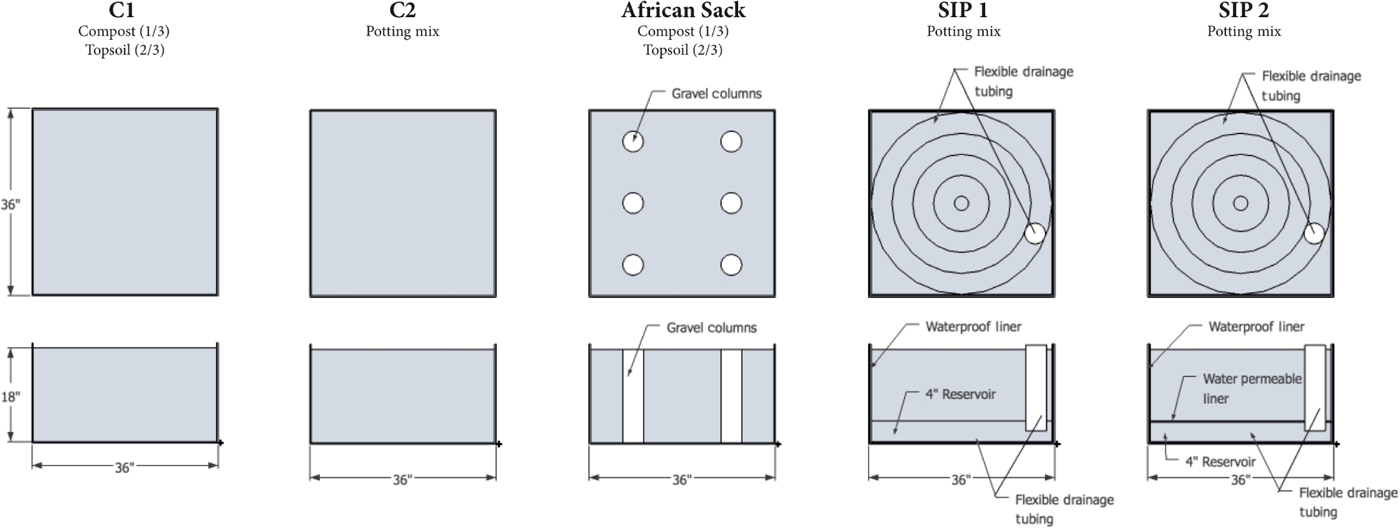
We modified a SIP design commonly used by individual gardeners, which uses perforated plastic recyclables to make a reservoir and potting mix. Some gardeners recommend including a landscaping fabric barrier between the soil and the reservoir to prevent waterlogging of the roots. We included one version with the landscaping fabric and one version without it. The last bed style evaluated is a variation on a SIP-style planter being promoted by several humanitarian organizations throughout Africa, where burlap sacks, such as coffee sacks, are filled with topsoil, compost and a central gravel column. These provide a lot of growing space with a small footprint and are encouraged for growing vegetables in home gardens or urban areas. They are referred to as sack gardens, African sack gardens and keyhole gardens; here we call them ‘Sack gardens.’ We wanted to test this style as it is widely promoted and does not require specialized products or plastic components and thus can be constructed from many of the materials gardens can acquire through donations. The SIP1, SIP2 and Sack gardens were adapted to be more suitable for farm-scale operations utilizing food-safe supersacks, 0.75 m3 flexible bulk bags, which are manufactured for shipping material on pallets, and flex drain, a perforated drainpipe used in landscaping (Fig. 1).
Schematics (top and side profile) of five raised-bed treatments evaluated.

Reconditioned supersacks provided the structure for all bed treatments. In the two conventional beds (C1 and C2), the supersacks were a substitute for a raised-bed frame that would typically be timber. Supersacks were significantly less expensive than the market price for lumber, making them an affordable option. Our SIP and standard raised-bed designs were produced with cost-effectiveness in mind, given the limited funds of many urban gardening projects, and the cost per m2 of gardening space ranged from $35.74 for the C1 to $79.80 for the SIP2 for beds with soil that was approximately 0.46 m deep (Table 1).
The beds used in the trial were in the first year of management. Regardless of treatment, each bed was 0.84 m2. Bed types were randomly assigned to a space within a block and plants were randomly assigned to a location within a bed. The beds were densely planted, including three tomato plants, two pepper plants, and two kale plants, with each plant occupying about 0.12 m2. Sungold cherry tomatoes were harvested 25 times over the season, cayenne peppers were harvested eight times and lacinato kale was harvested four times. We employed a block design as there were clear differences in sunlight coverage of the space allocated to the trial.
Beds were managed by the four authors as well as trained volunteers. The garden was visited on almost a daily basis. Water access in the garden was from a hydrant across the street. Beds were watered when soil was dry to touch 0.03 m below the surface. Data were collected on management, total yield, marketable yield, labor inputs, disease incidence, timing of harvest and a benefit-to-cost ratio (based on the cost to build and subsequent revenue stream). In addition to the quality evaluation done with each harvest, a brief consumer quality evaluation was held for sungold tomatoes. Four parameters, including size, color, flavor profile and taste quality, were evaluated on a scale of one to three by interviewees. These evaluations were held in the garden and the interviewees did not know either the block or the bed from which each tomato was picked. The interviewees were asked to rate the tomatoes relative to each other. Twenty evaluations were completed, although three blocks (2, 7 and 8) were not included in the evaluation. All data were entered into spreadsheets and summarized and analyzed using the ‘agricolae’Reference De Mendiburu 20 package of the R statistical software 21 .
Split plot analysis of variance (ANOVA) tests were conducted by established methods with a mixed effects modelReference Mutsaers 22 – Reference Piepho, Buchse and Emrich 24 . The mixed model was used because factors were both fixed (block, raised-bed treatment and their interactions) and random (crop and its interactions)Reference Piepho, Buchse and Emrich 24 . After ANOVA, mean differences of yields between raised-bed treatments were separated using least significant difference (LSD) tests at P⩽0.05 and ⩽0.01. With data from just one season and one location, these results are preliminary and could represent differences relative to the location or the season rather than differences due to the crops or raised-bed treatments.
Net returns per raised bed were calculated based on the revenue generated per bed minus the fixed costs to construct the bed, seed starting costs (seed, soilless medium and trays), fish emulsion treatments during the growing season, and packaging for crop sales. The labor input for managing the beds in the trial was much higher than the labor required for managing non-trial farm beds. Thus, labor inputs were excluded from the net revenue calculations, as it was not comparable to typical labor costs for farm management. It was assumed that all marketable produce was sold and all bed component materials were purchased. Crop prices were based on the farm's retail prices (US$) per kilogram (kg) averaged for each crop over the 2012 growing season ($11 kg−1). Soil costs were based on topsoil, compost and soilless growing medium market prices (including freight) in 2012 from McEnroe Organic Farm, a local source for high-quality compost and soil mixes. While many gardeners may never sell their produce nor purchase any of the materials that they use to construct their beds, this simplified cost–benefit analysis is nonetheless valuable as an assessment of whether small initial financial investments in soil medium and bed structure can be economically rational.
Results and Discussion
The yields for tomatoes and peppers in the trial were comparable to or better than those in conventional systems 25 , 26 and New York City gardensReference Gittleman, Jordan and Brelsford 19 (with tomato yields exceeding biointensive ‘low’ yields)Reference Jeavons 27 (Table 3). Kale suffered from shading by the tomato plants. While kale yields were lower than biointensive ‘low’ yields, they were on par or above conventional yields for all treatment except C1. There was variation in sunlight across the experimental area. Light intensity increased along a gradient from blocks 1 to 8, leading to greater tomato yields in blocks 7 and 8. Figure 2 shows production (kg per bed) for the whole plot (Fig. 2a) and the three crops (Figs 2b–2d) for five raised-bed treatments.
Total production (kg) per 0.84 m2 bed of (a) combined production of all three crops, (b) cayenne pepper, (c) lacinato kale, (d) sungold cherry tomato for one season by bed type; the box plots represent upper quartile, median, and lower quartile, whiskers represent the minimum and maximum values, and dots indicate outliers.

Mean crop yields (kg m−2) for three crops (sungold cherry tomatoes, cayenne peppers and lacinato kale) in the five raised-bed treatments evaluated in the trial, compared with conventional yields from national and New York state data from the US Department of Agriculture (USDA), averaged for 2010–2012, and the University of Vermont Extension (UVM) expected yields for New England, and biointensive ‘low’ yields from Jim Jeavon's in California for comparison 25 – Reference Jeavons 27 .

1 USDA data are for field tomatoes and chili peppers.
ANOVA showed significant effects of the raised-bed treatments, crop treatment, and the crop and bed treatment interaction on crop production (Table 4).
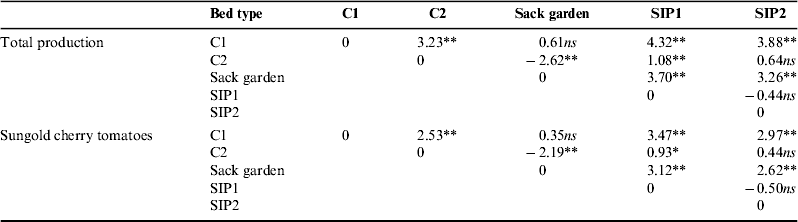
Sungold cherry tomato production was greatest in the SIP1, SIP2 and C2 systems and, relative to the mean of these three systems (4.80 kg per container), yield was 55 and 62% lower in the Sack garden and C1 systems, respectively. When raised-bed treatment means are compared at the subplot level, sungold cherry tomato production for the SIP1 and SIP2, and C2 was greater than the C1 and the Sack garden (P⩽0.01). Tomato production in the SIP1 was greater than in the C2 (P⩽0.05) (Table 5).
ANOVA for the effects of raised-bed treatments, crop and the interaction between the two on total production (kg) of three crops (sungold cherry tomatoes, lacinato kale and cayenne pepper) for five raised-bed treatments.

There was no difference in production of lacinato kale and cayenne pepper production across the five raised-bed treatments. The CV for both pepper production and kale production was high, 31.60 and 24.92, respectively. The CV for tomatoes in contrast is quite low, suggesting that tomatoes likely dominated the trial, overcrowding the beds and having an adverse effect on the yield of the other crops.
Because this study was not replicated across multiple years or locations, differences among treatments may be unique to the conditions at this site or in this particular growing season. While the location of the trial is quite distinct from rural agricultural land, it is representative of growing conditions (and constraints) common to many of the spaces available for food production within the urban landscape. Further data will be collected at a second location with more consistent light and with a lower planting density.
Least significant differences between means and significance of pairwise comparisons for effects at the whole plot and for sungold cherry tomato subplot.

Differences at the α=0.05 level are indicated with *, differences at the α=0.01 level and are indicated with **, and not significant differences are indicated with ns.
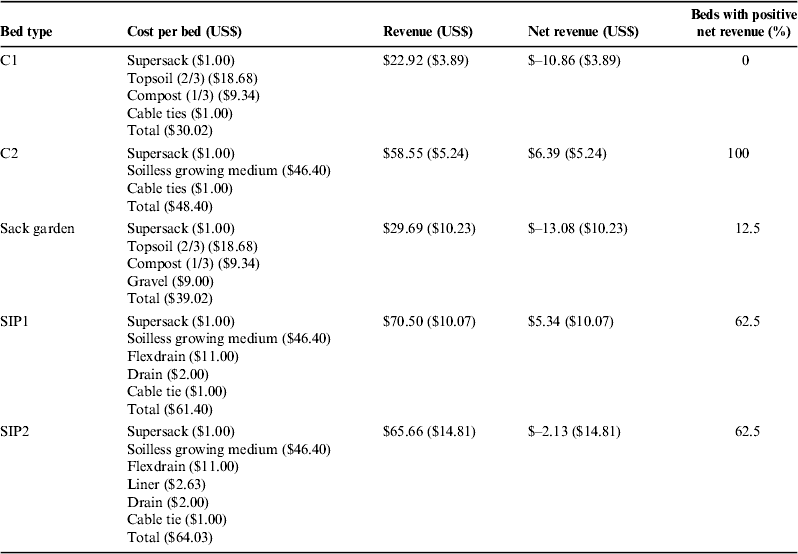
A simple evaluation of the revenue and net revenue from each bed revealed that the majority of beds with the soilless growing medium, both subirrigated and not (C2, SIP1 and SIP2), yielded enough produce to pay back the initial investment within this single summer growing season (Table 6). Investing in well-aerated, well-draining growing medium appears to pay off rapidly. The majority of SIP1 and SIP2 beds were also profitable in the first season despite their higher cost per m2. While the beds with topsoil and compost growing medium (C1 and Sack gardens) cost less per m2 to construct than the SIP1 and SIP2, none of these beds yielded enough produce to pay back the investment in materials. Gross revenue was highest on average for the SIP1 and SIP2 and the range in revenue was larger for all of the subirrigated variations. Sack gardens did not generate as large a revenue stream as either the C2s, or the SIPs; however, the average revenue from the Sack gardens was still greater than the highest revenue from a C1. The gross revenue stream of the SIP1 and SIP2 was 16% higher on average than the C2 and 197% higher on average than the C1. The gross returns on the most productive individual SIP beds were close to $107 m−2. While the net revenue stream per bed is small in the first season, this could make a significant difference for a farm operation if scaled up and considered over time.
One season cost-benefit per bed for five different raised-bed treatments, fixed costs for bed construction, revenue from sales of marketable produce, net revenue (excluding labor costs) (mean (standard error)) and the percentage of beds generating a positive net revenue stream after one growing season.

The landscaping fabric, which some SIP gardeners advise using as a strategy to prevent waterlogging of roots, did not have a positive impact on the flavor of the tomatoes. We do not recommend incorporating the barrier into SIP bed design because it adds cost and does not improve yield or flavor.
Farmers found the SIP beds much easier to maintain. On average, the SIP beds needed to be watered one time for every five times that the C1, C2 and Sack garden needed watering. Watering frequency was recorded but not watering length or the quantity of water. The Sack gardens required more frequent watering than the SIPs and did not have the yield benefit of the C2, SIP1 or SIP2. Our adaptation of this bed style for the trial may require refinement. What these beds do offer is that they utilize readily available materials and do not require any plastic input, potentially reducing their carbon footprint.
We did not measure water-use efficiency, but this is a critical metric for evaluating production systems, particularly in urban areas where expanding food production could increase pressure on municipal systemsReference Wortman and Lovell 9 . Subirrigation has been found to be an effective means of reducing water consumption in greenhouse systemsReference Klock-Moore and Broschat 12 , Reference Incrocci, Malorgio, Della Bartola and Pardossi 15 , Reference Dole, Cole and von Broembsen 28 , which would indicate that the system could have this property outside of the greenhouse as well. In previous studies, differences in crop production across irrigation systems were not driven by the growing mediumReference James and van Iersel 29 ; however, in those trials, various types of soilless growing media were compared. In contrast, in our trial, the bulk density of the topsoil and compost mix is on average more than twice that of the soilless growing medium (Table 1). With this difference in pore space as well as the addition of perlite and peat for water-holding capacity and the large subsoil reservoir, it is difficult to disaggregate whether there is reduced water use or simply greater water-holding capacity. In the continuation of this trial and future studies evaluating the performance of subirrigation, water use efficiency of the two systems needs to be measured.
Additionally, a more complete understanding of labor requirements would require a more complex metric than the one (frequency of watering) used in this study. Reduction in labor requirements has been an important factor in adoption of subirrigation in ornamental greenhouse productionReference Uva, Weiler and Milligan 30 . However, SIP watering requires filling the subsoil reservoir, which required somewhat more time than an average gardener would spend watering their bed (i.e., one visit to water a SIP is not identical to one visit to water a conventional bed). The continuous labor requirement of watering is a serious deterrent to continuing participation in gardens, and missed days can have serious consequences in terms of crop production, leaving gardeners frustrated with low yields. SIPs require watering much less frequently, permitting some management flexibility that may be especially appealing for many of the audiences (older residents or those with restricted mobility) who are being targeted for urban food security interventions. Easier-to-maintain garden beds that are equally or more productive may have an especially high payoff with these populations.
Interviewees evaluated four parameters: size, color, flavor profile and taste quality. The SIP1 and SIP2 were comparable to the conventional beds for all parameters with no statistically significant differences for either bed type or for block (Table 7). Average size of the fruit tended to be rated smaller for the lower-yielding beds (C1, Sack garden) as well as for the SIP2. Average rankings for the SIP1 and SIP2 were slightly higher for taste and color.
Consumer evaluation of size, color, taste quality and flavor of sungold cherry tomatoes grown in five different raised-bed treatments (mean (standard error), n=20).

Higher crop quality (dry matter, carbohydrates, protein and vitamin C) has been observed for zucchini under subirrigationReference Rouphael, Cardarelli, Rea, Battistelli and Colla 14 , but comparisons between tomatoes in subirrigation and drip irrigation systems did not result in quality differences (fruit size, acidity and soluble solids)Reference Incrocci, Malorgio, Della Bartola and Pardossi 15 . Lower fresh weight of fruits was found in the last two trusses of subirrigated tomato plantsReference Incrocci, Malorgio, Della Bartola and Pardossi 15 . There has been some concern among SIP gardeners that subirrigation could yield watery, bland tomatoes due to the potential for roots sitting in the subsoil reservoir. Although our consumer quality evaluation was limited in scope, we found no evidence of a distinct flavor profile for tomatoes from subirrigated plants, or for any crop quality difference. There was no significant difference between the SIPs and the other beds for size, color, flavor profile or taste.
Conclusion
This study provides critical information about potential yields and economic returns on an urban garden scale, where individuals, be they gardeners, farmers or project coordinators, make decisions about allocating scarce resources. While food production is just one of the many important activities that occurs in gardens and farms in urban areas, it is nonetheless a central activity and trade-offs between different production systems must be better understood.
SIPs are a raised-bed type that holds promise for highly productive and low maintenance growing in small spaces. SIP designs for larger-scale growing need to be refined, both for cost, ecological footprint and for function. The yield increases that we saw in raised beds (namely C2, SIP1 and SIP2) came with increased capital investment in the initial construction of the beds. Projects frequently hesitate to do this; instead, using whatever materials they can acquire. In this trial, the capital expenditure required to establish an intensive production space was largely paid off within one growing season, indicating that an investment in soil or soilless media well adapted for container growing, as well as the SIP modification, can be productive and profitable and a worthwhile investment for urban farmers and gardeners. However, study results are preliminary and the trial needs to be extended for an additional growing season. Water-use efficiency will be measured in the second season. Further research is needed to determine which crops and crop varieties benefit the most from subirrigation, to evaluate best practices for long-term soil fertility maintenance without compromising the lightweight soil necessary for wicking and the water-use efficiency of this style of raised bed. In general, there is a need for more research to inform management practices for urban growing and the specific constraints of the urban landscape, in addition to the attempts to quantify benefits of urban gardens and agriculture.
Acknowledgements
We would like to thank the entire garden community at the A Small Green Patch Community Garden and all the volunteers and enthusiasts who have contributed to Feedback Farms, as well as Jay Schipper for providing access to the lot. A number of organizations facilitated and supported our work; 596 Acres, Bob Hyland and Inside Urban Green, the Boerum Hill Association, Brooklyn Grange, Crop Count, Farming Up, New York City Department of Housing Preservation and Development, and IOBY. Our manuscript was greatly improved thanks to the constructive comments provided by two anonymous reviewers. We would also like to gratefully acknowledge McEnroe Organic Farm for their donation of the compost that was used in the beds in the trial, Michael Meehan for his editing and Kate Tully for her advice on bulk density sampling.