





Background
Ankle complaints are common, as 10% of the Dutch population reported ankle pain in the past year (Picavet and Schouten, Reference Picavet and Schouten2003) according to open population surveys. Moreover, consultations for ankle complaints occur often in general practice, as an annual prevalence of 8.8 per 1000 persons is reported in the United Kingdom (Jordan et al., Reference Jordan, Kadam, Hayward, Porcheret, Young and Croft2010) and 7.8 in the Netherlands (Vanhommerig and Overbeek, Reference Vanhommerig and Overbeek2022). Although it is unknown what the exact proportion of chronic ankle complaints is, some reports show that its prevalence could be up to 20% (Hiller et al., Reference Hiller, Nightingale, Raymond, Kilbreath, Burns, Black and Refshauge2012) and therefore contributes considerably to general practitioner (GP) consultations for ankle complaints. Ankle radiography is usually not advised for non-traumatic ankle conditions in primary care (Janssens HJEM et al., Reference Janssens HJEM, Schaafstra, Shackleton, Van der Helm-Van Mil, Van der Spruit, Van Peet, Wiersma and Woutersen-Koch2017; Expert Panel on Musculoskeletal et al., Reference Chang, Tadros, Amini, Bell, Bernard, Fox, Gorbachova, Ha, Lee, Metter, Mooar, Shah, Singer, Smith, Taljanovic, Thiele and Kransdorf2018), which are more often the reason for consulting GPs than traumatic ankle conditions (Menz et al., Reference Menz, Jordan, Roddy and Croft2010). However, ankle radiography requests for chronic complaints in primary care are not uncommon, as approximately 20% of the ankle radiography requests from GPs were for chronic ankle complaints in previous studies from our research group (Kloprogge et al., Reference Kloprogge, Katier, Mailuhu, van Vooren, van Ochten, Bindels, Bierma-Zeinstra and van Middelkoop2023a, Reference Kloprogge, Katier, Mailuhu, van Vooren, van Ochten, Bindels, Bierma-Zeinstra and van Middelkoop2023b).
There is a wide variety of potential causes of chronic ankle complaints (Expert Panel on Musculoskeletal et al., Reference Chang, Tadros, Amini, Bell, Bernard, Fox, Gorbachova, Ha, Lee, Metter, Mooar, Shah, Singer, Smith, Taljanovic, Thiele and Kransdorf2018; Chapman et al., Reference Chapman, Jones, Redmond, Flurey, Richards, Hofstetter, Smith, Arnold, Hannan, Maxwell, Menz, Shea, Golightly, Tugwell, Beaton, Conaghan, Helliwell and Siddle2023), but what conditions GPs suspect for chronic complaints, and if other (non-medical) underlying reasons might play a role in the consideration to request ankle radiography remains unknown. Previous research on GPs’ considerations to request radiography, whether for back pain (Little et al., Reference Little, Cantrell, Roberts, Chapman, Langridge and Pickering1998), or for diagnosing knee OA (Egerton et al., Reference Egerton, Nelligan, Setchell, Atkins and Bennell2018), illustrates that multiple factors play a role in this process. These factors not only include medical indications, but also patients’ satisfaction and reassurance (Little et al., Reference Little, Cantrell, Roberts, Chapman, Langridge and Pickering1998). Moreover, patients’ expectations, as well as GPs’ habits, perceived role, knowledge and skills, confidence, and organizational constraints also influence the decision-making process around imaging (Melnick et al., Reference Melnick, Shafer, Rodulfo, Shi, Hess, Wears, Qureshi and Post2015; Egerton et al., Reference Egerton, Nelligan, Setchell, Atkins and Bennell2018). Which factors play a role in GPs’ expectations of ankle radiography is currently unexplored.
Gaining insight into GPs’ reasons for requesting ankle radiography for chronic complaints is important for two main reasons. First, it helps to determine whether radiology reports align with the expectations of GPs. In addition, this understanding can serve as a basis for improving communication between GPs and radiologists. The communication from GPs to radiologists, usually by clinical information in the radiology request, is crucial for appropriate interpretation and reporting by radiologists (Doubilet and Herman, Reference Doubilet and Herman1981; Leslie et al., Reference Leslie, Jones and Goddard2000). However, clinical information from GPs in radiology requests may not always be optimal (Agarwal et al., Reference Agarwal, Bleshman and Langlotz2009). We do not know what clinical content GPs include in their radiology request for chronic ankle complaints and how radiologists experience this. If we could identify what GPs and radiologists consider important clinical information in radiology requests and reports for chronic ankle complaints, this could provide aspects to optimize the communication regarding ankle radiography and consequently patient care.
Therefore, the aims of this study were to characterize what expectations GPs and radiologists have regarding the reasons for radiography, the content of requests and reports and the impact of the results of radiographs for patients with chronic ankle complaints.
Methods
Considering the limited literature available in the field of radiography for chronic ankle complaints, an exploratory qualitative study (Rendle et al., Reference Rendle, Abramson, Garrett, Halley and Dohan2019) was conducted to characterize GPs’ and radiologists’ expectations regarding ankle radiography for chronic complaints. To gain insight into the entire range of individual and shared views among both groups, focus groups were organized (Britten et al., Reference Britten, Jones, Murphy and Stacy1995; Tong et al., Reference Tong, Sainsbury and Craig2007; Grossoehme, Reference Grossoehme2014; Meuleman et al., Reference Meuleman, Schade van Westrum, Bos, Mooijaart, van Buren, Tripepi, Stel, Jager, Zoccali and Dekker2025). We chose a semi-structured format to explore key topics (DeJonckheere and Vaughn, Reference DeJonckheere and Vaughn2019), namely the perspectives on reasons for referral, the content of referral requests and radiology reports and the expected and experienced impact of results for patient care. Given the absence of prior research in this area and complex clinical considerations involved in some topics, we used predominantly open-ended questions and allowed participants’ discussions to guide the emergence of further topics (Bradshaw et al., Reference Bradshaw, Atkinson and Doody2017). Semi-structured focus group discussions with GPs and radiologists separately were held in the Netherlands. All participants provided informed consent before participation. Data were analysed and stored anonymously. The medical ethic science committee of Erasmus University Medical Center (Erasmus MC) Rotterdam, approved this study (MEC-2022-0475).
Participants
To recruit participants, convenience sampling was used by approaching practice based GPs also working as trainers, teachers or involved in research at the Erasmus MC, and GPs specialized or specializing in the musculoskeletal (MSK) system. GPs were approached by email, posts on regional GP communication channels, and pitching on regional meetings and national training courses. Furthermore, authors used their own networks by personal approach and LinkedIn posts. Radiologists were approached by email using convenience sampling of MSK-specialized radiologists. For some focus groups snowball sampling of GPs and radiologists (in training) was used. During the recruitment phase, potential participants were informed on the reasons, aims and main topics of the research. Two of the study participants had been co-workers of the interviewer, and one is also member of the research group.
Data collection
From October 2022 until June 2023, semi-structured focus group discussions lasting 45–60 minutes were held online or live at the department of general practice at Erasmus MC, or at external general practices or radiology departments. During the analysis, data were evaluated for new or meaningfully revised codes. When focus groups no longer provided new insights and the dataset was considered sufficient to characterize expectations of GPs and radiologists, the organization of focus groups ceased (Malterud et al., Reference Malterud, Siersma and Guassora2016; Saunders et al., Reference Saunders, Sim, Kingstone, Baker, Waterfield, Bartlam, Burroughs and Jinks2018). Before each focus group, participants filled in an online questionnaire on demographics (age and sex) and work experience (in years and months as GP/radiologist and special MSK-interest, e.g. master/specialization). For GPs specifically, the questionnaire included questions about work area (urban/rural/both), accessibility of the nearest radiology department from their practice (in same building/minutes by car), (type of) academic affiliations, and estimated number of patients consulting them for chronic ankle complaints each year. For radiologists specifically, the questionnaire included questions about their type of hospital (academic/regional), estimated percentage of time spend on MSK radiology, if their reports provide advice for further management, and, if they consider osteoarthritis (OA) specifically, when reviewing each ankle radiograph.
Furthermore, the questionnaire included questions about how radiography for chronic ankle complaints is currently perceived, such as the amount of satisfaction with requests and indications for radiologists (very unsatisfied-unsatisfied-neutral-satisfied-very satisfied), and for GPs about how much they were satisfied with the reports from radiologists, and whether reports answer their question and impact their management for patients with chronic ankle complaints (always-often-sometimes-rarely-never). Before the focus groups, GP participants were asked to think of experiences with patients presenting with chronic ankle complaints. Radiologist participants in turn were asked before the focus groups to think of their experience with ankle radiography for chronic complaints from primary care. The focus group topic guide contained questions about the reason for referral, content of radiology requests and reports, and impact of results for patients with chronic ankle complaints (Appendix A). The focus group was pilot tested once with clinical researchers. For focus groups with radiologists, feedback from their responses on satisfaction with ankle radiography indications and requests for chronic complaints by GPs was used as an introduction of the topics. For focus groups with GPs, feedback from their responses on satisfaction with radiology reports for chronic ankle complaints, on whether their reports answer their question, and whether the results impact their management, were used as an introduction of the topics. Throughout the study, questions were slightly adjusted or added based on the previous focus group discussions, but topics were not altered or added. Each focus group discussion was led by one researcher (SK, female, GP trainee and PhD-student), and attended by a second researcher acting as a moderator and observant making field notes (RL, medical student, MvdV, researcher, and MC, GP trainee and PhD-student, all female). MvdV had experience in moderating focus groups. SK, MC and MvdV followed a training/course on qualitative research methods in Medicine. The live focus groups were audio-recorded, the online focus groups were held on Microsoft Teams and were audio- and video-recorded. Subsequently, all focus groups were transcribed verbatim and anonymized by removing names and identifying details (SK). During the focus groups, participants were offered to review either a summary of the main findings or the full transcript. As all participants expressed interest only in the main findings, the final manuscript along with a fact sheet summarizing the main findings were returned to the participants. None of the participants provided additional comments (Birt et al., Reference Birt, Scott, Cavers, Campbell and Walter2016).
Data analysis
The transcripts were analysed inductively in Max-QDA 2018, using semantic, codebook-based thematic analysis (Guest and Namey, Reference Guest and Namey2012). Subthemes and main themes were developed based on code comparison within and between focus groups. The first two focus groups with GPs were individually coded by two researchers (SK and MC), and the coding was discussed until consensus was reached. Thereafter, a meeting with the research group (SK, MC, MM, NK, SB, DS) was held discussing the coding system, and adjustments were made until agreement was achieved. Subsequently, another focus group with GPs and one with radiologists were individually coded (SK and MC). When full agreement was reached, one investigator (SK) coded all other transcripts deductively.
Results
Participant characteristics
Five focus groups with 24 GPs (group size 2–6, 3 online), and three focus groups with 11 radiologists (group size 3–5, 2 online) were held. A varied sample of GPs (age 29–63 years, 50% women) and radiologists (age 29–60 years, 36.4% women) participated (Table 1). Most GPs had academic affiliations and 27.3% of the radiologists worked in a university hospital. One participant was GP trainee (4.2%), five were radiologist trainees (45.5%).
Participant characteristics

Table 1. Long description
The table compares characteristics of general practitioners (GPs) and radiologists. It has two main columns: one for GPs and one for radiologists. Each column contains various attributes such as age, sex, work experience, work area, special interests, academic affiliations, estimated number of patients or radiographs, minutes by car to radiology, percentage of time spent on musculoskeletal radiology, and satisfaction with reports and reasons for radiography. The table includes 24 GPs and 11 radiologists. For GPs, the median age is 43.87 years, with 50 percent women. The median work experience is 11 years, with most working in urban areas. For radiologists, the median age is 41.43 years, with 36.4 percent women. The median work experience is 10.92 years, with most working in regional hospitals. The table also shows the percentage of time spent on musculoskeletal radiology and satisfaction levels with reports and reasons for radiography.
*GP, general practitioner; MSK-radiologist, radiologist specialized in musculoskeletal complaints.
Questionnaire responses
The GPs estimated their exposure to patients with chronic ankle complaints was 3.5 per year (range 1–30). Radiologist reported to approximately assess 10 (range (1–50) ankle radiographs for chronic complaints per week. GPs’ reported that their questions concerning chronic ankle complaints were often (58.3%) answered in the radiology report (Table 1). One fifth of the GPs (20.9%) indicated that results rarely or never affected their management. None of the GPs reported to be unsatisfied by the radiologists’ reports concerning chronic ankle complaints. Also none of the radiologists reported to be unsatisfied about GPs’ radiography reasons and requests concerning chronic ankle complaints.
Focus groups
The following main themes were identified in the interviews: Medical considerations, communication between GPs and radiologists, patient-related, physician-related, and organizational factors (Appendix B).
Medical considerations
Usefulness of radiography for chronic ankle complaints
Some GPs expressed that they do infrequently see patients with chronic ankle complaints. Some GPs also clearly stated that ankle radiography for chronic complaints would not have any clinical consequences.
FG4GP6: ‘… there aren’t a whole lot of answers, …that are incredibly helpful in the end.’ Unless, of course, if there is an old fracture…, or osteoarthritis’…‘is also a clinical diagnosis….ankle radiography often contributes very little’.
However, not all GPs agreed.
FG3GP1: ‘… concerning someone with chronic ankle complaints, …and the radiologist doesn’t see any abnormalities, then I would invest more in conservative management, by the physiotherapist for example…. Whereas if that radiologist describes a terrible osteoarthritis, indeed a referral to an orthopaedic surgeon is plausible….’
Some GPs worry about the low specificity, which could cause unnecessary referrals due to incidental findings.
FG4GP6: ‘What would you tell the patient when you see such a ‘thingy’ huh? …the question is whether that is a meaningful finding. You have something nice to write in your referral letter to the orthopaedic surgeon, but whether it really helps the patient in the end…
GPs worry about low sensitivity too, which could cause false comfort if the radiograph returns as ‘normal’.
FG3GP1: ‘I doubt by the way if chronic ankle complaints always have an osseous cause. So for that reason, I would personally rather send the patient to an orthopaedic surgeon’.
Aspects from medical history
GPs and radiologists considered on-going complaints after ankle trauma as an appropriate indication for ankle radiography, provided that no radiography was performed since the trauma was sustained. Diagnoses mentioned to rule in or out included avulsion or stress fractures, loose bodies (corpora libera), osteochondral lesions and OA. Moreover, symptoms of catching and locking were considered an indication for ankle radiography by GPs to rule out corpora libera. GPs and radiologists mentioned that indications for radiography also depended on a combination of symptom duration, age, occupation, (level of) sports participation, and extent of impairment in daily life.
Ankle disorders
GPs and radiologists seemed to focus on different disorders in respect to ankle radiography. In general, radiologists also focussed more on rare and urgent diagnoses that were less considered by GPs (Table 2). GPs used a low prevalence of certain ankle disorders more often than radiologists as an argument for not requesting radiography.
Ankle conditions considered as indications for radiography (GPs vs. radiologists)

Table 2. Long description
Table with four columns: Condition, General practitioners, Radiologists, and Quote. The table compares indications for ankle radiography between general practitioners and radiologists. Conditions listed include Osteoarthritis (OA), Fracture, Corpus liberum, Osteochondral lesion, Tarsal coalition, Arthritis, and Malignancy. Each condition has corresponding descriptions from general practitioners and radiologists, along with quotes. For example, Osteoarthritis is commonly mentioned by general practitioners for chronic ankle complaints, while radiologists generally look for and describe OA in reports. Fracture types include avulsion and stress fractures, with varying levels of indication for radiography. Corpus liberum is mostly considered to exclude ongoing complaints if there is a trauma history. Osteochondral lesions are indicated if trauma is in history. Tarsal coalition is not mentioned by general practitioners but is always paid attention to by radiologists, especially in younger patients. Arthritis is once mentioned by general practitioners and described in young patients by radiologists. Malignancy is considered doubtful by general practitioners but always by radiologists, especially with a medical history.
Physician related factors
Most GPs requested ankle radiographs for chronic complaints primarily to exclude pathologies that they did not want to overlook without having any specific pathologies in mind.
FG4GP3: ‘The thing is, you want to exclude with radiography, not include, rather exclude.
FG4GP6: Yes, but what do you want to exclude?
Radiologists did not oppose to this, as they found radiography a relatively cheap and an easy test which excludes major pathology.
Some GPs add to this, that ordering tests in general, gives them something to offer to a patient, to persuade patients of a wait-and-see-policy or management in primary care.
FG1GP6: ‘If I had an anxious patient’…but I’d actually rather not refer the patient yet, …but I just need a little more eloquence for that. Then I would use such a radiograph’.
Most GPs agreed that the more experience they had, and the longer the doctor-patient relationship, the more confidence GPs had in patient education and the less tendency to request radiography.
FG5GP4: ‘as a locum GP, I maybe request radiography a bit more often, because you have a little less confidence from the patients…. You (to other GPs) have built up certain credit’…‘I hope to be able to explain it clearly, but I might be more inclined to do it (request radiography)’.
FG5GP1: Yes, but it might have something to do with experience, years of experience, as well. That you dare to say more firmly, ‘that is really not necessary’, or something.
However, a few GPs stated that they will be less likely to request radiography because they do not feel confident in interpreting the results. Patient education was considered as a way to prevent unnecessary ankle radiography requests from a medical perspective, but GPs considered this complicated, time-consuming and mostly not fulfilling.
FG4GP6: ‘The point is to explain it to people, and that is of course awfully difficult indeed’.
FG4GP3: ‘Yes, there is, I think, the crux’.
Patient related factors
GPs declared that they request more ankle radiography ‘for their patient’ than for medical indications, namely for clarity, reassurance, recognition by the GP and relatives, and to prevent higher costs that accompany referrals to secondary care.
FG1GP3: ‘Sometimes some reassurance or eloquence of the patient, so not really a medical indication, right?
Organizational factors
GPs commonly mentioned using ankle radiography to confirm for themselves and to convince patients of further management in primary care, as GPs and radiologists agreed that its use could save societal costs by preventing medical specialist consultations or scans.
Radiography demanded by orthopaedic specialists
GPs mentioned that different hospitals apply different requirements for referral. For example, sometimes GPs were obliged to request ankle radiography before referral to orthopaedics. Most GPs considered this as bothersome. Moreover, GPs indicated that their patients always get radiography immediately when they first visited an orthopaedic surgeon.
FG3GP3: ‘It is a bit complicated if you explain (as a GP) that radiography does not relate with clinical osteoarthritis, and after a while a patient visits an orthopaedic surgeon and the first thing they do is request a radiograph’.
Time constraints
GPs mentioned that it is sometimes quicker to request an ankle radiograph than to convince the patient of its limited value. Moreover, time constraints were mentioned as a factor leading to writing radiology requests with less attention.
FG1GP6: ‘In the rush of a consultation, I am not always very careful with my question and information to the radiologist’.
Communication
Communication between GPs and radiologists occurred almost exclusively through radiology requests and reports.
Radiologists experienced sometimes an abundancy of text impairing them to find the important information within acceptable time.
FG1Rad5: ‘These days a complete copy of the medical history is included, then we read about the canary of the neighbour and so on…
FG1Rad3: ‘We are very busy, so we only want to know what matters’
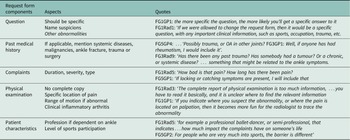
Concerning the radiology request form, GPs’ and radiologists’ both expected it to be short and concise, but should contain certain important aspects, which were in general: the question, past medical history, complaints, physical examination, and other patient characteristics (Table 3).
Important aspects to include in request form

Table 3. Long description
A table with four rows and three columns detailing important aspects to include in a radiology request form. The columns are labeled Request form components, Aspects, and Quotes. The rows are labeled Question, Past medical history, Complaints, Physical examination, and Patient characteristics. Each row lists specific aspects and quotes from GPs and radiologists. For example, the Question row suggests being specific, naming suspicions, and mentioning other abnormalities. The Past medical history row advises mentioning systemic diseases, malignancies, ankle fracture, trauma, or surgery if applicable. The Complaints row focuses on duration, severity, and type. The Physical examination row notes the importance of specific locations of pain, range of motion, and clinical inflammatory arthritis. The Patient characteristics row includes profession if dependent on the ankle and level of sports participation.
Although most participants agreed that radiology requests should contain a specific question, some GPs stated that they are cautious with specific questions, out of fear that it will bias the radiologist.
FG5GP4: ‘If the radiologist is a bit unfocussed, then they might think, no loose body, check,” and might miss an osteoarthritis or something. While, if you keep the question more open, you will get more information back’.
This fear of biasing radiologists is not necessary according to radiologists.
FG2R8: ‘Of course you look at everything, but if there’s a specific question, you focus on that very specifically. And then you also mention that separately’.
Low self-confidence of knowledge hindered some GPs in including specific questions or pain locations in radiography requests.
FG1GP6: ‘…sometimes I don’t really know what level of detail they (radiologists) want. I sometimes find it a bit tricky; I can include all sort of things, but does it matter? What exactly is useful information for the radiologist? If I’m unsure about that, I tend to remain a bit sketchy and I realise that that’s not helpful’.
Content of the radiology report
GPs’ and radiologists’ agreed that the content of the radiology report depended on the question and other aspects of the request form (Table 2). In general GPs found the reports too lengthy containing too detailed descriptions of abnormalities. Some GPs reasoned that radiologists only observe and do not interpret and therefore write down every abnormality they find. Radiologists explained that they do not have access to any other patient information than from the GPs’ radiography requests, and therefore are only able to interpret abnormalities if information in the request is complete and concise.
FG3GP6: A bit of sclerosis left or right, …what should I do with that?
Most GPs preferred reports containing clear conclusions which answers the question in the request form for this reason.
FG3GP6: ‘Nowadays reports consist of a description, followed by a conclusion, …and I find that last one pleasant, as I can retrieve what I should do with certain terminology’
Patients’ access to radiology reports
Some GPs felt forced to write a lay explanation or extra conclusion about radiology reports, as patients might become anxious of all details and medical terminology. Other GPs anticipated on this and usually explain certain expected results to patients before they request radiography to prevent miscommunication. In general, GPs found that the availability of reports to patients leads to more work and time spent on patient education and reassurance.
Discussion
Our study shows that radiologists and GPs have shared but also different expectations of ankle radiography for chronic complaints. Apart from medical reasons, patient-, physician-related and organizational factors play a complex but important role in GPs’ considerations to request ankle radiography. Based on GPs and radiologists’ expectations, multiple suggestions to optimize the content of ankle radiology requests and reports were provided. However, low confidence levels and time constraints of GPs may impair the quality of the requests.
A lower prevalence, and thus a lower a-priori likelihood of clinically significant ankle pathology in general practice compared to radiology departments likely explains why GPs and radiologists emphasize different ankle disorders. Radiologists stated the importance of finding osteochondral lesions and tarsal coalitions as these findings may lead to OA (Chau et al., Reference Chau, Klimstra, Wise, Ellermann, Tóth, Carlson, Nelson and Tompkins2021; Mehdi et al., Reference Mehdi, Bernasconi and Lintz2024), but GPs hardly mentioned them. Indeed surgery is advised for patients with unstable osteochondral lesions or skeletal maturity (Chau et al., Reference Chau, Klimstra, Wise, Ellermann, Tóth, Carlson, Nelson and Tompkins2021), but 41–44% of osteochondral lesions are missed on radiography (Loomer et al., Reference Loomer, Fisher, Lloyd-Smith, Sisler and Cooney1993; Expert Panel on Musculoskeletal et al., Reference Chang, Tadros, Amini, Bell, Bernard, Fox, Gorbachova, Ha, Lee, Metter, Mooar, Shah, Singer, Smith, Taljanovic, Thiele and Kransdorf2018). Tarsal coalitions are also mostly treated with surgery (Mehdi et al., Reference Mehdi, Bernasconi and Lintz2024), and the diagnostic accuracy of ankle radiography is good (Expert Panel on Musculoskeletal et al., Reference Tafur, Bencardino, Roberts, Appel, Bell, Gyftopoulos, Metter, Mintz, Morrison, Small K.M., Subhas, Weissman, Yu and Kransdorf2020b). Other differences in emphasis between GPs and radiologists concerned arthritis and malignancies, conditions that radiologists indicated to specifically look for in their assessments. However, only one GP mentioned radiography for arthritis and GPs found malignancies too rare to consider radiography for. The diagnosis and management of most types of arthritis belong to secondary care in the Netherlands, and the Dutch GP guideline discourages imaging (Janssens HJEM et al., Reference Janssens HJEM, Schaafstra, Shackleton, Van der Helm-Van Mil, Van der Spruit, Van Peet, Wiersma and Woutersen-Koch2017), which explains the sparse focus on arthritis by GPs. In a similar manner, primary bone tumours are uncommon, and radiography is considered insufficient for diagnosis (Expert Panel on Musculoskeletal et al., Reference Bestic, Wessell, Beaman, Cassidy, Czuczman, Demertzis, Lenchik, Motamedi, Pierce, Sharma, Sloan, Than, Walker, Ying-Kou Yung and Kransdorf2020a). So the added value and diagnostic accuracy of ankle radiography in primary care is overestimated for some, but underestimated for other ankle disorders and differed between GPs and radiologists. Avulsion fractures and intra-articular loose bodies were also mentioned, but little is known about their prevalence, radiographic accuracy and added value in primary care. Future research on radiographic accuracy and added value of the mentioned ankle disorders in primary care might support GPs in appropriate decision making regarding chronic ankle complaints.
Physician-, patient- and organizational-related factors were identified as underlying reasons for radiography requests. Research on imaging for other chronic (Little et al., Reference Little, Cantrell, Roberts, Chapman, Langridge and Pickering1998; Egerton et al., Reference Egerton, Nelligan, Setchell, Atkins and Bennell2018), but also acute MSK disorders showed that non-medical factors play a role (Melnick et al., Reference Melnick, Shafer, Rodulfo, Shi, Hess, Wears, Qureshi and Post2015). In our study, this was partly reflected in GPs requesting radiography not to miss ‘something’ instead of mentioning specific pathology, where a physicians’ lack of confidence might play a role. Providing reassurance was a patient-related reason to request ankle radiography. GPs expressed difficulties educating patients about the added value of radiography in our study, which made them request radiography deemed unnecessary by themselves. Similarly, lack of patients’ knowledge about OA (Spitaels et al., Reference Spitaels, Vankrunkelsven, Desfosses, Luyten, Verschueren, Van Assche, Aertgeerts and Hermens2017), in combination with poor patient-communication by health-care professionals were important factors for non-adherence to guidelines in knee OA care (Spitaels et al., Reference Spitaels, Vankrunkelsven, Desfosses, Luyten, Verschueren, Van Assche, Aertgeerts and Hermens2017). Furthermore, although imaging is not always found to be reassuring due to incidental findings (Litkowski et al., Reference Litkowski, Smetana, Zeidel and Blanchard2016), GPs perceived the risks of incidental findings concerning ankle radiography as low. Hence, GPs might benefit from education in appropriate testing where tests are used only when benefits outweigh the risks and costs (Power et al., Reference Power, Fell and Wright2013). This includes learning to recognize situations in which imaging has limited clinical implications and where incidental clinically insignificant findings may still cause unnecessary concern. Moreover, patient education that explains these issues effectively before deciding on imaging may also be beneficial. However, as some GPs did not experience chronic ankle complaints to be a common problem, low motivation for education might limit its effect. A previous study found that structured clinical correspondence improves GPs’ comprehension of information received from specialists (Melville et al., Reference Melville, Hands and Jones2002). Therefore, providing a convenient and structured layout of online radiology request forms and reports, developed in collaboration with both GPs and radiologists might facilitate communication and reduce time constraints.
GPs’ and radiologists’ experience of lengthy descriptions of details may be influenced by the different emphasis on ankle disorders between GPs and radiologists, and by physician-, patient- and organizational-related factors. Interestingly, no GPs and radiologists reported to be dissatisfied with the requests and reports in the online questionnaire before the focus groups. It was surprising that radiologists reported a relatively positive appraisal of GPs’ requests, given that previous studies reported quite low specialist satisfaction with GPs’ referral letters (Westerman et al., Reference Westerman, Hull, Bezemer and Gort1990; Berendsen et al., Reference Berendsen, Kuiken, Benneker, Meyboom-de Jong, Voorn and Schuling2009; Vermeir et al., Reference Vermeir, Vandijck, Degroote, Ommeslag, Van De Putte, Heytens, Reniers, Hanoulle, Peleman and Vogelaers2015; Stegmann et al., Reference Stegmann, Meijer, Nuver, Havenga, Hiltermann, Maduro, Schuling and Berendsen2019). However, one previous study reported that specialists considered GPs’ referral letters to contain too much irrelevant information (Stegmann et al., Reference Stegmann, Meijer, Nuver, Havenga, Hiltermann, Maduro, Schuling and Berendsen2019). This issue was similarly raised by radiologists in our focus groups. GPs desiring a short conclusion at the end of reports, is actually an interpretation of the clinical relevance, which radiologists are willing to provide, given the request is clear and complete. Other studies on correspondence between GPs and medical specialists refer to similar important aspects and addressed missing clinical information or specific questions in many referral letters (Westerman et al., Reference Westerman, Hull, Bezemer and Gort1990; Jenkins, Reference Jenkins1993; Grol et al., Reference Grol, Rooijackers-Lemmers, van Kaathoven, Wollersheim and Mokkink2003). As clear and complete requests are no guarantee for sufficient reports (Grol et al., Reference Grol, Rooijackers-Lemmers, van Kaathoven, Wollersheim and Mokkink2003), suggestions for important aspects to include in both requests and reports given during the focus groups could be considered to incorporate in standardized formats.
Strengths and weaknesses
Our study design enabled in-depth discussions and thereby revealed underlying reasons for radiography requests for chronic ankle complaints. Moreover, already experienced insufficiencies in communication between GPs and radiologists have been discussed in depth. Hereby we provided insight into many potential improvements for communication. The focus group participants were a representative sample of GPs and radiologists, including a variety of physicians in terms of sex, age, years of work experience, MSK-specialization, and work environment, enhancing the likelihood of discussing most expectations and considerations.
However, there are some limitations to our study. First of all, no focus groups were held with GPs and radiologists together. Although this was purposely done to preserve a safe speaking environment, focus groups including both GPs and radiologists could have given more tailored suggestions to improve communication and more solutions in cases of opposing preferences. Due to circumstances, one focus group with only two participants was held, which might have limited the discussion due to a lack of different perceptions. The interviewer present at all focus group was also a GP trainee, which helped to understand and interpret medical terminology, but could have influenced which opinions GPs and radiologists chose to reflect.
Conclusion
GPs and radiologists focus on different disorders when requesting and reviewing ankle radiography for chronic complaints. GPs consider the prior probability of disorders more than radiologists. Non-medical factors also play an important role for GPs in (the content of) ankle radiography requests for chronic complaints, such as GPs’ self-confidence of knowledge relating to chronic ankle complaints, patient reassurance and time constraints. GPs prefer a short conclusion answering their question at the end of radiologists’ reports. Radiologists in their turn, expect requests to include a specific question accompanied by applicable clinical information.
Due to the limited evidence on the radiographic accuracy and added value of the mentioned disorders in primary care, future research is needed to better support GPs in making well-informed decisions with patients regarding chronic ankle complaints. Involving patients in future qualitative studies on reasons for radiography requests may clarify their expectations regarding radiography for chronic ankle complaints and how patient education could support well-informed decisions. Future research in collaboration with developers of electronic referral systems may provide insight into how the layout of requests and referrals can be ‘nudged’ to better meet these expectations.
Supplementary material
The supplementary material for this article can be found at https://doi.org/10.1017/S1463423626101418.
Funding statement
This study was funded by the department of General Practice of the Erasmus MC Medical University Center in Rotterdam.




 Open access

