INTRODUCTION
Imposex leads to the development of additional male sex organs (penis and/or vas deferens) in female gastropods (Smith, Reference Smith1981). It is induced by exposure to tributyltin (TBT), a commercial product present in antifouling paints for ships and boats (Gibbs & Bryan, Reference Gibbs, Bryan and Kramer1994). TBT is also used as a biocide in wood preservatives, textiles, dispersion paints and agricultural pesticides, and as UV stabilizer in many plastics (Oehlmann et al., Reference Oehlmann, Bauer, Minchin, Schulte-Oehlmann, Fioroni and Markert1998). In neogastropods, imposex can occur at TBT concentrations lower than 0.5 ng/l (Bryan et al., Reference Bryan, Gibbs, Humerstone and Burt1986; Alzieu, Reference Alzieu2000).
Beach filling, defined as the addition of sediments transported from other source locations, is seen as a solution against coastal erosion. It is increasingly being used in many parts of the world including Europe, North America and South America (Marcomini & López, Reference Marcomini and López1999; Van Dalfsen et al., Reference Van Dalfsen, Essink, Toxvig Madsen, Birklund, Romero and Manzanera2000; Simonini et al., Reference Simonini, Ansaloni, Bonvicini Pagliai, Cavallini, Iotti, Mauri, Montanari, Preti, Rinaldi and Prevedelli2005; Colosio et al., Reference Colosio, Abbiati and Airoldi2007; Harriague & Albertelli, Reference Harriague and Albertelli2007).
In Argentina, beach filling activities were conducted along the Mar del Plata coastline (south-western Atlantic, 38°02′S), between November 1998 and April 1999 (López, personal communication). This resulted in the transport of almost 2.5 million m2 of sediments dredged from the harbour entrance (Marcomini & López, Reference Marcomini and López1999). Several studies have evaluated the incidence of imposex after the nourishment operation in this area. Penchaszadeh et al. (Reference Penchaszadeh, Averbuj and Cledón2001) found a high degree of imposex in the gastropods Adelomelon brasiliana (Lamarck, 1811) and Buccinanops monilifer (Kiener, 1834) in the last months of 2000, and Goldberg et al. (Reference Goldberg, Averbuj, Cledón, Luzzatto and Sbarbati Nudelman2004) reported tributyltin in water and sediments in Mar del Plata and Mar Chiquita (south-western Atlantic, 37°46′S), and in egg capsules of A. brasiliana in Mar del Plata. Cledón et al. (Reference Cledón, Theobald, Gerwinsky and Penchaszadeh2006) reported the occurrence of imposex in A. brasiliana and the proportion and distribution of butyltin compounds (BTs) in sediments in Mar del Plata, from November 2000 to November 2002.
There are many studies of the effect of nourishment with sand extracted from offshore areas on different invertebrate communities (Sardá et al., Reference Sardá, Pinedo, Gremare and Taboada2000; Van Dalfsen et al., Reference Van Dalfsen, Essink, Toxvig Madsen, Birklund, Romero and Manzanera2000; Colosio et al., Reference Colosio, Abbiati and Airoldi2007). In contrast, information involving sediments from harbours and port areas is scarce. TBT is highly concentrated at these sites due to its low degradation rate, with a half-life ranging between 0.9 and 5.2 years (De Mora et al., Reference De Mora, King and Miller1989, Reference De Mora, Stewart and Phillips1995; Stewart & De Mora, Reference Stewart and De Mora1990). This fact highlights the importance of assessing TBT contamination in port sediments.
Olivancillaria deshayesiana (Ducros de Saint Germain, 1857) (Mollusca: Gastropoda: Olividae) is commonly found from Rio de Janeiro, Brazil, to Mar del Plata at a depth of 6–12 m (Rios, Reference Rios1994).
The aims of this work were: (1) to evaluate the presence of imposex in O. deshayesiana females before, during and after the nourishment operations in Mar del Plata mentioned above; (2) to compare the current incidence of imposex in O. deshayesiana in Mar de Plata and Mar Chiquita, with low marine traffic and no beach filling activities; and (3) in the case of imposex occurrence, to evaluate differences in shell shape and body weight between O. deshayesiana females with and without imposex.
MATERIALS AND METHODS
Sampling and study site
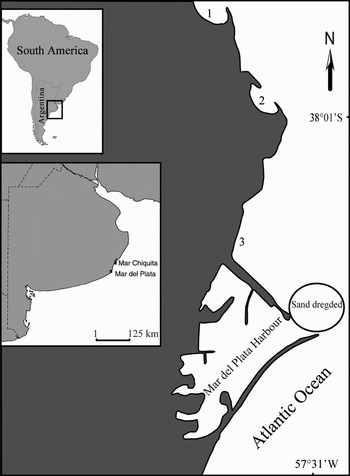
Mar del Plata (south-western Atlantic, 38°02′S; Figure 1) is an open coast characterized by rocky shores and sandy and sandy–silty bottoms and is the site of the most important coastal fishery fleet of Argentina (Olivier et al., Reference Olivier, Bastida and Torti1968; Penchaszadeh et al., Reference Penchaszadeh, Averbuj and Cledón2001).
Map showing the sampled area. 1, 2 and 3 sampled beaches.

Specimens of Olivancillaria deshayesiana were collected before, during and after the beach filling operation mentioned above (December 1995–February 1998, January–February 1999 and November 1999, respectively).
To determine the current incidence of imposex in O. deshayesiana, samples were collected on a monthly basis between October 2005 and August 2007 in Mar del Plata, Argentina. Specimens of these same species were collected in December 2000 and December 2006 in Mar Chiquita (south-western Atlantic, 37°46′S; Figure 1), Argentina.
All samples were collected between 5 and 12 m deep by bottom trawling with a net 15 mm of mesh size.
Laboratory procedures
To determine the presence of abnormalities in the sexual apparatus, the specimens were dissected and the mantle cavity was opened under a stereomicroscope by a longitudinal cut through the hypobranchial gland. Snails were sexed based on the presence of the capsule gland. The lengths of the shell and penis were measured with a Vernier caliper. The gonads of each individual were fixed in Bouin's solution, dehydrated in a graded ethanol series (70%, 80%, 96% and 100%), embedded in paraffin and resin, cut at 5 µm thickness and stained with Harris haematoxylin and eosin. Sex was confirmed by the histological examination of gonad sections under a Zeiss Axio Imager Z1 microscope. The body weight (without shell) of fresh female individuals was also measured. The following values were calculated for each species in each sampling site: mean female penis length, mean male penis length, mean shell length and relative penis size index (RPSI), defined as ((mean length of female penis)3/(mean length of male penis)3) * 100 (Gibbs & Bryan, Reference Gibbs, Bryan and Kramer1994). The imposex frequency was calculated as the proportion of females with imposex compared to the total number of females in the sample.
Statistical analysis
Differences in the frequency of imposex between periods were tested with the Chi-square test. Differences in the sex-ratio between periods were determined with the Chi-Square test for trend. The correlation between total shell length and penis length per sex per period was determined using the Spearman's correlation coefficient. Differences in the size-distribution between males and females were assessed with the one-way ANOVA test. The distribution of sizes between females with and without imposex was compared with the Kolmogorov–Smirnov test, and their respective body weights (without shells) were compared with the one-way ANOVA test. The data were pooled for these analyses because the sample size of females with and without imposex in each period was statistically insufficient (Bech, Reference Bech2002). Differences between the penis length of males and females exhibiting imposex were tested with the one-way ANOVA test.
RESULTS
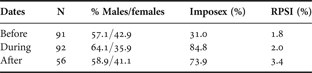
The imposex phenomenon, detected as the neoformation of a penis and a vas deferens in females, occurred throughout the study period in the Mar del Plata area (Tables 1 & 2). No individuals with obstructed vagina were observed.
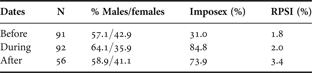
Mean percentage of imposex and mean RPSI (relative penis size index) in Olivancillaria deshayesiana from Mar del Plata area before (December 1995–February 1998), during (January–February 1999) and immediately after beach filling (November 1999).
Sampling sites, mean percentage of imposex and mean RPSI (relative penis size index) in Olivancillaria deshayesiana during October 2005–August 2007.

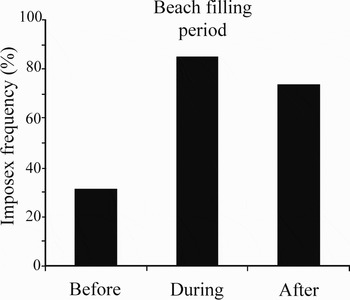
The frequency of imposex in O. deshayesiana was significantly higher during (84.8%) and after (73.9%) beach filling than before it (31.0%) (χ2=23.8 and 18.2, respectively; P < 0.01 in both cases) (Table 1; Figure 2).
Mean imposex frequency in Olivancillaria deshayesiana females in Mar del Plata, Argentina, before, during and after beach filling.

The sex-ratio was significantly higher during beach filling, with males outnumbering females (χ2 = 7.3, P < 0.01), and no significant differences were found before and after beach filling (χ2 = 1.9 and 1.8, respectively; P > 0.05 in both cases) (Table 1).
There was a significant positive correlation between the shell length and penis length of males during and after beach filling (Spearman R = 0.03 and 0.04, respectively; P < 0.05 in both cases), while no significant correlation was found before it (Spearman R = 0.04, P = 0.2).
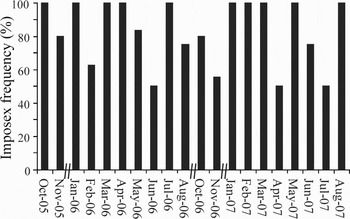
Between 2005 and 2007, the imposex frequency of O. deshayesiana females collected in Mar del Plata showed monthly variations, with a minimum value of 50% (Figure 3). The sex ratio was male-biased (χ2 = 3.61, P < 0.01). A significant positive correlation between shell length and penis length was found in males (Spearman R = 0.03, P < 0.05).
Mean imposex frequency in Olivancillaria deshayesiana females from Mar del Plata, Argentina, during the study period.

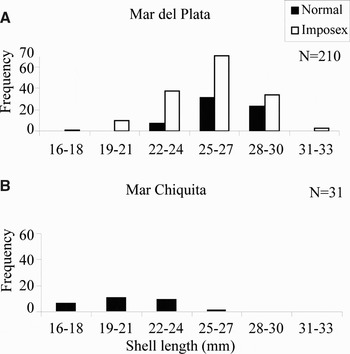
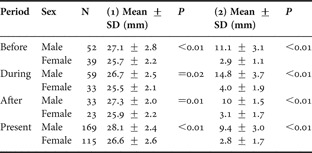
The mean shell length was significantly higher in males than in females when considering the entire study period (Table 3). Mean shell length was significantly higher in females without imposex (Table 4; Figure 4A). No significant differences in mean body weight were found between females with and without imposex (F = 1.92, P = 0.2). No correlation was found between shell length and penis length of females when considering the entire study period. The mean penis length of males was significantly greater than that of females exhibiting imposex when considering the entire study period (Table 3).
Olivancillaria deshayesiana. Size–frequency distribution of (A) females with and without imposex from Mar del Plata currently and (B) females without imposex from Mar Chiquita.

Results of ANOVA test for (1) shell length between males and females of Olivancillaria deshayesiana and (2) penis length between males and females with imposex of O. deshayesiana during the study period (October 2005–August 2007).

Results of Kolmogorov–Smirnov test for shell length between females without and with imposex of Olivancillaria deshayesiana during the study period.

No imposex was detected in O. deshayesiana samples from Mar Chiquita (Table 2); the sex ratio was 1:1 (χ2 = 0.9, P = 0.3), and there were no significant differences in the shell length between males and females (F = 3.4, P = 0.07), with mean shell lengths of 21.3 ± 2.3 and 21.0 ± 2.5 mm, respectively (Figure 4B).
DISCUSSION
The presence of imposex in Olivancillaria deshayesiana throughout the study period confirms the negative influence of the port of Mar del Plata on the local gastropod population, although imposex appears to be mild as sterilization was not found. Currently, the frequency of imposex is as high as 81.7% and the RPSI ranges from 1.8 to 3.4. In the same study area, Penchaszadeh et al. (Reference Penchaszadeh, Averbuj and Cledón2001) found an imposex frequency between 33.3 and 85.7% and a RPSI between 0.14 and 0.34 for a declining population of B. monilifer.
The increase in imposex frequency from 31.0 to 73.9% before and after beach filling, respectively, was probably due to a high concentration of TBT in the sediment dredged from the port of Mar del Plata. This may confirm the suggestion made by Stewart & De Mora (Reference Stewart and De Mora1990) that TBT shows a tendency to accumulate in sediments, which may cause a problem if they are remobilized through events such as storms or dredging operations. TBT concentration decreases rapidly in the water column (2.5 days–20 weeks), while it is considerably more persistent in the sediments (0.9–5.2 years, with a maximum of 8.7 years) (De Mora et al., Reference De Mora, King and Miller1989; Stewart & De Mora, Reference Stewart and De Mora1990; Stewart & Thompson, Reference Stewart and Thompson1997). The fact that the frequency of imposex in O. deshayesiana was greater during beach filling (85.3%) than after it (73.9%) could be explained by the direct effect of high concentrations of TBT in the water column and sediments in this period (Gibbs et al., Reference Gibbs, Pascoe and Burt1988; Ide et al., Reference Ide, Witten, Fischer, Kalbfus, Zellner, Stroben and Watermann1997). Moreover, the higher mean penis length (4.0 ± 1.9 mm) recorded during this period may indicate that the species shows a rapid response to TBT.
Evans & Nicholson (Reference Evans and Nicholson2000) pointed out that biological measurements of imposex should be confirmed by chemical measurements of TBT in tissue, sediment and/or water samples. In Mar del Plata there are no data available on the presence of TBT for the study period, but Goldberg et al. (Reference Goldberg, Averbuj, Cledón, Luzzatto and Sbarbati Nudelman2004) found this chemical in sediment and water in 2001.
The penis length of males was greater than that of females with imposex throughout the study period. This pattern has also been reported for Olivancillaria vesica vesica (Gmelin, 1791) from Brazil (Caetano & Absalão, Reference Caetano and Absalão2002) and for other gastropod species (Bech, Reference Bech2002; Huaquín et al., Reference Huaquín, Osorio, Verdugo and Collado2004).
Despite the close proximity and similar environmental conditions of Mar del Plata and Mar Chiquita, the O. deshayesiana populations showed different patterns. In contrast to males from Mar Chiquita, those from Mar del Plata had a longer shell and were more numerous than females (during beach filling and at present). In addition, the mean shell length of the population in Mar Chiquita was lower than that of the population in Mar del Plata. In highly TBT contaminated areas along the Northumbrian coast, England, Evans et al. (Reference Evans, Hutton, Kendall and Samosir1991) found a higher proportion of Nucella lapillus (Linnaeus, 1758) males compared with females. Normally, gonochoric molluscs show a general sex-ratio pattern of 1:1 (Fretter & Graham, Reference Fretter and Graham1994), as in A. brasiliana and Zidona dufresnei (Donovan, 1823), which are found near the study area (Gimenez & Penchaszadeh, Reference Gimenez and Penchaszadeh2002; Cledón et al., Reference Cledón, Arntz and Penchaszadeh2005). These considerations, together with a report by Goldberg et al. (Reference Goldberg, Averbuj, Cledón, Luzzatto and Sbarbati Nudelman2004) indicating high TBT concentrations in Mar del Plata, suggest that the differences between the studied populations could be due to higher levels of TBT contamination in Mar del Plata.
There are several studies on the effect of TBT on shell size. In a study of the genetic and morphological diversity of N. lapillus, Plejdrup et al. (Reference Plejdrup, Simonsen, Pertoldi, Schoyen and Bayley2006) recorded the largest phenotypic variation in shell size in a population with imposex from a polluted area. Bigatti & Carranza (Reference Bigatti and Carranza2007) reported that females of Odontocymbiola magellanica (Gmelin, 1791) with imposex were larger than those without imposex using multivariate analysis, and they obtained no significant differences in shell length with univariate analysis. We found that O. deshayesiana females without imposex were significantly longer than females with imposex, while Son & Hughes (Reference Son and Hughes2000) reported that the shell size of N. lapillus from North Wales increased significantly with increasing degree of imposex. This lack of consistency among results suggests that the effect of TBT on shell size depends on the gastropod species.
In Argentina, the first discovery of imposex was reported for Mar del Plata at the end of 2000 by Penchaszadeh et al. (Reference Penchaszadeh, Averbuj and Cledón2001), and Cledón et al. (Reference Cledón, Theobald, Gerwinsky and Penchaszadeh2006) suggested that imposex resulted from the beach filling operation carried out in November 1998–April 1999. However, our results indicated that this phenomenon was present at least since December 1995.
Based on the fact that the degree of imposex decreases with decreasing levels of TBT contamination in the environment (Evans & Nicholson, Reference Evans and Nicholson2000), the ordinance 4/98 of the Environment Protection Secretary of Argentina (DPMA, 1998) prohibits the application of TBT on boats in the study area (Cledón et al., Reference Cledón, Theobald, Gerwinsky and Penchaszadeh2006). The present study reveals an increase in the intensity of imposex between 1995 and 2007 with evidence of the use of painting containing TBT (Goldberg et al., Reference Goldberg, Averbuj, Cledón, Luzzatto and Sbarbati Nudelman2004).
The vast majority of studies on imposex have been conducted near marinas, harbours or likely sources of TBT contamination, probably because TBT pollution decreases as distance from the port increases (Evans & Nicholson, Reference Evans and Nicholson2000). We found no signs of imposex in the O. deshayesiana population from Mar Chiquita. A negative result was also reported by Goldberg et al. (Reference Goldberg, Averbuj, Cledón, Luzzatto and Sbarbati Nudelman2004) in A. brasiliana and B. monilifer collected in the same area. This could be explained by the distance between Mar Chiquita and the port (30 km), but Goldberg et al. (Reference Goldberg, Averbuj, Cledón, Luzzatto and Sbarbati Nudelman2004) detected an increase in TBT sediments from 0 ng × g−1 in 2001 to 0.2 ng × g−1 in 2002, and Cledón et al. (Reference Cledón, Theobald, Gerwinsky and Penchaszadeh2006) suggested a current transport of the pollutant from Mar del Plata to the Mar Chiquita coast.
According to the literature, beach filling may have no effect on macrofaunal assemblages (Guillén & Hoeksatra, Reference Guillén and Hoekstra1997; Harriague & Albertelli, Reference Harriague and Albertelli2007) or may be highly deleterious (Van Dalfsen et al., Reference Van Dalfsen, Essink, Toxvig Madsen, Birklund, Romero and Manzanera2000). To our knowledge, this is the first report on imposex in an area nourished with sand dredged from a port. Our results highlight the importance of analysing more carefully the sediment before beach filling. Olivancillaria deshayesiana can be used as a biological indicator of marine contamination with organotin compounds on the basis of the higher values of imposex recorded near the port of Mar del Plata.
ACKNOWLEDGEMENTS
Special thanks to our most skilful fisherman, the late José Luis Ungarelli. Thanks to Juliana Gimenez, Gregorio Bigatti and Florencia Arrighetti for their valuable comments made on an earlier version of the manuscript. Thanks to anonymous referees who made useful comments that improved the manuscript. S.V. Teso is supported by a CONICET fellowship. Special thanks to Lerner Gray Grant 2007 (AMNH) and PADI foundation Grant 2007. This work was partially supported by UBACyT X316, PICT 10975 and PICT 14419.