Many studies have shown the coexistence, hybridity and interaction of multiple rules and norms, including governmental, religious, customary and local traditions, all of which can serve as a basis for claiming property rights.Footnote 1 This article adopts Jacques Vanderlinden’s observation of legal pluralism as “a condition, a way of being, and of existing” in order to gain a better understanding of the continuous rule-making process of rangeland governance in pastoral Tibet.Footnote 2 Pluralism denotes the existence of several legal orders or laws.Footnote 3 It reflects both cooperative and competitive interactions among various overlapping normative systems.Footnote 4 The term “legality” is ambiguous, as the actors and institutions that generate order frequently intersect and evolve, resulting in indistinct borders between legal and non-legal realms. Franz von Benda-Beckmann posits that individuals, through “forum shopping,” seek support from multiple contexts or forums based on the legal framework or interpretation they perceive as the most likely to support their interests and their claims.Footnote 5 Thus, although state policies and legal frameworks generate platforms for powerful actors to engage in resource management, they also expand the room to manoeuvre for less powerful actors who compete for authority under multiple political contexts and institutional landscapes.Footnote 6 This plurality of rules and institutions is essential for adaptive governance, wherein contemporary rules are filtered through established layers of regulations and institutions, leading to reinterpretations that address local requirements.
Legal pluralist frameworks focus on the coexistence and interplay of multiple legal orders or rules within a social domain.Footnote 7 This approach underlines how individuals employ multiple rules to justify and legitimize their decisions regarding resource control and access.Footnote 8 Legal pluralism encompasses both legal and non-legal characteristics, both of which are essential in the study of rules in plural contexts. However, as the term “legal” implies, the legal pluralist framework often fails to address the deeper social, cultural and emotional aspects of rulemaking.
Pluralism in pastoral contexts is exemplified by the coexistence of a state-mandated legal system with a community-based regulatory framework. In this pluralistic environment, customary practices transcend issues of legality, regulation or official status. Instead, they represent a blend of formal and informal elements, where traditional values, norms and beliefs coexist with formality. The integration of collectively constructed customary practices encompasses unwritten and constantly evolving notions. Official, formal and written rules are invariably intertwined with unofficial, informal and unwritten norms, which are often embraced by different actors, including the state, local governments, investors and pastoralists, to implement state-funded projects or to claim and defend land rights through de facto recognition. Even without official recognition, these customary practices often combine to yield practical benefits for the community. Viewing this context through the lens of legal pluralism highlights the flexibility of applying formal rules to address different issues and contexts, allowing pastoralist communities to choose which rules to obey and which regulations to follow based on their needs.
Empirical evidence indicates that the customary practices in pastoral Tibet are shaped by regional conventions, taboos, ethics, codes of behaviour and, occasionally, the teachings of Dharma from the monastery.Footnote 9 Within this context, customary practices manifest in various forms and are continually evolving, highlighting the importance of informality in their socially embedded nature; their reliance on descent-based systems for ownership and inheritance (either patrilineal or matrilineal); and their selective inclusivity, dependent on cultural norms and roles (traditional values, practices and beliefs, upon which traditional pastoralism is based).Footnote 10 Practices of rangeland use and access are flexible through time and space, influenced by the tsowas Footnote 11 and the monastic elite as well as the changing centre–local relationship before the 1950s.Footnote 12 State interventions in rangeland management in peripheral regions have resulted in a blending of central administrative management and local customary practices, revealing flexibilities observed by ethnographic researchers in both agricultural and pastoral regions. These practices are characterized by fuzzy, overlapping boundaries that include a mix of individualized and collective use, which are not represented by idealized forms of feudalism, collectivism or privatization.
Methodology
Grassland accounts for almost 41 per cent of China’s total landmassFootnote 13 and provides a home to nearly 18 million herders in pastoral or semi-pastoral regions.Footnote 14 The Tibetan Plateau (Qingzang gaoyuan 青藏高原) is one of the world’s largest pastoral areas and contains rich natural grassland resources, including alpine steppes, alpine meadows and desert steppes. The livestock population has increased dramatically over the last few decades, with the total number of livestock, measured in sheep-equivalent units, exceeding 160 million in 2020.Footnote 15 Tsongon (Qinghai), like many rangeland-dependent populations worldwide, faces enormous socio-economic uncertainties.
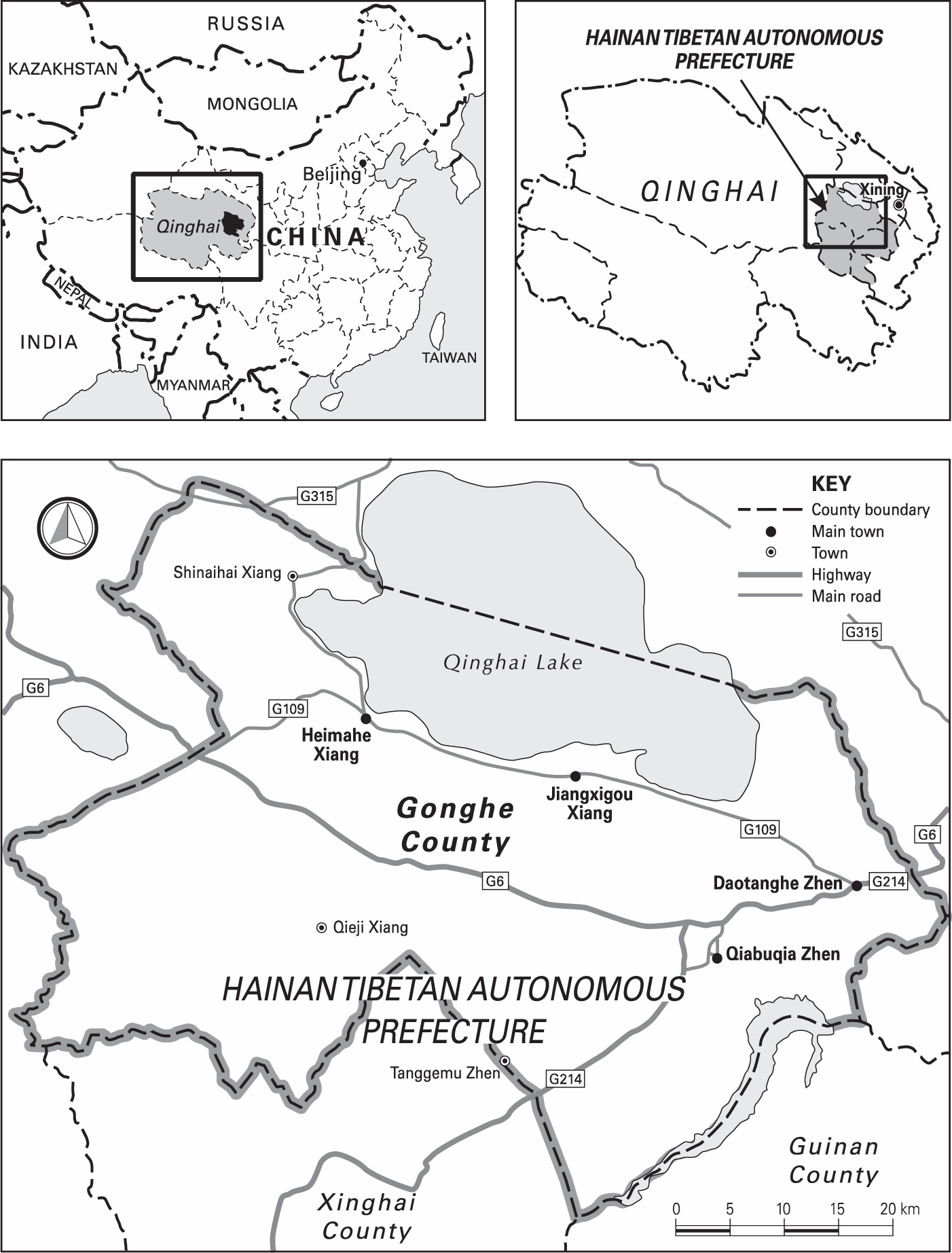
Saga is a pastoral village in the Tsolho Tibetan Autonomous Prefecture (Hainan zangzu zizhi zhou 海南藏族自治州, also known as the Kokonor region and referred to as such hereafter) (Figure 1).Footnote 16 The village sits at an elevation of 3,200 metres and is home to 366 households and a total population of 1,245.Footnote 17 Pastoralists in Saga graze 65,434 head of livestock, with sheep accounting for roughly 87 per cent of the total. Between 2019 and 2021, I spent 13 months gathering data, travelling and living among pastoralists on their winter and summer pastures – living in tents in the summer and concrete houses at lower altitudes in the winter. Additionally, I also spent seven months in Xining, where I conducted interviews with provincial and prefectural officials while writing.
Location of Saga Village in Kokonor, Amdo Tibet, China

This article deploys a multi-case ethnographic approach and uses mixed methods that combine various qualitative and participatory techniques. Ethnographic cases relevant to customary practices have been gathered and supplemented by participant observation, focus group discussions and in-depth interviews. The research highlights three cases: a grazing ban, summer pasture patrols and a communal summer pasture arrangement. These cases illustrate the ongoing rangeland practices and how pastoralists establish rules, roles and relationships to secure their rights to land.
Empirical Cases of Formal and Informal Rules and Practices in Pastoral Amdo Tibet
The grazing ban in Saga
By comparing satellite images of Kokonor, Tsolho TAP, from 1987 and 2000, researchers discovered an average annual decline in rangeland of 0.14 per cent throughout the 13-year period, resulting in the degradation of a total of 6,984.09 hectares of rangeland.Footnote 18 In response to such findings and increasing incidents of overgrazing and natural disasters such as sandstorms and floods, China initiated a nationwide rangeland conservation campaign known as “retire livestock, restore rangeland” (tuimu huancao 退牧还草) in 2003.Footnote 19 This initiative sought to mitigate rangeland degradation by limiting access to the contracted rangeland.Footnote 20
China initially implemented a “contract” policy in the cropland regions in the late 1970s. This was then extended to pastoral regions nationwide in the mid-1990s with the implementation of the “rangeland household contract” (RHC) policy.Footnote 21 The RHC policy was established to regulate overgrazing, facilitate rangeland restoration and enhance livestock productivity.Footnote 22 Under the RHC, formerly state-owned or community-owned livestock and rangelands were contracted to individual pastoral households, ensuring use rights for herders.Footnote 23 Although rangelands were intended to be privatized under the RHC, approximately one-third of all rangelands in the Kokonor and Golok (Guoluo zangzu zizhi zhou 果洛藏族自治州) regions were contracted to small groups of “households,” typically comprising three to six families or encampments.Footnote 24 These families are connected by family ties and help one another in many activities, including livestock migration and rangeland management.Footnote 25 Research by Jianjun Cao and colleagues finds that this multi-household management model incorporates “traditional management practices, social networks, trust and the low cost and high efficiency of informal institutions, which [act] to reduce the risk of unsustainable development of ecological and social systems.”Footnote 26
In accordance with the RHC policy, the state has implemented the “Rangeland ecological protection subsidy and reward” scheme (caoyuan shengtai baohu buzhu jiangli jizhi 草原生态保护补助奖励机制, REPSR hereafter) in eight main pastoral provinces since 2011 in response to escalating grazing pressures and declining rangeland quality.Footnote 27 The primary goal of the REPSR is to compensate pastoralists who designate their rangeland as a grazing ban zone (jinmu 禁牧) or a livestock–rangeland balance zone, which adheres to established rangeland carrying capacities (caochu pingheng 草畜平衡).Footnote 28
The REPSR scheme supports a ban on livestock grazing in areas with extreme natural conditions and on rangeland considered inappropriate for grazing.Footnote 29 In the case of Tsolho, the prefecture allocated 27.78 million mu 亩 of rangeland for grazing ban zones and an additional 23.14 million mu of rangeland for livestock–rangeland balance zones.Footnote 30 The subsidy and reward scales have evolved since the first phase (2011–2015), increasing from 10 yuan/mu for the subsidy and 1.5 yuan for the reward, to 12.3 yuan and 2.5 yuan, respectively, in the second phase (2016–2020). In 2020, the Ministry of Justice promulgated the “Rangeland management regulations” (RM regulations hereafter), which prohibit livestock herding in the grazing ban zones and regulate livestock populations according to the stipulated carrying capacity in the livestock–rangeland balance zones, as specified in Articles 30, 31 and 32.Footnote 31 Moreover, the RM regulations underline the necessity of management agreements and contracts between the government and the pastoralist households. The township government confirmed Saga’s grazing ban zones based on the areas designated by the pastoralists; however, the question of whether the proposed pasture met the requirements of the REPSR was deliberately overlooked to avoid further inspections by the county and prefectural governments.Footnote 32
Nonetheless, the pastoralists’ approach to establishing the grazing ban and livestock–rangeland balance zones seems to diverge significantly from the guidelines set by the REPSR. The REPSR scheme stipulates that the primary criterion for defining zones should be the ecological conditions of the rangeland, with a particular emphasis on areas with extreme natural conditions and those deemed unsuitable for grazing.Footnote 33 In contrast, the actual zone design is improvised and flexible, primarily shaped by pastoralists’ concerns about potential rangeland degradation, the proximity and distance of summer pastures and the restricted timeframe for summer pasture use, rather than adhering to the stipulated vegetation and biomass conditions set out in the REPSR scheme.
In both pastoral Nagchu (Naqu 那曲) and Saga, the grazing ban was established with the aim of ensuring financial support from the government. However, in Saga, the monetary fund was utilized not only as a tactic for an “upwardly accountable system,”Footnote 34 but also as a means for the government to exert control over the pastoralists. A case in 2020 revealed that when the landless pastoralists drafted a written request for compensation related to a lake expansion issue, the local government cautioned them against submitting the letter to the higher-level government. It warned that if the landless pastoralists did so, it would halt the grazing ban compensation.Footnote 35 In contrast to Nagchu, the grazing ban in Saga operated as a flexible tool for the government to exercise its authority in the local context.Footnote 36
In 2020, Saga had a total of 412,900 mu of rangeland, including 198,900 mu of winter pasture and 214,000 mu of summer pasture.Footnote 37 According to the village leader, the summer pasture was designated as the grazing ban zone, while the winter pasture was designated as the livestock–rangeland balance zone. Uncle Bam, the retired former Party secretary of the village, recounted the decision to divide the rangeland into two zones:
The government claimed that our rangeland must be divided into these two zones under the compensation and reward policy. We did not understand the policy at the beginning; people were worried that the government was planning to take away the land. Therefore, it was collectively decided that the summer pasture should be established as the grazing ban zone and the winter pasture as the rangeland and livestock balance zone in Saga.Footnote 38
Pastoralists find ways to turn the regulations to their advantage or at least to mitigate the damage those regulations might inflict. According to Uncle Bam, the grazing ban and livestock–rangeland balance zones in Saga were introduced in response to the government’s concerns about rangeland depletion and the desire to maximize rangeland utilization. The decision was based on the duration of grazing and the level of pasture utilization in Saga. As Apa Wad, the former village secretary noted, pastoralists typically graze their summer pastures for one to two months, and more than a hundred pastoral households in Saga opt to stay on their winter pasture. These families often have fewer animals, and the vegetation on the winter pasture is sufficient for their needs. Uncle Bam added that the decision to designate the summer pasture as the grazing ban zone was influenced by how far away it was, suggesting that the officials were less likely to inspect the area.
In contrast, retired pastoralists, such as Apa Libo who had sold all his livestock and moved to the township centre in 2015, told me:
I am happy the village and the government [at the township level] designated the summer pasture as the grazing ban zone, because I don’t have any animals, thus, the summer pasture is useless to me, and now there is money [the grazing ban subsidy], which is great for those who don’t graze on the summer pasture.Footnote 39
Since 1992, the winter pasture in Saga has been contracted to individual households under the RHC policy and fenced to establish clear boundaries between pastoralist households.Footnote 40 In contrast, the summer pastures remain communal and unfenced, with mountains, valleys and streams serving as boundary markers between pastoral villages. Under this communal system, all of the villagers in Saga have the right to access summer pasture; however, the village retains ultimate control over access and the timing and duration of use. Furthermore, as Apa Libo pointed out, the designation of the communally used summer pasture as a grazing ban zone benefited the majority of pastoralist households, particularly those in the village with fewer livestock. A pastoralist family from the township confirmed this:
It doesn’t matter how many sheep and yaks you have, you can always lease your winter pasture at a good price here, but you cannot lease the summer pasture [it is under collective use], so the money [from the grazing ban] benefits all pastoralists in the village.Footnote 41
The RM regulations have instituted a prohibition on livestock grazing within the designated grazing ban zone and have set restrictions on the quantity of livestock permitted in the livestock–rangeland balance zones. Nevertheless, these rules are ineffective in practice, as pastoralists continue to migrate and rotate their herds between the winter and summer pastures, a tradition they have upheld for millennia. To mitigate the impact of the grazing ban, each pastoral household in Saga receives an annual subsidy for the grazing ban and a reward for maintaining the livestock–rangeland balance zones, which is contingent upon the total area of contracted property. Although the REPSR scheme and RM regulations aim to limit rangeland use and access by banning grazing and controlling livestock numbers in rural pastoral areas, the governing regulations and official frameworks are largely improvised, allowing local pastoralists to circumvent the rangeland conservation policies to meet their grazing needs.
For the authorities, inspecting the grazing ban zones can be challenging. The pastoralists and the village have developed strategies to manage the inspections. For example, “We have to go and pick up the yak dung before every inspection, to make sure that when the government inspectors come, they don’t see anything and the compensation arrives on time.”Footnote 42
The location of the summer pastures also presents an additional obstacle for the inspection teams. The pastures tend to be far away from the township centre, and the poor conditions of the roads act as a barrier, making it difficult for government inspectors to reach the zones. Uncle Bam elaborated:
Officials at the provincial and prefectural levels only visit the township centre, they don’t have time to visit the summer pasture because their cars cannot get through, and they don’t like riding horses and motorbikes. That’s why they always finish their inspections at the township level, and the township government is on our side on this one because we are all in the same boat. If the provincial government discovers a violation of the ban, the township government will be held accountable first, and they are aware of this.Footnote 43
The government inspection team never visited Saga’s summer pastures, and no one knew the exact location of the grazing ban zone. When asked about the grazing ban zone, one of the township government’s secretaries replied, “You should ask the village leaders, they established the zones, and we only have the [livestock] numbers of the rangeland; we pay according to the numbers that the village leaders gave.”Footnote 44 Meanwhile, management of livestock numbers on the winter pasture is guided by local understanding and experience regarding rangeland and livestock capacity, rather than by the RM regulations, which allow for a maximum of 11 sheep per mu of rangeland (one yak is considered equivalent to five sheep, and one horse equivalent to eight sheep). Nonetheless, pastoralists have their own methods for handling the livestock numbers in everyday life. As Dako, a young pastoralist whose family also operates a hotpot restaurant in the township centre, explained,
When they come to verify the numbers, we always give them the fabricated ones. Usually, there are two types of numbers here. The first is the number for the government, which should be kept to a minimum. Then there is the number for the bank, which should be as large as possible. The reasons are that if you have a large flock, you will not be eligible for government subsidies under the rangeland management regulations; but you will be unable to get a loan from the bank if you claim to have only a few sheep, as this reduces your capacity to repay loans.Footnote 45
Pastoralists possess a clear understanding of the precise number of animals that should be kept on their pasture. Keeping more livestock demands additional pastureland, which in turn requires further investment in labour, livestock management, forage and pasture rental. This understanding contrasts with the state’s approach, which often relies on technocratic rules and regulations. In contrast, pastoralists adaptively select from competing regulations that better suit their practices and the local context. Saga pastoralists, with their deep knowledge of the social-ecological system, interpret regulations governing rangeland use differently and work to find a de facto balance, even under inappropriate de jure bans. Although the REPSR scheme and the RM regulations are intended to restrict rangeland use, the actual regulations and official arrangements governing land use and access remain largely improvised and flexible, with local pastoralists manoeuvring around and navigating the rigid and restrictive policies to secure their access to grazing. In this case, the interaction of multiple systems of rules, including the formal state programme, the RM regulations, the local establishment of a grazing ban zone and improvised customary practices coexist within the same social space, demonstrating how various actors employ the rule of law to exercise their rights to land.Footnote 46
Patrolling in line with customary practices
Among the many local arrangements for rangeland use and access, the customary practice of Tsasung (rtswa srung, or caochang xun hu 草场巡护) has been altered by state programmes in recent years.Footnote 47 In Saga, it was customary to appoint five to ten male pastoralists as the “guardians of the communal land” for a period of one to three years. After this time, the role rotated to other young pastoralists from the village. Tsasung guardians were responsible for patrolling the communal summer pasture and preventing disturbances and illegal grazing. Uncle Yuga shared his experiences of when he was appointed in the late 2000s:
There were seven of us, all in our 20s. The busiest time of year was during the move from the winter pasture to the summer pasture. As you are aware, pastoralist villages have collective use of the summer pastures in this region, and there are no clear boundaries between the summer pastures of each village. Therefore, we had to go to the summer pasture and make sure other villagers didn’t graze on our pasture.Footnote 48
In Saga, the Tsasung system focused on preventing livestock and herders from neighbouring villages encroaching on its summer pasture by fostering mutual assistance and collaboration within the village. Traditionally, there was no compensation or reward given to the Tsasung members for guarding the summer pasture. However, under the REPSR scheme, the responsibilities and relationships of the Tsasung within villages have changed. Tsasung members are now tasked with monitoring the incursions of intra-village herders who graze in the grazing ban zone. Moreover, the traditional mutuality-based arrangement of Tsasung has shifted, from a model involving the collective selection of young herders to one where guardians are appointed by the rural government. Currently, these formally appointed Tsasung are referred to as “ecological guards” (shengtai guanhu yuan 生态管护员) and are often selected from households registered as poor (jian dang li ka hu 建档立卡户) under the “Poverty alleviation and eradication” campaign (PAEC). Zen, the Party secretary of the county government, explained:
We pay a total of 21,600 yuan a year to the Tsasung in the village. We choose these people from among the poor household(s) registered under the poverty alleviation programme, and since they are receiving a huge amount of money from the government, we decided that they should do some work to gain the money, thus, we decided to let them patrol the summer pasture.Footnote 49
This new formal process of appointing Tsasung has, however, given rise to various practical issues. Under the system, elderly members of the community or people living with disabilities are sometimes selected for Tsasung, despite the difficult physical challenges that come with patrolling the pasturelands. Furthermore, these guards are additionally assigned other, unrelated governmental duties, such as part-time street cleaning during high-level government inspections or serving as a spokesperson for the township government during press interviews. All these duties result in a heavy burden of responsibility for the Tsasung. In his government-built resettlement site, 65-year-old Uncle Yiman explained to me how he managed: “I am too old to patrol; my legs won’t let me. But I need the money from the government. So, I employ a young pastoralist from our village to replace me, and I pay him 100 yuan per day [to patrol the summer pasture].”Footnote 50 This quote illustrates how pastoralists in Saga employ various strategies to navigate formal changes in the rules affecting their own practices and decisions. Uncle Yiman was too old and frail to patrol the summer pasture; however, the township government continuously selects Tsasung from among the impoverished households in the village, without considering the practical implications of the Tsasung responsibilities. This top-down approach places state aid recipients, such as Uncle Yiman, in a difficult position: he relies on the compensation from the government but is also tasked with patrolling the summer pasture, as mandated by higher levels. Consequently, he must use that financial assistance to hire others to cover his own patrol duties.
As mentioned above, those registered as poor under the PAEC are often the village’s senior citizens and those with disabilities. These individuals are usually relocated to the resettlement site and rely on the government’s monthly subsidy.Footnote 51 The new formal process for selecting Tsasung has sparked outrage among local pastoralists. As Dajee, the son of the former village Party secretary put it, “the government is only concerned with how to spend the state money and brag about their contribution towards conservation and overcoming poverty. They don’t care about destroying the traditional practices here.”Footnote 52 This statement exemplifies the tensions and paradoxes that arise when state planning undermines local practices, ostensibly for the same purpose (in this case, regulating rangeland use) but is then mixed with other objectives set by higher levels. It also highlights how local government prioritizes an upwardly accountable governance system to achieve the outcomes of the state-funded projects, even if it is just for publicity, at the expense of the traditional rangeland-patrolling practices.Footnote 53 In the case of Saga, the Tsasung practices have evolved in response to various governmental regulations and designated projects. For example, the new Tsasung selection system emerged in response to the township government’s efforts to accomplish the REPSR objectives, which include implementing rangeland protection and assigning vulnerable pastoralists as ecological guards.
The fuzzy boundaries between summer pasturelands underscore the necessity of the traditional Tsasung practices, which provide a more reliable means of preventing encroachments and violations from neighbouring villages while also helping to mitigate the overuse of summer pastures by those from Saga. The REPSR initiative has transformed the previously cooperative and locally responsive method, which depended on locals, often youths, volunteering to patrol pastures, into a formalized and bureaucratic system. In contrast to the customary Tsasung practices, official regulations are disseminated via distinct political processes, including diaries, smartphone recordings and uploads to WeChat for inspection and review purposes. In Saga, the formally hired Tsasung guards receive an annual salary, which comes with the responsibility, as ecological guards, to keep records in a journal. According to one of the pastoralists, the journal is a 400-page, leather-bound notebook featuring multilingual translations. The county forest and grassland bureau, in conjunction with the township government, issues the ecological guards with this journal and stipulates that they must undertake an average of two patrols a month. During patrols, the formal Tsasung are tasked with inspecting how the rangeland is used as well as monitoring illegal herding in grazing ban zones and rangeland pollution. They must record the details of each patrol in the journal, which is then submitted to the township government at the end of the year. Some of the Tsasung guards refer to the record keeping as “homework.” Yunda, a father of two, explained why: “Like our children at school, we have homework as well. If you want to receive payment, you must complete it. I don’t have to go and patrol the rangeland, but I have to fill it in, otherwise I will be removed [as an ecological guard] by the government, and they will take my subsidy away.”Footnote 54 A monk from the local monastery, who was also employed as an ecological guard, shared his views on the journal: “This is another formalistic way of doing things here, like a lot of other things they do. I just question why the government wastes such money on designing such a journal – and they need a lot of manpower to collect and check these journals. Moreover, these journals will just be a pile of waste. I hope they will recycle the paper.”Footnote 55
Villages use a variety of methods to record the patrols, including smart phones. In Saga, a government official created a WeChat group to which all Tsasung were required to send their patrol videos twice a week. I spoke to a female village-based cadre (zhucun ganbu 驻村干部) about keeping a check on the journals.Footnote 56 She told me: “They have to patrol the rangeland to get paid, but many of them cheat with their journal entries; this method [sending videos] is better than the journal writing, because you can see them performing their duties.”Footnote 57
Empirical data from Saga indicate that many guards, owing to their senior age and physical fitness, struggle to patrol the pastureland and prevent intrusions and violations. Consequently, many hire local youths to undertake the patrols, fill in the journal and take the video recordings on their behalf. Often, they enlist family, friends or other villagers to compile the recordings for submission to local authorities. In spring 2019, pastoralists in Saga decided to return to the traditional Tsasung ways to achieve the collectively desired outcomes. The village recruited ten young pastoralists to patrol the summer pasture on a non-payment, rotational and collective basis, rather than follow the government-appointed, salary-based Tsasung model. The traditional Tsasung practices proved to be not only effective but also efficient; however, when the Tsasung system was co-opted into wider poverty alleviation programmes as part of top-down planning, its very effectiveness and efficiency were undermined by state control and the need to regulate local practices. Not only were the local actors able to easily subvert the regulatory controls, but the controls themselves were costly to enforce and contextually inappropriate.
In the case of the Tsasung system in Saga, policies and fiats from above, especially in their implementation and interpretation, lacked the flexibility and adaptability necessary for local conditions. The involvement of multiple actors, notably through power-sharing in the management of resources, increased pluralism and created greater opportunities for negotiation. Local pastoralists, as the contractors of the rangeland, adapted their strategies through “forum shopping” to make the best of competing state policies, such as the grazing ban and rangeland patrols.Footnote 58 However, the potential for “forum shopping” varied depending on the context and often derived from pastoralists’ constant negotiations and contestations with the state and local authorities.
In other words, rules are subject to negotiation, reinterpretation and change.Footnote 59 And the rules governing rangeland management in Saga are conflicting within a pluralistic setting.
The collective use of summer pasture
Another case of a local practice or regulatory system that operates in concert with a state system is the collective use of summer pasture in Dramar, a village located in Henan Mongolian Autonomous County, Tsongon (Henan mengguzu zizhi xian 河南蒙古族自治县). Dramar leased a piece of its summer pasture to neighbouring Kotse village, which is located in Kanlho Tibetan Autonomous Prefecture (Gannan zangzu zizhi zhou 甘南藏族自治州), Gansu province. Although the land was contracted to Dramar in the 1980s under the rangeland household contract system, historical cultural, political and economic interactions between Kotse and the Labrang Monastery,Footnote 60 along with a reciprocal relationship with the Mongolian ruling authority in Henan county, allowed this summer pasture to be offered to the Tibetan pastoralists in Kotse under the instruction of the Labrang Monastery.
However, this customary rangeland practice was disrupted by escalating land conflicts between the Kotse and Dramar pastoralists. The land dispute drew the attention of the tenth Panchen Lama in the early 1980s, and in 1984, he initiated peaceful negotiations between the two villages. Village leaders from Dramar and Kotse, as well as religious elites from Tsongon and Kanlho, were brought together to resolve the conflict. As a result, a permanent lease of the land to Kotse was agreed upon. Subsequently, Kotse pastoralists were granted permission to use this specific parcel of land for the period spanning from early June to late July annually. Then, after the Kotse pastoralists leave the land, the Dramar pastoralists can use it.
This arrangement has served both villages well for four decades. However, with the implementation of the REPSR,Footnote 61 debates about the ownership and access rights of the land have resurfaced. This case shows that although the rangelands, according to the state, have been contracted to households, the actual working arrangements for their use and access are complex and flexible.Footnote 62 Although the Dramar summer pasture was contracted to Dramar, the land was still being shared with neighbouring Kotse, thanks to the historical connection between the Mongolian ruling authority and the Labrang Monastery. These customary rangeland practices are rooted in historical connections and serve to foster social connections between the Mongolian and Tibetan pastoralists who have collective use of this land. Thus, rangeland practices are not solely governed by a rigid regulatory contract system but instead rely on the interconnected dynamics between the ruling Mongolian authority and the Tibetan religious elite.
The use of summer pasture closely relates to the rules discussed in the two sections above. In the case of Saga, pastoralists often improvise by reinterpreting the rules and regulations imposed by the local government and the state. For example, the rangeland use regulations were developed in response to state-led scientific ecological research and rangeland conservation concerns and include the grazing ban imposed by the REPSR. As noted above, rather than following the state-regulated vegetation and biomass conditions, pastoralists from Saga allocated the area for the grazing ban zone based on its location and distance from the government headquarters, as well as the relatively short time it is needed for summer pasture. Furthermore, the control of livestock numbers, as required by the RM regulations, was not carried out according to the Ministry of Justice’s stipulations.
In contrast to ostensibly authoritative and scientific assumptions about biomass, carrying capacity and rangeland degradation, pastoralists’ decisions about rangeland use and numbers of livestock are primarily influenced by changing market livestock prices and rising rangeland prices, factors which have a greater relevance to their daily lives.Footnote 63 The REPSR and the RM regulations are designed to formally restrict access to rangeland by banning grazing and controlling livestock numbers in rural pastoralist regions. However, since the de jure rules of rangeland monitoring and enforcement are deemed to be inappropriate by the pastoralists, both access to rangelands and enforcement of livestock limits have reverted to the customary governance embodied in the Tsasung system.
Rangeland governance is continuously evolving, influenced not only by new top-down interventions and rules introduced by the state but also by emerging bottom-up practices.Footnote 64 In other words, rules are not fixed or settled; they are challenged and reinterpreted to suit local realities and needs. As one of the village leaders explained when I asked him about the contradiction of herding livestock within the grazing ban zone while receiving compensation from the state:
The life of the pastoralists depends on the livestock and rangeland. We always do what we can to allow the pastoralists to benefit from the pasture. The state wants to solve the problem of rangeland degradation by compensating us and making us reduce grazing and livestock numbers, but we know how many and how long we can graze on the summer pasture, and the local government knows that, too. However, when there are investigations from the state, we just try to pretend that we don’t use the grazing ban zone. We have to implement the rules; no local government dares reject the policy, because there is no room for that.Footnote 65.
As this quote reveals, policies from above are not fixed; rather, there is space to negotiate rules, aspects of which are subverted to meet local needs, and sometimes in ways that are accepted by local government. When multiple actors are involved in the governance and control of land and natural resources, the likelihood of negotiations increases. The state–local relationship is also in the process of being made and transformed. As pastoralists improvise in response to de jure orders from the state, their relations with the state and local authorities are also repeatedly tested for the opportunity for de facto rules to operate on the ground.
Discussion and Conclusion
The empirical cases in this study show that the government, whether at the provincial, county or township level, lacks authority in decision making regarding land use and access. The REPSR, as a key state policy for rangeland conservation, is implemented by the provincial government and cascades down through the county and township governments. However, local public authorities, such as village leaders, hold ultimate authority over grazing ban sites and rules within the village. While rangeland restoration and privatization are prominent in state narratives in Saga, summer pasture is used collectively because pastoralists, rather than state bureaucrats, have a better understanding of the ecological conditions of the pasture. Many interlocutors noted that weather conditions and the scarcity of vegetation render the summer pasture unsuitable for prolonged grazing. Therefore, the collective use of summer pasture aims to enhance its utilization while promoting its long-term regeneration.
In the case of the grazing ban and livestock–rangeland balance zones in Saga, the institutional arrangements governing land use and access are constructed through social and political negotiations. As a result, new rules incorporating elements of the state and local society emerge, but these rules remain contested depending on the context and as circumstances change. Thus, the summer pasture’s location facilitated the pastoralists’ ability to continue using the land. Additionally, although the township government was aware of the uninterrupted use of the summer pasture, it chose to remain silent about it.
The grassland conservation and restoration programmes have also influenced Tsasung practices. The government’s attempt to link grazing regulations with poverty alleviation efforts unintentionally undermined the existing and effective monitoring efforts. As a result, those physically unsuited to undertake the responsibilities, including the elderly and people with disabilities, were selected for patrolling duties. As the cases illustrate, in rural pastoralists’ regions, the policies formed by upper-level governments often lack a fundamental understanding of the ongoing dynamics of the targeted groups’ roles, rules and relationships. Ultimately, the government-imposed arrangements failed, and the traditional Tsasung system was re-established.
Legal pluralism allows for improvisation and flexibility, both of which are crucial for confronting uncertainties arising from environmental, livelihood, social and political upheavals.Footnote 66 With flexible rules and rights embedded in social, political and economic relationships, pastoralists have greater scope to navigate increasing uncertainties in changing contexts.Footnote 67
Thus, pastoralists engage in “forum shopping” and hybridize institutions that best support their claims across state and non-state, formal and informal spaces. It is more illuminating for researchers, practitioners and policymakers to acknowledge the dynamism of rangeland governance and the diversity of the stakeholders and positionalities involved than to strive for a clearly defined set of regulations that are controlled by a single, coherent authority. Disregarding the importance of local, community or religious-based systems of law and resource management rules is clearly untenable. As Filip Reyntjens writes, “Development actors may not like plural orders, but engineering that doesn’t take into account different governance processes and norms will keep failing to achieve its goals.”Footnote 68
This paper examines how different practices under the same policy may emerge in various pastoral contexts, particularly where central power is stronger and opportunities for local practices are limited. Further ethnographic research is necessary to understand the impact of de jure property rights policies on customary rangeland practices in pastoral China. Scholars have probed rangeland policies such as ecological restoration and sedentarization, as well as pastoralists’ adaptations through local practices like family division and herd splitting within families.Footnote 69 Although these local modifications cannot be adequately defined as “customary practices,” they are doubtlessly significant adaptive strategies that assist pastoralists to secure and maintain their livelihoods as animal herders under changing state policies.
Empirical studies in rural China continue to challenge the standard perception of the state controlling and local actors resisting. Different rules governing the use of and access to rangeland should not be seen in isolation but rather as mutually constitutive,Footnote 70 interacting and influencing each other. Flexible institutions and social networks in multi-level governance systems are key to adaptive management.Footnote 71
In practice, people improvise, reformulate and remake rules and arrangements from below, not necessarily to challenge state power but rather to find ways to negotiate and work in local contexts. This implies that political activity extends beyond the purview of formal authorities, be it the government or other entities. In closing, this raises a number of analytical questions that could frame future studies: how do pastoralists use de facto rules, roles and relationships in their daily lives, and yet, as legal citizens with authorized rangeland use rights, demand incorporation or better terms of incorporation into new systems of rangeland governance? How do pastoralists negotiate with powerful state–capital alliances, and what forms of everyday politics are there for resistance, manoeuvring, compromise and accommodation? These are key questions to explore when studying the negotiations, compromises and accommodations of the pastoralists as they confront the increasing uncertainties and changes that are taking place in the face of new formalized de jure rules imposed by the state.
Acknowledgements
I would like to express my sincere gratitude to the editors and reviewers of The China Quarterly, whose constructive comments and thoughtful suggestions have greatly enhanced the quality of this work. This work is supported by the PASTRES (Pastoralism, Uncertainty, Resilience: Global Lessons from the Margins) programme, which has received Advanced Grant funding from the European Research Council (ERC) under the European Union’s Horizon 2020 research and innovation programme (Grant agreement No. 740342).
Competing interests
None.
Palden TSERING earned his MSc from the Durrell Institute of Conservation and Ecology (DICE), University of Kent, and his PhD from the Institute of Development Studies (IDS), University of Sussex. He is currently the associate editor for the Journal of Pastoralism: Research, Policy and Practice, and professor (associate) at the School of Ethnology and Sociology, Qinghai Minzu University, China. He has been engaged in the development, conservation and governance of resources, as well as the politics of these dynamic interactions among diverse institutions amid changes and uncertainties in the pastoralist context.