Studies in several languages that vary in typology and degree of orthographic transparency have indicated that morphological awareness (MA) contributes to reading achievement in Indo-European, Logographic, and Semitic languages (Bar-On & Ravid, Reference Bar-On and Ravid2011; Berninger, Abbott, Nagy, & Carlisle, Reference Berninger, Abbott, Nagy and Carlisle2010; Carlisle, Reference Carlisle1995, Reference Carlisle2000; Kirby & Bowers, Reference Kirby and Bowers2017; Kirby et al., Reference Kirby, Deacon, Bowers, Izenberg, Wade-Woolley and Parrila2012; Nagy, Berninger, & Abbott, Reference Nagy, Berninger and Abbott2006; Ravid & Schiff, Reference Ravid and Schiff2006; Tibi & Kirby, Reference Tibi and Kirby2017; Tong, McBride-Chang, Shu, & Wong, Reference Tong, McBride-Chang, Shu and Wong2009; Wu et al., Reference Wu, Anderson, Li, Wu, Li, Zhang and Gaffney2009). While the majority of studies to date have explored the effect of MA on reading skill in Indo-European languages, a few studies have provided evidence for the salient and unique role of MA in reading acquisition in Arabic (Abu-Rabia, Reference Abu-Rabia2002, Reference Abu-Rabia2007, Reference Abu-Rabia2012; Abu-Rabia & Shalhoub-Awwad, Reference Abu-Rabia and Shalhoub-Awwad2004; Abu-Rabia, Share, & Mansour, Reference Abu-Rabia, Share and Mansour2003; Layes, Lalonde, & Rebai, Reference Layes, Lalonde and Rebai2017; Schiff & Saiegh-Haddad, Reference Schiff and Saiegh-Haddad2018; Tibi, Reference Tibi2016; Tibi & Kirby, Reference Tibi and Kirby2017) and specifically for the critical role of root knowledge in recognizing Arabic words (Boudelaa & Marslen-Wilson, Reference Boudelaa and Marslen-Wilson2001, Reference Boudelaa and Marslen-Wilson2005, Reference Boudelaa and Marslen-Wilson2011, Reference Boudelaa and Marslen-Wilson2015; Saiegh-Haddad & Taha, Reference Saiegh-Haddad and Taha2017; Shalhoub-Awwad & Leikin, Reference Shalhoub-Awwad and Leikin2016; Taha & Saiegh-Haddad, Reference Taha and Saiegh-Haddad2017).
ASSESSING MORPHOLOGICAL AWARENESS
The role of MA in different literacy outcomes has been documented in English, above and beyond the established strong effects of phonological awareness, vocabulary, and nonverbal reasoning (Bowers & Kirby, Reference Bowers and Kirby2010; Carlisle, Reference Carlisle1995, Reference Carlisle2000; Carlisle & Fleming, Reference Carlisle and Fleming2003; Deacon & Kirby, Reference Deacon and Kirby2004; Kieffer & Lesaux, Reference Kieffer and Lesaux2012; Kirby et al., Reference Kirby, Deacon, Bowers, Izenberg, Wade-Woolley and Parrila2012; Nagy et al., Reference Nagy, Berninger and Abbott2006; Wolter, Wood, & D’zatko, Reference Wolter, Wood and D’zatko2009). For example, Carlisle (Reference Carlisle2000) reported that MA measures were robust predictors of reading comprehension in English-speaking third- and fifth-grade children. There is also research that attests to the bidirectionality between MA and reading comprehension (Deacon, Kieffer, & LaRoche, Reference Deacon, Kieffer and LaRoche2014) and MA and reading accuracy (Deacon, Benere, & Pasquarella, Reference Deacon, Benere and Pasquarella2013). The unique association between MA and literacy skills has also been documented in other languages such as French (Casalis & Louis-Alexander, Reference Casalis and Louis-Alexander2000; Quemart, Casalis, & Cole, Reference Quemart, Casalis and Cole2011), Greek (Pittas & Nunes, Reference Pittas and Nunes2014), Hebrew (Ravid & Schiff, Reference Ravid and Schiff2006), Italian (Burani, Marcolini, De Luca, & Zoccolotti, Reference Burani, Marcolini, De Luca and Zoccolotti2008), Spanish (Ramirez, Chen, Geva, & Kiefer, Reference Ramirez, Chen, Geva and Kiefer2010), and Chinese (Tong et al., Reference Tong, McBride-Chang, Shu and Wong2009; Wu et al., Reference Wu, Anderson, Li, Wu, Li, Zhang and Gaffney2009).
The English literature is replete with various examples of MA tasks (Apel, Diehm, & Apel, Reference Apel, Diehm and Apel2013; Carlisle, Reference Carlisle1995, Reference Carlisle2000; Spencer et al., Reference Spencer, Muse, Wagner, Foorman, Petscher, Schatschneider, Tighe and Bishop2015; Tighe & Schatschneider, Reference Tighe and Schatschneider2015). For example, Tighe and Schatschneider (Reference Tighe and Schatschneider2015) used the Base Form Morphology Task, which required participants to decompose derivational target words into root morphemes by filling in the blank with the root word (e.g., “Popularity. The girl wants to be ___.”; “Popular.”). Tighe and Schatschneider (Reference Tighe and Schatschneider2015) used the Morphological Skill Task, which assessed one’s ability to recognize morphological relatedness between derived and root words. Participants were presented both visually and orally with morphologically complex derived words followed by three choices of root words, and asked to identify the correct root of the derived word. It is important to note here that when the term “root” is used in Indo-European languages, it does not mean the same as when it is used in Arabic. This is because the root in Arabic is (a) exclusively consonantal and (b) never occurs as a real word, but rather as an abstract bound morpheme.
MA tasks used in English and other Indo-European orthographies will not be sufficient in capturing the different nonlinear aspect of Arabic morphology. Research on MA and reading in Hebrew, a Semitic language like Arabic, has included tasks that assess the root and word pattern, which are interleaved onto each other in a nonlinear manner, in their morphological analogy tasks (Ravid & Malenky, Reference Ravid and Malenky2001; Schiff, Cohen, Ben-Artzi, Sasson, & Ravid, Reference Schiff, Cohen, Ben-Artzi, Sasson and Ravid2016). The characteristics of the Arabic morphology call for a similar approach in developing a tool to measure the morphological root for Arabic readers.
ARABIC MORPHOLOGY
Although Arabic morphology shares some similarities with that of other languages, the structural and derivational processes of its morphology are in sharp contrast with the morphology of Indo-European languages, such as English (Qasem & Foote, Reference Qasem and Foote2010; Boudelaa & Marslen-Wilson, Reference Boudelaa and Marslen-Wilson2001, Reference Boudelaa and Marslen-Wilson2005, Reference Boudelaa and Marslen-Wilson2015; Tibi & Kirby, Reference Tibi and Kirby2017). Nearly all Arabic words are created by combining two abstract linguistic units, roots and word patterns, which are affixed simultaneously in a nonlinear manner (Boudelaa & Marslen-Wilson, Reference Boudelaa and Marslen-Wilson2001; Saiegh-Haddad & Henkin-Roitfarb, Reference Saiegh-Haddad and Henkin-Roitfarb2014; Tibi & Kirby, Reference Tibi and Kirby2017). The root is composed of a continuous sequence of consonants and provides the general semantic field of the word; the word pattern, in contrast, is mostly vocalic and provides the morphosyntactic information. In the examples, /kataba/ (he wrote), /kutub/ (books), and /kita:b/ (book), the consonant root structure, k.t.b., which is a specific form of grapheme–phoneme–morpheme regularity, denotes the concept of writing, whereas the vocalic word patterns (e.g., -a-a-a, -u-u, and –i-a:) provide phonological and morphosyntactic information. The combination of the root with the word pattern yields a word that has a specific semantic and grammatical function (Holes, Reference Holes2004). In Arabic, there are 15 verb word patterns, but only 9 of them are in common use today, each representing a specific type of verb (e.g., infinitive, passive, or causative; Boudelaa & Marslen-Wilson, Reference Boudelaa and Marslen-Wilson2011). Arabic derived words are organized around the consonantal root and the (mostly) vocalic word pattern nonlinearly. For example, the Arabic word for “baker” (xabbaaz) comes from “bake” (xabaza), and “bake” comes from the three consonantal root /x.b.z/.
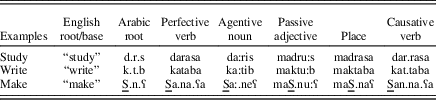
The root is always fully represented in an invariant order but not necessarily continuously in a word. Hence, graphemes in the root structure are interwoven with word patterns. Changing the order of the root’s consonants yields a completely different word with a different meaning. For example, the word /kabata/ (to supress) is constructed with the same consonants but in a different (k.b.t.) sequence. The sequential order of the root’s consonants, as they appear in their derivatives, allows for a well-defined orthographic representation (Ehri, Reference Ehri1992, Reference Ehri2005, Reference Ehri2017; Perfetti, Reference Perfetti1992; Rahbari & Sénéchal, Reference Rahbari and Sénéchal2010; Share, Reference Share1999; Taha & Saiegh-Haddad, Reference Taha and Saiegh-Haddad2017; Tibi, Reference Tibi2016). As a further illustration, Table 1 shows examples of words derived from three different root structures. For each of the three roots, their corresponding derivatives share the same letters with their respective root structure regardless of the specific meaning or morphosyntactic function of the words. The salient nature of the Arabic root and its prominent role in serving as a “binding agent” (Kirby & Bowers, Reference Kirby and Bowers2017), allows for orthographic–phonological–morphological integration. It also provides the foundational linguistic structure for creating an instrument to assess Arabic-speaking children’s knowledge of Arabic roots as a measure of MA, with which to predict reading.
Examples of roots and productive word patterns in Arabic

MA AS A PREDICTOR OF READING IN ARABIC
It is well established in other orthographies that MA is predictive in reading (Carlisle, Reference Carlisle2000, Reference Carlisle2010; Carlisle & Kearns, Reference Carlisle and Kearns2017; Deacon & Kirby, Reference Deacon and Kirby2004; Kirby & Bowers, Reference Kirby and Bowers2017; Kirby et al., Reference Kirby, Deacon, Bowers, Izenberg, Wade-Woolley and Parrila2012; Ravid & Malenky, Reference Ravid and Malenky2001; Tong et al., Reference Tong, McBride-Chang, Shu and Wong2009). There are fewer studies that have examined the predictive ability of MA in reading Arabic. For instance, Tibi and Kirby (Reference Tibi and Kirby2017) developed 10 MA measures based on the taxonomy proposed by Deacon, Parrila, and Kirby (Reference Deacon, Parrila and Kirby2008) and found that these 10 measures defined a single factor. They validated the factor by showing it predicted reading achievement.
In another study, Layes et al. (Reference Layes, Lalonde and Rebai2017) investigated the role of MA and rapid automatized naming (RAN) in word reading and reading comprehension in Arabic. They compared the performance of a typically developing sixth-grade group (n = 20) to two groups: a sixth-grade group with dyslexia (n = 20) and a typically developing younger group in Grade 4 (n = 18). Their results showed significant differences between the typically developing sixth graders and the other two groups on word reading, reading comprehension, MA, and RAN. Layes et al. noted that the group with dyslexia performed poorly on two MA tasks, morphological production and pattern recognition. However, the performance of the dyslexic group was comparable to the younger control group on RAN and MA. Layes et al. also reported that MA explained unique variance in reading comprehension, but not in word reading. Altogether, research indicates that MA is an important predictor of reading outcomes in different languages among primary school aged children.
ROOT AWARENESS (RA): A CENTRAL DIMENSION OF ARABIC MORPHOLOGY
RA is one aspect of MA used to assess morphological knowledge in Arabic and other Semitic languages such as Hebrew. The role of the root in the recognition of Arabic words has been investigated in several studies utilizing a priming paradigm with adult skilled readers (Boudelaa & Marslen-Wilson, Reference Boudelaa and Marslen-Wilson2001, Reference Boudelaa and Marslen-Wilson2005, Reference Boudelaa and Marslen-Wilson2011, Reference Boudelaa and Marslen-Wilson2015). Boudelaa and Marslen-Wilson designed priming experiments in which adults were required to decide as quickly and accurately as possible whether strings of letters were Arabic words or not. Primes were words with either the same root or the same word pattern, and the roots and word patterns varied in productivity. Boudelaa and Marslen-Wilson (Reference Boudelaa and Marslen-Wilson2011) found that priming was determined entirely by the productivity of the root. Even very productive nominal word patterns prime only when they co-occur with a productive root.
The primacy of the root identification, over word pattern identification, remained the same in all priming experiments regardless of variations in productivity of the roots. Conversely, word pattern priming seemed to be dependent on the productivity (family size) of the root with which it co-occurred, rather than the productivity of the word pattern by itself. They also found that the primacy of the root was comparable under both visual and auditory processing conditions.
Although Abu-Rabia and colleagues (Abu-Rabia, Reference Abu-Rabia2007, Reference Abu-Rabia2012; Abu-Rabia & Shalhoub-Awwad, Reference Abu-Rabia and Shalhoub-Awwad2004) had conducted studies with young participants assessing root morphology in addition to other MA tasks, Shalhoub-Awwad and Leiken (Reference Shalhoub-Awwad and Leikin2016) is the only study that tested priming among Arabic children. Shalhoub-Awwad and Leikin (Reference Shalhoub-Awwad and Leikin2016) investigated the effect of the root in visual word recognition among young second- and fifth-grade Arabic students using the priming technique. They compared primes that had the same root of the target with those that shared three letters with the target, but not the root letters. Their results showed that the roots played a facilitative role in lexical decision tasks. Findings of this nature demonstrate the importance of decomposing words to identify the roots while quickly reading Arabic words by adult readers, yet little is known about the development of these word decomposing processes in children during stages of reading acquisition.
Children’s ability to deduce relatedness between words based on the roots and word patterns was examined by Taha and Saiegh-Haddad (Reference Taha and Saiegh-Haddad2017) across Grades 2, 4, and 6. They found that the participants across the three grades were able to deduce the relationship between words based on the roots, rather than the word patterns. Taha and Saiegh-Haddad also reported that the performance of the sixth graders was superior to that of children in Grades 2 and 4, who did not differ.
In Hebrew, whose morphology shares similarities with Arabic morphology, RA has been shown to correlate with reading, and was found to be deficient in children with reading disabilities (Ben-Dror, Bentin, & Frost, Reference Ben-Dror, Bentin and Frost1995; Schiff, & Ravid, Reference Schiff and Ravid2007). Ravid and Malenky (Reference Ravid and Malenky2001) examined the development of RA in a cross-sectional study of 100 Hebrew speakers ranging in age from 5.5 years to 27 years. They found that roots were easier to identify and manipulate than word patterns, especially among young children, and concluded that the root is the most basic and salient constituent in Hebrew.
It is important to note that the majority of research on the role of the root in recognizing Arabic words has been conducted with adult participants. The few existing Arabic studies that have addressed the issue of the Arabic consonantal root and its role in word recognition among young children (Shalhoub-Awwad & Leikin, Reference Shalhoub-Awwad and Leikin2016; Taha & Saiegh-Haddad, Reference Taha and Saiegh-Haddad2017) used relatively few root items and MA tasks, and relatively small sample sizes. Furthermore, neither of these studies examined the relationship between RA and reading. Including multiple reading outcomes would inform us about the roles RA plays and add predictive validity to the RA measures. Finally, the Shalhoub-Awwad and Leikin (Reference Shalhoub-Awwad and Leikin2016) and Taha and Saiegh-Haddad (Reference Taha and Saiegh-Haddad2017) studies were conducted in Israel where all children are exposed to Hebrew either as a first or second language. Bilingual participants may not be representative of the broader range of Arabic-speaking children.
THE CURRENT STUDY
Previous research has demonstrated that MA is important for Arabic reading, as it is for reading in other languages. A key aspect of MA, especially for Arabic, is RA, due to the centrality of the consonantal root in the Arabic lexical structure. Several studies have investigated the effects of RA on Arabic reading, but none has validated those RA measures using confirmatory factor analysis and structural equation modelling. Therefore, the purpose of this study was to (a) develop a more psychometrically valid measure of RA, and (b) validate the RA measure by using it to predict different reading outcomes: word and pseudoword reading accuracy, word and text-reading fluency, and reading comprehension. We chose to work with monolingual Arabic children in Grade 3. We hypothesized that due to the salient nature of the Arabic root, RA will play a crucial role in Arabic reading acquisition. It should be noted that the data reported here are part of a larger study that investigated RA alongside other MA tasks and other proximal and distal measures related to different reading outcomes.
METHOD
Participants
Two hundred and one third-grade students were recruited from six different public schools in Dubai in the United Arab Emirates (UAE). Schools were selected randomly from a list of public schools provided by the Ministry of Education in the UAE, where Arabic is the mode of instruction in all subjects taught. Only children with parental consent and child assent were tested. All participants were native Arabic-speaking Emirati children with native Arabic-speaking parents. Seven participants who recorded zero correct answers on the maze reading comprehension test and read fewer than two words on the word reading test were deleted due to the possibility that they had substantial reading deficits. The final sample consisted of 194 Arabic speaking third graders (95 male, 99 female; age: M = 8.10, SD = 0.45).
Measures
A verbal ability task, five reading measures, and a novel MA measure of RA were adapted or developed for the Arabic language.
Verbal ability
The Peabody Picture Vocabulary Test—Third Edition (PPVT; Dunn & Dunn, Reference Dunn and Dunn1997) was translated into Modern Standard Arabic. The translated version was examined by four Arabic language curriculum specialists at the Ministry of Education in Dubai and one professor of Arabic language at a university in the UAE. This resulted in corrections to 6 items. Ninety-six items were grouped in sets of 12 starting from Set 5 and ending with Set 12. All children started with Set 5 (the appropriate starting point for ages 6–7 years according to the manual) and testing was discontinued when the child responded incorrectly on 7 items in a set. This test was administered individually to each child.
Reading outcome measures
Five outcome measures of reading (see Tibi & Kirby, Reference Tibi and Kirby2018a) were administered to all participants: word reading accuracy, pseudoword reading accuracy, word reading fluency, text reading fluency, and maze comprehension. With the exception of the maze reading comprehension, all reading outcome measures were administered individually.
Word Reading
The word reading accuracy measure had 87 words provided in order of increasing difficulty. Each participant was asked to read the words presented visually on laminated A4 papers. The test was discontinued after seven consecutive errors. The words varied in their frequency count ranging in descending order from 40,760 to 100 (Belkhouche, Harmain, Al Najjar, Taha, & Tibi, Reference Belkhouche, Harmain, Al Najjar, Taha and Tibi2010; Boudelaa & Marslen-Wilson, Reference Boudelaa and Marslen-Wilson2010). The stimuli presented to the participants were fully vowelized, phonemically and morphosyntatctically, and represented different parts of speech with nouns comprising the largest percentage, followed by verbs, adjectives, and particles. Words varied in number of syllables, from monosyllabic to five-syllable words, and in morphological structures (roots and word patterns). Participants received 1 point for each word read correctly. Hence, the score is the total number of words read correctly.
Pseudoword Reading
The pseudoword reading measure consisted of 30 vowelized pseudowords that varied in length (from one to eight letters, one to five syllables); the pseudowords included all Arabic phonemes and various orthographic combinations, some containing real word patterns. The score is the total number of words read correctly.
Word Reading Fluency
Participants were instructed to read out loud as many words as possible in 60 s out of a list of 55 vowelized words. The score for this test is the number of words read correctly per minute.
Text Reading Fluency
Participants were asked to read a previously unseen vowelized passage out loud as accurately and quickly as possible. The passage included 111 words ranging from one to six syllables in length. Because Arabic is an agglutinative language and highly morphemic, 30% of the words had one to two inflectional morphemes; in addition, each of the 26 verbs in the passage has undergone at least one derivational process. For example, a verbal noun (e.g., the Arabic word for “baker”) is derived from a verb (“bake”), and the verb was derived from the root (in Arabic, the root would be the three consonants /x.b.z/). The score on the test is the number of words read correctly per minute.
Maze Comprehension
Four previously unseen passages were developed to assess silent reading comprehension. Participants were instructed to read silently a series of four passages that increased in length, syntactic structures, and degree of inferencing required. In each passage, the first sentence was left intact to provide a meaningful start. After that, each sentence contained a missing word and brackets with three choices (e.g., “It was a windy day. Ahmed could not fly his kite, but he was determined to find a ________. (/Xal/ “vinegar,” /Hal/ “solution,” /haal/ “cardamom).” The choices included one correct answer and two distractors. The participant had to select which of the three words would best complete the sentence. The correct answer will be the word /Hal/ “solution”. The two distractors were either semantically incorrect or morphologically and semantically incorrect, but shared with the correct answer the phonological, orthographic, and morphological structure (in Arabic). Some test items assessed explicit understanding, whereas other items assessed inferential comprehension. There were 35 items across the four passages. The score for the child was the number of correct responses.
RA
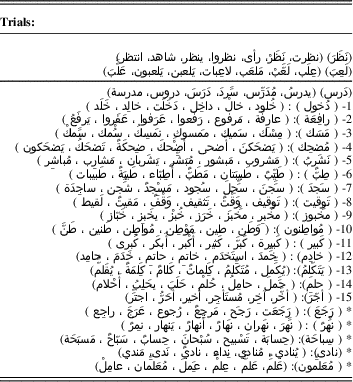
Twenty items were written for the measure of RA (see Appendix A). Each item included a target word and a choice of six vowelized words that fully vowelized, phonemically and morphosyntatctically. After four practice items, participants were asked to circle words from a list of six that were from the same family as the target. In groups of four children, the examiner explained that words belong to the same family if they share meaning with the target, whereas other words do not belong to the same family because they have a different meaning. For example, the target /kataba/ “to write” shares meaning with /kitaab/ “book,” /kutub/ “books,” /maktab/ “desk,” and /kaatib/ “writer,” but does not, for example, share any meaning with /kabata/ “to suppress,” or /kaðba/ “to lie.” The distractors were orthographic or semantic foils (see Appendix A for examples).
For each item, six alternatives were presented. Across all items, the number of correct choices varied from 1 to 5. Six points were available for each item; participants earned a point for each correct decision, indicating either that a related word was related or that an unrelated word was unrelated. There was no time limit, but all children finished within 20 min.
Procedure
All tests were administered by the first author, who is a native speaker of Arabic, and children were tested in two 30-min sessions. The first session included the word reading, pseudoword reading, word reading fluency, and text reading fluency tasks. The second session included the RA, maze comprehension, and the verbal ability tasks. All instructions were given in the Emirati dialect, which was the children’s spoken dialect.
Data analysis
The analyses were designed to develop a measure of RA and to examine the effects of the RA construct on reading performance. RA items were written explicitly to measure a single construct. As a result, only a one-factor congeneric model was developed, and no alternative multifactor models were specified. Items were retained based on their ability to optimally measure RA as a single latent factor, and items were excluded if they performed poorly.
A reliability analysis was first performed to determine which RA items should be specified in a confirmatory factor analysis (CFA) model. Items were retained for CFA if they had an item corrected total correlation greater than .40, resulting in the exclusion of five items (see Appendix A) that had low item corrected total correlations (<.40) with the remaining RA items.Footnote 1 Next, we specified the 15-item RA measure in a CFA using a maximum likelihood estimator in Mplus (Version 5.1; Muthén & Muthén, Reference Muthén and Muthén2008). Criteria for model fit decisions for all models in this study were based on a nonsignificant χ2, and Kline’s (Reference Kline2005) recommended model fit criteria (comparative fit index [CFI]>.90, root mean square error of approximation [RMSEA] between .05 and .08, and standard root mean square residual [SRMR]<.10). Although reporting a χ2 significance test is essential, a nonsignificant χ2 is rarely met in CFA (as sample size becomes large), and researchers typically do not base model fit decisions on the statistical significance of χ2 in isolation (Bollen, Reference Bollen1989). Statistically significant item loadings were those with p<.001. Reliability was based on coefficient α, with a value exceeding 0.70 indicating a minimum level of acceptability and a value exceeding 0.80 meeting a stricter level of acceptability (Hancock & Mueller, Reference Hancock and Mueller2001).
Finally, we specified a structural equation model to examine the effect of the RA construct on reading achievement. There were three types of variables in the model including the exogenous measurement model latent variable for RA, an exogenous observed control variable (verbal ability [PPVT]), and an endogenous outcome higher order latent variable for reading achievement (ACH). The endogenous outcome variable ACH was composed of three lower order latent variables including word reading (READ, composed of the word reading [WR] and pseudoword reading [PWR] measures), reading fluency (FLU, composed of word reading fluency [WRF] and text reading fluency [TRF] measures), and comprehension (COMP, composed of the maze comprehension [MZ] measure).Footnote 2 After regressing the outcome variable ACH on the PPVT control variable to account for variance due to verbal ability, ACH was regressed on the RA latent variable to determine the effect of RA on reading achievement.
RESULTS
Descriptive statistics
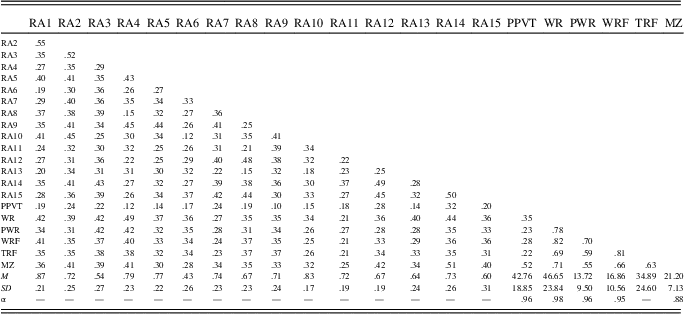
Descriptive statistics, correlation coefficients, and reliabilities for each of the included measures and the 15 individual RA items are reported in Table 2. Each of the measures fell within the range for normality for the values for skewness (≤+/–2) and kurtosis (≤+/–7) established by Curran, West, and Finch (Reference Curran, West and Finch1996). The coefficient α reliability of each of the observed variables ranged between 0.88 and 0.98 with the exception of TRF. TRF was sum scored at the time of data collection, and item level information was unavailable for this measure.
Mean, standard deviation, correlations, and reliabilities for root awareness items and reading outcome measures

Note: RA1, RA2 …, root awareness item. PPVT, Peabody Picture Vocabulary Test. WR, word reading. PWR, pseudoword reading. WRF, word reading fluency. TRF, text reading fluency. MZ, maze comprehension. α, coefficient alpha reliability. Statistical significance or correlations denoted by values ≥.14, p<.05, values ≥.19, p<.01, values ≥.25, p<.001.
CFA
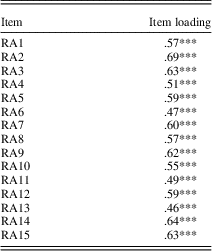
The model fit indices for the 15-item one-factor congeneric model indicated an acceptable fit to the data, χ2 (90) = 163.48, p<.001; χ2/df = 1.82; RMSEA = .066, 90% confidence interval (CI) [.049, .081]; CFI = .912; SRMR = .055. The results of the item loadings are listed in Table 3 and indicated each of the loadings was significant at p<.001. The coefficient α reliability was 0.88, indicating an acceptable level of reliability. Overall, the results of the RA scale met criteria consistent with values considered to be indicative of good psychometric properties.
Standardized item loadings for root awareness items

Note:
*** p < .001.
Structural equation model
Based on the reasonable fit of the RA measurement model, we developed a structural equation model to examine the effect of the RA latent variable on the higher order reading achievement latent variable (ACH), after controlling for verbal ability (PPVT). The overall model indicated an acceptable fit to the data, χ2 (186) = 344.05, p<.001; χ2/df = 1.85; CFI = .912; RMSEA = .066, 90% CI [.055, .077]; SRMR = .078. Each of the specified items loaded statistically significantly on the RA latent variable at p<.001.
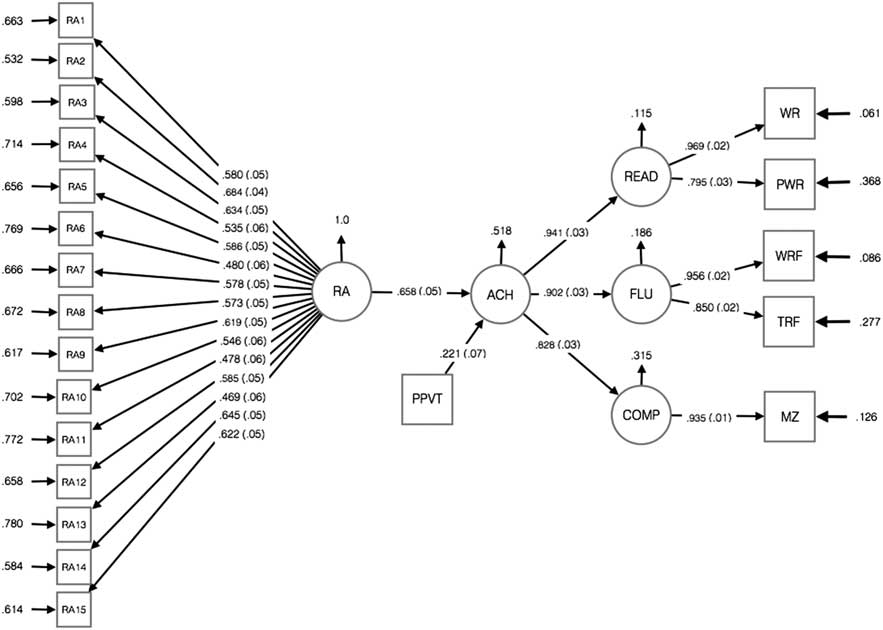
Next, each of the paths was examined to determine the effect of RA on ACH (see Figure 1). Each of the individual reading measures had large and statistically significant paths (READ [WR and PWR], FLU [WRF and TRF], and COMP [MZ]) to the latent variable for which they were specified. Each of the lower order latent reading variables had large and statistically significant paths to the higher order latent variable (ACH). PPVT accounted for a significant amount of variance (4.88%) in ACH. After partialing out variance due to PPVT, RA had a significant path to ACH, accounting for 43.30% of the total variance in the ACH latent variable.
Structural equation model with root awareness predicting reading achievement. Solid lines denote significant paths (p<.01). RA, root awareness. ACH, reading achievement. PPVT, Peabody Picture Vocabulary Test. READ, word reading. FLU, reading fluency. COMP, reading comprehension. WR, word reading. PWR, psuedoword reading. WRF, word reading fluency. TRF, text reading fluency. MZ, maze comprehension.

DISCUSSION
The purposes of this study were to develop a measure of RA as a measure of MA and to validate its relations with different reading outcomes in native monolingual Arabic-speaking children. Using CFA, a one-factor model was specified and showed good model fit of the RA measure. Results from the structural equation model indicated good model fit, and the RA measure accounted for a substantial portion (nearly half of the variance) in the included outcome measures, after controlling for vocabulary.
The current study’s results corroborate evidence about the role of the root in young Arabic speakers’ visual word recognition (Shalhoub-Awwad & Leikin, Reference Shalhoub-Awwad and Leikin2016) and ability to decide if words are related to the root (Taha & Saiegh-Haddad, Reference Taha and Saiegh-Haddad2017). Moreover, the robust role of the root underscores the predominance of the morphological structure being a core part of the Arabic reading model as proposed by Saiegh-Haddad (Reference Saiegh-Haddad2017). In addition, the current findings are in agreement with the English literature on the role of MA in multiple reading measures (Carlisle, Reference Carlisle2000; Deacon et al., Reference Deacon, Benere and Pasquarella2013; Kirby et al., Reference Kirby, Deacon, Bowers, Izenberg, Wade-Woolley and Parrila2012; Nagy et al., Reference Nagy, Berninger and Abbott2006), and in other orthographies (Arabic: Tibi & Kirby, Reference Tibi and Kirby2017; Hebrew: Ravid & Malenky, Reference Ravid and Malenky2001; Schiff & Ravid, Reference Schiff and Ravid2007; Italian: Burani et al., Reference Burani, Marcolini, De Luca and Zoccolotti2008; French: Casalis et al., Reference Casalis and Louis-Alexander2000; Spanish: Ramirez et al., Reference Ramirez, Chen, Geva and Kiefer2010; and Chinese: Tong et al., Reference Tong, McBride-Chang, Shu and Wong2009; Wu et al., Reference Wu, Anderson, Li, Wu, Li, Zhang and Gaffney2009).
Furthermore, the significant role of RA in reading in Arabic in the current study confirms that the root is a salient feature of Arabic orthography as noted earlier by Tibi (Reference Tibi2016), and other researchers (Saiegh-Haddad, Reference Saiegh-Haddad2017; Taha & Saiegh-Haddad, Reference Taha and Saiegh-Haddad2017). The current study shows that the root plays a significant unique role above and beyond that of vocabulary, which is quite interesting particularly if we take into consideration that vocabulary is derived from the roots. Although some researchers (Muse, Reference Muse2005; Spencer et al., Reference Spencer, Muse, Wagner, Foorman, Petscher, Schatschneider, Tighe and Bishop2015) have argued that vocabulary and MA are best represented as one latent construct, our findings clearly show that MA and vocabulary are distinct.
Validating measures with solid psychometric characteristics is important, and this study is a first step in that direction in Arabic. The ability of the current RA measure to predict reading ability above and beyond that of vocabulary could be utilized in identifying children at risk for reading failure. Historically, measures of phonological awareness have become established and used in identifying children at risk for reading failure (Torgesen, Wagner, & Rashotte, Reference Torgesen, Wagner and Rashotte1994; Torgesen, Wagner, Rashotte, Burgess, & Hecht, Reference Torgesen, Wagner, Rashotte, Burgess and Hecht1997; Wagner, Torgesen, & Rashotte, Reference Wagner, Torgesen and Rashotte1999). Given that morphological and phonological awareness are distinct (Deacon & Kirby, Reference Deacon and Kirby2004), the present results indicate that measures of MA may also have a role to play. There is merit in developing and validating measures of MA (for review, see Tibi & Kirby, Reference Tibi and Kirby2017); the present study of RA is a first step. This is particularly important for Arabic in which the root integrates orthographic, phonological, and morphological features, and has been shown to play a facilitative role in reading among Arabic-speaking children (Layes et al., Reference Layes, Lalonde and Rebai2017; Shalhoub-Awwad & Leikin, Reference Shalhoub-Awwad and Leikin2016; Taha & Saiegh-Haddad, Reference Taha and Saiegh-Haddad2017).
The current results provide a tool for researchers interested in pursuing studies in the morphological processes and reading of Arabic. Given the strong relationship between the root and different reading outcomes after controlling for vocabulary, the RA measure should be included in future studies so that a more complete picture of can be obtained. Building on the current findings will help us deepen our understanding of the root effects and help us refine the tool further to use it with different age groups. Similar techniques should be used with other MA measures to produce a set of psychometrically strong tests.
The current study has practical implications for assessment and intervention in regular classrooms as well as in the field of special education. For education and clinical practice, two applications arise. First, assessment of RA should be included in any Arabic early reading assessment. Teachers and speech–language clinicians need to give this area more attention in their assessments. The second application would be in instruction. The strong association between RA and reading suggests that it may be a useful target for instruction; this would be supported by instructional studies in other languages (see Bowers, Kirby, & Deacon, Reference Bowers, Kirby and Deacon2010; Carlisle, Reference Carlisle2010; Goodwin & Ahn, Reference Goodwin and Ahn2013, for reviews). Instructional programs explicitly targeting the root in Arabic are greatly needed (Tibi & Kirby, Reference Tibi and Kirby2018b). It could be hypothesized that increased RA would improve orthographic processing, morphological awareness, semantic processing, and vocabulary, which in turn would exert a positive influence on reading accuracy, fluency, and comprehension. This seems like a promising direction to explore for further research on Arabic reading, particularly with children learning to read and children exhibiting reading difficulties.
Limitations and future directions
The focus of the current work was to establish the measure of RA with the goal of providing an efficient tool so that future studies may be able to complete more comprehensive models of reading in Arabic. The next logical step would be to validate other measure of MA, and multiple measures of other constructs, such as phonological awareness and orthographic processing, in the same way. Developing multiple measures of each construct is a necessary prerequisite for proposing a comprehensive model for Arabic reading. Having multiple validated measures of each construct ensure adequate coverage of each construct and would reduce measurement error.
There are some limitations of the current study that need to be addressed. First, we used one comprehension measure composed of four reading passages in which the participants were required to choose a correct answer from a choice of three words. There is evidence (Keenan, Betjemann, & Olson, Reference Keenan, Betjemann and Olson2008) that shows that comprehension measures should not be seen as equivalent because they tap factors such as decoding and prior knowledge to different degrees. Clearly more studies are required with diverse outcome measures.
Second, we used only one measure of RA, in the written modality. Considering the taxonomy of MA as proposed by Deacon et al. (Reference Deacon, Parrila and Kirby2008), perhaps a similar measure of RA could be developed in the oral modality to make it more appropriate for younger children or students with reading difficulties. Third, the current RA measure includes choices that vary in inflectional and derivational morphology with different variations in the transparency of the relations (phonological–orthographic, morphological, and semantic) between items. Future research could design different versions of this measure to allow investigation of the effects of different types of transparency and different dimensions of morphology (e.g., certain word patterns or certain morphosyntatctic categories).
Fourth, our vocabulary measure tapped vocabulary breadth, rather than depth (Li & Kirby, Reference Li and Kirby2014). Future research should include additional vocabulary measures. The lack of a standardized vocabulary measure in Arabic is a serious impediment to future research. Fifth and finally, this study is limited by its sample, which is drawn from the UAE population, and the educational system in the UAE. Although the RA task was administered in standard Arabic (the written form used in all Arabic-speaking countries), the spoken language of the current sample may have influenced the sample’s performance on the RA task. Therefore, it is suggested that this RA measure should be administered with other Arabic populations speaking different Arabic dialects.
Conclusion
This is the first published study of Arabic reading to use CFA and structural equation modeling to investigate the role of MA, specifically RA, in reading among Arabic-speaking children. For the first time, the construct and predictive validity of a RA measure was established. Findings from this study have possible implications for assessment and instruction. This measure should be included in other studies conducted in other Arab countries so that a more complete picture of linguistic strengths and weaknesses can be obtained. Building on the current findings will help deepen our understanding of the effects of Arabic morphology, and help us refine the tool further for different age groups.
ACKNOWLEDGMENTS
The authors would like to give special thanks to the Ministry of Education in Dubai, United Arab Emirates, who allowed us to work with school children to collect data for this project. Additional acknowledgments should be given to Dr. Richard Wagner and Dr. Monique Sénéchal for their comments and feedback on earlier drafts of this paper.
Appendix A
ROOT AWARENESS
Arabic Root Awareness Measure