Implications
These relationships between handling pre-slaughter and cortisol, glucose and lactate concentrations post-slaughter have implications for training stockpeople to reduce stress in sheep at abattoirs and consequently safeguard sheep welfare and meat quality. While these results do not permit causal inferences to be made, the demonstration that improvements in stockperson and dog behaviour at abattoirs leads to reduced stress responses in sheep may provide opportunities for stockperson training to minimise sheep stress at abattoirs. In addition to meat quality, there is impetus to minimise sheep stress because of the increasing community concern about the treatment of farm animals at slaughter.
Introduction
The welfare of farm animals during transport and slaughter faces increasing scrutiny from the public (de Jonge and van Trijp Reference de Jonge and van Trijp2013), and includes concerns about the way animals are handled post-farm gate. The relationship between human handling and livestock welfare has been consistently demonstrated under both experimental and commercial conditions for a number of livestock species (e.g. dairy cattle, pigs, poultry and sheep (see reviews by Waiblinger et al., Reference Waiblinger, Boivin, Pedersen, Tosi, Janczak, Visser and Jones2006; Hemsworth and Coleman, Reference Hemsworth and Coleman2011). This extensive body of research has established that stockperson handling methods can elicit fear in farmed species, resulting in poor animal welfare and reduced productivity due to a fear-related stress response (see reviews by Waiblinger et al., Reference Waiblinger, Boivin, Pedersen, Tosi, Janczak, Visser and Jones2006; Hemsworth and Coleman, Reference Hemsworth and Coleman2011). Similarly, the handling methods used at abattoirs can be stressful for sheep and cattle (Hemsworth et al., Reference Hemsworth, Rice, Karlen, Calleja, Barnett, Nash and Coleman2011), with potential implications for animal welfare and meat quality.
Stress is an inevitable outcome in the process of transferring animals from farm to slaughter (Ferguson and Warner, Reference Ferguson and Warner2008; Fisher et al., Reference Fisher, Niemeyer, Lea, Lee, Paull, Reed and Ferguson2010), however, as with any animal use practice, there is the obligation on the animal users to minimise stress in order to safeguard animal welfare. In addition to handling, several other factors may cause stress to animals at abattoirs, such as the environment, management and facility design (see reviews by Grandin, Reference Grandin2007a and 2007Reference Grandinb).
The main physiological stress responses to environmental disturbances are the activation of the sympatho-adrenal medullary (SAM) and the hypothalamo–pituitary–adrenal (HPA) axis, with the consequent secretion of catecholamines and glucocorticoids, respectively (Moberg, Reference Moberg2000; Sapolsky, Reference Sapolsky2002; Kaltas and Chrousos, Reference Kaltas and Chrousos2007). Activation of the SAM axis occurs within seconds of perceiving a stressor, resulting in the secretion of adrenalin and noradrenalin. The second series of physiological events involves the HPA axis and the glucocorticoid hormones, for example, cortisol in sheep. The acute phase of this HPA response may last from minutes to hours, while prolonged challenges may result in sustained activation of the HPA axis for days, weeks or even months (Turner et al., Reference Turner, Hemsworth and Tilbrook2002). The activation of the SAM and HPA axes can be effective mechanisms to assist the animal in adapting to changes in its environment since the physiological outcomes include adjustments in metabolic rate, cardiac function, blood pressure, peripheral circulation, respiration, visual acuity and energy availability and use that allow the animal to meet physical and/or emotional challenges (Moberg, Reference Moberg2000; Sapolsky, Reference Sapolsky2002; Kaltas and Chrousos, Reference Kaltas and Chrousos2007). Behavioural responses are also a key mechanism in assisting animals to cope with environmental disturbance. Behavioural responses indicative of fear and pain in sheep include immobility or escape attempts, immobility and head down or up, baulks and high-pitch bleats (Romeyer and Bouissou, Reference Romeyer and Bouissou1992; Beausoleil et al., Reference Beausoleil, Stafford and Mellor2005; Hemsworth et al., Reference Hemsworth, Rice, Karlen, Calleja, Barnett, Nash and Coleman2011). Therefore, measuring both these behavioural responses and the activation of the SAM and HPA axes provides an opportunity to assess the magnitude of the stress response of animals before slaughter.
The pre-eminent effect of glucocorticoids upon metabolism is their ability to increase circulating glucose concentrations. This is accomplished through a number of mechanisms including intensifying the mobilisation of energy induced by the catecholamines (glycogenolysis and gluconeogenesis) and the stimulation of hepatic gluconeogenesis and glycogen deposition (Kuchel, Reference Kuchel1991; Rooyackers and Nair, Reference Rooyackers and Nair1997; Sapolsky et al., 2000). Thus, an increase in plasma glucocorticoids at slaughter is an indicator of increased stress pre-slaughter, while measures of metabolic state, such as plasma glucose and lactate, provide an indication of risks to meat quality as a consequence of pre-slaughter stress (Gruber et al., Reference Gruber, Tatum, Engle, Chapman, Belk and Smith2010). As reviewed by Ferguson and Warner (Reference Ferguson and Warner2008), Ferguson et al. (Reference Ferguson, Schreurs, Kenyon and Jacob2014) and Ponnampalam et al. (Reference Ponnampalam, Hopkins, Bruce, Li, Baldi and Bekhit2017), physical exercise, emotional stress and water and feed deprivation in ruminants can lead to depletion of body reserves such as muscle glycogen, with consequent release of high levels of blood metabolites (glucose and lactate) in the circulatory system. These metabolic changes in turn can lead to dark cutting meat in sheep and cattle: a lack of glycogen reserves in the muscle systems at the time of slaughter to produce lactic acid during the conversion process of muscle to meat after death, leads to high ultimate pH (>5.74) and thus development of dark meat. While glycogen concentration in the muscle at the time of slaughter is a key determinant of meat ultimate pH and in turn the meat quality attributes regulated by the ultimate pH, non-pH-mediated effects on meat quality, such as water-holding capacity and purge, can occur through pre-slaughter stress in cattle and sheep (Ferguson and Warner, Reference Ferguson and Warner2008).
The responses of animals to external challenges are modulated by several intrinsic animal factors, such as genetics, sex, age and physiological state, and by past experiences and acquired learning (Boissy et al., Reference Boissy, Fisher, Bouix, Hinch and Le Neindre2005a and 2005Reference Boissy, Bouix, Orgeur, Poindron, Bibé and Le Neindreb; Ferguson and Warner, Reference Ferguson and Warner2008). Thus, the behavioural and physiological responses of animals to novelty, isolation and presence of humans may provide the opportunity to identify animals that may be under sufficient stress during lairage to seriously compromise their welfare and meat quality.
The present research examined the relationships in lambs between handling before slaughter, lamb behaviour pre-slaughter and plasma cortisol, glucose and lactate concentrations in lambs post-slaughter. Furthermore, relationships between the behavioural and physiological responses of lambs to tests involving novelty, confinement and human contact and plasma cortisol, glucose and lactate concentrations in lambs post-slaughter were also studied to examine whether the behavioural and physiological responses of lambs to the tests were predictive of their stress and metabolic responses at slaughter. Some preliminary data from this study has been published previously in abstract form by Hemsworth et al. (Reference Hemsworth, Rice, Borg, Edwards, Ponnampalam and Coleman2016).
Material and methods
Animals, stockpeople and facilities
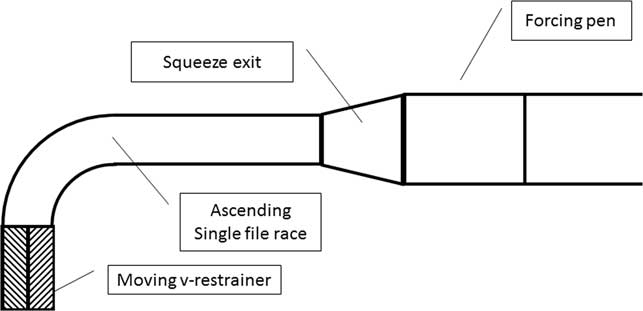
Over a 2-month period in summer in south west Victoria, Australia, four groups (replicates) of 100 lambs each (Merino first-cross, mean live weight of 43.26±0.23 kg (SE)) were sourced from an experimental farm and transported 170 km overnight to a commercial abattoir and slaughtered the following morning. A total of five stockpeople and their muzzled dogs handled the lambs at the abattoir. Video footage recorded using IR dome colour closed-circuit television cameras (2.8 to 12 mm, model 700TVL; Electrogear, Lansvale, NSW, Australia) was used to continuously record the behaviour of stockpeople, dogs and individual lambs as each lamb was held and moved from the forcing pen, through the squeeze exit and along an ascending single file race to the junction with the moving V-restrainer in the stunning area (Figure 1). Lambs were stunned using an electric stun compliant with Australian Meat Industry Council (2009) recommendations of minimum current 1.0 amp and minimum duration 3 s.
Layout of the three observation areas at the lamb abattoir: forcing pen, squeeze exit and the ascending single file race to the junction with the moving V-restrainer.

Behaviour and physiological measurements on farm
Three to five days before transport, each lamb was weighed, spray marked for individual identification, and observed in three behavioural tests: novel arena test (based on Forkman et al., Reference Forkman, Boissy, Meunier-Salaün, Canali and Jones2007), flight distance test to an approaching human (based on Roussel et al., 2006) and a ‘temperament’ test (based on Murphy et al., 1994). The test locations were a solid-sided 5×5 m test arena and a 1.25 m (L)×0.55 m (W)×1 m (H) crate. Closed Circuit Television (CCTV) cameras (Signet® mini CCD infra-red cameras with 1/3 inch and 3.6 mm lens, QC3694; Hong Kong Kason Industry Group Limited, Guangdong, China) were used to record lamb behaviour in the tests using i-Watch digital surveillance system (International Security Control Solutions Pty Ltd, Belrose, NSW Australia). Vocalisations in all tests were recorded by direct observation by an observer sitting nearby out of sight the lambs.
The novel arena test was conducted in the solid-sided 5×5 m pen with 25 1×1 m-grid marked on the solid floor. Individual lambs were drafted from a holding pen on the basis of the first lamb alternately sighted in the central and peripheral areas of the pen and quietly moved along a 30-m single file race into the test arena. From the digital video recordings, the number of squares entered (based on the head fully within the borders of a grid) in the 1-min test period was measured. The time taken to move each lamb from the holding pen to the test arena was also recorded.
The flight distance test was designed to measure the behavioural fear response to an approaching human. Following the conclusion of the novel arena test, an unfamiliar human quietly entered the arena and walked at a standard pace (1 m/s) around the perimeter of the arena for 1 min. From the digital video recordings and the use of the grid marked on the floor, the distance between the lamb and the experimenter was assessed using instantaneous point sampling at 5 s intervals so that the average separation between the lamb and the experimenter at 5 to 15 s (‘15 s’), 20 to 30 s (‘30 s’), 35 to 45 s (‘45 s’) and 50 to 60 s (‘60 s’) could be estimated.
The temperament test was designed to measure the behavioural reactivity of sheep in response to isolation and restraint in an enclosed crate. A modified test used previously by Rice et al. (Reference Rice, Jongman, Borg, Butler and Hemsworth2016) was conducted in this solid-sided crate (1.25 m (L)×0.55 m (W)×1 m (H)) for 2 min. Individual lambs were quietly moved from the arena in which the flight distance test was conducted along an 8 m-single file race to the test crate. Once inside the crate, the numbers of front leg steps, 180° turns and jumps were recorded from the digital video recordings.
On exit from the 2-min temperament test, each lamb was immediately restrained in a standing position and blood was collected via jugular venepuncture into a lithium heparinised tube (BD vacutainer®, Franklin Lakes, NJ, USA). The blood samples were immediately placed on ice, centrifuged within 15 min of collection, and plasma was separated and then stored at −20°C until analysis. The samples were analysed for plasma cortisol, glucose and lactate concentrations using a commercial assay kit (see below). All of the study lambs were sampled within 2 min of the researcher restraining the lamb for blood sampling to minimise the effects of on cortisol concentrations.
Behaviour observations pre-slaughter
The individual spray mark on lambs from the on-farm tests was still legible at the abattoirs and from digital video recordings, continuous observations were conducted by one observer to measure the duration of the behaviour of both stockpeople and dogs directed towards each lamb and well as the behaviour of lambs in the three observation areas, forcing pen, squeeze exit and ascending single file race. The time lambs spent in the three observation areas was also recorded. These behaviours and their definitions are listed in Table 1.
Ethogram with definitions of stockperson, dog and lamb behaviours

The duration of all behaviours was measured.
Plasma cortisol, glucose and lactate concentrations post-slaughter
Lambs were electrically stunned before slaughter and slaughtered by a ventral-neck incision and a 10-ml blood sample was collected using a Lithium Heparinised tube (BD vacutainer®, Franklin Lakes, NJ, USA) from each lamb within 1 min of the ventral-neck incision. The blood samples were immediately placed on ice, centrifuged within 30 min of collection, and plasma was separated and then stored at −20°C until analysis. The samples were analysed by a commercial laboratory for plasma cortisol, glucose and lactate concentrations (using a commercial assay kit, Immulite 2000 cortisol, Advia 1200 Glucose Hexokinase_3, and Advia 1200 Lactate, respectively; Seimens Health Care Diagnostics Inc.).
Statistical analyses
For each lamb, the replicate and the total durations of each lamb behaviour displayed per lamb and each stockperson and dog behaviour directed towards each lamb in the three locations, forcing pen, squeeze exit and ascending single file race, were collated. The independent statistical unit was the animal. Thus, for stockperson and dog variables, the unit of measurement was the duration of the stockperson or dog variable of interest displayed towards each lamb.
The behavioural variables in the three tests conducted on-farm and the stockperson, dog and lamb variables observed at the abattoirs were separately subjected to a principal component analysis (PCA) to identify sets of components that represent the underlying commonalities (components) within each of the four sets of variables (on-farm behavioural tests variables and stockperson, dog and lamb variables pre-slaughter). Component scores were calculated for each component as the sum of the standardised item scores multiplied by their corresponding component coefficient for that component.
Pearson correlations (SPSS statistical package, SPSS 22.0; SPSS Inc., Chicago, IL, USA) were used to examine the associations between plasma cortisol, glucose and lactate concentrations post-slaughter and the component scores for the three farm behavioural tests, cortisol, glucose and lactate concentrations post-behavioural tests, the component scores for stockperson, dog and lamb behaviour pre-slaughter and other pre-slaughter variables.
In order to examine those variables predictive of plasma cortisol, glucose and lactate concentrations post-slaughter, the variables correlated (P<0.05) with each of these three physiological variables post-slaughter were included in the three respective hierarchical multiple regression analyses (SPSS Statistical Package 22.0). In these regression analyses, replicate (dummy coded) was entered at the first step, the significant physiological variables and significant PCA component scores from the farm tests were entered at the second step, and then other significant pre-slaughter variables (stockperson, dog or lamb behaviour component scores and other pre-slaughter variables) were entered at the third step. This method of multiple regression analysis adds sequentially the strongest predictor variables until only the useful predictor variables remain in the model.
Results
One lamb was injured and culled before the farm behavioural tests. The average time taken for 399 lambs to move through the observation areas of the abattoir was 345 s (SD 141).
Results of the principal components analysis
Prior to conducting the four PCAs on the behavioural variables in the three on-farm behavioural tests and the stockperson, dog and lamb behavioural data at the abattoir, the suitability of the data for the analyses was assessed using criteria outlined by Pallant (Reference Pallant2013). An inspection of the correlation matrix for each of these four PCAs revealed that the correlation coefficients were all above the required 0.3. The Kaiser–Meyer–Olkin value exceeded the recommended value of 0.6, and Bartlett’s Test of Sphericity reached statistical significance. Thus, the factorability of the each of the correlation matrices was supported.
A Varimax rotation was conducted in each of these four PCAs. For the three behavioural tests conducted on farm, the resulting PCA extracted three components, each with an eigenvalue greater than 1. The first component which was labelled ‘Vocalisation score’, showed high loadings (>0.8) on the numbers of vocalisations in each of the three tests, and accounted for 17.3% of the variance. The second factor was labelled ‘Fear of humans score’, showed loadings >0.4 on the items ‘average estimate of separation distance at 15, 30, 45 and 60 s’ in the flight distance test, ‘jumps’ in the temperament test (negatively) and ‘escape attempts’ in the novel arena test (negatively) and accounted for 13.8% of the variance. The third factor was labelled ‘Restraint response score’, showed loadings >0.4) on the items ‘steps and turns’ in the temperament test, ‘squares entered’ in the novel arena test and ‘time taken to reach the novel arena’ (negatively) and accounted for 10.5% of the variance.
For the stockperson behavioural data, the resulting PCA with a Varimax rotation extracted two components, each with an eigenvalue >1. The first component which was labelled ‘Neutral stockperson score’, showed loadings >0.5 on the items ‘within 1 m’, ‘stand’ and ‘wave’, and accounted for 26.2% of the variance. The second component which was labelled ‘Negative stockperson score’, showed loadings >0.5 on the items ‘lift/pull’, ‘fast locomotion’ and ‘clear bottleneck’ and accounted for 11.2% of the variance. For the dog behaviour data, the resulting PCA with a Varimax rotation extracted two components, each with an eigenvalue >1. The first component which was labelled ‘Aggressive dog score’, showed loadings >0.7 on the items ‘lunge’, ‘lunge with snout contact’ and ‘bark’, and accounted for 29.1% of the variance. The second component which was labelled ‘Dog contact score’, showed loadings >0.5 on the items ‘on lamb’s back’, ‘cleared bottleneck’ and ‘within 1 m’ and accounted for 17.1% of the variance.
For the lamb behavioural data at the abattoir, the resulting PCA with a Varimax rotation extracted three components, each with an eigenvalue >1. The first component which was labelled ‘Lamb head down score’, showed loadings>0.7 on the items ‘head down total’, ‘head down near stockperson’ and ‘head down near observer’, and accounted for 17.8% of the variance. The second component which was labelled ‘Lamb escape score’, showed loadings >0.5) on the items ‘flee’, ‘hit fence’, ‘slip’ and ‘fall’ and accounted for 14.7% of the variance. The third component which was labelled ‘Lamb jump score’, showed loadings >0.8 on the items jump and mount and accounted for 14.7% of the variance.
Correlations and linear regressions
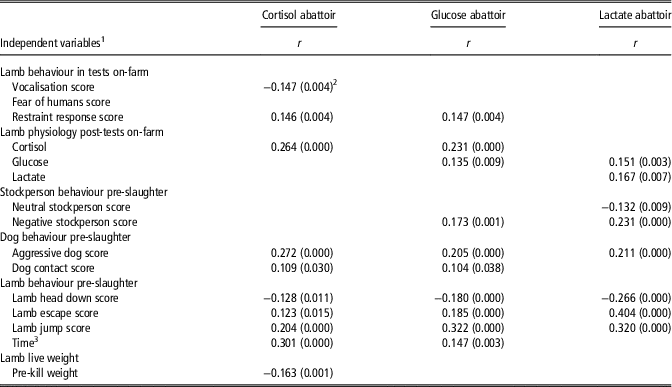
The significant (P<0.05) correlations between plasma cortisol, glucose and lactate concentrations in lambs post-slaughter and the PCA component scores for the stockperson, dog and lamb variables pre-slaughter are presented in Table 2. Furthermore, the significant (P<0.05) correlations between plasma cortisol, glucose and lactate concentrations in lambs post-slaughter and plasma cortisol, glucose and lactate concentrations in lambs immediately following the on-farm behavioural tests, duration that the lamb spent in the forcing pen, squeeze exit and ascending single file race of the abattoir prior to slaughter and live weight of the lamb before slaughter are also presented in Table 2.
Significant Pearson correlation coefficients (r) between lamb physiology post-slaughter, lamb behaviour and physiology on-farm, and stockperson, dog and lamb behaviour during handling pre-slaughter (n=399)

1 The scores are component scores from the principal components analysis conducted on stockperson, dog and lamb behaviour variables.
2 Significant P-values presented in parentheses.
3 Time refers to the time lambs spent in the three observation areas.
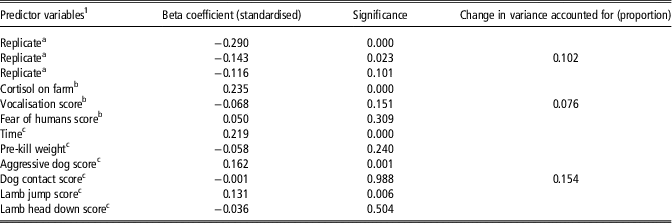
In the hierarchical multiple regression predicting plasma cortisol concentration post-slaughter, replicate was entered at Step 1, explaining 10.2% of the variance and Cortisol on farm and the Vocalisation and Restraint response scores were entered in Step 2, explaining 7.6% of the variance. After entry of the variables Pre-kill weight, Time and Aggressive dog, Dog contact, Lamb head down, Lamb escape and Lamb jump scores at Step 3, the total variance explained by the model was 33.2% (F 13,335=12.29, P=0.000). These abattoir variables explained an additional 15.4% of the variance in cortisol concentration post-slaughter after controlling for replicate and the farm test variables (R 2 change=0.154, F change (7,332)=10.60, P=0.000). In the final model replicates 1 and 2, Cortisol on farm, Time and Aggressive dog, Lamb escape and Lamb jump scores were statistically significant with the beta coefficients indicating that higher cortisol concentrations in lambs post-slaughter were associated with higher cortisol on farm, and longer durations of lambs in the observation areas, aggressive dog behaviour, lambs jumping and lambs escaping (Table 3).
Behavioural and physiological variables predicting plasma cortisol in lambs post-slaughter

1 The scores are component scores from the principal components analysis (PCA) conducted on stockperson, dog and lamb behaviour variables.
a,b,cReplicate (replicates 1, 2 and 3) was entered at the first step, the physiological variables and PCA component scores on-farm were entered at the second step, and then the other independent variables were entered at the third step, respectively.
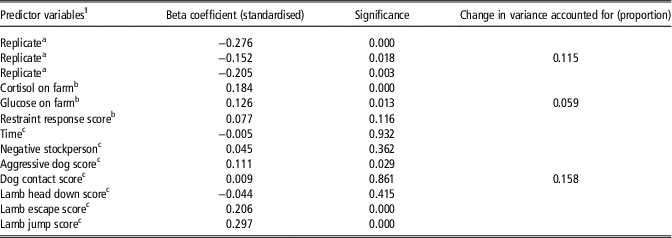
In terms of predicting plasma glucose concentrations post-slaughter, replicate was entered at Step 1, explaining 11.5% of the variance, and Cortisol and Glucose on farm and the Restraint response score were entered in Step 2, explaining 5.9% of the variance. After entry of the variables Pre-kill weight, Time and Aggressive dog, Dog contact, Lamb head down, Lamb escape and Lamb jump scores at Step 3, the total variance explained by the model was 33.3% (F 13,338=12.49, P=0.000). These abattoir variables explained an additional 15.8% of the variance in glucose concentration post-slaughter after controlling for replicate and the farm test variables (R 2 change=0.158, F change(7,325)=11.02, P=0.000). In the final model replicates 1, 2 and 3, Cortisol and Glucose on farm and Aggressive dog, Lamb escape and Lamb jump scores were statistically significant with the beta coefficients indicating that higher glucose concentrations in lambs post-slaughter were associated with higher cortisol and glucose concentrations on farm and longer durations of lambs jumping, lambs escaping and aggressive dog behaviour (Table 4).
Behavioural and physiological variables predicting plasma glucose in lambs post-slaughter

1 The scores are component scores from the principal components analysis (PCA) conducted on stockperson, dog and lamb behaviour variables.
a,b,cReplicate (replicates 1, 2 and 3) was entered at the first step, the physiological variables and PCA component scores on-farm were entered at the second step, and then the other independent variables were entered at the third step, respectively.
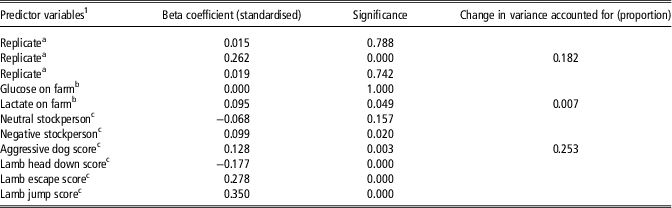
In terms of predicting plasma lactate concentrations post-slaughter, replicate was entered at Step 1, explaining 17.5% of the variance, and Glucose and Lactate on farm were entered in Step 2, explaining 0.7% of the variance. After entry of the variables Neutral stockperson, Negative stockperson, Aggressive dog, Lamb head down, Lamb escape and Lamb jump scores at Step 3, the total variance explained by the model was 44.1% (F 11,374=26.01, P=0.000). These abattoir variables explained an additional 25.3% of the variance in lactate concentration post-slaughter after controlling for replicate and the farm test variables (R 2 change=0.253, F change (7,332)=27.32, P=0.000). In the final model, replicate 2, Negative stockperson, Aggressive dog, Lamb escape, Lamb jump and Lamb head down scores were statistically significant with the beta coefficients indicating that higher lactate concentrations in lambs post-slaughter were associated with longer durations of lambs jumping, lambs escaping, aggressive dog behaviour and negative stockperson behaviour and shorter duration of lamb head down behaviour (Table 5).
Behavioural and physiological variables predicting plasma lactate in lambs post-slaughter

1 The scores are component scores from the principal components analysis (PCA) conducted on stockperson, dog and lamb behaviour variables.
a,b,cReplicate (replicates 1, 2 and 3) was entered at the first step, the physiological variables and PCA component scores on-farm were entered at the second step, and then the other independent variables were entered at the third step, respectively.
Discussion
While the significant relationships found in the present study between dog, stockperson and lamb behaviour pre-slaughter and plasma cortisol, glucose and lactate in lambs post-slaughter suggest the possibility of causality, observational and correlational studies like this one make causality difficult, if not impossible, to determine. Nevertheless, this study and the previous study by Hemsworth et al. (Reference Hemsworth, Rice, Karlen, Calleja, Barnett, Nash and Coleman2011) provide a rationale for future experimental research in which handling behaviour pre-slaughter is manipulated in a controlled manner to determine its effect on lamb physiology. A number of the variables studied predicted plasma cortisol concentrations post-slaughter in lambs (the regression model accounted for 33% of the variance in cortisol concentrations post-slaughter). In addition to replicate and cortisol concentrations post-behaviour tests on farm the PCA scores Aggressive dog (which included the variables ‘lunge’, ‘lunge with snout contact’ and ‘bark’), Lamb jump (which included the variables ‘jump’ and ‘mount’) and Lamb escape (which included the variables ‘flee’, ‘hit fence’, ‘slip’ and ‘fall’), and the time the lambs spent in the three observation areas (forcing pen, squeeze exit and ascending single file race to the stunning area) were predictive of cortisol concentrations post-slaughter. All of the behavioural and physiological variables were positively related with cortisol concentrations post-slaughter: higher cortisol concentrations in lambs post-slaughter were associated with higher cortisol concentrations post-behaviour tests on farm, and longer durations of lambs in the three observation areas, aggressive dog behaviour and lambs jumping and attempting to escape.
The present study and the previous study by the authors (Hemsworth et al., Reference Hemsworth, Rice, Karlen, Calleja, Barnett, Nash and Coleman2011) showed that dog behaviour was predictive of stress in sheep: scores for both duration and intensity of dog use in the previous study and duration of both dog lunging and barking in the present study were associated with increased cortisol concentrations in sheep post-slaughter. However, findings in these two studies differed in relation to stockperson behaviour. While predictive of lactate concentrations post-slaughter, stockperson behaviour in the present study was not predictive of cortisol concentrations post-slaughter. The relationship between frequent whistles, touches and pushes by stockpeople and reduced cortisol concentrations in the previous study may have been due to these handling behaviours alerting sheep to the approach of the stockperson and reducing startling them. In the present study, increased durations in the three observation areas and negative stockperson behaviour, consisting of lifting/pulling lambs in the forcing pen including when jammed at the exit and fast locomotion, were positively predictive of cortisol and lactate concentrations, respectively. Furthermore, the use of dogs, which was predictive of cortisol concentrations in sheep post-slaughter in both studies, is generally under the control of stockpeople and presumably reflects the stockperson attitudes to handling sheep. Poor control of dogs may also be a substitute for poor handling behaviour per se in these stockpeople.
A number of the variables studied also predicted plasma glucose and lactate concentrations post-slaughter in lambs (regression models accounted for 33% and 44% of the variance in glucose and lactate, respectively). Replicate, Cortisol and Glucose concentrations post-behaviour tests and Aggressive dog, Lamb jump and Lamb escape scores were predictive of glucose concentrations post-slaughter. Higher glucose concentrations in lambs post-slaughter were associated with higher cortisol and glucose concentrations post-behaviour tests and longer durations of aggressive dog behaviour and lambs jumping and attempting to escape. Replicate, Aggressive dog, Negative stockperson, Lamb jump, Lamb escape and Lamb head down scores were predictive of lactate concentrations post-slaughter. Higher lactate concentrations post-slaughter were associated with, longer durations of aggressive dog and negative stockperson behaviour and lambs jumping and attempting to escape, and shorter duration of lamb head down behaviour.
The relationships found in the present study suggest that pre-slaughter handling of lambs can affect stress, with implications for animal welfare and meat quality. Increases in plasma cortisol at slaughter are indicative of animals under stress and consequently the risk of compromised welfare. Increases in plasma glucose and lactate at slaughter reflect energy mobilisation from pre-existing energy stores for immediate use under stress (Sapolsky, Reference Sapolsky2002) and consequently the risk of compromised meat quality. In most cases, animals use muscle glycogen (and fat) reserves to release glucose and lactate in the circulatory systems and the glucose will be utilised as energy for survival and welfare maintenance under stressful conditions. The latter action can severely deplete the glycogen resources in the muscles at the time of death. Glycogen reserves in the muscle are important for the active process of muscle contraction to form meat soon after the death, yielding lactic acid in the muscle systems post-slaughter, which is important for the maintenance of meat ultimate pH (24 h) below 5.74. Most instances of depletion of muscle glycogen in the lairage can lead to high pH meat above 5.80, which is classified as dark meat and a risk to the development of degraded meat quality (Ponnampalam et al., Reference Ponnampalam, Hopkins, Bruce, Li, Baldi and Bekhit2017).
The observed relationships between animal and handling variables and stress and metabolic variables in the current study are likely to arise from both acute stress, such as pre-slaughter handling, as well as longer-term effects, such as transport and lairage conditions. Furthermore, both genotype and previous handling and other environmental experiences such as mixing and confinement, may also contribute to the lamb’s physiological responses to pre-slaughter handling (Hemsworth et al., Reference Hemsworth, Rice, Karlen, Calleja, Barnett, Nash and Coleman2011). Replicate was highly associated with the stress and metabolic responses of lambs post-slaughter, with replicate accounting for 12%, 11% and 18% of the variance in plasma cortisol, glucose and lactate concentrations post-slaughter. The relationships between replicate and the stress and metabolic variables are not surprising. Variation in physical and climatic conditions during transport as well as variation in physical and climatic conditions and duration in lairage before handling (Warner et al., Reference Warner, Greenwood, Pethick and Ferguson2010; Ferguson et al., Reference Ferguson, Schreurs, Kenyon and Jacob2014) and handling from the lairage holding area to the pre-slaughter handling area are likely to contribute to this replicate effect on these stress and metabolic variables in lambs post-slaughter. Anecdotal observations by the researchers also indicate that the use of negative stockperson and dog behaviour in moving animals from the lairage holding pens to the forcing pen, advocate the need to examine handling in this area in relation to lamb welfare and meat quality.
A number of behavioural responses of lambs to handling were associated with the stress and metabolic variables post-slaughter. The times that lambs spent fleeing, hitting the fence, slipping, falling, jumping and mounting in the three study areas of the abattoir (forcing pen, squeeze exit and ascending single file race) were positively associated with plasma cortisol, glucose and lactate concentrations post-slaughter, indicating that animals that are consistently showing these presumably avoidance or fear responses are at risk of compromised welfare and meat quality. In contrast to previous research by the authors (Hemsworth et al., Reference Hemsworth, Rice, Karlen, Calleja, Barnett, Nash and Coleman2011), there was no association between head down by lambs in the presence of humans and cortisol concentrations post-slaughter (Hemsworth et al., Reference Hemsworth, Rice, Karlen, Calleja, Barnett, Nash and Coleman2011). There is no obvious explanation for this contrary finding, except that there were major differences between the two studies in terms of animal genotype, experience and age, stockperson handling and abattoir conditions. For example, the lambs in the present study may have had different contact with humans, both in terms of the nature and amount of human contact, during rearing than those reared in the commercial settings, which may have subsequently affected the magnitude of their stress responses to humans. Further research on head down as an indicator of stress is clearly required. It is important to understand the main behavioural indicators of stress pre-slaughter since these could be used to develop guidelines to identify animals under stress during lairage to enable these animals to be either handled separately during slaughter or the carcass to be processed separately and packaged differently to reduce meat quality losses.
‘Emotional reactivity’ can be defined as the predisposition to express strong, quick and lasting emotions in response to external events (Savage and Eysenck, Reference Savage and Eysenck1964) and can be affected by both genetics and experience (Boissy et al., Reference Boissy, Fisher, Bouix, Hinch and Le Neindre2005a,Reference Boissy, Bouix, Orgeur, Poindron, Bibé and Le Neindreb). Variability in emotional reactivity may contribute to how well animals cope with these stressors prior to slaughter and indeed understanding the emotional reactivity of individual animals may also assist in identifying animals under stress during lairage. The three on-farm tests on the 400 lambs in the present study were conducted to examine their value in predicting the stress and metabolic responses of lambs to slaughter. While the behavioural responses of lambs to novelty, confinement and human contact were not predictive of the cortisol, glucose and lactate responses to slaughter, the cortisol response to the three successive behavioural tests was predictive of the cortisol response to slaughter. Furthermore, the glucose and lactate responses to slaughter were predicted by the cortisol and glucose responses and the glucose and lactate responses to the behavioural tests, respectively. In relation to the cortisol response to the behavioural tests it is unlikely that this is a response to handling associated with blood sampling since the samples were collected within 2 min of restraint. However, the glucose and lactate responses to the behavioural tests may have been affected by handling associated with blood sampling per se leading to rapid activation of the SAM axis and thus the release of adrenalin within seconds and in turn the conversion of muscle glycogen to glucose and lactic acid. The consistency of these physiological responses to both the behavioural tests and slaughter suggest the potential of utilising physiological responses to such behavioural tests to predict animals under stress during lairage. In a series of tests involving novelty, social isolation and human presence, Deiss et al. (Reference Deiss, Temple, Ligout, Racine, Bouix, Terlouw and Boissy2009) found that lambs that showed greater vigilance, based on the head in an upright position with ears perpendicular to the head and high-pitched bleats, had higher cortisol concentrations at slaughter. Further research is obviously required since behavioural and physiological predictors of the stress and metabolic variables post-slaughter would provide the opportunity to identify animals under stress during lairage and thus take necessary precautions or actions to minimise animal welfare and meat quality compromises, for example, perhaps by handling these separately and more carefully.
These relationships between handling behaviour, lamb behaviour and stress and metabolic variables post-slaughter found in the present and previous study by Hemsworth et al. (Reference Hemsworth, Rice, Karlen, Calleja, Barnett, Nash and Coleman2011), although not demonstrating causal relationships, indicate the potential of training stockpeople to reduce fear and stress in livestock at abattoirs. However, the validity of training stockpeople to reduce animal stress in abattoir situations is an empirical question, and clearly warrants further investigation. Furthermore, identifying the attitudes of stockpeople that are predictive of those stockperson behaviours affecting lamb behaviour and stress is necessary before such a training program could be implemented and evaluated. For example, determining the attitudes of stockpeople predictive of increased use of handling behaviours, such as lifting/pulling lambs, fast locomotion and close proximity to lambs, and particularly poor use of dogs, such as allowing dogs to bark and lunge at lambs with snout contact, requires investigation. Earlier research by the researchers on stockperson attitudes and behaviour towards sheep at abattoirs identified some attitudes related to stockperson behaviours (Coleman et al., Reference Coleman, Rice and Hemsworth2012) and further research by the authors is presently underway.
In conclusion, the significant relationships between handling and lamb behaviour and stress and metabolic variables post-slaughter suggest the possibility of causality. Furthermore, these predictor variables of stress and metabolic change may be a mixture of independent and mediating variables. Our model of the effects of stockperson attitudes and behaviour on animal welfare and productivity (Hemsworth and Coleman, Reference Hemsworth and Coleman2011) proposes that the effect of stockperson attitudes on animal welfare, productivity and (in the case of abattoirs) meat quality depends on the mediating variables of stockperson behaviour first followed by animal fear and stress response. That is, it is proposed that stockperson attitudes drive stockperson behaviour (including dog use) which in turn drives the animal’s stress response which in turn affects welfare, productivity and meat quality outcomes. Thus, stockperson behaviour and the animal’s stress response mediate the effects of stockperson attitudes on these outcomes. Understanding stressful handling practices, including use of the dog by abattoir stockpeople and their underlying attitudes, is obviously critical in reducing handling risks to animal welfare. Furthermore, handling stress may reduce meat quality through meat ultimate pH-mediated effects.
Acknowledgement
The research was funded by the Australian Meat Processing Corporation. The Hamilton Research Centre (Department of Economic Development, Jobs, Transport and Resources) is also acknowledged for providing lambs and facilities to undertake the on-farm research activities.
Declaration of interest
The authors declare no conflicts of interest.
Ethics committee
All methods and animals used in this study were approved by the Department of Environment and Primary Industries Agricultural Research and Extension Animal Ethics Committee (Animal ethics application ID 2014-22).
Software and data repository resources
None of the data were deposited in an official repository.