INTRODUCTION
Awareness is a complex construct comprising cognitive, psychosocial, and emotional components (Toglia & Kirk, Reference Toglia and Kirk2000). Neural substrates of awareness are thought to involve diverse brain regions including prefrontal areas, inferior parietal lobe, angular gyrus, supramarginal gyrus, and anterior temporal lobes (Prigatano & Schacter, Reference Prigatano and Schacter1991). Consequently, diffuse bilateral brain pathology seen after severe head injury or advanced dementia is more likely to produce awareness deficits than focal unilateral lesions (Prigatano, Reference Prigatano2010; Sherer, Hart, Whyte, Todd, & Yablon, Reference Sherer, Hart, Whyte, Todd and Yablon2005). Despite the proposed heterogeneity of neural substrates associated with awareness, frontal pathology is consistently associated with awareness deficits possibly reflecting the functionally integrative role of these brain regions (Banks & Weintraub, Reference Banks and Weintraub2009; Rosen et al., Reference Rosen, Alcantar, Rothlind, Sturm, Kramer, Weiner and Miller2010). Duration of time since injury is also associated with extent of awareness deficits with impairments typically manifest in the post-acute stage several weeks to 6 months post-injury (Fleming & Strong, Reference Fleming and Strong1999; Hart, Seignourel, & Sherer, Reference Hart, Seignourel and Sherer1999; Ownsworth, Desbois, Grant, Fleming, & Strong, Reference Ownsworth, Desbois, Grant, Fleming and Strong2006). Intelligence (Bogod, Mateer, & MacDonald, Reference Bogod, Mateer and MacDonald2003) and emotional state, specifically anxiety and depression, have also been shown to correlate with post-injury awareness (Fleming, Strong, & Ashton, Reference Fleming, Strong and Ashton1998). Epidemiological data show that awareness deficits affect approximately 45% of TBI patients (Flashman & McAllister, Reference Flashman and McAllister2002) and adversely affect rehabilitation compliance and outcome, frequency and severity of socio-behavioral problems, caregiver distress and patient quality of life (King, Reference King1997; Sherer et al., Reference Sherer, Boake, Levin, Silver, Ringholz and Walter1998; Wise, Ownsworth, & Fleming, Reference Ownsworth and Fleming2005).
Awareness models typically incorporate several stages or “types” of awareness (anticipatory, emergent or “on-line” awareness) driven by subsidiary cognitive processes (semantic memory, perceptual, emotional, and implicit processes) and integrated by a metacognitive component (metacognitive or intellectual awareness) (Crosson et al., Reference Crosson, Barco, Velozo, Bolesta, Cooper and Werts1989; Morris & Hannesdottir, Reference Morris, Hannesdottir, Morris and Becker2004; Toglia & Kirk, Reference Toglia and Kirk2000). Executive functions, often termed metacognitive, are higher-order supervisory processes that initiate, maintain or inhibit other cognitive processes to facilitate goal-directed behavior (Miyake, Friedman, Emerson, Witski, Howerter, & Wager, Reference Miyake, Friedman, Emerson, Witski, Howerter and Wager2000; Stuss & Alexander, Reference Stuss and Alexander2007). Concept formation, self-monitoring and self-appraisal executive functions are considered key processes mediating awareness (Toglia & Kirk, Reference Toglia and Kirk2000; Crosson et al., Reference Crosson, Barco, Velozo, Bolesta, Cooper and Werts1989). Diverse executive functions have been associated with degree of post-TBI awareness including, planning and mental flexibility, idea generation or fluency, self-regulation, sustained attention, and reasoning ability (Bogod et al., Reference Bogod, Mateer and MacDonald2003; O’Keeffe, Dockree, Moloney, Carton, & Robertson, Reference O’Keeffe, Dockree, Moloney, Carton and Robertson2007; Ownsworth, McFarland, & Young, Reference Ownsworth, McFarland and Young2000; Ownsworth & Fleming, Reference Ownsworth and Fleming2005; Wilson, Alderman, Burgess, Emslie, & Evans, Reference Wilson, Alderman, Burgess, Emslie and Evans1996). Some researchers have been unable to replicate earlier findings (Ownsworth & Fleming, Reference Ownsworth and Fleming2005), findings reported elsewhere (Bogod et al., Reference Bogod, Mateer and MacDonald2003), or found no relationship between executive function and awareness (O’Keeffe et al., Reference O’Keeffe, Dockree, Moloney, Carton and Robertson2007). Equivocal findings might be explained by use of limited and varied awareness measures across studies, difficulty isolating executive components of executive tasks (Hart, Whyte, Kim, & Vaccaro, Reference Hart, Whyte, Kim and Vaccaro2005; Ownsworth & Fleming, Reference Ownsworth and Fleming2005), absence of a consistent conceptual framework across studies, and under exploration of neurological variables (injury severity) known to significantly affect executive functions (Mattson & Levin, Reference Mattson and Levin1990) and awareness (Sherer et al., Reference Sherer, Hart, Whyte, Todd and Yablon2005).
Awareness models also include an implicit mechanism thought to guide behavioral responses in the absence of conscious awareness of current state (Morris & Hannesdottir, Reference Morris, Hannesdottir, Morris and Becker2004; Schacter, Reference Schacter1990), or conversely contribute to metacognitive awareness by augmenting conscious knowledge (Toglia & Kirk, Reference Toglia and Kirk2000). Although under-specified the implicit mechanism is an important component of awareness models accounting for tacit awareness (evidenced by task avoidance and behavioral adaptivity) in the absence of conscious awareness of deficits; a pattern of functional outcome well documented in the literature in relation to TBI and Alzheimer’s disease (Ownsworth et al., Reference Ownsworth, Desbois, Grant, Fleming and Strong2006; Prigatano & Schacter, Reference Prigatano and Schacter1991; Trahan, Pépin, & Hopps, Reference Trahan, Pépin and Hopps2006). It is less clear how implicit processes might augment metacognitive awareness.
Implicit processing refers to the acquisition of information expressed through altered behavior in the absence of subjective awareness of information acquired. There is extensive evidence of the role of implicit processes to social functioning in the experimental literature (see a recent review by Frith & Frith, Reference Frith and Frith2008), and neuroimaging data show that implicit stimuli produce a corresponding neural signature whilst subjective awareness remains at chance levels (Kouider & Dehaene, Reference Kouider and Dehaene2007). Implicit experimental paradigms have also been applied to TBI patients (Barker, Andrade, Morton, Romanowski, & Bowles, Reference Barker, Andrade, Morton, Romanowski and Bowles2010; Barker, Andrade, Romanowski, Morton, & Wasti, Reference Barker, Andrade, Romanowski, Morton and Wasti2006; Beldarrain, Grafman, de Valesco, Pascual-Leone, & Garcia-Monco, Reference Beldarrain, Grafman, de Valesco, Pascual-Leone and Garcia-Monco2002). Barker et al. (Reference Barker, Andrade, Romanowski, Morton and Wasti2006) found that patients with impaired implicit sequence learning had higher behavioral discrepancy scores (indicating impaired awareness) than those with intact implicit learning. These findings hint at a possible contribution of implicit as well as executive processes to awareness post-injury and provide supporting evidence for an implicit mechanism proposed in awareness models. However, models reviewed here do not account for the possibility that implicit processes are diminished post-injury instead they are generally assumed to be robust to neuropathology (see Reber, Reference Reber, French and Cleeremans2002, for rationale). Consequently, the integrity of implicit processes post-TBI and possible contribution of both implicit and executive functions has not been subject to empirical scrutiny in awareness studies.
The present study investigated severity of injury, IQ, mood state, implicit and executive contributions to awareness post-injury in a sample of 34 TBI patients using several measures of awareness, executive function and implicit cognition. We hypothesized that executive functions would contribute to metacognitive awareness and that executive and implicit functions would contribute to emergent/anticipatory awareness on the basis of theoretical frameworks. We also expected injury severity to result in greater impaired awareness on executive function and awareness tasks than moderate injury.
METHOD
Participants
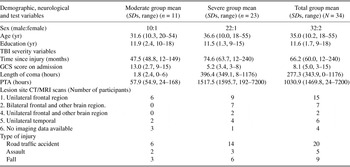
Research was conducted in accordance with the declaration of Helsinki and participants gave informed consent. To account for injury severity, thought to be an important determinant of post-injury awareness, 34 participants were assigned to moderate (n = 11) and severe (n = 23) head-injured groups (Sherer et al., Reference Sherer, Boake, Levin, Silver, Ringholz and Walter1998). Injury severity was determined by at least two of the following criteria: (i) Glascow Coma Scale (GCS) score on admission (severe < 9, moderate ≥ 9, and < 13), (ii) length of coma (severe > 6 hr, moderate < 6 hr > 1 hr), (iii) posttraumatic amnesia (PTA) (severe > 7 days, moderate < 7 days > 1 day), (iv) evidence of focal pathology from routine CT and MRI brain scanning (Lezak, Reference Lezak1995; Mild Traumatic Brain Injury Committee, 1993). Participants were a minimum of 1 year since injury to account for post-acute functional recovery (Fleming et al., Reference Fleming, Strong and Ashton1998). Lesion site could not be identified for four cases due to absence of imaging records although clinical and medical records indicated anterior neuropathology (see Footnote Table 1 for descriptive data).
Demographic, neurological, intelligence, emotion, and awareness variables for moderate, severe and total TBI group

Note
TBI = traumatic brain injury; GCS = Glascow Coma Scale; PTA = posttraumatic amnesia; CT/MRI = computed tomography/magnetic resonance imaging.
IQ and Executive Function Measures
Intelligence (Wechsler Abbreviated Scale of Intelligence, WASI; Wechsler, Reference Wechsler1999), pre-morbid IQ (Wechsler Test of Adult Reading, WTAR; The Psychological Corporation, 2001), and mood state (Hospital Anxiety and Depression Scale, HADS; Zigmond & Snaith, Reference Zigmond and Snaith1983) were measured to account for variables previously shown to affect post-injury awareness (Bogod et al., Reference Bogod, Mateer and MacDonald2003; Fleming et al., Reference Fleming, Strong and Ashton1998). Due to the multi-componential nature of awareness, executive and implicit cognitive constructs several measures of each were selected to best capture underlying processes (Andrés & Van Der Linden, Reference Andrés and Van Der Linden2002; Barker et al., Reference Barker, Andrade, Romanowski, Morton and Wasti2006; Miyake et al., Reference Miyake, Friedman, Emerson, Witski, Howerter and Wager2000). Awareness measures were chosen to measure metacognitive and emergent/anticipatory aspects of awareness in line with awareness conceptual models (Crosson et al., Reference Crosson, Barco, Velozo, Bolesta, Cooper and Werts1989; Morris & Hannesdottir, Reference Morris, Hannesdottir, Morris and Becker2004; Toglia & Kirk, Reference Toglia and Kirk2000), and on the recommendation of other researchers (O’Keeffe et al., Reference O’Keeffe, Dockree, Moloney, Carton and Robertson2007). Tests of executive function included, the Self-ordered Pointing Test measure of response monitoring (SOPT; Petrides & Milner, Reference Petrides and Milner1982), the Sorting Test measure of concept formation (D-KEFS, Delis, Kaplan, & Kramer, Reference Delis, Kaplan and Kramer2001), and the Brixton measure of strategy initiation and response inhibition (Hayling and Brixton - Burgess & Shallice, Reference Burgess and Shallice1997). A Verbal Fluency task (FAS - Benton & Hamsher, Reference Benton and Hamsher1989) was selected as a modality specific distractor task for the mere exposure effect task to prevent explicit rehearsal of auditory primes and is not considered further here though descriptive data are provided (Footnote Table 2 results section). Serial Reaction Time and mere exposure effect implicit tasks were chosen to measure implicit cognition as they are thought to depend on mechanisms governing tacit non-verbal encoding and decoding of contextual cues (Lieberman, Reference Lieberman2000), and are sensitive to pathology across patient-based studies (Barker et al., Reference Barker, Andrade, Romanowski, Morton and Wasti2006; Barker et al., Reference Barker, Andrade, Morton, Romanowski and Bowles2010; Beldarrain et al., Reference Beldarrain, Grafman, de Valesco, Pascual-Leone and Garcia-Monco2002).
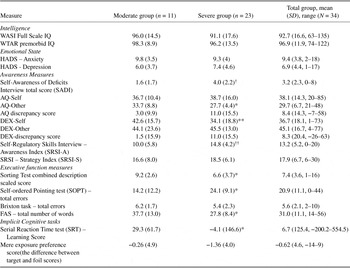
Moderate and severe subgroup and total group scores for executive and implicit experimental tasks (mean, SD, and range)

*p < .05, **p = .04, †p = .001, ††p = .007, one-tailed.
Note. WASI = Wechsler Abbreviated Scale of Intelligence; WTAR = Wechsler Test of Adult Reading; HADS = Hospital Anxiety and Depression Scale; AQ = Awareness Questionnaire; FAS = Verbal Fluency task; DEX = Dysexecutive Questionnaire.
Metacognitive Awareness Measures
Awareness Questionnaire (AQ - Sherer et al., Reference Sherer, Boake, Levin, Silver, Ringholz and Walter1998; Sherer, Hart, & Todd, Reference Sherer, Hart and Todd2003)
The AQ comprised 17 items comparing individual’s pre- and post-injury abilities and consisted of Self and Other versions completed by the participant and family member/significant other, respectively. Significant others were selected by patients to complete Other ratings for AQ and DEX questionnaires on the basis that the person knew them well before injury and had significant daily contact with them since time of injury. Items were rated on a 5-point scale from 1 (“much worse”) to 5 (“much better”) and summed to give a total score for participant and significant other ratings (range, 17–85). Self-awareness score was calculated by subtracting Other ratings from patient ratings to provide an AQ discrepancy score (range, −51 to +51). Positive scores indicated that patients underestimated their deficits post-injury. The measure has good internal consistency (r = 0.88; Sherer et al., Reference Sherer, Boake, Levin, Silver, Ringholz and Walter1998; Sherer et al., Reference Sherer, Hart and Todd2003).
Dysexecutive Questionnaire (DEX - Wilson et al., Reference Wilson, Alderman, Burgess, Emslie and Evans1996)
The DEX is a 20-item, 3 factor (cognitive, emotional, and motivational) questionnaire measuring post-TBI deficits and also comprises Self and Other versions. Items are rated on a 5-point scale indicating frequency of occurrence ranging from 0 (“never”) to 4 (“very often”). Items were summed to give a total score for participant and Other ratings (range, 0–80). Self-ratings were subtracted from Other-ratings to produce a Self-Other (DEX-Discrepancy/Insight) score (−80 to +80). As with the AQ questionnaire positive DEX-Discrepancy scores represented underestimation of deficits by patients. There are no data on the inter-rater reliability of DEX-Other ratings or test–retest reliability for DEX-Self or Other raters. Other raters (one per patient) for both AQ- and DEX-discrepancy were primarily female (85%) and comprised parents (44%), spouse/partner (35%), friends (12%), or other family members (9%).
Self-Awareness of Deficits Interview (SADI - Fleming, Strong, & Ashton, Reference Fleming, Strong and Ashton1996)
The SADI is a semi-structured interview measuring three factors, self-awareness of deficits, self-awareness of functional implications of deficits, and ability to set realistic goals. Each section was scored on a 4-point scale (range, 0–3, total score = 0–9). High scores on the SADI represented low levels of self-awareness across these dimensions. The measure has good inter-rater reliability (r = 0.82; Fleming et al., Reference Fleming, Strong and Ashton1996) and good test–retest reliability (r = 0.85–0.94; Fleming et al., Reference Fleming, Strong and Ashton1998).
Emergent/Anticipatory Awareness Measures
Self-Regulation Skills Interview (SRSI - Ownsworth et al., Reference Ownsworth, McFarland and Young2000)
The SRSI is a five-item semi-structured interview measuring emergent awareness, anticipatory awareness, strategy generation, strategy-use and strategy effectiveness. The five items were scored on a 10-point scale. Two item scores were summed to provide an Awareness Index score (range, 0–20) measuring emergent/anticipatory awareness of a behavioral problem identified by the participant (for example, memory or anger problems) and scored according to standard prompts. The remaining three items were combined to generate a Strategy Index score (range, 0–30) measuring participant’s awareness of any behavioral strategies they used with the identified problem(s). Again, high scores represented low levels of awareness. The test has good inter-rater (r = 0.81–0.92) and test–retest reliability (r = 0.69–0.91; Ownsworth et al., Reference Ownsworth, McFarland and Young2000).
SADI and SRSI interviews were conducted and scored by the first author. An independent rater scored a random subset of 10 interviews. Results of Pearson’s correlations showed a significant degree of inter-rater reliability for SADI total score (r = 0.95; p < .001), SRSI-Awareness index (r = 0.96; p < .001), and SRSI-Strategy index scores (r = 0.97; p < .001) indicating that interview ratings accurately reflected participants’ problems.
Implicit Experimental Tasks
Serial Reaction Time task (SRT - Nissen & Bullemer, Reference Nissen and Bullemer1987)
This computer-based task has been used in previous studies with TBI patient and control groups (Barker et al., Reference Barker, Andrade, Romanowski, Morton and Wasti2006, Reference Barker, Andrade, Morton, Romanowski and Bowles2010; Barker, Andrade, & Romanowski, Reference Barker, Andrade and Romanowski2004). Participants completed a practice session before beginning the task. In the learning phase, participants were told to respond as quickly as possible to a target (1 cm white circle) appearing in a predetermined 10 trial sequence, A B C D B C B D B C, by pressing the corresponding key (v, b, n, or m). The circle remained on the screen until the correct key press was made. In random blocks the stimulus circle appeared with the same frequency at screen locations as sequence blocks but did not follow a sequence. The response-stimulus interval was 200 ms and reaction time responses to each trial were recorded. The learning phase consisted of seven blocks of 50 trials comprising an initial random block to discourage participants from explicitly assuming that circles followed a pattern at the outset of the experiment, followed by six sequence blocks. Test phase comprised one sequence block flanked by two random blocks and followed immediately after the learning phase without warning to participants. Self-determined rest breaks appeared after each block of 50 trials. A learning score was calculated by summing reaction time (RT) mean of medians for each 10-trial sequence (5 medians summed to produce a mean RT for each of the three blocks at test). The sequence block mean was subtracted from the random mean (two random block means combined) to produce a sequence learning score. After the task participants completed an explicit knowledge questionnaire with a maximum score of 16 (Seger, Reference Seger1997).
Mere Exposure Effect Task (Zajonc, Reference Zajonc1968, Reference Zajonc1980)
This task has been used in previous studies with neuropathological and control groups (Barker et al., Reference Barker, Andrade, Romanowski, Morton and Wasti2006, Reference Barker, Andrade, Morton, Romanowski and Bowles2010). Participants were instructed to listen to one of two lists of 15 disyllabic Finnish words, matched for likeability, recorded on compact disc, and presented audibly as in previous studies. The word list was presented twice, at a rate of one word per 1.5 s. After the acquisition phase, the FAS verbal fluency task was administered as a modality specific distracter to prevent participants from explicitly rehearsing stimulus words after presentation. Participants then heard a test list containing all 30 words, targets, and foils, recorded in random order with a 4-s inter-stimulus interval. For the preference task, participants were asked to guess whether the words meant something good or something bad on the basis of their sound, rating each word as “very nice/good”, “slightly nice/good”, “slightly nasty/bad” or “very nasty/bad”. The mere exposure effect is shown by preference for previously presented words relative to foils. Responses were scored on a 4-point scale (0 = very nasty, 3 = very nice). Preference priming scores were calculated by subtracting sum of preference ratings for foil words from sum of preference ratings for target words resulting in a preference score ranging from −30 to +30. Positive scores indicated a mere exposure effect for target words.
Procedure
All measures were administered in counterbalanced order and duration of assessment varied from 2.5 to 4 hr.
RESULTS
We compared scores of moderate and severe groups on neuropsychological measures using the Mann Whitney nonparametric test due to unequal group sizes (Footnote Table 1). Groups were not significantly different in duration of time since injury U = 86.0, p = .34, and measures of current (WASI-IQ) U = 98.5; p = .31, and pre-morbid intelligence (WTAR), U = 103.0, p = .80 (Footnote Table 2). Mean WASI-IQ scores fell within average ranges and there was no significant reduction in intelligence from premorbid levels as estimated by the WTAR for both groups F(1,32) = .91, p .35. Mean depression (U = 110.0; p = .60) and anxiety scores (U = 116.5; p = .72) were not different for groups.
Metacognitive Awareness Variables
The severe group had higher total SADI scores than the moderate group indicating greater awareness deficits (Footnote Table 1). Self-rating mean was lower than Other mean for both groups on the DEX questionnaire and higher than Other means on the Awareness Questionnaire (where higher scores indicate fewer identified problems) indicating diminished awareness of problems for both patient groups. Self-Other Discrepancy on the Awareness questionnaire was significantly different for the severe group t(44) = 3.2, p = .003, but not for the moderate group t(20) = .73, p = .48. Self-Other discrepancy was also significantly different on the DEX questionnaire for severe t(44) = −2.3, p = .02, but not for moderate patients t(20) −.17, p = .87. The severe group had significantly lower DEX Self-ratings than the moderate group U = 68.5, p = .05, suggesting less awareness of executive/emotional and social problems after severe compared with moderate head injury (Footnote Table 2).
Anticipatory/Emergent Measure of Awareness
The severe group had larger SRSI-Awareness index scores than the moderate group indicating more impaired awareness (see Footnote Table 1 postscript). There was no difference between groups for the SRSI-Strategy measure. Both groups in the current study showed impaired awareness on SRSI subscales compared with previous findings with 38 TBI patients (SRSI-Awareness, M = 5.6; SRSI-Strategy M = 5.4; Wise et al., Reference Wise, Ownsworth and Fleming2005) where larger scores were associated with diminished employment status. To establish whether SRSI-Awareness and SRSI-Strategy subscales shared variance we conducted a Pearson’s correlation for total group scores and results showed a moderate correlation between the two measures r(34) = 0.65, p = .01.
Executive Function Tasks
The severe group had significantly lower scores on the Sorting Test measure of concept formation U = 62.5, p = .02 compared with normal ability in the moderate group (Footnote Table 2). Severe participants generated fewer items on FAS verbal fluency U = 70, p = .04 (although both group mean scores fell within normal ranges), and showed a higher number of errors on the SOPT measure of response monitoring U = 65.5, p = .02 than the moderate group.
Implicit Experimental Tasks
Both groups showed a lack of mere exposure effect (no preference for previously exposed targets compared with foils at test), and were not significantly different in this respect U = 107.0, p = .47 (see Footnote Table 2). This is an impaired pattern of performance on this task compared with control data with 20 participants (M = 3.5; SD = 3.2; Barker et al., Reference Barker, Andrade, Romanowski, Morton and Wasti2006) and 16 participants (M = 3.2; SD = 3.3; Barker et al., Reference Barker, Andrade, Morton, Romanowski and Bowles2010), respectively. The moderate group showed some learning on the SRT (shown by a positive mean score), that differed significantly from the severe group who showed little implicit learning U = 83, p = .05. However, moderate group performance (M = 29.3; SD = 61.7) also fell in the impaired range when compared with control data with 20 participants (M = 82.4; SD = 41.1; Barker et al., Reference Barker, Andrade, Romanowski, Morton and Wasti2006) and 16 participants (M = 96.4; SD = 40.5; Barker et al., Reference Barker, Andrade, Morton, Romanowski and Bowles2010). Neither group reached the cut-off criterion of 16 on the explicit measure, M = 6.6 (SD = 4.9) for the moderate group, and M = 1.9 (SD = 3.1) for the severe group.
To summarize, groups were not different in time since injury, IQ, or mood state. The severe group had greater awareness deficits on SADI and SRSI-Awareness measures than the moderate group, although both groups showed impaired emergent awareness on SRSI-Awareness and -Strategy indices. Groups had discrepant Self- and Other- ratings on AQ and DEX awareness measures that differed significantly for the severe group. The severe group had greater impairment on the SOPT and Sorting Test measures of executive function than the moderate group. Neither group showed a priming effect for previously exposed stimuli and the severe group had significantly lower learning scores on the SRT task than the moderate group, although both group mean scores were low compared with published control data. Due to the small sample size all further analyses were conducted on the total sample of 34 participants.
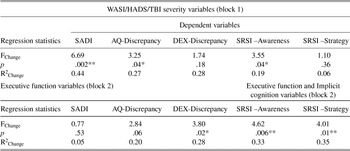
We conducted five separate hierarchical multiple regressions with each of the criterion variables (DEX and AQ-discrepancy, SADI, SRSI-Awareness, and SRSI-Strategy) to establish the unique contribution of predictors to the variance in criterion variables with the contribution of other variables accounted for. We followed the standard convention of introducing demographic variables of IQ, mood state and injury severity at block one to account for any effects and measured the unique and additional contribution of theoretically important predictors in block two. In block one, measures of intelligence (WASI), emotional state (HADS combined anxiety and depression score), and severity of injury were entered into the analysis. Executive function variables, SOPT, Sorting Test, and Brixton scores were entered in block two for the metacognitive criterion variables (SADI, AQ-, and DEX-discrepancy scores). For the emergent/anticipatory awareness criterion variables (SRSI-Awareness and SRSI-Strategy), implicit task predictors (SRT learning score and mere exposure effect preference score) were also entered into the analysis with executive function predictor variables at block two (see Footnote Table 3).
Hierarchical regression model statistics for all predictor and criterion variables

Note
WASI = Wechsler Abbreviated Scale of Intelligence; HADS = Hospital Anxiety and Depression Scale; TBI = traumatic brain injury; SADI = Self-Awareness of Deficits Interview; AQ = Awareness Questionnaire; DEX = Dysexecutive Questionnaire; SRSI = Self-Regulation Skills Interview.
*p ≤ .05, **p ≤ .01.
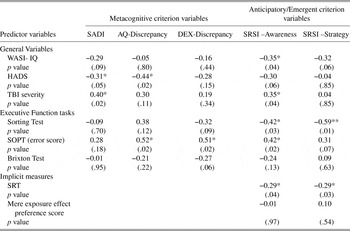
Regression statistics show that the greatest change to models occurred for the SADI criterion variable with the addition of severity of injury, WASI, and HADS at block one, and SRSI-Awareness and SRSI-Strategy criterion variables with the addition of executive and implicit variables in block two (Footnote Table 3). Beta values and significance levels of each predictor are shown in Footnote Table 4.
Beta values and significance level for all predictor and criterion variables in hierarchical regression models

*p ≤ .05; **p ≤ .01.
Note. WASI = Wechsler Abbreviated Scale of Intelligence; HADS = Hospital Anxiety and Depression Scale; TBI = traumatic brain injury; SADI = Self-Awareness of Deficits Interview; AQ = Awareness Questionnaire; DEX = Dysexecutive Questionnaire; SRSI = Self-Regulation Skills Interview; SOPT = Self-Ordered Pointing Test; SRT = Serial Reaction Time task.
The strongest unique predictor of the SADI metacognitive criterion variable was severity of injury followed by mood state measured by the HADS. For AQ- and DEX- discrepancy criterion variables the strongest unique predictor was response monitoring measured by the SOPT, followed by mood state (HADS) for AQ-Discrepancy only. For the emergent/anticipatory criterion variables, the strongest unique predictors of SRSI-Awareness were response monitoring (SOPT), concept formation (Sorting test), IQ, severity of injury, and implicit learning on the SRT task. The strongest unique predictor of the SRSI-Strategy emergent awareness measure was concept formation, followed by implicit learning on the SRT task. The Brixton executive function task and mere exposure effect implicit task made no significant contribution to criterion variables in regression models. It is likely that mere exposure effect made no significant contribution to the regression model because neither patient group showed any priming effects at test and the variance in scores across participants was therefore small for the severe group (mean = −1.36; SD 4.0 and for the moderate group (mean = −0.26; SD 4.9). Normal populations typically show a small but robust priming effect on this task (Barker et al., Reference Barker, Andrade, Romanowski, Morton and Wasti2006, Reference Barker, Andrade, Morton, Romanowski and Bowles2010).
DISCUSSION
The present study investigated the contribution of injury severity, IQ, mood state, executive and implicit function contributions to metacognitive and emergent/anticipatory awareness post-injury. Results of non-parametric analyses showed that the severe group had greater impairment on metacognitive measures of awareness (SADI, AQ- and DEX-Discrepancy), and emergent/anticipatory awareness measured by the SRSI-Awareness subscale. Metacognitive awareness is thought to depend on executive, processes and emergent/anticipatory awareness is thought to depend upon executive, implicit and other sub-component (episodic and working memory) processes (Toglia & Kirk, Reference Toglia and Kirk2000; Morris & Hannesdottir, Reference Morris, Hannesdottir, Morris and Becker2004). In line with this assumption, the severe group also had greater impairment than the moderate group on executive measures of concept formation, verbal fluency, response monitoring (indexed by Sorting Test, FAS, and SOPT, respectively), and implicit cognition measured by the SRT task. We did not find global awareness, executive and implicit deficits after severe compared with moderate injury possibly reflecting the multi-componential nature of these functions.
Groups were not different in time since injury, current and premorbid IQ and mood state and showed similarly impaired scores on the SRSI-Strategy measure of emergent/anticipatory awareness and the mere exposure effect implicit task. The moderate group showed impaired metacognitive (AQ- and DEX-discrepancy scores) and emergent awareness (SRSI-Awareness and SRSI-Strategy scores), and diminished implicit learning and priming compared with normative data (Barker et al., Reference Barker, Andrade, Romanowski, Morton and Wasti2006, Reference Barker, Andrade, Morton, Romanowski and Bowles2010).
Metacognitive Awareness Measures
We found no appreciable contribution of executive function to metacognitive awareness measured by the SADI, instead only injury severity and mood state significantly predicted scores on this variable. Injury severity is a relatively non-specific variable and we found that executive and implicit functions decreased as a function of severity of injury so it is possible that the significant contribution made by the severity variable to SADI scores masked the contribution of other variables to this measure. However, further investigation of the SADI is probably warranted to establish which aspects of awareness are captured by this measure. Combined anxiety and depression scores also predicted metacognitive awareness measured by SADI and AQ-discrepancy measures with greater emotional distress associated with lower awareness scores (i.e., greater awareness) suggesting that increased emotional distress might heighten self-reflection/self-evaluation (Alloy & Abramson, Reference Alloy and Abramson1979; Forgas, Reference Forgas1998; Godfrey, Partridge, Knight, & Bishara, Reference Godfrey, Partridge, Knight and Bishara1993). It remains to be established whether improved awareness of deficits increases emotional distress or emotional distress precipitates more accurate self-appraisal, and it is likely that the relationship between awareness of functional deficits and mood state is bidirectional.
The executive function of response monitoring (number of errors made) measured by the SOPT was the largest unique predictor of metacognitive awareness measured by AQ- and DEX-discrepancy measures (see Hart et al., Reference Hart, Whyte, Kim and Vaccaro2005 for similar findings). Errors on the SOPT occur due to failure to effectively monitor previously used responses (Petrides & Milner, Reference Petrides and Milner1982). Other findings show that diminished self-monitoring processes deleteriously affect self-report accuracy of cognitive deficits post-injury (Oddy, Coughlan, Tyerman, & Jenkins, Reference Oddy, Coughlan, Tyerman and Jenkins1985; Schmitz, Rowley, Kawahara, & Johnson, Reference Schmitz, Rowley, Kawahara and Johnson2006). Our findings support the assumption that self-monitoring is an important executive process mediating metacognitive awareness proposed by theoretical models (Ownsworth et al., Reference Ownsworth, Desbois, Grant, Fleming and Strong2006; Toglia & Kirk, Reference Toglia and Kirk2000). Response monitoring is also likely to recruit working memory processes and working memory span has been associated with successful SOPT performance (Rich, Blysma, & Brandt, Reference Rich, Blysma and Brandt1996). Future work should incorporate executive function and working memory measures to further extract the constituent cognitive components of awareness post-head injury.
Emergent/Anticipatory Awareness
The strongest unique predictors of emergent/anticipatory awareness measured by SRSI-Awareness were concept formation (Sorting Test scores) and response monitoring (SOPT error scores) contributing an equal amount of variance to the criterion variable. Current IQ status and severity of injury were the second strongest predictors of SRSI-Awareness also contributing an equal amount of variance to emergent awareness scores. In the present study, IQ was assessed using two subtests, one of verbal knowledge/reasoning and the other involving abstract rule detection and nonverbal reasoning processes, either or both of these aspects of ability could have contributed to scores on awareness measures. Severity of injury also made a significant contribution to emergent awareness, as with the SADI metacognitive criterion variable indicating some general effects of diffuse neuropathology to awareness indexed by this measure.
Implicit learning measured by the SRT task made a significant contribution to emergent awareness. Concept formation and implicit learning also contributed significantly to awareness measured by the SRSI-Strategy awareness subscale. This latter effect is likely to reflect shared variance across SRSI-Awareness and -Strategy subscales shown by the moderate correlation between indices, and that specific executive and implicit predictors captured these shared processes across the two measures. In contrast, response monitoring only significantly contributed to SRSI-Awareness, although the beta was large but non-significant for the contribution of response monitoring to awareness indexed by the SRSI-Strategy subscale.
The contribution of implicit learning to emergent awareness shown in present data raises questions about the mechanisms underpinning sequence detection and learning on this task (Barker et al., Reference Barker, Andrade, Romanowski, Morton and Wasti2006, Reference Barker, Andrade, Morton, Romanowski and Bowles2010; Lieberman, Reference Lieberman2000). One candidate explanation is that learning on the task depends upon the integrity of an implicit anticipatory/ predictive mechanism mediated by frontal circuitry and diminished or abolished after neuropathology (Seidler, Puroshotham Kim, Ugurbil, Willingham, & Ashe, Reference Seidler, Puroshotham, Kim, Ugurbil, Willingham and Ashe2005; Wong, Bernat, Bunce, & Shevrin, Reference Wong, Bernat, Bunce and Shevrin1997), that may contribute to other functions including emergent awareness. Typically, participants are faster on sequence compared with random trials on the SRT task because they have learned the sequence and can predict/anticipate subsequent stimulus locations (Seger, Reference Seger1997). Although the exact cause of absence of learning on the task remains to be elucidated, slowed responses on sequence compared with random blocks at test indicate that participants are unable to anticipate or predict subsequent stimulus locations. Head-injured participants also usually show an absence of explicit knowledge of the sequence shown by low scores on the explicit measure indicating that participants are not relying on explicit awareness of the sequence to facilitate performance in the absence of implicit learning. This finding is relatively robust and has been replicated across several studies with different head-injured cohorts (Barker et al., Reference Barker, Andrade, Romanowski, Morton and Wasti2006, Reference Barker, Andrade, Morton, Romanowski and Bowles2010; Beldarrain et al., Reference Beldarrain, Grafman, de Valesco, Pascual-Leone and Garcia-Monco2002).
Overall, regression data indicate that failure to implicitly encode contextual regularities and accurately predict/anticipate a response, inability to formulate and monitor response strategies and injury severity is associated with impaired emergent awareness. IQ, mood state, injury severity and response monitoring contribute to metacognitive awareness. It remains to be established if these functions share similar neural substrates (although see Schmitz et al., Reference Schmitz, Rowley, Kawahara and Johnson2006; Seidler et al., Reference Seidler, Puroshotham, Kim, Ugurbil, Willingham and Ashe2005; Sherer et al., Reference Sherer, Hart, Whyte, Todd and Yablon2005), and/or typically operate as a functional system(s) mediating awareness that may be differentially affected by neuropathology.
Considered together our findings might shed some light on anecdotal reports of patients who express awareness of deficits but are unable to read and respond to social cues appropriately (Prigatano & Schacter, Reference Prigatano and Schacter1991), and those who show intact implicit awareness by avoiding tasks they find difficult but who seem unable to verbalize awareness deficits (Kihlstrom & Tobias, Reference Kihlstrom, Tobias, Prigatano and Schacter1991; Schacter, Reference Schacter1990; Morris & Hannesdottir, Reference Morris, Hannesdottir, Morris and Becker2004). Although speculative these patterns of functional outcome might reflect some dissociation of emergent/anticipatory and metacognitive awareness and/or differential impairment to cognitive functions contributing to these aspects of awareness. Although there is a growing body of evidence investigating executive components of awareness (Bogod et al., Reference Bogod, Mateer and MacDonald2003; O’Keeffe et al., Reference O’Keeffe, Dockree, Moloney, Carton and Robertson2007; Ownsworth et al., Reference Ownsworth, McFarland and Young2000; Ownsworth & Fleming, Reference Ownsworth and Fleming2005), less attention has been paid to the empirical measurement of implicit cognition in awareness studies. Our findings go some way to elucidate some of the constituent components of metacognitive and emergent/anticipatory awareness and the differential effects of moderate and severe injuries on these functions and awareness more generally.
ACKNOWLEDGMENTS
The authors thank all head-injured participants who took part in the study. The authors report no conflict of interest or sources of financial support.