The economic and financial crisis initiated a wave of changes in multi-pillar pension systems in Central and Eastern European (CEE) countries that introduced mandatory funded pension components between 1998 and 2005. In the period of 2008–2012, facing worsening public finance situation resulting from the crisis, many of these countries decided to introduce changes to their pension systems, which limit the multi-pillar nature of these schemes strengthening the role of pay-as-you-go (PAYG) component in their schemes. The scope of these changes was different: from full reversal to PAYG system in Hungary to transitory changes in Estonia and Romania. These developments are covered in the literature both from the perspective of political economy (Guardiancich, Reference Guardiancich2009; Orenstein, Reference Orenstein2011; Casey, Reference Casey2014), public finance and economic situation in the time of the crisis (Beblavý, Reference Beblavý2011; Drahokoupil and Domonkos, Reference Drahokoupil and Domonkos2012), overall performance of the pension system in the past and in the time of crisis (Chybalski, Reference Chybalski2011; Hirose, Reference Hirose2011; Jarett, Reference Jarett2011; Fultz, Reference Fultz2012; Price and Rudolph, Reference Price and Rudolph2013) or projected level of expenditure or pension adequacy measured by projected level of replacement rate for workers who just enter the labour market (OECD, 2013; European Commission, 2015). The aim of this paper is to assess the outcome of changes caused by the reduction of pension contribution to the fully funded pension system on pension rights of individuals. Due to lower payments to fully funded systems, individuals accumulate less pension savings. However, the contributions diverted to the PAYG component allow accumulating pension rights. The question arises: do individuals lose or gain from this change? How does the situation differ between the countries?
To answer these questions, I analyse the net outcome of pension system change measured by the value of pension capital understood as pension rights lost or gained between 2009 and the retirement age. The analysis is made for six CEE countries: Poland, Latvia, Lithuania, Estonia, Romania and Slovakia.Footnote 1 In the analysis, instead of the projected replacement rate measure, which is most commonly used to assess pension adequacy (Borella and Fornero, Reference Borella and Fornero2009; DG Employment, and Social Protection Committee, 2012; OECD, 2013; European Commission, 2015). I use the measure based on pension wealth value, i.e., measurement of the value of accumulated pension capital (in the case of DC systems or total projected flow of pension benefits in the case of DB systems), which is a measure proposed and used by (OECD, 2011; Grech, 2013).
There are three hypotheses that I test in the paper. First: the net change of pension wealth depends not only on the change in contribution rate to the fully funded component, but also on the design of the PAYG part of the system, for the assessment of the adequacy outcome of the change it is important to analyse the net, not gross outcome (for example in their assessment Price and Rudolph, (Reference Price and Rudolph2013) take into account only gross impact on final pension level). Second: the impact of the change is higher in the case of countries where the reduction in fully funded contribution level was permanent. Third: the impact of the change is higher in the case of younger workers, whose pension rights are accumulated for longer time after the change was introduced.
For the verification of the abovementioned hypotheses, I construct the microsimulation model, in which I calculate the value of pension wealth for two scenarios: before and after the pension system change. I take into account both the value of the pension wealth loss in the funded part, as well as pension wealth gain in the PAYG part, leading to the assessment of the net pension wealth change. In this analysis I take into account those participants of the pension system who were already working when the change was introduced, taking different ages (from age 30 to 50) as well as different wage levels (from 50% to 150% of average wage).
1 The contribution changes in pension schemes and their impact on pension rights
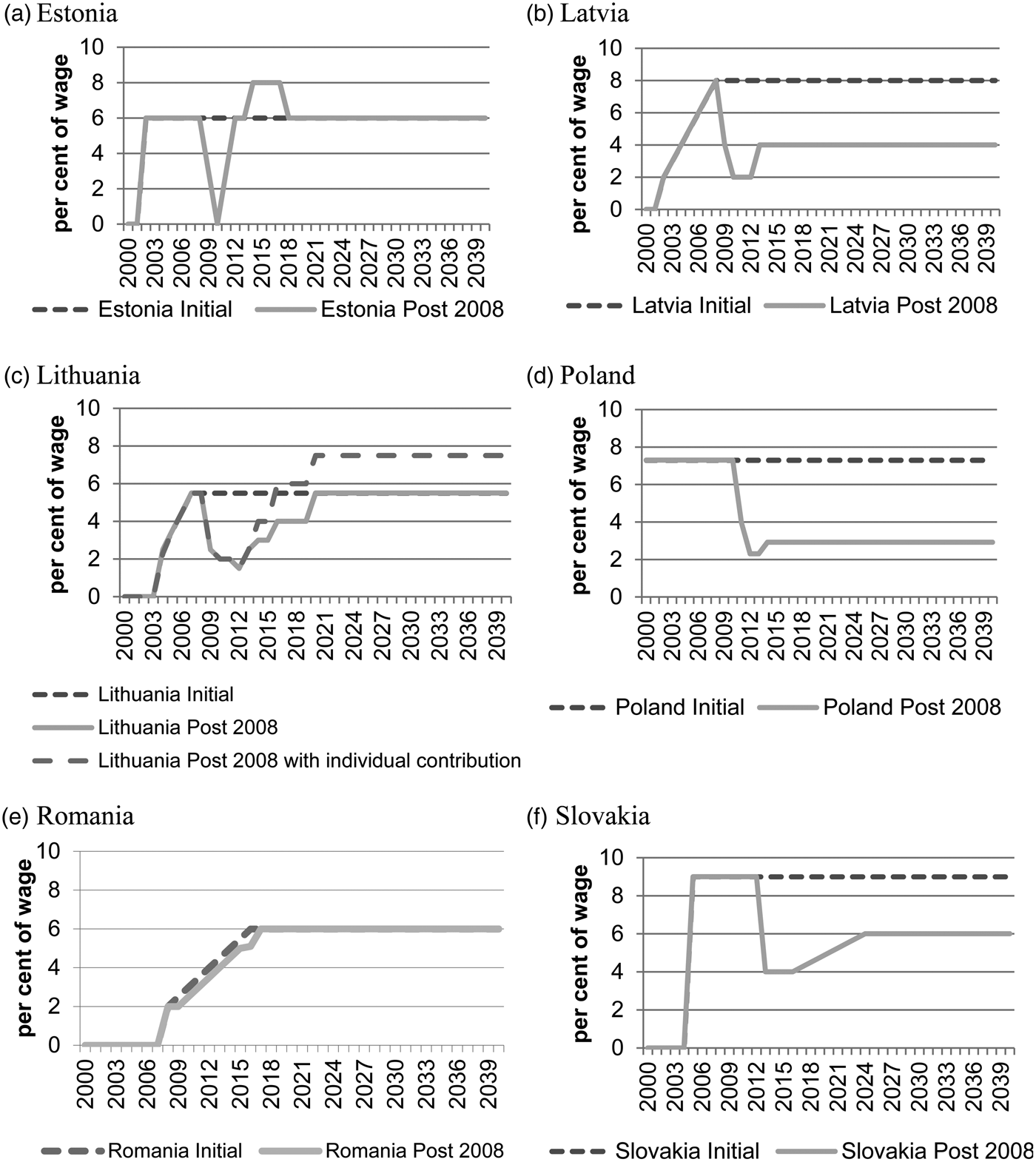
The timing and scale of adjustments of pension contributions in the analysed countries differ, following individual decisions made by the countries (Price and Rudolph, Reference Price and Rudolph2013; Schwarz and Arias, Reference Schwarz and Arias2014; Bielawska et al., Reference Bielawska, Chłoń-Domińczak and Stańko2016). The rates of pension contribution to the fully funded component between 2000 and 2040 are presented in Figure 1. In the case of Estonia, Lithuania and Romania the change is temporal and after the period of adjustment, the contribution rate are expected to come back to the initial level. In Estonia, the initial reduction between 2009 and 2011 will be compensated by higher contribution rates between 2014 and 2017. In Romania, the initial path of contribution rate increases was postponed by 1 year, which means that there is a difference of 0.5% of wage in contribution between initial and post-2008 scenarios between 2009 and 2015, in 2016 the contribution was raised by 0.1% of wage, and it is announced to be raised to 6% of wage in 2017.
Initial and post-2008 fully funded contribution rates in the CEE countries (% of wage). Source: authors’ analysis based on country sources.

An interesting solution was chosen by Lithuania. The contribution rate for fully funded part since 2014 was 2% from mandatory pension contribution plus 1% coming additionally from participants income and another 1% average wage financed from the state budget. Individuals could choose whether they want to remain in fully funded system and pay additional contribution, which is matched by the state budget payment from general taxes. Since 2016 the contribution mix becomes 6% (i.e., 2 + 2 + 2) and since 2020, 3.5% of contribution rate is paid from social insurance plus 2% participant wage plus 2% of average wage state budget. While this change increased contribution income to the social insurance system, the state budget co-payment means that the level of contributions financed from social insurance and other taxes will go back to the initial level. However, there is an additional contribution deducted from wage. The participant income part (1% between 2014 and 2019 and 2% afterwards) is not included in comparison of pension rights change but it actually increases the level of future pension for individuals, increasing the role of fully funded pension income in the old-age.
Three countries: Latvia, Poland and Slovakia reduced their fully funded contribution rates permanently. The long-term decrease is by 4 percentage points in Latvia (from 8% to 4%) 4.38 percentage points in Poland (from 7.3% to 2.92%) and by 5–3 percentage points in Slovakia (from 9% to 4% and back to 6%). The scope of the change (in particular permanent vs. temporary one) is an outcome of many factors, including, most importantly, the public finance situation and worsening of the fiscal stability triggered by the financial and economic crisis after 2008 (see also: Bielawska et al., Reference Bielawska, Chłoń-Domińczak and Stańko2015).
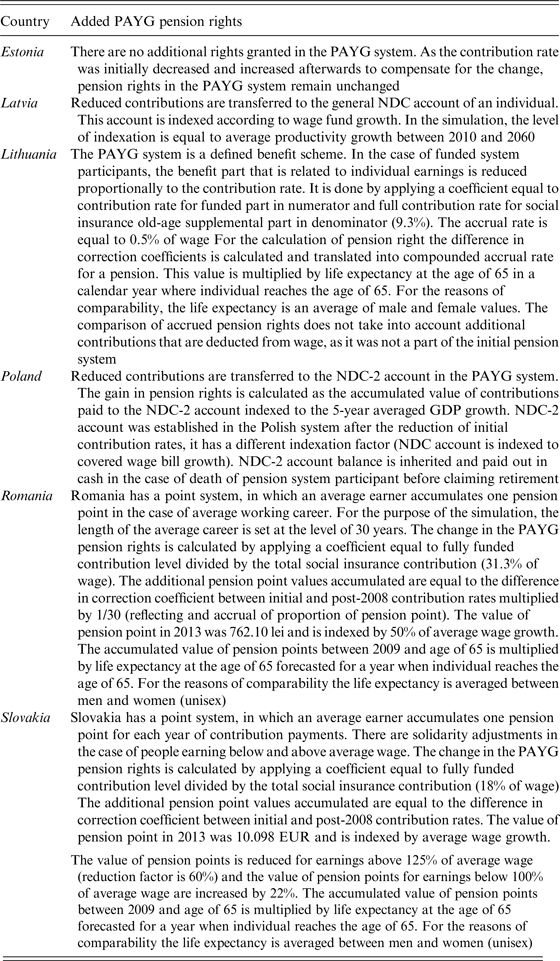
The six countries also differ in the design of their pay-as-you-pillars. This means that contributions reversed to these parts of their pension systems accrue different pension rights, which has an impact on the overall change of the pension wealth of workers. Among the three countries with permanent change two – Poland and Latvia – have notional defined contribution schemes (NDC). In that case, the change in the pension wealth results from differences in the notional and funded rates of return offered by the two schemes, as well as fee levels (which are not charged to the NDC accounts). In Slovakia, there is a point system, where benefits are calculated using pre-defined values of points, with additional redistributive component (as indicated in Table 1). The extent to which pension rights in the PAYG and funded components are changed depends on the parameters of the point system and the extent to which they are set taking into account actuarial stability. These design elements have a significant impact on whether the reversal will result in positive or negative impact on pension wealth, which is discussed in the following sections of the paper.
PAYG pension rights in analysed countries resulting from contribution change

Source: Own analysis based on information obtained from country experts and (OECD, 2013).
2. Method and assumptions for calculation of net change in pension wealth
In order to calculate the impact of the change on net pension wealth, I construct a microsimulation model for each of the analysed countries.
In the model I calculate the net change in pension wealth (NCPW), according to the following formula:
 $$NCPW = \; \left[ {FV\; \; AC_{AC}^{FF} - \; FV\; AC_{BC}^{FF}} \right] + FV\; PW_{AC}^{PAYG}, $$
where:
 $FV\; \; AC_{AC}^{FF} $
– future value of accumulated contributions paid to the fully funded component after change from year 2010 until the age of 65;
 $FV\; AC_{BC}^{FF} $
– future value of accumulated contributions paid to the fully funded component after change from year 2010 until the age of 65;
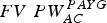 $FV\; PW_{AC}^{PAYG} $
– future value of accumulated pension wealth after the pension system change in the PAYG component resulting from additional contributions paid to after 2010 until the age of 65.
The
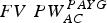 $FV\; PW_{AC}^{PAYG} $
calculation depends on the type of the PAYG system and pension rights accumulation in a given country, as described below. For comparability of the results, the NCPW is calculated as percentage of the annual average wage.
Country-specific assumptions for the
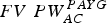 $FV\; PW_{AC}^{PAYG} $
are presented in Table 1.
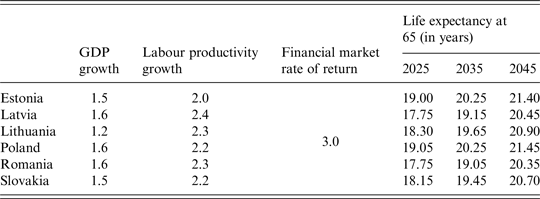
Assumptions used in the microsimulation are based on the ones used in the 2015 Ageing Working Group report (European Commission DG ECFIN, 2015), which are summarised in Table 2. The wage growth is assumed at the level of average labour productivity growth in the period 2010–2060 and the GDP growth as an average GDP growth for the same period. I assume that in Latvia the NDC rate of return is equal to the productivity growth and in Poland – to the GDP growth (that is the NDC-2 account rate of return).
Assumptions on GDP, labour productivity growth, financial market rate of return and life expectancy at age 65 in the analysed countries

Source: (European Commission DG Economic and Financial Affairs, 2014).
The rate of return in the fully funded schemes is set at the level of 3.0% annually (all rates of growth and return are assumed in real terms). Furthermore, I assume that contributions paid to the fully funded scheme have an up-front fee equal to 5% of the contribution paid and asset management fee of 0.5% of assets annually. Life expectancy assumptions used in the simulation follow Eurostat EUROPOP projection from 2013.
The simulations in the case of each countries are made for nine cases depending age in 2010 and wage level. In the case of age there are three ages: 30, 40 and 50 years of age. That means that they have different period between the time when change occurred and their retirement. In the case of wage levels I assume individuals earning 50%, 100% and 150% of average wage. I use flat earnings profile in order to extract the impact of the change in contribution rates to potential pension wealth, which is an approach similar to the one used by the Organisation for Economic Co-operation and Development (OECD) (OECD, 2013, 2015 and earlier). As the simulations are made for individuals at different ages, the use of age specific wage profile would make the results dependant on the age specific wage level for different simulation cases and the impact of the pension system change would be difficult to assess under such assumption.
The simulation results are sensitive to the difference between the growth of pension wealth in the fully funded and PAYG component. I test the sensitivity of the results to the assumption on the rate of return, with two additional scenarios: rate of return equal to 2.0% in real terms (penalty scenario) and 4.0% in real terms (premium scenario).
3 Simulation results
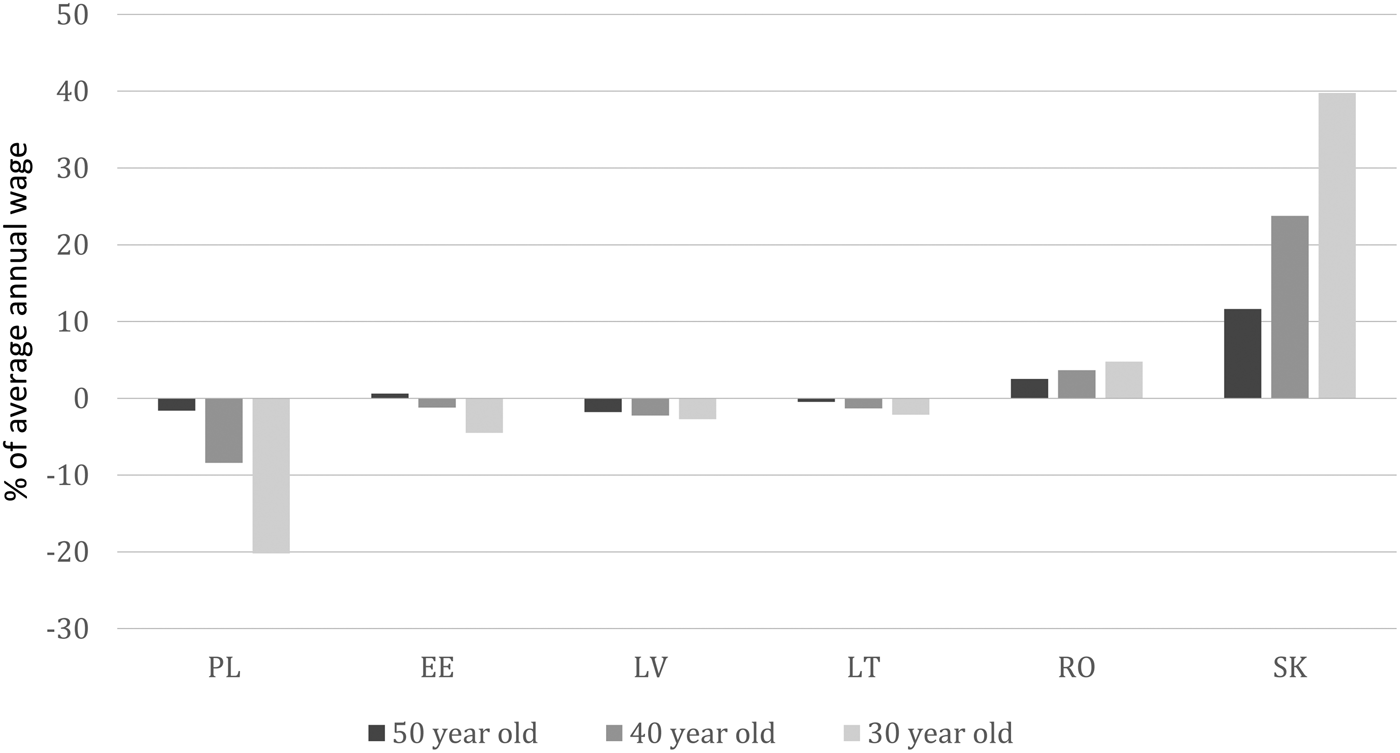
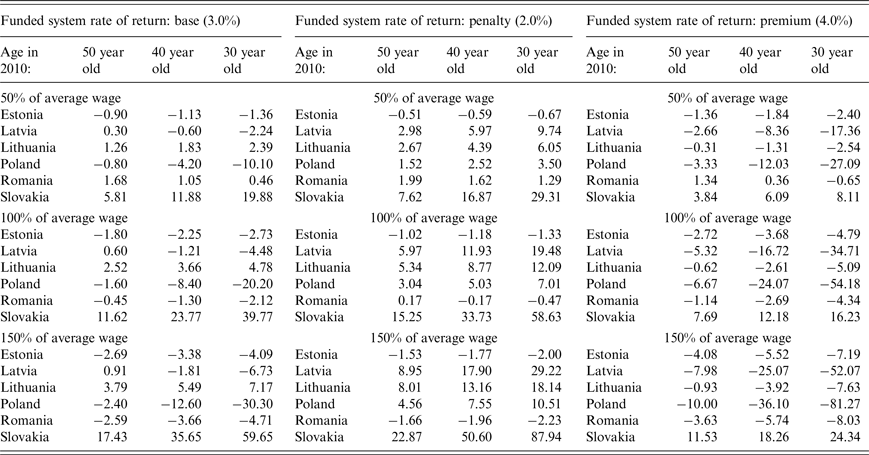
The results of the simulation indicate that the individual pension rights change resulting from the post-2008 pension system changes differ between CEE countries. The outcomes are presented as a value of pension wealth measured in relation to annual average wage. The 10% of annual average wage of pension wealth can be roughly translated to around 0.5–0.6 percentage point of replacement rate in pension system. The exact impact on the replacement rate depends, among others, on the way life expectancy changes are accounted for in the pension calculation. In the case of defined contribution schemes (funded or notional), increasing life expectancy will be leading to the reduction of the monthly benefit and thus, the replacement rate (that is the case of Poland and Latvia). In countries with point system or defined-benefit schemes (Slovakia, Lithuania and Romania) the impact can be relatively higher (Table 3, Figure 2).
Change in the pension wealth due to the post-2008 modification of fully funded contribution rates for average wage earners, base rate of return in funded component. Source: Author's calculations.

Change in the pension wealth due to the post-2008 modification of fully funded contribution rates by age, wage level and rate of return

Source: Author's calculations.
The simulations show that in the case of average wage earner in three out of six analysed countries, there is almost no difference in pension wealth level. These are countries with temporary change of pension contributions: Estonia, Lithuania and Romania), as a few years’ small diversion from the original path does not influence significantly the long-term outcome of pension wealth accumulation during the entire working career. In Estonia there is a small negative difference showing that the pension wealth would be slightly higher in the case of initial contribution split between pension system components, regardless the wage level, age and assumptions on the rate of return. Under the two sensitivity scenarios we can see the rising difference in the level of pension wealth in the case of Lithuania – when rate of return in fully funded component is lower, the pension wealth differential increases more than two times compared with the baseline scenario. In the premium scenario the pension wealth difference turns negative, which indicates higher pension wealth in the case of initial level and split of contribution between the two components of the pension system.
The impact of the change leads to more significant alterations in pension wealth in countries with permanent reversals: Poland, Latvia and Slovakia.
In the two countries with PAYG components based on the NDC principle – Poland and Latvia, the difference in pension wealth is attributed to difference in the fully funded and NDC rates of return. In Poland, the contributions that were initially assigned to the fully funded component are diverted into NDC-2 account, indexed by average GDP growth. As assumed rate of return in fully funded component (2.5% net of assets fee) is higher than NDC-2 rate of return (1.6%), there is a loss of pension wealth, resulting from difference in accumulated return. The same applies in Latvia, where the financial market rate of return is higher than the wage growth (2.4%).
The loss is higher for the younger people, who have longer time of pension wealth accumulation ahead. By the same token, the loss measured by pension wealth changes with the wage level, it is lowest for those with low wage level (50% of average wage) and higher for those with higher wage level (150% of average wage).
The results are also sensitive to the difference between the fully funded rate of return and productivity growth (assumed rate of return in the NDC component). If fully funded rate of return is lower by one point compared with the baseline scenario, the results indicate that both in Poland and Latvia the pension wealth is higher in favour of post-2008 split of contributions. If rates of return are higher, the difference is, as one could expect, in favour of initial levels of contributions.
In the case of Slovakia, the calculation of pension points with target accrual rate of around 1.25% per year of work indicates that the PAYG part of the pension system offers currently higher pension rights for the contribution paid compared with the fully funded component, which can indicate that there is an actuarial deficit in the PAYG scheme. As a result, there is an observed gain in pension wealth due to the reduction of contribution paid to the fully funded component. The impact of the change for lower income earners (50% of average wage) is almost similar to those who earn average wage, which shows the impact of the redistribution included in the PAYG formula. The sensitivity scenario shows that, the gain increases when fully funded rate of return is lower and decreases (but remains positive) in the scenario with higher rate of return. The higher pension wealth in the PAYG component in Slovakia also results from the rising life expectancy, which increases the pension wealth if the target accrual rate is kept constant.
The result for Slovakia indicates potential imbalances in the PAYG part in the future. This is also seen when we look at the macroeconomic projections. According to projections in the 2015 Ageing Working Group report (European Commission DG ECFIN, 2015), the pension expenditure in Slovakia between 2010 and 2060 is expected to increase from 8.1% of GDP in 2013 to 10.2% of GDP and the benefit ratio contribution that measures the impact of benefit level to the overall change of expenditure is relatively small (−2.6 percentage points of GDP, compared with −4.5% of GDP in Latvia and −5.2% of GDP in Poland).
4 Conclusions
The multi-pillar systems changes in Central and Eastern Europe, according to the simulations, will have relatively small impact on the value of future old-age pensions, in particular in countries that decided to make the contribution change temporary. The comparison of the situation in countries that opted for a permanent change indicates different outcomes: loss of pension wealth in Poland and Latvia and gain in pension wealth in Slovakia. This shows that the design of the matching part of the PAYG system affects the potential pension wealth, which may have influenced some of the individual decisions (in those countries which left a choice to pension system participants).
However, these findings should be seen only as one of the outcomes of the recent wave of pension systems changes. One should not forget that the change in the proportion of contributions affects the risk diversification of financing future pensions.
The changes also resulted in a loss of society trust towards state-organised pension system and reliability of accumulated pension savings. Recent modifications in funded systems increased the reliance of future pension income on wage-based financing, which will be more difficult to achieve given projected labour supply shortages due to the population ageing in the future.