Introduction
It is frequently asserted that marriage is more beneficial for the mental health of men than women (Gove & Tudor, Reference Gove and Tudor1973; Wu & DeMaris, Reference Wu and DeMaris1996; Kiecolt-Glaser & Newton, Reference Kiecolt-Glaser and Newton2001), but the evidence for this is far from clear cut (Wishman et al. Reference Wishman, Weinstock, Tolejko, Keyes and Goodman2006). Research has shown that marital distress is a risk factor for anxiety and mood disorders for both men and women (Wishman & Bruce, Reference Wishman and Bruce1999; Wishman et al. Reference Wishman, Weinstock, Tolejko, Keyes and Goodman2006), but that women are more likely to experience marital distress (Almeida & Kessler, Reference Almeida and Kessler1998; Schumm et al. Reference Schumm, Webb and Bollman1998). This makes gender differences in marital distress a plausible contributory factor to the higher rates of depression or anxiety among married women relative to married men (Wishman et al. Reference Wishman, Weinstock, Tolejko, Keyes and Goodman2006), but it does not clarify whether gender differences in prevalence of anxiety-mood disorders are actually greater among the married than the never married or the previously married.
Longitudinal studies can usually provide greater clarity on this issue than cross-sectional studies because their information on the temporal sequence of mental health symptoms and marital status change helps to differentiate selection (into or out of marriage on the basis of prior mental health) from protection effects. Most longitudinal studies on the relationship between marital status and mental health have focused on depression and most of these have investigated the effects of marital dissolution. These studies have generally found that separation or divorce is associated with increased risk of depression, but they are strikingly inconsistent in whether they find this increase higher among women (Aseltine & Kessler, Reference Aseltine and Kessler1993; Marks & Lambert, Reference Marks and Lambert1998; Hope et al. Reference Hope, Rodgers and Power1999), higher among men (Bruce & Kim, Reference Bruce and Kim1992; Kendler et al. Reference Kendler, Thornton and Prescott2001) or the same across genders (Booth & Amato, Reference Booth and Amato1991; Maciejewski et al. Reference Maciejewski, Prigerson and Mazure2001; Gahler, Reference Gahler2006). The few studies on gender differences in mental health outcomes associated with getting married relative to remaining unmarried also vary in their findings (e.g. Horwitz et al. Reference Horwitz, White and Howell-White1996; Simon, Reference Simon2002).
This inconsistency probably reflects variation across studies in several key methodological features, with no one feature sufficient to explain the discrepant results. First, many studies of marital disruption exclude the remarried; this may exaggerate the effect of marital disruption on mental health, especially among women, because remarriage may select the better adjusted and men may be more likely to remarry (Aseltine & Kessler, Reference Aseltine and Kessler1993). Second, length of time between divorce/separation and the follow-up assessment varies across studies and depressive symptoms may persist longer in men following marital disruption (Gahler, Reference Gahler2006). Third, most studies have used depression symptom scales rather than standardized diagnostic measures and it is notable that the studies cited above that found a stronger association of divorce with depression among men, have typically used diagnostic measures of depression, while those finding a stronger association among women have typically used depression symptom scales. Fourth, degree of control for history of prior psychopathology varies across studies. This control is important for two reasons. It is necessary to differentiate the influence of a history of depression on current symptoms from the influence of marital disruption on current symptoms (in that women are more likely to have current symptoms due to their higher likelihood of depression history, regardless of the impact of a stressor such as marital disruption). It is also important for reducing the influence of selection into marital disruption on the basis of a history of psychopathology. Although longitudinal studies of depression symptoms in response to marital disruption control for symptoms at time 1 (T1), this may not fully reflect history, such as those first onsets that occur between T1 and time 2, or that occurred prior to T1 with remission at T1. Finally, any inconsistency in results relating to gender that may be attributable to variation across studies in methodological features differentially sensitive to effects in men and women is exacerbated by the small sample sizes that a number of these studies have.
An additional limitation to the literature on this topic is that, for a balanced perspective, studies should include mental disorders where men predominate (substance use) as well as those where women predominate (depression and anxiety disorders). Few studies have done so, exceptions include Horwitz et al. (Reference Horwitz, White and Howell-White1996) and Simon, (Reference Simon2002) and we are not aware of any that have used diagnostic measures of alcohol use disorders. Several longitudinal studies have examined changes in drinking behavior following changes in marital status, usually marital gain (see Duncan et al. Reference Duncan, Wilkerson and England2006 for review) but again, although most find reduction in heavy drinking on marriage, there is no consistency in findings relating to gender differences (e.g. Horwitz et al. Reference Horwitz, White and Howell-White1996; Power et al. Reference Power, Rodgers and Hope1999; Simon, Reference Simon2002; Duncan et al. Reference Duncan, Wilkerson and England2006).
The World Mental Health (WMH) surveys, a consortium of population surveys of mental disorder epidemiology in developed and developing countries, comprise a substantial sample that allows investigation of a range of mental disorder outcomes and comparison among three levels of marital status (never married, married, previously married). Although the WMH surveys are cross-sectional, information was collected on both current and lifetime history of mental disorder, age of first onset of disorder, age at first marriage and age at ending of the first marriage (if applicable). The timing data on marital status and mental disorder allow survival analysis to be used to examine the association between marital status and subsequent first onset of mental disorder. This approach avoids the problem of insufficient control for history of disorder and helps reduce selection bias by excluding situations where the prior existence of a mental disorder influences subsequent marital status. An additional advantage of the ability to differentiate between first onset and recurrent disorder is that it is in first onsets that gender differences in psychopathology have been found most reliably (Kessler et al. Reference Kessler, McGonagle, Swartz, Blazer and Nelson1993).
In this study from the WMH surveys, we examine three questions: (1) Does the gender differential in first onset of a wide range of DSM-IV mental disorders vary across never married, married and previously married groups? (2) Does the association of first marriage (versus never married) with risk of disorder onset differ by gender? (3) Does the association of being previously married (versus being stably married) with risk of disorder onset differ by gender?
Methods
Sample
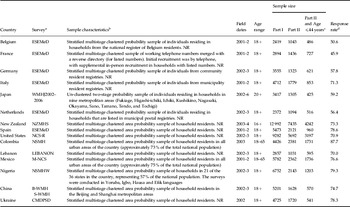
This report uses the data from 15 of the WMH surveys: Colombia; Lebanon; Mexico; Nigeria; Ukraine; China; Belgium; France; Germany; Italy; Japan; Netherlands; New Zealand; Spain; USA (Table 1). The total sample size was 73 099, with individual country samples ranging from 2372 (the Netherlands) to 12 992 (New Zealand). The weighted average response rate was 70.0% with country-specific response rates ranging from 45.9% (France) to 87.7% (Colombia) (Table 1). All interviews were carried out face to face by trained lay interviewers.
World Mental Health (WMH) sample characteristics

a ESEMeD, The European Study Of The Epidemiology Of Mental Disorders; WMHJ2002–2006, World Mental Health Japan Survey; NZMHS, New Zealand Mental Health Survey; NCS-R, The US National Comorbidity Survey Replication; NSMH, The Colombian National Study of Mental Health; LEBANON, Lebanese Evaluation of the Burden of Ailments and Needs of the Nation; M-NCS, The Mexico National Comorbidity Survey; NSMHW, The Nigerian Survey of Mental Health and Wellbeing; B-WMH, The Beijing World Mental Health Survey; S-WMH, The Shanghai World Mental Health Survey; CMDPSD, Comorbid Mental Disorders during Periods of Social Disruption.
b Most WMH surveys are based on stratified multistage clustered area probability household samples, in which samples of areas equivalent to counties or municipalities in the USA were selected in the first stage followed by one or more subsequent stages of geographic sampling (e.g. towns within counties, blocks within towns, households within blocks) to arrive at a sample of households, in each of which a listing of household members was created and one or two people were selected from this listing to be interviewed. No substitution was allowed when the originally sampled household resident could not be interviewed. These household samples were selected from census area data in all countries other than France (where telephone directories were used to select households) and the Netherlands (where postal registries were used to select households). Several WMH surveys (Belgium, Germany, Italy) used municipal resident registries to select respondents without listing households. The Japanese sample is the only totally unclustered sample, with households randomly selected in each of the four sample areas and one random respondent selected in each sample household. In total, 10 of the 15 surveys are based on nationally representative (NR) household samples, while two others are based on NR household samples in urbanized areas (Colombia, Mexico).
c Nigeria, the People's Republic of China, and Ukraine, which were age restricted to ⩽39 years.
d The response rate is calculated as the ratio of the number of households in which an interview was completed to the number of households originally sampled, excluding from the denominator households known not to be eligible either because of being vacant at the time of initial contact or because the residents were unable to speak the designated languages of the survey. The weighted average response rate is 70.0%.
Internal subsampling was used to reduce respondent burden by dividing the interview into two parts. Part 1 included the diagnostic assessments for most mental disorders. Part 2 included additional information related to a range of survey aims, including information on timing of first marriage. All respondents completed part 1. All respondents who met criteria for any lifetime mental disorders (or had other indicators of psychiatric problems) in the part 1 interview were retained for part 2, along with a probability subsample of non-cases. Part 2 respondents were weighted by the inverse of their probability of selection for part 2 of the interview to adjust for differential sampling. This study uses the part 2 sample (n=34 493). Weights were also used to adjust for differential probabilities of selection within households and to match the samples to population sociodemographic distributions.
More detail on the sampling methodology of the WMH surveys is provided elsewhere (Kessler & Ustun, Reference Kessler and Ustun2004; Heeringa et al. Reference Heeringa, Wells, Hubbard, Mneimneh, Chiu, Sampson, Berglund, Kessler and Üstün2008; Pennell et al. Reference Pennell, Mneimneh, Bowers, Chardoul, Wells, Viana, Dinkelmann, Gebler, Florescu, He, Huang, Tomov, Vilagut, Kessler and Üstün2008).
Training and field procedures
The central WMH staff trained bilingual supervisors in each country. Consistent interviewer training documents and procedures were used across surveys. Some surveys were carried out in bi- or multi-lingual form (Belgium, Ukraine, Nigeria). Others were carried out exclusively in the country's official language. Quality control protocols were standardized across countries to check on interviewer accuracy and to specify data cleaning and coding procedures. Informed consent of participants was obtained in each country.
DSM-IV disorders
The assessment of mental disorders was based on version 3.0 of the WHO Composite International Diagnostic Interview (CIDI), a fully structured diagnostic interview. Disorders were assessed using the definitions and criteria of DSM-IV. The disorders included in this report include mood disorders (major depressive disorder, dysthymia, bipolar disorder), anxiety disorders (panic disorder, generalized anxiety disorder, agoraphobia without panic disorder, social phobia, specific phobia, post traumatic stress disorder) and substance use disorders (alcohol and illicit drug abuse with or without dependence). CIDI organic exclusion rules were used to make diagnoses. Blinded clinical reappraisal interviews carried out with a probability subsample of WMH respondents found generally good concordance between CIDI and clinical diagnoses (Haro et al. Reference Haro, Arbabzadeh-Bouchez, Brugha, de Girolamo, Guyer, Jin, Lepine, Mazzi, Reneses, Vilagut, Sampson and Kessler2006). Retrospective age of onset reports were obtained in the CIDI using a series of questions designed to avoid the implausible response patterns obtained in response to a simple question asking for recall of age of first episode of a focal disorder (Knauper et al. Reference Knauper, Cannell, Bruce and Kessler1999).
Marital status
Timing data were obtained for first marriage only. Respondents were asked how old they were when they got married for the first time and, if separated or divorced from their first spouse, the age they separated for the last time and if their first spouse died, the age when that happened. Analyses considered person years in three categories of marital status: never married (person years prior to first marriage); in first marriage; previously married (includes separated, divorced, widowed and remarried).
Statistical analyses
Gender differences in risk of first onset of each disorder were examined using discrete-time survival analysis (Efron, Reference Efron1988) with person year as the unit of analysis, with a separate model for each disorder. Each year in the life of each respondent up to and including the age of onset of the focal disorder (and, in the case of respondents who never had the disorder, up to their age at interview) was treated as a separate observational record, with the year of first onset coded 1 and earlier years coded 0 on a dichotomous outcome variable. Years after first onset were excluded from the data file. Logistic regression analysis was used to analyze these data, with gender, age at interview, age squared (to allow for non-linear relationships between age and disorders), age at disorder onset, country, marital status and relevant two-way interactions included as predictors of first onset of the disorder. The logistic regression coefficients and their standard errors were converted to odds ratios (ORs) and 95% confidence intervals for ease of interpretation.
One set of analyses included all person years and compared male and female disorder onsets in all three levels of marital status. Analyses of the association of first marriage (relative to those never married) with disorder onsets were restricted to person years in first marriage or never married; similarly, analyses of being previously married (relative to still being in first marriage) were restricted to person years in first marriage or previously married. Models for mood, anxiety and substance use disorders were run for all countries combined (dummy variables for countries were included in models). Models were elaborated to investigate the possibility of three-way interactions between gender, marital status and both age or age at disorder onset in predicting disorders, but no substantive gender differences were found so these results are not shown (available on request).
Two further sets of analyses were undertaken. First, using person-level, not person-year data, we investigated the possibility of gender by marital status interactions in predicting disorder recurrence (those with 12-month disorders from among those with lifetime history of disorder), but no significant interactions were found (results available on request). Second, to explore our finding of gender differences in association between marital status and first onset of depression and substance use disorder in more detail, we performed a post hoc analysis that assessed whether this finding could be explained by the inclusion in the person-year survival models of a constructed variable measuring gender role traditionality (GRT). Values on this variable were assigned to individuals and reflect the degree of GRT of the individual's age cohort (18–34, 35–49, 50–64, ⩾65 years) and country, as measured by a composite of four indicators of GRT: the ratio of women:men with labour force experience before age 35; the ratio of women:men achieving the median level of education among the employed; the ratio of the median ages of marriage of women versus men; the proportion of women who used contraception before age 25 years (see Seedat et al. Reference Seedat, Scott, Angermeyer, Berglund, Bromet, Brugha, Demyttenaere, de Girolamo, Haro, Jin, Karam, Kovess-Masfety, Levinson, Medina Mora, Ono, Ormel, Pennell, Posada-Villa, Sampson, Williams and Kessler2009 for further detail on the GRT variable).
Standard errors of survival coefficients were estimated using the Taylor series linearization method implemented in the SUDAAN software system (Research Triangle Institute, USA) to allow for the complex survey design. Multivariate tests of the significance of interactions involving gender with marital status were made with Wald χ2 tests using Taylor series design-based coefficient variance-covariance matrices. All significance tests were evaluated at the 0.05 level with two-sided tests.
Results
Gender differences in disorder onsets by marital status
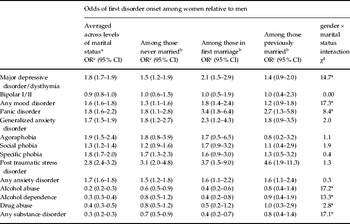
The first column of Table 2 displays the expected gender pattern of women in the total sample being more likely than men to have experienced a first onset of a depressive or anxiety disorder (OR>1) and less likely to have experienced a first onset of a substance use disorder (OR<1), irrespective of marital status. The next three columns show that some of these gender differences in disorder onset vary significantly by marital status. For depressive disorders (major depressive disorder and dysthymia) and substance use disorders, gender differences are largest among the married relative to the other levels of marital status (the gender by marital status interaction in disorder onset is significant for depressive disorders, any mood disorder and all of the substance use disorders). Among anxiety disorders, however, it is only panic disorder that shows a significantly greater gender difference in onset among the married, as indicated by the significant interaction term for this disorder.
Association of gender with first disorder onset, averaged across levels of marital status and within each level of marital status, all countries combined

OR, Odds ratio; CI, confidence interval.
a Model is for all person years and includes: gender, age at interview, age squared, age at disorder onset, marital status, country.
b Model is for all person years and includes age at interview, age squared, age at disorder onset, marital status, country, gender×age at interview, gender×age at disorder onset, gender×marital status (three levels of marital status).
c Reference group=males.
* p<0.05.
Association of first marriage with risk of disorder onset
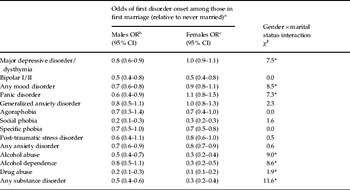
Table 3 shows the ORs for risk of first onset of mental disorder among those in first marriage relative to those never married in the pooled dataset. For men, all ORs for the 11 individual disorders are <1 and for women this is the case for 8/11 disorders, suggesting a generally protective pattern associated with marriage for both genders. A little over half (5/8) of the coefficients for mood-anxiety disorders are stronger among men, indicating that this protective pattern is greater among men for these disorders. In fact, it is confined to men for depressive disorders and panic disorder (with significant gender by marital status interactions for depressive disorders, any mood disorder and panic disorder). By contrast, all four coefficients for substance use disorders are stronger among women, with a significant gender by marital status interaction for all substance use disorders, indicating a significantly stronger protective pattern associated with marriage against onset of these disorders for women.
Association of first marriage (relative to never married) with first disorder onset, among males and females, all countries combined

OR, Odds ratio; CI, confidence intervals.
a Model is for person years never married or in first marriage only and includes gender, age at interview, age squared, age at disorder onset, country, marital status, gender×age at interview, gender×age at disorder onset, gender×marital status (two levels of marital status).
b Reference group=never married males.
c Reference group=never married females.
* p<0.05.
Association of being previously married compared with being in first marriage
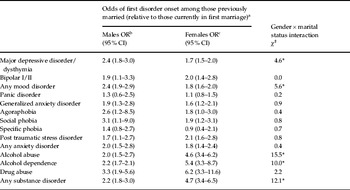
Table 4 shows the ORs for risk of first onset of mental disorder among those who were previously married relative to those still in their first marriage. Being previously married, relative to being stably married, is associated with increased risk of disorder onset for both genders, as indicated by 11/11 individual disorder ORs among men and 10/11 among women being >1 (Table 4). However, there are significant gender by marital status interactions for depressive disorders, where the increased risk of onset is significantly more pronounced among men, and for substance use disorders, where the increased risk of onset is significantly more pronounced among women.
Association of being previously married (relative to being stably married) with first disorder onset, among males and females, all countries combined

OR, Odds ratio; CI, confidence intervals.
a Model is for person years previously married or in first marriage only, and includes gender, age at interview, age squared, age at disorder onset, country, marital status, gender×age at interview, gender×age at disorder onset, gender×marital status (two levels of marital status).
b Reference group=married males.
c Reference group=married females.
* p<0.05.
Post hoc test of GRT as an explanatory factor
In models assessing the association of first marriage with depression and substance use disorder outcomes, adjusting for differences in GRT across levels of marital status made no difference to the association of marriage with disorder onsets among men and women (data not shown, available on request).
Discussion
The WMH surveys found that, for both men and women, being in first marriage (relative to never being married) was associated with reduced risk of most mental disorder onsets. However, for depressive disorders and panic disorder this reduced risk was confined to men, while for substance disorders it was stronger in women. Being previously married (relative to stably married) was associated with increased risk of all disorder onsets in men and women. However, in the case of depressive disorders this association was stronger in men and in the case of substance disorders it was stronger in women.
These results are consistent with one of the few longitudinal studies that included both depression and alcohol use outcomes, which also found that getting married was more protective against depression among men but more protective against alcohol use among women (Horwitz et al. Reference Horwitz, White and Howell-White1996). The wider scope of the current study, which includes anxiety disorders, a range of mood and substance use disorders and compares across three levels of marital status, allows a better contextualization of gender differences in the relationship between marital status and mental disorder than has previously been possible. The generally protective pattern associated with marriage that we observed for both men and women, and the greater reduction in risk of substance use disorders for women, is not consistent with prior assertions that the mental health of men benefits more from marriage than that of women.
Nonetheless, we did find that the protective pattern associated with marriage against depression was stronger for men, which could be consistent with a gender role interpretation, such that women's marital roles are less satisfying or involve more chronic strain than men's (Gove & Tudor, Reference Gove and Tudor1973; Wu & DeMaris, Reference Wu and DeMaris1996; Nolen-Hoeksema et al. Reference Nolen-Hoeksema, Larson and Grayson1999). Moreover, other analyses of the WMH surveys have found that reduction in GRT across cohorts within countries correlated with a narrowing of the gender differential in depression in recent cohorts (Seedat et al. Reference Seedat, Scott, Angermeyer, Berglund, Bromet, Brugha, Demyttenaere, de Girolamo, Haro, Jin, Karam, Kovess-Masfety, Levinson, Medina Mora, Ono, Ormel, Pennell, Posada-Villa, Sampson, Williams and Kessler2009). However, inclusion of GRT in analyses in this paper did not influence the gender difference in the association of marital status with depression. This may be related to the fact that employment, a key component of our GRT measure, is often associated with mental health benefit in the absence of other major role demands, but the combination of employment with responsibility for children in particular, has been associated with increased distress in women (Ross & Mirowsky, Reference Ross and Mirowsky1988; Rosenfield, Reference Rosenfield1989; Simon, Reference Simon1995; Plaisier et al. Reference Plaisier, de Bruin, Smit, de Graaf, ten Have, Beekman, van Dyck and Penninx2008).
Being the primary caregiver for young children, a role women are more likely to fulfill than men (Ross & Mirowsky, Reference Ross and Mirowsky1988; Lennon & Rosenfield, Reference Lennon and Rosenfield1994; Bird, Reference Bird1999), may also explain the stronger protective pattern against substance use disorders among married women. Alcohol consumption reduces sharply among women during pregnancy (Ebrahim et al. Reference Ebrahim, Luman, Floyd, Murphy, Bennett and Boyle1998) and there is evidence that this restraint extends into the period of early child care. A longitudinal study of the 1958 British cohort found that heavy drinking occurred to a similar degree among married men regardless of parental status, but reduction in heavy drinking among women who married was associated primarily with becoming a parent (Power et al. Reference Power, Rodgers and Hope1999). Cross-sectionally, being a parent has been positively associated with psychological distress among women and negatively associated with alcohol consumption (Cho & Crittenden, Reference Cho and Crittenden2006).
Gender differences in role strains and role constraints may then contribute to the gender differences that we find in the association between getting married and both depression and substance use onset in individuals. This dataset does not have information on parenting status for each year of life of respondents as required by survival analysis, so we are unable to test this explanation directly; in this respect, it remains speculative. Further research by individual surveys within the WMH consortium may help shed light on the relationship between indicators of marital strain within current marriage and mental disorder (O'Leary et al. Reference O'Leary, Tintle, Bromet and Gluzman2008).
These results need to be considered in light of the study limitations. An important limitation is the use of retrospective recall, which is known to underestimate occurrence of mental disorders, particularly in the mild–moderate spectrum (Simon & von Korff, Reference Simon and von Korff1995). Retrospective data are also likely to be less accurate with regard to the timing of mental disorder onsets and marital status changes, probably introducing some non-systematic error in the temporal sequencing of marital status and mental disorder onsets. However, even the better recall of depressive episodes by women (Wilhelm et al. Reference Wilhelm, Parker, Geerligs and Wedgwood2008) cannot readily account for our finding that gender differences in rates of depression change with marital status. Nonetheless, the retrospective nature of the data remains a significant limitation.
We obtained timing data only in relation to first marriage, which means that those who were in their first cohabiting relationship would have been classified as never married. This is not likely to have significantly impacted on results for developing countries or for developed countries with more traditional gender roles where cohabitation is relatively rare, but it may have lowered the estimates for the association of marriage (relative to never married) with mental disorders in developed countries where cohabitation is more common. We also acknowledge that the aggregation of the separated, divorced and widowed into the one ‘previously married’ group obscures differences between these subgroups in their relationship with mental disorders. This approach was adopted due to the small numbers of cases in the previously married subgroups in the smaller surveys and to reduce the complexity of findings. A further limitation, which follows on from the small sample size of many of the surveys, is that we needed to pool the individual country datasets, which does not take into account the fact that the meaning of marriage is likely to differ across cultures and countries.
Finally, the limitations to the control of selection bias also need to be acknowledged. The survival analysis that we employed reduces the effects of selection bias by excluding situations where the prior existence of the focal disorder has an influence either on reduced chances of becoming married or increased chances of marriage dissolution. However, it cannot eliminate the possible influence of factors that may both decrease the likelihood of getting married and increase the likelihood of mental disorder onset, such as personality or history of sexual abuse. The fact that we found that marriage was associated with reduced onset of disorders that typically occur well before marriage (the phobias), is suggestive of some residual selection bias of this sort, though this would only apply to the contrast between the married and the never married.
These limitations notwithstanding, we believe this study is the most comprehensive to date on the relationship between marital status and mental disorder. It provides unique information on the gender similarities and differences in the associations between being unmarried, married and previously married with a wide range of mental disorder first onsets.
Acknowledgments
The surveys included in this report were carried out in conjunction with the World Health Organization WMH Survey Initiative. We thank the WMH staff for assistance with instrumentation, fieldwork and data analysis. These activities were supported by the United States National Institute of Mental Health (R01MH070884), the John D. and Catherine T. MacArthur Foundation, the Pfizer Foundation, the US Public Health Service (R13-MH066849, R01-MH069864 and R01 DA016558), the Fogarty International Center (FIRCA R01-TW006481), the Pan American Health Organization, Eli Lilly and Company, Ortho-McNeil Pharmaceutical, Inc., GlaxoSmithKline and Bristol-Myers Squibb. A complete list of WMH publications can be found at http://www.hcp.med.harvard.edu/wmh/. The Mexican National Comorbidity Survey is supported by The National Institute of Psychiatry Ramon de la Fuente (INPRFMDIES 4280) and by the National Council on Science and Technology (CONACyT-G30544- H), with supplemental support from the PanAmerican Health Organization. The Lebanese survey is supported by the Lebanese Ministry of Public Health, the WHO (Lebanon) and unrestricted grants from Janssen Cilag, Eli Lilly, GlaxoSmithKline, Roche, Novartis, Fogerty (R03 TW0006481) and anonymous donations. The ESEMeD project was funded by the European Commission (contracts QLG5–1999–01042; SANCO 2004123), the Piedmont Region (Italy), Fondo de Investigación Sanitaria, Instituto de Salud Carlos III, Spain (FIS 00/0028), Ministerio de Ciencia y Tecnología, Spain (SAF 2000–158-CE), Departament de Salut, Generalitat de Catalunya, Spain and other local agencies and by an unrestricted educational grant from GlaxoSmithKline. The Colombian National Study of Mental Health is supported by the Ministry of Social Protection, with supplemental support from the Saldarriaga Concha Foundation. The World Mental Health Japan Survey is supported by the Grant for Research on Psychiatric and Neurological Diseases and Mental Health (H13-SHOGAI-023, H14-TOKUBETSU-026, H16-KOKORO-013) from the Japan Ministry of Health, Labour and Welfare. The New Zealand Mental Health Survey is supported by the New Zealand Ministry of Health, Alcohol Advisory Council and the Health Research Council. The South Africa Stress and Health Study is supported by the US National Institute of Mental Health (R01-MH059575) and National Institute of Drug Abuse with supplemental funding from the South African Department of Health and the University of Michigan (National Institutes of Mental Health HHSN271200700030C). The Ukraine Comorbid Mental Disorders during Periods of Social Disruption Study is funded by the US National Institute of Mental Health (RO1-MH61905). The US National Comorbidity Survey Replication is supported by the National Institute of Mental Health (NIMH; U01-MH60220) with supplemental support from the National Institute of Drug Abuse, the Substance Abuse and Mental Health Services Administration, the Robert Wood Johnson Foundation (RWJF; Grant 044780) and the John W. Alden Trust.
Declaration of Interest
None.