The multitude of strategies employed by Indigenous people to weather the chaos and atrocities of the colonial incursion have become a topic of intense interest throughout the Americas (e.g., Oland et al. Reference Oland, Hart and Frink2012; Panich and Schneider Reference Panich and Schneider2014; Silliman Reference Silliman2005, Reference Silliman2009) and particularly in California, where they have been the focus of extensive research (e.g., Byrd et al. Reference Byrd, Dearmond and Enbring2018; Gamble and Zepeda Reference Gamble and Zepeda2002; Hull and Douglass Reference Hull and Douglass2018; Lightfoot Reference Lightfoot1995, Reference Lightfoot2005; Panich Reference Panich2013; Panich et al. Reference Panich, Allen and Galvan2018; Peelo Reference Peelo2011; Reddy Reference Reddy2015; Reddy et al. Reference Reddy, Douglass, Grenda, Ciolek-Torello and Altschul2016). In most instances cultural perseverance has been evaluated at sites of Indigenous relocation, specifically Spanish missions (Panich Reference Panich2010; Panich and Schneider Reference Schneider2015; Panich et al. Reference Panich, Allen and Galvan2018; Peelo Reference Peelo2011, Silliman Reference Silliman2001a, Reference Silliman2001b) and presidios (Hull and Voss Reference Hull and Voss2016), trading posts (Schneider et al. Reference Schneider, Janzen, DeAntoni, Hill, Apodaca and Cuthrell2018), and postcontact refugia (Bernard and Robinson Reference Bernard, Robinson, Hull and Douglass2018; Bernard et al. Reference Bernard, Robinson, Sturt, Panich and Schneider2014; Ruby and Hildebrandt Reference Ruby, Hildebrandt, Bakhtiary, Delacorte and Jones2020; Ruby and Whitaker Reference Ruby and Adrian2019). Less common are studies focused on in situ responses at Native settlements following the onset of colonialism (e.g., McNulty Reference McNulty2000; Rechtman Reference Rechtman2000; Reddy Reference Reddy2015). Here we consider an instance of the latter, examining the effect of colonialism on mobility and subsistence, specifically increased sedentism and maritime intensification as responses to Spanish colonization around 1769–1830. Although Indigenous people often reduced their mobility in response to European contact, such as in the Great Basin where year-round villages were established early during the historic era adjacent to newly developing Euro-American mining, ranching, and commercial centers (Delacorte Reference Delacorte, Bakhtiary, Delacorte and Jones2020; Sunseri Reference Sunseri2020), here we report a case of postcontact sedentism in California that instead was part of a strategy to avoid and persevere in the face of the Spanish invasion.
Some California societies like the Chumash of the Santa Barbara Channel (Arnold Reference Arnold1992; Gamble Reference Gamble2008, Glassow et al. Reference Glassow, Gamble, Perry, Russell, Jones and Klar2007; Kennett Reference Kennett2005, among others) and the Yurok of the north coast (Pilling Reference Pilling and Heizer1978) were largely sedentary, but this was not the case for most other groups, including those living on the central coast. Year-round occupation of a single community was probably not a common feature of life on the central coast until after the establishment of Spanish missions, when highly intensified subsistence, pursued from a single year-round residence, seems to have been part of a response to the cultural chaos wrought by the Spanish colonial presence. In support of this assertion, we employ artifactual, paleoethnobotanical, and faunal findings from a yak tichu tichu yak tilhini Northern Chumash village of Tstyiwi (CA-SLO-51/H), well north of the Santa Barbara Channel; there, a discrete postcontact component provides evidence for a variety of responses to arrival of the Spanish, including extreme maritime intensification and year-round site use following establishment of a sustained Spanish presence. The postcontact occupation of CA-SLO-51/H stands out significantly from 35 exclusively precontact local components in its seasonal profile, artifact diversity, density of plant remains, and especially abundance of fish remains. A small recently recovered sample from another site occupied both before and after contact (CA-SLO-1197/H) shows similar trends. Although diachronic changes in settlement and seasonality are evident over the millennia preceding contact, including incremental increases in fishing and the use of acorns, these foods, particularly the former, became the primary focus of subsistence for the coastal community at Tstyiwi (CA-SLO-51/H) in punctuated fashion after establishment of a sustained Spanish presence, as site inhabitants attempted to cope with the Spanish invasion of their traditional hunting and gathering territory.
Ethnography and Sedentism in Central California
The central California coast between San Francisco Bay and Point Conception has long been recognized for its archaeological record, particularly its shellmounds that have been a focus of study for more than a century. The region's ethnography, however, is decidedly less well documented, particularly regarding the details of settlement-subsistence. Unlike much of the rest of California, most of the ethnography for the central coast was recorded by the Smithsonian's J. P. Harrington, who logged a considerable amount of field time with Indigenous peoples; he amassed a mountain of field notes but was unable to publish much of his work before his death in 1960 (Klar Reference Klar1991). Despite this missing information, it seems clear that there were four main language families represented in the region—Costanoan, Esselen, Salinan, and Chumash—and that these groups were organized into small autonomous polities defined by Kroeber (Reference Kroeber1955) as “tribelets.” Each tribelet owned a well-defined territory and was further organized into a series of seasonally occupied villages and camps. Although villages were the primary social, political, and economic units of the society, the duration of their occupation varied year to year and season to season, depending on resource productivity and storage surpluses.
The seasonal nature of most settlements was clearly noted by early Spanish explorers, including those from the Portolá expedition of 1769–1770; they traversed the central coast twice, describing their encounters with Native individuals and communities along the way (Brown Reference Brown2001). In traveling essentially the same route during different times of the year, the Portolá expedition noted no fewer than 10 instances of villages inhabited in 1769 that were empty or abandoned in 1770 (Juan Crespí in Brown Reference Brown2001:629–643). Although it is possible that some of these abandonments were caused by incursion of the Spanish, we suggest that it is equally likely that some represent seasonal movements of communities or of segments of communities as part of a settlement system that was not wholly sedentary.
Despite such uncertainty, it is also reasonably clear that the resource associated with low mobility if not full sedentism throughout Native California was acorns, which become available in large quantities in the fall (Basgall Reference Basgall1987; Gifford Reference Gifford, Heizer and Whipple1971). Acorns were collected en masse and stored in granaries to feed families at least through the winter throughout central California. The issue of sedentism ultimately was determined by the extent to which people could have harvested and stored enough acorns to eliminate the need for seasonal migrations to obtain other foods, which itself may have been dependent on the degree of demographically induced local resource competition (Codding and Jones Reference Codding, Jones and Contreras2016) and the quality and quantity of acorn resources in any local area (McCarthy Reference McCarthy1993; Whelan Reference Whelan, Bakhtiary, Delacorte and Jones2020).
Archaeological Mobility and Settlement
The need to supplement the incomplete central coast ethnography with archaeological information was recognized long ago, and archaeologists have the added objective of identifying diachronic patterns leading up to the time of the Spanish incursion. The most productive approaches began in the 1980s when researchers took advantage of the massive accumulation of new data produced by cultural resource management studies, which were interpreted through theoretical constructs like Binford's (Reference Binford1980) forager-collector model. It was used to portray settlement systems in the San Francisco and especially the Monterey Bay areas where there was a general consensus that the Late periodFootnote 1 and the postcontact period featured a collector-like settlement system with major residential bases situated inland near acorn resources, as well as task-specific locations on the Monterey Peninsula where abalone was processed en masse for transport to permanent interior residential bases (villages). The Late period collector pattern was thought to be preceded by a forager pattern that featured short-term coastal and interior residential bases with no task-specific locations (Breschini and Haversat Reference Breschini and Haversat1980, Reference Breschini and Haversat1992; Dietz and Jackson Reference Dietz and Jackson1981). To the south, in the current study area, Bertrando (Reference Bertrando2006) likewise argued for a collector system but suggested that it began earlier. There was no comparable consensus for the San Francisco Bay area where scholars argued for a “periodically mobile home base” model (Banks and Orlins Reference Banks and Orlins1981) that was specifically envisioned to represent Kroeber's tribelets. Eerkens and coauthors (Reference Eerkens, Byrd, Spero and Fritschi2013) subsequently used shellfish seasonality findings to infer a settlement system that was not fully sedentary but involved seasonal (late winter–early summer) dispersal to small camps and aggregation at major residential bases through the rest of the year (late summer through early winter). Around the same time Whitaker and Byrd (Reference Whitaker and Byrd2012) found evidence in the Monterey Bay area for Late period residential bases along the coast, negating the earlier interpretation that settlement there featured only interior villages and coastal task-specific locations. We suggest that occupation of small seasonal camps, in addition to longer-term residential bases and task-specific locations, was probably the most common settlement strategy associated with tribelets in central California prior and up to historic contact. This nonsedentary system that Eerkens and colleagues (Reference Eerkens, Byrd, Spero and Fritschi2013) referred to as “fission-fusion” seems, at a minimum, to have been present during the Late Prehistoric period throughout much of the coastal region. We further suggest that it gave way to full sedentism in our study area, and perhaps others, only during the colonial era under the pressures wrought by the Spanish invasion.
Archaeological Investigations on the South-Central California Coast
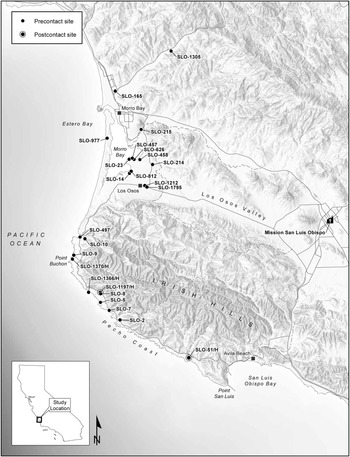
Here we consider archaeological findings from south-central California in San Luis Obispo County, specifically the Pecho Coast and Morro Bay areas where excavations were completed between 1968 and 2020 (Figure 1). Pecho Coast is a rocky 20 km long peninsula between Point San Luis Obispo and Hazard Canyon, whereas Morro Bay is an 8.1 km2 estuary immediately to the north. The Pecho Coast's high-energy, wave-battered shoreline harbors abundant California mussels (Mytilus californianus), abalone (Haliotis spp.), and turban snails (Tegula spp.). Kelp beds offshore provide habitat for rockfish (Sebastes spp.), cabezon (Scorpaenichthys marmoratus), and Pacific sardines (Sardinops sagax). Coastal terraces and low hills are covered with scrub, grassland, and oak woodland that provide habitat for acorns, seeds, rabbits, and deer. Oaks are not found much closer than 1 km from the shoreline. The Morro Bay estuary is a protected habitat with a mud/sand/gravel substrate that provided a habitat for 19 species of clams and cockles, as well as oysters (Ostrea lurida). Historically, the Morro Bay dunes were covered with coastal sagebrush shrub and some coast live oak (Quercus agrifolia) forest that is more prevalent inland. Fish include many small schooling species such as surfperches (Embiotocidae) and New World silversides (Atherinopsidae). The bay's marshes also provide habitat for migratory birds. Marine mammals that frequent both Morro Bay and the Pecho Coast include sea otters (Enhydra lutris), harbor seals (Phoca vitulina), and California sea lions (Zalophus californianus). Northern fur seals (Callorhinus ursinus) were present prehistorically.
Study sites mentioned in text.

Field and Analytical Methods
Most of the excavation findings discussed here derive from three major projects: the Los Osos Sewer project at Morro Bay (Jones et al. Reference Jones, Deborah A., Hildebrandt, Hadick and Mikkelsen2019), Cal Poly San Luis Obispo field classes (2004–2017) on the Pecho Coast (Jones and Codding Reference Jones and Codding2019), and Greenwood's (Reference Greenwood1972) mitigation work for the Diablo Canyon Nuclear Power Plant, also on the Pecho Coast. With the exception of Greenwood's work, which was completed with 6 mm (¼-inch) mesh screening, all the deposits were excavated using 3 mm (⅛-inch) mesh. Recovery volumes varied, as did unit dimensions, but the majority of excavations involved 1 × 2 m units excavated in arbitrary 10 cm levels. Here we consider only formal artifact assemblages, fish remains, and paleoethnobotanical remains from temporally controlled contexts. Findings from Greenwood's work were used only for their artifactual data, which were evaluated for diversity. We also calculated the volumetric densities of three key artifacts—projectile points, milling tools, and fishing equipment—to evaluate the relative importance of activities related to those items. A mix of dry and wet screening was used at some sites; we here consider only dry-screened results from 3 mm mesh for evaluation of fish remains that were identified by Ken Gobalet using a reference collection in the Department of Biology at CSU Bakersfield. Additional information on the recovery of fish remains is available from Jones and coauthors (Reference Jones, Gobalet, Mikkelsen, Hadick, Hildebrandt and Jones2016, Reference Jones, Jones, Hadick, Gobalet, Porcasi and Hildebrandt2017). To compare the abundance of fish remains between components, we calculated the volumetric density of fish bones (NISP/m3) and divided that by the number of centuries of occupation (NISP/m3/century).
The recovery of paleoethnobotanical remains involved specialized methods (flotation) that were used only at some sites. From the Pecho Coast, botanical remains were recovered exclusively from features, whereas some column samples from Morro Bay were subjected to these methods. Flotation was conducted using a manual tub technique to process hundreds of samples in northern and central California (Wohlgemuth Reference Wohlgemuth, Basgall and Hildebrandt1989). Buoyant light fraction was collected using 40 mesh/inch (0.4 mm) screen and then heavy fraction washed through 1 mm (window screen) mesh. Inasmuch as recovery effectiveness measured at other sites ranges from 85%–95% of dense nutshell and berry pits, and more than 98% of small seeds, only the buoyant light fraction material was sorted for charred plant remains. The light fraction was size-sorted using 2 mm, 1 mm, 0.7 mm, and 0.5 mm mesh. All seed and fruit remains were removed from the sorted portions of samples. Nutshell fragments were sorted only to the 0.7 mm grade, whereas small seeds were sorted to the 0.5 mm grade. Unidentified nongrain pieces (not wood charcoal, nutshell, or seeds) were sorted only from the 2 mm grade, and wood charcoal was sorted from the 2 mm and 1 mm grades. All segregated constituents were counted, but fragments of nutshell and wood charcoal were weighed to 0.1 mg. Remains were identified by Wohlgemuth and Angela Armstrong-Ingram using a reference collection maintained at the Far Western Anthropological Research Group in Davis, California.
To evaluate site seasonality, we considered the presence/absence of floral and some faunal resources that were restricted in their yearly availability. In addition to migrating shorebirds at Morro Bay, other seasonally restricted animals include California sea lions (present from the fall through the spring), northern fur seals (present offshore only in winter), Pacific hake (Merluccius productus; present in winter and spring only), plainfin midshipman (Porichthys notatus; present in late winter and spring), and bat ray (Myliobatis californica; present in summer only). In addition to acorns, which were available in the fall, other important seasonally restricted plant foods were islay (Prunus ilicifolia; fall), brome (Bromus spp.; spring), red maids (Calandrinia ciliata; spring), clover (Trifolium spp.; spring), fescue (Vulpia spp.; spring), and goosefoot (Chenopodium spp.; summer). We also note the results from one specialized seasonality analysis (oxygen isotopes) reported previously (Jones et al. Reference Jones, Kennett, Kennett and Codding2008).Footnote 2
Component function was defined based on two criteria. First, the Margalef diversity index (Magurran Reference Magurran2013) was calculated for all components that yielded at least 10 formal artifacts (Supplemental Table 1), using functional artifact categories and excluding beads. Components that produced diversity scores of 2.5 or greater that also showed occupation profiles covering at least three seasons were classified as long-term residential bases. Components with diversity values of less than 2.5, seasonality profiles covering less than three seasons, or both, were classified as short-term residential bases. Components lacking seasonality data were generally not assigned to a functional category. However, two components with low diversity scores (< 2.0) and high volumetric frequency of one artifact class (projectile points) were considered task-specific locations.
To examine how these key indicators of sedentism varied over time, we followed previous statistical approaches used in the study area (see Codding et al. Reference Codding, Porcasi and Jones2010). Specifically, we fit functional artifact diversity, fish bone density, and charred nut density as a function of the midpoint of the component's dates using generalized linear models in R (R Core Team 2019). We specified a Gamma distribution and inverse link, appropriate for highly skewed data (Faraway Reference Faraway2016). Results report the predicted trend, likelihood r-square value (rl2), and the p-value.
Results
Based on 93 calibrated radiocarbon dates, 18 temporal components were identified on the Pecho Coast from 11 sites, dating from 11,100 to 120 cal BP, and 19 temporal components were defined at Morro Bay from 13 sites spanning 8100–300 cal BP, based on 91 dates (Supplemental Table 1).Footnote 3 Of the 37 temporal components, 28 produced formal artifact assemblages that could be evaluated quantitatively to help define component function, 27 yielded fish remains that were methodologically comparable to one another (from dry-screened 3 mm mesh samples), 9 yielded paleoethnobotanical remains, and seasonality estimates were made for 19. Based on diversity and seasonality assessments, 22 components were assigned to functional categories.
Postcontact Occupation
California archaeologists have recently been criticized for inadequately linking the archaeological record to historic and living Native Californians and their cultures (Panich and Schneider Reference Panich and Schneider2019). We sought to explicitly make this critical connection in our research on the south-central coast; however, establishing this linkage for some areas of California is challenging because of imprecise, incomplete, and unpublished historic records. North of the present study area on the Big Sur coast, the field notes from J. P. Harrington's work with multiple Salinan-speaking consultants include detailed (albeit confusing) maps of sites and other locations known and used by Native people as recently as the twentieth century. Jones and coauthors (Reference Jones, Anderson, Brown, Garsia, Hildebrand and York1989, Reference Jones, Rivers, Joslin, Maliarik and Alger2000) and Rivers and Jones (Reference Rivers and Jones1993) linked these place names to dozens of locations—some with archaeological residues and some without. The Harrington notes for other parts of the central coast lack sufficient locational details to establish such connections with any degree of confidence. Harrington never walked the Pecho Coast with his primary consultant, Rosario Cooper, nor did the Spanish explorers. The other primary source of data, Spanish mission records, lists names of villages with only vague locational descriptions. As such, delineating the Northern Chumash cultural landscape has been a long-standing challenge. Harrington's notes establish that the area surrounding Mission San Luis Obispo was known as yak tichu tichu yak tilhini (Klar Reference Klar1991), but the boundaries of this polity and the location of constituent villages, use areas, and other sites are not known. A long series of varying ethnogeographic maps has been presented based primarily on mission records (Greenwood Reference Greenwood and Heizer1978; King Reference King1975; Kroeber Reference Kroeber1925; Milliken and Johnson Reference Milliken and Johnson2005), the most recent of which depicts one village, Tsquieu (Tstyiwi) situated somewhere along the 20 km of Pecho Coast where more than 50 archaeological sites have also been recorded. Likewise, nearly 100 archaeological sites have been recorded in the Morro Bay area, but Spanish accounts suggest that only one village was occupied there in 1770 (Brown Reference Brown2001), and we have no historic information on other types of sites such as resource-procurement areas or special-purpose locations.
CA-SLO-51/H was first recorded by Arnold Pilling in the late 1940s as a large shell midden overlain partially by the remains of an historic (post-1850) adobe, known as Rancho del Pecho or Pecho adobe. Greenwood (Reference Greenwood1972) tested CA-SLO-51/H in 1968 and recovered a single glass bead. She was also the first to report village names gleaned from Harrington's work with yak tichu tichu yak tilhini Northern Chumash consultant Rosario Cooper, who stated that Rancho del Pecho was the location of Tstyiwi. However, in her 1978 ethnographic summary, Greenwood did not explicitly link CA-SLO-51/H with the village and depicted no villages on the Pecho Coast.
A Cal Poly San Luis Obispo field class in collaboration with the University of Utah Archaeological Center investigated CA-SLO-51/H in 2015 at the behest of its current owner, PG&E, which was concerned about impacts to the deposit from an ongoing farming operation. A series of excavation units was laid out in two areas: the eastern edge of the site where there was evidence for impacts from plowing (Units 1–4) and the northern edge of the deposit (Units 5 and 6) where a long-established fence protected a sector of the deposit from plowing. Excavation revealed that Units 5 and 6 were deeper and more intact than the other site area. The only discrete feature identified during the investigation, a dense hearth-like concentration of rock, charcoal, and ash that yielded abundant ethnobotanical remains, was discovered in Unit 6. A total of nine radiocarbon dates (Table 1; Figure 2) revealed horizontal separation of temporal residues. Three dates from Unit 5, away from the agricultural field, show a 95% range from 267 to 0 cal BP, with an auger date (obtained from beneath the maximum depth [50 cm] of actual hand excavation) extending the span of occupation in that area to 377–134 cal BP. These dates suggest strongly that the midden materials recovered from 0–50 cm in Units 5 and 6 primarily represent postcontact (post–240 cal BP) occupation between approximately 250 and 120 cal BP. The dates from Units 1–4 are generally older than those obtained from Unit 5. Excluding a Middle Period date obtained via auger from the 90–100 cm level, three of the four remaining dates from Units 1 and 4 show a 95% range from 674 to 275 cal BP; the final one ranges from 277 to 0 cal BP. Thus, three samples from Units 1 and 4 exhibit 95% ranges that do not extend into postcontact time. These findings, combined with the fact that seven of the nine glass beads recovered from the site came from Units 5 and 6, suggest that Units 1–4 primarily represent occupation of the village of Tstyiwi during the Late Prehistoric period (ca. 600–250 cal BP), whereas Units 5 and 6 predominantly represent postcontact occupation.
Calibrated 95% range of radiocarbon dates from CA-SLO-51/H and SLO-1197/H (+ = median probability).

Radiocarbon Determinations for Sites with Pre- and Postcontact Occupation at the Pecho Coast.

One additional postcontact component was recently identified on the Pecho Coast based on radiocarbon evidence alone (Table 1). Although only a small sample (0.8 m3) is available, radiocarbon dates indicate that CA-SLO-1197/H was initially occupied as early as 330 cal BP and continued to be used into the nineteenth century. No ethnographic village or camp name can be linked to the occupation, nor could pre- and postcontact components be delineated. Nonetheless, the site testifies to additional use of the Pecho Coast by yak tichu tichu yak tilhini Northern Chumash after the Spanish intrusion.
Fish Remains
Fish remains from the Pecho Coast were dominated by rockfish and cabezon (Supplemental Table 1) that were likely caught with hooks, whereas components from Morro Bay were dominated by New World silversides, surfperches, or herrings,Footnote 4 most likely caught with nets. The volumetric density of remains was consistent with patterning in artifact assemblages, especially the postcontact component at CA-SLO-51/H that yielded 8,873 fish bones/m3/century, more than an order of magnitude greater than any other component (Supplemental Table 1; Figure 3b). As shown in Figure 3b, this density of fish bone is well above the general trend modeled through time, indicating that the reliance on fishing during the postcontact occupation at CA-SLO-51/H was greater than anything previously recorded in the study area. The newly recognized pre/postcontact component at CA-SLO-1197/H shows an intermediate volumetric density of fish remains (723 m3/century), which is greater than any precontact component but less than that of CA-SLO-51/H. The next highest value in the current study area is associated with the Middle–Late Transition at CA-SLO-457, which showed a value (677/m3/century) distinctively higher than any other occupation at Morro Bay. Jones and colleagues (Reference Jones, Jones, Hadick, Gobalet, Porcasi and Hildebrandt2017) attributed the spike in fish remains at SLO-457 to a downturn in terrestrial productivity during extreme droughts of the Medieval Climatic Anomaly. Whether that assessment is correct or not, the even greater fish bone recovery from CA-SLO-51/H and CA-SLO-1197/H suggests an unprecedented amount of fishing during the postcontact period. This is illustrated clearly in Figure 3b, where a model fitting fish bone density as a function of time accounts for 45% of the variance (p = 0.0031), with CA-SLO-51/H driving the exponential fit.
Artifactual, faunal, and paleoethnobotanical indicators of sedentism for each component through time with each point color-coded by the number of seasons occupied (see Supplemental Table 1). (a) Artifact diversity increases gradually through time, while the density of (b) fish bones and (c) charred nutshells increase exponentially in the postcontact period driven by Tstyiwi (CA-SLO-51/H). Trend lines show the predicted fit of a Gamma generalized linear model. Model likelihood r-squared (rl2) and p-values appear above each panel.

Projectile Points
Volumetric density of projectile points at the two sites with postcontact components was noticeably higher (5.7 points/m3 at SLO-51/H and 4.7/m3 at SLO-1197/H) than all but one of the 35 precontact components (Supplemental Table 1). The Early period occupation at SLO-1305 showed an extraordinary abundance of projectile points (14.9 m3) that we interpreted as evidence for a specialized hunting location. The high frequency of points from the postcontact contexts without high densities of hunted game suggests the possibility that site inhabitants may have prepared to defend themselves in the face of the Spanish incursion.
Paleoethnobotanical Remains
Charred plant remains from nine components represent the Early through postcontact periods only (Supplemental Table 1; Table 2; Figure 3). Analysis identified five genera of nuts, two berries, 27 small seeds, one Brodiaea group corm, and foliage of yucca. Of these, however, only remains of three nuts (acorns, bay nuts, and wild cucumber), manzanita and wax myrtle berry pits, and seven genera of small seeds (red maids, goosefoot, bedstraw, bird's foot, phacelia, sage, and fescue) were common in at least one site component. Small seeds that could be identified only to the sunflower, bean, mint, and grass families were also common in some components. Three common taxa were not eaten: wild cucumber and bedstraw were used medicinally, and although wax myrtle was used for wax, its abundance is probably due more to use of this shrub as firewood. The other 33 common taxa are from plants that are well-described ethnographic foods. Also identified were 12 Eurasian cultigen grains, including four barley and three wheat from the postcontact component at CA-SLO-51/H. As with fish bone density, by far the highest density of charred nutshell occurs at the postcontact component at CA-SLO-51/H, which is largely responsible for driving the exponential trend over time (Figure 3c) that accounts for 66% of the variance (p = 0.0013).
Mean Density per Liter of Charred Plant Remains from Morro Bay and Pecho Coast Components.

Notes: ct = count/liter; mg = milligrams/liter; + = present but not quantifiable
Seasonality
Seasonality implications from the paleoethnobotanical and faunal indicators show only seasonally restricted occupations prior to the onset of the Early period with summer-only, winter-only, or winter and summer (Figure 4). Occupations postdating the beginning of the Early period (after 5700 cal BP) show both long-term (three or more seasons) and short-term (one or two seasons) occupation. Early period components at CA-SLO-23 and SLO-165 at Morro Bay represent occupations from spring through fall, with possible year-round use of CA-SLO-23. The winter–spring profile of CA-SLO-1370/H seems to complement the spring–fall emphasis at CA-SLO-23 and SLO-165, reflecting an overall settlement strategy that included seasonal movements. Nine components dating between the Early and Late periods exhibit seasonally restricted occupations of one or two seasons, again with emphasis on either summer, winter, or both. The Late period occupations at CA-SLO-23 and SLO-626 (Morro Bay) are seasonally prolonged, with the possibility of year-round site use at CA-SLO-23. Still, CA-SLO-1366/H on the Pecho Coast was used only during the winter–spring during the Late period, suggesting ongoing use of a seasonally mobile settlement system.
Summary of component seasonality based on paleoethnobotanical, faunal, and stable isotope2 indicators.

In contrast with other study sites, CA-SLO-51/H exhibited a dense and wide range of charred plant taxa that ripen in the full range of seasons in which plants can be gathered (Table 2). If we focus only on the most abundant key plant foods, the full range of seasonal indicators is also represented, with fall nuts (acorn and islay), vernal seeds (brome, red maids, clover, and fescue), and summer seeds (goosefoot) and berries (manzanita). Additionally, the high frequency of nuts and small seeds suggests intensive site use consistent with year-round occupation.
Artifact Diversity, Density, and Component Function
Most components yielded artifact assemblages diverse enough to suggest use by a broad range of social group members, meaning residential as opposed to task-specific use. Diversity scores ranged between 1.291 and 3.826 (Supplemental Table 1; Figure 3a). The record shows a gradual increase in artifact diversity over time (Figure 3a), accounting for about 10% of the variation; however, the trend is only marginally significant (p = 0.09), suggesting that other factors—such as site type—account for additional variation in artifact diversity. For the most part, assemblage diversity was consistent with seasonality inferences in that sites with longer seasonal profiles tended to exhibit greater assemblage diversity. Combining diversity scores with seasonality findings, three components were classified as long-term residential bases, 16 were short-term residential bases, one was a task-specific location, and one (the postcontact occupation at CA-SLO-51/H) was classified as a year-round residential base. All the pre-5700 cal BP components (Millingstone/Lower Archaic) were classified as short-term residential bases; only after 5700 cal BP (Early period) are long-term residential occupations evident at CA-SLO-23 and SLO-165 at Morro Bay. Eleven components dating from the Early and Middle Periods were classified as short-term residential bases that seem to complement the long-term residential site use at CA-SLO-23 and SLO-165. Use of these two types of settlements seems consistent with a fission-fusion settlement strategy that can be linked to more intensive use of acorns from this point forward, as others have suggested (Glassow Reference Glassow and Glassow2020; Jones Reference Jones1996; Rosenthal and Hildebrandt Reference Rosenthal and Hildebrandt2019). Directly dated macrofossils and mortars and pestles from the Early period component at CA-SLO-165 suggest intensive use of acorns at this time depth.
Sites from the Late Prehistoric period, predating the Spanish intrusion, show continued use of both long- and short-term residential bases; however, the latter are less numerous, and CA-SLO-23 actually shows evidence for year-round use. At Morro Bay, this apparent decrease in the number of short-term residential sites is associated with a slight shift inland for Late period long-term residential settlements, which is also seen across the entire central coast region (Jones Reference Jones and Jones1992) and is attributed to at least a modest increase in the use of terrestrial foods, likely acorns. However, short-term occupation of CA-SLO-1366/H on the Pecho Coast during the Late period suggests the continued use of multiple settlements through the year, and not full sedentism.
The postcontact occupation of Tstyiwi at CA-SLO-51/H showed a diversity value of 3.211, consistent with long-term (but not necessarily year-round) use, although this was not the highest value in the sample and is only slightly above the predicted temporal trend modeled in Figure 3a. This site also showed strikingly high densities of projectile points (5.7/m3), milling tools (1.6/m3), and fishing equipment (11.5/m3)—a combination unique to the study area that also seems consistent with pursuit of a wide range of activities and an intensity of site use greater than at any other study location. Especially noteworthy was the high density of fishing equipment compared with other sites.
Summary
Combined artifact, faunal, and paleoethnobotanical findings from 24 sites and 37 temporal components spanning 11,100–120 cal BP suggests modest variation over time in settlement and subsistence leading up to the Spanish invasion in 1769. Coincident with the greater use of acorns, a shift to a fission-fusion system in which groups aggregated in larger communities generally in the fall and split up into smaller encampments during other times of the year is apparent after about 5700 cal BP. The fall congregation involved acorn collection, and there is some indication that acorn use increased slightly during the Late Prehistoric period as represented by the findings from the precontact component at CA-SLO-23 (compared with earlier sites).
Variation between CA-SLO-51/H representing the village of Tstyiwi and all earlier components is much more pronounced than the modest intensification evident during the Late period. The postcontact component at this site shows extremely high volumetric densities of projectile points, ground stone, fishing equipment, and fish remains, along with a clear year-round seasonality profile based on botanical and faunal remains.
Discussion
For over 10,000 years prior to the arrival of the Spanish in 1769, yak tichu tichu yak tilhini Northern Chumash people subsisted on a mixed economy that included a wide variety of marine and terrestrial foods collected via a settlement strategy that involved seasonal movements between different types of residential bases. At least as early as 5,700 years ago when it is clear that acorns were part of their diet, people occupied long-term residential bases in late summer through early winter and moved to short-term residential sites, like CA-SLO-1370/H, in the late winter and early spring as part of an overall fission-fusion settlement system that persisted for more than 5,000 years through the Late Prehistoric period.
All these precontact changes, however, pale in comparison to the necessary adjustments exhibited at CA-SLO-51/H, the postcontact village of Tstyiwi—especially the high volumetric densities of fishing equipment and fish remains, the year-round seasonality profile, and the abundance of projectile points. We interpret the striking differences between the precontact occupation of Morro Bay and the Pecho Coast and the postcontact component at CA-SLO-51/H as signs of logical adjustment made by the inhabitants of the village to the Tstyiwi during the first decades following the appearance of the Spanish. CA-SLO-51/H is situated 5 km from the port (Avila Beach) used by the Spanish to establish their mission at San Luis Obispo. In response to the arrival of the Spanish, we surmise that village inhabitants tried to avoid the intruders (see discussion by Lightfoot and Simmons Reference Lightfoot and Simmons1998), curtailing forays to different settlements. Paleoenvironmental evidence to the south indicates that Spanish land use also altered the terrestrial ecosystem through grazing, introduced plants, and reduced fire activity (Anderson et al. Reference Anderson, Ejarque, Rice, Smith and Lebow2015), which likely limited traditional resource availability. As a result, individuals began relying more heavily on locally available fish than they had at any time in the past, as indicated by the extraordinary abundance of fish remains and fishing equipment recovered from the midden deposit at CA-SLO-51/H. Preliminary findings from a newly identified site with radiocarbon evidence for both pre- and postcontact occupation (CA-SLO-1197/H) also show a higher density of fish remains than any strictly precontact occupation.
Fish had sustained people on the Pecho Coast and at Morro Bay for 10,000 years and had helped people weather the medieval droughts. Slow increases in fish remains over the Holocene also suggest that this resource could always be relied on to feed growing numbers of people. In the face of new challenges from outside, people turned yet again to this reliable local resource, transforming a part-time settlement into a year-round fishing village. That people persisted at this traditional location for several decades after the Spanish invasion is consistent with recent findings from the San Francisco Bay area (Byrd et al. Reference Byrd, Dearmond and Enbring2018). Although the character of site use at Tstyiwi seems to have changed, cultural continuity is also evident: the archaeological record shows increased intensity of traditional subsistence pursued with traditional technologies. Greater density and a wider variety of acorns and other traditional plant foods further suggest that year-round site occupation also featured pronounced intensification of vegetable foods, possibly reflecting the congregation of more people from the surrounding area; traditional plant foods served to maintain and reinforce social relationships as Reddy (Reference Reddy2015) suggests for the Tongva in southern California. More intensified use of local plant foods also seems consistent with attempts to avoid the Spanish, a phenomenon noted by Bernard and Robinson (Reference Bernard, Robinson, Hull and Douglass2018) for the postcontact refuge communities among the Emigdiano in the rugged interior of the Chumash-speaking region. In contrast, high frequencies of projectile points at the postcontact Pecho settlements without high densities of faunal remains of hunted game suggest that the local survival strategy also included preparations to defend against the Spanish in cases when avoidance was no longer possible.
In general, our results from the Pecho Coast and Morro Bay indicate that, to maintain their social autonomy in this colonially circumscribed environment, individuals intensified their work in traditional outlets to levels never before seen on the central coast. As others have argued elsewhere in California (e.g., Panich Reference Panich2013; Panich and Schneider Reference Panich and Schneider2015; Schneider Reference Schneider2015; Silliman Reference Silliman2001a, Reference Silliman2001b), this is a testament to the resilience of this community and the agency of its members. Radiocarbon dates, glass beads, and remains of Eurasian domesticates indicate contact between the Spanish and the inhabitants of Tstyiwi before the last inhabitant of the village was brought to Mission San Luis Obispo in 1803, ending two decades of postcontact autonomy (Milliken and Johnson Reference Milliken and Johnson2005). Our currently available historic and archaeological data provide us with no understanding of activities at Tstyiwi during the first half of the nineteenth century. A Mexican land grant was established on the property in 1858. Nonetheless, at least some cultural memory of the site and its name was carried forward, given that Rosario Cooper provided the name Tstyiwi to J. P. Harrington in 1916 (Greenwood Reference Greenwood1972:83). Two of Rosario Cooper's great-great-great-grandchildren, Matthew Goldman and MacKenzie Goldman, were present when investigations in 2015 definitively linked the place name to the archaeological site CA-SLO-51/H.
Acknowledgments
Most of the findings reported here are the results of investigations undertaken for the Los Osos Wastewater project at Morro Bay between 2002 and 2014 and Cal Poly San Luis Obispo archaeological field classes conducted between 2004 and 2017 on traditional lands of yak tityu tityu Northern Chumash. We thank Elise Wheeler, Maggie Trumbly, Sally Krenn, Kelly Kephart, Mike Taggart, and Kate Ballantyne for facilitating that work. We thank Chelsea Karthauser for the preparation of Figure 1. We also are deeply indebted to Matthew Goldman, McKenzie Goldman, the late Leilynn Odom, Peggy Odom, Johnnie Odom, and Mona Tucker, and representatives of the yak tityu tityu Northern Chumash Tribe who consulted on the projects during the planning stages and participated in fieldwork. We are honored to be able to continue our collaboration with them.
Data Availability Statement
Data supporting findings from the Pecho Coast are presented in Jones and Codding (Reference Jones and Codding2019). Data from Morro Bay investigations are published in Jones and coauthors (Reference Jones, Deborah A., Hildebrandt, Hadick and Mikkelsen2019). The latter work includes supplemental data tables available at UofUPress.com. All collections resulting from this work were curated at the San Luis Obispo County Archaeological Society Curation Facility, San Luis Obispo.
Supplemental Material
For supplemental material accompanying this article, visit https://doi.org/10.1017/aaq.2022.1.
Supplemental Table 1. Temporal Components, Assemblage Characteristics, Seasonality, and Fish Remains in the Morro Bay and Pecho Coast Study Area.
Supplemental Text 1. Supplemental References for Supplemental Table 1.