Introduction
Rice serves as a staple food for approximately 65% of the population in China (Hsiaoping, Reference Hsiaoping, Toriyama, Heong and Hardy2005). To ensure rice self-sufficiency and food security, there has been a major effort in China to increase rice productivity by improving the yield potential of the rice plant. Hard work pays off; the yield potential of rice grown in China increased by ∼30% as a result of the development of semi-dwarf varieties in the late 1950s and further increased by 10–20% through the use of heterosis in the late 1970s (Cheng et al., Reference Cheng, Zhuang, Fan, Du and Cao2007; Peng et al., Reference Peng, Tang and Zou2009), and an additional increase of more than 10% was achieved by the development of super-rice hybrids in the late 1990s–2000s (Huang et al., Reference Huang, Zou, Jiang, Xia, Ibrahim and Ao2011; Zhang et al., Reference Zhang, Tang, Zou, Li, Qin, Yang, Chen, Xia and Peng2009). Moreover, the yield potential of rice continuously increases in China as new super-rice hybrids are deployed (Yuan, Reference Yuan2017).
Grain yield in rice is formed by producing biomass and partitioning the biomass into the grains, and it can be increased by increasing biomass production or by increasing the ratio of biomass partitioned into grains (i.e., harvest index), or both. It has been well-documented that the increase in yield potential by the development of semi-dwarf rice varieties is attributable to an increase in the harvest index, while the increases in yield potential by the development of rice hybrids and super-rice hybrids are mainly due to increases in biomass production (Peng et al., Reference Peng, Cassman, Virmani, Sheehy and Khush1999; Peng et al., Reference Peng, Laza, Visperas, Sanico, Cassman and Khush2000; Zhang et al., Reference Zhang, Tang, Zou, Li, Qin, Yang, Chen, Xia and Peng2009). In addition, it is generally considered that any further improvement in rice yield potential will depend on an increase in biomass production (Ma and Yuan, Reference Ma and Yuan2016).
Biomass production can be increased by either prolonging the crop growth duration or increasing the crop growth rate (CGR) (i.e., the gain in biomass production per unit time). However, it is not practical to increase biomass production by prolonging the growth duration of rice in China because: (1) rice varieties with shorter growth durations fit better into multiple cropping systems than do those with longer durations, and they play an important role in ensuring the production of sufficient rice and other crops in China which has 22% of the world’s population but only 7% of the world’s arable land and (2) the emergence of large-scale farming shortens the crop growth duration in multiple cropping systems due to increases in the time of farming operations (Chen et al., Reference Chen, Huang, Cao, Yin and Zou2020a; Huang and Zou, Reference Huang and Zou2018). This highlights the fact that developing super-rice hybrids with short growth durations and high CGR is vital for achieving substantial increases in biomass production and grain yield of rice in China. In this regard, it has been recognized that the CGR is affected by climatic conditions such as temperature and the level of solar radiation as well as crop canopy traits including leaf area index (LAI) and leaf photosynthetic capacity (e.g., leaf N content, LNC) (Huang et al., Reference Huang, Zhang, Jiang, Xie, Zhou, Cao and Zou2016; Takai et al., Reference Takai, Matsuura, Nishio, Ohsumi, Shiraiwa and Horie2006; Ying et al., Reference Ying, Peng, He, Yang, Yang, Visperas and Cassman1998). Chen et al. (Reference Chen, Zhang, Cao, Yin, Zou, Huang and Abou-Elwafa2020b) reported that short-duration rice hybrids had higher apparent radiation use efficiency (RUE) and consequently higher CGR and biomass production during the post-heading period than long-duration rice hybrids. However, there is limited information available on the physiological factors contributing to the higher RUE during the post-heading period in short-duration rice hybrids, and it is not clear whether the previous finding is applicable to super-rice hybrids.
In this study, climatic conditions during the growing season and crop traits including grain yield, biomass production and remobilization, harvest index, and CGR and its related factors were compared between two super-rice hybrids with different growth durations in a 3-year field experiment. The objective of this study was to determine the characteristics of yield formation in the shorter-duration super-rice hybrid.
Materials and Methods
Field experiments were conducted at the research farm of the Crop and Environment Research Center (28°09′ N, 113°37′ E, 43 m asl) at Hunan Agricultural University, China from 2018 to 2020. The research farm has a moist subtropical monsoon climate, which allows two to three cropping cycles per year (e.g., rice-rice, rice-rapeseed, rice-rice-milk vetch). The soil of the experimental field is clay in texture with the following chemical properties in the upper 20 cm layer: pH = 6.16, organic matter = 34.8 g kg–1, available N = 140 mg kg–1, available P = 28.9 mg kg–1, and available K = 118 mg kg–1.
Two rice hybrids, ‘Guiliangyou 2’ (G2) and ‘Y-liangyou 1’ (Y1), were used in the experiment. G2 and Y1 were developed at the Rice Research Institute, Guangxi Academy of Agricultural Sciences in 2008 and the Hunan Hybrid Rice Research Institute in 2006 and approved as super rice by the Ministry of Agriculture of China in 2010 and 2006, respectively. These two hybrids were selected because they have different growth durations. Preliminary variety tests at the research farm showed that the growth duration is ∼10 days shorter in G2 (∼120 days) compared to Y1 (∼130 days).
The two super-rice hybrids (G2 and Y1) were planted in a randomized complete-block design with four replications and a plot size of 60 m2. Pre-germinated seeds were sown on 5 May. Twenty-day-old seedlings were transplanted at a hill spacing of 20 cm × 20 cm with two seedlings per hill. Urea (46% N), superphosphate (12% P2O5), and potassium chloride (60% K2O) were used as N, P, and K fertilizers, respectively. The N fertilizer was applied in three splits: 75 kg N ha–1 as basal fertilizer (1 day before transplanting), 45 kg N ha–1 at early-tillering (7 days after transplanting), and 30 kg N ha–1 at panicle initiation. The P fertilizer was applied as a basal fertilizer at a rate of 75 kg P2O5 ha–1. The K fertilizer (150 kg K2O ha–1) was split equally as a basal fertilizer and at panicle initiation. The plots were kept flooded at a water depth of 5–10 cm from transplanting until 7 days before maturity, at which time the water was drained from the plots in preparation for harvesting. Insects, diseases, and weeds were intensively controlled by chemicals to avoid yield loss.
In each year, the daily mean temperature and solar radiation during the rice-growing season were recorded using an on-site weather station (Vantage Pro2, Davis Instruments Corp., Hayward, CA, USA). Pre-heading and post-heading cumulative solar radiation were calculated. Twelve hills were sampled from each plot at heading and maturity. Plant samples were separated into leaves, stems, and panicles at heading and into straw and filled and unfilled grains at maturity. The filled and unfilled grains were separated by submerging them in tap water. The dry weight of each plant organ was determined after oven-drying at 70°C to a constant weight. Pre-heading, post-heading, and total biomass production, biomass remobilization (i.e., pre-heading biomass translocated to the grains), harvest index, and pre-heading and post-heading CGR were calculated according to Yin et al. (Reference Yin, Chen, Cao, Tao and Huang2020). Pre- and post-heading RUE were calculated by dividing the pre- and post-heading biomass production by the cumulative solar radiation during the corresponding period, respectively. Grain yield was determined from a 5-m2 area in each plot and adjusted to a moisture content of 14%.
In 2019 and 2020, 12 hills were sampled from each plot at 7, 14, and 21 days after heading. Green leaves were collected from the sampled plants to measure leaf area using a leaf area meter (LI-3000C, Li-Cor, Lincoln, NE, USA). LAI was calculated by dividing the leaf area by the ground area occupied by the sampled plants (0.48 m2). The collected leaves were oven-dried at 70°C to a constant weight after the leaf area measurement and then ground to a fine powder with a mechanical grinder (JFSD-100-II, Shanghai Jiading Cereal and Oil Instrument Co. Ltd., Shanghai, China). Samples of ∼0.5 g of leaf powder were digested with H2SO4-H2O2 to determine the N concentration using a segmented flow analyzer (Skalar SAN Plus, Skalar Inc., Breda, The Netherlands). LNC was calculated on a leaf area basis.
Statistical analysis was performed using Statistix 8.0 (Analytical Software, Tallahassee, FL, USA). All data were analyzed by the analysis of variance to determine the significance of differences in the means between the two super-rice hybrids at the 0.05 probability level. Linear regression was employed to assess relationships between selected variables.
Results
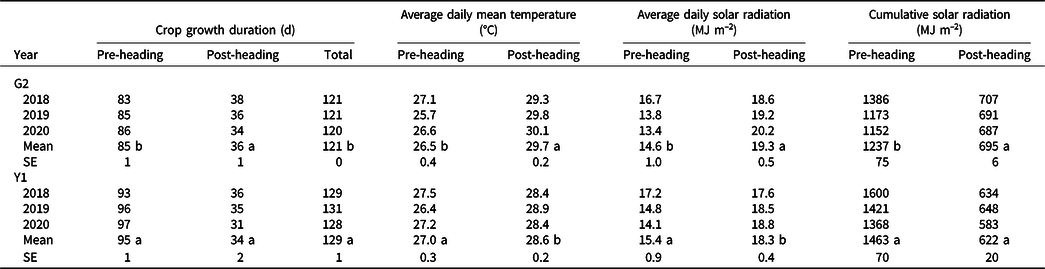
The pre-heading growth duration of G2 was 10 days shorter than that of Y1, while its post-heading growth duration was not significantly differed compared to Y1 (Table 1). The total growth duration of G2 was 8 days shorter than that of Y1. G2 experienced 0.5°C lower but 1.1°C higher average daily mean temperatures than Y1 during the pre- and post-heading periods, respectively. The average daily solar radiation was 0.8 MJ m–2 lower but 1.0 MJ m–2 higher for G2 compared to Y1 during the pre- and post-heading periods, respectively. The cumulative solar radiation was 226 MJ m–2 lower for G2 than for Y1 during the pre-heading period, whereas the difference was not significant during the post-heading period.
Crop growth duration and climatic conditions during the growing season in two super-rice hybrids, ‘Guiliangyou 2’ (G2) and ‘Y-liangyou 1’ (Y1), grown in 2018–2020

Means followed by different letters are significantly different from each other at the 0.05 probability level.
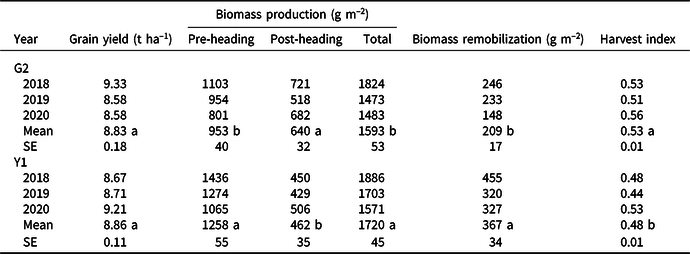
There was no significant difference in grain yield between G2 and Y1 (Table 2). Pre-heading biomass production was 24% lower in G2 than in Y1, while post-heading biomass production was 39% higher in G2 compared to Y1. Total biomass production in G2 was 7% lower than in Y1. G2 had 43% lower biomass remobilization than Y1, and the harvest index was 10% higher in G2 than in Y1.
Grain yield, biomass production and remobilization, and harvest index in two super-rice hybrids, ‘Guiliangyou 2’ (G2) and ‘Y-liangyou 1’ (Y1), grown in 2018–2020

Means followed by different letters are significantly different from each other at the 0.05 probability level.
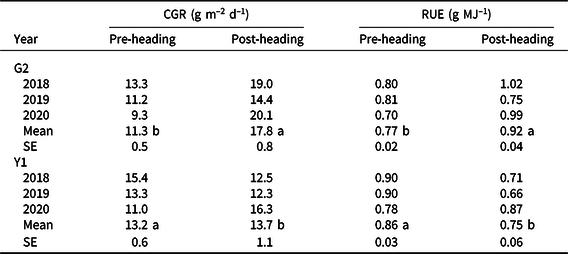
CGR was 14% lower during the pre-heading period but 30% higher during the post-heading period in G2 compared to Y1 (Table 3). G2 had 10% lower pre-heading RUE but 23% higher post-heading RUE than Y1.
Crop growth rate (CGR) and apparent radiation use efficiency (RUE) during the pre- and post-heading periods in two super-rice hybrids, ‘Guiliangyou 2’ (G2) and ‘Y-liangyou 1’ (Y1), grown in 2018–2020

Means followed by different letters are significantly different from each other at the 0.05 probability level.
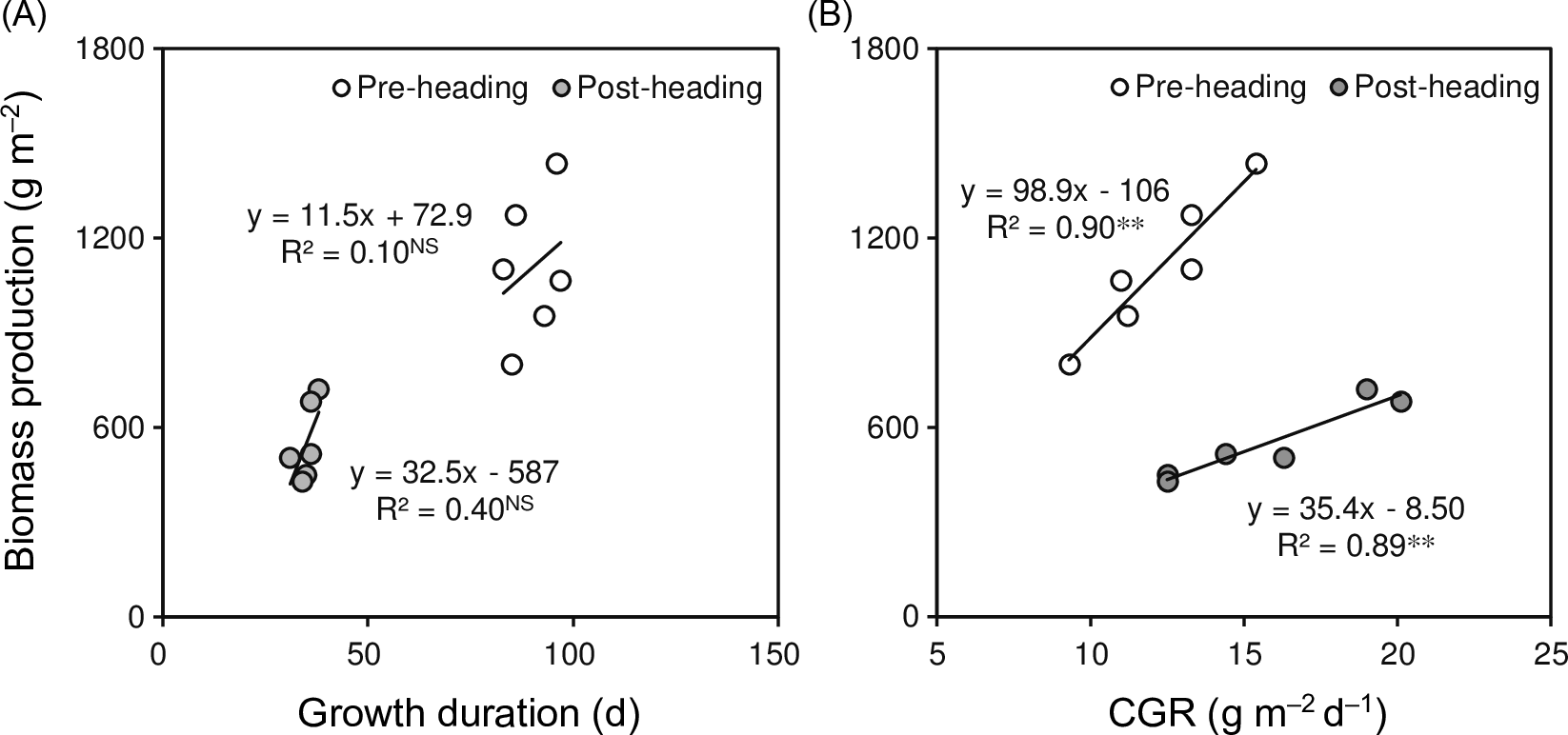
The relationship between biomass production and growth duration was not significant during the pre- or post-heading periods (Figure 1A). A significant positive relationship between biomass production and CGR was observed during both the pre- and post-heading periods; CGR explained approximately 90% of the variation in pre- and post-heading biomass production (Figure 1B).
Relationships between biomass production and growth duration (A) and between biomass production and crop growth rate (CGR) (B) during the pre- and post-heading periods for two super-rice hybrids over 3 years. NS denotes a non-significant relationship at the 0.05 probability level. ** denotes a significant relationship at the 0.01 probability level.

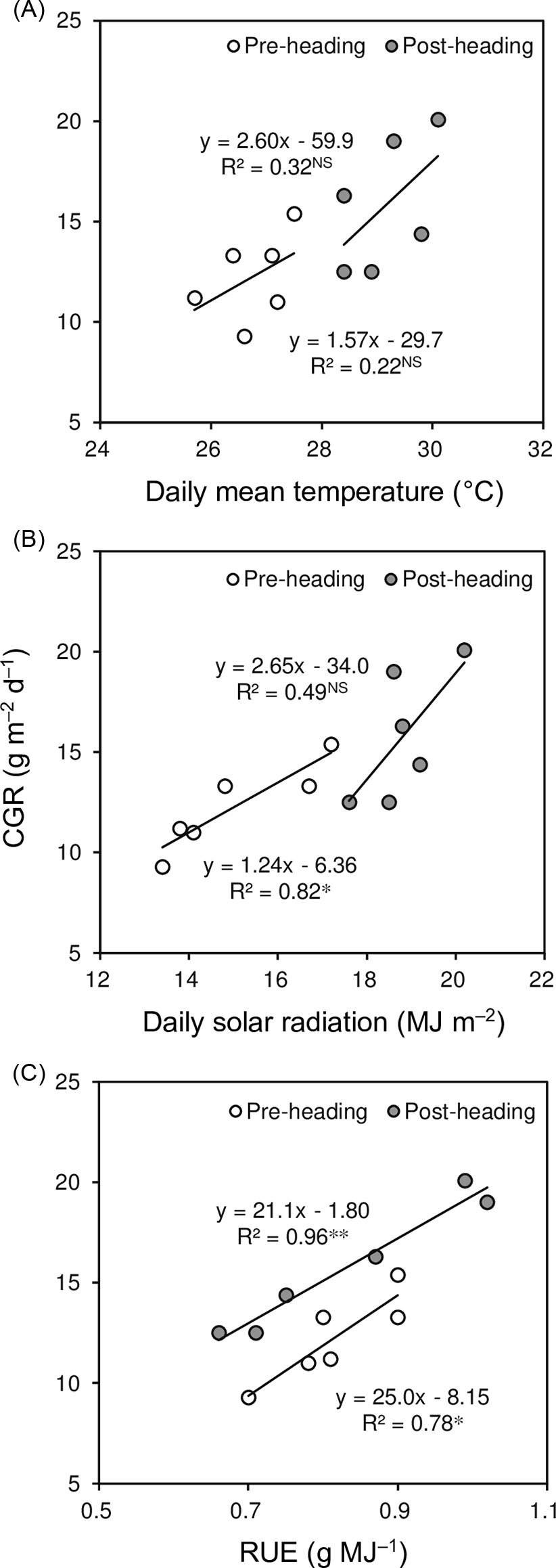
There was no significant relationship between CGR and average daily mean temperature during both the pre- and post-heading periods (Figure 2A). The relationship between CGR and average daily solar radiation was significant during the pre-heading period but not during the post-heading period (Figure 2B). CGR was significantly positively correlated with RUE during both the pre- and post-heading periods (Figure 2C).
Relationships between crop growth rate (CGR) with average daily mean temperature (A), average daily solar radiation (B), and apparent radiation use efficiency (RUE) (C) during the pre- and post-heading periods for two super-rice hybrids over 3 years. NS denotes a non-significant relationship at the 0.05 probability level. * and ** denote significant relationships at the 0.05 and 0.01 probability levels, respectively.

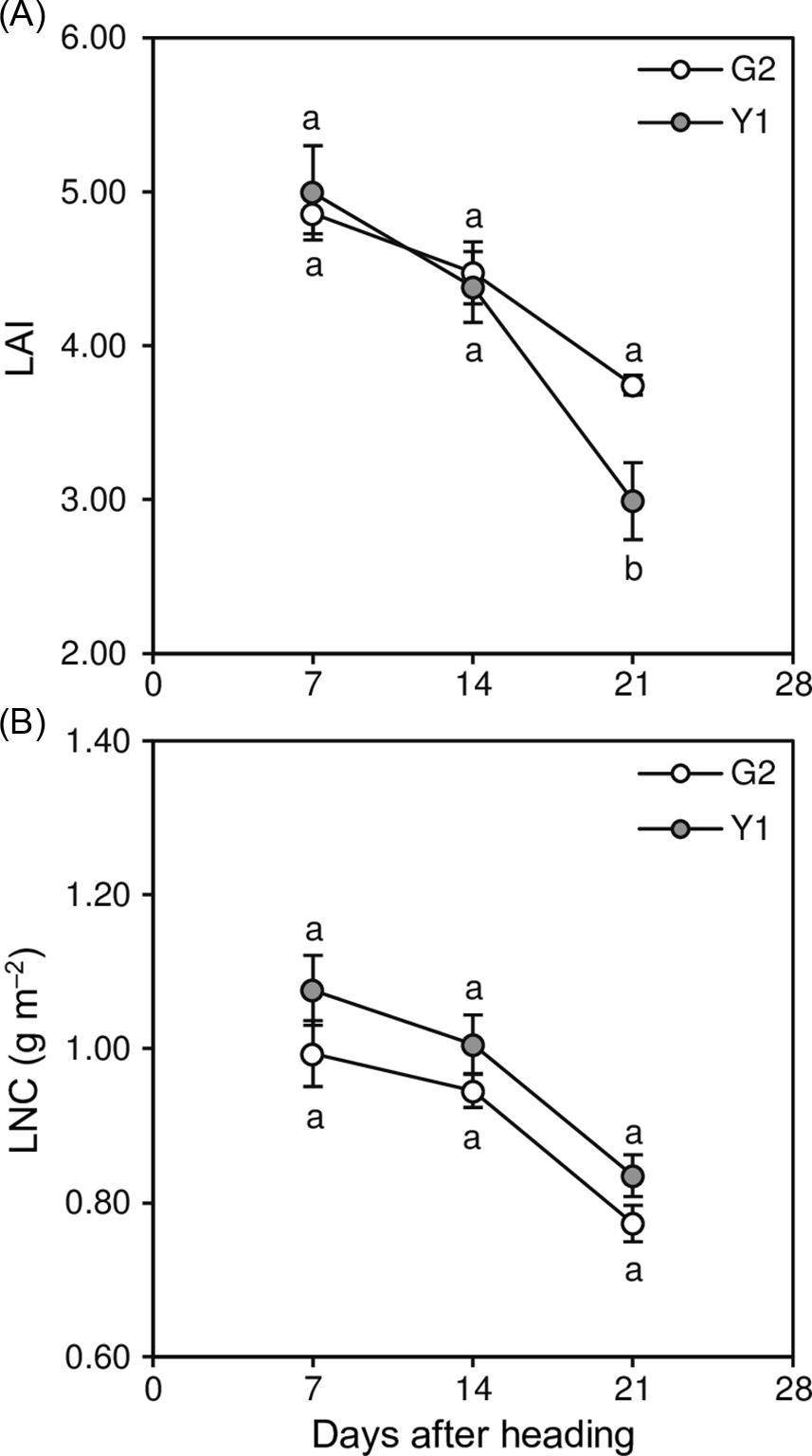
No significant differences were observed in LAI between G2 and Y1 on days 7 and 14 after heading, while on day 21 after heading the LAI for G2 was 25% higher than for Y1 (Figure 3A). The difference in LNC was not significant between G2 and Y1 at 7, 14, and 21 days after heading (Figure 3B).
Leaf area index (LAI) and leaf N content (LCN) during the post-heading period in two super-rice hybrids, ‘Guiliangyou 2’ (G2) and ‘Y-liangyou 1’ (Y1). Data are averaged across 2 years (2019 and 2020). Error bars represent the SE (n = 8). Data points labeled with different lowercase letters are significantly different from each other at the 0.05 probability level.

Discussion
Consistent with observations in preliminary variety tests, the total growth duration was ∼10 days shorter in G2 than in Y1 in this study. The shorter total growth duration in G2 was attributable to a shorter pre-heading growth duration compared to Y1, because the post-heading growth duration was slightly longer in G2 than in Y1. However, more importantly, the shorter total growth duration in G2 did not result in a significantly lower grain yield compared to Y1. This finding suggests that G2 is a super-rice hybrid, taking into account both its short growth duration and high grain yield.
Although no significant difference was observed in grain yield between G2 and Y1, they had contrasting yield formation characteristics. Compared with Y1, G2 produced lower total biomass but had a higher proportion of biomass that was partitioned into the grain (i.e., a higher harvest index). The lower total biomass production in G2 compared to Y1 was attributable to reduced biomass production during the pre-heading period, which was associated with a lower pre-heading CGR. These findings are not consistent with those of Zhang et al. (Reference Zhang, Tang, Zou, Li, Qin, Yang, Chen, Xia and Peng2009), who reported that the high grain yield of super-rice hybrids is mainly driven by increases in biomass production. These findings also highlight how increasing the harvest index can compensate for decreased biomass production and consequently enable the grain yield to be maintained at a high level in short-duration super-rice hybrids. In this regard, it is generally considered that the harvest index of modern high-yielding rice varieties is about 0.5 (Khush, Reference Khush1995). In our study, the maximum harvest index reached as high as 0.56 in the super-rice hybrid G2 (Table 2), indicating that there is still room (more than 10%) for increasing the harvest index in the development of high-yielding rice varieties.
The harvest index can be increased by increasing biomass remobilization and/or by increasing post-heading biomass production (Yang and Zhang, Reference Yang and Zhang2010). In this study, the higher harvest index in G2 was due to higher post-heading biomass production than in Y1, because the biomass remobilization was lower in G2 compared to Y1. Furthermore, this study showed that the higher post-heading biomass production in G2 than in Y1 was mainly attributable to a higher post-heading CGR. Slower leaf senescence (i.e., slower decline in LAI during the post-heading period) was partially responsible for the higher post-heading CGR in G2 compared to Y1. This could also be supported by finding that biomass remobilization, which can be improved by promoting plant senescence (Yang and Zhang, Reference Yang and Zhang2006), was lower in G2 compared to Y1.
Unexpectedly and interestingly, the results of our study show that the contrasting yield formation characteristics between the two super-rice hybrids that differ in growth duration actually had little relation to the differences in growth duration. It is well known that crop growth duration is related to the climatic conditions experienced by crops and hence affects crop growth and yield formation (Vergara et al., Reference Vergara, Tanaka, Lilis and Puranabhavung1966). In the present study, the difference in growth duration led to different daily mean temperatures and solar radiation in the two-tested super-rice hybrids during the pre- and post-heading periods. However, most of the relationships of CGR with daily mean temperature and solar radiation during the pre- and post-heading periods were not significant, except the relationship between CGR and daily solar radiation during the pre-heading period. On the contrary, both of the relationships between CGR and RUE during the pre- and post-heading periods showed positive significance. These findings suggest that it is feasible to reduce the dependence of yield formation on growth duration to a certain extent in rice by increasing the use efficiency of solar radiation through crop improvement. This also highlights the need for a greater fundamental understanding of the physiological processes involved in higher use efficiency of solar radiation in super-rice hybrids. In this study, the higher RUE during the post-heading period in G2 compared to Y1 could be partially explained by the slower leaf senescence in G2. However, there is limited information available on the factors that contribute to the higher RUE during the pre-heading period in Y1 compared to G2. Therefore, additional investigations are required to clarify this point.
There is a limitation that needs to be acknowledged and addressed in the present study. In addition to biomass production and translocation traits, yield components are also important parameters for describing the yield formation characteristics in rice. However, we did not determine the yield components in this study. Fortunately, we used G2 and Y1 in another experiment conducted at the same site as this study in 2020. The results of this experiment showed that G2 had higher spikelet number per panicle but lower spikelet filling percentage and grain weight than Y1, while they had almost the same panicle number per m2 (data not published). This experiment is continuing and additional data will be collected to draw a concrete conclusion on the differences in yield components between G2 and Y1.
Conclusions
This study identified the yield formation characteristics in the shorter-duration (∼120 days) super-rice hybrid (G2) by comparing it with a longer-duration (∼130 days) super-rice hybrid (Y1). In particular, we found that lower total biomass production resulting from lower daily solar radiation, RUE, CGR, and biomass production during the pre-heading period occurred in G2 compared to Y1, but its grain yield was not significantly lower than that of Y1 because it was compensated for by a higher harvest index that resulted from slower leaf senescence and higher RUE, CGR, and biomass production during the post-heading period.
Acknowledgements
The authors thank other members of the Crop and Environment Research Center for their help with this study.
Financial Support
This study was supported by the National Natural Science Foundation of China (31771722) and the Open Fund of the Guangxi Key Laboratory of Rice Genetics and Breeding (2018-15-Z06-KF17).
Conflicts of Interest
The authors declare none.