Palygorskite (Pal), also known as attapulgite, is a 2:1 layered-chain hydrated magnesium–aluminium-rich clay mineral. It was first discovered in 1862 by the Russian scholar T. von Ssaftschenkow within a hydrothermal alteration zone in the Palygorsk mining district of the Ural Mountains, from which its name was derived (Ssaftschenkow, Reference Ssaftschenkow1862). In China, the first major deposit was identified in Jiangsu Province in 1976 (Xu et al., Reference Xu, Fang and Li1980). Its reserves in China account for over 70% of the world’s proven reserves. A complete industrial chain from mining, purification, modification and product manufacturing has since been created in China.
Following Bradley’s seminal structural model in the 1940s (Bradley, Reference Bradley1940), which laid the key foundation for understanding the unique crystal chemistry of Pal, international research on Pal flourished in the subsequent decades. In the mid- to late twentieth century, pioneering work by Western scholars made significant contributions to the fundamental mineralogy, structural analysis and preliminary exploration of the adsorption and rheological properties of Pal (Drits & Sokolovam, Reference Drits and Sokolovam1971; Serna et al., Reference Serna, VanScoyoc and Ahlrichs1977; VanScoyoc et al., Reference VanScoyoc, Serna and Ahlrichs1979; Singer & Galán, Reference Singer and Galán1984; Galán, Reference Galán1996). These early efforts established the core scientific framework for Pal as a distinctive clay mineral. Subsequently, continuous advances in analytical techniques were developed, being used to improve the understanding of Pal’s formation mechanism, crystal chemistry and surface properties (Suarez et al., Reference Suarez, Martin Pozas, Robert and Elsass1994; Giustetto & Chiari, Reference Giustetto and Chiari2004; García-Romero et al., Reference García-Romero, Suárez, Santarén and Alvarez2007; Li et al., Reference Li, He, Yin, Xiong and Zheng2007; Nasedkin et al., Reference Nasedkin, Boeva, Garbuzova, Kovalchuk and Vasiliev2009).
In China, relevant research began in the 1980s (Xu et al., Reference Xu, Fang and Li1980), and this evolved through three stages from tracking and imitation, to parallel development with international fronts, to independent innovation. This trajectory is evidenced by China leading in global Science Citation Index (SCI) publication output (accounting for 59.82% as of 31 January 2026 according to Web of Science) and a broadening scope of the studies to resource distributions, mineralogy, physicochemical properties, surface modifications and diverse functional applications (Wang et al., Reference Wang, Mu, Zhang, Wang and Zhu2021a). Consequently, the research paradigm has moved from a foundational focus on nanostructures towards the deeper integration of nanomaterials and nanoengineering, while a cohesive technical framework has been established spanning mineral materials, nanomaterials and functional materials to effectively form a full-chain development mechanism across resource characteristics, key technological breakthroughs, functional material construction and industrial application.
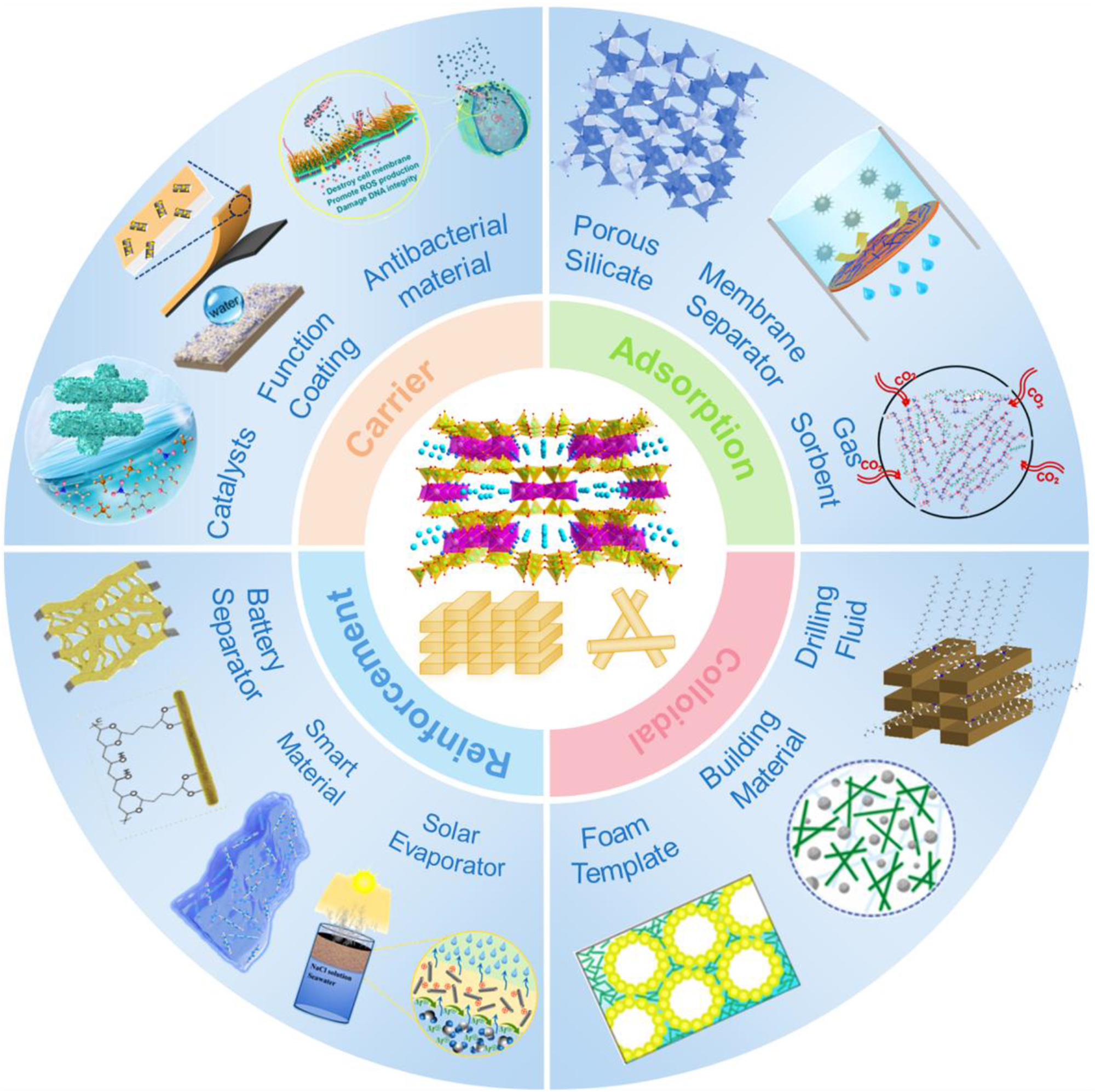
The Chinese Pal industry has traversed a 50 year journey of development from resource discovery to high-value utilization. Since 2000, our group has carried out systematic research on crystal bundle disaggregation, surface modification and functional applications of Pal, and thus the Key Laboratory of Clay Minerals of Gansu Province was approved and established in 2016. As the leading practitioners and promoters of the fundamental research and industrial applications of Pal in China, we published four monographs based on our relevant research achievements (Zheng et al., Reference Zheng, Wang and Zhan2007; Wang et al., Reference Wang, Wang, Zheng, Zheng and Liu2014a, Reference Wang, Mu, Zhang, Wang and Zhu2021a; Wang & Wang, Reference Wang and Wang2019). With the deep interdisciplinary integration of mineralogy, materials science, chemical engineering, environmental science and biology, the functional applications of Pal in China have gradually expanded into emerging fields such as energy storage (Li et al., Reference Li, Sun, Lv and Liao2025a; Ouyang et al., Reference Ouyang, Song, Wang, Li, Pan and Han2025), environmental remediation (Zhang et al., Reference Zhang, Huang, Qiao, Liu, Zhang and Wang2024b), phase-change materials (Guo et al., Reference Guo, Qiao, Liu, Lin, Liu and Fang2024), haemostatic agents (Ding et al., Reference Ding, Qian, Liang, Li, Chen and Jiang2026), tribo-composites (Yu et al., Reference Yu, Shang, Fu, Zuo and Yang2024), functional coatings (Cai et al., Reference Cai, Yin, Zhang, Yang, Zhang and Wang2025) and drug delivery (Chen et al., Reference Chen, Su, Luo, Liao, Wang and Huang2024a), among others (Fig 1; Wang et al., Reference Wang, Mu, Zhang, Wang and Zhu2021a). This article aims to systematically review the key advances of Chinese scientists in the microstructural elucidation, efficient disaggregation of crystal bundles, green construction of functional materials and overall utilization of mixed-dimensional Pal clay (MDPal), and future development directions are proposed from the perspective of mineral materialization to promote international collaborative research and the sustainable utilization of Pal resources by integrating representative case studies.
Representative advanced functional materials related to the adsorption, colloidal, carrier and reinforcement properties of Pal. ROS = reactive oxygen species.

Figure 1 Long description
The circular diagram is divided into four sections, each representing the functional applications corresponding to different properties of Pal: adsorption, colloidal, carrier and reinforcement. 1. Adsorption: - Porous Silicate - Membrane Separator - Gas Sorbent 2. Colloidal: - Drilling Fluid - Building Material - Foam Template 3. Carrier: - Catalysis - Function Coating - Antibacterial Material 4. Reinforcement: - Battery Separator - Smart Material - Solar Evaporator Each section contains illustrations and labels depicting the specific applications or materials related to the property it represents. The central image shows the crystal structure, channel structure, and rod-like morphology of attapulgite, representing the integration of these properties.
From raw Pal ore to nanostructured powder
The Pal content in raw ores varies significantly with mining site and ore stratum (Xu et al., Reference Xu, Xie, Xu, Wang, Zhou, Chen and Xu2022a). Grinding is the common but key step in Pal processing procedures, and the method and intensity of grinding decisively influence product performance (Liu et al., Reference Liu, Wang and Wang2012). Lu et al. (Reference Lu, Mu, Wang and Wang2024b) systematically compared with the effects of dry and wet pulverization on the structure and properties of Pal. The Pal nanorods significantly shortened after dry pulverization for just 5 s, and a greater pulverization time caused progressive increasing in fracturing, structural damage and agglomeration. In contrast, introducing 40% moisture during pulverization buffered these mechanical impact, preserving the nanorod aspect ratio, dispersion, surface activity and colloidal properties.
For high-end functional materials, additional refined treatments are often necessary, including de-gritting, deep purification and crystal bundle disaggregation. Natural Pal clay is often associated with quartz, calcite, dolomite, montmorillonite and illite. Developing efficient, low-cost purification technologies has consistently been an important research direction in China, and to that end Xu et al. (Reference Xu, Feng, Li, Li and Yao2024a) developed a three-stage cascade process for Pal clay from Xuyi, China. Ultrasonication–sedimentation, acid treatment and complexation–reduction were sequentially used to remove quartz sand, carbonates and various elements (Fe and Mn) from Pal clay. This process produced a Pal purity of ∼99.9%, with improved specific surface area, pore volume and surface activity, and the estimated cost of this process is ∼3000 RMB ton–1.
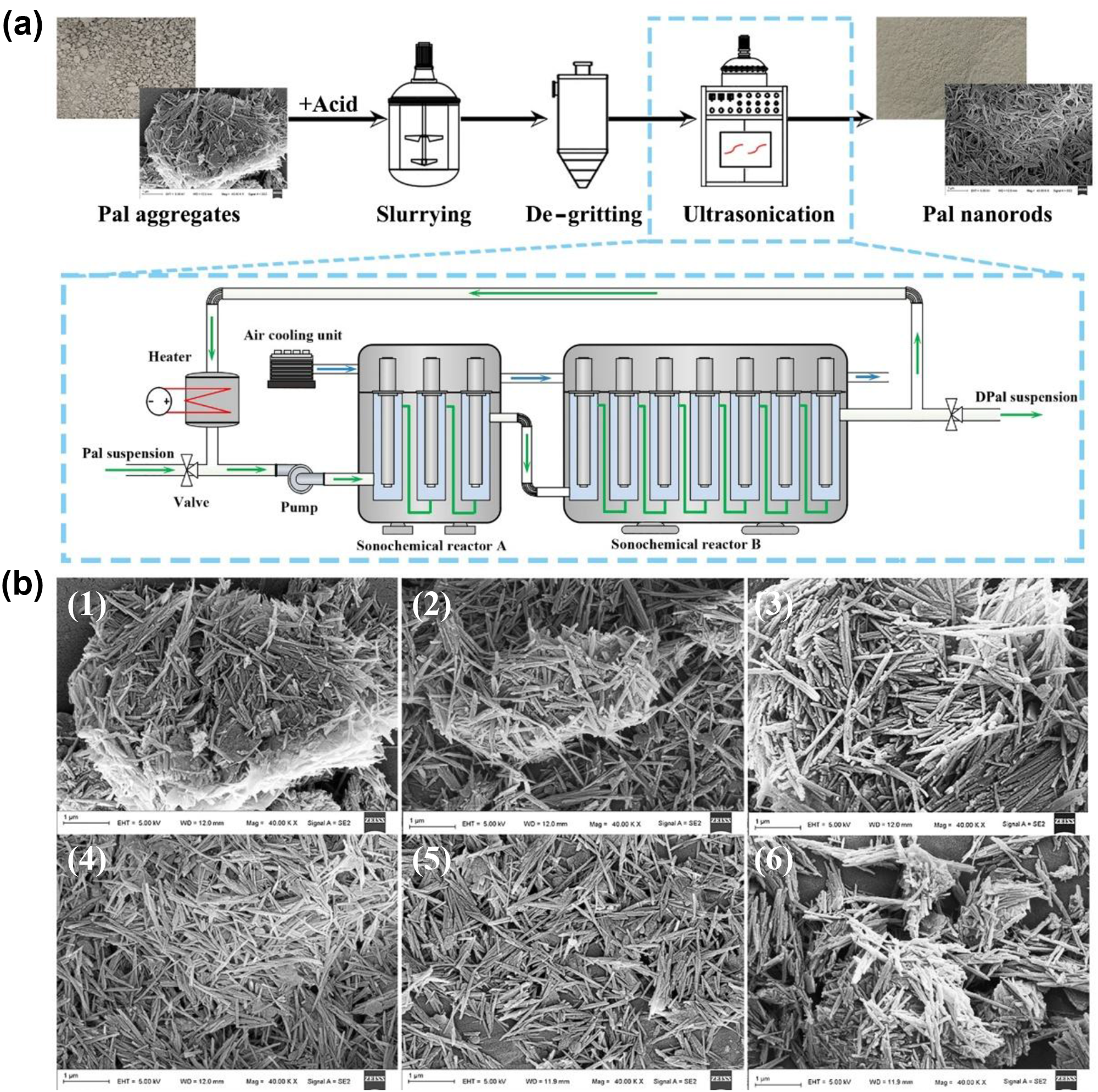
The microstructure of Pal consists of individual nanorods, crystal bundles and their aggregates (Fig. 2b). In fact, natural Pal typically exists as tightly packed aggregates resembling ‘nests’ or ‘stacks’ due to strong electrostatic attraction and hydrogen bonding among the rod crystals. Without disaggregating crystal bundle aggregates, Pal exhibits a relatively low specific surface area, limited active surface sites and poor applied performance. Chinese scientists have systematically investigated disaggregation technologies, including physical methods (Cai et al., Reference Cai, Wu, Jiang, Ding, Tong, Chu and Yu2009; Chen et al., Reference Chen, Jin, Lu, Ding, Jiang and Chen2014; Wang et al., Reference Wang, Hui, Chen, Li, Jin, Ding and Chen2015a) and chemical methods (Wang & Wang, Reference Wang and Wang2016). Chemical treatments weaken inter-rod interactions but inevitably alter surface characteristics (charge, activity, polarity and hydrophilicity), potentially hindering further functionalization.
(a) Schematic illustration of the scale-up disaggregation process of Pal crystal bundles via ultrasonic treatment. DPal = disaggregated Pal. (b) Scanning electron microscopy images of Pal before and after various treatments: (1) raw Pal; (2) acid treatment; acid treatment followed by ultrasonication for (3) 2 min, (4) 5 min and (5) 12 min; and (6) ultrasonication alone for 5 min without acid treatment (Xu et al., Reference Xu, Wang, Lu, Zhang, Kang and Mu2022b).

Figure 2 Long description
The image consists of two parts. The first part illustrates the disaggregation process of Pal crystal bundles. It begins with Pal aggregates, followed by the addition of acid, leading to slurrying, de-gritting and ultrasonication, resulting in Pal nanorods. Below this sequence, a detailed schematic shows the setup for the disaggregation process. It includes a heater, air cooling unit, valve, pump and two sonochemical reactors labeled A and B, connected by pipes. The DPal suspension is indicated at the end of the process. The second part contains six scanning electron microscopy images labeled from one to six. Image one shows raw Pal, image two shows Pal after acid treatment, image three shows Pal after acid treatment followed by ultrasonication for two minutes, image four shows ultrasonication for five minutes, image five shows ultrasonication for twelve minutes and image six shows ultrasonication alone for five minutes without acid treatment. Each image displays the microstructure of Pal, highlighting the changes in texture and arrangement of nanorods and crystal bundles due to different treatments.
High-pressure homogenization is an effective technique for liquid–liquid emulsification or liquid–solid dispersion. The cavitation effect exerts outward force from within crystal bundles, yielding individually dispersed Pal with minimal nanorod damage (Xu et al., Reference Xu, Zhang, Wang and Wang2011b). Combining high-pressure homogenization with roller processing or freezing treatment further enhanced disaggregation efficiency (Wang et al., Reference Wang, Zhang and Wang2014b; Xu et al., Reference Xu, Wang and Wang2014b). The combined treatment of roller extrusion, homogenization and freezing on Pal increased the rotational viscosity of its suspension from 152 to 2682 mPa s–1 (Xu et al., Reference Xu, Wang and Wang2013). Furthermore, an ethanol/water system with a volume ratio of 2:8 innovatively resolved the secondary aggregation of nanorods after liquid-phase disaggregation during drying, where ethanol primarily adsorbed onto the nanorod surfaces and was thermally removed without altering their surface properties (Xu et al., Reference Xu, Wang and Wang2014a). Through systematic research, an integration process of roller processing, slurry purification, high-pressure homogenization, then solvent treatment was developed to achieve efficient disaggregation of Pal crystal bundles without damaging their aspect ratio (Wang & Wang, Reference Wang and Wang2016). However, industrial-scale operation demonstrated that residual quartz sand in the slurry could severely abrade the high-pressure homogenizer, and thus ultrasonic treatment technology was developed for crystal bundle disaggregation (Fig. 2a). For trioctahedral Pal, ultrasonication for over 5 min could completely disaggregate crystal bundles (Fig. 2b; Xu et al., Reference Xu, Wang, Lu, Zhang, Kang and Mu2022b), while ultrasonication for over 8 min was required for dioctahedral Pal (Xu et al., Reference Xu, Wang, Lu, Zhang, Hui and Zhu2023b). This process is now used to supply Pal nanostructured powder, providing high-quality raw materials for diverse functional material construction.
From nanostructured powder to advanced functional materials
The functionalization of Pal has become a prominent research focus, attracting significant attention from scientists worldwide (Li & Zhang, Reference Li and Zhang2025; Ouyang et al., Reference Ouyang, Song, Wang, Li, Pan and Han2025; Koufany et al., Reference Koufany, Santacruz, De la Torre, Rodríguez-Ruiz and Aranda2026; Liu et al., Reference Liu, Zhao, Xie and Yang2026). Using the unique nanorod morphology, abundant surface hydroxyl groups and well-defined nanochannels of Pal as functional platforms, Chinese researchers have developed various advanced functional materials through surface modification, nanoparticle loading, molecular grafting, hybrid assembly and organic–inorganic composites without fundamental alteration to the intrinsic tetrahedral–octahedral framework. The relevant methods provide the native nanoarchitectures for using Pal as efficient nanoreactors, nanocarriers and nanoconfiners to construct various advanced functional materials for use in various new application fields (Dong et al., Reference Dong, Li, Tang and Yang2026).
Energy materials
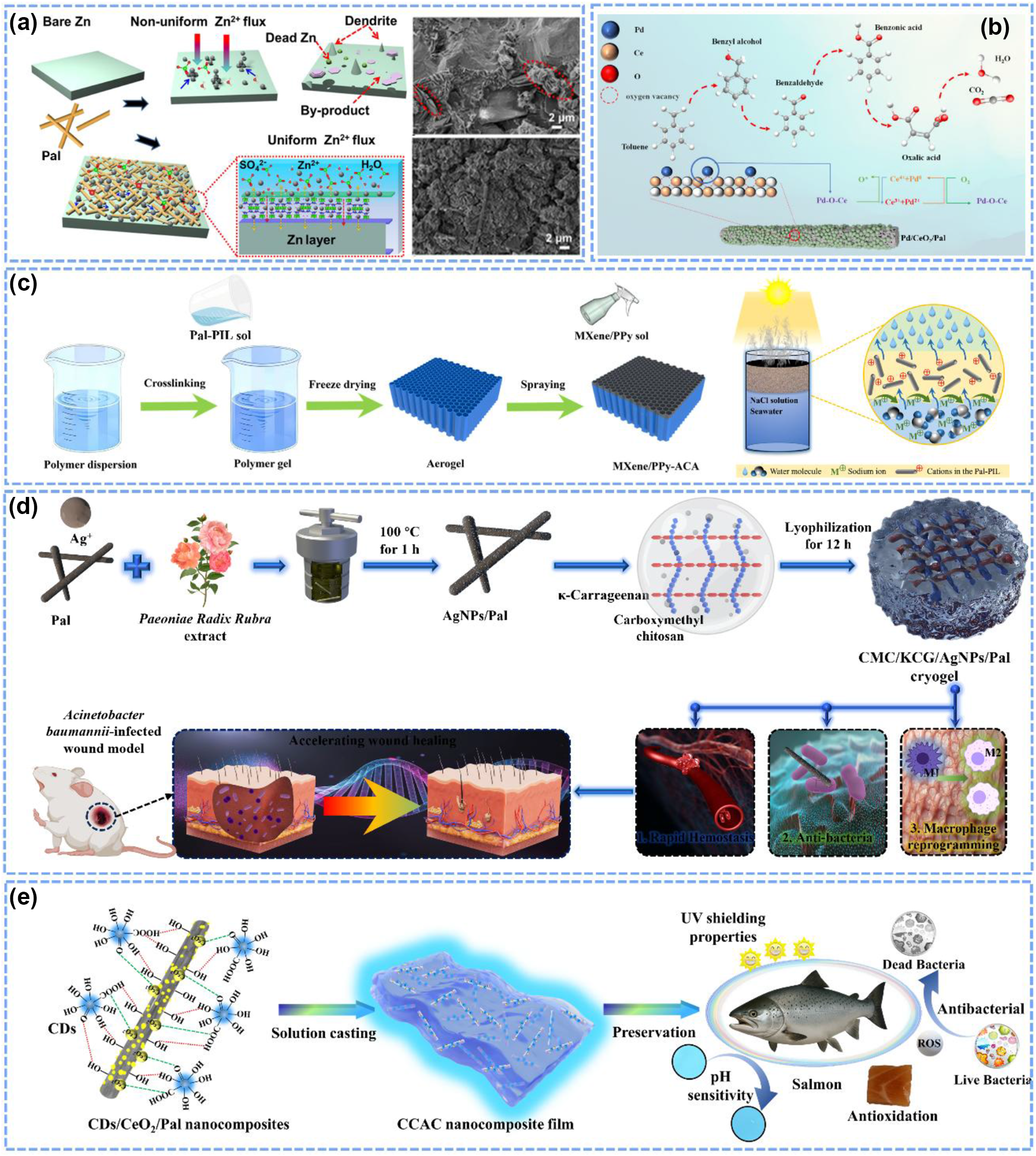
In the field of electrochemical energy storage, Pal was converted in situ into three-dimensional (3D) porous silicon nanosheet anodes through molten-salt electrochemical reduction, which effectively accommodated volume expansion and enabled a high specific capacity and extended cycle life (Yu et al., Reference Yu, Liu, Liang, Liu, Zheng and Lai2022a). In separator and electrolyte engineering, Pal derivatives were employed to modify superlithiophilic separators, leading to improved rate capabilities and cycling stabilities in lithium-ion batteries (Yang et al., Reference Yang, Wang and Zhang2020); or they served as ionic sieves in lithium–sulfur battery separators to suppress polysulfide shuttling (Sun et al., Reference Sun, Sun, Akhtar, Li, Wang and Wang2020); or they were formulated into quasi-solid electrolytes for aqueous zinc-ion batteries to promote Zn2+ transport and mitigate side-reactions (Zhang et al., Reference Zhang, Zeng, Liu and Xue2026b). For metal anode protection, Pal-based fibrous membranes or porous coatings were applied to lithium metal (Zhang et al., Reference Zhang, Yang, Tang and Yang2022d) and zinc anodes (Fig. 3a; Sun et al., Reference Sun, Yu, Lin, Wang, Deng and Zhou2021), respectively, which homogenized ion flux and inhibited dendrite growth. Additionally, Pal–supported polyaniline and MoS2 composites as sulfur cathodes of lithium–sulfur batteries significantly improved polysulfide conversion kinetics and cycling stability (Jiang et al., Reference Jiang, Yan, Zhang, Yang, Sarwar, Tang and Yang2023). Pal functioned as a structural scaffold for MnO2 loading in supercapacitors, resulting in an integrated composite electrode that delivered a specific capacitance of 138.2 F g–1 at 0.5 A g–1 and retained 92% of its capacity after 5000 cycles (Lin et al., Reference Lin, Lin, Wei, Lu and Yin2023).
(a) Schematic diagram and scanning electron microscopy images showing the surface morphology changes of bare Zn and Pal–Zn anodes during cycling (Sun et al., Reference Sun, Yu, Lin, Wang, Deng and Zhou2021). (b) Catalytic oxidation mechanism of toluene over Pd/CeO2/Pal (Li et al., Reference Li, Lu, Zhou, Yao and Chen2026). (c) Fabrication process of a double-layered solar evaporator (Lu et al., Reference Lu, Xiao, Yin, Jin, Xu and Hasi2024a). Pal-PIL sol = polymeric ionic liquid grafted Pal sol; PPy-ACA = Pal-PIL-based aerogel; PPY sol = polypyrrole sol. (d) Synthesis of AgNPs/Pal nanocomposites and their application in wound healing (Li et al., Reference Li, Yang, Mu, Liu and Wang2025c). CMC/KCG = carboxymethyl chitosan/κ-carrageenan. (e) Preparation of carbon dots/CeO2/Pal/chitosan (CCAC) composite films for salmon preservation (Gao et al., Reference Gao, Mu, Yang, Tang, Luo and Wang2026). ROS = reactive oxygen species; UV = ultraviolet.

Figure 3 Long description
The image consists of five sections labeled (a) to (e), each depicting different processes and applications of nanocomposites and materials. (a) Shows the surface morphology changes of bare Zn and Pal–Zn anodes during cycling, highlighting non-uniform and uniform Zn²⁺ flux, dendrite formation and by-products. (b) Illustrates the catalytic oxidation mechanism of toluene over Pd/CeO/Pal, detailing the reaction process and molecular interactions. (c) Describes the fabrication process of a double-layered solar evaporator, including steps like polymer dispersion, gel formation, freeze drying and aerogel creation, leading to MXene/PPy-ACA. (d) Details the synthesis of AgNPs/Pal nanocomposites for wound healing, showing the process from Ag⁺ and Pal to CMC/KCG/AgNPs/Pal cryogel and its application in an Acinetobacter baumannii-infected wound model. (e) Depicts the preparation of carbon dots/CeO/Pal/chitosan (CCAC) composite films for salmon preservation, highlighting UV shielding, pH sensitivity and antibacterial properties against bacteria.
In fuel cells, Pal as a nanofiller was incorporated into polymer matrices such as Nafion or chitosan to address critical challenges of dehydration and mechanical instability (Xu et al., Reference Xu, Mu and Pan2011a; Hu et al., Reference Hu, Zhong, Wen, Zheng, Gong, Qin and Liu2020). For anion-exchange membrane fuel cells, the hydrophilic Pal exhibited good compatibility with quaternized polymers, promoting the formation of a well-defined hydrophilic–hydrophobic microphase-separated structure, which created efficient hydroxide ion-conducting pathways, and hydroxide conductivity increased by ∼48% (Li et al., Reference Li, Li, Zhou, Xue, Zhang and Zhao2020b). In solid oxide fuel cells, porous Pal mixed with Ho0.9Sr0.1Cr0.5Fe0.5O3 to form a promising cathode that greatly increased specific surface area and nearly doubled the maximum power density at 500°C (Zhu et al., Reference Zhu, Zhai, Zhang, Zhang, Liu and Song2018a).
Pal has also proven instrumental in solar-thermal energy conversion, in which it was employed as a porous support framework to fabricate bilayer aerogels with vertically aligned channels in combination with polymers and photothermal materials (Fig. 3c; Jia et al., Reference Jia, Liang, Sun, Zhu, Wang and Li2019; Mu et al., Reference Mu, Song, Geng and Li2021; Lu et al., Reference Lu, Xiao, Yin, Jin, Xu and Hasi2024a; Wang et al., Reference Wang, Li, Zhang, Sun, Zhu, Li and Liang2024c). This rational design separated the functions of light absorption and water supply, synergistically enhancing overall evaporation performance. By integrating photocatalytic components (e.g. MXene, polypyrrole), Pal-based evaporators gained the additional functionality of degrading organic dyes, enabling simultaneous solar desalination and water purification (Lu et al., Reference Lu, Xiao, Yin, Jin, Xu and Hasi2024a). Notably, the evaporators fabricated from Pal and pectin exhibited exceptional acid resistance, maintaining high efficiency even in strongly acidic wastewaters (pH = 1), which broadened their application to the treatment of complex industrial effluents (Wang et al., Reference Wang, Li, Zhang, Sun, Zhu, Li and Liang2024c).
In thermal management, Chinese researchers systematically optimized Pal’s performance through three key strategies: pretreatment, such as acid, thermal and grinding activation, to increase the surface area and pore volume of Pal for high phase-change material loading (Yang et al., Reference Yang, Peng, Zhang, Guo, Xiong and Wang2016; Zhang et al., Reference Zhang, Zhang, Li, Huang, Guo, Xiong and Chen2019a; Miao et al., Reference Miao, Gan, Li and Lv2020); surface modification with silane coupling or dopamine coating to improve compatibility and crystallization (Shi & Li, Reference Shi and Li2020; Hu et al., Reference Hu, Lin, Cao, Feng and Pan2022; Liu et al., Reference Liu, Deng, Zheng, Wang, Wu, Lu and Sun2022b); and structural engineering to form 3D networks (Wang et al., Reference Wang, Song, Li, Zhang, Zhang and Guo2020b) or hybrid scaffolds with expanded graphite (Wang et al., Reference Wang, Liang, Tang, Jia, Liu and Yang2020a) to enhance thermal conductivity and enable light–thermal conversion. The resulting Pal-based phase-change materials achieved high energy density, improved heat transfer and reliable cyclic stability, showing great potential for thermal energy storage.
Pal was also used for CO2 capture, but amine functionalization was crucial to improving adsorption capacity (Cecilia et al., Reference Cecilia, Vilarrasa-García, Cavalcante, Azevedo, Franco and Rodríguez-Castellón2018). Amine-rich compounds, such as tetraethylenepentamine or polyethyleneimine, were commonly impregnated into acid-activated Pal to provide abundant active sites, increasing the absorption capacity from less than 1 to 2–4 mmol g–1 (Ouyang et al., Reference Ouyang, Gu, Zhang, Yang, Jin, Chen and Jiang2018; He et al., Reference He, Liu, Han and Hu2024). Furthermore, aminosilane grafting could further improve the thermal stability and cycling performance of adsorbents due to the strengthening of interactions between amine species and Pal (Peng et al., Reference Peng, Sun, Wang, Qiu, Zhang and Ning2021). Additionally, Pal nanorods acted as rigid skeletons or dispersants to support the active phases of CoAl-LDHs (Zuo et al., Reference Zuo, Sun, Gong, Tang, Ye and Liu2024), calcium-based sorbents (Shan et al., Reference Shan, Li, Meng, Yu and Min2016) or metal–organic frameworks (MOFs; Wan et al., Reference Wan, Que, Chen, Wu, Gu and Meng2017), effectively inhibiting their stacking and sintering, thereby improving their structural stability and mitigating capacity decay during long-term cycling.
Pal has also demonstrated versatile secondary applications in gas storage and safety. Early research established its potential as a hydrogen storage medium due to its nanochannels and polar surfaces (Mu et al., Reference Mu, Pan and Yuan2005), which supported its ongoing investigation for underground hydrogen storage (Wang et al., Reference Wang, Jin, Cheng, Sun, Liu and Zhang2024b). Concurrently, ultrafine Pal powder was used as an effective inhibitor of methane explosions, leveraging its endothermic decomposition and radical quenching capabilities to improve the safety of the fuel transport and storage infrastructure (Wang et al., Reference Wang, Jia and Zhao2024a).
Medical materials
Chinese scientific efforts have systematically advanced Pal from a foundational material to a versatile component in next-generation biomedical solutions. The stable hybrids fabricated by combining Pal with natural plant essential oils via a simple mechanical grinding method based on hydrogen bonding interactions, thereby realizing the aqueous dispersion and sustained release of essential oils, resulted in potent antibacterial efficacy at minimum inhibitory concentrations of 2.0 mg mL–1 (Zhong et al., Reference Zhong, Mu, Zhang, Hui, Kang and Wang2020, Reference Zhong, Mu, Yan, Jing, Hui and Wang2021; Zhang et al., Reference Zhang, Cao, Li, Xiong, Fu and Zhang2023b). The active sites of Pal were optimized to achieve efficient loading of silver nanoparticles (AgNPs) and the construction of ZnO–essential oil composites, resulting in synergistic antibacterial effects, with over 99% inhibition against drug-resistant bacteria (Hui et al., Reference Hui, Yang, Yan, Kang and Wang2021; Zhang et al., Reference Zhang, Lu, Zhang, Yang, Hui and Wang2022a,c). Furthermore, light-responsive Ag2S/MoS2/Pal composites were designed for efficient and multi-mechanism pathogen clearance under light irradiation (Liu et al., Reference Liu, Zhang and Gao2022a), while the incorporation of metal oxide-based nanozymes also improved the bacterial eradication of Pal through multi-mechanistic actions (Feng et al., Reference Feng, Zhang, Mu, Wang, Chen and Zhang2022).
In the field of haemostasis, the moderate structural leaching of Pal effectively adjusted nanorod morphology, surface charge and the release of coagulant ions (e.g. Fe3+, Mg2+), improving Pal’s intrinsic procoagulant activity (Yang et al., Reference Yang, Wang, Li, Mu, Yang, Wang and Liu2024a). Moreover, the synergistic effect between one-dimensional (1D) nanorods and two-dimensional (2D) nanosheets in MDPal led to rapid haemostasis owing to the superhydrophobicity of MDPal towards blood, as well as improving platelet activation and stable clot formation (Wang et al., Reference Wang, Yang, Yang, Mu and Wang2024f). Based on structural control, active factors such as iron oxide nanoparticles were loaded onto MDPal, integrating functional components with synergistic haemostatic, antibacterial and antioxidant properties (Wang et al., Reference Wang, Li, Yang, Yang, Mu and Wang2026b). In parallel, combining Pal with chitosan led to the development of rapid-acting sponges and films that leverage the adsorbent properties and surface charge of Pal to accelerate clotting via the activation of platelets and coagulation pathways, demonstrating superior performance to commercial haemostats in terms of controlling severe bleeding in animal studies (Yang et al., Reference Yang, Wang, Li, Yang, Liu and Wang2024b; Du et al., Reference Du, Zhao, Liu, Chen, Li, Zhang and Wang2025). In particular, the cross-linking network of carboxymethyl chitosan and κ-carrageenan integrating ultrasmall AgNPs-anchored Pal achieved triple-function therapy for infected wounds by combining potent antibacterial action with rapid haemostasis and active immunomodulation, which promoted macrophage polarization for accelerated tissue regeneration (Fig. 3d; Li et al., Reference Li, Yang, Mu, Liu and Wang2025c).
In terms of controlled drug release, Pal-based microspheres fabricated via spray-drying achieved a high drug encapsulation efficiency of over 95% for doxorubicin, enabling sustained release kinetics and reducing burst effects (Wang et al., Reference Wang, Yan, Cheng, Yang, Li and Wang2025e). Similarly, the incorporation of Pal as a reinforcing filler into cyclodextrin pseudopolyrotaxane hydrogels markedly improved their mechanical strength, resulting in injectable supramolecular hydrogels with shear-thinning behaviour and sustained anti-inflammatory effects for intra-articular delivery (Ha et al., Reference Ha, Wang, Zhao and Shi2021). In the context of targeted intestinal delivery, Wang et al. (Reference Wang, Wang, Wu and Wang2011) designed pH-sensitive Pal composite hydrogel beads, which achieved minimal drug release in gastric fluid (only 3.71%) and maintained sustained release profiles in intestinal fluid.
In bone tissue engineering, Zhao’s group have extensively utilized Pal as a bioactive component in 3D-printed scaffolds (Zhao et al., Reference Zhao, Zhang, Zhou, Weng, Qin and Pan2020; Ma et al., Reference Ma, Wu, Liu, Liu, Ni and Dai2022; Dai et al., Reference Dai, Wu, Liu, Ni, Li and Zhang2024; Liu et al., Reference Liu, Ni, Wu, Zhang, Dai, Wang and Zhao2024a). The incorporation of Pal into these scaffolds significantly improved their mechanical properties and printability. More importantly, these composites exhibited the ability to promote the adhesion and osteogenic differentiation of stem cells, as well as vascularization, leading to effective bone regeneration in animal defect models. Furthermore, teriparatide microspheres were equipped on Pal scaffolds for controlled release, or Pal modified with specific ligands (glycine) conferred dual osteogenic and chondrogenic activity, enabling the repair of complex osteochondral defects (Yin et al., Reference Yin, Xia, Fan, Yang, Xiang, Ren and Zhu2024; Zhao et al., Reference Zhao, Feng, Zhao, Song, Zhang and Zhang2025b).
Catalytic materials
Due to their favourable Brønsted acid sites, low cost and high stability and surface area, Pal and activated Pal have served as cost-effective solid acid catalysts (Tian et al., Reference Tian, Shao, Liang, Xu, Zhang and Zhang2020; Tan et al., Reference Tan, Zhang, Yue, Zhao, Xi and Yan2022). Differently from common powdered or granular catalysts, Pal-based catalysts were incorporated into poly(vinyl alcohol) (PVA) to obtain hybrid catalytic membranes for esterification (Li et al., Reference Li, Zhang, Zhou, Zhao and Technology2020a). In addition, heterogeneous supported catalysts were designed by anchoring metal-based nanoparticles with a well-defined size and surface properties onto support materials to improve their catalytic activity (Tao & Salmeron, Reference Tao and Salmeron2024), and a space-confined synthesis strategy was employed to fabricate Pal-based heterogeneous supported catalysts for accelerating reactions at solid–gas or solid–liquid interfaces due to the unique rod-like morphology, zeolite-like nanochannels and surface properties of Pal (Tian et al., Reference Tian, Nie, Xiang, Zhang, Qu, Li and Wang2025; Wang et al., Reference Wang, Liang, Wang, Shi, Xu and Li2025d). Many Chinese scholars have designed and synthesized Pal-based heterogeneous supported catalysts by incorporating various metal-based nanoparticles for low-temperature catalytic oxidation of volatile organic compounds (VOCs; Liu et al., Reference Liu, Zhang, Huhe, Yao and Li2025), catalytic combustion (Zhang et al., Reference Zhang, Ge, Hao, Zhang and Zhang2025) or catalytic oxidation of toluene (Zou et al., Reference Zou, Guo, Peng, Dai, Xu and Zhang2025), photocatalytic CO2 reduction coupled with biomass conversion (Tao et al., Reference Tao, Zhang, Yang, Yao and Li2025) and selective catalytic reduction of NOx by NH3 (Zhou et al., Reference Zhou, Huang, Xie, Luo, Yao, Li and Zuo2017). In particular, a directional photodeposition strategy was developed to anchor atomically dispersed Pd onto Pal-supported CeO2 nanoparticles (Li et al., Reference Li, Lu, Zhou, Yao and Chen2026), which demonstrated exceptional activity and stability in the catalytic oxidation of toluene, with a conversion ratio of 99% at 205°C (Fig. 3b). In addition to their use in efficient environmental catalysis, Pal-based heterogeneous supported catalysts also were employed to realize the catalytic transformation of organics for organic synthesis (Guo et al., Reference Guo, Ding, Zhang, Wang, Peng and Xiong2021; Sun et al., Reference Sun, Zhang, Liu, Wu and Yang2024). Differently from the chemical modification of Pal, dielectric barrier discharge plasma was also introduced to improve Pal’s catalytic conversion of CO2 (Zhang et al., Reference Zhang, Wang, Yu, Hu and Liao2026a).
Polymer nanocomposites
As one of its promising functional applications in the strengthening and toughening of polymers, Pal has previously been used as a functional nanofiller-loaded catalyst to induce in situ ethylene polymerization, resulting in the uniform dispersion of Pal into a polyethylene matrix the demonstrated improved mechanical performance (Rong et al., Reference Rong, Sheng, Li and Ruckenstein2002; Li et al., Reference Li, Adams, Wang, Blümich and Yang2010). However, the gelation usually accompanying the grafting reaction during the polymerization forms cross-linked networks, which are damaging to the mechanical properties of polymers. Thus, thiol-modified Pal nanorods were prepared as chain transfer reagents for the radical bulk polymerization of styrene (Liu et al., Reference Liu, Wang, Pan, Pei and Wang2018).
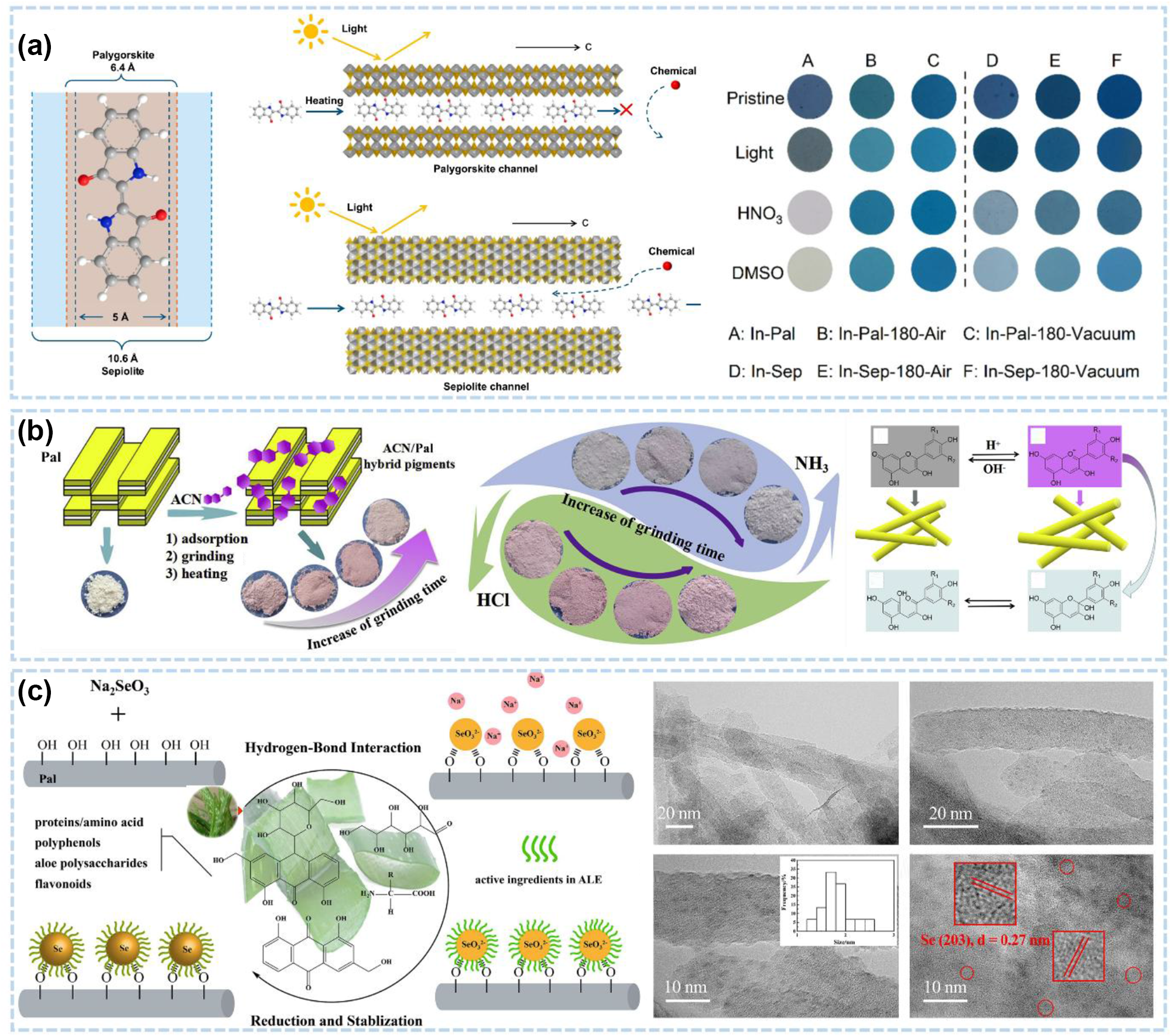
To produce colourful polymers, various dyes and pigments were loaded onto Pal to fabricate hybrid pigments integrating with the advantages of each component, which effectively improved the mechanical properties, thermal stability and aging resistance of Pal, as well as producing products with various hues (Wu et al., Reference Wu, Mu, Yang, Wang, Zhu, Dou and Wang2025). In fact, Pal also served as a nanofiller for incorporation into ultra-high-molecular-weight polyethylene (UHMWPE) to ameliorate its wear resistance and improve the service life of bearings, bushings, clamps and other wear parts, and the friction coefficients and specific wear ratios of the composites were reduced compared with that of unaltered UHMWPE (Meng et al., Reference Meng, Wang, Xin, Liu, Yan and Yan2020) and glass fibre–UHMWPE composites under both dry-friction and water-lubrication conditions (Wei et al., Reference Wei, Zhang, Cui, Huang, Gao, Cao and Zhao2025). To improve the thermal conductivity and thermal stability of UHMWPE composites, TiO2 nanoparticles were loaded onto the surface of Pal using a steam method to produce promising nanofillers for reinforcing UHMWPE composites (Meng et al., Reference Meng, Wang, Liu, Yan and Yan2022). The network structure formed by the nanofillers was conducive to improving heat conduction, reducing friction coefficients and wear losses by up to 33.3% and 49.4%, respectively, after the introduction of 5 wt.% nanofillers.
In addition, Zhang’s group systemically investigated the role of Pal in reducing the friction and wear behaviour of polyetheretherketone (Wang et al., Reference Wang, Zhao, Zhang, Myshkin and Zhang2022b), phenol-formaldehyde resin containing short carbon fibres (Wang et al., Reference Wang, Li, He, Li, Wang, Wetzel and Zhang2024e) and polyurethane composites (Chen et al., Reference Chen, Li, Qu, Qi and Zhang2026), and the results confirmed that the incorporation of Pal lowered the friction and wear of the polymer matrix, especially for polyurethane composites. The friction and wear of the optimized polyurethane composites containing 10 wt.% Pal and 10 wt.% MoS2 decreased by 92.8% and 78.7%, respectively, which were significantly lower than those of commercial materials. That study provided experimental evidence for the broader application of Pal in polymer-based multifunctional lubricating materials.
The relevant materials were also introduced into natural polymers for the preparation of nanocomposite films for food packaging. It was found that the incorporation of Pal or MDPal effectively enhanced the mechanical performances and water resistance of chitosan-based nanocomposite films, especially nanosized Pal or MDPal after high-pressure homogenization treatment (Huang et al., Reference Huang, Wang, Xu and Wang2012; Lu et al., Reference Lu, Mu, Kang, Gao and Wang2025), in which the mixed-dimensional heterogeneous structure of MDPal enabled better mechanical properties than Pal alone. To extend the shelf life of foods, natural extracts with antibacterial and antioxidant activities and antibacterial metal-based nanoparticles were facilely loaded onto Pal to endow the nanocomposite films with bioactivities for food preservation (Gao et al., Reference Gao, Mu, Yang, Li and Wang2024a,b). Furthermore, environmental-responsive factors, such as natural dyes or carbon dots, were also simultaneously anchored onto the surface of Pal to indicate the degree of food spoilage (Fig. 3e; Li et al., Reference Li, Ding, Mu, Wang, Kang and Wang2019b; Gao et al., Reference Gao, Mu, Yang, Tang, Luo and Wang2026).
Functional coatings
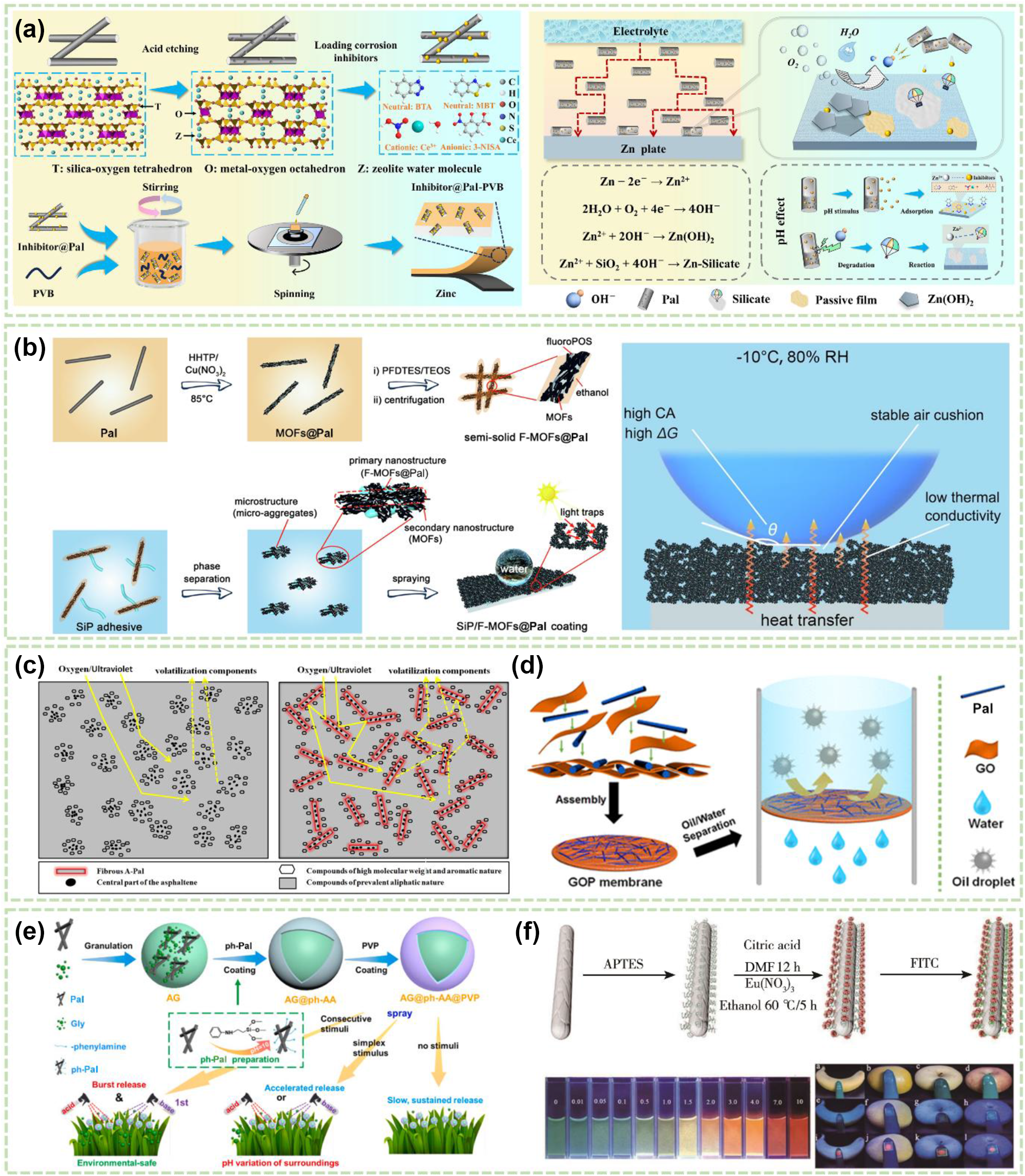
Due to its nanochannels, nanorods and surface functional groups, Pal was employed as a container for loading corrosion inhibitors, representing a promising corrosion protection coating for metal substrates (Fig. 4a; Li et al., Reference Li, Yin, Meng, Qiao, Zhang and Cai2025b), and undecylimidazoline was loaded onto Pal to design dual-function self-healing oil coatings with anticorrosion and antibiofouling properties (Wu et al., Reference Wu, Wei, Shi and Zhao2023). Furthermore, biomimetic superhydrophobic Pal-based coatings were recently fabricated for metal protection with self-cleaning and anticorrosion properties, combining micro/nano-rough structures and surface superhydrophobic modifications with low-surface-energy materials (Xue et al., Reference Xue, Li, Mu and Li2022; Wang et al., Reference Wang, Wang, Wang and Zhang2026a), while fluorinated compounds and edible paraffin wax were developed for the surface modification of Pal to prepare superhydrophobic coatings for reducing 5G radome rain attenuation (Li et al., Reference Li, Zhang and Wang2024b) or food-grade superhydrophobic coatings for the packaging of liquid foods (Ding et al., Reference Ding, Wei and Zhang2023), respectively. In addition, this technology was also employed to achieve oil/water separation via the deposition of Pal-based superhydrophobic coatings on metal meshes (Li et al., Reference Li, Zhu, Shen, Han, Zhang and Li2019a) and textiles (Wang et al., Reference Wang, Wang and Wang2025a). Among the various clay minerals assessed, Pal-based superhydrophobic coatings exhibited the optimal anti-wetting performance, especially Pal obtained from Mingguang with its higher Mg content and aspect ratio (Dong & Zhang, Reference Dong and Zhang2018; Dong et al., Reference Dong, Zhu, Wei, Zheng, Li and Zhang2018), and the coatings’ superamphiphobicity was determined according to their surface morphology derived from their microstructure.
(a) Preparation of inhibitor@Pal composite coatings and the corresponding active/passive corrosion protection mechanisms (Li et al., Reference Li, Yin, Meng, Qiao, Zhang and Cai2025b). 3-NISA = 3-nitrosalicylic acid; BTA = benzotriazole; MBT = 2-mercaptobenzothiazole; PVB = polyvinyl butyne vinyl acetate. (b) Fabrication process of silicone polyester adhesive-modified fluorinated MOFs@Pal nanorods (SiP/F-MOFs@Pal) coatings and their passive anti-icing mechanism (Mao et al., Reference Mao, Wei, Li, Li, Huang and Zhang2024). ΔG = Gibbs free energy; CA = contact angle; fluoroPOS = fluorinated polyorganosiloxane; HHTP = 2,3,6,7,10,11-hexahydroxytriphenylene hydrate; PFDTES/TEOS = 1H,1H,2H,2H-perfluorodecyltriethoxysilane/tetraethoxysilane; RH = relative humidity. (c) Dispersion mechanism of nano-organic Pal within an asphalt system (Jin et al., Reference Jin, Gao, Wu, Li, Liu and Wei2021). A-Pal = organomodified Pal. (d) Free-standing GO–Pal nanocomposite membrane for oil/water separation (Zhao et al., Reference Zhao, Su, Liu, Li and Jiang2016). GOP = graphene oxide–Pal nanocomposite membrane. (e) Pal-based herbicide particles with a smart wetting surface for environmentally safe glyphosate delivery triggered by consecutive base–acid stimuli (Jing et al., Reference Jing, Chen, Chen, Yuan, Ma and Teng2025a). AG = raw Pal spheres; Gly = glyphosate; ph-AA = phenylamine-modified Pal and amino silicon oil; ph-Pal = phenylamine-modified Pal; PVP = polyvinyl pyrrolidone (f) Fluorescent Pal and rare earth-integrated nanoprobes for the rapid detection of tetracycline (Jia et al., Reference Jia, Zhang, Zhu and Xu2022). APTES = γ-aminopropyltriethoxysilane; DMF = dimethylformamide; FITC = fluorescein isothiocyanate.

Figure 4 Long description
This infographic is a 2-row, 3-column multi-panel figure read left-to-right, top-to-bottom, summarizing Pal-based composites and coatings. (a) Shows the preparation of inhibitor@Pal composite coatings for corrosion protection, detailing steps from acid etching to passive film formation. (b) Describes the fabrication of silicone polyester adhesive-modified fluorinated MOFs@Pal nanorods, highlighting passive anti-icing mechanisms with high contact angle and low thermal conductivity. Key conditions include −10°C and 80 percent RH. (c) Illustrates the dispersion mechanism of nano-organic Pal within an asphalt system, focusing on organomodified Pal interactions. (d) Depicts the assembly of a free-standing GO–Pal nanocomposite membrane for oil/water separation, showing the separation of oil droplets. (e) Details Pal-based herbicide particles with a smart wetting surface for glyphosate delivery, triggered by base–acid stimuli. (f) Describes fluorescent Pal and rare earth-integrated nanoprobes for tetracycline detection, emphasizing the preparation process and application. Each panel follows an input→process→output structure, focusing on the application outcomes.
In particular, the microstructure of the Pal-based coatings could be facilely adjusted by acid activation and solid-state grinding, which effectively enhanced the superamphiphobicity of the coatings due to the formation of smaller protrusions and micropores on the surface of the coatings, while thermal activation had a negative influence, decreasing the superamphiphobicity (Zhang et al., Reference Zhang, Tian, Zhang and Wang2018a). To extend the application scenarios of Pal-based superhydrophobic coatings, various functional factors were introduced to increase the surface roughness and/or bestow specific functions on the coatings followed by surface superhydrophobic modification (Zhang et al., Reference Zhang, Dong, Sun, Yu, Zhu, Zhang and Wang2016a; Dong & Zhang, Reference Dong and Zhang2019; Jing et al., Reference Jing, Mu, Zhang, Wang, Zhong, Liu and Wang2020). This process demonstrated significant potential in various fields due to the excellent environmental stability of the prepared superhydrophobic coatings. Furthermore, three-tier hierarchical micro-/nano-/nanostructures were deigned to prepare robust photothermal superhydrophobic coatings for efficient anti-icing and de-icing in simulated/real environments via the deposition of nanosized MOFs on Pal nanorods, fluorination and phase separation of a hydrophobic adhesive and spraying assembly (Fig. 4b; Mao et al., Reference Mao, Wei, Li, Li, Huang and Zhang2024).
Construction materials
Chinese scholars have extensively explored Pal as a functional nanomaterial in infrastructure applications. As a high-performance stabilizer, Pal effectively addresses the inherent limitations of problematic subgrades, such as soft clays and expansive soils, by leveraging its nanorod morphology and surface active sites to bind soil particles and moisture, thereby increasing internal friction and modifying soil failure behaviour (Zhang et al., Reference Zhang, Pishro, Zhang, Ma, Matlan, Taha and Pishro2023c, Reference Zhang, Zhang, Ahad, Siti and Wang2024c). Furthermore, the combination of Pal with PVA leveraged the cation-exchange capacity of Pal for chemical bonding with soil particles, while PVA contributed extensive hydrogen bonding. This synergistic interaction constructed a robust 3D ‘soil–Pal’ network, delivering substantial engineering benefits, including enhanced unconfined compressive strength, reduced compression coefficients and improved shear strength (He et al., Reference He, Hu, Mei, Zhu, Xue and Liu2022). Consequently, the risks associated with volume change (swelling and shrinkage) and post-construction settlement are greatly mitigated, providing a multifaceted approach to improving long-term subgrade stability and infrastructure integrity.
In asphalt mixtures, nanorod crystals of Pal could form a 3D network that physically restricts asphalt flow at high temperatures, significantly improving rutting resistance, moisture stability and overall durability (Yang et al., Reference Yang, Cao, Cui, Xi, Cai and Yuan2025). To further improve its dispersion and compatibility, surface organic grafting of Pal was developed to improve the rheological properties, water stability and thermo-oxidative ageing resistance of the asphalt binder (Fig. 4c; Jin et al., Reference Jin, Gao, Wu, Li, Liu and Wei2021). Chemically, Pal suppressed the formation of carbonyl and sulfoxide groups during oxidative ageing, effectively delaying asphalt hardening (Wei et al., Reference Wei, Zhang, Liu, Ban, Tian and Yang2024). Additionally, Pal inhibited VOCs generation during asphalt heating and paving operations, offering environmental benefits (Wang et al., Reference Wang, Liu, Wu, Lv, Wan, Gong and Liu2023a). Emerging applications leverage Pal to produce self-healing asphalt, and calcium alginate/Pal composite capsules exhibited good mechanical strength and controlled rejuvenator release, enabling autonomic micro-crack repair under cyclic loading and prolonging pavement service life, even under ageing conditions (Bao et al., Reference Bao, Liu, Rao, Yu and Zhang2020; Rao et al., Reference Rao, Liu, Yu, Wan, Wang, Song and Ye2021; Yu et al., Reference Yu, Liu, Wan, Song, Wang and Zhao2022b).
For cement-based materials, thermal activation unlocked the pozzolanic reactivity of Pal, yielding a highly active supplementary cementitious material (Shi et al., Reference Shi, Liu, Zhang, Lan, Zhao, Zhao and Wang2022; Liu et al., Reference Liu, Tian, Ma, Xiang, Sun, Li and Zuo2023b; Yan et al., Reference Yan, Zhou, Fan, Duan and Zhang2023). Calcined Pal positively influenced the rheology of fresh cement paste and improved hydration kinetics. In the cement’s hardened state, Pal refined its pore structure, reducing total porosity and increasing the proportion of harmless pores, thereby improving its mechanical strength and durability. In the innovative field of 3D concrete printing, nano-sized Pal played a dual role in optimizing the rheology of fresh ink for seamless extrusion and shape retention while also reinforcing the hardened matrix through nanorod bridging to mitigate fibre clumping and resolve the printability–buildability conflict (Liu et al., Reference Liu, Sun, Tian, Bu, Zuo and Li2023a). As a functional nanofiller in new wall materials, Pal effectively reduced material self-weight, improved workability and improved thermal insulation and mechanical performance, which were key components in the development of next-generation, environmentally friendly wall systems (Li et al., Reference Li, Tang, Li, Zhao, Zuo and Yang2024a).
Membrane separation materials
Chinese research on Pal-based membrane separation materials has transitioned from simply utilizing Pal as a reinforcing filler to establishing Pal-based multifunctional structural units. Initially, Pal was introduced to improve the mechanical strength, thermal stability and hydrophilicity of polymer and ceramic membranes (Ji et al., Reference Ji, Zhou, Lai, Wang and Li2015; Zhou et al., Reference Zhou, Xue, Zhang, Huang, Li and Zhao2015). Recently, magnetic Fe3O4 nanoparticles were loaded onto Pal to induce the formation of orientated nanofibre channels within the membrane under a magnetic field (Mao et al., Reference Mao, Xu, Zhou, Fan, Xue and Li2023a,c). This unique structure resulted in a narrower pore-size distribution and lower tortuosity, thereby significantly improving water permeance during oil/water separation. In addition, Fe3O4 endowed the membrane with Fenton-like catalytic activity, enabling in situ degradation of irreversible oil fouling and providing a self-cleaning function (Zhai et al., Reference Zhai, Mao, Zhou, Zhou, Wang and Li2023, Reference Zhai, Li, Mao, Zou, Zhou and Li2025). Furthermore, Pal decorated with antibacterial AgNPs yielded thin-film nanocomposite membranes with improved antibacterial activity (Wang et al., Reference Wang, Li, Wang, Gao and Wang2019b), while TiO2/Pal nanocomposites demonstrated prominent photocatalytic bactericidal and organic pollutant decomposition capacities under light irradiation (Zhang et al., Reference Zhang, Li, Wang, Wang, Gao and Wang2019b). Advanced surface grafting of responsive polymers onto Pal resulted in ‘easy-cleaning’ membranes, where simple changes in temperature or pH could effectively remove biofoulants, achieving significantly higher flux recovery ratios than pristine membranes (Mao et al., Reference Mao, Zhou, Shi, Xue, Li and Cai2022, Reference Mao, Zhou, Li, Wang, Ma and Xiao2023b). Finally, the ability to fabricate large-area, aligned Pal nanofibre coatings via evaporation-induced self-assembly opened new avenues for developing high-performance separation membranes (Jiang et al., Reference Jiang, Mao, Zhou, Shi, Li and Xue2022).
In addition, recent research trends on membrane separation have shifted towards the diversification and sophistication of material design. For instance, Pal nanorods as spacers were intercalated between graphene oxide nanosheets by vacuum-assisted self-assembly to precisely adjust interlayer spacing, forming sub-nanometre 2D selective channels (Fig. 4d; Zhao et al., Reference Zhao, Su, Liu, Li and Jiang2016, Reference Zhao, Zhao, Wang, Meng, Wei, Hu and Wang2025a). Fixing the GO–Pal composite layer on stable Al2O3 ceramic substrates further mitigated swelling and improved long-term stability (Liu et al., Reference Liu, Wang, Soomro, Fu, Qiao and Yu2019). In addition, a green Pickering foam templating approach was developed to produce porous membranes with stable, interpenetrating 3D networks, using Pal as a foam-stabilizing particle with natural foaming agents (Xu et al., Reference Xu, Mu, Li, Lv, Wang and Fan2026), which possessed high porosity and abundant internal anchoring sites. These membranes demonstrated outstanding performance in terms of the adsorption and enrichment of radioactive uranium, with an adsorption capacity of 216 mg g–1 and a removal ratio exceeding 95%.
Smart materials
Smart materials are also referred to as advanced or intelligent materials, and they can respond smartly to environment changes including thermal, electrical, chemical, mechanical and optical stimuli (Bahl et al., Reference Bahl, Nagar, Singh and Sehgal2020). Wu’s group has led the research on Pal-based smart materials, focusing mainly on environmentally responsive pesticide controlled-release systems that utilize the adsorption, colloidal and carrier traits of Pal (Chi et al., Reference Chi, Zhang, Xiang, Cai and Wu2017). To achieve the light-driven response of the release system, biochar was incorporated to form biochar–Pal composites so as to load glyphosate and azobenzene, which were incompletely encapsulated by amino silicone oil to construct light-responsive controlled-release herbicide particles with a core–shell structure and abundant micro/nanopores in the shell. The controlled release of glyphosate was triggered by isomer transformation of azobenzene under ultraviolet–visible (UV-Vis) light radiation (Chen et al., Reference Chen, Zhang, Dai, Xiang, Liu and Bian2018). With the loading of magnetic nanoparticles onto the surface of Pal, the nanocomposites presented magnetically controlled liquid crystals with Bragg diffraction under an external magnetic field (Fu et al., Reference Fu, Li and Zhang2019), and thus a magnetic-responsive controlled-release herbicide was developed after the introduction of Fe3O4 to enable the controlled release of glyphosate under an external magnetic field (Chi et al., Reference Chi, Chen, Zhang, Ye, Su, Ren and Wu2021). Furthermore, these researchers designed Pal-based herbicide particles with smart wetting surfaces for glyphosate delivery induced by consecutive base–acid stimuli combined with phenylamine-modified Pal and polyvinyl pyrrolidone (Fig. 4e; Jing et al., Reference Jing, Chen, Chen, Yuan, Ma and Teng2025a). In other research, pH/temperature-responsive Pal-based herbicide particles were encapsulated with an acid-sensitive layer composed of carboxymethyl chitosan and gelatine for precision aphid management (Jing et al., Reference Jing, Chen, Yuan, Ma, Teng and Zhang2025b). These studies developed a promising approach to controlling the release and loss of pesticides, improving their utilization efficiency and reducing environmental pollution.
Furthermore, Pal-based materials have been extensively explored for intelligent sensing applications. A fluorescent nanoprobe functionalized with europium ions on Pal enabled the rapid visual detection of tetracycline antibiotics with a 19 nM detection limit, and integration with smartphone colour analysis facilitated on-site monitoring (Fig. 4f; Jia et al., Reference Jia, Zhang, Zhu and Xu2022). Similarly, a ratiometric fluorescent nanosensor based on lanthanide-functionalized Pal detected the bacterial spore biomarker dipicolinic acid at 9.8 nM within 10 s (Xu et al., Reference Xu, Shen, Jia, Zhang, Ma and Zhou2018). In electrochemical sensing, Pal nanorods dispersed with Super-P carbon black achieved ultrasensitive detection of the diquat pesticide (0.1514 nM; Li et al., Reference Li, Zhao, Wang, Rinklebe, Lam, Liu and Bai2022a). Pal has also served as a support for enzymes and nanozymes, in which horseradish peroxidase immobilized on Pal enabled electrochemical measurement of cellular H2O2 (Wu et al., Reference Wu, Cai, Chen, Zhang and Cai2011), and copper ion-complexed Pal exhibited improved peroxidase-like activity for colorimetric glucose sensing (Chen et al., Reference Chen, Zhong, Li, Zhang, Wang and Hu2024b). Additionally, a pristine Pal-based humidity sensor showed over five orders of magnitude greater impedance over a 3 s response time (Duan et al., Reference Duan, Zhao, Wang, Yuan, Zhang and Li2020). More recently, a 3D porous colorimetric sensor fabricated from Pal–nanofibre composite aerogels loaded with anthocyanin achieved real-time food freshness monitoring with a 2.60 ppb detection limit for trimethylamine and 120 day stability (Cao et al., Reference Cao, Chen, Liu, Han and Yan2024). These diverse sensing platforms expand the applicability of Pal-based intelligent materials into environmental protection, food safety and biomedical diagnostics.
Other functional materials
In response to water pollution, modified Pal acted as a high-capacity scavenger for the adsorption of phosphates and radioactive uranium (Pan et al., Reference Pan, Fan, Fan, Tang, Zhang and Wu2017; Xu et al., Reference Xu, Feng, Li, Yang, Jiang and Wu2023a). They also served as a potent immobilizer for toxic heavy metal ions (Li et al., Reference Li, Pang, Zhou, Shen and Zhang2024c). Beyond aquatic systems, the environmental application of Pal has also been extended to terrestrial ecosystems for soil and sediment rehabilitation (Ren et al., Reference Ren, Zhu, Ren, Tao and Mu2026). Pal facilitated the conversion of heavy metals from bioavailable forms into stable and residual fractions, drastically reducing ecological risk and leaching potential. In air quality management and solid waste treatment, Pal effectively captured and stabilized volatile heavy metals during sludge incineration (Li et al., Reference Li, Pang, Zhou, Shen and Zhang2024c). This holistic efficacy across water, soil, air and waste matrices underscores Pal’s comprehensive capability as an integrative solution for contemporary environmental challenges (Wal et al., Reference Wal, Rutkowski and Stawiński2021; Ren et al., Reference Ren, Mu, Ren, Tao and Zhu2025a; Wang et al., Reference Wang, Liu, Zhang, Hu, Liu and Fu2025c).
Regarding sustainable agriculture, Pal plays a transformative role in soil improvement and circular resource systems (Zhang et al., Reference Zhang, Degré, De Clerck, Li, Lian and Peng2024a). Its rod-like morphology and high cation-exchange capacity were shown to improve soil aggregation, water infiltration and nutrient retention, especially in arid regions (Niu et al., Reference Niu, Su, Li, An and Liu2023). Field trials confirmed that the addition of Pal increased crop yields and improved water- and fertilizer-use efficiency. In animal husbandry, modified Pal as a feed additive improved livestock antioxidant status, gut health and overall growth (Wang et al., Reference Wang, Wen, Qian, Tang, Zhang and Xu2024d, Reference Wang, Zeng, Weng, Chang, Zhai and Huang2025b). Moreover, incorporation of Pal into manure composting promoted heavy metal sequestration and improved fertilizer quality (Zhang et al., Reference Zhang, Zhu, Yu, Wang and Guo2023a; Ren et al., Reference Ren, Wang, Ren, Tao, Li and Mu2025b). This integration across the ‘soil–plant–feed–manure’ cycle highlights the pivotal function of Pal in closing nutrient loops and establishing robust, green agricultural ecosystems that prioritize both productivity and environmental stewardship.
From structural evolution to advanced functional materials
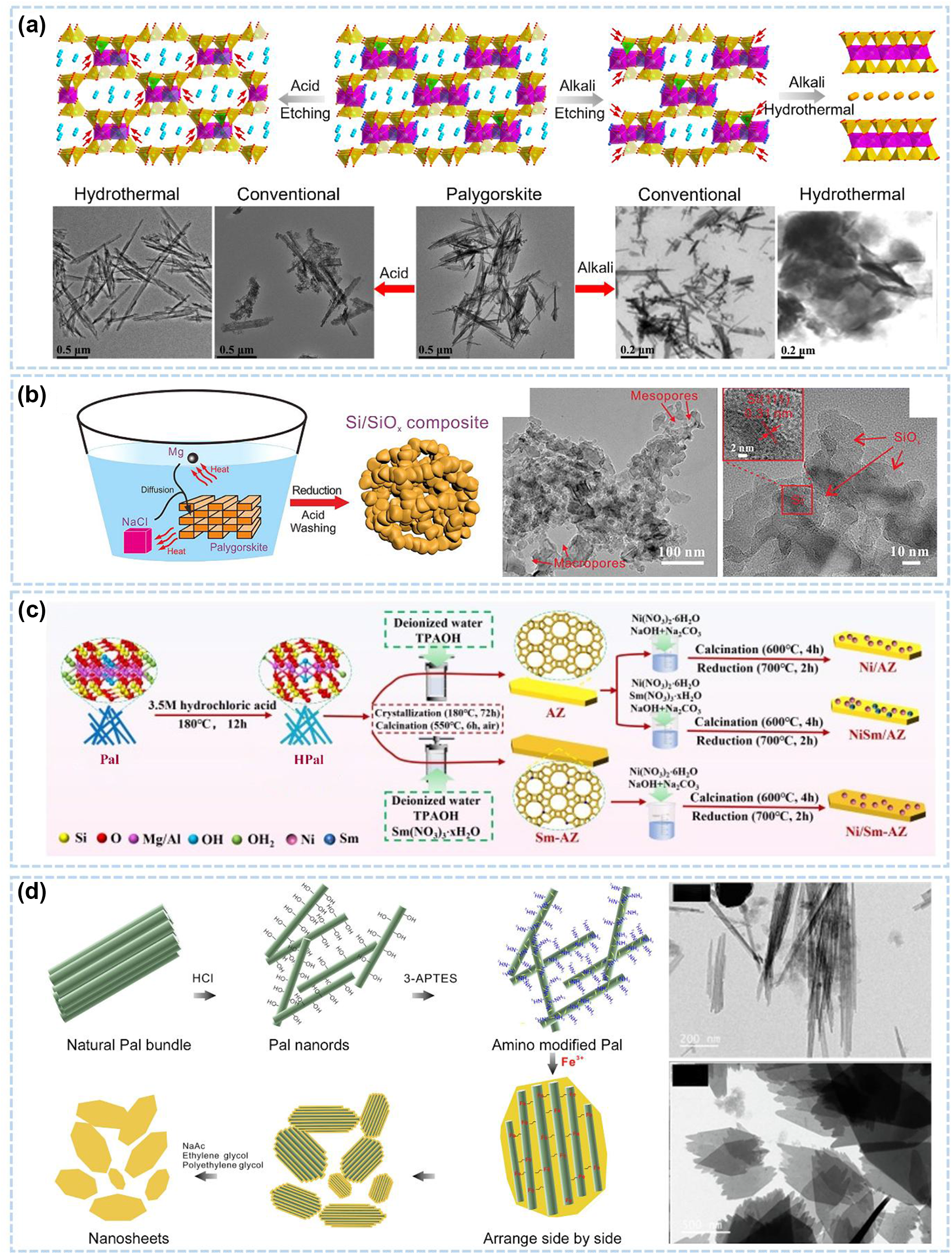
Chinese researchers have made substantial contributions to advancing the structural evolution of Pal into functional materials through acid, alkali, hydrothermal and solvothermal treatments, driving innovations in material design and application (Lu & Wang, Reference Lu and Wang2022). The processes involve disrupting, reorganizing or reconstructing the original tetrahedral–octahedral framework. Acid treatment using strong inorganic acids such as HCl or H2SO4 was primarily employed to remove carbonate impurities such as calcite and dolomite, as well as to exchange the cations, with the aims of unblocking channels and improving porosity (Chen et al., Reference Chen, Feng and Shi2003; Chen et al., Reference Chen, Xu, Peng, Wang and Xu2004). However, traditional acid-leaching methods often shortened the nanorods and reduced their aspect ratio (Fig. 5a; Lai et al., Reference Lai, Yue, Zhao and Gao2010; Zhu et al., Reference Zhu, Zhang, Wang, Wen, Su and Zhu2018b). Notably, Wang et al. (Reference Wang, Dong, Tian, Sun, Wang and Hui2019a) demonstrated that mild hydrothermal acid leaching could produce high-purity silica nanorods with specific surface areas exceeding 230 m2 g–1 while maintaining the original rod length without shortening (Fig. 5a). In contrast, Lu et al. (Reference Lu, Wang, Wang, Xu and Wang2019b) achieved the efficient removal of metal cations to obtain a high-porosity 1D silica for nanocomposites using oxalic acid under conventional conditions without damaging nanorod length. Beyond silica derivation, Chen et al. (Reference Chen, Zhu, Deng, Ma, He and Du2019) applied magnesiothermic reduction in molten salt to directly convert Pal into silicon/silicon oxide composites with hierarchical porosity, which exhibited notable adsorption performance towards VOCs (Fig. 5b).
(a) Schematic diagrams and transmission electron microscopy (TEM) images of Pal undergoing acid–alkali treatment under conventional and hydrothermal conditions (Wang et al., Reference Wang, Wang, Kang and Wang2015b,Reference Wang, Zhang, Tian and Wangc, Reference Wang, Dong, Tian, Sun, Wang and Hui2019a). (b) Synthesis and TEM images of hierarchical porous Si/SiOx composites via molten salt-assisted magnesiothermic reaction (Chen et al., Reference Chen, Zhu, Deng, Ma, He and Du2019). (c) Synthesis diagram of ZSM-5 using Pal (Liang et al., Reference Liang, Wang, Wang, Yang, Yue and Xu2026). Sm-AZ = samarium-doped Pal-based ZSM-5 zeolite; TPAOH = tetrapropylammonium hydroxide. (d) Structure evolution and TEM images of Pal from nanorods to nanosheets (Liu et al., Reference Liu, Zhong, Chen, Mao, Liu and Zhang2021a). 3-APTES = 3-aminopropyltriethoxysilane; NaAc = sodium acetate.

Figure 5 Long description
The composite illustration is divided into four labeled sections, each pairing a schematic workflow with corresponding transmission electron microscopy micrographs showing morphological outcomes. Section a shows schematic diagrams of palygorskite undergoing acid etching and alkali etching under both conventional and hydrothermal conditions. The workflow moves from the starting palygorskite structure through acid etching steps andalkali etching steps, branching into conventional and hydrothermal pathways. Labels present include Hydrothermal, Conventional, Palygorskite, Acid and Alkali. Transmission electron microscopy micrographs are arranged below the schematic, showing fiber and rod morphologies at each stage. Scale bars are visible in each micrograph. Section b shows a schematic of the synthesis of a silicon and silicon oxide composite using a molten salt-assisted magnesiothermic reduction process. The label Si slash SiO subscript 2 composite appears on the resulting product. A transmission electron microscopy micrograph on the right shows a porous granular structure, with an inset at higher magnification displaying nanostructured surface detail. Scale bars of 100 nanometer and 10 nanometer are visible. Section c shows a synthesis workflow for ZSM-5 zeolite using palygorskite as a starting material. The label HPal appears after an initial acid treatment step using 3.5 molar hydrochloric acid at 100 degrees Celsius for 12 hours. The workflow then branches into two routes using deionised water and tetrapropylammonium hydroxide, leading to products labeled AZ and Sm-AZ. Steps include crystallisation at 100 degrees Celsius for 72 hours, calcination at 550 degrees Celsius for 4 hours and reduction at 700 degrees Celsius for 2 hours. Additional reagents labeled include Ni subscript 2 O subscript 3, NiSm subscript x and Sm(NO subscript 3) subscript 3. Final products labeled are Ni slash AZ and NiSm slash AZ. Section d shows the structural evolution of palygorskite from a natural bundle form through nanorod separation to amino-modified nanorods and finally to nanosheets arranged side by side. Labels include Natural Pal bundle, Pal nanorods, Amino modified Pal, Arrange side by side and Nanosheets. Reagents labeled include HCl, 3-APTES, Fe, NaAc and Enzyme slash glucose slash glyoxal. Two transmission electron microscopy micrographs on the right show elongated rod structures and flat sheet-like structures respectively, with scale bars visible.
Alkali treatment extends structural modification from leaching to framework reorganization and phase transformation. Under conventional heating, alkaline treatment primarily disrupted Si–O–Si bridging bonds on the Pal surface, converting them into more reactive Si–O⁻ groups, which significantly improved cation adsorption capacity but shortened the nanorod length (Fig. 5a; Wang et al., Reference Wang, Wang, Kang and Wang2015b). Under hydrothermal conditions, Pal underwent recrystallization into smectite, a transformation elucidated by Zhang et al. (Reference Zhang, Chen, Cheng and Ye2009) and later refined by Wang et al. (Reference Wang, Zhang, Tian and Wang2015c) under mild alkaline environments (Fig. 5a). This phase transition altered the mineral structure and enabled the tailoring of textural properties, yielding mixed-dimensional composites with improved adsorption performance towards heavy metals and organic pollutants (Wang et al., Reference Wang, Zhang, Tian and Wang2015c; Zhao et al., Reference Zhao, Wang, Wang, Meng, Zhang and Liang2022).
Furthermore, alkali or acid treatment facilitated the extraction of silicon and/or aluminium species from Pal, which served as precursors for synthesizing zeolitic and mesoporous materials. Yang et al. (Reference Yang, Tang, Ouyang, Li and Mann2010) first utilized acid-leached Pal-derived amorphous silica as a silicon source, which was then hydrothermally treated in the presence of structure-directing agents to synthesize ordered mesoporous Al-MCM-41, which demonstrated excellent efficiency in removing aromatic pollutants. Building on this approach, Chinese researchers have widely adopted Pal as a low-cost, natural silicon source to fabricate diverse zeolites and ordered mesoporous materials (Fig. 5c), including ZSM-5, MCM-41, 5A zeolite, SBA-15 and Linde type A (LTA) zeolites, thereby establishing a sustainable pathway towards high-performance catalysts and molecular sieves (Feng et al., Reference Feng, Kou, Tang, Shi, Tong and Zhang2023). In particular, Li et al. (Reference Li, Jiang, Liu, Shi, Zhang and Sun2017) pioneered a vapour-induced transformation method to directly convert Pal into ZSM-5 using NH4F as a mineralizing agent, circumventing the need for conventional silicon precursors and further simplifying the synthesis process.
Zhang et al. (Reference Zhang, Wang and Wang2015a) illustrated that strongly polar organic molecules could intercalate into Pal tunnels under solvothermal treatment, causing lattice expansion and introducing functional groups such as C=O and S=O. In addition, various organic acids, as well as chloroacetic acid and glycine, not only served as donors of functional groups to introduce –COOH, –NH2 and other moieties, but also promoted the partial collapse and rearrangement of the Pal crystal structure, generating numerous active Si–O⁻ adsorption sites (Zhang et al., Reference Zhang, Wang and Wang2015b, Reference Zhang, Wang, Kang, Zong and Wang2016b). This synergy between structural evolution and surface functionalization significantly enhanced the adsorption performance of Pal for organic dyes and heavy metal ions. Moreover, solvothermal treatment can drive the structural assembly of 1D nanorods into 2D nanosheets. Liu et al. (Reference Liu, Zhong, Chen, Mao, Liu and Zhang2021a) developed a solvothermal method to synthesize uniform, single-layered palmate Pal nanosheets through a multi-step process involving acid leaching, surface amination and solvothermal assembly assisted by Fe3+ coordination in ethylene glycol (Fig. 5d). These nanosheets showed exceptional demulsification performance for crude oil-in-water emulsions, achieving a separation efficiency of 99.99%. Furthermore, Ag/nanosheet hybrids served as lubricant fillers that significantly improved the tribological properties of fabric composites, delivering a synergistic improvement with a 89.59% reduction in wear rate and a 9.5% decrease in friction coefficient (Chen et al., Reference Chen, Zhang, He, Liao, Zhang and Yang2025).
From MDPal to overall mineral utilization
China possesses vast reserves of MDPal (Liu et al., Reference Liu, Zhang, Liu, Liu and Deng2021b; Zhang et al., Reference Zhang, Liu, Liu, Zhang, Qiao and Teppen2021). Unlike high-purity Pal with well-developed rod crystals and minimal associated minerals, MDPal is a complex assemblage dominated by 1D rod-like Pal, accompanied by 2D clay minerals such as illite, chlorite, kaolinite and illite-smectite mixed-layer clays. The characteristic dark brick-red, grey or khaki colouration of MDPal arises from isomorphic substitutions, such as Fe3+ replacing Mg2+ in octahedral sites, and the presence of crystalline or amorphous iron oxides such as hematite. Historically, the complex mineralogy and intense colouration of MDPal have hindered its high-value utilization. Our research group has pioneered a paradigm shift, moving away from the conventional practices of isolating single-phase Pal or discarding associated minerals towards an integrated strategy for comprehensive mineral utilization (Wang et al., Reference Wang, Lu, Mu, Zhang, Wang and Hui2022a).
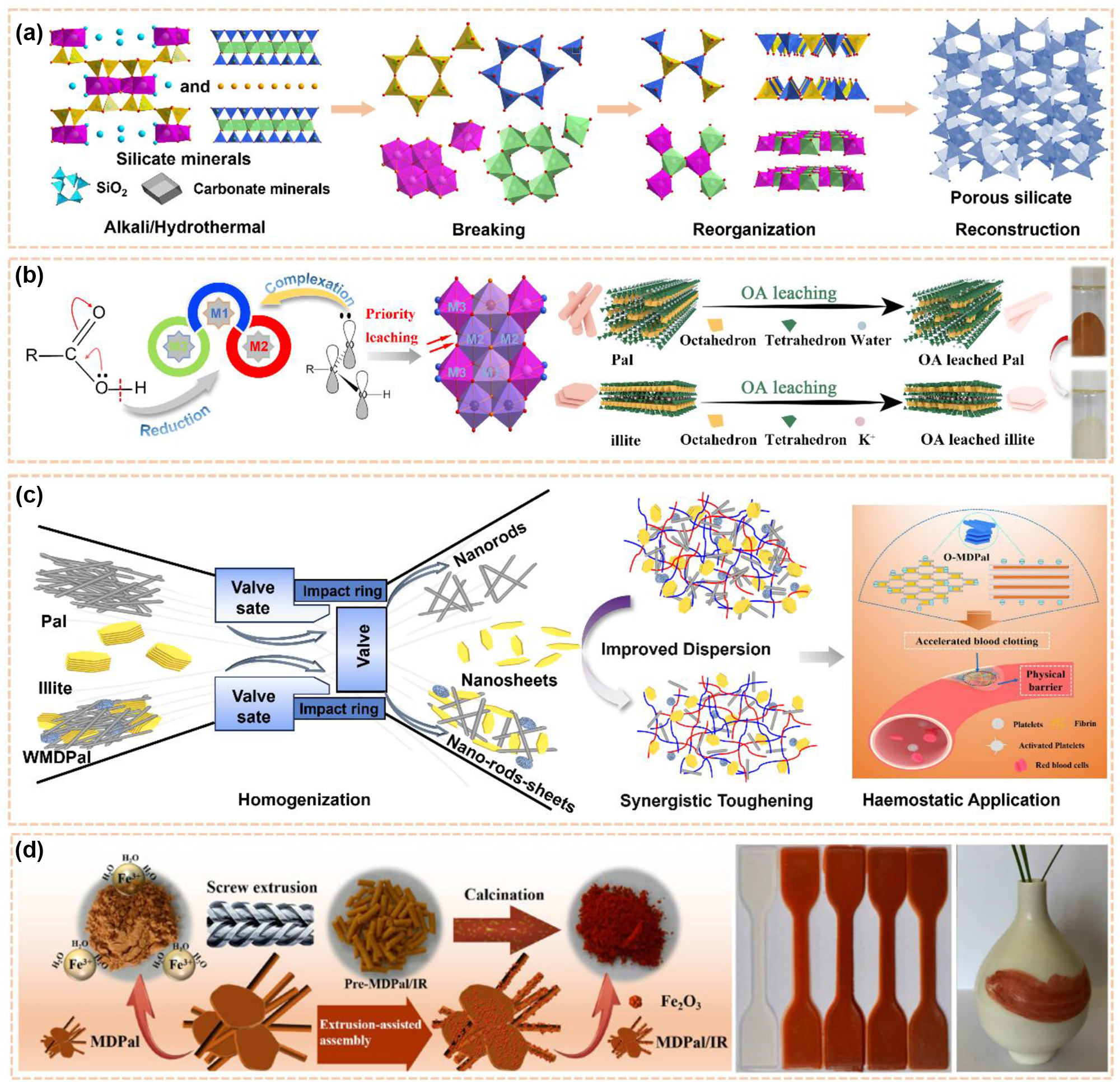
Inspired by natural mineralization processes, structural reorganization strategies, particularly hydrothermal treatment, have been developed to simultaneously transform the diverse silicate minerals in MDPal, as well as carbonate minerals and quartz, into novel mineral functional materials (Fig. 6a; Wang et al., Reference Wang, Tian, Wang, Zhang, Kang, Zong and Wang2016a,Reference Wang, Tian, Zong, Wang, Zhou and Wangb, Reference Wang, Zhao, Zhang, Xu, Zong, Kang and Wang2021b). The various minerals could be transformed into porous hybrid silicate materials via a one-step hydrothermal process without the need for complex purification or expensive templates. The crystalline phase, morphology and porosity of the resulting materials were tuned by modulating the type and concentration of metal ions in the reaction system. Increasing Zn2+ availability drove the evolution from sheet-like zinc silicate intermediates towards spindle-shaped crystalline Zn2SiO4 (Wang et al., Reference Wang, Tian, Zong, Wang, Zhou and Wang2016b), whereas Mg2+-dominant systems favoured the formation of amorphous magnesium silicate microspheres (Wang et al., Reference Wang, Tian, Wang, Zhang, Kang, Zong and Wang2016a). The engineered mesoporous architectures exhibited markedly enhanced specific surface areas and a high density of surface active sites, endowing them with exceptional adsorption capacities for organic pollutants. This biomimetic, mineral-based synthesis route provides a scalable strategy for producing high-value functional materials directly from mineralogically complex natural clays and solid wastes (Wang et al., Reference Wang, Tian, Zong, Zhou, Kang, Wang and Wang2017; Zhao et al., Reference Zhao, Feng, Zhang, Han, He and Huang2023; Lu et al., Reference Lu, Huang, Zhao, Shan, He, Zhang and Wang2026).
(a) Schematic illustration of the transformation of MDPal into porous silicate under alkaline hydrothermal conditions. (b) Whitening of brick-red MDPal via oxalic acid (OA) leaching (Zhang et al., Reference Zhang, Wang, Wang, Xu, Lu and Wang2022b). (c) High-pressure homogenization treatment of whitened MDPal (WMDPal) for polymer toughening and reinforcement and imparting haemostatic properties (Wang et al., Reference Wang, Mu, Zhang, Du, Yang and Wang2023b; Lu et al., Reference Lu, Mu, Kang, Gao and Wang2025). O-MDPal = oxalic acid-leached MDPal. (d) Preparation and application of MDPal-based iron-red (IR) nanocomposite pigments via a mechanochemical method (Yang et al., Reference Yang, Mu, Wu, Xu and Wang2026b).

Figure 6 Long description
(a) The transformation of silicate minerals, SiO2 and carbonate minerals through alkali hydrothermal conditions into porous silicate. The process involves breaking, reorganization and reconstruction. (b) The oxalic acid (OA) leaching process of Pal shows the leaching of the octahedrons, resulting in OA-leached Pal and illite. (c) High-pressure homogenization of Pal, illite and WMDPal through a valve seat, impacting into nanosheets and nanorods, leading to improved dispersion and synergistic toughening. The haemostatic application is depicted with nano rod-sheets aiding in blood clotting. (d) Preparation of MDPal-based iron-red (IR) nanocomposite pigments through screen extrusion and calcination, resulting in MDPal/IR. Images show the process stages and final product forms.
MDPal presents a distinctive multidimensional architecture, characterized by the coexistence of 1D rod-like and 2D sheet-like phyllosilicates, and it holds considerable promise as a toughening and reinforcing filler in polymer composites. To fully realize this potential and expand it into high-value applications, it is essential to develop efficient whitening methods to remove the variable-valence metal elements, especially Fe (Ding et al., Reference Ding, Huang, Wang, Wang and Wang2019). The authors’ team has explored various whitening strategies for brick-red MDPal, including hydrothermal treatment in thiourea solution (Zhang et al., Reference Zhang, Wang, Mu and Wang2018c), solvothermal processing in dimethyl sulfoxide/water mixtures (Zhang et al., Reference Zhang, Wang, Tian, Wang and Wang2018d) and reductive reflux using hydroxylamine hydrochloride (Zhang et al., Reference Zhang, Wang, Kang, Wang and Wang2018b), achieving effective decolourization through the reduction and/or leaching of Fe3+ species. In pursuit of a simpler and faster whitening process operable under conventional conditions, the multifunctional oxalic acid was used to develop various efficient whiting techniques (Fig. 6b), including wet (Zhang et al., Reference Zhang, Wang, Wang, Xu, Lu and Wang2022b), semi-dry (Lu et al., Reference Lu, Wang, Xu, Ding, Wang and Wang2020) and microwave-assisted approaches (Lu et al., Reference Lu, Zhang, Wang and Wang2022b). These methods selectively removed colouring metal ions, largely retaining the aspect ratio of Pal nanorods and preserving the structural integrity of associated layered minerals.
Subsequently, high-pressure homogenization and ultrasonication were used to further unlock the reinforcement potential of this mixed-dimensional structure by disaggregating 1D Pal crystal bundles and exfoliating 2D clay mineral layers (Fig. 6c; Xu et al., Reference Xu, Wu, Mu, Lu, Wang and Wang2024; Lu et al., Reference Lu, Mu, Kang, Gao and Wang2025). The unique 1D/2D heterostructure facilitated the formation of an interlocking network within the polymer matrix, yielding a remarkable synergistic enhancement effect (Lu et al., Reference Lu, Mu, Kang, Gao and Wang2025). This dimensional complementarity enabled concurrent and substantial improvements in key properties of polymer composites, including tensile strength, elongation at break, water resistance and thermal stability (Zhang et al., Reference Zhang, Wang, Wang, Xu, Lu and Wang2022b; Wang et al., Reference Wang, Mu, Zhang, Du, Yang and Wang2023b; Xu et al., Reference Xu, Wu, Mu, Lu, Wang and Wang2024; Lu et al., Reference Lu, Mu, Kang, Gao and Wang2025). Notably, the overall process was designed as a closed-loop system, in which metal ions solubilized during acid leaching, traditionally regarded as waste, were recovered and repurposed as precursors for synthesizing layered double hydroxides (LDHs; Dong et al., Reference Dong, Lu, Wang, Zhang, Jing and Wang2020; Lu et al., Reference Lu, Yu, Zhu, Mu and Wang2022a), which exhibited high efficacy in terms of dye adsorption. Subsequent anaerobic calcination of the dye-loaded LDHs yielded mixed metal oxide/carbon composites to efficiently capture heavy metals. This closed-loop approach mitigated secondary pollution and converted waste streams into value-added functional materials.
MDPal features a unique heterostructure, intrinsic alkalinity, surface Si–OH groups and permanent negative surface charge. Thus, iron-rich brick-red MDPal was used as a raw material to construct iron-red hybrid pigments (α-Fe2O3/MDPal) via hydrothermal or mechanochemical methods (Fig. 6d), eliminating the need for external precipitants (Lu et al., Reference Lu, Dong, Wang, Wang, Hui and Wang2019a; Yang et al., Reference Yang, Mu, Wu, Xu and Wang2026b). The structural confinement and compositional synergy of MDPal effectively inhibited nanoparticle aggregation, which endowed the resulting hybrid pigments with exceptional tinting strength, weather resistance and chemical stability. Crucially, this overall mineral utilization strategy extended beyond the clay matrix itself. Quartz sand, for instance, has been used as a substrate for synthesizing high-chroma cobalt blue hybrid pigments, demonstrating the functional value of these coexisting minerals (Yang et al., Reference Yang, Mu, Li, Wang and Wang2022b).
From Pal-based solid wastes to sustainable utilization
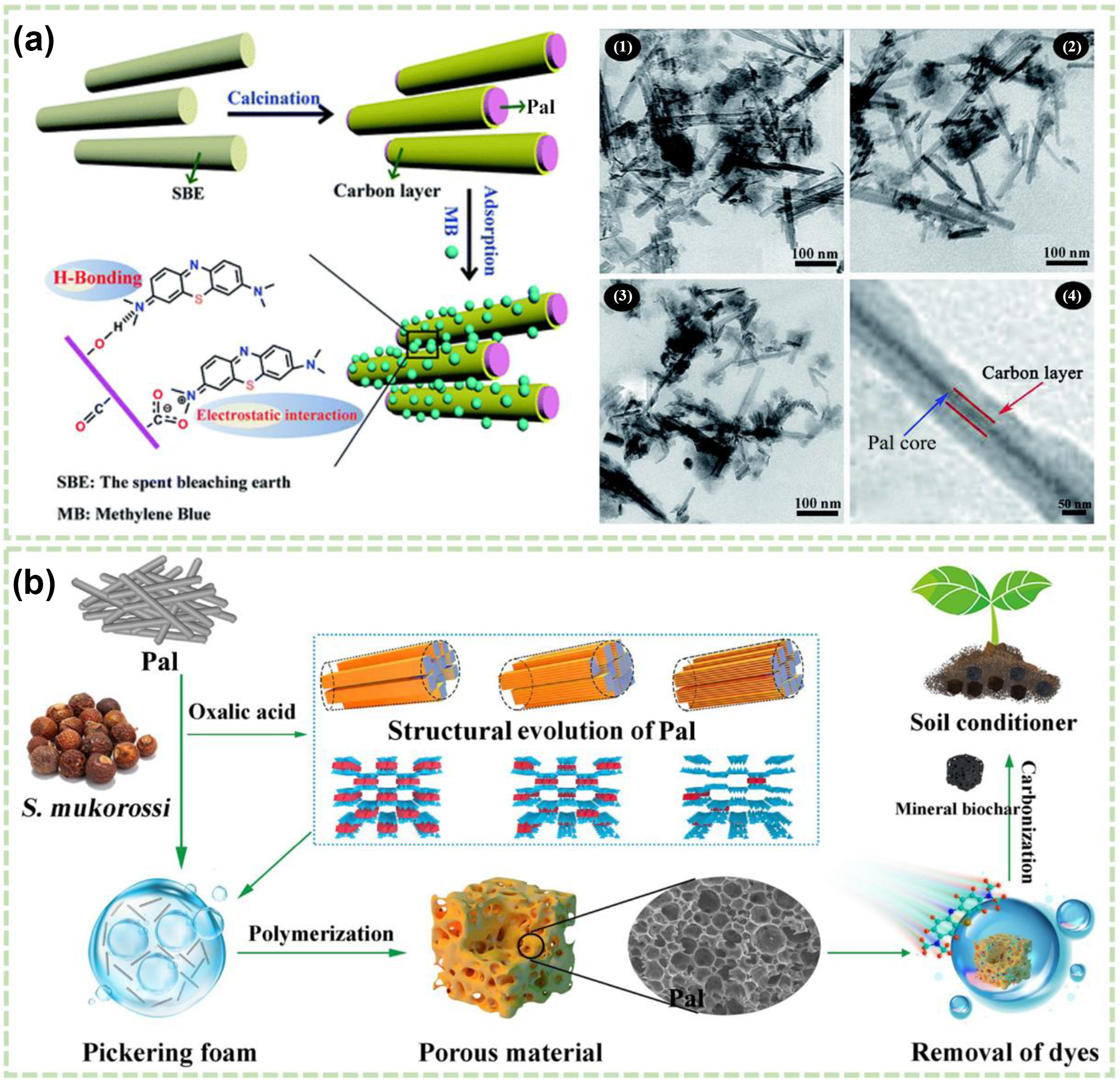
Adsorption performance is one of the crucial application parameters of Pal. However, most studies in this area only focus on the adsorption properties and preparation costs of Pal-based adsorbents, with the green disposal and sustainable utilization of spent adsorbents remaining ignored. Typically, spent bleaching earth (SBE), a solid waste from the edible oil industry after bleaching, retains 10–20% (w/w) residual oil and other organic substances, and the relevant reports mainly focused on the regeneration of either organic matter or Pal in SBE (Mu & Wang, Reference Mu, Wang, Martínez, Kharissova and Kharisov2018). Our group explored hydrothermal carbonization of SBE to prepare Pal/carbon nanocomposite-loaded MnO2, magnetic compounds or organic functional groups (Tang et al., Reference Tang, Mu, Wang, Zheng and Wang2016, Reference Tang, Mu, Zong, Zheng and Wang2017, Reference Tang, Mu, Zong and Wang2018a) for the removal of heavy metal and organic dyes. Furthermore, the facile direct pyrolysis carbonization of SBE also presented good adsorption properties towards pollutants, as this process activated Pal in SBE, accompanied by the carbonization of organic matter (Fig. 7a; Tang et al., Reference Tang, Mu, Zheng and Wang2015a,Reference Tang, Mu, Zong, Zheng and Wangb). Thus, adsorption–carbonization cyclic regeneration technology was developed for the sustainable utilization of SBE-based adsorbents after the adsorption of organic pollutants, which exhibited high adsorption capacity towards organics after 10 adsorption–regeneration cycles (Tang et al., Reference Tang, Zong, Mu, Zhu and Wang2018b, Reference Tang, Mu, Zong and Wang2019). Inspired by this, such cyclic regeneration technology was developed to regenerate spent Pal-based adsorbents after the adsorption of organics (Wang & Wang, Reference Wang and Wang2022).
(a) Illustration of the preparation of Pal/C composites via direct calcination of SBE for pollutant adsorption, along with transmission electron microscopy images of the samples calcined at (1) 250°C, (2) 300°C and (3) 450 °C, and (4) a locally magnified image of the sample obtained at 300°C (Tang et al., Reference Tang, Mu, Zong, Zheng and Wang2015b). (b) Schematic representation of the preparation of porous adsorbents from Pickering foam templates using the structural evolution of Pal and S. mukorossi as a stabilizer and its sustainable application (Duan et al., Reference Duan, Zhu, Zhang, Lu and Wang2023b).

Figure 7 Long description
The image consists of two main parts. In the first part, labeled (a), the preparation of Pal/C composites is illustrated. It begins with the calcination of spent bleaching earth, labeled as SBE. This process involves the formation of a carbon layer around Pal, depicted with arrows indicating adsorption of methylene blue through hydrogen bonding and electrostatic interactions. Adjacent to this illustration are four transmission electron microscopy images. Image (1) shows a sample calcined at 250 degrees Celsius, image (2) at 300 degrees Celsius, image (3) at 450 degrees Celsius and image (4) is a magnified view of the sample at 300 degrees Celsius, highlighting the carbon layer and Pal core. The second part, labeled (b), is a schematic representation of the preparation of porous adsorbents from Pickering foam templates. It starts with Pal treated with oxalic acid and S. mukorossi, which undergoes structural evolution to form a porous material via Pickering foam templating. This material is then used for dye removal, and the resulting waste adsorbents are subsequently applied as a soil conditioner. Arrows in the diagram indicate the flow towards these applications.
To regenerate the spent adsorbents, our group first fabricated porous adsorbents based on eco-friendly aqueous Pickering foam templates stabilized by the plant Sapindus mukorossi and Pal for the efficient adsorption of organic pollutants (dyes and antibiotics), and then the spent adsorbents were carbonized and transformed into mineral/biochar composites for soil remediation and soil improvement (Fig. 7b; Duan et al., Reference Duan, Zhu, Yu and Wang2023a,Reference Duan, Zhu, Zhang, Lu and Wangb). It was found that the prepared mineral/biochar composites effectively adjusted the pH value, cation-exchange capacity and soil organic matter, improving plant growth. The relevant studies not only fit well with the sustainable development concept of ‘from nature, for nature, and into nature’ of natural clays or clay minerals, but also proposed a promising sustainable strategy to recycle spent Pal-based adsorbents.
Green construction of advanced functional materials
With the advancement of technology and the severity of environmental protection requirements, green sustainable development has become an inevitable trend in the construction of functional materials, including green raw materials, green preparation technologies and green products. Regarding this concept, one could refer back to the famous Maya Blue composed of natural Pal and indigo, with its vivid colour and excellent resistance to acids and biocorrosion (Van Olphen, Reference Van Olphen1966). Zhuang et al. (Reference Zhuang, Li, Li and Yuan2022) found that the presence of zeolitic water and coordinated water was crucial to the preparation of stable Maya Blue, thus Pal-based Maya Blue presented more optimal environmental stability (Fig. 8a; Fan et al., Reference Fan, Liu, Li, Zhuang and Yuan2025). With the in-depth understanding of the interaction mechanisms of Maya Blue, various natural pigments were employed to prepare Pal-based colour-tuneable organic/inorganic hybrid pigments (Fig. 8b) for multifunctional packaging materials (Li et al., Reference Li, Ding, Mu, Wang, Kang and Wang2019b, Reference Li, Mu, Zhang, Kang and Wang2022b) and cosmetics (Liu et al., Reference Liu, Cao, Jiang, Wang, Zhang and Liu2024b).
(a) Schematical diagram of indigo (In)-Pal or sepiolite (Sep) interactions and the stability of hybrid pigments (Fan et al., Reference Fan, Liu, Li, Zhuang and Yuan2025). DMSO = dimethyl sulfoxide. (b) Preparation and colour change of anthocyanin (ACN)/Pal hybrid pigments (Li et al., Reference Li, Ding, Mu, Wang, Kang and Wang2019b). (c) Formation mechanism and transmission electron microscopy images of plant-mediated Se/Pal nanocomposites (Song et al., Reference Song, Yang, Mu, Ma, Quan and Wang2023). ALE = Aloe vera leaf extract.

Figure 8 Long description
The image consists of three parts: (a) shows a schematic of indigo-Pal or sepiolite interactions with stability of hybrid pigments. It includes a diagram of pigment channels and a comparison of pigment states under different conditions: pristine, light, HNO3 and DMSO. Labels A to F represent different conditions: In-Pal, In-Pal-180-Air, In-Pal-180-Vacuum, In-Sep, In-Sep-180-Air and In-Sep-180-Vacuum. (b) illustrates the preparation and color change of anthocyanin/Pal hybrid pigments. It details the process of adsorption, grafting and bonding, with a focus on the increase of synthetic time and the effects of NH3 and HCl. (c) depicts the formation mechanism and transmission electron microscopy images of plant-mediated Se/Pal nanocomposites. It includes a diagram of hydrogen-bond interactions, reductive stabilization and images showing the nanocomposite structure at different scales, with a histogram and highlighted areas indicating specific features.
Correspondingly, Pal-based eco-friendly inorganic/inorganic hybrid pigments were also fabricated by the in situ growth of inorganic pigment nanoparticles on the surface of Pal via various liquid-phase methods (Mu et al., Reference Mu, Wang and Wang2015; Tian et al., Reference Tian, Wang, Wang, Wang and Wang2017; Wang et al., Reference Wang, Mu, Hui, Wang and Wang2018), and the incorporation of Pal prevented from the aggregation of inorganic nanoparticles, decreased the crystallization temperature and preparation cost of inorganic pigments and adjusted the chroma content via the doping of mineral elements. However, numerous waste liquids were inevitably discharged with such low yields obtained. Therefore, Yang et al. (Reference Yang, Mu, Li and Wang2022a) developed a mechanochemical method to prepare inorganic hybrid pigments using hydrated metal salts as a metal source, while the crystal water served as micro-solvent system to promote the reaction of the material. This process was different from the traditional ball milling-assisted mechanochemical process. Furthermore, twin-screw extrusion-assisted mechanochemical synthesis was developed to prepare inorganic hybrid pigments based on natural MDPal without the discharging of wastes (Fig. 6d; Zhu et al., Reference Zhu, Li, Mu, Yang, Wu, Wang and Wang2023; Wu et al., Reference Wu, Mu, Yang, Wang, Zhu, Dou and Wang2025). Based on the synergistic effects of each component, Pal-based hybrid pigments served as pigments and fillers for colouring, for toughening and reinforcing polymers, for glaze colourants and for anticorrosive paints.
In addition to the colouring properties of metal-based nanoparticles, the enzyme-like characteristics of nanomaterials, especially metal or metal oxide nanoparticles (i.e. ‘nanozymes’) have also attracted much attention (Yang et al., Reference Yang, Yang, Zhu, Chu, Li and Xu2021). It is imperative to develop eco-friendly preparation strategies for the synthesis of high-performance nanozymes of controllable size. Our group employed a plant-mediated synthesis method to prepare Pal-based composite nanozymes using plant extracts as reducing agents, capping agents and stabilizers (Duan et al., Reference Duan, Yang, Mu, Zhu and Wang2024). The synthesized metal-based nanoparticles possessed ultra-small size, good dispersion and enzyme-like activity due to the confinement effect of Pal and the bioactivity of plant extracts, and the prepared mineral composite nanozymes exhibited excellent broad-spectrum antibacterial activity and promoted wound healing (Fig. 8c; Song et al., Reference Song, Yang, Mu, Ma, Quan and Wang2023; Yang et al., Reference Yang, Li, Mu, Kang, Xu and Wang2026a).
Conclusions and future perspectives
Scientists from around the world have achieved systematic innovations in the fundamental research and high-value utilization of Pal. As briefly summarized in this review article, Chinese scientists have successfully elevated Pal from traditional applications to advanced functional applications. Although significant progress has been made in both fundamental and applied research on Pal, the scaled functional utilization of Pal resources requires forward-looking and in-depth research to meet the demands of green, low-carbon and sustainable development in the following aspects:
(1) Strengthen stratified mining and classified utilization of Pal clay deposits . Currently, the functional utilization of Pal often adopts an ‘off-the-shelf’ approach, with the results lacking reproducibility and universality. This represents a key bottleneck restricting the industrial application of these functional materials. Pal clay exhibits distinct regional characteristics, and Pal deposits in different countries and regions also therefore possess common features and unique differences. Even within the same mine, significant variations in microstructure and physicochemical properties exist between the various layers. It is recommended to strengthen the stratified mining and classified stockpiling of Pal clay deposits to provide homogeneous raw materials as a foundation for scaled functional applications. For high-purity Pal clay resources, the focus should be on developing high-end functional materials, for which 1D nanorods are irreplaceable. For MDPal resources, research should focus on the nanostructured complementarity of the different dimensional clay minerals by fully determining and utilizing the mineral attributes of these resources.
(2) Deepen research on the genesis mechanism of Pal and develop directed transformation strategies. High-purity Pal is rare in nature, and the artificial synthesis of Pal has not yet been achieved. It is essential to deepen research into the genesis mechanism of Pal. By simulating natural mineralization conditions (temperature, pressure, fluid chemistry, etc.), research on the interconversion of clay minerals should be conducted to deepen the understanding of the evolutionary pathways and transformation mechanisms among multi-mineral phases, aiming to decipher the ‘code’ behind the symbiosis and transformation of 1D and 2D clay minerals. In addition, attention must be given to the occurrence states of the various associated metal elements within the minerals, providing theoretical support for developing disruptive technologies for the directed transformation and in situ functional utilization of these clay minerals.
(3) Develop green and low-carbon construction methods to expand application fields and boundaries. In recent years, sustainable development has garnered worldwide attention. The construction of advanced Pal-based functional materials must place greater emphasis on clean preparation technologies. The application of mechanochemical approaches and natural plant extract-mediated technologies in functional material construction should be strengthened. Moreover, the role of microbe–mineral interactions deserves particular attention. Exploring microbial modification and interfacial regulation of Pal could facilitate green surface functionalization and reveal new pathways for function applications, such as food fermentation (e.g. immobilized enzymes or microbial starters), safe animal farming (e.g. probiotic encapsulation and mycotoxin/pathogen adsorption) and ecological environment remediation (e.g. synergistic microbial degradation of organics).
(4) Promote interdisciplinary integration and artificial intelligence (AI)-driven frontier innovation. We should promote the deep integration of mineralogy with frontier fields such as synthetic biology, quantum information and energy science. The vigorous development of AI-driven mineral engineering is essential, utilizing machine learning and computational simulations for the high-throughput prediction of material formulations and the optimization of synthesis pathways. Systematic research should be carried out along the innovation chain of structure analysis to intelligent design to green preparation to application expansion. Priority should be given to exploring the applications of Pal-based functional materials in emerging fields such as new energy sources, carbon neutrality, flexible bioelectronics and sensors, advanced catalytic systems and tissue engineering, which will promote Pal resources as playing irreplaceable roles in emerging industries, future industries and even planetary science.
Acknowledgements
It is regretful that many outstanding works of Chinese scientists are not contained in this paper due to the word limit. We would like to express our deepest gratitude to the editor of Clay Minerals, Dr Prof Chun Hui Zhou. Without his support, the publication of this issue would have been impossible.
Financial support
The authors wish to acknowledge the financial support from the National Natural Scientific Foundation of China (42402045, 52402134, 52573128) and the Basic Research Creative Groups Project of the Science and Technology Plan of Gansu, China (23JRRA568).
Competing interests
The authors declare none.