Percutaneous arterial catheterisation was initiated by SeldingerReference Seldinger 1 in 1953 and afterwards modified by LurieReference Lurie, Armer and Klatte 2 for use in children and infants. Since then, cardiac catheterisation has become common practice in the diagnosis and treatment of children with heart disease and is becoming increasingly used. In fact, definitive repair of heart diseases that once required open-heart surgery can now be provided in a cardiac catheterisation laboratory.
Following the increase in arterial catheterisations performed in the diagnosis and treatment of children with heart disease, lower limb ischaemia is being increasingly recognised as a complication of those procedures. It is, in fact, the most frequent complication of cardiac catheterisation. Its relevance is becoming more prominent because it can result in significant patient disability and may limit arterial access sites to repeat diagnostic or interventional catheterisations that are becoming more often needed. In this narrative review, we report the prevalence, mechanisms, and therapy of this complication aiming to increase awareness for this frequently overlooked complication. In particular, new preventive and treatment strategies should be prospectively investigated in order to obtain more safe and predictable results.
Prevalence of femoral artery thrombosis after arterial catheterisation
A prospective studyReference Vitiello, McCrindle, Nykanen, Freedom and Benson 3 to determine complications associated with paediatric diagnostic, interventional, and electrophysiologic catheterisation in 4952 consecutive paediatric catheterisation procedures detected a global complication rate of 8.8%. Vascular complications were the most common adverse event, occurring in 3.8% of the procedures and 7.3% in those below 1 year of age. Arterial thrombosis was the most frequent vascular complication with either decreased or absent pulse affecting 165 patients. Restoration of flow was possible in most of them with unfractioned heparin infusion. Interventional catheterisation and lower age were identified as independent risk factors for arterial complication.
However, the true incidence of arterial compromise cannot be entirely known using physical examination alone. In a study that used Doppler ultrasonography to examine arterial flow after arterial cannulation, Kocis et al,Reference Kocis, Snider, Vermilion and Beekman 4 found a higher incidence of flow compromise, affecting 32% of the patients. Notably, in only 57% of these patients was the diagnosis apparent on clinical examination.
It has been shown that cardiac magnetic resonance can also be useful for evaluating obstructive lesions of the iliofemoral arteries after balloon angioplasty in children.Reference Burrows, Benson, Babyn and MacDonald 5 A study using gradient magnetic resonance imagingReference Burrows, Benson, Babyn and MacDonald 5 for the detection of obstructive iliofemoral arterial lesions, after balloon dilation angioplasty of aortic coartation, found a very high incidence of 58%. Once again, the prevalence by clinical examination led to underestimation of this complication. The main contributing factors identified were catheter size and manipulation, including changing catheter.
An angiographic studyReference Hurwitz, Franken, Girod, Smith and Smith 6 to determine long-term arterial patency – 6 months to 9 years after the first catheterisation – in 48 patients requiring repeated left heart catheterisation from the opposite leg diagnosed total arterial occlusion in four cases.
In all, four independent variables have been found to significantly increase the risk of iatrogenic vascular injury.Reference Lin, Dodson and Bush 7 These are age <3 years, therapeutic intervention, multiple earlier catheterisations, and the use of a ⩾6 F guiding catheter.Reference Lin, Dodson and Bush 7 Arterial occlusion is probably related to the interaction of catheter size and the diameter of the vessel.Reference Hurwitz, Franken, Girod, Smith and Smith 6 , Reference Franken, Girod, Sequeira, Smith, Hurwitz and Smith 8
Pathophysiology and complications
The exact mechanism of post-catheterisation thrombus formation is still incompletely understood. Nonetheless, several mechanisms have been suggested as potential contributors to thrombotic occlusion after arterial catheterisation. They can be related to the arterial puncture and sheath, to the vessel itself, or to patient characteristics.
Direct arterial puncture can result in intimal dissection.Reference Kocandrle, Kittle and Petasnick 9 Indeed, intimal flaps have been identified at the time of surgical thrombectomy for post-catheterisation thrombosis.Reference Lin, Dodson and Bush 7 Intimal flaps and dissection can promote the occlusion of the true lumen and present as limb ischaemia either by thrombosis or by compression of the true lumen.
The sheath and catheters may also harbour some additional thrombogenic potential. AnimalReference Nejad, Klaper, Steggerda and Gianturco 10 and humanReference Siegelman, Caplan and Annes 11 , Reference Formanek, Frech and Amplatz 12 studies have shown that one possible mechanism of thrombosis is stripping off of fibrinous material from the catheter surface when it is removed. Although some materials may be more thrombogenic than others,Reference Nejad, Klaper, Steggerda and Gianturco 10 , Reference Formanek, Frech and Amplatz 12 no material is entirely devoid of this hazard.
The major clinical significant vessel-related mechanism is arterial spasm.Reference Mortensson 13 A study in which angiography of the femoral artery was performed after completion of angiocardiography in 100 consecutive infants and children identified arterial spasm in 62%.Reference Franken, Girod, Sequeira, Smith, Hurwitz and Smith 8 Although patient age, previously reported as playing a major contribution to arterial spasm, has been shown to contribute to spasm,Reference Mortensson 13 the most important factor is the relative size of catheter to artery.Reference Franken, Girod, Sequeira, Smith, Hurwitz and Smith 8 The spasm may be caused by shearing injury and endothelial denudation due to catheter friction because injured endothelium has been shown to have abnormal function that predisposes the vessel to vasospasm and thrombosis.Reference Cartier, Pearson, Lin and Schaff 14 Groin compression is usually done to stop bleeding of puncture site after catheterisation and, if excessive, may be a contributing factor to femoral artery thrombosis.Reference Liu, Yan and Zhao 15
Patient-related contributing factors include polycythaemia, changes in the blood viscosity, coagulability, and cardiac output related to the congenital cardiac defects.Reference Taylor, Troutman, Feliciano, Menashe, Sunderland and Porter 16
Femoral artery thrombosis has been reported to be associated with claudication, ischaemia, and tissue necrosis.Reference Vitiello, McCrindle, Nykanen, Freedom and Benson 3 Chronic femoral occlusion consequences include severe claudication and limb growth impairment.Reference Lin, Dodson and Bush 7
Growth retardation has been documented even in the absence of symptomatic ischaemia in patients with arterial thrombosis.Reference Bassett, Lincoln, King and Canent 17 – Reference Smith and Green 19 Unfortunately, there is insufficient information to help us predict how and when a reduced pulse may result in delayed limb growth and what is the best strategy to avoid it. A strategyReference Lee, Reddy and Rao 20 in case limb reperfusion is not successful and if there is evidence for leg growth retardation is to monitor progression using orthoroentgenographyReference Anderson, Messner and Green 21 and bone age determination at yearly intervals to estimate anticipated leg length descrepancy.Reference Moseley 22 If more than 2 cm of discrepancy is anticipated at maturity,Reference Lin, Dodson and Bush 7 , Reference Moseley 22 arterial grafting and methods to equalise extremity length may be necessary. Indeed, reduction of leg length discrepancy can be achieved by revascularisation and appear to be dependent on the adequacy of that revascularisation.Reference Cardneau, Henke and Upchurch 23
Prevention
Proof of concept that reduction of thromboembolism after catheterisation may be achieved by systemic heparinisation was obtained in animal studies.Reference Nejad, Klaper, Steggerda and Gianturco 10 , Reference Wallace, Medellin, De and Gianturco 24 Following those findings, clinical studies have tested unfractioned heparin anticoagulation to prevent thrombotic complications of percutaneous arterial catheterisation in 2200 children. Most of these studies were done more than two decades ago, particularly those that were placebo controlled.
In 1974, Freed M.D. et alReference Freed, Keane and Rosenthal 25 demonstrated, in a randomised double-blind placebo-controlled study, that unfractioned heparin 100 U/kg significantly reduced the incidence of arterial spasm and thrombosis requiring treatment from 40% in the placebo group to 8% in the unfractioned heparin pre-treated group. Accordingly, aggressive reperfusion techniques were only necessary in the placebo group, of which seven patients underwent surgical embolectomy. Notably, there were no complications related to systemic anticoagulation.
In 1981, Rao P.S. et alReference Rao, Thapar and Rogers 26 published a randomised double-blind placebo-controlled trial using unfractioned heparin 100 U/kg administered at the end of the catheterisation procedure that did not show a reduction of arterial complications with unfractioned heparin treatment. Possible factors contributing to the neutral results include the fact that the studied population was mainly aged over 5 years, a lower risk population, and the fact that arterial sheath was universally used. This resulted in a very low event rate in both the treatment and in the placebo arms of the trial that may have precluded observing a treatment effect.
The largest trialReference Girod, Hurwitz and Caldwell 27 evaluated three different anticoagulation strategies using unfractioned heparin in 1316 consecutively catheterised infants and children with regard to femoral artery thrombosis following percutaneous cardiac catheterisation. There were no significant differences whether a single bolus of 100 U/kg unfractioned heparin was used or a strategy including bolus infusion and supplementary 50 U/kg of unfractioned heparin after 45 or 75 minutes was used. Nonetheless, this study showed a very low incidence of arterial thrombosis with the use of systemic heparinisation.
Another randomised trialReference Saxena, Gupta, Kumar, Kothari and Wasir 28 prospectively studied the effect of 50 and 100 U/kg of unfractioned heparin on the incidence of arterial thrombosis in 366 children. The two anticoagulation strategies were equally efficacious in preventing arterial thrombosis.
A randomised unfractioned heparin dose comparative study (100 U/kg versus 150 U/kg) in 60 patients weighing <10 kg did not find any significant differences between unfractioned heparin doses.Reference Bulbul, Galal and Mahmoud 29 In fact, only three patients (5%) were treated for pulse loss, all in the higher unfractioned heparin dose group. Again, the low incidence of clinical thrombosis along with the small sized sample did not allow making firm conclusions.
The most recently published clinicalReference Hanslik, Kitzmuller and Thom 30 trial comparing low- (50 U/kg) and high-dose unfractioned heparin therapy (100 U/kg followed by 20 U/kg/hour in continuous infusion) was stopped prematurely, when 137 of the planned 200 patients had been included, because there was a much lower incidence of thrombotic events than expected. There were no significant differences in treatment effect between both treatment arms.
In current practice, repeated heparin boluses or a constant infusion are frequently used in prolonged procedures, especially during interventional catheterisations, and activated clotting time is used to monitor anticoagulation; however, the benefits of this practice are not known.
With regard to the putative protective effects of antiagregation, the data are particularly scarce. In a historic trial,Reference Freed, Rosenthal and Fyler 31 prophylactic use of aspirin did not significantly reduce the incidence of femoral artery thrombosis.
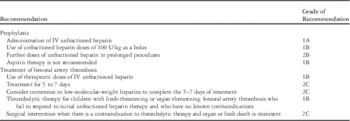
In 2012, the American College of Chest Physicians issued recommendations regarding the use of antithrombotic therapy in neonates and children with specific recommendations on the prevention of thrombosis in patients undergoing cardiac catheterisationReference Monagle, Chan and Goldenberg 32 (Table 1). The use of unfractioned heparin is recommended in bolus doses of 100–150 U/kg, to be repeated in prolonged procedures. The use of aspirin for prophylaxis of procedure-related thrombosis is not recommended.
Summary of the 2012 American College of Chest Physicians recommendationsReference Monagle, Chan and Goldenberg 32 regarding cardiac catheterisation thrombosis prophylaxis and treatment

IV=intravenous.
There are some limitations in the background studies that support current recommendations. The most striking is that only one placebo-controlled trial in children has shown that routine use of unfractioned heparin can reduce arterial thrombosis in cardiac catheterisation. That was observed many years ago when the catheterisation procedure had a different protocol without the routine use of arterial sheath and using different catheter materials. Furthermore, as suggested by previous trials, the benefit of systemic anticoagulation may be confined to a subgroup of younger patients with lower body surface area. Patients requiring the use of bigger sheath sizes and the use of balloons or implantable stents have not been prospectively investigated as a potentially good treatment target, as suggested by observational studies. Finding the subgroups in which anticoagulation derives the best benefit would be important because it could lead to the withdrawal of unnecessary therapy in patients who would be otherwise prone to develop unfractioned heparin-related adverse events. It would also be interesting to have prospective data on the role of new anticoagulant and antiplatelet agents in preventing arterial thrombosis after cardiac catheterisation.
Therapy
Different treatment strategies have been proposed to treat arterial thrombosis after arterial catheterisation. Most patients have been treated with anticoagulation. When refractory, thrombolysis and percutaneous or surgical thrombectomy may be useful.
Anticoagulation
It is general practice to initiate therapy with unfractioned heparin for patients with post-cardiac catheter femoral artery thrombosis. Most of the studies that tested other reperfusion strategies also used unfractioned heparin upfront. Furthermore, it seems to be very efficacious with reported arterial thrombosis resolution in 40–70% of the cases, when using unfractioned heparin alone.Reference Brus, Witsenburg, Hofhuis, Hazelzet and Hess 33 , Reference Zenz, Muntean, Beitzke, Zobel, Riccabona and Gamillscheg 34 The efficacy may be dependent on the length of the anticoagulation. Nonetheless, it seems consensual that highly symptomatic patients should undergo other methods of mechanical or pharmacological reperfusion.
Enoxaparin has been tested in a prospective observational studyReference Bontadelli, Moeller and Schmugge 35 of 32 patients with arterial thrombosis. It showed a high rate of success (91%) in infants after a mean period of 23 days of therapy. A dose of 1.5 mg/kg every 12 hour in infants aged 0–2 months and 1 mg/kg every 12 hour in infants aged 2–12 months was used and anticoagulation was monitored using anti-Xa activity. Bleeding complication only occurred in one patient.Reference Bontadelli, Moeller and Schmugge 35 The strategy of using enoxaparin to treat arterial thrombosis is appealing because it provides both a reliable level of anticoagulation without the need for routine therapeutic monitoring and with relatively greater proximal inhibition of the coagulation cascade. It may also avoid long-term hospitalisation for intravenous unfractioned heparin administration. In addition, low-molecular-weight heparins are associated with a lower incidence of immune thrombocytopaenia and osteoporosis in adults. Therefore, the efficacy and safety of enoxaparin should be tested in larger randomised trials using placebo or unfractioned heparin as comparers in order to establish whether enoxaparin is at least non-inferior to unfractioned heparin for the treatment of catheter-related arterial thrombosis.
Thrombolysis
Thrombolysis is seen as an alternative for thrombectomy in patients with continuing lower limbs ischaemia after left cardiac catheterisations, particularly when there is limb-threatening or organ-threatening femoral artery thrombosis who fail to respond to initial unfractioned heparin therapy, as suggested in the guidelines.Reference Monagle, Chan and Goldenberg 32 Although the reported outcomes have a significant clinical impact, the evidence to support thrombolysis in post-catheterisation thrombosis in children is scarce and was only provided by uncontrolled case series.
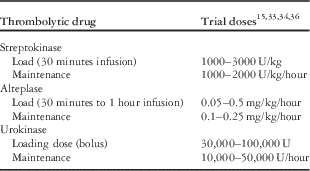
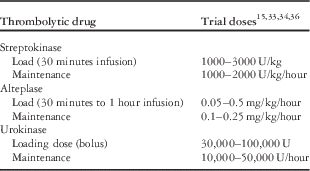
In a studyReference Brus, Witsenburg, Hofhuis, Hazelzet and Hess 33 of nine patients with persisting signs of impaired arterial circulation after cardiac catheterisation, systemic infusion of streptokinase restored normal perfusion in all patients, although in one it was delayed. In another prospective observational study,Reference Zenz, Muntean, Beitzke, Zobel, Riccabona and Gamillscheg 34 fibrinolytic therapy with alteplase was evaluated in infants and children with persisting arterial thrombosis after cardiac catheterisation following 24 hour of unfractioned heparin therapy. The study protocol included alteplase infusion at a rate of 0.5 mg/kg/hour for the first hour followed by 0.25 mg/kg/hour until pulses were palpable and blood pressure in both legs was similar. Alteplase achieved total clot lysis 4–11 hours after starting treatment in 16 of the 17 included patients. Complications were frequent, but were only significant in three patients who needed transfusion of packed erythrocytes. Alteplase outcomes were also reported in a recently published retrospective analysis of 1155 catheterisationsReference Bratincsák, Moore and El-Said 36 that included three cases of persistent femoral thrombosis after 12-hour heparin therapy. A lower dose alteplase regime was successfully used (0.05 mg/kg/hour for 30 minutes, followed by 0.1 mg/kg/hour for 4 hours) without any complications. This observation in such a small sample suggests that low-dose alteplase may still be effective with increased safety compared with higher doses. Urokinase has also been used in a study that included seven children.Reference Liu, Yan and Zhao 15 The urokinase infusion (loading dose of 30,000–100,000 U followed by constant infusion of 10,000–50,000 U/hour) was started on top of unfractioned heparin started 8 hours after documentation of post-catheterisation limb ischaemia. Arterial pulses were restored in four of the included patients, whereas the remaining three patients were successfully treated with transcatheter intra-arterial thrombolysis. There was only one local haemorrhagic complication with bleeding at the puncture site.
According to the available evidence, streptokinase, alteplase, and urokinase may be used for treatment of catheterisation-related thrombosis with relatively high success rate and low risk of significant bleeding. The doses that were used in the clinical studies are listed in Table 2. Although the guidelinesReference Monagle, Chan and Goldenberg 32 recommend that thrombolysis should be reserved as bailout therapy for severe ischaemia after anticoagulation fails to resolve symptoms, these criteria may be overly restrictive. First, most of the uncontrolled clinical studies using thrombolysis did not require severe limb-threatning ischaemia but only persisting arterial thrombosis 8–24 hours after starting heparin.Reference Liu, Yan and Zhao 15 , Reference Zenz, Muntean, Beitzke, Zobel, Riccabona and Gamillscheg 34 , Reference Bratincsák, Moore and El-Said 36 Second, even if collateral flow may prevent severe ischaemia at presentation, chronic femoral occlusion may still result in severe disability.Reference Lin, Dodson and Bush 7 Therefore, although the results of thrombolysis have not been compared head-to-head with surgery, it seems a reasonable choice for patients with arterial thrombosis not resolving with unfractioned heparin therapy. It may be a particularly good option for small children, in whom the surgical outcome is not usually optimal. However, the optimal timing to start thrombolytic therapy in order to achieve the best possible results exposing the patients to the lowest risk is still elusive and should be addressed by future trials.
Thrombolytic drugs for post-catheterisation thrombosis treatment
Percutaneous treatment
Percutaneous treatment is slowly becoming more popular for the treatment of femoral thrombosis after cardiac catheterisation, particularly in patients who have a contraindication for anticoagulation or thrombolysis. The results of percutaneous transluminal angioplasty for the treatment of acute arterial occlusion after retrograde cardiac catheterisation in nine consecutive patientsReference Peuster, Bertram, Fink, Paul and Hausdorf 37 are promising. Recanalisation of the vessel was achieved in all patients and pulses were also universally restored, without any reocclusion.
Devices for percutaneous thrombectomyReference Barth, Gosnell and Palestrant 38 , Reference Castaneda, Li, Patel, DeBord and Swischuk 39 have been developed as an alternative to pharmacologic or surgical revascularisation in order to avoid the complications of thrombolysis and to decrease the procedure time. They may have the advantage of limiting distal embolisation of the thrombus when compared with other percutaneous approaches. Recently, there have been anecdotal reportsReference Kobayashi, Kobayashi, Shinohara, Tomomasa and Morikawa 40 of successful percutaneous thrombectomy after femoral artery occlusion in children. Its advantages compared with other therapeutic modalities include not subjecting the patient to the risk of bleeding, and thus it can be applied to those patients who are not candidates for thrombolysis or heparin. However, it may not be suitable for small children and neonates because of the size of the catheter. Its major disadvantage is to need another arterial catheterisation that can result in further arterial trauma, prone to new thrombosis that can limit future access for catheterisation in patients who may need more studies in the future.
Surgical treatment
Not many centres have presented data on surgical therapy for post-catheterisation arterial thrombosis. A prospective registry of the Egleston’s Children Hospital in AtlantaReference Lin, Dodson and Bush 7 including data of 1674 catheterisation procedures reported surgical treatment for ischaemic complications in 21 patients (1.25%). Among them, acute femoral ischaemia was present in 14 patients who underwent surgical thrombo-embolectomy via the femoral artery with Fogarty catheter. In two children, there were intimal flaps requiring resection of a small segment of the femoral artery. Symptomatic femoral artery occlusion occurring more than 30 days after the procedure was reported in seven patients. Surgical treatment included iliofemoral bypass grafting, femorofemoral bypass grafting, and femoral artery patch angioplasty. Long-term surgical success with normal limb circulation was achieved in 84% of children with ischaemic complications in this prospective registry.Reference Lin, Dodson and Bush 7 Several reports suggest that children younger than 2 years of age have worst outcomes after thrombectomy for acute limb ischaemiaReference Perry 41 , Reference Leblanc, Wood, O’Shea, Williams, Trusler and Rowe 42 including increased death rate.Reference Lin, Dodson and Bush 7
Guidelines (Table 1)
The 2012 American College of Chest Physicians guidelinesReference Monagle, Chan and Goldenberg 32 suggest the use of therapeutic doses of intravascular unfractioned heparin for the treatment of femoral thrombosis following cardiac catheterisation in children. The duration of treatment should be at least 5–7 days and low-molecular-weight heparin is an option to complete treatment when thrombolysis and surgery are not required. Thrombolytic therapy is recommended for children with limb-threatening or organ-threatening femoral artery thrombosis who fail to respond to initial unfractioned heparin therapy and who have no known contraindications to thrombolysis. In the guidelines, surgical intervention is recommended when there would be indication for thrombolytic therapy but there is a contraindication for thrombolysis in the presence of critical organ or limb ischaemia.
Future perspective
Arterial thrombosis after cardiac catheterisation is still a frequent complication. To avoid this problem, paediatric cardiologists have modified the catheterisation techniques used in small children by using systemic heparinisation and smaller catheters.
Avoiding arterial entry with alternative techniques to enter the left heartReference Kocis, Snider, Vermilion and Beekman 4 can avoid this complication, particularly in high-risk patients. It can be achieved by transvenous catheterisation in patients with intracardiac shunts. Other emerging techniques to reduce femoral arterial trauma include the transvenous transseptal approach and the umbilical artery approach in the newborn infant. There is a still an unexplored role for echo-Doppler guided arterial puncture that may have the potential to decrease the number of arterial punctures and vessel damage. On the device development side, there is also a challenge to keep miniaturising the catheters and sheaths and making them less thrombogenic and traumatic.
Finally, the best diagnostic and therapeutic strategy has to be prospectively investigated, particularly for clarifying the role of new pharmacologic interventions and of percutaneous and surgical thrombectomy in the current era.
Acknowledgement
None.
Conflicts of Interest
None.