Surgical site infections (SSIs) are harmful healthcare-associated infections that occur in almost 2% of surgical procedures and are associated with increased healthcare costs and a 3% mortality rate.Reference Awad 1 , Reference Mu, Edwards, Horan, Berrios-Torres and Fridkin 2 Pediatric SSI rates have been reported as high as 1 to 3.4 infections per 100 surgeries, with risk factors including neonatal age, African American race, failure to thrive diagnosis, and urinary catheter placement.Reference Nateghian, Taylor and Robinson 3 – Reference Duque-Estrada, Duarte, Rodrigues and Raphael 5 Many children receive ambulatory surgical care, and significantly less is known about SSIs following ambulatory surgery. Recent adult SSI studies following ambulatory surgery found SSI rates from 3 to 10 infections per 1,000 surgeries, and administrative billing codes demonstrating only 36% positive predictive value.Reference Owens, Barrett, Raetzman, Maggard-Gibbons and Steiner 6 – Reference Mitchell, Gottschalk, Butts and Xerogeanes 8 Some evidence suggests that ambulatory infections have a larger burden of disease than inpatient healthcare-acquired infections.Reference Rinke, Milstone and Chen 9
Pediatric SSIs following ambulatory surgery, part of the family of healthcare-associated infections, are understudied and represent a high-need area for further study. This study aimed to identify pediatric SSI rates following ambulatory surgery and examine risk factors and outcomes for these SSIs. We also investigated the sensitivity and specificity of administrative billing codes for SSI following ambulatory surgery to help researchers, hospital epidemiologists, and quality improvement specialists better understand this method for identifying and monitoring these infections.
METHODS
Setting
This retrospective study was performed at an urban, tertiary care, 136-bed pediatric children’s hospital from April 1, 2009, through March 31, 2014. Approximately 3,000 ambulatory surgeries are performed annually in this center. The operating suites, located on 3 separate campuses, are used for both inpatient and ambulatory surgeries. All patients from birth to 22 years old on the day of surgery were included in this analysis.
Definitions
Ambulatory surgeries were defined as any patient who received a surgery in the operating room but was not admitted overnight to the hospital. All surgery types were included. A surgery was defined as follows: “At least one incision (including laparoscopic approach) is made through the skin or mucous membrane, or reoperation via an incision that was left open during a prior operative procedure.” 10 This designation was applied to the primary procedure code for every patient. When a procedure code was vague regarding the use of an incision (eg, a cardiac catheterization with incision over the femoral vein), the procedure was excluded. The National Healthcare Safety Network (NHSN) 2014 definition for inpatient SSIsReference Pronovost, Needham and Berenholtz 11 was adapted for the ambulatory arena. A superficial surgical or procedural site infection was defined as occurring within 30 days after the surgery with day 1 as the surgery date, and as defined by the NHSN “involves only skin and subcutaneous tissue of the incision and the patient has at least one of the following: a. purulent drainage from the superficial incision. b. organisms isolated from an aseptically-obtained culture of fluid or tissue from the superficial incision. c. superficial incision that is deliberately opened by a surgeon, attending physician or other designee and is culture positive or not cultured and patient has at least one of the following signs or symptoms: pain or tenderness; localized swelling; redness; or heat. A culture negative finding does not meet this criterion. d. diagnosis of a superficial incisional SSI by the surgeon or attending physician or other designee.” 10 A deep SSI was similarly defined regarding dates and as defined by the NHSN “involves deep soft tissues of the incision (eg, fascial and muscle layers) and patient has at least one of the following: a. purulent drainage from the deep incision. b. a deep incision that spontaneously dehisces or is deliberately opened by a surgeon, attending physician or other designee and is culture-positive or not cultured and patient has at least one of the following signs or symptoms: fever (>38°C); localized pain or tenderness. A culture-negative finding does not meet this criterion. c. an abscess or other evidence of infection involving the deep incision that is detected on direct examination, during invasive procedure, or by histopathologic examination or imaging test.” 10 A positive wound culture or any wound culture are not requirements for a patient to meet the NHSN SSI definition. Surgical wound class (clean, clean-contaminated, contaminated, or dirty) was defined by the NHSN criteria. 10 Medical comorbidities were defined as any listed condition in the patient’s problem list or preoperative anesthesia or surgical history and physical examination.
Identification of Infections
Demographic data on all ambulatory surgeries in the study time window were abstracted from an administrative database (age, gender, race, ethnicity, insurance status, and procedure type). All patients who had billing International Classification of Diseases, Ninth Revision (ICD-9), codes of 998.5 “postoperative infection,” 998.51 “infected postoperative seroma,” or 998.59 “other postoperative infection” were identified. Each patient’s chart with any of these ICD-9 codes was searched for evidence of an adapted NHSN SSI for 30 days following the surgery, using the definitions above. The medical chart review included all notes, laboratory values, subsequent primary care or surgical clinic visits, admissions, and emergency department visits. Those with a suspected adapted NHSN SSI based on the first medical chart review (J.N.) had their infection confirmed by a second author (M.L.R). An infection preventionist helped train both reviewers and was used for consultation and for final adjudication when there was conflict between the 2 reviewers (N=1).
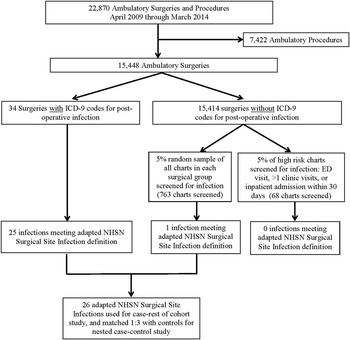
In order to confirm the accuracy of the ICD-9 billing codes and obtain complete case capture, a 5% random sample of patient charts from each surgical group was searched to determine whether evidence of SSI exists without receipt of the billing code for postoperative infection (Figure 1). To further ensure no cases were missed, a second non-overlapping 5% random sample of “high-risk for SSI” patient charts without receipt of the billing code for postoperative infection was also searched. “High-risk for SSI” patients were defined as patients who were evaluated in the emergency department, evaluated in clinic more than once, or admitted in the 30 days following their ambulatory surgery.
Design of study of surgical site infections following pediatric ambulatory surgery. ED, emergency department; ICD-9, International Classification of Disease, Ninth Revision; NHSN, National Healthcare Safety Network.

Outcome data were collected from medical charts identified as meeting the adapted NHSN SSI case definition.
SSI Risk Factors
Adapted NHSN SSI cases were compared with the rest of the surgical cohort without found infections to identify administratively available risk factors, denoted as a “case–rest of cohort” design. We acknowledge that the rest of the surgical cohort may include a small number of SSI cases, although this analysis is still valid because those few cases are overwhelmed by the 15,000 other controls in the cohort. Risk factors abstracted included age, gender, race, ethnicity, and insurance status.
A nested case-control design was used for risk factor data available only through medical chart review. Risk factors abstracted for the nested case-control study included number of medical comorbidities, history of prematurity, neonatal age (younger than 30 days), body mass index at time of surgery, day of week of surgery, antibiotics in the 7 days prior to initial surgery, duration of surgery, antibiotics administered immediately before or during the surgery (patients received antibiotic in the 60 minutes prior to surgery or before completion of surgery), use of central venous catheters, use of urinary catheters, and immediate postoperative complications. Patients who received antibiotics before surgery were grouped with those who received antibiotics during surgery because patients who received antibiotics during surgery were more similar to patients who received antibiotics before surgery than to patients who received no antibiotics, and there were relatively few patients who received antibiotics during surgery (1 case and 5 controls). These risk factors were identified in prior SSI studies or by the research team as logical risks for infection. Adapted NHSN SSI cases were matched 1:3 with control patients on the first basis of primary surgical code. When more than 3 controls were available for matching, controls were chosen on the second basis of proximity in time to the case’s surgical date. If more than 3 controls were available with the same primary surgical code and with a surgical date within 1 month of the case’s surgical date, controls were chosen on the third basis of matching secondary procedures. All cases had at least 3 identifiable controls. All control charts were specifically checked to exclude SSIs. The matching scheme prevented wound class from being analyzed as a risk factor. We considered investigating postoperative antibiotics as a preventative risk factor for SSI but these data were inconsistently recorded in the chart.
Data Analysis
Descriptive analysis was performed for demographic characteristics of pediatric patients with ambulatory surgeries and clinical outcomes of SSI following pediatric ambulatory surgeries. All patients with ICD-9 codes for SSI and those in the 5% random sample from charts without ICD-9 codes were included with sampling weights of 1 and 20, respectively, to estimate SSI rates identified by the adapted NHSN definition for ambulatory SSI and investigate sensitivity and specificity of ICD-9 codes. Despite the recent transition to ICD-10 codes, significant data exists utilizing ICD-9 SSI codes, and it is important for researchers and policymakers to understand the sensitivity and specificity of these codes. SSI rates following ambulatory surgeries per 1,000 ambulatory surgeries with 95% confidence intervals (CIs) were obtained by binomial regression incorporating the sampling design. SSI rates were compared between surgical groups by log-binomial regression.
Adapted NHSN SSI cases versus rest of cohort were compared by the χ2 or Fisher exact tests for categorical risk factors and Wilcoxon rank sum tests for continuous risk factors given concern for nonnormally distributed case data. Adapted NHSN SSI case versus control data were analyzed using unadjusted conditional logistic regression. For thorough investigation, we additionally performed 2 ad hoc analyses. One compared the cases versus rest of cohort without 19 randomly selected patients. These 19 patients represent the 1 infection found in a 5% random sample with a sampling weight of 20 to simulate the potential for additional unfound SSI cases in the cohort. The other compared the adapted NHSN SSI cases identified only by ICD-9 codes versus their matched controls (ie, conducting a case-control analysis without the adapted NHSN SSI case found via random sampling and its matched controls) to assess the possible impact of the adapted NHSN SSI case found via random sampling on risk factors. Statistical analyses were completed in Stata 11 (StataCorp). This study was approved by the Albert Einstein College of Medicine Institutional Review Board.
RESULTS
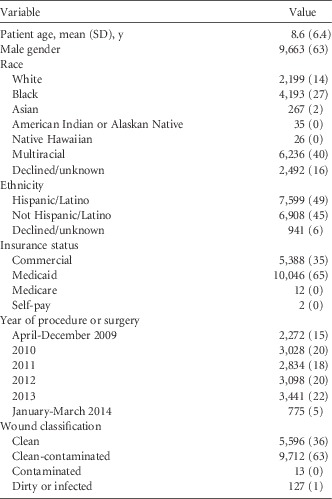
There were 22,870 ambulatory procedures or surgeries performed during the 5-year study window (15,448 surgeries and 7,422 procedures). Among 15,448 surgeries, half of patients were Hispanic/Latino, 40% were multiracial, and 65% had Medicaid insurance, and the most prevalent surgery groups were otolaryngology (40%), male genital (16%), musculoskeletal (13%), digestive (10%), and integumentary (8%) (Table 1 and Table 2; Online Supplementary Appendix describes most common specific surgeries and surgeries with infections). Sixty-three percent of surgeries were classified as clean-contaminated (Table 1).
Demographic Characteristics of 15,448 Pediatric Ambulatory Surgeries

NOTE. Data are no. (%) of surgeries unless otherwise indicated. Some percentages do not equal 100% because of rounding.
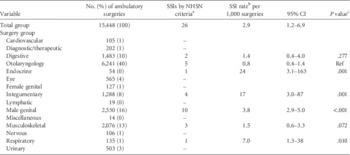
Surgical Site Infection (SSI) Rates Following Pediatric Ambulatory Surgery

a A total of 34 patients were identified through International Classification of Disease, Ninth Revision (ICD-9) codes for postoperative infection, and 25 of them had true site infections by adapted NHSN criteria. One infection in the integumentary group was discovered by 5% random chart audits.
b Infection rates and 95% CIs were calculated incorporating the sampling design based on all patients who met the adapted NHSN definition for SSI following ambulatory surgery, those who did not but had an ICD-9 code for SSI, and those in the 5% random sample of charts audited without ICD-9 codes.
c Compares otolaryngology SSI rate with other surgery group SSI rates using log-binomial regression.
A total of 34 patients had an ICD-9 code for SSI and 25 of those patients met the adapted NHSN criteria for a SSI following ambulatory surgery. One additional infection met adapted NHSN criteria and was discovered from the 5% random chart sampling (Figure 1). Incorporating the sampling design, the overall SSI rate following pediatric ambulatory surgery was 2.9 per 1,000 surgeries (95% CI, 1.2–6.9) (Table 2).
Using otolaryngology surgeries as the reference group (SSI rate, 0.8 [95% CI, 0.4–1.4]), SSI rates were significantly higher in endocrine surgeries (24.2 [3.1–163.9]; P=.001), integumentary surgeries (16.9 [3.1–87.3]; P=.001), male genital surgeries (3.8 [2.9–5.0]; P<.0001), and respiratory surgeries (7.0 [1.3–37.6]; P=.01).
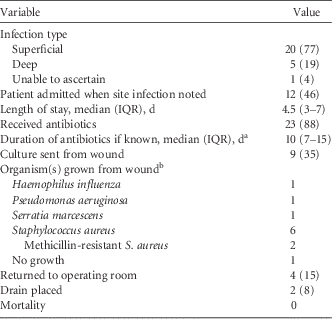
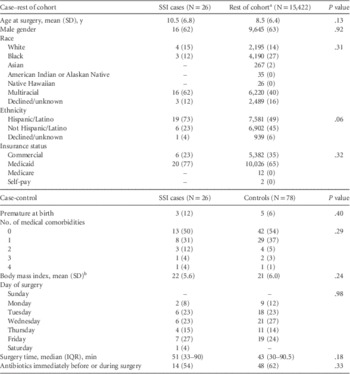
Outcomes of patients with SSI following ambulatory surgery are presented in Table 3. Almost half of patients with an SSI (46%) were admitted, 88% received antibiotics, and 15% returned to the operating room. No risk factors in either the case–rest of cohort or case-control analyses were significantly associated with SSI (Table 4), although appreciable effect sizes were noted for Hispanic ethnicity, median age, premature birth, and median surgery time. The results of additional ad hoc analyses described above with the case–rest of cohort and case-control designs were not different from those presented in Table 4.
Outcomes of 26 Surgical Site Infections (SSIs) Following Pediatric Ambulatory Surgery

NOTE. Data are no. (%) of SSIs unless otherwise indicated. IQR, interquartile range.
a 4 patients had unknown or unclear durations of antibiotics based on retrospective chart review.
b One patient’s culture had Serratia and Pseudomonas.
Risk Factors for Surgical Site Infection (SSI) Following Pediatric Ambulatory Surgery

NOTE. Data are no. (%) of SSIs unless otherwise indicated. Administratively available data were analyzed with a case–rest of cohort design. Other data were obtained from a nested case-control design with 1:3 case:control matching based on primary surgery. P values represent the χ2 or Fisher exact test for categorical risk factors and Wilcoxon rank sum test for continuous risk factors in the case–rest of cohort, and conditional logistic regression in the case-control.
The following variables were unable to be analyzed as risk factors because 0 cases met the criteria: neonatal age, antibiotics in the 7 days prior to initial surgery, use of central venous catheters, use of urinary catheters, and immediate postoperative complications. IQR, interquartile range.
a This number includes patients with International Classification of Disease, Ninth Revision codes for SSI but not meeting the adapted National Healthcare Safety Network definition of SSI following ambulatory surgery and may include a very small number of SSI cases that are overwhelmed by the other controls in the surgical cohort.
b 2 patients who had unknown body mass indexes at time of surgery are excluded.
The sensitivity of ICD-9 codes for SSI following ambulatory surgery, obtained from the weighted sample, was 55.31% (95% CI, 12.69%–91.33%) and the specificity was 99.94% (99.89%–99.97%).
DISCUSSION
This 5-year study found SSI rates following pediatric ambulatory surgery to be approximately 10 times lower than SSI rates following pediatric inpatient surgeries,Reference Nateghian, Taylor and Robinson 3 – Reference Duque-Estrada, Duarte, Rodrigues and Raphael 5 but comparable with SSI rates following adult ambulatory surgery.Reference Owens, Barrett, Raetzman, Maggard-Gibbons and Steiner 6 – Reference Mitchell, Gottschalk, Butts and Xerogeanes 8 Rates of SSI following pediatric ambulatory surgery were significantly lower in otolaryngology surgeries, and while rare, these infections cause appreciable patient morbidity. No statistically significant risk factors for SSI following pediatric ambulatory surgery were identified, although Hispanic ethnicity, median age, premature birth, and median surgery time demonstrated larger effect sizes. Finally, although ICD-9 codes for postoperative infections had 99% specificity, their sensitivity was only 55%.
Reducing healthcare-associated infections is a priority for many governmental, insurer, and medical center quality improvement efforts. 12 – Reference Pfuntner, Wier and Steiner 15 Most of these efforts focus on the inpatient arena, even though these infections occur in the ambulatory sphere and at potentially 3 times the disease burden.Reference Rinke, Milstone and Chen 9 Echoing other ambulatory healthcare-associated infection studies, this study suggests that appreciable morbidity can arise in children who have SSIs following ambulatory surgeries. As pediatric hospital costs have been estimated between $4,500 and $8,200 per stay,Reference Pronovost, Needham and Berenholtz 11 these 12 potentially preventable admissions for SSI following ambulatory surgery could represent between $54,000 and $98,400 in preventable hospital costs for a single institution over 5 years. There are also significant differences between SSI rates in different surgical groups, potentially providing early targets for quality improvement intervention. Furthermore, agencies like the NHSN should be encouraged to develop definitions for SSI following ambulatory surgery to aid practitioners in accurately measuring these infections.
It is unclear whether SSI rates following pediatric ambulatory surgeries are truly comparable with previously reported adult ambulatory SSI rates,Reference Owens, Barrett, Raetzman, Maggard-Gibbons and Steiner 6 – Reference Mitchell, Gottschalk, Butts and Xerogeanes 8 or whether varying applications of definitions and study cohorts bias the results. Furthermore, prior pediatric ambulatory SSI studies with higher SSI rates following ambulatory surgeryReference Audry, Johanet, Achrafi, Lupold and Gruner 16 – Reference Duque-Estrada, Duarte, Rodrigues and Petto 18 may not be generalizable to the United States. One article from France reported an ambulatory inguinal surgery infection rate of 10 infections per 1,000 surgeries for children.Reference Audry, Johanet, Achrafi, Lupold and Gruner 16 Another study, including 75% ambulatory cases, reported an overall SSI rate of 9.9 infections per 1,000 surgeries, although 73% of infections were in children admitted to the hospital postoperatively.Reference Bucher, Guth and Elward 4 The pediatric ambulatory SSI rate for inguinal surgeries was 48 infections per 1,000 surgeries in a study from Nigeria,Reference Usang, Sowande, Adejuyigbe, Bakare and Ademuyiwa 17 and 22 infections per 1,000 surgeries for all ambulatory surgeries in a study from Brazil.Reference Duque-Estrada, Duarte, Rodrigues and Petto 18 One study on pediatric otolaryngologic surgeries, including 76% ambulatory cases, found 20 infections per 1,000 surgeries.Reference Shah, Stey, Jatana, Rangel and Boss 19 Our study would suggest billing codes may be a good trigger to begin identifying ambulatory SSIs, given their high specificity, although ICD-9 code SSI identification should be followed by close medical chart review, given the 55% sensitivity. As ICD-10 codes are still in their infancy, researchers and policymakers should be cautious in using solely ICD-9 or ICD-10 codes for SSI identification based on these data.
This study has a number of limitations. An urban, single-center study may not be generalizable to all ambulatory surgery centers, although the large numbers of surgeries included do suggest robust effect sizes. We appreciate the need for multicenter studies with even larger numbers of surgeries to definitively identify risk factors, and suggest this initial study adds potential targets for ambulatory SSI reduction efforts that are actively underway. Also, investigating risk factors for other possible complications arising from ambulatory surgeries would add to the research, although this was beyond the scope of this study. Additionally, the study assumes an adapted NHSN SSI definition is the gold standard for identifying true infections, and we acknowledge that some healthcare-associated infections that meet NHSN definitions may not be truly caused by the surgery in question. Similarly, there are a number of possible ICD-9 and Current Procedural Terminology codes that could be used to define an SSI,Reference Owens, Barrett, Raetzman, Maggard-Gibbons and Steiner 6 , Reference Rhee, Huang and Berrios-Torres 7 and it is possible that other codes have greater sensitivity or specificity. The codes used in this study were chosen for their unambiguous definition and applicability to all surgeries, not certain surgical subgroups, and their prior usage.Reference Bucher, Guth and Elward 4 The SSI rates presented in this study use the weighted 26 confirmed infections identified from either ICD-9 codes or the random chart sampling methodology. It is possible that additional infections exist in the 95% of charts not directly screened, and/or additional SSIs would have been found if we had employed prospective data collection, leading to higher SSI rates. This could also affect conclusions about higher SSI rates in non-otolaryngology surgeries. There is also potential for misclassification bias because the “surgery” definition was applied on the basis of administrative codes that could be inaccurate or broad in their application, and potential for missed infections if patients presented to other hospitals for SSI care.
In conclusion, SSIs following ambulatory surgery occur in children and require further study. Using standard coding methods to identify these infections may overestimate the incidence of ambulatory SSIs. While the rates of these infections are lower than previously reported inpatient SSI rates, they still convey morbidity to the children who experience them and efforts should be undertaken to reduce the incidence of SSI following ambulatory surgery.
ACKNOWLEDGEMENTS
We gratefully acknowledge the assistance of Audrey Adams in the application of the SSI definitions set forth by the NHSN. We also acknowledge the assistance of Mimi Kim with the statistical design.
Financial support. Agency for Healthcare Research and Quality K08 award (1K08HS021282 to M.L.R., entitled “CLABSIs in Ambulatory Pediatric Oncology Patients”).
Potential conflicts of interest. All authors report no conflicts of interest relevant to this article.
SUPPLEMENTARY MATERIAL
To view supplementary material for this article, please visit http://dx.doi.org/10.1017/ice.2016.98.