Bernhard Lang’s ‘comic psychological opera’ I Hate Mozart (2006) reveals the backstage machinations of a production from auditions to opening night.Footnote 1 For all the characters Mozart is both inspiration and millstone. The conductor Adriano made his reputation as an interpreter of Mozart early; he is married to Grace Moor, a famous American soprano slightly older than himself, who is supposed to be Pamina in the new production, but is indisposed. An alternative is auditioned and rehearsals begin. Grace then decides she will be able to sing. She reports to her friend over the telephone: ‘I entered right in the middle of “Ach, ich fühl’s.” Yes, it was marvellous … That inevitable Junges Lyrisches was already on her way to stardom. Well, she is quite good looking.’
Grace does not just speak the words, ‘Ach, ich fühl’s’ to her friend; she sings the melody from Mozart’s aria. And then she sings it again. And again. The interjection of the lyrical momentarily slows the music’s pace. On the third iteration Grace takes a little more loving care over the phrasing. Each time, though, the line is barely finished before she jumps back to the start, like a skipping record.
Lang incorporates portions of several arias and choruses by Mozart into his score (not all are from Die Zauberflöte), but rarely leaves them untouched. Instead they are fragmented and irregularly looped. It is a process endemic to Lang’s compositions that derives from the writings of French philosopher Gilles Deleuze on difference and repetition, and DJ and sampling techniques.Footnote 2 Yet in this opera the so-called Wiederholungsmaschinerie also serves a dramaturgical purpose: according to Stefan Grissemann’s programme notes, ‘The repetitions emphasise the compulsiveness of the conversations: the people are stuttering and stammering, get caught in the banality of their games of power and love.’Footnote 3 Catching Mozart’s music up in those loops indicates the problem of the great man’s reputation, according to the opera’s catchphrase: ‘Ich hasse Mozart und seine unendliche Musik!’ In the case of ‘Ach, ich fühl’s’, though, Lang’s musical process can also be interpreted as a commentary on the way this particular aria – and, perhaps by extension, an idea of aria more generally – itself plays with lyricism and repetition.
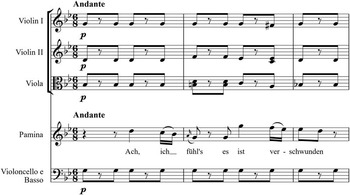
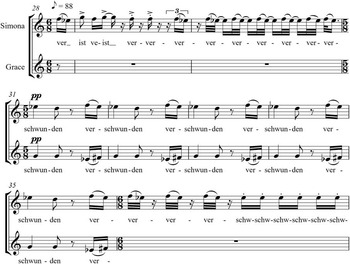
‘Ach, ich fühl’s’ has already been heard in I Hate Mozart by the time Grace limns its melody. As she reported, Simona – the Junges Lyrisches – sang it at her audition, and her version is one of Lang’s most substantial reworkings of an aria as an aria.Footnote 4 When Simona starts to sing all other stage business recedes into the background, emphasising that this is a diegetic performance. Lang uses only the first two lines of Mozart’s aria: ‘Ach, ich fühl’s, es ist verschwunden / Ewig hin der Liebe Glück’. It is already hesitant music: Pamina’s short phrases, separated by rests, convey her state of shock and despair at Tamino’s silence. The unclear rhythms of the ostinato in the accompaniment (being neither iambic nor trochaic) are, in James Webster’s words, similarly ‘numb’ and ‘undifferentiated’ (see Ex. 1).Footnote 5 In Lang’s adaptation the accompanying rhythms have an even blurrier profile, being spread across an orchestral texture distended by divisi strings and two turntablists. The vocal line is made still more stammering by being broken into vowels and consonants repeated at irregular intervals in erratic rhythms.
Despite Lang’s disassembly of Mozart’s score it retains a clear sense of identity. From Simona’s first, tentative ‘A-’ the audience knows what is being sung: an aria, and a very famous one. This is one of Mozart’s lines of beauty, like the oboe melody of the Adagio from the Serenade for Twelve Winds and String Bass, K. 361, of which Scott Burnham claims: ‘even before the oboe moves off its first pitch, its voice is marked with a kind of grace’.Footnote 6 In the Serenade, the initial melody does little more than descend through an octave; in ‘Ach, ich fühl’s’ the voice similarly falls by step as if an unassuming sigh.Footnote 7 Lang dwells on the octave transfer (g to g1) of the second bar of Mozart’s vocal melody, delaying the gratification of the descent back to the melody’s opening pitch. The ♭6-5 suspension is also exaggerated by Lang, who changes the metre from 6/8 to 5/8 and, for once, provides a regular rhythm, though he still alters Mozart’s original, here by lengthening the upper note from a quaver to a crotchet (see Ex. 2). The phrase is repeated five times, complete with the two-semiquaver upbeat of the Mozart. Its contrasting character to the previous material is further emphasised by a decrease in dynamics and a change of accompaniment – the turntablists drop out, and the orchestral texture is thinned. What’s more, a second voice enters: the soprano Grace. While the notes of Grace’s anacrusis are also taken from Mozart’s harmony, by presenting them as an augmented interval, moving in contrary motion to Simona’s descent, Lang makes them jarring, an effect enhanced by the whistling artificial harmonics from the violins. The disappearance of which singer, of which lover, is indicated here by Lang’s treatment of the word ‘verschwunden’? Is Grace trying to upset her new rival? Or has Simona stolen her star part, and with it her husband?
Wolfgang Amadeus Mozart, ‘Ach, ich fühl’s’, Die Zauberflöte, Act II no. 17.

Bernard Lang, I Hate Mozart, reproduced by kind permission of the composer and Zeitvertrieb Wien Berlin.

While the dramaturgical significance of the doubled aria is debatable, the addition of extra voices (soon Simona and Grace are joined by mezzo Franziska) does not unsettle the music. Rather it suggests that it cannot be owned as the singers might like: Mozart belongs to all. Although this gestures towards the music’s transcendent qualities, it also indicates its ubiquity. Lang has complained that while once Vienna was the birthplace of the new, ‘Now, they repeat Mozart until you vomit. They play Mozart three times a day for tourists, while wearing wigs! This is stupid, but politicians say that this kind of repetition is our culture.’Footnote 8 The repetitions in Lang’s score, then, might be taken to constitute less of an attack on Mozart’s music than a critique of the way in which it has been commodified.
The negative associations of repetition, of course, were the starting point for Carolyn Abbate’s and Roger Parker’s 1990 article ‘Dismembering Mozart’, which began by asking why audiences found laughable the exact correspondence between musical and physical gestures in a dance to the C minor fugue, K.426, choreographed by Mark Morris. It was a question of redundancy, they surmised, asking provocatively: ‘What, then, will happen if we read Mozart not for correspondences, but for ways in which various systems operate independently, resist engagement with one another?’Footnote 9 Lang’s reworking of two lines from ‘Ach, ich fühl’s’ seems to decouple musical and semantic systems to such an extent that it becomes impossible to imagine their re-attachment. For some listeners, I Hate Mozart might then stand as the apotheosis – or nadir – of a post-structural reading of classical opera. And yet this is the closest thing Lang’s piece has to a stand-alone aria. It is recognisable as such because of the way it is framed by the plot – the audition panel, impressed, applaud (quickly followed in the live recording by the real audience), and the next scene switches to frantic electronics and chatty recitative between Franziska and her agent (although she’s said to be humming ‘Ach, ich fühl’s’ in the shower she never actually provides its melody). Its aria status is also proved musically by Lang’s willingness to reveal moments of lyricism and potential romance. The words ‘der Liebe’, as set by Mozart, are left untouched by Lang, though stripped of harmony and, unusually for this motoric score, marked senza tempo. Amid the rush and whooshes of its surroundings, this unadorned fragment references a very different mode of music making and appreciation. This is a comic opera that perhaps despite itself seems to want to make us fall in love again with the beauty, rather than the banality, of Mozart’s aria.