Whether learners’ production of modified output after feedback is indicative of noticing is a contentious debate in the field of second language acquisition (SLA). Both sides are empirically supported, with studies finding mixed results regarding the psycholinguistic relevance for modified output (e.g., Egi, Reference Egi2010; Loewen, Reference Loewen2005; Mackey & Philp, Reference Mackey and Philp1998; McDonough, Reference McDonough2005; McDonough & Mackey, Reference McDonough and Mackey2006; see discussion by Long, Reference Long2007). The recent increase in online language courses further exacerbates this debate: Modified output has a significantly lower presence in the synchronous computer-mediated communication (SCMC) mode (e.g., Baralt, Reference Baralt2010; Smith, Reference Smith2010), and it is not known why or how this difference affects language learning opportunities online. Given the increase in second language (L2) learning and use in online contexts, there is a need to connect theoretical and empirical work done in the face-to-face (FTF) mode to SCMC contexts.
The purpose of this paper is to reignite considerations for the production of modified output during task-based conversational interaction. We argue that a lack of operationalization coherence has been a main reason for mixed findings in the research and, following suggestions by Loewen (Reference Loewen2005), propose a fine-grained approach to researching the construct for interaction in both traditional and online environments. After discussing the theoretical justification of the construct of modified output, we make the case for critically examining the difference between the constructs of uptake (as a general category) and, subsequently, full modified output, partial modified output, and no modified output. We then present the results from an experiment where we examined which modified output type best predicted noticing of corrective feedback during task-based conversational interaction and whether or not this was the same in the FTF versus SCMC modes. To conclude, we discuss how and why looking at different types of modified output is relevant for SLA theory.
THE PSYCHOLINGUISTIC RELEVANCE OF MODIFIED OUTPUT DURING INTERACTION
The theoretical justification for modified output is premised on noticing. Schmidt's (1990, 1995) noticing hypothesis defines noticing as attention plus awareness and says that awareness of forms at the level of noticing (e.g., conscious attention) is necessary for SLA to take place (1995, p. 29). He also proposes two levels of awareness: awareness at the level of noticing (e.g., when learners consciously register a form) and awareness at the level of understanding (e.g., when learners go beyond conscious registration and form a rule or a pattern). Robinson (Reference Robinson1995) has also argued that noticing is necessary for learning but extends the definition of noticing as detection plus rehearsal in short-term memory, which is described as activation via the allocation of attentional resources. Robinson places great importance on the design of pedagogical tasks as having the capacity to mediate language learning. That is, the processing demands of the task directly impact learners’ ability to rehearse a form in short-term memory and to engage in data-driven processing (i.e., processing of stimuli that are later assembled in working memory) or conceptually driven processing (i.e., an effortful integration of stimuli that results in schemata activation in long-term memory; Robinson, Reference Robinson1995, pp. 297–298). For Robinson, awareness is equivalent with conceptually driven processing, which is a deeper processing of noticed input.
As noticing has been theorized to be necessary for SLA, the question arises regarding what pedagogical means practitioners have to facilitate learner noticing. It is generally agreed that positive evidence, or what Long (Reference Long, Ritchie and Bhatia1996) refers to as “models of what is grammatical and acceptable” (p. 413), is on its own insufficient for SLA to take place (see Long, Reference Long, Ritchie and Bhatia1996; Ellis, Reference Ellis2008, for reviews). Negative evidence, or “direct or indirect evidence of what is ungrammatical,” such as corrective feedback, is also needed to substantiate SLA (Long, Reference Long, Ritchie and Bhatia1996, p. 413). In his interaction hypothesis, Long (Reference Long, Ritchie and Bhatia1996) explains how immediate corrective feedback (negative evidence), provided in the moment of need, can heighten learners’ noticing of the form. During conversational interaction, a learner can receive feedback when they need it (after having attempted to communicate their own message). By catering to learners’ own production, the juxtaposed, immediate timing of feedback right after an error facilitates learners’ capacity to notice the forms’ differences. Conversational interaction also fosters the negotiation of meaning process, during which learners have opportunities to produce modified output after receiving corrective feedback. Producing modified output after feedback can generate a rehearsal of the form and more conceptually driven processing. Swain's output hypothesis (1985, 1995) also explains the noticing function of output during interaction. By having to produce in the target language, learners will notice gaps between their developing grammatical system and what they want to say in the target language. Their production of output, to include modified output, can encourage syntactic processing, and noticing of mismatches prompts them to solve their linguistic deficiencies. It is noticing these types of mismatches that has been argued to be necessary for SLA (Gass, Reference Gass1997).
It has been empirically demonstrated that learner-produced output has a greater noticing effect than input. Izumi (Reference Izumi2002) illustrated this by comparing the effects of enhanced input (what he called an external attention-drawing device) versus pushed output (an internal attention-drawing device) on the noticing and learning of English relative clauses. Sixty-one learners of English as an L2 were assigned to a control group or one of four experimental groups, which differed depending on (a) whether they had enhanced input and (b) whether they had to produce output in conjunction with the input. Noticing was measured with notes learners had written as well as immediate uptake of form, and L2 development was measured with three different assessments. Izumi found that participants who produced output demonstrated significantly more learning. He concluded that while both approaches can assist learners in noticing, output has an even greater noticing effect, as it puts learners in an ideal position to notice the mismatch between their erroneous utterance and the targetlike form and induces them to engage in deeper and more integrative processing, which results in a more durable memory trace. Enhanced input, on the other hand, does not generate this level of processing. While Izumi (Reference Izumi2002) investigated produced output, he did not look at modified output after feedback provision in interaction. Izumi called for more research on the levels of integrative processing associated with different types of output, to include enhancement procedures that will most effectively stimulate the “right kind of cognitive integration” needed for SLA (2002, p. 573).
MODIFIED OUTPUT AS UPTAKE OF CORRECTIVE FEEDBACK
Looking more closely at modified output during interaction is particularly relevant to understanding how learners’ responses during negotiation for meaning correspond to their accurate noticing of form. To provide a definition, learner modified output takes place after corrective feedback and when the learner opts to reformulate his or her original erroneous production by incorporating the feedback. It is interesting that type of modified output may make a difference in learning outcomes. This has been the case for studies looking at whether modified output after feedback leads to L2 development. For example, McDonough and Mackey (Reference McDonough and Mackey2006) found that when learners simply repeated corrections given to them, this did not lead to learning. However, learners modifying their output categorized as primed production (i.e., the use of the targetlike form within six turns later and on their own), significantly predicted learning. Loewen (Reference Loewen2005) also examined the quality of different types of uptake, coding it as successful or unsuccessful depending on the accuracy with which learners incorporated corrective feedback. He found that successful uptake significantly predicted learning but that unsuccessful uptake did not. He also found that simple repetition of feedback, or acknowledgment of uptake (i.e., “yes”), was worse in predicting learning than not producing any uptake at all. Based on these findings, Loewen (Reference Loewen2005) called for further examination of different types of uptake. However, as these studies did not address the concurrent cognitive processes underlying learners’ use of feedback (e.g., did they notice the feedback target?), there is also a need to examine the role that different types of modified output play in noticing, particularly since they are both premised to be important for learning outcomes.
What complicates SLA research on modified output is that it is often optional to produce in natural discourse. It may feel marked and embarrassing for some adult learners to stop and repeat (or incorporate) a new form after being corrected during communicative tasks. In addition, learners might not even have the opportunity to produce modified output immediately after feedback if, for example, their interlocutor keeps talking (e.g., Lyster, Reference Lyster1998; Oliver, Reference Oliver2000). Some learners may also be more attuned to producing covert modified output, such as whispering to themselves in a form of private speech (e.g., Ohta, Reference Ohta, Hall and Verplaeste2000), which can be difficult to capture in empirical research.
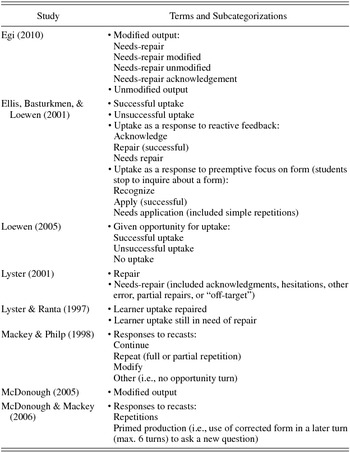
Another issue is lack of coherence in the way in which the construct is referred to and operationalized. The terms uptake and modified output are used synonymously by some, whereas they imply very different notions for others. For the purpose of this paper, we concur with Lyster and Ranta's (2013) most recent definition: uptake, in the most general sense, is a “discourse phenomenon” that “refers to a range of responses made by students following [corrective feedback]” (p. 171). The term uptake can therefore include simple acknowledgments (e.g., “yes”), as well as accurate, or inaccurate, modified output. In Table 1 Footnote 1 we highlight different ways that the construct has been researched. A quick visual inspection of Table 1 shows that common terminology included uptake (e.g., Ellis, Reference Ellis2006; Lyster, Reference Lyster2001; Nuevo, 2006), repair versus needs-repair (e.g., Ellis, Basturkmen, & Loewen, 2001; Lyster, Reference Lyster2001; Lyster & Ranta, Reference Lyster and Ranta1997), modified output (e.g., McDonough, 2004, 2005; Pica, Reference Pica1988; Swain, Reference Swain, Cook and Seidlhofer1995), and even successful uptake and unsuccessful uptake with subcategories recognize, apply, needs application (e.g., Ellis et al., Reference Ellis, Basturkmen and Loewen2001). Some researchers examined modified output as responses following feedback (e.g., Lyster & Ranta, Reference Lyster and Ranta1997), while others did not consider feedback a prerequisite for uptake (e.g., Ellis et al., Reference Ellis, Basturkmen and Loewen2001). Finally, other researchers have used the construct of uptake as a metric to show that feedback was successful in the classroom setting, reporting on the rate of uptake that the feedback elicited (e.g., Havranek, Reference Havranek2002; Lochtman, Reference Lochtman2002; Lyster, Reference Lyster1998; Lyster & Ranta, Reference Lyster and Ranta1997; Panova & Lyster, Reference Panova and Lyster2002; Pica, Holliday, Lewis, & Morgenthaler, 1989).
Examples of approaches to studying learner uptake

To our knowledge, only two studies have examined whether learner-produced modified output after interactionally driven feedback implies that the learner successfully noticed the feedback. Using stimulated recall methodology to measure noticing, Mackey, Gass, and McDonough (2000) found that learners accurately noticed two-thirds of feedback episodes where the production of modified output followed. Learners did not accurately notice feedback for the remaining one third of the data where modified output was not produced. Egi (Reference Egi2010) also used stimulated recall methodology and reported that (1) learners noticed recasts significantly more when they produced uptake and (2) when the uptake was categorized as correct modified output, learners were significantly more likely to notice mismatches between the target-language form and their own form. By demonstrating the connection between modified output and noticing, these studies are a first step at providing insight into the relationship between learner responses to feedback and noticing, both constructs believed to be important for SLA (e.g., Long, Reference Long, Ritchie and Bhatia1996; Robinson, Reference Robinson1995; Schmidt, Reference Schmidt1990, Reference Schmidt and Schmidt1995).
Examining modified output in a more fine-grained way may shed further light on the integrative processing involved when learners incorporating feedback. Examining modified output as partial versus full modified output could be particularly revealing to achieve this goal. For example, Robinson (Reference Robinson2007) found that more cognitively complex tasks (hypothesized to push learners to pay greater attention to forms necessary to complete the task) generated more of what he referred to as partial uptake. In his study, participants were asked to narrate picture stories that varied in how complex the reasoning demand was. They were provided with written input on picture prompts, which included useful phrases. Robinson coded learner uptake in two ways: exact uptake, or the use of a provided phrase in its entirety (without any changes), and then partial uptake, or the incorporation of at least one content word from the provided picture prompts.
Even though Robinson was not looking at reactive feedback in his study, this concept of partial versus exact, or full, modified output could be useful to conceptualize and test claims that the learner-produced modified output following a correction implies accurate noticing. It may be the case that an exact incorporation of corrective feedback is more of an imitation of that feedback, whereas partial modified output is more indicative of assimilation of the feedback. Consider Example (1) below, where a learner is provided with a corrective recast immediately after his error.
-
(1) Learner: Pon el libro debajo la mesa. (Put the book below the table).
Interlocutor: Pon el libro debajo de la mesa. ← recast
Learner: Pon el libro debajo de la mesa.
If, as in (1) above, the learner repeats the recast exactly, it is difficult to know if they are engaging in analytic thinking about what the recasted form means. Partial modified output, however, could be more indicative of learners’ breaking up the feedback, trying to assimilate the content that has been corrected. In (2), the learner repeats only the corrected element of the recast:
-
(2) Learner: Pon el libro debajo la mesa. (Put the book below the table).
Interlocutor: Pon el libro debajo de la mesa. ← recast
Learner: Debajo de. (Below).
In order to repeat only the corrected form, the learner had to parse the feedback input and tune in to the only difference between his original utterance and the correction: debajo de. By producing partial modified output (i.e., a modification of only the erroneous element), the learner has arguably decoded and noticed the mismatch. Examining modified output in this light could provide insight into the way in which learners perceive unitized structures. For example, Graf and Schacter (Reference Graf and Schacter1989) put forth that unitization (a component of integrative processing) does not happen simply by exposure. Unitization comes out of activities that require a conceptualization of stimuli as units. Partial modified output could be an indicator of detection and encoding of the corrected form as a “unitized structure” (Izumi, Reference Izumi2002) and of the learner's attempt to subsequently rehearse it.
MODIFIED OUTPUT IN THE COMPUTERIZED ENVIRONMENT
Research in this area cannot be exclusive to traditional FTF interaction. Computer-mediated communication has become a prevalent and high stakes context for a wide manner of social, academic, and professional activity (Thorne, Black, & Sykes, Reference Thorne, Black and Sykes2009), and this has resulted in a major increase in online language courses or hybrid classes, as well as the inclusion of computer-assisted language learning activities to teach languages in traditional FTF settings. One computerized interaction environment that has particularly caught researchers’ interest is synchronous online chat because of how much it resembles synchronous FTF interaction (e.g., Pellettieri, Reference Pellettieri, Warschauer and Kern2000). Both are conversations in real time, but there are several theoretical postulations as to the affordances of SCMC-based interaction. For example, SCMC provides learners with L2 input concomitantly with written forms of that input, and this dual coding (Paivio, Reference Paivio1986) of incoming stimuli may facilitate noticing of forms. Learners also have additional processing time to formulate their response in SCMC. Long (Reference Long2007) argued that the written mode of SCMC holds greater potential for corrective feedback for learners because feedback is more salient in this mode. Long's idea has been empirically supported by a few studies that have compared feedback provision in SCMC to FTF interaction. Yilmaz and Yuksel (Reference Yilmaz and Yuksel2011), for example, found that recasts in SCMC resulted in significantly better learning than recasts in FTF. The researchers explained their findings by suggesting that SCMC reduces the burden on learners’ cognitive resources and makes it easier for them to notice. Lai and Zhao (Reference Lai and Zhao2006) also found a greater noticing effect in SCMC than in FTF and methodologically confirmed this by using stimulated recalls.
However, there are some marked differences inherent to SCMC interaction that may mitigate these theorized benefits in practice. For example, turn-taking in SCMC discourse is characterized by what Smith (Reference Smith2003) called “split negotiation routine,” where the juxtaposition of an error and the corrective feedback is not contingent. Sauro (Reference Sauro2009) explained that lack of adjacency of the recast with the original utterance can reduce the saliency of feedback in SCMC, and Lai, Fei, and Roots (Reference Lai, Fei and Roots2008) found that learners notice continent recasts significantly better than noncontingent ones. In contrast, Gurzynski-Weiss and Baralt (Reference Gurzynski-Weiss and Baralt2014) compared feedback in the traditional FTF mode and SCMC chat mode and found no difference in students’ perception of corrective feedback or of the target of the corrective feedback. However, they did find marked differences in opportunities for learners to modify their output after feedback, with significantly fewer opportunities in the computerized environment. In addition, when learners had the opportunity to modify their output via chat, there was still significantly less modified output produced in SCMC, a finding corroborated by other researchers (e.g., Baralt, Reference Baralt2010; Smith, Reference Smith2010). In sum, it is inconclusive whether the theorized benefits for modified output production after feedback extend to the SCMC environment.
No study so far has compared learner noticing of corrective feedback in the SCMC mode with their noticing in the FTF mode and whether qualitatively different types of modified output differentially imply accurate noticing. As Loewen (Reference Loewen2005) rightly argued, type of learner uptake after feedback makes a difference, and studies are needed that examine this in relation to learner noticing of feedback. As more institutions adopt online language learning or hybrid courses, it is imperative that we understand how differences in learners’ processing of feedback mediate what they notice during interaction. Doing so can help inform the design of tasks for online language teaching. As the literature review presented here suggests, examining partial versus full modified output, when learners have the opportunity to modify and when that modification is correct, may provide a unique lens with which the psycholinguistic justification for modified output is viewed. The following research question addresses these considerations.
RESEARCH QUESTION
Is modified output type (no modified output, partial modified output, or full modified output) indicative of learners’ accurate noticing of feedback in FTF and SCMC environments?
METHOD
Larger project
The study reported here is part of a larger project. (See also Gurzynski-Weiss & Baralt, Reference Gurzynski-Weiss and Baralt2014, which details learners’ perception of the target of feedback in relationship to type of feedback and modified output.) For this and the larger study, data was collected in a Spanish and Portuguese department at a large private research university in the eastern United States. The department utilizes the communicative language teaching approach (Brandl, Reference Brandl2008) and is a task-supported language-learning environment (Bygate, Reference Bygate2000; Ellis, Reference Ellis2003). Information-gap tasks similar to the ones utilized in the study are regularly employed in this program and were chosen due to their familiarity to the learners.
Participants
Twenty-four intermediate-level learners of Spanish aged 18–21 participated in the study. All were native speakers of English, and some had experience with additional languages, including Korean, Greek, Latin, Italian, and French. Fourteen participants were female and 10 were male. All were frequent users of SCMC chat (an average of 2.7 hr/week), although they chatted online almost exclusively in English.
One researcher (the “interlocutor”) interacted in two dyadic tasks, one task per mode, with each participant. The learners received extra credit for their participation in the study; anyone who did not wish to participate was offered a different opportunity for extra credit. The other researcher (the “researcher”) administered the stimulated recall protocols and questionnaires. At the time of data collection, the interlocutor and researcher were doctoral candidates in SLA, native speakers of English (near-native speakers of Spanish), and trained in task-based interaction with 7 and 4 years of teaching experience, respectively.
Materials
The materials utilized in the study included two information-gap tasks, stimulated recall questions, and a questionnaire targeting learners’ demographic information and mode preferences. Each will be described briefly in the following paragraphs; additional information can be found in Gurzynski-Weiss and Baralt (Reference Gurzynski-Weiss and Baralt2014). All instruments from the study can be downloaded from IRIS (http://www.iris-database.org).
Tasks
The information-gap tasks utilized in this study were completed one-on-one between the interlocutor and each participant. In each task the participant directed the placement of 12 furniture items in a black-and-white kitchen or living room scene. The learner participant's scene contained the 12 furniture items placed in the room and highlighted in blue, while the interlocutor's room was empty of those furniture items, which were instead presented to her as loose pictures to be placed in the room scene. The participant's task was to instruct the interlocutor where to place the furniture items so their pictures matched at the end of the task, using only the target language, Spanish. Each participant completed both the living room and kitchen tasks, one in SCMC and one in FTF. Both the order of the task scene (living room or kitchen) and the mode (FTF or SCMC) were counterbalanced using a Latin squares design.Footnote 2 These tasks naturally elicited the use of prepositional vocabulary, directions or commands and the vocabulary of the 12 furniture items.
Stimulated recall questions
Stimulated recalls protocols, a retrospective measure of cognitive processes (Gass & Mackey, Reference Gass and Mackey2000) were used to measure learners’ noticing in this study. In this methodology, participants are shown a stimulus of the interaction, most commonly a video of their task. The video is often paused at specific moments so that participants may be asked to recall what they were thinking at that time of the original interaction. To ensure robust measures and prevent memory decay, it is imperative these protocols be conducted as soon after the original interaction as possible.
In this study, the stimulated recall focused on learners’ perception of feedback during the task-based interaction in both the FTF and SCMC modes and took place immediately after the task interaction. All learners successfully completed the tasks by directing the interlocutor's placement of all furniture items in the tasks. Conducting the stimulated recalls immediately after the task was possible because the researcher was in the room during the participant–interlocutor interaction. During this time, the researcher sat in corner and took detailed notes to choose the moments on which to focus in the protocols. Learners were shown an average of 10 interaction episodes (range = 9–15), at least 8 of which contained (a) a student error, (b) interlocutor response, and (c) student response, if any. After each interaction episode was shown, the researcher paused the tape and asked the learner what they remembered thinking at the time of the original interaction. The additional interaction episodes did not contain an error and were utilized to obtain learner comments specific to the mode (e.g., a moment where a learner commented on how they felt motivated by an emoticon sent to them by the interlocutor in SCMC). Learners were also invited to request to view and/or comment on any additional moments that took place during the interaction. The stimulated recalls targeting representative episodes in the FTF interaction lasted an average of 12.5 min; for the episodes from the SCMC they lasted an average of 10.2 min. The protocols were recorded using a digital recorder and conducted in English. The complete list of questions can be downloaded from http://www.iris-database.org (see also Gurzynski-Weiss & Baralt, Reference Gurzynski-Weiss and Baralt2014).
Participant questionnaire
The questionnaire, given to participants upon completion of the study, contained demographic questions, such as native language, age, area of study, and computer use, as well as questions soliciting learners’ opinions regarding interacting in the two modes. The purpose of the questionnaire was to provide additional, qualitative data to explain patterns emergent from the results and to ensure all learners were familiar with SCMC.
Procedure
The study took place in a one-shot design, in a computer laboratory reserved for the experiment. Only the researcher, the interlocutor, and the participant were present in the lab during the task-based interactions; the interlocutor was not present during the protocols. When the participant entered the room, the researcher explained the experiment, gave the participant a consent form to sign, and offered an opportunity to ask questions. The participant then started the first task with the interlocutor while the researcher covertly took notes.
When completing the task in the FTF mode, the participant and interlocutor sat across from each other at a table with a barrier blocking each other's picture. FTF interactions were recorded via a camera placed on a tripod a short distance away from the participant and interlocutor. Completing the task in the FTF mode took an average of 13 min (range = 7–25). After the first interaction (in SCMC or FTF, either with the living room or kitchen scene), the interlocutor left the room and the researcher and participant conducted the stimulated recall. For the FTF mode, the stimulus was interaction episodes from the video recording of the interaction, shown on a TV screen. After the protocol, the learner was offered a break (which no one utilized) and the second task began.
When completing the information-gap task in SCMC, the interlocutor and participant sat at computers across the room from each other in the lab, with their backs to each other. The SCMC written iChat interaction was recorded using iShowU HD (a screen-recording software), capturing the chat video data in real time. Completing the task in SCMC took participants an average of 25.5 min (range = 10–37).Footnote 3 After the second task, the interlocutor again left the room for the researcher and participant to complete the mode-specific stimulated recall. For the SCMC mode, the stimulus was interaction episodes chosen from the iShowU HD movie, presented to the learner on a computer screen. After the second protocol, the learner completed the questionnaire and then received an information sheet detailing the specific focus of the study.
In both modes, and following precedent set by earlier research (e.g., Baralt & Gurzynski-Weiss, Reference Baralt and Gurzynski-Weiss2011; Gurzynski-Weiss & Baralt, Reference Gurzynski-Weiss and Baralt2014; Mackey et al., Reference Mackey, Gass and McDonough2000), the interlocutor provided feedback and opportunities for modified output where and how it felt natural for her to do so.Footnote 4
CODING
The primary data set utilized for this study was the stimulated recall protocols for each participant in both the FTF and SCMC modes. The interaction episodes within the protocols were analyzed in terms of error type, feedback type, opportunity for modified output, and learner-produced modified output. Five error types were identified in the data set: errors in lexis, semantics, morphosyntax, and phonology (specific to FTF) or misspelling (specific to SCMC); errors not belonging to these categories, such as choosing a furniture item that was not one of the 12 targets, were coded as “other.” Types of feedback provided naturally by the interlocutor included overt corrections, recasts, metalinguistic information, confirmation checks, clarification requests, elicitations, elaborations, repetitions, and negotiation for meaning. The category of “no feedback” was used whenever the interlocutor did not address a learner error with feedback. Operationalizations and examples of both feedback and error types can be found in Appendix A.
Opportunities for modified output were operationalized as binary: either learners were given time and space to produce modified output in the turn immediately following the interlocutor's feedback, or they were not. An opportunity for modified output can be seen in (3), whereas a moment when a learner was not given the opportunity to modify his or her output can be seen in (4).
-
(3) Learner: Al lado de la sofá.
Interlocutor: Al lado del sofá.
Learner: Del sofá.
Learner: To the side of the [fem.] couch [masc.].
Interlocutor: To the side of the [masc.] couch [masc.].
Learner: Of the [masc.] couch [masc].
-
(4) Learner: Es arriba del tablón.
Interlocutor: Está arriba del tablón. Ok. ¿Qué más?
Learner: It is [wrong copula] on top of the counter.
Interlocutor: It is on top of the counter. Ok. What else?
Learners’ production of modified output
In this study, learner modified output was operationalized as a tertiary variable: no production of modified output, partial modified output, and full modified output, as a response to the feedback provided. No production of modified output occurred when learners did not produce any modified output after receiving feedback when they had an opportunity to do so. Learner acknowledgements such as “sí,” “ok,” or “yeah” were also coded as no modified output, as were repetitions of their original errors. An example of a learner utterance coded as no modified output in this data set is seen in (5), with a corresponding translation below.
-
(5) Learner: “. . .un foto.”
Interlocutor: “¿Una foto?”
Learner: “Sí.”
Learner: A(masc.) photo(fem.).
Interlocutor: A(fem.) photo(fem.)?
Learner: Yes.
When learners isolated and repeated only the element that had been corrected in feedback, that was coded as partial modified output. In (6), we see the learner responds to the feedback by producing partial modified output, repeating only the corrected element (the verb estar instead of ser, both to be in Spanish).
-
(6) Learner: “. . . y es en frente—”
Interlocutor: “—Está en frente”
Learner: “Está.”
Learner: . . . and it's in front—[use of wrong copula]
Interlocutor: It's in front. [corrects to estar, correct copula].
Learner: It’s. [repeats only the corrected element, the copulative verb estar]
Finally, the third category, instances of full modified output, were identified as learners’ accurate use of all feedback provided by the interlocutor in the turn immediately following feedback. An example of full modified output is seen in (7).
-
(7) Learner: “Debajo la mesa.”
Interlocutor: “Encima de la mesa.”
Learner: “Encima de la mesa.”
Learner: Under the table. [wrong preposition]
Interlocutor: On the table. [correct preposition]
Learner: On the table.
Note that in (7), the learner repeated the feedback in its entirety. This is different from (6), where the learner only repeated (and hence isolated out) the corrected form. Thus, when learners repeated all of the interlocutor's feedback, and/or added additional detail in his or her turn in the conversation after the feedback, this was coded as full modified output.
Learners’ noticing of feedback
To explore noticing of feedback, learners’ stimulated recall comments were examined. In the larger project, the comments were coded according to comment type as well as learners’ reporting of noticing the feedback as feedback (or not) and their perception of the target of the feedback (see operationalizations and examples in Appendix A). For additional detail on learner perception see Gurzynski-Weiss & Baralt, Reference Gurzynski-Weiss and Baralt2014. For the current study, learners’ noticing of feedback was operationalized as binary: Either the learners reported correctly noticing the feedback as feedback, as well as the target of the feedback, or they did not. An example of a learner's correct noticing of feedback is seen in (8), which corresponds to the interaction shown in the second example above.
-
(8) Interlocutor: “What do you remember thinking at this point during the task?”
Learner: “Well, I mean, she was basically repeating what I said but doing it correctly. So I mean, I appreciated it. I used ser instead of estar.”
In contrast, in (9), a learner reported incorrectly perceiving the target of the feedback, which was coded as incorrect noticing/failure to notice feedback as feedback. In (9) the learner reports thinking about the name of one of the items in the picture, while the correction was targeting his need to use a correct preposition. The learner did not notice that the feedback changed his original, erroneous preposition.
-
(9) Interlocutor: “What did you think your partner was trying to communicate to you at this time?
Learner: “Liquid soap was behind the other soap, and so then I thought that she was just reaffirming what I had laid out.”
In this study, type of modified output was the (tertiary) independent variable; learner noticing of feedback was the (binary) dependent variable.
RESULTS
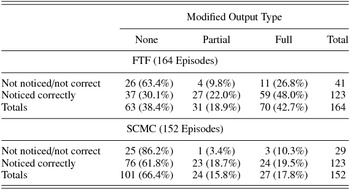
In order to address the research question, descriptive statistics were first calculated to obtain a thorough picture of the data, followed by binary logistic regressions to investigate if type of modified output was representative of learners’ accurate noticing. Binary logistic regressions were the chosen as the most appropriate statistical test to investigate the relationships in this study because the dependent variable, learners’ correct noticing of feedback, was binary and categorical.Footnote 5 Thus, as argued in this study, we were testing if learners’ correct noticing of feedback was demonstrated by the type of modified output that they produced (full, partial, or none), entered into SPSS as categorical covariates. The modified output type “no modified output” served as the reference category,Footnote 6 and confidence intervals were set at 95%. A separate regression for each mode was run to answer the research question, followed by a regression to test the interaction between mode and modified output type. In binary logistic regressions, two key pieces of information divulge the predictive nature of the relationship: odds ratios and p values. The odds ratio is the measure of effect size in this analysis and provides information about the strength of the relationship. In other words, it reveals how strongly related the independent variable (in our case, modified output type) is to the dependent variable (learners’ accurate noticing of feedback). The p values reveal how confident we are about finding that same predictive relationship in another, larger population. Thus, both the odds ratios and p values provide important information for interpreting these relationships. Table 2 presents the descriptive statistics.
Learner noticing in relation to modified output and mode

Note: FTF, Face-to-face; SCMC, synchronous computer-mediated communica-tion.
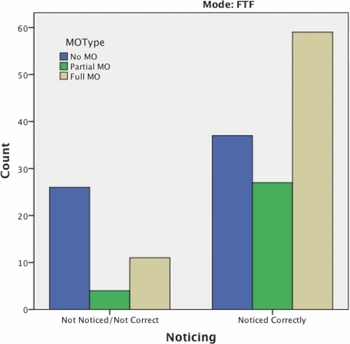
As seen in Table 2, there are comparable amounts of interaction episodes examined for each mode: 164 in FTF, and 152 in SCMC. There are notable differences, however, in the types of learner-modified output produced in each mode. Three types of modified output were coded for in the current study: no modified output, partial modified output, and full modified output. Overall trends in the FTF mode revealed that learners most often produced full modified output (42.7% of the time), followed by no modified output (38.4%), and then partial modified output (18.9%). This pattern was echoed in learners’ noticing: when learners correctly noticed feedback in FTF, they produced full modified output 48.0% of the time, followed by 30.1% no modified output and 22.0% partial modified (see Figure 1).
Learners’ correct noticing and modified output (MO) type in face-to-face (FTF).

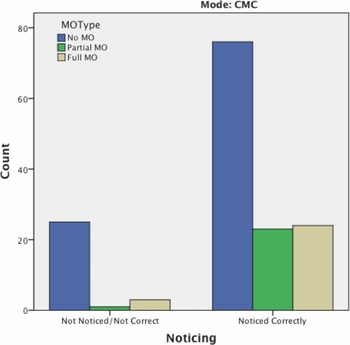
In contrast, different patterns were seen in SCMC. In this mode, learners most often did not produce any modified output at all (66.4% of the time), followed by full modified output (17.8%) and then partial modified output (15.8%). This pattern was also observed in relation to learners’ correct noticing; when learners correctly noticed SCMC feedback, they did not produce any modified output 61.8% of the time, followed by 19.5% full modified output and 18.7% partial modified output, This is represented in Figure 2.
Learners’ correct noticing and modified output (MO) type in synchronous computer-mediated chat (SCMC).

Relating learners’ noticing to modified output type
A binary logistic regression determined that learners’ production of both partial and full modified output was significantly demonstrative of their correct noticing in the FTF mode, as compared with learners’ noticing when they produced no modified output at all. There was a greater effect for partial modified output, the modified output type that was produced the least. In FTF, when learners produced partial modified output, they were 4.74 times more likely to accurately notice feedback (odds ratio = 4.74, p < .01). When they produced full modified output, they were 3.77 times more likely to accurately notice feedback as feedback (odds ratio = 3.77, p < .01). In other words, both partial modified output (i.e., isolating out and repeating only the corrected form targeted in the feedback they received) and full modified output (i.e., repeating the entire correction), significantly predicted accurately noticing more, when compared to not producing any modified output. The effect was stronger, however, for partial modified output.
The binary logistic regression run for SCMC revealed a different finding. While the odds ratios were large, the p value was only significant for the partial modified output. In chat, when learners produced partial modified output, they were 7.57 times more likely to accurately notice feedback (odds ratio = 7.57, p = .053). When learners produced full modified output in SCMC they were 2.63 times more likely to correctly notice feedback (as compared with no production of modified output; odds ratio = 2.63, p = .139), but this was not significant. Just as in the FTF mode, the production of partial modified output after feedback in SCMC resulted in significantly more accurate noticing of feedback.
Thus, results revealed that in both FTF and SCMC, partial modified output was the best demonstrator of learners’ accurate noticing of feedback, significant in both modes. Full modified output was also significantly predictive of learners’ accurate noticing in FTF.
Differences in SCMC and FTF
We ran a second binary logistic regression with an interaction for mode and modified output type to ensure there were no statistical differences in the way in which modified output type related to accurate noticing in the two environments, FTF versus SCMC. While we split the file in SPSS to allow us to have independent output for each of the two modes, we wanted to ensure that mode of interaction was not a mediating factor influencing the relationship between noticing and type of modified output. This regression was not found to be statistically significant (p = .810). In other words, in both FTF and SCMC, partial modified output, followed by full modified output, most strongly predicted learners’ accurate noticing of feedback. There was no statistical difference in the effect of modified output type on noticing in the two interaction environments.
Summary
A fine-grained assessment of learner-produced modified output after corrective feedback revealed that in this study, learners’ production of modified output demonstrated how well they noticed the feedback provided to them. When learners responded to feedback by decoding and repeating only the corrected form, operationalized here as partial modified output, this significantly demonstrated their accurate noticing of the feedback target. Furthermore, this finding held in both the FTF and SCMC interaction environments. Learner production of full modified output, or complete use and repetition of feedback addressing their errors, also predicted accurate noticing in FTF, although this was not found in SCMC.
DISCUSSION
The purpose of this study was twofold. The first goal was to further elucidate the relationship between type of modified output and accurate noticing in response to interactionally driven feedback. The second goal was to examine whether this relationship held in both the FTF and SCMC environments, thereby linking mainstream FTF research on SLA processes to SCMC contexts, which are an increased reality for L2 learning and use. As Loewen (Reference Loewen2005) suggested, the quality of modified output is a theoretically relevant construct that could mediate potential learning outcomes, though research has shown that this is not always the case (Mackey & Philp, Reference Mackey and Philp1998; Révész, Sachs, & Mackey, Reference Révész, Sachs, Mackey and Robinson2011).Footnote 7 When modified output can be and is produced, most past studies have not distinguished between type of modified output. The data from this study show that partial modified output was the strongest indicator of accurately noticed feedback targets. This finding, which held in both interaction environments, suggests the need for future research to examine types of modified output in relationship to noticing in other environments and, subsequently, the effect of this relationship on learning.
The few studies exploring different types of modified output have shown that “successful uptake” (e.g., Loewen, Reference Loewen2005), or “correct modified output” (e.g., Egi, Reference Egi2010), or “primed production” (use of a correct form in the conversation, after recently having been corrected; McDonough & Mackey, Reference McDonough and Mackey2006), is significantly related to noticing the mismatch between error and the targetlike form. In the present study, we went beyond successful/correct uptake, and examined learners’ capacity to demonstrate accurate noticing of this mismatch by producing partial modified output. Proposed first by Robinson (Reference Robinson2007), partial modified output has been hypothesized to be more revealing than exact (or full) modified output about how learners process task-relevant input. We have shown this to be the case for demonstrating accurate noticing of corrective feedback.
Thus, learner-produced modified output is psycholinguistically relevant, but it may depend on modified output type. When learners produce partial modified output during task-based interaction, they are showing that they have broken apart the feedback and have identified and decoded the corrected form. After receiving corrective feedback, producing the corrected element aloud (or writing it out explicitly in SCMC) in an isolated fashion supports the contention that the learner is engaging in a deeper, integrative processing of the forms’ mismatches. Based on the data reported here, producing partial modified output may be highly indicative that a cognitive comparison of the corrected form with the previous erroneous form took place. Isolating and producing just the corrected form can lead to unitized encoding of the perceived form within the context of meaning, which may more effectively lead to the corrected form's reintegration into the interlanguage system (Graf & Schacter, Reference Graf and Schacter1989). Producing full modified output also has the capacity to facilitate detection of the corrected form but may not be as strong of a stimulator of integrative processing of the targeted form as is partial modified output. It can be argued that producing partial modified output is demonstrative of heightened and more focused attention allocation to the specific mismatch of interlanguage–target language forms, followed by a unitized encoding. As such, partial modified output may have a greater noticing function during task-based interaction.
Considering the psycholinguistic relevance of partial modified output in this way may explain why it had such predictive effectiveness in the SCMC mode in the present study. Recall that partial modified output was a much stronger indicator of accurate noticing in SCMC, with an odds ratio of 7.57 (p = .053) compared to 4.74 (p < .01) in FTF. In SCMC, the learner can read, process, and visually compare the two statements. The erroneous form and its correction are set up side by side, written out for the learner in the context of their meaningful utterance, and this can greatly enhance noticing of their contrast. This visual juxtaposition may be precisely why recent findings have shown that feedback is better noticed in SCMC (e.g., Lai & Zhao, Reference Lai and Zhao2006; Yilmaz & Yuksel, Reference Yilmaz and Yuksel2011). If, after being provided with feedback in SCMC (which gives the learner a visual parallel of erroneous form with its corrected form), the learner produces partial modified output, he or she has deliberately chosen to retype and assimilate the corrected form. Given that both the original erroneous form and the corrected form are already (and still) present on the screen, partial modified output in SCMC is therefore a highly superfluous move. Thus, due to its markedness, if partial modified output does take place, one can almost guarantee that the learner has noticed that form. This finding supports the notion that cognitive integration of forms addressed during SCMC-based interaction is qualitatively different from FTF-based interaction and that it is positively enhanced (e.g., Long, Reference Long2007; Yilmaz & Yuksel, Reference Yilmaz and Yuksel2011). SCMC may alleviate language learners’ attentional resource limitations that are needed to encode corrected forms during interactionally driven feedback, while at the same time, enhancing their ability to encode and rehearse these forms.
What might explain why full modified output was a not significant predictor of accurate noticing in SCMC, while it was in FTF? We propose that retyping full modified output in this mode (e.g., retyping the entire utterance with the corrected form) in SCMC is more of a social move than evidence for conceptually driven processing. Full modified output in SCMC can at times serve as a very explicit means of acknowledging receipt (and incorporation) of the interlocutor's feedback. This explicit feedback–receipt confirmation is not natural in conversational interaction and may be why full modified output in SCMC is so rare (occurring only 27 times in the data set). Incipient research using screen-recording technology has reported that some learners produce full modified output in SCMC to reiterate to their interlocutor that they were aware that they were being “corrected” (Baralt, Reference Baralt2010), regardless of whether or not they noticed the accurate target of the feedback. In addition, Baralt (Reference Baralt2010) observed that full modified output in SCMC, when it did happen, was sometimes simply a copy and paste of the entire rephrased utterance, to make clear as quickly as possible that they knew their partner had given them feedback. Copying and pasting text does not entail the same encoding processes as does typing out partial modified output. This finding seemed to be upheld in the current study as well, according to learner comments stating that they utilized the copy and paste functions in SCMC. While exploring the qualitative covert features of SCMC is beyond the scope of this paper, it appears that full modified output in this mode may have more of a social function than a noticing one.
In the FTF mode, producing full modified output does imply encoding: encoding via the verbal system. In order to be able to produce full modified output, learners have had to successfully hold the entire utterance, with the correction, in their working memory space in order to say it. This obligates a reliance on their own cognitive resources, a reliance that is not required in the SCMC mode. For some learners and on some feedback episodes, this activation of learner internal resources to decode feedback can facilitate their accurate comparison, and noticing, of the corrected form with their original erroneous form. Still, and as we have argued throughout, their production of partial modified output, which required a parsing, comparison, and identification of the mismatch between the two juxtaposed utterances in working memory, is even more predictive of accurate noticing in FTF. These are some hypotheses with respect to why both full and partial modified output corresponded to accurate noticing in FTF, but only partial modified output is in SCMC.
It is important to point out that interaction in FTF and SCMC are not isochronous and that the ability to produce partial modified output (to process corrective feedback, to notice and repeat only the corrected form) is hard to do from the language learner perspective. Individual differences, such as working memory, have been shown to moderate this ability (Mackey, Adams, Stafford, & Winke, 2010). The nature of typing out modified output in SCMC, plus the individual differences that may moderate learners’ ability to produce modified output, may explain why it was the least common type of uptake in our data set and in both modes. It merits restating that this type of modified output was what most strongly predicted noticing in both modes. The present study also found that overall the production of modified output in the SCMC mode was rare, supporting other studies that have also reported this observation (e.g., Smith, Reference Smith2010).
Examining error type as potential mediator
SCMC's capacity to enhance the saliency of forms may therefore be heightened when compared to FTF. This hypothesis is particularly supported when breaking down the data presented here by error type. To investigate a potential mediating effect of targeted linguistic items on the relationship between type of modified output and learner noticing found in this study, we ran additional binary logistic regressions. The first regression examining error type in FTF found a significant mediating effect; the type of error the feedback was targeting did mediate the relationship between type of output and learners’ noticing. When learners produced full modified output after being given feedback addressing lexis or semantics, they were less likely to notice the feedback (p < .01 and < .05). However, the relationship between noticing and type of modified output held for both partial and full modified output when looking at morphosyntax. In other words, once we accounted for error type, the significant relationship between full modified output and noticing abated for FTF mode and with respect to lexis and semantics. This supports our postulation that partial modified output has a greater noticing effect than full modified output. It is interesting that in the regression examining the data from the SCMC mode, error type did not mediate the relationship between type of modified output and noticing; the relationship stayed the same. This reiterates the hypothesis that noticing is enhanced in SCMC. These data collectively support recent findings that (a) in FTF the complexity level of a form affects learners’ attentional resources associated with produced output (Uggen, Reference Uggen2012) and (b) that feedback provided in SCMC helps to make forms more salient for the learner, regardless of the linguistic item targeted (e.g., Long, Reference Long2007; see, however, Yilmaz, 2012).
Future studies should address type of linguistic item in relation to the native language of the learners; both could play a role in the salience of the feedback, particularly when comparing lexical or semantic feedback to feedback targeting morphosyntax. In the work by Sagarra and Ellis (Ellis & Sagara, Reference Ellis and Sagarra2011; Sagara & Ellis, Reference Sagarra and Ellis2013), for example, they examine differences in morphological processing of Spanish by learners whose native language is English (a lexically focused language where overt subjects are required), Romanian (a morphologically focused language, like Spanish, with optional subject pronunciation) and Chinese (a morphologically focused language without explicit subject pronunciation). These studies have found learners to pay more attention (as measured by eye tracking and event-related potentials) to the cues set by their native language, up through the advanced levels of learning Spanish. Because our learners were at the intermediate level (in addition to our tasks being very lexically focused, as we also discuss), it could be the case that learners’ first language(s) increased the salience of feedback on particular error types. This is supported also by learners’ more accurate perception of morphosyntactic feedback when learning Arabic, as opposed to English or Italian, where they are not as accurate at perceiving feedback targeting morphosyntax (cf. Mackey et al., Reference Mackey, Gass and McDonough2000, Reference Mackey, Al-Khalil, Atanassova, Hama, Logan-Terry and Nakatsukasa2007, etc.).
LIMITATIONS AND AREAS FOR FUTURE RESEARCH
This is the first study to compare specific types of learner-modified output in FTF versus SCMC and relate these types of modified output to accurate noticing of feedback. Several characteristics of this study prohibit the generalizability of our results to other contexts and can be addressed in future designs. The current study was executed in a one-shot, experimental, laboratory-based design. Future research must be undertaken in both experimental and natural contexts to test the ecological validity of these findings and potential implications for the L2 classroom. We utilized a single task type, information-gap tasks. While these tasks have been found to provide the necessary contexts for natural feedback provision, learner noticing, and production of modified output, future studies would do well to investigate task type as a potential mediating factor in learners’ accurate noticing. This study also took place in a Spanish foreign language setting, and these results may not be directly applicable to other L2 populations. Future studies could also examine potential interactions between target language and task type, as previous studies on learner noticing of feedback have found this noticing to appear to be, at least in part, mediated by the linguistic target(s) of the task, or the salient cues of the target language (cf. Gurzynski-Weiss & Baralt, Reference Gurzynski-Weiss and Baralt2014; Mackey et al., Reference Mackey, Al-Khalil, Atanassova, Hama, Logan-Terry and Nakatsukasa2007; Mackey et al., Reference Mackey, Gass and McDonough2000).
Finally, future studies can utilize technological advancements, such as eye-tracking technology, to examine learner noticing in relation to modified output produced in the turn immediately following feedback provision, as compared with modified output produced later in the interaction (e.g, Smith, Reference Smith2012). While we found similar relationships between learner noticing and modified output type, there is still more to examine in terms of modal comparisons to thoroughly understand the nature of task-based interaction, learner noticing, and use of feedback in both FTF and SCMC. To our knowledge, no one has examined feedback provision, learner responses to feedback, and noticing or L2 development outcomes in online video chat. This is a technological capability that is now being used in several online language courses, and research on how to best utilize this environment would contribute to our understanding of learning opportunities in this computer-mediated context.
CONCLUSION
The current study sought to examine the explanatory values of modified output types for accurate noticing of feedback in the FTF and SCMC environments. We found that in both modes, learners’ accurate noticing of feedback was predicted by their production of partial modified output. While partial modified output corresponded to learner noticing at the level of significance in both FTF and SCMC, the strength of these predictive relationships differed according to mode. In addition, in FTF only, full modified output also significantly corresponded to learner noticing, although less so than partial. We hypothesize that full modified output in SCMC may be more of a social than noticing function. In light of these findings, we argue that a more fine-grained operationalization of what constitutes learner modified output after feedback is needed in future research employing these concepts, in order to inform SLA theory.
APPENDIX A
Error and feedback types according to Gurzynski-Weiss and Baralt (Reference Gurzynski-Weiss and Baralt2014)