Childhood adversity, including disaster, chaos, abuse and neglect, is a consistently documented risk factor for a wide variety of negative outcomes (Anda et al., Reference Anda, Felitti, Bremner, Walker, Whitfield, Perry and Giles2006), particularly amongst youth who lack relational buffers to the stress (Ludy-Dobson & Perry, Reference Ludy-Dobson, Perry and Gil2010; Lupien, McEwen, Gunnar, & Heim, Reference Lupien, Gunnar, McEwen and Heim2009). Children who grow up in chaotic, unpredictable and abusive environments with minimal relational support and consistency are simply more at risk for enduring problems spanning multiple domains, including developmental, behavioural, mental health and even physical health, than children who do not (Bellis et al., Reference Bellis, Hughes, Leckenby, Hardcastle, Perkins and Lowey2015; Jonson-Reid, Kohl, & Drake, Reference Jonson-Reid, Kohl and Drake2012). This is particularly true for children whose adversity occurs early in life and is chronic and severe, both due to the direct effect of adversity and to the “side effect” of missed developmental opportunity (McDermott et al., Reference McDermott, Troller-Renfree, Vanderwert, Nelson, Zeanah and Fox2013, Raby et al., Reference Raby, Roisman, Labella, Martin, Chris Fraley and Simpson2018).
A major mechanism underlying the disruptive developmental “echo” of early adversity is the crucial role that perinatal experience plays in shaping the sensitivity and reactivity of the stress response systems in the brain (Beeghly, Perry, & Tronick, Reference Beeghly, Perry, Tronick and Maltzman2016). These primary regulatory networks that originate in lower areas of the central nervous system play a major role in providing organising input to higher areas of the brain during development. If these are abnormally organised by early developmental trauma and neglect, they will continue to disrupt the normal organisation of neural networks in higher areas of the brain throughout the rest of childhood (Perry, Hambrick, & Perry, Reference Perry, Hambrick, Perry, Fong and McRoy2016). The result can be a magnification of the original insult, and these children will fall further and further behind their same age cohort (Tronick & Perry, Reference Tronick, Perry, Marlock, Weiss, Young and Soth2015).
The diversity of outcomes observed in children with histories of adversity is of great interest given that such heterogeneity poses major problems for social and clinical intervention. Indeed, if all maltreated children could benefit from the same intervention strategies, then perhaps the estimated lifetime cost in the United States (US) of just one year's worth of confirmed child maltreatment cases would not hover over 120 billion dollars, inclusive of mental health, physical health, criminal justice and other associated costs (Fang, Brown, Florence, & Mercy, Reference Fang, Brown, Florence and Mercy2012).
For over a century, child welfare systems in the US and other developed countries have intervened when child maltreatment is suspected or substantiated. Since the late 1800s, or the advent of family-based out-of-home placements for maltreated children in the US (McGowan, Reference McGowan, Mallon and Hess2005), many lessons have been learned, but perhaps the most salient lesson has been humility in the face of such a staggering and complex public health problem. Indeed, we have learned that all interventions, whether social (family preservation vs. out-of-home placement) or clinical (talk therapy vs. play therapy) are apt to fail when they are inappropriately matched to a unique child's cultural context, strengths and needs (Hambrick, Oppenheim-Weller, N'zi, & Taussig, Reference Hambrick, Oppenheim-Weller, N'zi and Taussig2016). Yet, for decades, the conversation has primarily revolved around which social and clinical interventions are best for the entire population of maltreated or child welfare-involved children, instead of which interventions are best for each unique child.
Our goal is to engage in nuanced examination of some of the complex questions regarding which developmental and social factors, both adverse and relationally positive, are associated with which outcomes for children with histories of adversity. As a first point of examination, we explore the role of current relational health in promoting positive outcomes for child welfare-involved youth while controlling for factors associated with a child's degree of developmental adversity, such as the timing and degree of adversity. We focus on current relational health because the quality of the relational context is a potentially modifiable factor during a child's involvement with child welfare, no matter if the child is living in their biological home or an out-of-home care placement. Research suggests that there may be a disproportionate impact of early life trauma and adversity compared to traumas occurring later in life (Manly, Kim, Rogosch, & Cicchetti, Reference Manly, Kim, Rogosch and Cicchetti2001; Ogle, Rubin, & Siegler, Reference Ogle, Rubin and Siegler2013), in part due to early traumatic experiences becoming “biologically embedded” in a child's physiology (Berens, Jensen, & Nelson, Reference Berens, Jensen and Nelson2017) and in part due to the previously mentioned impact on the developing stress response systems (Beeghly et al., Reference Beeghly, Perry, Tronick and Maltzman2016). And yet, research also suggests that a high degree of relational sensitivity and support may be an important protective factor (Bellis et al., Reference Bellis, Hardcastle, Ford, Hughes, Ashton, Quigg and Butler2017). We seek to evaluate how both the timing of developmental risk and a child's current relational context are associated with child outcomes.
As such, we respond to the call made by McSherry and Fargas Malet (Reference McSherry and Fargas Malet2017) that ‘. . .we need more detailed research on the experiences of children in care that attempts to capture, in as much detail as possible, the complexity of their lives before, during, and after care.’ (p. 220). Examples of youth recovering within each “out-of-home” placement type (foster, relative, residential) are evident, as are examples of youth who are deteriorating. The heterogeneity in the developmental history and current functioning of children and youth makes blanket policies regarding placement unwise. Children have different patterns of developmental experience, both positive, and negative and we cannot expect to make successful blanket policy, social and clinical decisions for such a heterogeneous group.
A significant challenge to understanding the heterogeneous outcomes associated with childhood adversity, and how to intervene on both individual and societal levels, is the need for incredibly large, nuanced data. Because of the complexity of development, culture and community, we need thousands of observations to have adequate power. We also need detailed information regarding children's experiences in a variety of risk and resilience-promoting domains, within a range of developmental periods.
In the present study, we use a large dataset to explore how the current degree of relational health experienced by child welfare-involved children is associated with their current developmental functioning. Specifically, we explore the association between children's current degree of relational health across domains such as relationship with primary caregivers, siblings, peers, school teachers and community supports, with their current functioning in key brain-mediated domains, including attention, sleep, arousal, affect regulation/mood and modulation of reactivity. Given that relationships have been shown to buffer stress (Bellis et al., Reference Bellis, Hardcastle, Ford, Hughes, Ashton, Quigg and Butler2017), we expect a high degree of relational health to promote positive outcomes. This is not only because of the proposed ability of relationships to make lasting change in children's functioning (Dai et al., Reference Dai, Chen, Tan, Wang, Lai, Kaminga and Liu2016), but due to the often “state-dependent” nature of children's functioning (Perry, Pollard, Blakley, Baker, & Vigilante, Reference Perry, Pollard, Blakely, William and Vigilante1995). When children are in environments that promote their safety and that are replete with relational supports and resources, they may be more likely to show their developmental strengths. Most people can relate to the idea that functioning across domains such as mood, cognition and interpersonal functioning is improved when we are in supportive, low-stress contexts, and is compromised when we are dysregulated.
To provide a more informed estimate of the association between current relational health and children's neurodevelopmental functioning, we control for the timing and degree of children's history of adversity and relationally positive experiences (henceforth developmental risk). We predict that a high degree of current relational health or connectedness may buffer early stress experiences, or more specifically, remain strongly associated with improved functioning across a range of brain-mediated domains.
Method
Study Design
De-identified data collected by clinicians using the Clinical Practice Tools (henceforth NMT Metrics, see Measures section) associated with the Neurosequential Model of Therapeutics (NMT; Perry, Reference Perry and Webb2006; Perry & Hambrick, Reference Perry and Hambrick2008), an approach to clinical problem solving with at-risk individuals, were used. De-identified NMT Metric data were downloaded from the web-based repository of Metric data tracked by the ChildTrauma Academy (NMT developers) as part of their internal quality improvement initiatives. Ethics approval was provided by the Institutional Review Board at the University of Missouri – Kansas City. These data were utilised because the Metrics contain information about a child's developmental history (both negative and positive) and a child's current relational health and current functioning. We provide a brief description of the NMT to help contextualise the data.
The NMT focuses, in a nuanced way, on “what happened” to the child. Importance is placed on the timing of developmental risk, and how a child's unique developmental experiences may be associated with functioning across a range of brain-mediated domains, including arousal, attention and inhibition. The NMT is developmentally informed and biologically respectful. The certification process comprises three steps: (1) capacity building and mastery of core concepts including attachment, the impact of abuse, neglect and trauma and emerging concepts in developmental psychology, neuroscience and traumatology; (2) an assessment process to determine (a) the timing and nature of developmental adversities and resilience-related factors, (b) current functioning in multiple domains (e.g., sensory integration, self-regulation, relational, cognitive) and (c) current relational milieu (i.e., connection to family, community, culture); and (3) the selection and sequencing of specific educational, therapeutic and enrichment interventions.
The lens that providers pursuing NMT certification obtain helps them both flexibly and intentionally work with children who demonstrate the emotional, social and behavioural “sensitivity” that is common in developmental trauma. Readers are referred to publications regarding the theoretical rationale for the NMT (e.g., Perry et al., Reference Perry, Pollard, Blakely, William and Vigilante1995), the NMT certification process and implementation (e.g., Perry, Reference Perry2009; Perry & Dobson, Reference Perry, Dobson, Ford and Courtois2013) and NMT effectiveness (e.g., Hambrick et al., Reference Hambrick, Brawner, Perry, Wang, Griffin, DeMarco and Poales2018; Zarnegar, Hambrick, Perry, Azen, & Peterson, Reference Zarnegar, Hambrick, Perry, Azen and Peterson2016) to learn more about the approach. The NMT was designated an “emerging practice” by the National Quality Improvement Center for Adoption & Guardian Support and Preservation (QIC-AG.org), and research examining NMT efficacy and effectiveness is ongoing by several research teams.
A byproduct of the NMT approach is the data gathered on the developmental experiences and current functioning of a wide range of clinic-referred, typically developmentally compromised, individuals by providers who use the NMT Metrics. There are approximately 1000 providers throughout the world who have achieved acceptable reliability in using the NMT Metrics. The Metrics, described in more detail below, are a method of organising information regarding a child's developmental experience and current functioning. Following Metric completion, clinicians receive a set of recommendations regarding ways to time and sequence interventions for a given child to help ameliorate their developmental compromise.
Providers are instructed to use these recommendations to help family, educators, therapists and related professionals create a therapeutic web of support around the child and work collaboratively toward shared goals. Each clinician whose metrics were included was working toward or had already received NMT Phase I Certification. Clinicians are provided with extensive training in the use of the metrics throughout the certification process (Phase I certification requires approximately 140 hours of training). NMT Trainers from the ChildTrauma Academy conduct bi-annual Fidelity Exercises, where NMT Metric users are given hypothetical case-based data and asked to complete the Metrics using this information. Clinician performance in the Fidelity Exercise yields a fidelity rating of None, Low, Acceptable or High. All metrics included in this study were completed by clinicians who had achieved a rating of “acceptable” or “high” fidelity regarding their Metric use. Additional clinician characteristics are unknown because they are not recorded in the Metrics.
Measures
NMT Metrics. The NMT Metrics are divided into four parts: Part A (Developmental Adversity), Part B (Relational Health), Part C (Central Nervous System (CNS) Functioning: Current) and Part D (Current Relational Health). This study utilised data from all four parts. In Part A (Adversity), clinicians report whether a child experienced a range of potentially traumatic and/or adverse experiences during the following periods: Perinatal (birth to 2 months), Infancy (2 months to 12 months), Early Childhood (13 months to 4 years) and Childhood (4 years to 11 years). The six experiences assessed per developmental period are quality of primary caregiving, caregiver drug/alcohol use, neglect, domestic violence, transitions/chaos and “other trauma.” Clinicians rate the severity of each experience from 1 to 12, ranging from None/Minimal (1–3), Mild (4–6), Moderate (7–9), to Severe (10–12). Although the metrics are only completed by clinicians, clinicians use information from clinical interviews, child welfare case files, observations of child/family, medical records, psychosocial assessments, etc. while completing them. When clinicians are uncertain about a child's specific adverse experiences (or relational health: see below), they are firmly instructed to provide a neutral score and, when partial information is available, score in a manner that will, if anything, underestimate developmental risk.
In Part B (Relational Health), clinicians report on the quality of a child's relationships across the same developmental periods. The six experiences assessed per developmental period are primary caregiver safety, primary caregiver attunement, consistency in primary caregiving, paternal (or partner) support, kinship support and community support on a scale of 1–12 from Poor (1–3), Episodic (4–6), Adequate (7–9), to Positive (10–12).
Part C (CNS Functioning: Current) is clinician rating of a child's capabilities across several brain-mediated functions spanning from basic autonomic regulation, such as cardiovascular regulation (heart rate), to sleep, feeding/appetite, fine motor skills, affect regulation, relational skills, arousal, ability to modulate reactivity/inhibit impulsivity and abstract/reflective thinking skills. Clinicians rate whether a child's capabilities are “age typical” or whether they fall above or below age typical on the 32 items that make up the CNS Functioning checklist on a scale of 1–12, where 1–3 = Severe Dysfunction, 4–6 = Moderate Dysfunction, 7–9 = Mild Dysfunction and 10–12 = Normal Range.
Finally, Part D (Current Relational Health) is clinician rating of the quality of a child's current relational context across nine different domains, including primary caregivers, siblings, extended family, school, peers and community. Clinicians rate the quality of the child's current relational experiences on a scale from 1–12 from Poor (1–3), Episodic (4–6), Adequate (7–9) to Positive (10–12).
In a sample of children with fetal alcohol spectrum disorders, improvements in CNS Functioning following six months of NMT-guided intervention coincided with improvements in scores on the Battelle Developmental Inventory – 2nd Ed (BDI-2) and the Parenting Stress Inventory (PSI; Zarnegar et al., Reference Zarnegar, Hambrick, Perry, Azen and Peterson2016). The correlation between the BDI-2 and Part C (CNS Functioning) was .67 and the PSI and Part C was −.38. Associations between Part C items and the Trauma Symptom Checklist for Young Children Posttraumatic Stress Total score have also been identified, such as arousal (r = −.408) and child ability to modulate reactivity/inhibit impulsivity (r = −.390; Jackson, Frederico, Hameed, Cox, & Kascamanidis, Reference Jackson, Frederico, Hameed, Cox and Kascamanidis2016). In this study, Cronbach's α was .95 for Part C (CNS Functioning), and was .84 for Part D (Current Relational Health). Cronbach's α was not computed for the Developmental Risk scores, as this is an inappropriate statistic when an endorsement of one item does not necessarily increase the likelihood of an endorsement on other items (Bollen & Bauldry, Reference Bollen and Bauldry2011).
Participants
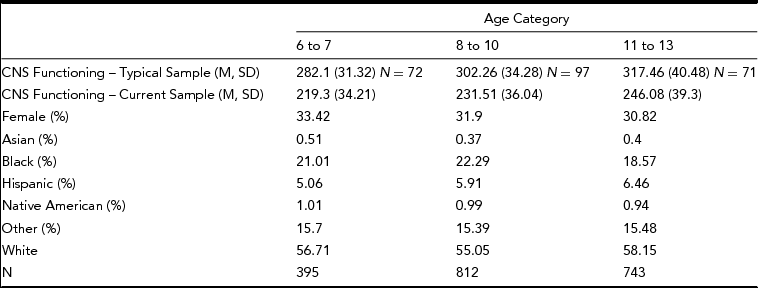
Data from 1,950 6 to 13-year-olds receiving behavioural health services at 19 sites that primarily treat child welfare-involved children (80–100% of patient population was estimated to be child welfare-involved based upon known ratios of child welfare-involved children who are provided services by each site) and that were using the NMT were analysed. All data were obtained from the de-identified NMT Clinical Practice Tools, or “Metrics” (see Measures), and therefore little demographic data regarding the participants are known. Descriptive statistics regarding age, gender and race/ethnicity per sample are available in Table 1; however, placement data or data confirming child welfare status were not available. Fifteen sites were in the US (across various states), two sites were in Australia, and two sites were in Canada. Most sites provided a continuum of care including residential, day hospital, outpatient mental health and in-home foster care supports. Several of the smaller sites exclusively provided residential and day treatment services. Based upon the known distribution of services, it is estimated that 80% of the sample is comprised of outpatient clients in foster or kinship care. Ten per cent are adopted or pre-adoption, and 10% were in day hospital or residential settings at the time of evaluation.
Sample descriptives.

Notes. CNS = Central Nervous System. Typical CNS Functioning scores were obtained from metrics completed on children and youth well-known to the clinician who have no obvious or known cognitive, mental, social or motor problem requiring “clinical” intervention. As part of the NMT certification process, clinicians are asked to complete metrics on “typical” children, youth and adults to learn how to navigate the web-based app, and learn more about the items and anchors of the metrics. “Typical” children, youth and adults may have had some developmental adversity; the selection of “typical” is based upon the clinician's impression that this individual's current functioning is generally within a typical (non-clinical) range.
Data Analysis
Scores on Part A and Part B are summed here into a “Developmental Risk” score to indicate the balance of adversity and relational health, respectively, experienced during each developmental period. Developmental Risk was used as an independent variable. Part D scores are summed to create a broad indicator of a child's current relational health, hereafter “Current Relational Health,” which was also used as an independent variable. Part C scores are summed to create a broad indicator of a child's current developmental functioning in key brain-mediated domains, hereafter called the “CNS Functioning” score. The CNS Functioning score was our dependent variable.
The analysis features a multivariate model of CNS Functioning as a function of Developmental Risk scores for each of the developmental periods and current relational health. We further control for degree of intrauterine substance abuse (on a scale from 1 to 12, with 12 indicating the highest level of intrauterine substance use/abuse) and demographic attributes (age in months, gender (male = 0, female = 1) and race/ethnicity (using separate binary indicators per group, e.g., 0 = not White, 1 = White, etc.) and we include binary indicators for each of the sites represented. A separate model is fit for three age categories, including 6- to 7-year-olds, 8- to 10-year-olds and 11- to 13-year-olds. We fit separate models for these age categories due to the way the NMT Metric reports are completed. When completing the metrics, clinicians are given a different reference for what a “typical” score on a given Part C item would be per age category. Given the change in reference point per category, the data are best analysed per category. We restrict our analysis to these three categories given that these categories had sufficient sample size for the proposed analysis.
An important feature of the data is the correlation among the Developmental Risk scores, which produces a concern for multicollinearity in the models. As evidence of this, the condition numbers, which capture the ratio of the largest and smallest eigenvalues in a matrix decomposition of the model inputs, for the three age categories are 13.6, 16.3 and 15.2, figures that are indicative of unstable regression coefficients (Fox, Reference Fox2008). To address this, we introduce a ridge penalty. Ridge regularization is commonly employed to reduce variance due to multicollinearity and improve the quality of inferences (Hastie, Tibshirani, & Friedman, Reference Hastie, Tibshirani and Friedman2009). In addition, in coordination with cross-validation, regularization helps prevent overfitting (Type 1 Errors). The value of the regularization parameter is chosen via generalised cross-validation.
To interpret the output from these regression models, there are two additional consequences of regularization. First, analytical standard errors are not available, and therefore we evaluate uncertainty in the coefficient estimates using 95% accelerated bootstrap confidence intervals (Efron, Reference Efron1987). Second, to penalise the terms in the model equally, all independent variables (IVs) are standardised to the same scale. Namely, unit changes in the standardised IVs correspond to one standard deviation, and estimates should be interpreted as the expected change in CNS Functioning due to a change of one standard deviation in the IV in question.
Results
For reference, Table 1 shows the difference between the CNS Functioning scores obtained per age category in the current sample of clinic-referred youth compared to the typical CNS Functioning scores obtained in a sample of metrics completed on “typical” children (see Table 1 for information regarding how typical metrics were obtained). The CNS Functioning scores in the current sample are substantively lower than those in the typical sample.
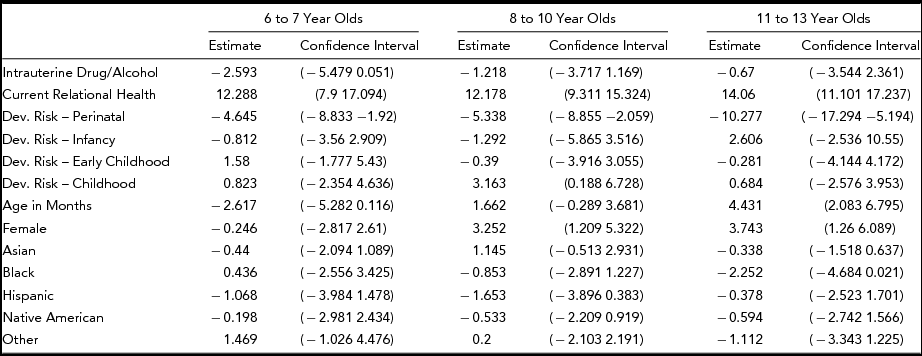
The results of the regularized regression models of CNS Functioning for each age category are provided in Table 2. Again, because standard errors cannot be evaluated in this setting, we use bootstrap confidence intervals to indicate uncertainty in the parameter estimates. The results show a statistically and substantively significant positive association between Current Relational Health and CNS Functioning, and this result is consistent across the three age categories. Thus, we find robust evidence across these samples of a buffering effect of current relational health on current functioning.
Ridge regression model: Developmental risk, relational health and CNS functioning.

Note. CNS = central nervous system, Dev. = developmental. Binary site indicators and intercept terms were included in the analysis but not represented here for brevity. For ethnic/racial indicators, White is the reference category.
In addition, we see a consistent negative association between Development Risk during the perinatal period and CNS Functioning. For each category, the association is negative, and the confidence intervals indicate that the result is statistically distinguishable from zero. Interestingly, the magnitude of the association appears to be increasing as the age of the children represented in the sample increases. While suggestive, these results indicate that the effect of adversity and poor relational health in the earliest months of life sets these children on a developmental trajectory that increasingly deviates from what would otherwise be expected in the absence of those experiences.
Once accounting for perinatal development risk, the risk indicators in the subsequent age groups and the indicator of degree of intrauterine substance abuse do not show any consistent association with Current CNS Functioning. Indeed, the coefficient estimates for these indicators are all much smaller in magnitude, and their respective confidence intervals provide no clear evidence that the associations are distinguishable from zero. There is one exception to these statements, however, regarding the positive association we find between Developmental Risk during the childhood period and CNS Functioning in the sample of 8- to 10-year olds. Yet, because the finding appears unique to this age category, we are hesitant to suggest the finding generalises beyond this sample.
To provide a sense of the substantive effects on CNS Functioning of our key features, in Figure 1 we use the fitted model from the sample of 11- to 13-year olds to plot the predicted values of CNS Functioning while varying Current Relational Health and each of the Developmental Risk variables from three standard deviations below to three above their mean. As we would expect given the estimates in Table 2, the strongest effects in Figure 1 correspond to the Development Risk indicator during the perinatal period and the Current Relational Health indicator. Specifically, all else being equal, our model suggests that the expected value of CNS Functioning in the sample when Perinatal Development Risk is one standard deviation below the mean (i.e., low risk) is approximately 256, while at one standard deviation above the mean (i.e., high risk) the expected value is approximately 236, a difference of approximately 20. Regarding Current Relational Health, all else being equal, the shift from one standard deviation below to one standard deviation above the mean results in a shift in the expected value of CNS Functioning from approximately 232 to 260, a difference of 28. The plots for the remaining indicators show expected values that are relatively unchanging, all hovering around approximately 245.
Substantive effects: Risk, relational health and predicted CNS functioning.

Discussion
Findings from this first pass at the NMT Metric data using a sample of clinic-referred, primarily child welfare-involved youth provide important insights about the associations between developmental risk, current relational health and current child functioning in brain-mediated domains. Across all three age categories, the total CNS Functioning score is significantly lower than the CNS Functioning scores evidenced in age-matched samples of “typical” children – or children who were not receiving treatment and who were unlikely to be child welfare-involved (Table 1). Then, also across all three age categories, we find a consistent theme: developmental risk in the perinatal period (first two months of life) and current relational health are the strongest predictors of children's current functioning (Table 2, Figure 1). Our regression model was subjected to regularization and cross-validation, analytic techniques drawn from the machine learning world, to increase the likelihood that the findings generalise beyond the sample in this analysis. We discuss implications of each finding.
The timing of developmental risk is becoming of great interest given research suggesting that adversity (or trauma) occurring during early childhood is perhaps more detrimental for later outcomes, including mental health and developmental, than adversity occurring later in life (Dunn, Nishimi, Powers, & Bradley, Reference Dunn, Nishimi, Powers and Bradley2017; Manly et al., Reference Manly, Kim, Rogosch and Cicchetti2001; McDermott et al., Reference McDermott, Troller-Renfree, Vanderwert, Nelson, Zeanah and Fox2013; Ogle et al., Reference Ogle, Rubin and Siegler2013; Raby et al., Reference Raby, Roisman, Labella, Martin, Chris Fraley and Simpson2018). Yet, previous research has been limited by important factors. The examination of timing has not been fine-grained. The rate of development is greatest during the first few months of life, sharply declining as a child ages in a logarithmic fashion (Johnson, Reference Johnson2001). Grouping trauma occurring during the first 5 or even 3 years of life still yields imprecise results regarding exactly when exposure to adversity is most detrimental. Second, little research has been conducted on the relative impact of adversity during infancy compared to adversity occurring during childhood. Clearly, adversity during any developmental period can be detrimental. This is one of the first studies to indicate that the relative impact of adversity occurring during the first few months of life is stronger than the impact of adversity during other developmental periods.
From a prevention perspective, the implications that can be drawn regarding the importance of the perinatal period are compelling. Yet, we must not infer that developmental risk occurring later in life does not matter. Indeed, the significant multicollinearity between predictor variables identified in the regression models suggests that risk in the perinatal period was significantly associated with risk in later developmental periods, and that risk in all developmental periods was associated with decreases in current functioning. However, when holding all else equal, risk during the perinatal period evidences the strongest association with current functioning across all age categories.
Of particular interest is the fact that the association between perinatal risk and current functioning grows stronger, instead of weakening, as children age. Indeed, a commonly held misunderstanding about children and trauma has been the assumption that the further “away” from the traumatic event, the less impact it has on current functioning. However, the current findings tell a different story. In fact, findings suggest that early developmental risk may have a cascading impact on a child's development. Risk in the earliest months of life may set these children on a developmental trajectory that increasingly deviates from what would otherwise be expected in the absence of those experiences. This finding is consistent with organisational theories of development, which suggest that children's current functioning is highly influenced by their functioning during earlier developmental periods (Perry, Reference Perry, Franey, Geffner and Falconer2001; Sroufe & Rutter, Reference Sroufe and Rutter1984). In other words, if trauma interrupts a child's developmental trajectory, then functions emerging later in life are built upon improperly organised developmental and neurodevelopmental systems.
Given the impact of perinatal risk on current CNS functioning, the strikingly strong association between current relational health and CNS functioning is poignant. This association is stronger than the association between perinatal risk and developmental functioning. Moreover, when controlling for risk, current relational health remains an important predictor of a child's developmental functioning. The implications for child welfare are profound. Although the “question” is typically which type of placement might best suit a child (e.g., Ainsworth & Hansen, Reference Ainsworth and Hansen2014; McSherry & Fargas Malet, Reference McSherry and Fargas Malet2017), perhaps another important question is “what is the quality of the relational context in each placement?” or “what are the opportunities for ‘connectedness’ for this child?” The various sites included in this study contained children from various types of out-of-home placements, most with severe functional impairments. Although the de-identified nature of the data collected via the NMT Metrics precludes identification of which children were living in which types of placements, the finding that relational health has such a strong association with current functioning suggests that placement type might be quite secondary in importance to placement's quality of relational connectedness.
The measure of current relational health used in this study focused on a broad range of relational opportunities at all levels of a child's ecological system. Clinicians are asked to report on relationships with biological parents (as relevant), current primary caregivers, extended family, school-based peers and adults, individuals met in extracurricular activities, and community-based support. Given that in this study we used a composite of the entire measure, it seems that children who have high levels of quality relational support across their ecological system exhibit higher levels of functioning than children with less support.
Although the relational health finding result is not entirely surprising given previous research on relationships as a buffer to stress (Bellis et al., Reference Bellis, Hardcastle, Ford, Hughes, Ashton, Quigg and Butler2017; Ludy-Dobson & Perry, Reference Ludy-Dobson, Perry and Gil2010; Schumm, Briggs-Philips, & Hobfoll, Reference Schumm, Briggs-Phillips and Hobfoll2006), it is somewhat surprising that the relational health finding is stronger than the developmental risk finding. The implication for child welfare is that we should not take a limited view of relational health, but expand our understanding of how to provide relationally supportive contexts. If the child is in a residential placement, how do we improve and provide consistency in their relationships with the peers and adults they encounter throughout their daily programming, and with individuals who visit them? For children living with relatives, biological caregivers, or “traditional” (non-relative) foster caregivers, how do we build a “therapeutic web” within the child's home, school and community? Our results suggest that these questions may be prudent when the question is how to improve the lives of clinic-referred, child-welfare involved children. The results also provide hope that our welfare systems may indeed be able to help an extremely high-risk subset of youth.
Results must be interpreted considering study strengths and limitations. This study utilised data from children from three countries and across several states in the USA. While this diversity could be considered a strength, the child welfare systems and out-of-home placements in which they were living, then, were quite heterogeneous, and these system-level differences were unable to be controlled other than at the site level. Clinicians likely varied in the degree and quality of information available to them regarding a child's life experiences. Many clinicians may not have had access to either child welfare records or a reliable reporter of the child's developmental history. Clinicians also may have assumed that children who were currently living in relationally positive contexts, with caregivers who were easy to work with, were functioning better than children who were not. Thus, retrospective reporting bias may have occurred, in that clinicians assumed children with poor current functioning sustained extreme adversity, and vice-versa. Use of retrospective reports of developmental histories in the study of how trauma influences functioning has long been a debated practice (Greenhoot, Reference Greenhoot, Laursen, Little and Card2013) given that retrospective reports have been shown to differ from actuarial reports (Hambrick, Tunno, Gabrielli, Jackson, & Belz, Reference Hambrick, Tunno, Gabrielli, Jackson and Belz2014). However, aspects of NMT training may have mitigated the impact of retrospection on the data used in this study.
Clinicians using the NMT Metrics have completed over 150 hours of training, and have passed fidelity exercises to demonstrate competence and inter-rater reliability with these tools. When scoring, they are instructed to use all evidence available to them, including multiple reporters, case files, psychological assessments and medical records. Studies have indicated that there is no “gold standard” from which a child's developmental history should be obtained, given that case file report is often incomplete, and can differ from reports received from children and adults (Hambrick et al., Reference Hambrick, Tunno, Gabrielli, Jackson and Belz2014) in ways that are meaningful for outcomes (Cho & Jackson, Reference Cho and Jackson2016). Thus, allowing clinicians to use all information available to them when reporting on the nuances of child's developmental history may be a useful strategy. Additionally, clinicians are firmly instructed to provide a neutral score when risk is unknown, and to only rate scores in the “severe” category if they have reports from child welfare documents, or reliable child, caregiver/case manager reports indicative of severe adversity in a specific developmental period.
Another important issue is unmeasured variable bias. Many variables may influence the degree of a child's current relational health, and may partially account for the strong association found in this study. The reciprocal relationship, for example, between children's behaviour problems and placement instability in the child welfare system is well-known, with some studies indicating that behaviour problems may indeed precede placement instability, which could reduce a child's degree of relational health (Aarons et al., Reference Aarons, James, Monn, Raghavan, Wells and Leslie2010). And, children who possess the capacity to relate with others or have certain attachment capabilities may engender relationships in return, making it difficult to determine whether improving the relational health of all child welfare-involved children would have a positive effect – or only for certain children, with certain relational capacities.
Regardless, prospective, longitudinal studies that track multiple dimensions of children's adversity experiences are ultimately needed. We are aware that the predictive utility of the current dataset will be vastly improved when it is linked to other indicators of children's functioning, and we look forward to expanding our current understanding of how relational health improves the lives of child welfare-involved youth over time. Currently, we are working to help clinical sites collect additional data on children who are receiving NMT-guided intervention, such as expanded demographic information (e.g., placement type, indicators of which sources were used to inform the developmental history reports, caregiver and clinician information), standardised measures of behavioural, social and neuropsychological function, and detailed information about the sequence and type of intervention children are receiving.
Future research directions include replicating results with data from larger, more diverse samples, including samples of child welfare-involved children who are not clinic-referred and who may be functioning at a higher level. In these samples, important additional analyses can be conducted, such as parsing out the unique role of adversity and relational health during various developmental periods on current functioning. It will also be useful to operationalise early risk experiences in additional ways, by creating variables that account for severity, duration and type of risk. Interactions between risk trajectories and current functioning also need to be explored, as does the association between the timing of various risk or protective experiences and specific brain-mediated developmental functions.
Further examination of the role of current relational health as a potential buffer is needed. Despite this analysis furthering the understanding of the association between timing of developmental risk, and relational health experiences, and outcomes, much remains unknown. For example, which aspects of relational health are most beneficial, and when? What child factors facilitate or challenge the ability to create relationally healthy contexts? Answering these questions will help the field move toward making policy, social and intervention decisions that are most likely to improve the lives of each of the heterogeneous youth who intersect with the child welfare system.
Acknowledgements
We acknowledge the NMT Network Sites, clinicians and clients whose contributions made this study possible.