Introduction
Subnational diplomacy has come to life in India. In early 2015, India's Ministry of External Affairs (MEA) asked Chandrababu Naidu Chief Minister of Andhra Pradesh to lead a high-profile delegation to China in April, a month before Prime Minister Narendra Modi's state visit to China (Everlives, 2015). On his visit to Bangladesh in June 2015, Prime Minister Modi included in his official delegation the Chief Minister of West Bengal, Mamata Banerjee. During his visit to Bangladesh in September 2011, the then Prime Minister, Manmohan Singh, included four chief ministers from India's Northeastern states bordering Bangladesh. Inclusion of chief ministers in prime ministerial visits overseas, and particularly the MEA asking a chief minister to lead an overseas delegation in advance of a prime ministerial visit, is a phenomenon previously unthinkable in the official conduct of India's foreign relations.
It is clear that subnational governments (SNGs) are emerging as a significant new type of actor in India's foreign affairs landscape. They are a type of international actor about which little is known and very little has been written. Although still on the periphery, Indian SNGs have begun to conduct what is identified in the literature as ‘paradiplomacy’, ‘constituent diplomacy’, and ‘subnational diplomacy’. By Indian subnational governments, we mean governments below the central government, mainly state governments, but also some city governments. Here our focus is primarily on Indian state governments, although we also include some discussion of city-level SNG international engagements.
Although still nowhere near in the same league as their counterparts in North America, Europe, parts of Asia, and even other developing countries, SNGs in India are increasingly engaged abroad through involvement in regional and global affairs, questioning the central government on international matters, seeking foreign direct investment, organizing trade fairs and investment summits, leading economic missions, and hosting visiting dignitaries to showcase their jurisdiction's economic potential. Indian SNGs have begun to pursue their interests in two distinct arenas: (1) seeking economic opportunities to enhance their business and commercial activities through global linkages (Jenkins, Reference Jenkins and Mitra2009; Hazarika, Reference Hazarika2014), and (2) influencing India's foreign policy, especially in India's border-states. Some states and even cities have begun to establish sister-city styled linkages with their foreign counterparts, though so far with little of substance by way of concrete programs.
Some SNGs in India have taken lead roles, while others are learning from international and domestic peers through a ‘me-too-ism’ approach. Economic linkages have certainly accelerated, but other linkages, such as cultural, educational, sporting, or scientific/technical exchanges, remain undeveloped – areas that SNGs around the world pursue actively as part of their international engagement. Similarly, there are still institutional weaknesses, and administrative capacity to conduct local diplomacy is still lacking. But a modest beginning (Sridharan, Reference Sridharan2003) has provided the basis for growth, with the potential to expand substantially. State/local leaders now recognize that their global connections are vitally important for their jurisdiction's economic growth and political status, and in some cases their efforts are supported by the central government. As a high-ranking retired Indian diplomat observed, ‘the central government cannot avoid involvement of states in key foreign policy issues’.Footnote 1
This new development has implications for central–subnational relations. A significant centre–state divide holds on some key political issues with India's border-states such as Bangladesh, Pakistan and Sri Lanka, matters where the centre generally takes a tough stand. Nevertheless, the centre does not generally obstruct states’ activities in economic spheres overseas, as long as they are congruent with national policies. But even in the economic field, there are centre–local tensions, for example on foreign investment and financial services or international trade, such as with India's accession to the WTO (Sridharan, Reference Sridharan2003: 478–85). With the Modi government (2014–) at the centre, some SNGs may feel more encouraged than before to ‘think locally and act globally’. A new era of centre–state relationships may emerge, pushing India's case internationally with SNGs as some of the frontline actors. Both during his election campaign and since taking office in May 2014, Modi has emphasized the need for a greater role for state governments and city-to-city interactions with overseas partners (Aneja, Reference Aneja2015).
To pursue the key points outlined above, this article sets the context by briefly considering the international roles that SNGs, in North America, Europe, Asia, and elsewhere, including developing countries, play globally to advance their ‘local’ interests. Then it outlines the Indian federal structure and the place of SNGs in it, pointing out the structural and other constraints that have hindered SNGs from going global. The next section examines the main drivers of the Indian SNGs’ increasing interest and participation in international affairs. We also question why Indian SNGs remained for so long largely untouched by this emerging global phenomenon. Following this, we present the various types of recent international initiatives of Indian SNGs, noting specific factors propelling their actions. We then examine the implications of this development for the national–subnational relationship within India's ‘centralized’ federal structure. Finally, we assess the significance of this development for India's foreign policy.
India as a ‘centralized’ federal system
In India's federal structure of governance, constituting units enjoy significant autonomy. However, states and other lower level units have always faced severe institutional, policy, and financial constraints imposed on them through central control, both economic and political. As Shah (Reference Shah2014) observes, centralization began early in post-independent India under Congress Party dominance, which Kothari (Reference Kothari1964) dubbed the Congress System, and by the 1970s, according to Shah, ‘centralization of power became even more acute as central governments started dismissing elected [state] governments freely. By 1990, the centralization of power was complete.’ Through the constitutional provision of ‘presidential rule’ (removal of elected state governments and direct rule by the central government through a presidential decree), central governments controlled states and imposed national political policy upon them (Manor, Reference Manor1998). Centralization was even more pronounced in the case of foreign policy, where the constitution gives exclusive powers to the central government.
Article 246 Seventh Schedule of the Indian Constitution distinguishes functions of the central and state governments under three lists: union, state, and concurrent.Footnote 2 The union list is the exclusive domain of the central government, the state list of state jurisdictions, and the concurrent list of matters extending jurisdictions across both the central and state governments. In any controversy over concurrent list matters, central government prevails.
Foreign affairs come under the exclusive jurisdiction of the central government. Six items (10–16) in the constitution specifically pertaining to foreign policy are on the union list. These are: foreign affairs; all matters that bring the union into relation with any foreign country; diplomatic, consular, and trade representation; United Nations; participation in international conferences, associations, and other bodies, and implementing any decisions made; entering into treaties and agreements with foreign countries and implementing treaties, agreements, and conventions with foreign countries; and matters of war and peace.
As the state list does not include any matters pertaining to foreign policy or external affairs, not even any related to trade, economic, or cultural ties abroad, it is not surprising that since independence in 1947, India's foreign policy has remained Delhi-centric, driven primarily by MEA diplomats. Until recent times, states have not, and have not been allowed, to play any role in matters on foreign affairs matter, even when such matters affect states’ jurisdiction (Sridharan, Reference Sridharan2003). Today the constitutional constraints remain, but SNGs have found extra-constitutional means to conduct what can be broadly described as ‘diplomacy’.
States in India were also centrally managed through the Planning Commission of India until the Modi government abolished it in 2015. The Planning Commission directed economic policy of state governments through central and macro lenses that did not necessarily prove effective given the differences in the circumstances and needs of states (Palit, Reference Palit2015). Nationally appointed career bureaucrats are placed in senior administrative positions in administrative and police services at subnational levels. And as Antholis observes of local elected officials, although they formally represent the grassroots of Indian society, ‘they often are constrained from experimenting or being entrepreneurial by nationally appointed bureaucrats’ (Antholis, Reference Antholis2013: 29). Until recent times, state leaders were consumed with domestic politics and lobbied hard for greater central dispensation rather than pursuing policy innovation or seeing themselves and their constituencies as part of a globalized world. Although in the 1990s some chief ministers did make overseas trips to seek foreign investment, they were largely regarded as a waste of taxpayers’ money, and rarely any concrete outcomes resulted from their foreign trips (Rai, Reference Rai1997).
At a lower level of this centralized system, state governments have jurisdiction over city and other local units, treating them as subordinate and allowing them little autonomy. Since state governments themselves have had little involvement in the internationalization process, their subordinate and smaller units have been positioned likewise, effectively closed off from the international community of SNGs formed by their counterpart states, cities, and municipalities overseas (Amen et al., Reference Amen, Toly, McCarney and Segbers2011). Even large metropolitan cities such as Delhi (India's political capital) and Mumbai (India's financial capital) have been slow to recognize the importance of international linkages, though lately these and many others have become sister-cities, or adopted other pairing arrangements internationally.
While the Indian Constitution is heavily skewed in favour of the centre and municipal governments remain ever dependent on state governments, SNGs are now becoming involved in India's foreign affairs. This move has begun to decentralize and fragment India's external affairs, although still in a marginal way. States in India are massive units in terms of population and budget. If Uttar Pradesh (UP), a state with more than 204 million people in 2012, were an independent nation, it would be the fifth most populated country in the world, after China, India, the US, and Indonesia. But with GDP per capita below $1,000 in 2010, the state would also qualify for one of the poorest countries in the world. The level of poverty/prosperity differs significantly between what Antholis identifies as ‘forward states’ (Maharashtra and Gujarat in central India, and Tamil Nadu in the south) and ‘backward states’ (Bihar and Uttar Pradesh in east and north India). Maharashtra, Gujarat, and Tami Nadu with a combined population of 250 million and one fifth of India's population account for nearly one third of India's GDP and each has more than double the nation's GDP per capita (Antholis, Reference Antholis2013: 109, 31).
Drivers of SNGs new activism
A combination of factors has propelled the gradual foray by states into foreign affairs in recent years. One is the end of one-party dominance at the centre through the rise of regional political parties, leading to the formation of coalition governments at the centre that are politically dependent on their coalition regional parties (Sridharan, Reference Sridharan2003). These regional parties, because they are operating in their regional rather than national political and social contexts, often pursue interests different from those of the central coalition government on some foreign policy issues. This is especially true for contentious issues concerning India's border-states that have ethnic and linguistic affinity with neighbours on the other side of India's national boundary and with which India is in conflict, as discussed later in this article. Because these regional parties’ political support is crucial for the national government, they have been able to compel the central government to agree to their demands, despite differences in the central government's national perspective (Mazumdar, Reference Mazumdar2015: 31).
Other factors inspiring SNGs to look and act abroad are those that have made SNGs around the world significant players in international affairs. These include the forces of globalization that through the movement of trade and investment across borders have exposed the economies of SNGs to both vulnerability and opportunity. To generate more employment, prosperity, and opportunities leading to an improved lifestyle for ‘local’ residents, they can no longer remain inward-looking and financially dependent on the central government. At least some SNG leaders in India have realized that they need to operate proactively beyond their national borders to advance their economic interests. Jenkins has noted the impact of some Indian states on matters of trade and finance through the WTO and the World Bank cases (Jenkins, Reference Jenkins and Mitra2009: 64–72). Now they are driven by ‘local interests’ that at times differ from – perhaps conflict with – what the central government pursues as the ‘national interest’.
Beyond economic concerns, in an ever-more complex international environment, India's national governments and their diplomats alone are unable to handle the complexities of foreign affairs and have acknowledged SNGs as ‘unavoidable partners’ (Sahai, Reference Sahai2012). This emerging trend in India is similar to what Hocking (Reference Hocking1993) referred to as ‘multilayered diplomacy’, where SNGs become an important layer in a nation's diplomatic effort.
Comparative perspectives
In the second decade of the twenty-first century, studies on SNGs within the international relations literature form a rich seam of empirical and conceptual analyses that detail the role in international affairs of various types of actors beyond the nation and national-level players. Studies of internationally active SNGs speak of ‘sub-state diplomacy’, ‘paradiplomacy’, ‘protodiplomacy’, ‘microdiplomacy’, and ‘constituent diplomacy’, with ‘diplomacy’ denoting the official, government nature of these actors and their actions (Criekemans, Reference Criekemans2010). Brande (Reference Brande2010: 200) acknowledges ‘sub- or infra-state foreign relations’ but advances the term ‘federated state diplomacy’ where subnational actors become key players in a nation's foreign affairs, including treaty making, as, for example, in Belgium. Each term has its own nuances, with some emphasizing major, and others see only limited, roles for subnational governments, The overall message is that nation-state sovereignty has become perforated and the nation-state is not the sole actor in international affairs (Michelmann, Reference Michelmann and Michelmann2009).
North American and European SNGs have long established themselves as independent international actors (Fry, Reference Fry1998; Brande, Reference Brande2010), but this trend is increasingly evident in other parts of the world. Australian states have become much more active (Jain, Reference Jain2012; Spoehr and Jain, Reference Spoehr and Jain2012), and in Brazil a large number of states and big cities ‘act substantially on the international scene in ways that fit, in one way or another, into the loose categories termed paradiplomacy’ (Salomon, Reference Salomon, Amen, Toly, McCarney and Segbers2011: 45). This trend is visible in Asia, too, in both industrially developed and developing nations. Two leading examples in Asia are Japan and China. Japanese SNGs have taken a lead role in connecting themselves to the international community through a repertoire that extends well beyond economic linkages to extensive networks of sister-city and state relationships, educational and cultural agreements, delivery of foreign aid including transfer of technical know-how, and even challenging the national government on a few security and defence issues where SNGs are vitally concerned (Jain, Reference Jain2005). In China, provinces have launched themselves vigorously into the international arena as traders, investors, and investment seekers, facilitators of national policy goals and cultural agents. Some have become aid providers (Cheung and Tang, Reference Cheung, Tang and Lampton2001; Chen and Jian, Reference Chen and Junbo2009) and some supply labour overseas for aid-related infrastructure projects (Hess and Aidoo, Reference Hess and Aidoo2016: 312). Scholars have argued that SNGs are becoming an important link in internationalizing state capital, as in China's Yunnan's province providing finance to the Greater Mekong Subregion (Tubilewicz and Jayasuriya, Reference Tubilewicz and Jayasuriya2015).
The two Asian examples are especially noteworthy here because both operate in a unitary system of government: Japan a democracy and China a one party state. But in both nations SNGs are now actively involved in international affairs despite the lack of subnational autonomy in these centralized unitary systems. Yet even though India's system of government is federal in structure, Indian SNGs have had little engagement internationally. The circumstances of these three Asian giants suggest that the type of political system is not a crucial factor – what matters are factors concerning both the central government and the layers of government below it. For the central government, it is recognition that in this era of perforated sovereignty SNGs have capacity and will to play a crucial role in foreign affairs; they are, after all, still official actors. For SNGs, it is the craftsmanship and political finesse of their leaderships to carve out space even within constitutional and structural constraints to pursue benefits for their own constituents that mostly also serve national interests.
The trend among SNGs to pursue linkages with counterparts abroad for mutual benefit is now institutionalized. Many subnational governments across the globe are aware of their shared goals and interests and are more inclined to both seek and share mutually rewarding opportunities with counterparts abroad. This is important as context for considering the Indian case, since it makes evident that there is both a climate of goodwill and a set of precedents from which Indian SNGs can draw in pursuing their own international engagements.
Emergence of Indian SNGs in international affairs
In this study, we explore three types of Indian states: (1) those that have borders with India's neighbouring states, especially to assess how they influence India's foreign relations with neighbouring nations; (2) those that have already taken lead roles in promoting trade and attracting investment; and (3) those that in more recent years are becoming internationally active, as part of the emerging ‘me-too-ism’ phenomenon. Some examples of cities are also included in this discussion to deepen understanding of this new trend in India's global engagement. We focus on two types of activities, examining states’ roles in (1) influencing the national government's foreign policy outcomes; (2) promoting themselves as attractive destinations for FDI, trade, and other connections.
States influencing foreign policy: the role of border-states
States’ influence on India's foreign policy outcomes began in the late 1980s with the advent of coalition governments at the centre, which required the support of regional parties and in doing so empowered subnational leaders. This was particularly true of regional parties in border-states such as West Bengal (bordering Bangladesh) and Tamil Nadu (closest to Sri Lanka). Before Modi came to power with a healthy majority, support of regional parties to form coalition governments at the centre was crucial for their survival. Some states actually influenced India's policy on issues that clearly come under the exclusive jurisdiction of the central government as defined in the Constitution's Article 246 (7th Schedule), where Item 14 states that ‘Entering into treaties and agreements with foreign countries and implementing of treaties, agreements and conventions with foreign countries’ come exclusively under the central purview.’
One illustrative example is that of the Teesta Water River agreement that India was ready to sign with Bangladesh in 2011. India had to drop the agreement because of strong opposition from the West Bengal Chief Minister, Mamata Banerjee, whose regional party was in coalition with the national government then led by Prime Minister Manmohan Singh. Although the central government announced inclusion of a number of border state chief ministers, including Mamata Banerjee as part of the negotiation team, Banerjee refused to join the delegation claiming the agreement would be disadvantageous to West Bengal. With major persuasion efforts failing to bring on board the West Bengal Chief Minister, the Singh government decided not to sign the treaty because the support of Banerjee's party was crucial to the survival of the Singh government. This was virtually a ‘veto’ by an Indian state on a foreign policy issue on which, constitutionally, the national government has exclusive jurisdiction.
Another example occurs Tamil Nadu, where the two main political parties – the Dravida Munnetra Kazhagam (DMK) and All India Anna Dravida Munnetra Kazhagam (AIADMK) – compelled the central government to vote against Sri Lanka in the United Nations in 2012 and again in 2013. The parties were concerned about the Sri Lankan government's human rights excesses against Sri Lankan Tamils during counter-terrorism operations against the Liberation Tigers of Tamil Eelam (LTTE). In 2012, the DMK was part of the Congress-led United Progressive Alliance (UPA) at the centre, but it left the coalition in 2013, accusing the UPA Government of not taking a strong enough stand against Sri Lanka and making the central government somewhat unstable through its departure. The Indian Prime Minister, Manmohan Singh, did not attend the November 2013 Commonwealth Heads of Government Meeting (CHOGM) in Colombo, again due to pressure from the Tamil Nadu government, as well as from some senior Congress leaders from Tamil Nadu. Significantly, the Tamil Nadu Chief Minister, J Jayalalithaa took a strong stand not just on the issue discussed above but also expressed her strong opposition to training Sri Lankan defence personnel in Tamil Nadu, and even sent back a Sri Lankan football team (Suryanarayan, Reference Suryanarayan2013).
The example of Tamil Nadu political leaders exercising a veto over India's Sri Lanka policy is often cited as one of the reasons why Sri Lanka's Rajapaksa government (November 2005–January 2015) developed closer economic and strategic ties with China and weakened the New Delhi–Colombo ties – an outcome not in India's national interest (Kanwar, Reference Kanwar2013). While the state government of Tamil Nadu compelled India to vote against Sri Lanka at the UN, as mentioned earlier, China availed itself of this opportunity to win a number of important infrastructural projects in Sri Lanka that otherwise India could have won. However, India's relations with Sri Lanka today are likely to be at least amicable, with the electoral defeat of Rajapaksa and a new president who the Tamils find more acceptable, Maithripala Sirisena, in Colombo (Sharma, Reference Sharma2015).
Undoubtedly, some regional parties such as the AIADMK, DMK, and TMC may have played an obstructionist role in India's foreign policy. There are others such as the Shiromani Akali Dal in Punjab, National Conference and the People's Democratic Party in Jammu and Kashmir that have been pushing for better ties with Pakistan. Furthermore, the Telugu Desam Party (TDP) led by Chandrababu Naidu has sought to connect successfully to the diaspora community from Andhra Pradesh (Min, Reference Min2014: 188). Naidu played a pioneering role in connecting with the diaspora and in developing the information technology industry in his state during his earlier tenure as chief minister (1995–2004).
With weakening of the influence of regional parties in the Modi government, a veto from regional parties is unlikely to be the case. Yet the 2016 state elections and return of J Jayalalithaa in Tamil Nadu and Mamata Banerjee in West Bengal may see regional parties playing an assertive role.Footnote 3 Banerjee is already being touted as the possible leader of a ‘third front’ consisting of regional parties. Whether this will eventuate or not is something analysts will watch with great interest.
In the past decade, the central government has acknowledged a greater role for states in the border regions, especially in the context of India's ties with neighbouring states. In this context, bus services between Srinagar in India and Muzzafarabad in Pakistan (April 2005), Amritsar in India and Nankana Sahib in Pakistan (March 2006), and rail services between Munabao (Rajasthan) and Khokhrapar (Pakistan) (February 2006) began connecting India's border provinces with Pakistan. Former Prime Minister Manmohan Singh had in fact spoken about the need for making borders irrelevant (Saran, Reference Saran2006). Such railway routes connecting Pakistan and the Indian border provinces could be useful in promoting trade, tourism, and other bilateral linkages.
It is important to note here that in certain contexts there was a bi-partisan consensus between the central and state governments. A relevant example is the role of Indian Punjab vis-à-vis Pakistan Punjab. The foundations for interactions between the two Punjabs were laid in 2004 by the Congress-led Punjab government under Captain Amarinder Singh, then Chief Minister of Indian Punjab and a member of the Indian Parliament until November 2016. Singh began this dialogue at a time when the centre had a BJP government, but the dialogue stalled with the rapid deterioration in the India–Pakistan bilateral relations in the wake of the Mumbai attacks in 2008, leaving little scope for any meaningful interaction between the two Punjabs. From 2011, however, with the resumption of bilateral engagement nationally, especially in the economic sphere, the two Punjabs sensed an opportunity to improve relations. Some of the national-level initiatives taken in 2012, such as the inauguration of an Integrated Check Post at the Wagah–Attari border and an increase in the types of goods that could be traded through the land route, had a direct bearing on the Punjabs. Interestingly, during this period there was a Congress Government at the Centre, while the state was run by the Shiromani Akali Dal, an ally of the BJP. Despite their different political leanings, both central and state governments were on the same page concerning ties with Pakistan (Rajamohan, Reference Rajamohan2012).
The Deputy Chief Minister of Indian Punjab visited Pakistan in November 2012 and the two sides explored the possibility of greater cooperation in cultural aspects, while the Chief Minister of Punjab (Pakistan), Shahbaz Sharif (brother of Pakistani Prime Minister Nawaz Sharif), visited India in December 2013 for a Kabaddi championship.Footnote 4 During these visits, apart from cultural events, the Chambers of Commerce of both sides also sought to engage with each other and discussed a number of economic issues.
Beyond the context of India's western borders, on India's eastern side too, the current BJP-led National Democratic Alliance (NDA) government, like its UPA predecessor, is seeking to enhance connectivity with neighbouring countries. These include Bangladesh and Myanmar. For a long time, India's approach to the Northeast was informed by security matters: the wars with China in 1962 and with Pakistan in 1971, and by the issue of migration from Bangladesh (Nath, Reference Nath2004). As a result, development issues were put on the backburner and this neglect resulted in the lack of infrastructure transport connectivity between state capitals of the region as well as with other parts of India (Phukan, Reference Phukan2016). In the past decade, there has been an increasing focus on the Northeast, and the Modi government, like its predecessor, seeks to enhance connectivity within the region as well as with neighbouring countries (Bhaumik, Reference Bhaumik2016).
India's Northeast state of Tripura that shares borders with Bangladesh has been supportive of central government efforts to improve ties with Bangladesh. Tripura's Chief Minister Manik Sarkar has established direct contact with the Hasina government in Dhaka, and even invited the Bangladesh Prime Minister to the state. In 2012, Tripura University conferred upon Prime Minister Hasina an honorary doctorate. As a result, India and Bangladesh have cooperated, especially in the power sector and the internet field (New Age Online, 2016).
Modi's NDA government is also trying to keep Northeastern states in the loop with regard to India–Bangladesh ties. In a strong illustration, during his Bangladesh visit in August 2014, India's Minister of State for External Affairs Vijay Kumar Singh was accompanied not just by business people and members of the Chambers of Commerce, but also by the Meghalaya Chief Minister, Mukul Sangma (Congress Party), and the Tripura Industry and Commerce Minister, Tapan Chakraborty (Communist Party of India) (Zee News, 2014).
Furthermore, the Modi government was able to conclude a long-negotiated land boundary agreement with Bangladesh in June 2015 mainly because his government recognized it needed support from the five Northeast Indian states bordering Bangladesh – West Bengal, Meghalaya, Tripura, Mizoram, and Assam (all, incidentally, ruled by non-BJP governments). Negotiations for this agreement were begun as far back as in 1974 but stalled through lack of consensus between the central government and India's bordering states. The 2015 agreement seeks to address the problem of hundreds of enclaves in each other's territories by simplifying close to 4,000 kilometres of undefined border, and establishing the identity of hitherto stateless people residing in more than 150 enclaves in the border region. That one of the world's most difficult boundary disputes was settled in this way is a great tribute to the governments in New Delhi and Dhaka, but credit also goes to India's Northeast states, without whose cooperation this deal would have been very difficult to conclude (Sobhan, Reference Sobhan2015).
The central government is also seeking to work with Manipur which shares a border with Myanmar, especially to upgrade infrastructure in the border area. Following BJP's ascent to power in Assam in mid-2016, Prime Minister Modi was quick to state that Assam ‘will emerge as powerfully developed part of the country as a part of our “act east policy”’ (Chaterjee, Reference Chaterjee2016).
From the examples discussed here, we see that the political influence states have exercised upon India's foreign policy is still a relatively new phenomenon. To some extent, it was enabled largely by politically weak central governments, dependent upon state support. This dependence, and therefore states’ capacity to bear the political weight necessary to pursue state interests through foreign policy, may weaken if a single political party at the centre holds a strong parliamentary majority as the BJP does through its domination of the national parliament since 2014. Yet as the 2015 Land Boundary Agreement signed with Bangladesh reveals, the states’ capacity for political influence on foreign policy may continue, given the political, cultural, and other complexities of India's relations with many of its neighbours. Here Modi clearly plays his ‘cooperative federalism’ and ‘team India’ cards to promote his foreign policy agenda by including state chief ministers in crucial foreign affairs issues.
States pursue economic interests overseas
In addition to coalition politics as a catalyst for growing state intervention in foreign affairs, liberalization of the economy has also opened up space for states to engage across the national border. With economic liberalization in motion from the early 1990s, and increased internationalization of the Indian economy from the turn of the century, some SNG leaders came to recognize the potential for their state's economic growth through global engagement. State leaders such as Narendra Modi in Gujarat, Chandrababu Naidu in Andhra Pradesh, and Somanahalli Mallaiah Krishna in Karnataka were among the first few who broke the ‘insular culture’. Their global and regional engagements were different from the earlier attempts by some chief ministers who travelled overseas without a clear agenda and few achievements (Rai, Reference Rai1997). Leadership and vision for their states became the key factors in these leaders’ bids to engage their states with nations beyond India's borders.
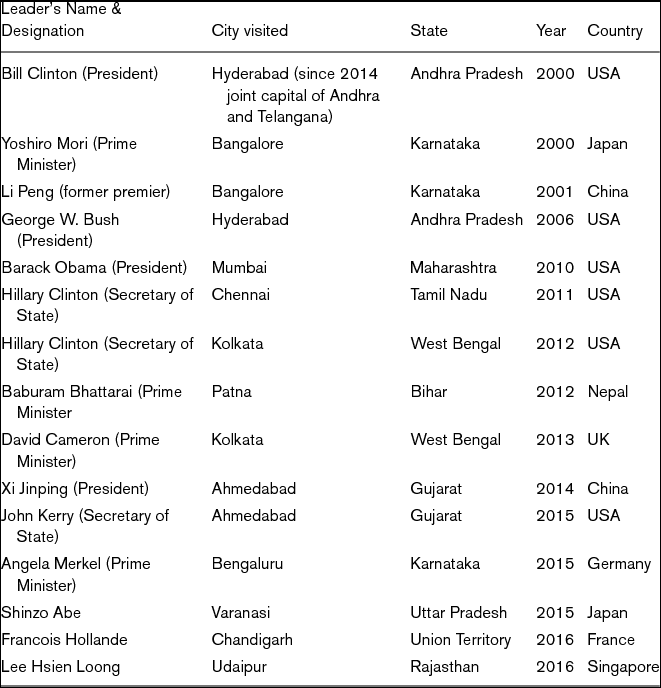
Not only did they lead state delegations overseas, convincing their international interlocutors of the rewards of investing and doing business in their states, they also rubbed shoulders with key political leaders at international forums and attracted some top world leaders to their states to showcase their state's offerings. Table 1 gives details on world leaders’ visits to India's state capitals. The reasons for these visits vary. Visits to Southern Indian states (Andhra Pradesh, Karnataka), including by US presidents, can be attributed to the successes in information technology achieved by these states (especially cities such as Hyderabad, now also temporary capital of the newly formed state of Telangana,Footnote 5 and Bangalore) (Rudolph and Rudolph, Reference Rudolph and Rudolph2001). A number of successful individuals in Silicon Valley, who set up companies like TiE, hailed from India and lobbied for these visits by US leaders. The India lobby in the US is gaining strength, and often persuades top US political and business leaders to visit India and state capitals (Kennedy, Reference Kennedy2010)
World leaders’ visits to states/cities in India

Source: Compiled by the authors from various newspaper reports.
Hillary Clinton's visits to Tamil Nadu and West Bengal in 2012 can be attributed to the increasing dominance of regional parties (in this case the AIADMK and the Trinamool Congress respectively) in national politics and their influence on policy. The US Secretary of State was on a mission to advance the case of American retailers, such as Walmart, to enter the Indian market – a mission possible only through reform in India's retail sector. Clinton in fact landed in Kolkata before New Delhi, which was a rather unusual move. She wanted to convince Mamata Banerjee of the merits of the ‘free market’, as Banerjee's party – a key coalition partner in the central government – opposed allowing a majority share of foreign direct investment in multi-brand retail outlets (Stancati, Reference Stancati2012). Even powerful global leaders such as Hillary Clinton understood the influence of regional parties in the Manmohan Singh government.
State chief ministers also understood the importance of visiting overseas destinations seeking trade and investment, and of not depending on the central government to support for them. Modi as chief minister of Gujarat (2002–13) was able to promote his state overseas through visits to China and Japan and other countries that did not follow western countries’ ‘sanctions’ on him. But the real trendsetter for SNG involvement in economic ties with the outside world was Chandrababu Naidu (in 2015 Andhra chief minister) who led this state in the 1990s. Naidu aggressively marketed his state, especially the suitability of then state capital Hyderabad to emerge as an IT hub. His efforts yielded dividends and Bill Gates of Microsoft set up the first research centre in India in Hyderabad after having been impressed by Naidu's presentation. Both President Clinton and President Bush included Hyderabad in their itineraries, earning Hyderabad ‘the distinction of being the only city besides New Delhi to be visited by two US Presidents’ (Rediff India, 2006).
More recently, foreign leaders have focussed on Gujarat, Modi's home state. Two high profile recent visits were by Chinese President, Xi Jinping (September 2014), and the US Secretary of State, John Kerry (January 2015). While President Xi landed in Ahmedabad, on Indian Prime Minister Modi's birthday in an effort to strike a personal rapport, John Kerry visited Gujarat to attend the Vibrant Gujarat Summit, which Prime Minister Modi opened. As chief minister of the state until 2014, Modi was the architect of Vibrant Gujarat, which brought the state onto the global map and accelerated foreign investment in Gujarat.
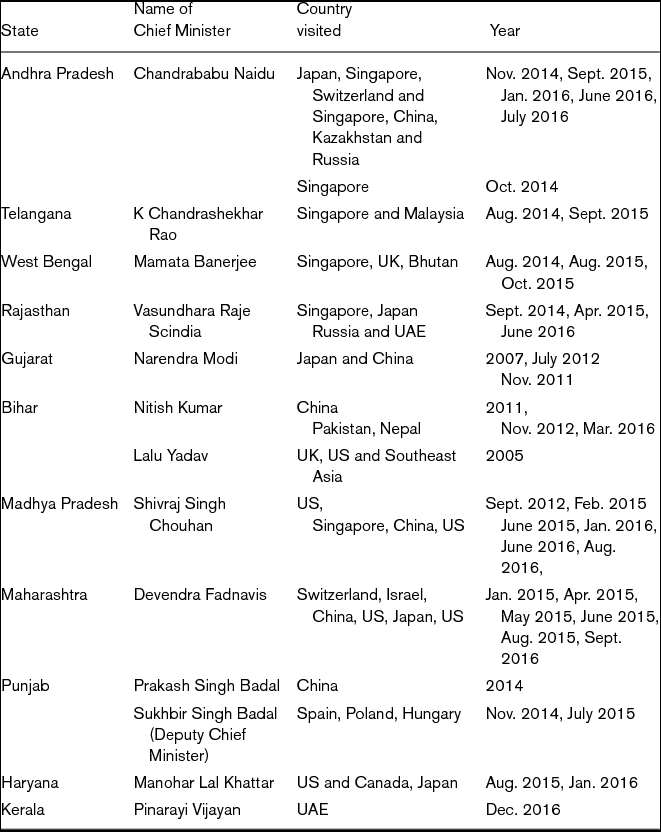
West Bengal was long a ‘reluctant state’ since ruled by the Communist Party. Recently, however, its Chief Minister Mamata Banerjee (2011–) has acknowledged how the state missed out on opportunities in the past through her reluctance (when in opposition) to welcome investment, even from Indian companies. As opposition leader, Banerjee opposed a plan by Tata to establish its new car project in Singur in West Bengal, and amidst strong protests, the company had to relocate its plant to Gujarat where Modi welcomed Tata's investment. Now as the state's chief minister, Banerjee is trying to woo foreign investors to her state. She calls West Bengal ‘a destination for industry’. As Table 2 shows, her first overseas visit since taking office as chief minister in 2011 was to Singapore in January 2014 to seek investment from the city state. Three agreements between Kolkata-based companies and Singapore-based companies were signed in the fields of ship-building, oil and gas exploration, and riverside development projects (PTI, 2014). In July 2015, Banerjee led a delegation of senior government officials, key political leaders, including the mayor of Kolkata, and top business leaders to the UK. When she took office as chief minister of West Bengal in 2011, she had promised to turn Kolkata into London (Dinda, Reference Dinda2015). To that end, she visited the UK, on the invitation of British Prime Minister David Cameron, who had visited Kolkata in November 2013, and discussed the possibilities of UK–West Bengal bilateral cooperation and trade and investment opportunities (NDTV, 2015b).
Indian chief ministers’ visits abroad

Source: Compiled by the authors from various newspaper reports.
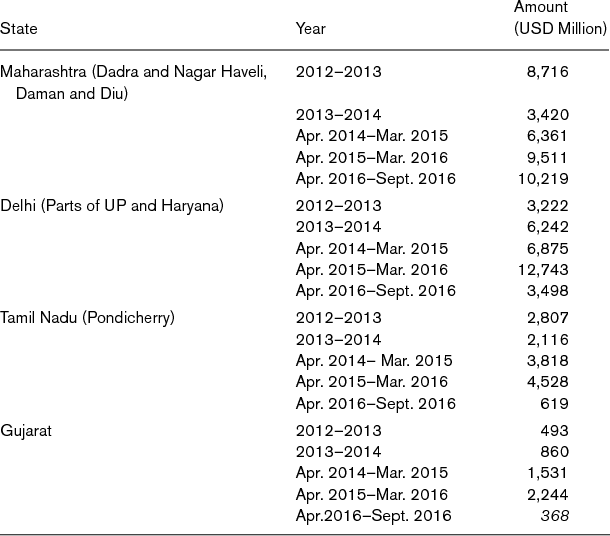
It is difficult to get a complete set of direct foreign investment data for the states as a result of such bilateral visits, but various reports suggest that these visitations have resulted in significant increases in direct investment. Table 3 below gives an incomplete overview of such investments.
Foreign investment in selected states/cities

Note: A complete set of statistics on foreign investment in states are difficult to obtain; data above are incomplete, as newspapers report many more investment projects in various states. Sources: Factsheet on Foreign Direct Investment (DIPP) http://dipp.nic.in/English/Publications/FDI_Statistics/2015/india_FDI_January2015.pdf http://dipp.nic.in/English/Publications/FDI_Statistics/2015/FDI_FactSheet_OctoberNovemberDecember2015.pdf; http://dipp.nic.in/English/Publications/FDI_Statistics/2016/FDI_FactSheet_April_Sep_2016.pdf
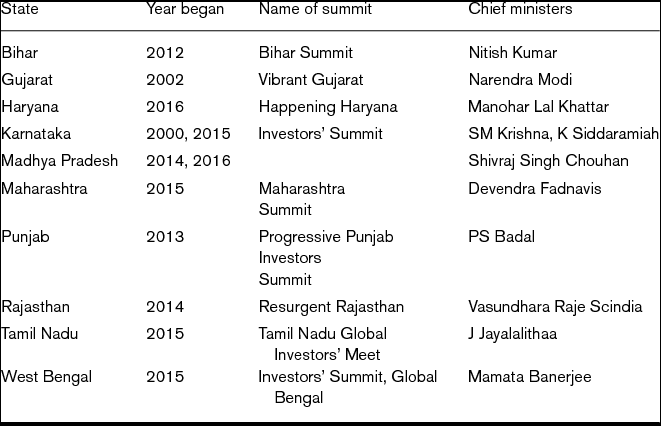
An important tool in attracting foreign investment has been through showcasing states’ economic and industrial achievements and potential through a number of policy instruments, such as availability of land, power, and infrastructure and less bureaucratic hurdles at the state level. States have now been actively organizing ‘investment summits’ in their capital cities attracting potential investors to their doorstep. As one commentary points out ‘such summits provide an opportunity for both investors and governments to engage each other and reach realistic conclusions’ (Times of India, 2015). Table 4 below gives a glimpse of such summits in the last decade. These are becoming regular features on some states’ calendar of events.
Investor summits

Source: Compiled by the authors from various newspaper reports.
Me-tooism states: Bihar, Madhya Pradesh, and Rajasthan
Gujarat under Chief Minister Anandi Behn and her successor Vijay Rupani and Andhra Pradesh under Chief Minister Chandrababu Naidu today continue their economic promotion internationally. As mentioned above, West Bengal moves beyond its regional concern about Bangladesh and its Chief Minister Banerjee now actively promotes the state as an attractive investment destination. Other states, such as Bihar and Madhya Pradesh, have also begun to reach out pro-actively, registering high growth rates largely due to successful governance under their strong leaders – for example, Bihar's Nitish Kumar (Chief Minister in 2005–14, and again from 2015) and Madhya Pradesh's Shivraj Singh Chouhan. Bihar has promoted its investment potential in China through the visit of its chief minister, and has forged economic ties with counterparts in Southeast Asia via the establishment of a ‘new’ Nalanda University for which Southeast Asian nations, and Japan, China, and Australia have pledged financial assistance (Muni, Reference Muni2010).
Bihar and Madhya Pradesh (part of the BIMARU club that refers to Bihar, Madhya Pradesh, Rajasthan, and Uttar Pradesh)Footnote 6 have drawn considerable attention through the rising political influence of their leaders. Before Modi emerged as the leading contestant for the top job at the centre, Chauhan and Kumar, as chief ministers of these two states respectively, were seriously perceived as potential prime minister candidates. The Bihar Chief Minister even visited Pakistan in 2012 and met with then President Asif Ali Zardari and Nawaz Sharif (current Prime Minister); as many politicians in Pakistan, as in India, viewed Kumar as a prospective dark horse in the 2014 general election. Kumar's move was clearly driven by his political ambition and through his visit to Pakistan, he was sending a political message to the Indian Muslim population whose votes could be crucial to his political success (Jha, Reference Jha2012). Even former cricketer-turned politician Imran Khan referred to the Nitish Kumar model of governance in Bihar (Joshua, Reference Joshua2012). Kumar was invited to visit by the Federal Government of Pakistan, as well as by the provincial governments of Sindh and Punjab. In 2011, Kumar also went to China visiting Beijing, Shanghai, and Shandong to attract investment and seek cooperation especially in agro-business. Kumar is of course not the first Bihar chief minister to travel overseas seeking to link Bihar economically to the international community. In 1995, when very few chief ministers even thought of going overseas to promote their states for economic opportunities, then Bihar chief minister Lalu Yadav, like Chandrababu Naidu subsequently, not only opened up to the idea of foreign investment, but also visited Southeast Asia, the UK, and the US, seeking private investment in an effort to create a ‘new Bihar’ (Kumar, Reference Kumar2013: 118).
Similarly, Rajasthan Chief Minister Vasundhara Raje Scindia visited Japan in April 2015 and met with the Japanese Prime Minister Shinzo Abe, with Economy, Trade and Industry Minister Yoichi Miyazawa, and top officials of the Japan International Cooperation Agency (JICA), responsible for Japan's foreign aid. Notably, Nimrana in Rajasthan has a special Japanese Investment Zone where more than 45 Japanese companies have already invested in various industries (NDTV, 2015a). This Chief Minister also visited Singapore in 2014 and signed agreements on water management, urban management, and tourism (Economic Times, 2014). In February 2015, the Rajasthan Government also signed an agreement with the Singapore Cooperation Enterprise to develop capabilities in urban water management in Rajasthan (Business Standard, 2015). In her earlier stint as chief minister of Rajasthan (2003–07), Scindia had started the ‘Resurgent Rajasthan Summit’ to showcase Rajasthan to the world and attract foreign investment.
Cities as new sites for internationalization
Cities around the world have come to play an increasingly vital role in connecting themselves to their international partners around the world (Hobbs, Reference Hobbs1994). Hundreds of official sister-city ties today link Indian cities to foreign cities, but they have been largely symbolic and inactive. Even metro cities in India – Delhi, Mumbai, Chennai, and Kolkata – do not see themselves as independent actors in the international arena. Although Delhi, the capital city, has the status of a state, it is not actively projected independently to the outside world. Some initiatives at the city level have begun to emerge recently.
Prime Minister Modi acknowledges cities as partners in India's development. His idea is to link Indian cities to counterparts internationally for mutual learning, growth, and development. Modi's initiative to link the city of Kyoto in Japan (where he first arrived during his Japan visit in 2014) to Varanasi (his parliamentary constituency) is one such indication of linking cities that share similar characteristics. The aim is to develop Varanasi along the lines of Kyoto, which maintains its distinct cultural identity appealing to tourists because of its hundreds of well-maintained Buddhist temples. Varanasi is India's ‘holy city’ and has been proposed as one of India's smart cities, an idea promoted by the Modi government. Although the Varanasi–Kyoto sistering sounds promising, it remains unclear how the two cities can work together, particularly in the context of Modi's smart cities vision. Sahoo (Reference Sahoo2015) observes a ‘lack of emphasis and relatively small budgetary allocation for “smart cities”, an ambitious project of the Modi government aimed at constructing well-planned, sustainable urban environments. This is a departure from the previous budget [2013–14], which provided greater funding to the initiative.’
The message is nevertheless loud and clear for Indian SNGs that in an age of globalization, states, and cities need to ‘think globally and act locally’. In Asia's two leading economies, Japan and China, SNGs are actively involved in subnational linkages (Jain, forthcoming). Like Japan, India is looking to China to develop these linkages, particularly for mutual economic gain. Chengdu and Bengaluru, Guangzhou and Ahmedabad, and Guangzhou and Mumbai exemplify the India–China SNG linkages. India is also looking at non-coastal Chinese provinces such as Zhejiang. Both countries are also seeking to enhance links through Buddhism between Indian states and Chinese provinces, such as Gansu and Shandong (Aneja, Reference Aneja2014).
The territorial division of power in India, and Indian cities’ heavy financial and policy dependence on state and central governments for their development have worked against the fostering of a culture that promotes and sustains international linkages at the city level. Initiatives that have emerged recently are essentially nationally driven (such as Kyoto and Varanasi) or state-driven (Andhra Chief Minister Chandrababu Naidu's plan to build a new capital city for the state with foreign funding). Chandrababu Naidu is actively seeking foreign assistance, mainly from Singapore, in designing, building, and developing his high-tech modern new capital city of Andhra Pradesh.
It is a still a long way off though for Indian cities to be active internationally as their peers in many other countries including in Asia. Until a culture develops through which Indian SNGs appreciate and act on the opportunities that are possible through various types of links with counterparts abroad, the momentum for cities to initiate and invest in international linkages will remain unignited.
A new catalyst: the Modi government
Modi is the second Prime Minister who held the position of chief minister before being elected to the nation's top job. The first was H. D. Deve Gowda, who was previously a parliamentarian and chief minister of Karnataka state (1994–96). Gowda ran an avowedly fractious coalition and could not survive even a year in office (June 1996–April 1997). Prime Minister Narasimha Rao (1991–96) also parachuted to the central government after serving as Andhra Pradesh chief minister from 1971 to 1973. However, unlike him, Modi had never been elected to the national parliament and without this history, his government is not dependent upon many parliamentary allies. Although Deve Gowda as chief minister of Karnataka had travelled to Switzerland and Singapore and had drawn some foreign investment to his home state,Footnote 7 at the time there was little feel for SNG international activity, which began to take off only in the late 1990s through the trendsetter states such as Andhra Pradesh under Naidu, Karnataka under Krishna, and later Gujarat under Modi, as discussed earlier.
Modi also has great appeal to the large Indian diaspora, especially in the US, UK, Canada, and Australia.Footnote 8 The diasporic community serves as an important conduit for establishing expatriate and other connections back to Indian origins. Diasporic communities, especially from states like Gujarat, Andhra Pradesh, and Punjab, have contributed in different ways to promoting linkages between their ‘new’ and their native homes. In addition to economic prowess and achievements in Information Technology, significant accomplishments in politics, especially in Canada and the US, have paved the way for linkages not just at national but also at subnational levels. During her 2014 visit to Punjab, then South Carolina Governor and now US Ambassador to the UN under the Trump administration, Nikki Haley Randhawa (whose parents migrated from Punjab's Amritsar district) met with the Punjab Deputy Chief Minister, Sukhbir Singh Badal and discussed the need for greater cooperation between the jurisdictions in areas such as education, pharmaceuticals, and agro processing (Singh, Reference Singh2014).
Punjab has also actively tried to leverage its diaspora in the US, Canada, and the UK to the state's economic advantage (Thandi, Reference Thandi2006). Political leaders have travelled to the countries where Punjabi diaspora are concentrated. For example, former chief minister Amarinder Singh visited a number of cities in the US and also Canada addressing some of the long-standing concerns of non-resident Indians (NRIs) (Agnihotri, Reference Agnihotri2016). However, Punjab has not been particularly successful in leveraging its vast diaspora as did Naidu in Andhra because of division within the Punjabi community overseas. Some of them still do not identify themselves with India as they favour a separate Sikh state for Khalistan (Thandi, Reference Thandi2006).
Prime Minister Modi has expressed an interest in providing policy space to SNGs. He works to make them responsible stakeholders in their own economic development, less dependent on the central government for guidance or for taking initiative on their behalf. Indeed, the Modi government has indicated that states have a vital role to play in India's economic development and that their linkages overseas are crucial (Basu, Reference Basu2015). Modi's speeches on India's Independence Day in August 2014, during his visits to the US, Australia, and elsewhere, including at the 2015 Vibrant Gujarat, referred to the role of Indian states in economic activities. The newly established policy think-tank NITI (National Institution for Transforming India) Ayog that Modi established envisages states as active participants in national economic policymaking. As Palit (Reference Palit2015:4) has noted, a ‘bottom-up’ approach to economic policymaking resonates with the sentiments of Prime Minister Modi who, as Chief Minister for several years, developed the view that the Indian states should be allowed more room in contributing to national economic policies.
Central–subnational relations
India is constitutionally a federal polity. Yet, as discussed, it functions like a ‘centralized’ state in which the central government dominates and ‘controls’ states in many policy matters. This dominance was more pronounced post-independence under the ‘Congress system’ in which the Indian National Congress Party dominated India's political landscape. The Congress Party held tight political control overs states, which were essentially fiscally dependent on central dispensation with little financial autonomy. And since the constitution grants states no power or voice on foreign affairs, it goes without saying that states have had little say on this policy area. The advent of coalition politics changed the central–subnational political dynamics and also opened up policy space for regional political parties to influence India's foreign relations, especially concerning border-states as illustrated in the example of Tamil Nadu's influence on India's UN vote over Sri Lanka's human rights violations. Although the Modi government is not dependent on regional parties for its political survival, states have become crucial to conducting India's foreign relations, as we have seen with the land boundary agreement and negotiations over the Teesta River water agreement with Bangladesh. One high-ranking Indian diplomat commented that there has been a ‘steady erosion of central government in the foreign policy space’.Footnote 9 There are now many actors who have become influential in shaping the course of foreign policy and states are some of them.
A tight fiscal environment at the Centre has ‘forced the states to become more self-reliant – meaning, in practice, that they turn to private capital and international development assistance (Jenkins, Reference Jenkins and Mitra2009: 63). Most state leaderships are aware that central assistance is not enough to fulfil their plans for social and economic development, another reason why SNGs have begun to orient themselves internationally. On the 2015, ‘Vibrant Gujarat Summit’ and the 2015 Global Bengal Summit (Kolkata), Indian Finance Minister Arun Jaitley remarked, ‘states in India are going to compete with each other in cornering investment. I have no doubt that the ones which consistently and uniformly pursue reforms and business friendly policies are likely to succeed’ (The Hindu Business Line, 2015). Speaking at the Tamil Nadu Global Investors Summit, Union Commerce Minister Nirmala Sitharaman in similar spirit observed, ‘both Union and State governments are committed to eliminate all the roadblocks for facilitating investment decisions’, and she praised Tamil Nadu for its leading role in improving infrastructure and providing an attractive destination for investment (Economic Times, 2015). It is clear that the national leadership now encourages states to engage internationally because it helps promote the national government goals of greater foreign investment and the ‘make in India’ campaign.
Institutionalization
For SNGs to pursue their international strategies, institutional arrangements are essential to provide consistency and continuity in their international policy designs, objectives, and implementation. Canada's Quebec, for example, ‘has built a formidable force of trade officers, immigration advisers and quasi-ambassadors around the world’.Footnote 10 Chinese provinces have established a well-developed local bureaucracy to manage their external affairs (Chen and Jian, Reference Chen and Junbo2009: 5). Japan has established a national body: the Council of Local Authorities for International Relations (CLAIR) with staff drawn both from the national and subnational governments, representing SNG interests (Jain, Reference Jain2005: 49–51).
Although Indian states now actively seek foreign investment, technology, and international trade, their institutions to support these activities remain underdeveloped. Organizational structures at the state level for human resources, finance, and administration are inadequate. Some states such as Andhra, Gujarat, and Tamil Nadu are somewhat organized, but many states do not have resources or the wherewithal, and with poor infrastructure and finances they are unattractive to investors considering locating their capital in such states. Lack of transparency, information, and political stability, alongside weak regulatory frameworks, create uncertainty and hesitancy in the minds of foreign investors. Haryana has established an Investment Cell within its Industrial and Infrastructure Development Corporation to promote inward investment but its functions are still unclear. Andhra Pradesh Chief Minister Naidu announced to open a China desk in his state to attract Chinese investment.Footnote 11 While these are a good start, there seems to be a lack of strategy about international engaging through institutions providing continuity and progress.
Even coordination between the central government and state governments lacks a strong institutional framework. It was not until late 2014 that the MEA opened a new section to coordinate states’ activities overseas. Called ‘Liaison with State Governments’, the division is headed by a joint secretary with two other senior officials at director and deputy secretary levels.Footnote 12 The division is responsible for coordinating visiting foreign dignitaries’ trips to Indian states and cities and Indian states’ delegations overseas delegations, and to establish a database of state-level tie-ups and work on sister cities (Haidar, Reference Haidar2014). Within the MEA, there is now greater acceptance of states’ involvement in foreign affairs, but the perspective overall is still far from inclusive. Resistance still stalls the Ministry's acceptance of state officials’ bids to work overseas and open State offices – even within the premises of the Indian missions abroad, let alone in their own independent State office as is typical for many SNGs around the world.
Significantly, states with strong regional parties and entrepreneurial leaders have pulled their weight in influencing India's foreign affairs authorities and have launched themselves into the international arena for economic growth and modernization of their states. Some have emulated the lead role of Andhra and Gujarat, including the so-called BIMARU states. However, some states still remain on the periphery of such activities, with neither the wherewithal nor the will to enter into the international arena. It thus appears highly unlikely that Indian SNGs across the board will actively pursue international orientations anytime soon. For now, they lack resources and infrastructure; they depend heavily on financial and other support from the central government; and thus they have not generated momentum that would see a culture of international linkage building thrive nationwide among Indian SNGs.
Conclusion
Our discussion in this article has made clear that India's SNGs now have an emerging role in India's foreign affairs. Some states in particular have become actively engaged in courting foreign investors to their jurisdictions. Others have followed a ‘me-tooism’ course, and achieve uneven success. It is unlikely that all 29 states in India will become actively engaged in international affairs in the near future. Those now seeking to engage international investors still lack institutions to sustain and strengthen their activities. More will need to be done to sustain this line of activity that clearly rewards both the SNG and national levels. States now have palpable economic incentives to ‘go international’ since they recognize the costs to their state of limited central government support. They are no longer insulated from the impact of globalization and cannot depend on central government financial support alone if they are to pursue the possibilities for development and economic growth that foreign investment and other forms of international linkage can enable. Some of their counterparts in India now provide helpful precedents on SNGs going global.
These new and emerging actors in India's foreign affairs landscape are pluralizing and decentralizing India's foreign policy, albeit in a limited way and on a small scale. The central government and its relevant ministries have conceded the utility of state participation for successful outcomes, as the land boundary agreement with Bangladesh and other examples have illustrated. This is why the MEA has established a new division to liaise with state governments.
Furthermore, India's economic growth is highly dependent on states, which have jurisdiction over land, roads, and other infrastructure plans. Without cooperation and initiative from states, the central government cannot achieve the national economic growth it now seeks keenly. Appreciation of this reverse dependence came under the Manmohan Singh government, and early indications suggest that the Modi government, as its successor, is also seeking to accelerate international linkage building, by cities as well as states.
The power of states to influence India's relations with neighbouring nations may retract somewhat, as the emergence of a powerful BJP-led NDA government at the nation's centre weakens the clout of regional parties. Yet their influence will continue in some ways, given the vital role that states can and do play in economic relations and strategic diplomacy, as Modi's inclusion of relevant chief ministers during his trip to Bangladesh illustrates. Trade, investment, and infrastructure development linkages are likely to grow, fuelling possibilities for growth in related areas, such as environment resources and city management, as well as in education, culture, and sports.
Management of India's external relations is thus no longer informed or conducted simply by a select group of diplomats, high-ranking political leaders, and other specialist foreign policy advisers in New Delhi. Today subnational actors are becoming an essential component in India's foreign affairs. They are joining the huge traffic of SNGs from countries around the world that are linking with counterparts and others across national borders to serve the interests of local constituencies. It is a trend changing not only diplomatic roles, but also the nature of economic and political relationships among government actors worldwide.
About the authors
Purnendra Jain is Professor and Head of the Department of Asian Studies at the University of Adelaide in Australia. His most recent book is Japan's Strategic Challenges in a Changing Regional Environment (edited with Lam PE) and an article on Japan's foreign aid in Pacific Review (2016) and a co-authored chapter (with T. Mito) on energy institutions in Asian Designs: Governance in the Contemporary World Order (2016).
Tridivesh Singh Maini is a New Delhi based Policy Analyst. He is an Assistant Professor with the Jindal School of International Affairs, OP Jindal Global University, Sonepat, Haryana. Maini was also an Asia Society India-Pakistan Regional Young Leaders Initiative (IPRYLI) Fellow (2013–2014).