Introduction
Osseointegrated implants for hearing rehabilitation were pioneered in 1977.Reference Tjellstrom and Hakansson1 In the US, they are approved for use in adults and children over the age of five years for the treatment of mixed, conductive or profound unilateral sensorineural hearing loss.Reference Koch, Staller, Jaax and Martin2 The device consists of two components in a ‘screw within a screw’ design. The portion of the implant that is placed in the skull is termed the fixture. The fixture, which is either 3 or 4 mm in length, is held in place by osseointegration.Reference Mikulec3 The external portion is termed the abutment. The standard or default length of the abutment is 5.5 mm, but it also comes in sizes of 8.5 mm and, more recently, other lengths have become available.
Most of the literature regarding osseointegrated implantation for hearing rehabilitation focuses on the 5.5 mm abutment. Experience with the 8.5 mm abutment has been reported,Reference Doshi, McDermott, Reid and Proops4, Reference Pelosi and Chandrasekhar5 but long-term results remain unclear. The goal of this study was to add to the data available on the survival of the 8.5 mm abutment, and to describe its utility in obese patients. One concern regarding the use of a longer abutment is that the underlying fixture needs to withstand higher torque from lateral forces applied to the abutment (see Figure 1 and Appendix 1), which might increase extrusion rate.
Model of mechanical advantage of various abutment and fixture length combinations. Force vectors and torque magnitude are represented by arrows and circles respectively. The darker arrows represent relative force necessary to counteract a given force, F1 (shorter arrows indicate less required force).

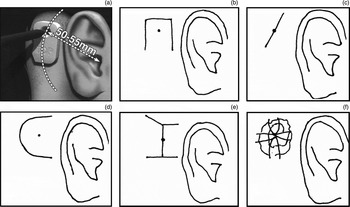
A myriad of soft tissue approaches have been utilised for osseointegrated hearing implant placement, including pedicled skin flaps, a single linear incision and more complex incisions (Figure 2). It remains unclear as to what the best technique is. One of the hallmarks of successful implantation, irrespective of incision design or skin flap use, is adequate undermining of subcutaneous soft tissue. Obese patients tend to have copious soft scalp tissue, which makes trouble-free implantation more challenging. The authors work in an area where high obesity is prevalent. This paper describes a simplified soft tissue technique which, when used in combination with an 8.5 mm abutment, can be performed successfully even on obese patients.
Soft tissue approaches for bone-anchored hearing aid implant surgery showing: (a) template used to plan the incision, (b) inferiorly based skin flap, (c) vertical incision, (d) U-graft incision, (e) modified French door incision and (f) antibiotic-impregnated bolster held in place by four sutures.

Materials and methods
Local institutional review board approval was obtained and a retrospective analysis of patients who received bone-anchored hearing aid (BAHA) implants was performed. Patient records from 2005 to 2010 were obtained using a procedure code for osseointegrated implants (current procedural terminology code 69714). Adult and paediatric patients were included if they had received one or more BAHA osseointegrated implants and had been fitted with a BAHA processor.
The following information was gathered from each patient record: age; gender; height; weight; body mass index; number of days from surgery to latest post-operative follow up; number of visits during the first 180 days post-operation; BAHA device usage after activation; complications encountered at any point; duration of follow up; type of hearing loss; aetiology of hearing loss; and type of soft tissue procedure (specifically, whether or not the BAHA dermatome was used). This information was then analysed.
In addition to the retrospective analysis, a model of mechanical forces was created based upon the lengths of the fixture and abutment combinations. The concept of equilibrium of a rigid body was applied to develop this model.Reference Cutnell and Johnson6 This was derived from the equation ∑τ = 0, where τ is torque and the sum of the torques in equilibrium is equal to zero. In the equation τ = FL, F is the magnitude of the force and L is the lever arm length. Using the lengths of the fixtures and abutments as lever arms, the relative torques were calculated for an equal given force, F1, acting perpendicular to the edge of the abutment of various fixture and abutment combinations (see Figure 1).
All p values were calculated using the Fisher exact probability test (all reported values are two-tailed unless specified otherwise). Statistical significance was set at p = 0.05.
Results
Patient population
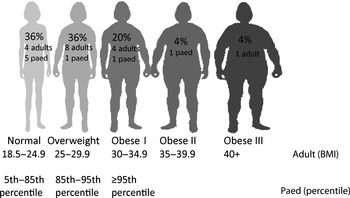
In total, 25 patient records met the study criteria. Age and gender were well represented; ages ranged from 9 to 78 years (mean age of 40 years), with 12 males and 13 females. There were 8 paediatric patients (aged less than 18 years old). The 5.5 mm length abutment was utilised initially in 16 patients. The 8.5 mm abutment was used initially in 9 patients, 1 of whom received implants bilaterally (a total of 10 longer abutments). In the study population, 28 per cent of the patients were obese (5 adults and 2 paediatric), 36 per cent were overweight (8 adults and 1 paediatric), and 36 per cent were of normal weight (4 adults and 5 paediatric). This was determined using the current World Health Organization definitions for adults, and the US Center for Disease Control definitions for paediatric patients (Figure 3).
Body mass index classification of patients. Paed = paediatric; BMI = body mass index (kg/m2)

The mean number of follow-up visits in the first and second 90-day post-operative periods for patients that received the 5.5 mm abutments versus the 8.5 mm abutments were 1.6 and 1.8 versus 1.8 and 1.6 visits respectively. All patients were using the device after activation except one due to pain. Mean follow-up time from the day of the implant placement to the latest follow-up visit was 502 days (range 96–1175 days).
With regards to the type of hearing loss, 12 of the 25 patients (48 per cent) received the BAHA implant for unilateral sensorineural hearing loss, 7 (28 per cent) for bilateral conductive hearing loss, 2 (8 per cent) for unilateral conductive hearing loss, 2 (8 per cent) for unilateral mixed hearing loss, and 2 (8 per cent) for bilateral mixed conductive hearing loss. The most common aetiology of hearing loss was chronic ear infection, including chronic otitis media and/or mastoiditis in 8 of the 25 patients (32 per cent). Chronic idiopathic sudden sensorineural hearing loss was also relatively common, affecting 6 of the 25 patients (24 per cent). Other aetiologies of hearing loss were: atresia of the external ear including those with Treacher Collins syndrome (5 cases, 20 per cent), traumatic hearing loss (2 cases), post-stapedectomy (1 case), Ménière's disease (1 case) and schwannoma (1 case).
Complications
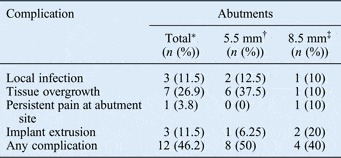
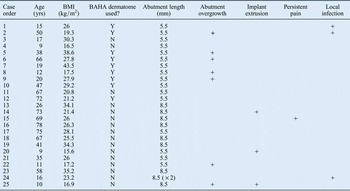
The proportion of patients who experienced a complication at any point was 48 per cent (12 of the 25 patients) (Table I). Specific observations of interest are addressed below. Paediatric patients had a higher rate of complications during follow up (75 per cent, 6 of 8 patients) compared with adults (41 per cent, 7 of 17 patients), but this difference did not reach statistical significance (p = 0.202). One study published in 2011 observed that 41.9 per cent of children who received BAHAs required subsequent revision surgery in the operating theatre.Reference Ida, Mansfield, Meinzen-Derr and Choo7
Abutment complications

*Total n = 26. †Total n = 16. ‡Total n = 10 (1 of 9 patients in this group received implants bilaterally).
Bone-anchored hearing aid dermatome and tissue overgrowth
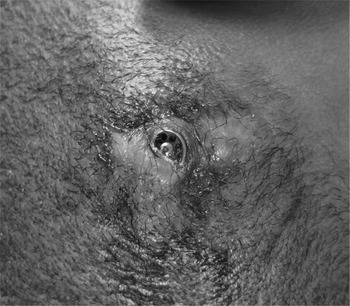
Seven abutments developed overgrowth complications (Figure 4 and Table I). Six of these were in patients with 5.5 mm abutments and one was in a patient with an 8.5 mm abutment. Overgrowth of the longer abutment has been reported previously.Reference Pelosi and Chandrasekhar5 A BAHA dermatome surgical procedure had been performed in five of the six patients with 5.5 mm abutments that subsequently developed abutment overgrowth. The BAHA dermatome was used in a total of 9 patients, of which 55.5 per cent (5 of 9 patients) developed soft tissue overgrowth. There was a significant association between the dermatome procedure and the development of tissue overgrowth compared with non-dermatome techniques (55.5 per cent vs 12.5 per cent respectively, p = 0.034 (one-tailed)). It should be noted that most of these complications occurred early on in the case order and decreased over time, possibly due to modified technique (Table II).
Bone-anchored hearing aid abutment tissue overgrowth.

Complications over time

Yrs = years; BMI = body mass index; BAHA = bone-anchored hearing aid; Y = yes; += indicates the presence of the specified complication; N = no
The 8.5 mm versus the 5.5 mm abutment
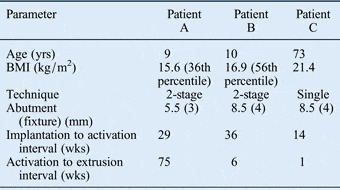
Complication rates for the two types of abutments were similar, with no significant differences. The complication rate was 50 per cent for (8 of 16) recipients of the 5.5 mm abutment versus 44 per cent for (4 of 9) recipients of the 8.5 mm abutment. There was a trend for less tissue overgrowth in the 8.5 mm abutment group (10 per cent of abutments, 1 of 10) compared with the 5.5 mm abutment group (37.5 per cent, 6 of 16), p = 0.19. In total, 88.5 per cent (23 of 26) of the implants survived for the duration of follow up. The characteristics of patients who experienced spontaneous extrusion are summarised in Table III. None of the extrusions were associated with trauma or infection. One of the affected patients had a 3 mm fixture placed due to thin bone. The 3 mm fixture has previously been associated with increased implant failure.Reference Badran, Arya, Bunstone and Mackinnon8 One elderly gentleman who received an 8.5 mm abutment was a smoker. Smoking has been associated with higher rates of failure in oral osseointegrated implants,Reference Hinode, Tanabe, Yokoyama, Fujisawa, Yamauchi and Miyamoto9 but has not been demonstrated to significantly increase the extrusion rate in BAHA implants. Overall, the extrusion rate was higher with the 8.5 mm abutment (20 per cent, 2 of 10) than the 5.5 mm abutment (6.25 per cent, 1 of 16) (Table I), but this was not a significant result (p = 0.54).
Characteristics of patients whose implants extruded

Yrs = years; BMI = body mass index; wks = weeks
Body mass index
There were no significant differences between obese and normal weight individuals in terms of the number of complications. However, more complications occurred in overweight or obese patients that received the 5.5 mm abutment (55.5 per cent, 5 of 9; Table II) compared with those that received the 8.5 mm abutment (16.7 per cent, 1 of 6) (p = 0.29). This suggests that implantation with the 8.5 mm abutment can achieve relatively good outcomes in overweight and obese individuals.
Model of mechanical advantage
The model of mechanical advantage for various abutment and fixture length combinations is shown in Figure 1. The 5.5 mm abutment in combination with the 4 mm fixture requires the least calculated force to counteract mechanical forces acting upon the abutment. In practical terms, this combination has the best mechanical advantage to external forces. The 8.5 mm abutment and 4 mm fixture combination requires 1.545 times the relative calculated force of the 5.5 mm abutment and 4 mm fixture combination to counteract the torque generated by a given force acting perpendicularly to the long axis of the implant on the edge of the abutment. The 8.5 mm abutment and 3 mm fixture combination has the least mechanical advantage, requiring 2.060 times the relative force compared with the standard 5.5 mm abutment and 4 mm fixture combination. The potential implications of this are addressed in the Discussion.
Discussion
Osseointegrated implantation techniques for hearing augmentation continue to evolve. Soft tissue procedures have been refined in an attempt to minimise tissue overgrowth of the abutment, which is the most common complication. In our experience, abandoning the dermatome approach and using a longer abutment significantly decreases the risk of tissue overgrowth. The use of a longer abutment provides more soft tissue clearance, but due to the force vectors involved, it puts the underlying osseointegrated fixture under greater stress. The fact that all extrusions in the current study occurred in patients with relatively low or normal weight is an intriguing finding of unclear significance (Table III). The current study showed that implantation of obese patients was successful using the longer 8.5 mm abutment.
Osseointegrated implants have proven useful for the rehabilitation of conductive, mixed and profound unilateral sensorineural hearing losses. A wide variety of techniques have been reported in the published literature. These can broadly be divided into two categories: those utilising a skin graft, usually pedicled, and those avoiding a skin graft.
Most early papers describing osseointegrated hearing implants focused on the skin graft technique, but soft tissue complications such as poor wound healing in the early post-operative period and abutment overgrowth later on were common.Reference Hobson, Roper, Andrew, Rothera, Hill and Green10 This led a number of authors to search for a non-skin graft technique;Reference van de Berg, Stokroos, Hof and Chenault11, Reference De Wolf, Hol, Huygen, Mylanus and Cremers12 some of these published soft tissue approaches are shown in Figure 2.
The complication rates for skin graft free techniques range from: 6.5–22 per cent for skin reactions with a Holgers grade of 2 or greater; 6 per cent for skin overgrowth; and 9.3–16.3 per cent for implant loss.Reference De Wolf, Hol, Huygen, Mylanus and Cremers12, Reference De Wolf, Hol, Mylanus and Cremers13 This shows improvement compared with some of the earlier skin graft technique reports.Reference Badran, Arya, Bunstone and Mackinnon8 Indeed, the senior author's experience of early complications with the skin graft technique led to a search for a more robust soft tissue strategy. Nevertheless, some surgeons continue to utilise a pedicled skin graft successfully, suggesting that sufficient experience with this technique can lead to acceptable soft tissue complication rates.Reference van de Berg, Stokroos, Hof and Chenault11
The soft tissue technique reported in the current study using the 8.5 mm abutment resulted in an average of 1.77 post-operative visits in the first 90 days following surgery. A normal post-operative course consisted of a first post-operative visit within two to three weeks, at which point the bolster was removed. This was followed by a second visit at about 90 days, with device activation shortly thereafter. The literature comparing osseointegrated soft tissue techniques is difficult to compare due to the heterogeneous reporting of outcomes and complications. We suggest that the number of post-operative visits in the first 90 days, as provided here, can be a useful proxy for the comparison of various soft tissue techniques.
Abutment overgrowth and soft tissue impingement on the BAHA device account for the majority of late complications. These result in the compromise of amplification and may require surgical revision. The current study showed that the use of the 5.5 mm abutment led to complications of tissue overgrowth in six patients, which required intervention with either clobetasol in the clinic or revision with the placement of a longer 8.5 mm abutment. Clobetasol cream has been used successfully for the non-surgical management of mild cases of abutment soft tissue overgrowth.Reference Falcone, Kaylie, Labadie and Haynes14 In contrast, patients with the 8.5 mm abutment did not require either of these treatments, with one notable exception in which surgical revision was required in a paediatric patient. However, it should be noted that most complications with the 5.5 mm abutment occurred early on in the study period (see Table II); the difference in outcomes between the 5.5 and 8.5 mm abutments could partly reflect a learning curve and/or the use of the BAHA dermatome technique early on in this series. Extensive soft tissue removal is necessary to minimise abutment overgrowth and to avoid soft tissue impingement, but less soft tissue needs to be removed for an 8.5 mm abutment compared with a 5.5 mm abutment.
• Soft tissue overgrowth is common in patients with bone-anchored hearing aids (BAHAs)
• Use of the 8.5 mm abutment following this complication can prevent subsequent problems
• It is unclear whether initial use of the 8.5 mm abutment can prevent soft tissue complications
• This study investigated outcomes of initial 8.5 mm abutment placement, and its utility in obese patients
• The study also compared the BAHA dermatome pedicled flap technique with other techniques
• A model of mechanical advantage was created, comparing calculated relative forces upon combinations of fixture and abutment lengths
The 8.5 mm abutment results in 1.55 times greater torque (compared with the 5.5 mm abutment) on the underlying 4 mm fixture when force is applied perpendicular to the long axis of the fixture–abutment combination (Figure 1). In addition, a higher extrusion rate was observed in the 8.5 mm abutment group; however, this finding did not approach statistical significance (possibly due to the small sample size), and it is unclear if this difference will persist over time. One study has shown good survivability of the 8.5 mm abutment.Reference Monksfield, Ho, Reid and Proops15 In that study, 111 patients converted to the longer abutment due to soft tissue complications, with a mean follow up of 21.1 months following receipt of the longer abutment. Reported experience with the combination of the 8.5 mm abutment and 3 mm fixture has been minimal; it is therefore difficult to draw conclusions regarding the durability of such a combination. Early extrusion in this study was observed in one elderly patient who wore a hard hat and two paediatric patients (an extrusion rate of 11.5 per cent, 3 of 26 implants). This is comparable to the published extrusion rate of 4–10 per cent.Reference Hobson, Roper, Andrew, Rothera, Hill and Green10, Reference De Wolf, Hol, Huygen, Mylanus and Cremers12 During the study period, patients were followed for an average of 1.37 years, which adds up to 34 patient years of implant experience.
Obese patients, who usually have thick subcutaneous tissue, provide an added challenge to the osseointegrated implant surgeon. The US has some of the highest obesity rates in the world and worldwide obesity is increasing. The state in which this study was carried out, Missouri, has one of the highest rates of obesity in the union. The current study showed that overweight and obese patients can be successfully treated using the proper soft tissue techniques and the longer 8.5 mm abutment.
Appendix 1. CalculationsReference Cutnell and Johnson6
∑τ = 0, equilibrium of a rigid body
τ = Fl, where F is magnitude of the force and l is the lever arm length
 $$\sum \tau=0\comma \; \rm {F}_{1}\rm {L}_{1}+\rm {F}_{2} \rm {L}_{2}=0\comma \;\rm {F}_{1}\rm {L}_{1}=-\rm {F}_{2} \rm {L}_{2}$$
F1(5.5 mm) = −F2(4 mm), rearranges to F2=− 1.375 F1
F1(5.5 mm) = −F2(3 mm), rearranges to F2 = −1.833 F1
F1(8.5 mm) = −F2(4 mm), rearranges to F2 = −2.125 F1
F1(8.5 mm) = −F2(3 mm), rearranges to F2 = −2.833 F1