The Nordic region is usually associated with Euroscepticism, with Nordic people less supportive of integration than the citizens of the European Union (EU) as a whole. This Euroscepticism is usually explained by the affluence of the region that, together with the egalitarian welfare state model – based on universal benefits financed by relatively high taxation – make the Nordic people less interested in transferring policy-making powers to the European level. The political culture is also more state centred than in most Central and Southern European EU countries, with concepts such as nation state and national sovereignty highlighted in Nordic political discourse. While Finland and the other Nordic countries display relatively high levels of fiscal decentralization, with local governments delivering most of the welfare state policies (notably education and health care), the contents of these policies are decided by national-level political institutions in the framework of unitary countries.
Considering the salience of the welfare state and the importance of national institutions, it is not surprising that Nordic Euroscepticism is more pronounced on the left, with the leftist parties experiencing severe internal problems over both EU membership and the deepening of integration. However, interestingly, left-wing dissent over integration has been considerably weaker in Finland than in Denmark, Norway or Sweden, despite successive Finnish governments displaying solid and consistent support for greater integration.Footnote 1 Finland is also the only Nordic country that belongs to the Eurozone, with the single currency generally adopted without much political dispute.Footnote 2
Beyond such Nordic Euroscepticism, European integration has proved to be a difficult issue for the social democrats in most EU countries. Many socialist or social democratic parties, such as the British Labour Party, were initially strongly opposed to European integration, arguing that the market-driven logic of integration did not further the interests of their electorates. But the 1990s and the empowerment of the EU constituted a turning point, with the majority of socialist (and green) parties understanding that collective action at the European level was necessary to advance their policy objectives.Footnote 3 As a result, deeper integration nowadays enjoys more support among centre-left than among centre-right parties, with social democrats advocating a stronger role for the EU in employment, environment and social policies.Footnote 4 There is an important difference among the social democratic parties that belong to the Party of European Socialists (PES). As Marks and Wilson argue: ‘To the extent that social democratic parties have been able to achieve their goals at the national level (for example, by creating national Keynesianism, strong welfare states and a highly institutionalized industrial relations system)…they will regard the deepening of market integration in Europe as a threat.’Footnote 5 This was certainly true of the Nordic social democratic parties that had been the main driving forces behind the gradual establishment of the extensive welfare state regimes.Footnote 6
This article examines how the Finnish Social Democratic Party (SDP) has adapted to European integration. The data consists of party documents and interviews with key party officials and politicians.Footnote 7 The theoretical section focuses on the ideological development and identity of the party, with particular emphasis on the ideological dilemma facing the party when European integration came onto the Finnish political agenda. The analysis in the empirical section shows that the SDP has successfully argued to its electorate that the objectives of integration are compatible with core social democratic values. Considering that Finland was hit by a severe recession in the early 1990s, discourse about economic integration and monetary stability facilitating the economic growth that is essential for job creation and the survival of domestic welfare state policies sounded appealing to SDP voters. Determined party leadership, support from trade unions and the lack of a credible threat from the other leftist parties have also contributed to the relatively smooth adaptation to Europe. However, recent internal debates about the direction of party ideology and poor electoral performances, notably in the European Parliament (EP) elections, indicate that not all sections within the party are in favour of the current market-friendly policies.
THE IDEOLOGICAL CHALLENGE FACING SOCIAL DEMOCRATS
The SDP was founded in 1899, with the current name adopted in 1903.Footnote 8 The SDP has won on average 24.6 per cent of the vote in parliamentary elections since the Second World War, and in terms of electoral success it is the largest of the three core parties in the Finnish party system. It was the largest party in all elections held from 1907 to 1954, and since the 1966 elections it has finished first in all elections, apart from those held in 1991, 2003 and 2007. Unlike its sister parties in Scandinavia, the SDP has never occupied a dominant position in the party system, and hence it is accustomed to sharing power with both centre-right and other left-wing parties.
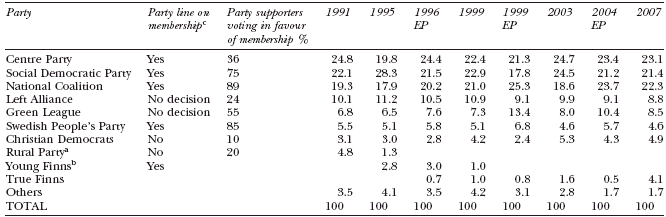
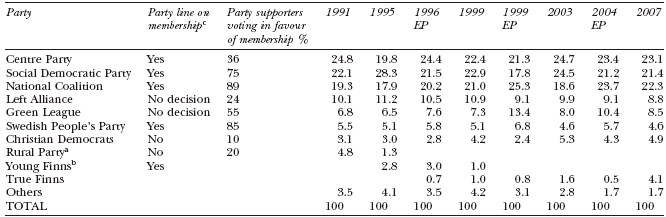
The SDP operates in the context of a highly fragmented party system (see Table 1). Measured by the number of effective parties, the Finnish party system is the most fragmented of the former ‘West’ European countries, with an average of 5.1 effective parties between 1945 and 2000.Footnote 9 Moreover, bloc politics has never been as important in Finnish politics as in most European countries. Finland has a long tradition of cross-bloc majority coalitions,Footnote 10 usually formed between the SDP and the Centre Party together with minor parties such as the Swedish People's Party.Footnote 11 In order to avoid excluding themselves from government formation negotiations, parties neither present to the voters any pre-election alliances nor make any statements about not sharing power with a particular party.
Distribution of Votes (%) in Eduskunta and EP Elections Since the Early 1990s and the Position of the Parties and their Supporters on EU Membership in the 1994 Referendum
a The Rural Party was disbanded after the 1995 elections. The True Finns, established that same year, can be considered its successor.
b The right-wing Young Finns was established in 1994. The party failed to gain seats in the 1999 elections and was subsequently disbanded.
c The Left Alliance and the Green League did not adopt official positions prior to the referendum.
Sources: Voting results – Statistics Finland; the share of party supporters voting in favour of membership – Paloheimo, ‘Vaaliohjelmat ja ehdokkaiden mielipiteet’, p. 58.
During Finland's EU membership the SDP has been in government and in opposition. From 1995 to 2003 it led broad ‘rainbow’ governments that brought together the SDP, the National Coalition, the Left Alliance, the Swedish People's Party and the Green League (which left the cabinet in 2002 over a dispute about nuclear energy). From 2003 to 2007 it was the second largest party in the Centre-led cabinet, which also included the Swedish People's Party. At the time of writing, the SDP is the leading opposition party, as since the elections held in 2007 Finland has been governed by a coalition between the Centre Party, National Coalition, the Green League and the Swedish People's Party.
As class divisions were crucial in the emergence of most Finnish parties, it is not surprising that since the 1960s class dealignment and the gradual consolidation of the welfare state have contributed to increasing electoral instability, both in terms of party-system fragmentation and electoral volatility. However, despite the entry into the Eduskunta – the unicameral national parliament – of new parties such as the Christian Democrats, the Rural Party (now the True Finns) and the Green League, overall the party system has remained stable, with the three core parties – the SDP, the Centre Party and the National Coalition – largely holding on to their vote shares in recent decades.Footnote 12
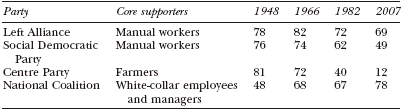
This class dealignment is also reflected in the ideologies and strategies of the political parties. Finnish parties have their core sets of supporters, but essentially all parties try to broaden their appeal beyond their natural electorates. The SDP still receives most of its vote from the urban working class, but overall changes in economy and occupational structures have clearly affected its electorate.Footnote 13 Whereas in the mid-1960s manual workers constituted 74 per cent of the party's support, this figure had declined to 49 per cent in the 2007 Eduskunta elections (see Table 2). Ideologically, the polarization between the right and the left that characterized political discourse before the 1970s has given way to policy moderation and convergence, with the SDP and other leftist parties (the Left Alliance and the Green League) represented in the Eduskunta moving rightwards and accepting the role of market economy. Obviously there are still noticeable ideological differences between the individual parties along several issue dimensions, but one can argue that nowadays it is more a matter of parties emphasizing different issues rather than having radically different policy programmes.Footnote 14
The Core Sets of Party Supporters by Occupational Category and Their Share of the Total Party Support (%), 1948–2007

Sources: Risto Sänkiaho, Puolueiden kannattajakunnan rakenne; SVT, Vaalit 1991: 2, Kansanedustajain vaalit 1991; Paloheimo, ‘Ideologiat ja ristiriitaulottuvuudet’.
These developments present a dilemma for the SDP. As the centre of the left–right spectrum is already fairly crowded, any further centripetal moves might jeopardize its support among the traditional working-class electorate. Moving to the left is an equally problematic option, and would probably not please the urban white-collar employees voting for the party. Moreover, the SDP also faces competition from parties to its left. The radical left or communist bloc has traditionally been very strong in Finland, with the Finnish People's Democratic League winning over 20 per cent of the vote in elections held between 1945 and 1966. Its successor, the Left Alliance, founded in 1990, brought together a variety of leftists and former communists, and the party is definitely more pro-market than most of its European sister parties.
Perhaps a more serious challenge to the SDP comes from the Green League. The first green MPs entered the parliament in 1983, and the Green League was officially established in 1988. The Green League is on the moderate wing of the green movement, and is one of the most successful green parties in Europe, having served in the government from 1995 to 2002 and again after the 2007 elections.Footnote 15 The Green League has a younger, more modern image not tarnished by close links with the trade unions, and the party has certainly emerged as a serious contender to the SDP. This applies particularly in Helsinki, where in the 2008 municipal elections the Green League finished second with 23 per cent of the vote, ahead of the SDP, which captured 18 per cent of the vote.
Maintaining the support of the faithful while broadening electoral appeal is no easy task in a fragmented party system, and debate over the issue flared up in the SDP from the late 1980s onwards. It must be emphasized that the debate was not so much about party ideology – either in terms of specific policy goals or whether the party should move to the right or the left – as about party identity and whom the party represents. Many within the party argued that SDP should change from a party of the working class to a party that defended the broader interests of wage earners. Obviously this also involved some change or re-evaluation of party policies. A good illustration of the intensity of the debate is the fact that while the party had adopted only two general party programmes before the mid-1980s (in 1903 and 1952), it has done so twice since – in 1987 and 1999. A real turning point, and recognition of the need for reform, came after the 1991 elections in which the party suffered a major defeat, losing eight seats in the Eduskunta. Much of the blame was put on the image of the party, which was seen as old-fashioned and ill-suited for the post-industrial society.Footnote 16
The decision to discard the programme adopted in 1987 was taken by the party congress in 1993, with the need for programmatic reform justified by the need to take into account the collapse of the Soviet Union and Finland's impending EU membership. It was also argued that the instability that characterizes working life in post-industrial society and the challenges posed by Europe and globalization necessitated a different kind of response. As a result, the party programme that was adopted in 1999 was much shorter than its predecessor, and focused on spelling out core social democratic values instead of more specific policy goals.Footnote 17 The focus on more general values was logical in terms of appealing to broader sections of the electorate and because the basic policy goals of the party had already been implemented during the previous decades. In terms of policy goals, the party had thus in a sense become a victim of its own success, as it had been the leading force behind the gradual consolidation of the welfare state policies.Footnote 18 Hence the former innovator found itself a defender of the status quo.Footnote 19
This debate about the party's ideology and identity coincided with the serious recession of the early 1990s that followed the collapse of the Soviet Union.Footnote 20 With unemployment reaching at worst nearly 20 per cent of the workforce,Footnote 21 and with SDP voters particularly afflicted by the bad times, the SDP and the trade unions closely attached to it began to emphasize the virtues of budgetary discipline and monetary stability alongside traditional social democratic goals such as universal social policies and job creation. Since trade with the Soviet regime had accounted for around 15–20 per cent of overall national trade, the demise of the communist bloc increased trade dependence on the EU countries. As a result, internal party debates about ideology, the possibility of joining the EU and the need to restore economic well-being became closely entangled. In those circumstances, the gradual move towards the right was made as much out of necessity as out of deliberate choice.
While it is thus plausible to argue that European integration arrived at a convenient juncture, at a time when the SDP was undergoing internal debates about its identity and the whole country was looking for a way out of economic recession, there were also voices in the party that opposed EU membership and the market-driven logic of integration. As the discussion in this section has indicated, the SDP had certainly achieved its fundamental policy goals, and hence sections within the party had cause to view integration in negative terms. The Finnish SDP thus belonged to that section of the social democratic party family that had basically achieved much of its domestic policy goals (mainly the extensive welfare state regime), and hence convincing the rank and file of the benefits of Europe was a major challenge for the party leadership. Managing internal dissent was thus crucial first in the run-up to the EU membership referendum held in October 1994 and then in adjusting to the rules and conditions set by the EU for membership and Economic and Monetary Union (EMU) in particular.
EFFECTIVE LEADERSHIP AND THE POWER OF DISCOURSE
In comparison with most social democratic parties in Europe, and particularly those in the other Nordic countries, the SDP has been relatively united over integration. There has of course been dissent and unease among the party's core electorate, but these divisions have at no point created serious problems for the party leadership. The analysis in this section argues that this smooth adaptation to Europe can be explained by three factors: effective leadership, discourse and persuasion, and lack of credible threats from other (left-wing) parties. The factors are presented in their order of significance. Effective and cohesive leadership enabled the party to send clear signals to its supporters and to mobilize the party machinery behind the official party line. That leadership in turn made effective and consistent use of discourse and persuasion in convincing the party electorate of the benefits of integration. A lack of credible threats from other parties in turn made life easier for the SDP as the parties have not been able to offer appealing alternatives to the EU policy of the Social Democrats.
Effective Leadership
The SDP established a working group in early 1988 to examine Finland's future involvement in Europe. In the report published later that year, the working group did not take a position on Finland's membership in the European Economic Area (EEA), but recommended that Finland should participate actively in European cooperation. The working group was given official status within the party, and local party branches were also encouraged to consider how changes both in the EU and in the Soviet Union affected Finland's role in Europe. The SDP council came out in favour of EU membership in the autumn of 1991, and an additional party congress held in November that year adopted a similar position.Footnote 22
Ever since then the SDP leadership has been basically agreed over integration. This lack of serious conflict at the top level has enabled the party to provide clear signals to its electorate. Here there is a contrast with neighbouring Sweden, where the Social Democrats that ruled the country as a single-party minority government from 1994 to 2006 have faced serious difficulties over Europe. The division within the party has been so severe that the leadership has had little option but to accommodate or appease the Eurosceptics through giving them proper funding and even ministerial portfolios.Footnote 23 Indeed, the party essentially had no choice but to organize a referendum on EMU in 2003. In the referendum 49 per cent of Social Democrats voted against the single currency.Footnote 24
In the EU membership referendum held in October 1994, the leadership of the Finnish SDP was highly influential in mobilizing party supporters behind the official party line:
Even as late as September SDP supporters were almost evenly divided into three camps: ‘Yes’, ‘No’, and those yet to make up their minds. This was problematic for the party elite as the party chair Paavo Lipponen had been one of the first to speak publicly in favour of membership. The leading party organs had unanimously favoured membership, but the rank and file were much more hesitant. In the actual referendum those Social Democrats that a month earlier had not yet formed an opinion voted ‘Yes’.Footnote 25
Thus it is probable that the party leadership influenced the voting behaviour of the SDP electorate, with the Social Democratic voters taking their cue from the united leadership.
In the referendum, 75 per cent of the SDP voters were in favour of membership (see Table 1), leaving thus a significant minority of 25 per cent within the party disappointed with the outcome of the referendum. Crucially, the Eurosceptics have not at any point organized themselves, and of the senior party figures, only Erkki Tuomioja has publicly criticized the party's EU policy. An experienced MP known for his radical past and quite strong leftist views, Tuomioja chaired the Eduskunta's EU committee from 1995 to 1999 (and again after the 2007 elections). Tuomioja was particularly critical of EMU membership, but in the end accepted his party's line on the issue.Footnote 26 Tuomioja served in the government from 1999 to 2007 (as the foreign minister from 2000 to 2007), and this muted his public criticism of integration.Footnote 27
It is almost impossible to overestimate the leadership provided by Paavo Lipponen, who was the party chair from 1993 to 2005 and the prime minister from 1995 to 2003. Lipponen received a major boost from the 1995 Eduskunta election, in which the SDP gained 15 seats and captured 28.3 per cent of the votes – an all-time high for the party. Lipponen can be justifiably classified as a committed European, whose interest in integration can be traced back to the 1960s.Footnote 28 In the late 1980s he had been one of the first to raise the possibility of Finland joining the EU, and in a high-profile speech in the College of Europe in Bruges in November 2000, Lipponen supported the idea of drafting a constitution for the EU and saw a clear benefit in the reinforcement of the supranational EU institutions at the expense of the intergovernmental elements of decision-making.Footnote 29 While the SDP's European programmes and other major integration decisions have been processed by the formal party organs, there is no denying the leadership shown by Lipponen.Footnote 30 Given his personal commitment to Europe, it is not surprising that his successors as the party chair (Eero Heinäluoma 2005–8, Jutta Urpilainen 2008–-) and even the prime minister (Matti Vanhanen, Centre Party, 2003–-) have received a great deal of criticism for their lack of interest and leadership in European matters.
Discourse and Persuasion
While most of the SDP leadership and parliamentarians showed little hesitation in embracing the idea of European integration, persuading the party members and voters about the virtues of the EU and its internal market have demanded consistent efforts from the entire party organization. This persuasion has taken two forms. To begin with, the SDP and the various organizations affiliated with it have organized both before the membership referendum and after accession to the EU literally hundreds of seminars and working groups for consulting the rank and file and informing them of the party's policies and how they are related to European integration.Footnote 31 Second, in its various programmes adopted since the early 1990s – specific EU programmes, election manifestos and domestic party programmes – the SDP has repeatedly argued that Finland's active involvement in a strong EU benefits both the country as a whole and SDP voters in particular.
When examining the party programmes, a consistent discourse emerges that stresses the compatibility of the goals of European integration and the basic values of the SDP.Footnote 32 This compatibility has several dimensions. First, the SDP has an established track record of long-standing active participation in the Socialist International Party and in cooperation among Nordic social democratic parties,Footnote 33 and hence cross-national party linkages in the context of European integration only enhance such international networking. The party has also consistently emphasized the need for international cooperation in order to promote peace and global justice, and again the basic principles of European integration fit into this line of argument. The gradual development of the EU's security policy through increasing the EU's involvement in peace-keeping and crisis-management operations is also compatible with the SDP's traditional interest in similar United Nations-led operations.
More crucially, the party leadership has argued that European integration is not incompatible with the welfare state model. Quite the contrary, the SDP has stressed that through facilitating economic growth and monetary stability, the internal market with its competition rules and the single currency area help generate the income that is needed for financing public services. Such discourse, emphasizing employment and economic growth, was particularly pronounced in the legitimization of EMU membership.Footnote 34 This line of argument is all the more relevant when considering the gradual ageing of the Finnish population and the much-debated ‘demographic time-bomb’ that arguably weakens the ability of governments throughout Europe to finance money-intensive welfare state policies. Moreover, the SDP has promised its supporters that decisions regarding key welfare state policies are and will continue to be made by national governments, not by the EU – which has little if any direct competence in those areas.
In line with other European social democratic parties, the SDP also emphasizes that combating the excesses of capitalism and globalization requires concerted action at the European level. Within that framework, the SDP has insisted that traditional leftist policy concerns such as employment, environment and social policy should be given more weight in the EU, while simultaneously maintaining that member states should retain the constitutional right to decide policies related to welfare states.Footnote 35 This discourse in tandem with consistent and rapid domestic economic growth – which resulted in reduced unemployment (until the recent economic decline) – has contributed to most SDP voters not contesting their party's pro-EU policy.
A key role in convincing voters has been played by trade unions and particularly their umbrella organization, the Central Organization of Finnish Trade Unions (SAK). Reflecting the corporatist nature of the political system, trade union density has risen over the decades, with currently over 80 per cent of the Finnish workforce belonging to trade unions. While the links between social democratic parties and trade unions have weakened in recent decades throughout the Nordic region,Footnote 36 the SDP maintains an active working relationship with the SAK. Upon returning to power in 1995, the SDP in fact invested resources in reviving the role of trade unions. Relations between the governments and the trade unions had worsened since the early 1980s, and were at their worst during the Centre Party-led centre-right coalition that governed from 1991 to 1995. The SDP leadership knew quite well that without support from the SAK, its pro-EU policy would have shaky foundations. Bearing in mind the economic recession of the early 1990s and the dependence of Finland on trade with European countries, it was not very surprising that the SAK came out in favour of EU membership in the autumn of 1994 and has since then supported national integration policies. The SAK was initially against EMU, fearing that it might weaken or even abolish the corporatist system of collective wage-bargaining, but changed its opinion – partially as a result of the SDP and the entire government agreeing to so-called buffer funds in 1997.Footnote 37 This active pro-European policy of the SAK has certainly made the management of the EU issue, and adjustment to the internal market and single currency in particular, much easier for the SDP leadership.
Lack of a Credible Threat From Other Left-Wing Parties
The third factor that explains the SDP's relatively smooth adaptation to Europe is the logic of party competition and the associated lack of any credible threat from other leftist parties. Operating in the context of a fragmented multiparty system, the SDP is used to policy compromises – both in the government and in the Eduskunta. As all Eduskunta parties want cabinet seats, aspirations to enter government have contributed to ideological convergence, including on European matters.Footnote 38 Indeed, Finnish parties are highly office-seeking in their overall behaviour.Footnote 39
The fragmented nature of the party system contributes to interparty cooperation. The dividing line between government and opposition has increased in significance as a result of a series of constitutional reforms that have brought Finland closer to a standard parliamentary democracy,Footnote 40 but the pragmatic and consensual style of politics still prevails, particularly in European and foreign policy matters. The formulation of a national EU policy is geared towards building broad national consensus. In the Eduskunta the emphasis is on pragmatic examination of the EU's legislative initiatives in committees, with relatively few partisan ideological debates about national integration policy or the overall development of integration. Opposition parties are actively involved in formulating national EU policy in the EU Committee and in the specialized committees. On the one hand this reduces the likelihood of the main features of Finnish integration policy being altered after each parliamentary election, and on the other hand it further lowers the likelihood of EU issues featuring in domestic party competition.Footnote 41 It is not surprising that there has been broad elite agreement against the idea of having further referendums on European matters (such as on joining the single currency or on ratification of the Constitutional Treaty), with the SDP also consistently against having such referendums.
The significance of the formation of the first ‘rainbow’ government in 1995 should not be underestimated, for it paved the way for Finland's entry to the Eurozone and ensured a broad backing for national European policy that was strongly shaped by Prime Minister Lipponen. As that cabinet included both the most right-wing (National Coalition) and the most left-wing (Left Alliance) parties in the parliament, it meant that the EU did not become a left–right issue as it did in several other EU countries. The rainbow government included the Green League as well as the Left Alliance, two parties that had been so divided over membership that they chose not to adopt official positions on the issue. Joining the government meant that both parties had to align themselves almost overnight as pro-integrationist parties.
This adaptation was more difficult for the Left Alliance and, while divisions within the party over integration have become less intense, the party continues to be split over EU integration. Within the party the anti-EU faction has been spearheaded by former MEP Esko Seppänen, who has consistently criticized the pro-European policies of his own party and of the successive Finnish governments. In government from the 1995 elections to 2003, the party was forced to balance the Euroscepticism of its electorate with the responsibility of being a junior partner in a government committed to further integration. As in the case of the SDP, the Eurosceptics within the Left Alliance are those that are more critical of the increasingly dominant role of the market economy. The Left Alliance is thus also internally divided on the left–right dimension, with the party leadership advocating ideological moderation and leaning towards the Social Democrats, while the hard-line socialists oppose such centrist moves.
The divisions within the Left Alliance have helped the SDP, for the former has been unable to offer an effective and attractive alternative to the European policy of the Social Democrats.Footnote 42 Turning to the Green League, their strongly pro-European policies may have lured a section of SDP voters to support them in European parliamentary elections, but probably a more serious challenge for the SDP would be posed by the Greens, or other parties ideologically close to the SDP, offering a more critical view of European integration. This leaves the Eurosceptical minority within the SDP with no party to defect to really, as the other leftist parties also have pro-integrationist policies.
Here it is again worth comparing the Finnish situation with Sweden, where both the Left Party and the Greens have been highly critical of integration. Their reasons for opposing the EU are very similar. Both think that European integration in its current form serves the interests of the rich to the detriment of average citizens and the environment. Both parties emphasize the importance of defending the Nordic welfare model, and argue that supranational integration is a threat to the universalistic welfare state. Both the Greens and the Left Party are also against the militarization of the EU and support Sweden's status as a neutral country. Their Euroscepticism can in part be seen as an attempt to appeal to the more left-wing Social Democrat voters who were against Sweden's EU membership. The Left Party and the Green Party performed well in the 1995 and 1999 EP elections. In the 2004 elections their vote share would undoubtedly have been higher without the arrival on the scene of the June List, a cross-party Eurosceptic coalition formed in February 2004 that is in favour of Sweden's EU membership but against further integration. Successfully appealing to primarily centrist – and Social Democratic – Eurosceptical voters, the June List won 15 per cent of the votes.Footnote 43
CONCLUSIONS
According to the SDP discourse, active involvement in European integration offers protection against the vagaries of global economic competition while simultaneously enabling leftist parties to influence politics at the European level. European integration also fosters economic growth and thereby helps to finance the public services that form the core of the welfare state. While these arguments may be true, a sizeable minority inside the SDP does not have as much faith in integration as the party leadership. These doubts have become more evident as a number of large firms have relocated their factories from Finland to other EU countries and beyond. Moreover, much of the discussion at European level has in recent years focused on the need to make the EU more competitive, and when this discourse is combined with Finnish domestic measures aiming at making the public sector and the national economy in general more cost efficient and competitive, it is understandable that Social Democratic voters may find it hard to identify themselves with European integration. In short, the SDP may like to portray Europe positively, but large sections of the party's electorate probably still view integration as a threat.
There are no organized factions inside the party that contest the official party policies, but the leadership has good cause to take the alienation of Eurosceptic voters seriously. While opinion polls show that the overall support of the party has not declined much, the SDP did suffer a humiliating defeat in the 2007 Eduskunta elections, falling to a third place with 21.4 per cent of the vote – the first time since the 1962 elections that the SDP was not one of the two largest parties in the parliamentary elections. The poor result was repeated in the 2008 municipal election in which the party finished second with 21.2 per cent of the vote, but saw its vote share decline by 2.9 per cent from the previous local elections. Evidence from EP elections points in the same direction. The support of the SDP in European elections has on average been considerably below that achieved in Eduskunta elections (see Table 1). While ‘second-order election’ effects explain some of this decline, survey data from the 2004 elections showed that the opinion gap between the party and its electorate over the EU was quite significant – and probably contributed to many SDP supporters not bothering to cast their vote.Footnote 44 A potential, but somewhat risky, solution would be for the party to field one or more high-profile Eurosceptic candidates in the EP elections. This would probably increase the vote share of the party, but perhaps at the cost of reduced party unity over integration.Footnote 45
To conclude, the adaptation of the SDP to European integration has generally run smoothly, aided quite significantly by the consistent economic growth that has accompanied Finland's EU membership. So far, trade unions have offered unequivocal support for integration, and this has also helped the SDP leadership in convincing their electorate of the virtues of Europe's internal market. The more recent poor election results do nonetheless indicate that not all SDP voters agree with their party's pro-European and pro-market policies. It is obviously difficult to measure the extent to which EU-related factors have contributed to these results, but it is important to understand that support for integration has been closely linked to the overall ideological development of the party.
The SDP has certainly moved gradually towards the centre, and adaptation to Europe and its internal market has been one of the factors contributing to that ideological moderation. However, the extent of this policy moderation should not be exaggerated, and in any case needs to be understood in the context of the economic and political developments of the 1990s that quite fundamentally altered many aspects of Finnish society. In opposition after the 2007 elections (for the first time since 1995), the SDP has attempted to depict itself as the defender of the welfare state, with the new party leader Urpilainen consistently deploying quite leftist discourse. However, the recent downturn and uncertainty in the global economy has moderated such left-wing rhetoric – and would most probably limit what the SDP could deliver if it was elected into office. The party must thus find a balance between advocating leftist policies and the need to portray itself as a credible manager of the national economy.Footnote 46 In this situation, defending past achievements – the welfare state – may indeed turn out to be the best strategy.