INTRODUCTION
The global trade in marine aquarium fish has an import value for wild-caught fish (which supply 98% of stock) of US$ 28–44 million and an estimated total catch of 14–30 million fish (Wood Reference Wood2001). Approximately 1450 species of marine fish are traded (Wabnitz et al. Reference Wabnitz, Taylor, Green and Razak2003). The fact that the overwhelming majority of stock is derived from wild fisheries has given rise to concern over the sustainability of the industry, particularly its effect on populations of rare species, and its impact on coastal habitats as a result of damaging methods of collection (Wood Reference Wood2001). The problem of introduction of marine aquarium species to geographical areas outside their natural range has also been recognized (Ruiz et al. Reference Ruiz, Carlton, Grosholz and Hines1997), but has so far received relatively little attention (Padilla & Williams Reference Padilla and Williams2004). Non-native aquarium species may enter natural water bodies through deliberate release, escape from aquaria or aquaculture facilities, drainage of water from domestic or public aquaria, or disposal of water in which specimens have been transported (Padilla & Williams Reference Padilla and Williams2004).
More than 150 species of vertebrates, invertebrates, plants and microorganisms (including pathogens) have invaded natural water bodies via the aquarium trade and ornamental aquaculture (Padilla & Williams Reference Padilla and Williams2004). Well-known marine examples include the macroalga Caulerpa taxifolia (introduced to parts of the Mediterranean, Australia and California; Zaleski & Murray Reference Zaleski and Murray2006) and the lionfish, Pterois volitans (introduced to the east coast of the USA; Whitfield et al. Reference Whitfield, Gardner, Vives, Gilligan, Courtenay, Ray and Hare2002). Sixteen species of marine fish imported to the USA for the aquarium trade have been reported from 32 locations in the western Atlantic (Semmens et al. Reference Semmens, Buhle, Salomon and Pattengill-Semmens2004). These introductions pose potential threats to local biodiversity and to social, cultural and economic (such as impairment of fishing and aquaculture) values (for example Davis et al. Reference Davis, Roberts and Cummins1997; Padilla & Williams Reference Padilla and Williams2004; Pejchar & Mooney Reference Pejchar and Mooney2009).
Previous studies have identified a positive relationship between the frequency of occurrence of freshwater aquarium fish and plants in shops in Canada and the USA and the likelihood of introduction and establishment in natural waterways (Duggan et al. Reference Duggan, Rixon and MacIsaac2006; Cohen et al. Reference Cohen, Mirotchnick and Leung2007). The same may also be true of marine aquarium species, as evidenced by the fact that introduced species recorded in the western Atlantic are imported in relatively large numbers compared to those of other marine aquarium species (Semmens et al. Reference Semmens, Buhle, Salomon and Pattengill-Semmens2004).
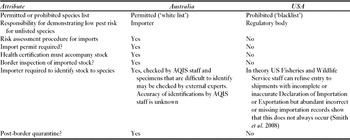
Regulation of imports of aquarium stock usually involves quarantine and inspection protocols. These are aimed primarily at control of diseases and parasites but are often integrated with any protocols the country may operate for imported pests. Whittington and Chong (Reference Whittington and Chong2007) reviewed the quarantine policies for import of fish into 27 countries worldwide and classified them as ‘stringent’ or ‘non-stringent’ on the basis of their levels of pre-border and border controls. The regime in Australia, which includes requirement for health certification, border inspection or post-border quarantine, was classified as stringent (Table 1). The quarantine regime of the USA, in contrast, lacks any of these requirements and was classified as non-stringent. Import to the USA of potential environmental pests is managed principally under the provision for ‘injurious wildlife’ in the Lacey Act (Code of Federal Regulations, title 50, part 16) but this legislation has failed to protect ecosystems against animal invasions, and only 17 taxa (including two families and two genera of freshwater fish, crabs in the genus Eriocheir and mussels in the genus Dreissena) are currently prohibited (Fowler et al. Reference Fowler, Lodge and Hsia2007). Fowler et al. (Reference Fowler, Lodge and Hsia2007) have identified the lack of a rigorous and consistent risk assessment process as another factor undermining the effectiveness of the Lacey Act in regulating potentially invasive species. Simberloff (Reference Simberloff2006) also emphasized the failure of the ‘blacklist’ approach (i.e. list of prohibited taxa, such as those defined as ‘injurious’ under the Lacey Act) to prevent the introduction of invasive species to the USA, and the need for complementary ‘white lists’ of permitted taxa, such as exists in Australia.
Summary of differences in regulation of import of live marine organisms to Australia and the USA.

All Australian states and territories are required to develop policies and guidelines for assessing risks associated with domestic (including interstate) movement of live aquatic organisms, in accordance with the National Policy for the Translocation of Live Aquatic Organisms (Ministerial Council on Forestry, Fisheries and Aquaculture 1999). The objective of this policy is to ‘provide a consistent national framework to assess the potential risk associated with all proposals for translocation of live aquatic organisms’. The policy requires that all translocation proposals undergo a risk assessment process, particularly with regard to pest potential, potential to introduce parasites and diseases, and possibilities of affecting biodiversity. Standardized protocols may be used to assess similar applications. The process includes assessment of the likelihood and consequences of an introduction and the mechanisms for risk management and minimization.
Internet trade in marine aquarium species via on-line retailers, hobbyist sites and auction sites is a growing and largely unregulated means for translocation of pest species in the USA, using the mail service, commercial courier companies or other means (Kay & Hoyle Reference Kay and Hoyle2001; Walters et al. Reference Walters, Brown, Stam and Olsen2006).
The objectives of the present study were to: (1) characterize the trade in marine ornamental species in Australia at the national and state levels; (2) describe regulatory arrangements for managing pest risks in Australia; and (3) contrast regulation of the trade in Australia with that in the USA, which operates in a non-stringent regulatory environment. We begin with a characterization of the transfer chain for marine ornamental species, from supplier to consumer (including a limited review of online trading), and then provide more detail on the nature and regulation of each stage in the chain. Given the growing biosecurity risks associated with, and the current lack of information on, the marine aquarium trade (Padilla & Williams Reference Padilla and Williams2004), an assessment of the trade and its regulation under a relatively stringent regulatory regime is likely to be of broader relevance.
METHODS
Information on the size and structure of the marine aquarium trade in Australia was obtained from the Global Marine Aquarium Database (GMAD; Wabnitz et al. Reference Wabnitz, Taylor, Green and Razak2003), import data for aquarium animals and plants supplied by the Australian Quarantine and Inspection Service (AQIS, part of the Department of Agriculture, Fisheries and Forestry [DAFF]), summary trade data from the website of the Australian Bureau of Agricultural and Resource Economics (ABARE; Love & Langenkamp Reference Love and Langenkamp2003) and from a telephone survey of a sample of businesses trading in marine aquarium species.
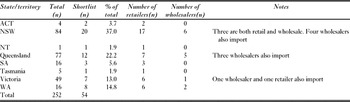
For the telephone survey, a list of relevant retailers and wholesalers was obtained from several Internet-accessible business directories. This preliminary search produced a list of approximately 250 businesses whose advertisements or website indicated that they traded in marine species (Table 2). Some businesses were removed from the list because they were no longer trading in marine species and those without email addresses were also removed to facilitate communication. The list was further reduced to achieve a target number of about 50, consistent with the resources available for the study, but ensuring proportional representation among states and among types represented (principally retailers and wholesalers). The shortlist was developed in collaboration with the Pet Industry Association of Australia (PIAA). Each business was contacted by telephone during the period 23 May–1 June 2007, six days after an explanatory email was sent out by PIAA. The final number of businesses that completed the survey was 37, a comparable sample size to those in the surveys of the marine aquarium trades in Florida, New England and San Francisco (Larkin & Degner Reference Larkin and Degner2001; Weigle et al. Reference Weigle, Smith, Carlton and Pederson2005; Chang et al. Reference Chang, Grossman, Spezio, Weiskel, Blum, Burt, Muir, Piovia-Scott, Veblen and Grosholz2009).
Geographical distribution and types of businesses selected for the telephone survey. ‘Total’ indicates the number of businesses that deal in marine species. ‘Shortlist’ indicates the number selected for the survey. ACT = Australian Capital Territory, NSW = New South Wales, NT = Northern Territory, SA = South Australia, WA = Western Australia.

The survey questionnaire was designed to obtain information on several aspects of the retail and wholesale trade in marine aquarium species, including: (1) the numbers of species and individuals of marine organisms that the business sells; (2) sources of stock; (3) whether the business sells ‘live rock’; (4) how dead or surplus stock is disposed of; (5) how water in which animals and plants were received or held is disposed of; (6) the interviewee's knowledge of marine pest issues; (7) any measures the business takes, or would be willing to take, to encourage customers not to release unwanted specimens; and (8) whether the business is affiliated to PIAA or another industry organization. Responses to questions that sought numerical responses were coded into range classes for analysis.
To identify specimens being traded informally among hobbyists within Australia, we undertook a brief review of marine aquarium hobbyist websites and internet auction sites. The principal internet auction site in Australia, eBay (http://www.ebay.com.au), was searched on 23 March 2007, but it was readily apparent that this site is not used much for trading live aquarium organisms because of eBay's prohibition on the sale of livestock in Australia (http://www.ebay.com.au/help/policies/wildlife.html). This is in contrast to the situation in the USA, where specimens of Caulerpa and live rock could be readily obtained via eBay auctions (Walters et al. Reference Walters, Brown, Stam and Olsen2006), and in New Zealand (Derraik & Phillips Reference Derraik and Phillips2010).
We also searched the Marine Aquarium Society of Australia (MASA; see http://www.masa.asn.au/) equipment and livestock trading forum, covering all postings made during the period 1 March–2 April 2007 (total searching time 270 minutes, 279 postings including 61 of livestock for sale and 35 to buy). Our investigations indicated that this is the most important Australian website for trading marine aquarium items.
Information on the regulatory frameworks for import and translocation of ornamental marine species was obtained from the websites of relevant national (AQIS, DAFF, the Department of the Environment and Water Resources, DEWHA) and state/territory agencies, and also by reviewing the relevant statutes and statutory instruments (such as relevant fisheries regulations). This information was then summarized and sent out to contacts in the relevant agencies for comment. We also asked specific questions about how state agencies would deal with applications to import or translocate recognized pest species and arrangements for verifying applicants’ claims on permit applications (including the identity of the species imported).
RESULTS
Importation
Transfer pathways
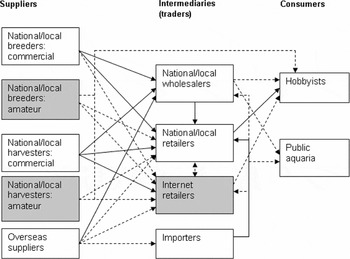
The survey of marine aquarium businesses identified a variety of sources of stock, namely overseas exporters, domestic breeders and wild fisheries located in several states (Fig. 1). These provided stock to retailers directly or via wholesalers. There is also a relatively small amount of unrecorded trade among hobbyists, as identified by the review of internet trading sites.
Components and exchange points of the transfer network for marine aquarium organisms. Solid arrows indicate major links (as identified by the survey of wholesalers and retailers) and dotted lines indicate minor links. Grey boxes are assumed components not identified in the survey.

Among the seven wholesaler respondents, the range of stock obtained directly from overseas was 0–90% (median 50%). All obtained at least some of their stock from Australian producers or wild harvesters and only one obtained stock from an Australian importer. Ten per cent of retailers (three out of 30) imported stock direct from overseas. Most obtained their stock from Australian importers and/or wholesalers, producers or wild harvesters. Only 10% of retailers (three out of 30) obtained all of their stock from Australian importers, 20% (six out of 30) obtained all of their stock from Australian producers or wild harvesters, and the remainder used both of these sources.
The transfer pathway for marine species within Australia (Fig. 1) can therefore be relatively simple. For example, the simplest pathway was from producer or wild harvester within Australia direct to retailers and then to the consumer (hobbyist). The most complex pathways identified by the survey involved the sequence of: overseas collector or producer → Australian importer → wholesaler → retailer → consumer; or Australian producer or wild harvester → wholesaler → retailer → consumer.
Types and quantities of marine aquarium species imported
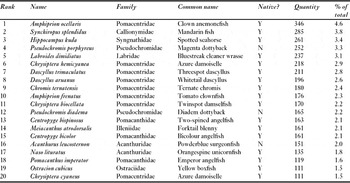
GMAD records show that 212 species of marine fish, representing 35 families, were imported to Australia for the aquarium trade during 1997–2003. Pomacentrids (damselfish, including anemonefish) were the most commonly-imported family (36.2% of individuals), followed by pomacanthids (angelfish, 12.0%), acanthurids (surgeonfish and tangs, 8.2%), labrids (wrasse, 7.9%), pseudochromids (dottybacks, 6.3%), chaetodontids (butterflyfish, 3.9%), callionymids (dragonets, 3.9%), syngnathids (seahorses and pipefish, 3.8%), blenniids (blennies, 3.1%) and ostraciids (boxfishes, 2.0%). The most popular species imported during the same period was clown anemonefish (Amphiprion ocellaris) (Table 3).
The 20 most commonly-imported marine aquarium fish to Australia (data from GMAD: total recorded individuals from 1997–2001 = 7592 across 212 species). Information on whether a species is native to Australia was derived from FishBase (Froese & Pauly Reference Froese and Pauly2002).

A total of 278 447 marine fish were legally imported into Australia in 2006 (data from AQIS). Marine fish represented only a small proportion of the total number of ornamental fish imported (1.8% across all states and less than 10% in any state). Nine countries exported marine aquarium fish to Australia in 2006, with Indonesia by far the largest supplier (64% of all marine fish imported), followed by the Philippines (16%) and Vanuatu (10%).
Domestic trade
Among the seven wholesaler respondents, four did not stock corals, and none stocked more than 50 species. All of the wholesalers sold fish, and the modal response category for number of species stocked was 1–10 (median category 11–20). Only two of the wholesalers sold marine plants, and both of these sold only one species, which is consistent with the pattern shown among retailers (see below).
Most retailers stocked 21–50 species of corals (the modal and median category) and all 30 respondents stocked at least some corals. All retailer respondents stocked at least some fish and most stocked between 21–50 types of fish (median category). Numbers of types of invertebrates (other than corals) were generally smaller than those of corals or fish (modal category 1–10, median 11–20) and two of the 30 respondents did not stock any non-coral invertebrates. Plants were even less commonly stocked, with 18 respondents stocking none, and 10 stocking less than 10 types.
All retailer respondents sold live rock and 60% (18 out of 30) obtained their stock from Queensland. Other sources were Western Australia, Northern Territory and Victoria, and 20% (six out of 30) of the retailers sourced live rock from more than one state/territory. Three of the seven wholesalers sold live rock, obtaining it from Queensland, Western Australia or both.
Unrecorded trade
Internet trade in live marine aquarium organisms among hobbyists in Australia suggested that about 900 fish, representing 16 families, may be offered for sale through the most popular site each year (extrapolating from the month sampled, March 2007). Trades of fish were dominated by clownfish (pomacentrids: 25% of sales) and tangs (acanthurids: 19% of sales). Muraenids (moray eels) and balistids (trigger fish) ranked higher on the list of families traded on the MASA site than they do among imports to Australia. Live rock, corals and various other invertebrates from a range of phyla were also offered for sale. Specimens of Caulerpa were listed but the species involved are not known. The large majority of trades (111 out of 116 trades where both the source and destination state were identified) were within the same state and all involved species that are on the Live Import List (http://www.environment.gov.au/biodiversity/trade-use/lists/import/pubs/live-import-list.pdf) or native to Australia (and so may have originated from the domestic aquarium fishery).
Understanding and management of pest risks
Responding retailers generally dispose of unwanted stock by freezing the specimen and putting it out for municipal waste collection, but corals are often bleached and resold. Wholesalers, some of whom were also importers and, therefore, subject to AQIS regulation, generally either freeze or incinerate unwanted, dead or diseased stock. Some specimens are put into municipal sewers (whether dead or alive was not stated) or used as food for other stock. Quarantine material is either frozen and sent to AQIS for disposal or incinerated. Again, corals are commonly bleached and resold.
Retailers dispose of the water in which animals and plants are received from suppliers, or held in the store, by discharging it to the sewer, incorporating it into the store's aquarium system, sterilizing it (by unspecified methods), or bagging it and putting it out for municipal waste collection. One retailer was allowing the water to discharge to their car park and evaporate. In accordance with AQIS guidelines, three of the wholesalers treated water and others discharged it to the sewer. Some incorporated it into their own aquarium system; this was presumably water that had not been used to transport or hold quarantine material.
Twenty-five of the 30 retailers surveyed in Australia had heard of marine pests, but 12 of these had only heard of the problem and claimed no understanding of it. Three respondents did not think that marine pests were a problem. Responses were fairly evenly spread among states/territories. Among the seven wholesalers surveyed, only one knew nothing at all about marine pests, two had heard of the issue and the other four believed that they knew enough to explain the issue to another person.
On the more specific issue of marine pests related to the aquarium trade, 22 out of 30 retailers (73%) had heard of marine aquarium pests and could name one or more species. These were commonly either Caulerpa taxifolia (13 of 30 respondents) and/or the north Pacific sea star (Asturias amurensis, four respondents), although the latter is not an aquarium species. Two respondents stated that they had noticed other organisms on consignments of live rock that they had received. Only five respondents had not heard of any marine aquarium pests.
Knowledge of marine aquarium pests among wholesalers was similar to that of retailers, with four out of seven respondents indicating that they had heard of, and could name, one or more pest species (again, Caulerpa taxifolia was the species most commonly named: three out of seven respondents). A further two respondents had heard of the problem but could not name any species. There was no evidence from our survey that wholesalers were any better informed on pest issues than retailers.
All of the wholesalers and retailers surveyed provided direct advice to customers on appropriate handling and disposal of unwanted stock when requested, and many also provided written information (5/7 wholesalers, 10/30 retailers). Eighty-six per cent of wholesalers and 97% of retailers said that they would consider displaying posters or providing brochures on handling and disposal of unwanted stock, and 71% and 90% of wholesalers and retailers, respectively, were willing to consider displaying information on marine pest.
DISCUSSION
Importation
The relative simplicity of the supply pathway in Australia is consistent with the findings of the study by Weigle et al. (Reference Weigle, Smith, Carlton and Pederson2005) of businesses in Massachusetts (USA) in which the transfer pathway for marine aquarium species involved only four levels of exchange and a total of six links between the collector and consumer (compare with seven principal links in the Australian context; Fig. 1), with each level playing a clearly-defined role. Australian wholesalers may also act as importers and some wholesalers also act as retailers to the public, reducing the potential number of levels to: overseas collector or producer → Australian importer/wholesaler → consumer.
The relatively popularity of species imported to Australia reflects global patterns, with pomacentrids the most commonly-traded species (43% of trade), followed by pomacanthids, acanthurids, labrids, gobiids, chaetodontids, callionymids, microdesmids (wormfish), serranids (groupers, cods, anthias, basslets and others) and blenniids (Wabnitz et al. Reference Wabnitz, Taylor, Green and Razak2003). The number of marine fish imported to Australia as a proportion of the total number is similarly to that for ornamental fish imported to the USA (4%; Wood Reference Wood2001).
Apart from the two species of Pseudochromis and Acanthurus leucosternon, all the species most commonly imported to Australia (Table 3) are also native to parts of Australia. Establishment of feral populations by these species may still be of concern, however, in terms of potential genetic or disease effects on native populations, or establishment in regions of Australia where they do not occur naturally (such as between the west and east coasts). For example, invasive populations of Caulerpa taxifolia in temperate regions of Australia may have derived from tropical populations (possibly via the aquarium trade), rather than from a genetically-modified cold-tolerant ‘aquarium’ strain (Murphy & Schaffelke Reference Murphy and Schaffelke2003; Glasby & Gibson Reference Glasby and Gibson2007).
The effectiveness of controls on imported organisms into Australia depends on the rigour of inspection at the border (for example the proportion of consignments inspected or the probability of detection of non-permitted species in inspected consignments). This, in turn, depends on the availability of resources, the level of staff training and many other variables. Although fish specimens of uncertain identity are forwarded to taxonomic experts for analysis, the precision of identifications that AQIS officers carry out without referral to taxonomic specialists is unknown and may be less than 100%, dependent upon level of training and expertise. This leaves a gap through which mislabelled and/or misidentified species, and hence species not on the import list or of unknown identity, could enter Australia. For imported plants, AQIS relies on the statement of the plant's identity in the import documentation and does not inspect material to confirm identify. The effectiveness of risk assessments may be significantly reduced by lack of information (Simberloff Reference Simberloff2005).
McNee (Reference McNee2002) suggested that 5–10% of fish imported into Australia for the aquarium trade are smuggled. This value applies to the total of all imported fish, the large majority of which are freshwater fish. If the same percentage value also applies to marine species alone, it implies that 14 000–28 000 marine aquarium fish may have been smuggled into Australia in 2006. In reality, the percentage is probably much smaller for marine species because it is a smaller and more specialized hobby. Fisheries for marine aquarium fish, corals and other invertebrates within Australia can also supply a wide range of species, which may reduce the incentive to smuggle unusual specimens into the country. In contrast, Chan and Sadovy (Reference Chan and Sadovy1998) estimated that official declarations of marine aquarium fish imported to Hong Kong, which has a non-stringent quarantine policy (Whittington & Chong Reference Whittington and Chong2007), underreported by a factor of 2–3.
Regulation of imports
The import into Australia of live organisms for the marine aquarium trade is controlled and managed by the Australian Government through DEWHA and AQIS in the case of animals and Biosecurity Australia (BA, an agency of DAFF) and AQIS in the case of plants. Translocation of animals and plants for the aquarium trade within Australia is controlled through state/territory legislation.
Eligibility of animal species for live import into Australia is determined by their inclusion in the List of Specimens taken to be Suitable for Live Import (the Live Import List), established under the Environment Protection and Biodiversity Conservation Act 1999 (EPBC Act). Any organism not on the list cannot legally be imported into Australia (such lists of permitted species are often referred to as ‘white lists’).
Part 1 of the current list (3 April 2009) contains 65 taxa (families, genera or species) of Osteichthyes (bony fishes), including many popular aquarium species, and two species of Chondrichthyes (cartilaginous fishes), that do not require a permit for live import. In total, Part 1 of the list allows import of 443 genera and 3261 species. There are no marine invertebrates in Part 1 and consequently none can be imported live into Australia without a permit.
Part 2 contains live animals and plants suitable for live import with a permit issued under the EPBC Act. All but two of the fish taxa and most marine invertebrates (the exceptions being two species of Haliotis [abalone], two of Nautilus [shelled cephalopods] and the pearl oyster, Pinctada maxima) in Part 2 can only be kept in high security facilities once imported and are therefore unsuitable for ornamental purposes. It includes animal species listed in Appendices I, II or III of the Convention on International Trade in Endangered Species (CITES).
In addition to compliance with the Live Import List, a permit to import live fish for ornamental purposes must be obtained from AQIS prior to arrival of fish in Australia. In 2006, 94 were issued, 38 of which were for marine species. AQIS is primarily concerned with administering the quarantine risk associated with species on the Live Import List. Each consignment must be accompanied by health certification from the AQIS-approved Competent Authority in the exporting country and all marine ornamental fish are examined and quarantined at AQIS-approved premises for seven days. Fish are examined by AQIS at the end of the quarantine period for signs of pests or disease before being released for on-sale. Any contaminating biological material in the consignment is destroyed or re-exported.
Live fish may only be imported from certain AQIS-approved countries (there are 26 in the current list) and the AQIS-approved Competent Authority in each approved country assesses exporters and exporters’ premises for approval to export to Australia. Assessment is made against a set of standards provided by AQIS, including making sure that the exporter is aware of the species permitted for export to Australia.
In the case of plants, species included in a permitted list (the Permitted Seeds List contained in Schedule 5 of the Quarantine Proclamation 1998, see URL http://www.comlaw.gov.au/ComLaw/Legislation/LegislativeInstrument1.nsf/0/64472ADA6FBF65CBCA256F700080C866?OpenDocument; the list also applies to live plants) do not require a permit for import. None of the commonly-kept marine aquarium plants are currently on the Permitted Seed List. Any species not on the list is subject to a weed risk assessment (WRA) by Biosecurity Australia (Biosecurity Australia 2008). The WRA is applied to any new species of imported plant (including macroalgae) whether they enter as seeds, plants or tissue culture and regardless of their use in Australia. Management of quarantine risks for plants is done once they have arrived in Australia.
The past effectiveness of Australia's regulation of the import of marine aquarium species is difficult to judge. Although there have been very few, if any, documented cases of non-indigenous marine species becoming established in the wild in Australia via the aquarium trade, this may be the result of low probability of detection of exotic species when present as small populations with limited distribution. A worldwide literature review for the present study identified 30 species of marine organisms (including 11 isolated or uncertain records; Appendix 1, see supplementary material at Journals.cambridge.org/enc) that have likely been introduced to natural waters outside their native range via the aquarium trade. Other than Caulerpa spp., all of these records are from Florida or Hawaii and most involve Indo-Pacific species, 20 of them native to Australia. The ability to identify exotic species in the field in Australia is consequently likely to require more specialist taxonomic skills than in the western Atlantic.
Twenty-two species of ornamental freshwater fish are known to be established in Australia, 11 since 1990 (Fig. 3 in Lintermans Reference Lintermans2004). Nine of the 22 species are on the Live Import List and have presumably undergone some form of risk assessment. Lintermans (Reference Lintermans2004) and McDowall (Reference McDowall2004) pointed out that inclusion of a species on a permitted list, such as the Live Import List, may reflect a lack of information to support a valid establishment risk assessment, rather than an absence of risk., and that a precautionary approach is therefore justified.
Translocation and domestic trade
Translocation of marine aquarium organisms within Australia
The current state of progress towards compliance with the National Policy for the Translocation of Live Aquatic Organisms varies among states. There is no requirement to keep records of the movement or sale of a species once it has entered Australia (whether legally or illegally), nor any means of recalling it if it is subsequently identified as an environmental risk (Lintermans Reference Lintermans2004).
States regulate movement and possession of live aquatic animals via lists of prohibited species (‘black lists’). Prohibited lists focus very strongly on freshwater species, and any marine species included tend to be those that are already present in Australia. Although these prohibited lists do not, therefore, generally provide a mechanism for preventing translocation of potential marine pests for the aquarium trade, the fisheries legislation of several states requires permits for import or translocation of live fish. In most jurisdictions permits are unlikely to be granted for recognized pests and assessment of applications for permits may include an explicit risk-assessment process, as required by the National Policy. Inspection processes to verify the information provided with applications generally involve random, on-site checks of species identity, as resources permit. Other states rely on the honesty of the applicant in declaring the identity of the species to be translocated.
In addition to a list of ‘noxious’, ‘controlled’ and ‘pest’ species, Tasmanian legislation specifies a permitted list of tropical marine invertebrates that may be imported without a permit. Queensland also operates a permitted list, in addition to its list of prohibited., ‘noxious’ species, specifying 160 ‘prescribed’ non-indigenous freshwater species that may be kept. South Australia has additional lists of low-risk and high-risk species.
Domestic breeding and harvesting
Published summaries of state aquacultural production statistics for aquarium species do not generally distinguish between freshwater and marine species, but there appears to be a trend of increasing aquacultural production of aquarium species over time, often with considerable year-to-year variation. Total production across the four main producer states of Victoria, Queensland, New South Wales and Western Australia (ranked by decreasing number of fish produced and value of product) in 2001–2002 was 6.9 million marine and freshwater fish (Love & Langenkamp Reference Love and Langenkamp2003). Exports represented 18.3% of production in 1995–1996 but only 2% in 2001–2002. Both native and exotic species are cultured, including seahorses (Hippocampus spp.), clownfish (Amphiprion spp.), dottybacks (Pseudochromis spp.), cardinalfish (Apogon spp.), yellow devilfish (Assessor flavissimus) and comets (Calloplesiops altivelis).
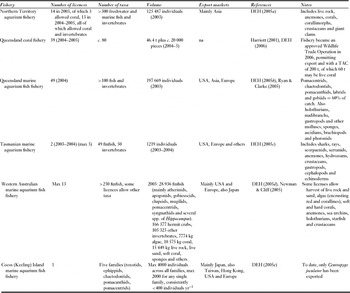
Commercial collecting of marine aquarium species occurs in the Northern Territory, Queensland, Tasmania, Western Australia and the Cocos (Keeling) Islands (Table 4). A wide range of hard and soft corals, ‘live rock’, live sand, marine invertebrates and fish (over 100 species in Queensland alone, not including corals) are taken, including tropical and temperate species. The Cocos fishery currently targets only one species (the yellow-headed angelfish, Centropyge joculator). Specimens are sold on the domestic market and also exported to North America, Europe and Asia. Fisheries are regulated at state level, usually by licensing of collectors, bag limits and restrictions on species taken and gear used. Amateur collection is unquantified but considered to be negligible, and fishers are usually subject to gear restrictions and bag limits.
Summary data on wild fisheries for marine aquarium species by state/territory. na = not applicable (see notes column).

Following the example of the USA (Kay & Hoyle Reference Kay and Hoyle2001; Walters et al. Reference Walters, Brown, Stam and Olsen2006), Internet trade in marine species is likely to become increasingly important in Australia. The relatively high ranking of moray eels and trigger fish among Internet trades compared with imports may reflect the large size that individuals can grow to, and their predatory behaviour.
Understanding and management of pest risks
The responsible attitude to disposal of stock and water in Australia contrasts with some descriptions of the situation in the USA. All of the marine ornamental businesses and public aquarium respondents in Weigle et al.'s (Reference Weigle, Smith, Carlton and Pederson2005) study who discharged water to local water bodies, treated or filtered the water before discharging it. This suggests that individuals trading in aquarium species may have a better awareness of the associated risks of introducing non-local species, and their potential environmental effects, than individuals in other sectors. However, Jensen et al. (Reference Jensen, Lichtkoppler, Starinchak and Meyers2006) found that 30% of freshwater aquarists and pond-keepers surveyed in the USA had unwanted specimens during the previous three years and, of these 30%, 18% dealt with the problem by releasing fish, plants, freshwater crayfish, snails or turtles into natural waterways (a total of 43 releases). The marine aquarium trade may also serve as a route for the introduction of non-indigenous species, some of which may have the potential to become pests.
Although many retailers and wholesalers interviewed were aware of the issue of marine pests, including those associated with the aquarium trade, most seemed to be very confused about marine pests and had limited understanding about the significance of the issue. In many cases interviewees appeared to equate issues related to a species’ pest potential with issues related to disease. Consequently, they tended to consider that, if the animals or plants had been quarantined, there was no risk. One apparent factor in their perception of potential environmental effects of aquarium species released into natural water bodies was an assumption that exotic aquarium species could not survive in Australian conditions. There was generally little appreciation of the potential environmental and genetic effects that aquarium species may have in feral populations. Even in the case of Caulerpa, awareness often related to the possibility of incurring penalties for selling it rather than the environmental effects it may have.
There is clearly a willingness among wholesalers and retailers to provide advice on appropriate handling and disposal of stock to customers, and the limited numbers of businesses that currently provide published information may simply reflect lack of access to, or awareness of, suitable material.
The importance of involving representatives of the aquarium industry and hobbyists in developing regulatory frameworks, of which raising public awareness is a part, is now recognized by regulators (for example see DAFF 2005). Attempts by the United States Fish and Wildlife Service to amend the Lacey Act in the 1970s to restrict imports of live animals to a list of permitted species considered to be of low risk of invasiveness, or to increase the number of prohibited species, failed partly because of strong opposition from the pet industry (Fowler et al. Reference Fowler, Lodge and Hsia2007). This opposition stemmed in part from lack of public information on what types of species would be permitted and how risk would be assessed. Previous attempts to regulate the ornamental fish industry in Australia have also failed, largely because of failure to consult and engage with industry stakeholders (DAFF 2005).
ACKNOWLEDGEMENTS
This study was funded by DAFF project number 01/2007. Sarah Gowland and Brett Evans (DAFF) provided helpful advice on running the study and comments on an earlier version of the manuscript. Thank you to the numerous staff of Australian Commonwealth and state/territory governments who provided advice and comment during this study, in particular: Rebecca Chapman, Helen Cribb, Joel Freeman, Louise Galli, John Gilliland, Karen Hollingworth, Scott Horan, Alistair Morton, Caryn Scott, Stephanie Turner and John Wright. We are also grateful to Anthony Ramsay and Colin Bransgrove of the Pet Industry Association of Australia. Thanks to Oli Floerl for comments on an earlier draft and the NIWA library staff for their usual excellent service.