Introduction
Recent estimates suggest that the global biomass of mesopelagic fishes could be the order of 9–19.5 gigatonnes (Irigoien et al., Reference Irigoien, Klevjer, Røstad, Martinez, Boyra, Acuña, Bode, Echevarria, Gonzalez-Gordillo, Hernandez-Leon, Agusti, Aksnes, Duarte and Kaartvedt2014; Proud et al., Reference Proud, Cox and Brierley2017, Reference Proud, Handegard, Kloser, Cox and Brierley2019), roughly equivalent to 100 times the annual tonnage captured worldwide by commercial fishing (Hidalgo and Browman, Reference Hidalgo and Browman2019; FAO, 2022). Myctophids (members of the family Myctophidae) are one of the most important members of mesopelagic fishes in the world's oceans both in terms of abundance and biomass (Gjøsæter and Kawaguchi, Reference Gjøsæter and Kawaguchi1980; Brodeur and Yamamura, Reference Brodeur and Yamamura2005). They are distributed throughout the oceans from subarctic and Antarctic to tropical waters, and from waters over continental shelves and slopes to the open oceans, and include 249 species in 32 genera (Priede, Reference Priede2017). The ecological roles of myctophids in the oceanic ecosystems are recognized as a critical mid-trophic level that transfers energy from the zooplankton to upper trophic levels, mainly because of their huge biomass (Davison et al., Reference Davison, Checkley, Koslow and Barlow2013; Choy et al., Reference Choy, Wabnitz, Weijerman, Woodworth-Jefcoats and Polovina2016; Eduardo et al., Reference Eduardo, Lucena-Frédou, Mincarone, Soares, Le Loc'h, Frédou, Ménard and Bertrand2020).
The most remarkable biological and ecological feature of myctophids is their diel vertical migrations (DVM) between the mesopelagic and epipelagic layers (Clarke, Reference Clarke1973; Oozeki et al., Reference Oozeki, Hu, Tomatsu, Noro, Kubota, Sugisaki, Sassa, Takasuka and Tokai2012; Sutton, Reference Sutton2013). The DVM of myctophids has been regarded as an upward feeding migration from the mesopelagic layer into the productive epipelagic layer at night (Hopkins and Baird, Reference Hopkins and Baird1985; Williams et al., Reference Williams, Koslow, Terauds and Haskard2001; Dypvik and Kaartvedt, Reference Dypvik and Kaartvedt2013). Also, nighttime feeding in the epipelagic layer has been considered to be an adaptive response to escape from visual epipelagic predators such as larger fishes, squids, sea birds and marine mammals (Robison, Reference Robison2003; Brodeur and Yamamura, Reference Brodeur and Yamamura2005). Main prey items of myctophids are crustacean zooplankton (Gartner et al., Reference Gartner, Crabtree, Sulak, Randall and Farrell1997; Pusch et al., Reference Pusch, Schiel, Mizdalski and von Westernhagen2004b; Drazen and Sutton, Reference Drazen and Sutton2017), while some myctophid species feed mainly on gelatinous plankton (Takagi et al., Reference Takagi, Yatsu, Itoh, Moku and Nishida2009; Bernal et al., Reference Bernal, Olivar, Maynou and de Puelles2015; Sassa and Takasuka, Reference Sassa and Takasuka2020). Based on analyses of diel changes in the stomach contents (SC), daily rations (DR) of myctophids have been shown to range from approximately 0.4 to 5.9% of the body weight per day (Moku and Hidaka, Reference Moku and Hidaka2002; Pusch et al., Reference Pusch, Hulley and Kock2004a; Tanaka et al., Reference Tanaka, Sassa, Ohshimo and Aoki2013; Drazen and Sutton, Reference Drazen and Sutton2017; Contreras et al., Reference Contreras, Olivar, Hulley and González-Gordillo2020), although information on the DR is still limited for this family.
Various myctophid species are reported to be multiple batch spawners with relatively short interspawn periods, usually within several days, and show high relative batch fecundities of 480–870 eggs g−1 (Lisovenko and Prut'ko, Reference Lisovenko and Prut'ko1987; Gartner, Reference Gartner1993; García-Seoane et al., Reference García-Seoane, Bernal and Saborido-Rey2014; Sassa et al., Reference Sassa, Tanaka and Ohshimo2016; Sarmiento-Lezcano et al., Reference Sarmiento-Lezcano, Triay-Portella, Guerra-Marrero, Jiménez-Alvarado, Rubio-Rodríguez, Núñez-González, Bordes and Castro2020). Egg production of myctophids is considered to be at a similar level as that of anchovies (Engraulis spp.), one of the most active multiple spawners (Alheit, Reference Alheit1993; Sassa, Reference Sassa, Nagai, Saito, Suzuki and Takahashi2019; Caiger et al., Reference Caiger, Lefebve and Llopiz2021).
Diaphus fulgens is a small-sized myctophid [maximum standard length (SL) of approximately 45 mm] and broadly distributed in subtropical–tropical waters of the Indo-Pacific, being one of the most abundant species in the genus Diaphus in the Kuroshio waters (Wisner, Reference Wisner1976; Kawaguchi and Shimizu, Reference Kawaguchi and Shimizu1978; Nafpaktitis, Reference Nafpaktitis1978). They perform DVM from the mesopelagic layer between 400 and 600 m during the day up to the epipelagic layer between 20 and 200 m at night (Kawaguchi and Shimizu, Reference Kawaguchi and Shimizu1978; Ohizumi et al., Reference Ohizumi, Watanabe, Moku and Kawahara2001). The multiple batch spawner D. fulgens actively spawns in the Kuroshio waters of the East China Sea (ECS) during late winter (Sassa and Takahashi, Reference Sassa and Takahashi2022). Spawning interval of this species is estimated to be 3–4 days, with a mean relative batch fecundity of 726 eggs g−1 (Sassa and Takahashi, Reference Sassa and Takahashi2022). The high egg productivity of D. fulgens would be supported by feeding during the spawning season, as suggested for some species of this family (Gartner, Reference Gartner1993; Sassa et al., Reference Sassa, Tanaka and Ohshimo2016; Sassa and Takasuka, Reference Sassa and Takasuka2019); however, there is no information on the feeding ecology of this species to assess this hypothesis.
The present study described the diet composition, diel feeding periodicity and DR of mature adult D. fulgens in the Kuroshio waters of the ECS during the spawning season. Estimated daily caloric intake was compared with the caloric value to produce a batch of oocytes to discuss the energy budget required to sustain multiple spawning.
Materials and methods
Sample collection
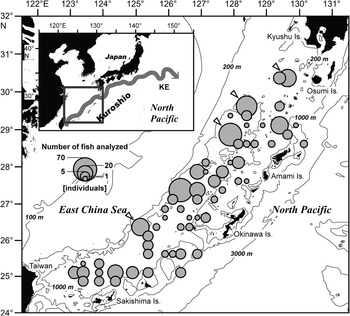
Diaphus fulgens were collected at 89 stations in the Kuroshio waters from the slope region to the Okinawa Trough in the ECS during February to March in 2008 and from 2012 to 2017 onboard either the RV ‘Yoko-Maru’ (Japan Fisheries Research and Education Agency) or ‘Kaiyo-Maru No. 7’ (Nippon Kaiyo Co. Ltd.) (Figure 1, Table 1). The specimens were collected over almost the whole distribution depth range during different hours of both the day and night. In 2008, a midwater otter trawl (25 × 25 m mouth opening; 9 mm mesh of cod end) tow was conducted for 30 min horizontally during the nighttime (2200–0400 h) in the epipelagic layer between 30 and 60 m depth (Table 1). A Matsuda–Oozeki–Hu trawl (MOHT, 2.24 × 2.24 m mouth opening; 1.59 mm mesh net) (Oozeki et al., Reference Oozeki, Hu, Kubota, Sugisaki and Kimura2004) was obliquely towed from the surface to 152 ± 3 m [mean ± standard deviation (SD)] at night in 2012 and from the surface to 518 ± 45 m (mean ± SD) regardless of day or night during 2013–2017 (Table 1). Mean towing duration (±SD) of the MOHT was 38 ± 4 min in 2012 and 58 ± 12 min during 2013–2017. In 2013, a small-sized midwater trawl [larval catcher net (LC net, Tokyo, Japan), Nichimo Co. Ltd., 8 × 8 m mouth opening; 9 mm mesh net] was towed during the daytime for 40–60 min in the mesopelagic layer between 400 and 600 m depth where the deep scattering layers were observed (Table 1). During all towings, net depth was monitored acoustically using a trawl monitoring system (Scanmar AS, Åsgårdstrand, Norway). Samples were fixed in 10% buffered formalin-seawater or preserved in 99.5% ethanol at sea.
Geographical distribution of Diaphus fulgens caught in the Kuroshio waters of the East China Sea in 2008 and 2012–2017. The number of individuals in each sampling location was combined within 30′ × 30′ (minute) of latitude and longitude. The size of circles indicates the number of fish examined at each site. Arrowheads indicate sampling locations where diet composition was examined. The total number of analysed specimens was 550. KE, Kuroshio Extension. Modified from Sassa and Takahashi (Reference Sassa and Takahashi2022).

Sampling data for Diaphus fulgens in the Kuroshio region for the 7 years

The maximum depth to which the MOHT sampled was averaged for each year. *Diet composition was analysed for 75 individuals collected at four nighttime sampling stations by the midwater otter trawl in 2008 (Figure 1). Research vessel: a, ‘Kaiyo-Maru No. 7’; b, ‘Yoko-Maru’. N, night; D, day.
Stomach content analysis
For 550 individuals, after SL and body wet weight (BW) were measured to the nearest 0.1 mm and 1 mg, respectively, stomachs were dissected, and the contents removed. Gonads of these individuals have already been analysed by Sassa and Takahashi (Reference Sassa and Takahashi2022). Total wet mass of the SC was weighed to the nearest 0.01 mg for the 550 individuals to analyse the diel feeding periodicity and DR. In this study, stomachs were considered ‘empty’ if the SC was <3 mg. SL of these individuals ranged from 24.3 to 43.1 mm, with a mean ± SD of 33.5 ± 2.1 mm (Figure 2), most of which have matured gonads based on histological examination (Sassa and Takahashi, Reference Sassa and Takahashi2022). The degree of stomach fullness was estimated by the stomach content index (SCI):

Standard length (SL) frequency distributions of Diaphus fulgens examined. To estimate feeding rhythm and daily ration, total wet mass of the stomach contents was weighed for all individuals. Of these, 75 individuals were examined for diet composition (filled bars). n, total number of fish analysed.

To analyse the diet composition, for 75 individuals with SCI >1% collected at four nighttime sampling stations by the midwater otter trawl in 2008 (15–20 individuals at each station) (Figure 1, Table 1), SC were counted and identified to the lowest possible taxon, based on the keys of Chihara and Murano (Reference Chihara and Murano1997). Diet composition in the present study should not be biased by incidental feeding in the cod-end after capture (i.e., net feeding) because of the adoption of a 9 mm mesh of cod end, which allowed most of the zooplankton prey to pass through. Total lengths and widths were determined to the nearest 0.01 mm under a microscope fitted with an ocular micrometer for each item for which body measurements were possible. Additionally, prosome lengths were measured for copepods; trunk lengths for appendicularians. The mean dimensions of each prey item were converted to the approximate dry weight (DW) based on equations from Uye (Reference Uye1982) and Anraku et al. (Reference Anraku, Hirota, Taniguchi, Endo and Uye1986) for copepods, ostracods and decapods; Ikeda (Reference Ikeda1990) for amphipods; Iguchi and Ikeda (Reference Iguchi and Ikeda1995) for euphausiids; Tomita et al. (Reference Tomita, Ikeda and Shiga1999) for appendicularians; and Uye (Reference Uye1982), Anraku et al. (Reference Anraku, Hirota, Taniguchi, Endo and Uye1986) and Uye et al. (Reference Uye, Nagano and Tamaki1996) for the other taxa.
The modified index of relative importance (IRI), i.e., using DW rather than the wet weight (WW) of prey items, was calculated to characterize the diet and to rank prey taxa. The IRI was expressed as the percentage of total IRI (%IRI) for each prey item i:

where %Ni is the percentage of each prey item i to the total number of identifiable prey items, %Wi is the percentage DW of each prey item i to the total DW of identifiable prey items, %Fi is the frequency of occurrence of each prey item i in the total number of stomachs examined. To obtain a robust estimation of the relative importance of the prey, the results of diet composition should be reported as %N, %W, %F and %IRI for all taxa considered (Hyslop, Reference Hyslop1980; Cortés, Reference Cortés1997).
The niche breadth of D. fulgens was based on Levins' standardized index (B sta; Levins, Reference Levins1968):

where Pi is the %IRI × 10−2 of each prey item i in the diet, and n is the number of prey categories. This index ranges from 0 (the species consumes a single item) to 1 (the species exploits all available items in equal proportions).
The feeding strategy of D. fulgens was investigated based on the modified Costello (Reference Costello1990) graphical method (Amundsen et al., Reference Amundsen, Gabler and Staldvik1996), plotting prey-specific abundance (y-axis) against %F (x-axis). The prey-specific abundance was defined as the number (or the weight) of prey item i divided by the total number (or the weight) of prey items in the stomachs that contained prey item i, expressed as a percentage. This method allows to infer information on the relative importance of the prey, feeding strategy and niche width contribution through the position of prey types along the diagonals and axes of the graph (Amundsen et al., Reference Amundsen, Gabler and Staldvik1996).
Estimation of daily ration
In the present study, samples were collected on a 24 h basis. To analyse the diel feeding periodicity, the median and mean values of SCI were determined for the time periods of 2 h intervals from 0000 to 2400 h. The sunrise and sunset times during the samplings were approximately 0650–0705 and 1820–1850 h (local time), respectively. The SCI data sampled over 7 years were pooled to get enough data in each time period for producing a reliable result of diel feeding periodicity. We assumed no significant variation in the feeding habits among years in the Kuroshio waters where both physical oceanographic and biological conditions have been shown to be stable interannually (Watanabe et al., Reference Watanabe, Kawaguchi and Hayashi2002; Sugisaki et al., Reference Sugisaki, Nonaka, Ishizaki, Hidaka, Kameda, Hirota, Oozeki, Kubota, Takasuka, McKinnell and Dagg2010; Tadokoro et al., Reference Tadokoro, Hidaka, Okunishi, Ono, Oozeki, Sassa, Setou, Shimizu, Sugimoto, Takasuka and Yamazaki2022). Our objective is to describe the average feeding habits of D. fulgens during the spawning season.
DR of food was estimated based on the temporal change in SCI using the Elliott and Persson model (Elliott and Persson, Reference Elliott and Persson1978). This model assumes that SC decline exponentially with time, and feeding is constant within each specific and consecutive sampling time interval. Food consumption for each time interval can be estimated by the following equation:

where Ct is the food consumption between time intervals t and t–1, S is the median SCI at time intervals t and t–1, t is the duration of each time interval in hours, i.e., 2 h and R is the instantaneous gastric evacuation rate (h−1). To perform accurately, the Elliott and Persson model requires that sampling intervals be 3 h or less (Elliott and Persson, Reference Elliott and Persson1978), and the present study meets this requirement. The DR was taken as the sum of Ct obtained for each interval during the period of active feeding.
R was determined from SCI over a period of fasting after a period of heavy feeding by the following equation:

where t is the time after fasting started, S 0 is the median SCI value at the start of the fasting time interval (t = 0) and St is the median SCI value at time interval t. In this study, R was estimated by a linear regression from the natural ln-transformed equation, using the data from the early morning (0400–0600 h or 0600–0800 h) to the late afternoon (1600–1800 h) when the SCI was declining (see results):

To discuss the relationship between the daily caloric intake and energetic cost of multiple spawnings, food requirements (F) of D. fulgens females based on the caloric value (cal day−1) were calculated using the following equation:

where $\overline {{\rm BW}}$ is the mean BW of D. fulgens females (mg) and DR is the daily ration estimated (% of BW). Since mean BW (±SL) of female and male D. fulgens is 520 ± 126 and 513 ± 119 mg, respectively, in the specimens used in the present study (same specimens as used in Sassa and Takahashi, Reference Sassa and Takahashi2022), 520 was adopted as the value of $\overline {{\rm BW}}$
 . A WW–DW ratio of 0.20 for mesozooplankton (Peters and Downing, Reference Peters and Downing1984) was used. Proteins form the major biochemical component of zooplankton, including copepods and appendicularians, main prey items of D. fulgens (Mayzaud and Martin, Reference Mayzaud and Martin1975; Harmelin-Vivien et al., Reference Harmelin-Vivien, Bӑnaru, Dromard, Ourgaud and Carlotti2019). In the present study, the conversion factors in energy for proteins was assumed to be 5.1 cal (=21.4 J) per 1 mg of DW of food, based on Postel et al. (Reference Postel, Fock, Hagen, Harris, Wiebe, Lenz, Skjoldal and Huntley2000) for zooplankton.
Results
Diet composition
Overall, 2263 prey items were found from the 75 stomachs examined. The maximum number of prey items per stomach (72 individuals) was found in an individual of 36.1 mm SL collected at 0200–0400 h. A total of 59 prey items were identified in the stomachs (Table 2), while Levins' standardized index B sta had a markedly low value of 0.04 which indicates a restricted niche breadth, i.e., specialized feeding.
Summary of prey items in Diaphus fulgens in the Kuroshio waters of the East China Sea during late winter in 2008

%N is the numerical percentage, %W is the dry weight percentage, %F is the frequency of occurrence percentage of fish with prey item i and %IRI is the percentage of total IRI (index of relative importance) for all prey taxa. IRI = (%N + %W) × %F.
Appendicularians were one of the most important prey items in terms of %N, %W and %F (41.0, 24.8 and 65.3%, respectively), being the highest %IRI value of 48.6% (Table 2). Mean trunk length (±SD) of appendicularians eaten was 750 ± 230 μm. Additionally, appendicularian mucus houses showed high values of %N and %F (15.8 and 54.7%, respectively), resulting in %IRI values of 13.6%. Appendicularian houses were compressed as they pass through the oesophagus and stay in the stomach, which makes the size compact, with a mean length (±SD) of 1266 ± 411 μm.
Copepods included three orders, 19 genera and 44 species or species groups, having the highest species diversity among prey items (Table 2). In terms of %W, copepods were the most dominant prey items, accounting for the cumulative %W of 53.4% for total copepods. Of these, the large-sized copepods Pleuromamma piseki and P. abdominalis were important species, accounting for %IRI values of 6.9 and 4.2%, respectively. Mean prosome length (±SD) of these two species was 1022 ± 273 and 2047 ± 438 μm, respectively. The importance of P. piseki would potentially be underestimated because of the considerable proportion of Pleuromamma spp. (%IRI = 10.2%) and Calanoida (%IRI = 8.3%), unidentifiable to the species level due to digestion, but can be considered as P. piseki, based on the similarity of the prosome length (1165 ± 475 and 996 ± 449 μm, respectively).
Based on the numerical Costello analysis, only appendicularians were located in the upper right quadrant, indicating a feeding specialization for this prey item (Figure 3A). Appendicularian houses, Pleuromamma spp., P. piseki and Calanoida were located in the lower right quadrant, contributing to a broader trophic niche breadth, although the contribution to the overall diet was limited. The other prey items were located in the lower left quadrant of the graph (Figure 3A), showing that they occurred rarely and were of relatively low importance to the overall diet. Based on the Costello analysis by weight, appendicularians, appendicularian houses, Pleuromamma spp., P. piseki and Calanoida were located in the lower right quadrant, showing a similar trend to the numerical analysis (Figure 4B). The other prey items were located in the lower left quadrant of the graph, although Pleuromamma abdominalis, P. xiphias and Euchaeta rimana showed relatively high values of prey-specific abundance (Figure 4B). These three species were consumed rarely, but when they were consumed accounted for a large proportion of the diet by weight.
Modified Costello–Amundsen plots showing relationships between prey-specific abundance, expressed as (A) number and (B) weight, and frequency of occurrence of prey items in the diet of Diaphus fulgens collected in the Kuroshio waters of the East China Sea in 2008.

Diurnal changes in (A) the percentage of empty stomachs and (B) the stomach content index (SCI) of Diaphus fulgens. Data of the same diel time period from different years were pooled. The box plots denote median values and 25 and 75% interquartiles; the lower and upper whiskers represent 10 and 90% interquartiles; while squares represent the means. The sunrise and sunset times during the sampling were approximately 0650–0705 and 1820–1850 h (local time), respectively. n, total numbers of fish analysed for each time period.

Diel feeding periodicity
Diel change in the percentage of empty stomachs and the SCI revealed a clear feeding periodicity (Figure 4). The percentage of empty stomachs increased gradually from the lowest values of 1.6% in the early morning (0400–0600 h) to the highest value of 55.0% in the late afternoon (1600–1800 h) (Figure 4A). Then, the values declined sharply to 15.8% between 1800 and 2200 h and continued to decline gradually until the early morning (0400–0600 h).
Median SCI fluctuated between 0.49 and 2.19% over 24 h, and its diurnal variation showed a reverse pattern to that of the percentage of empty stomach (Figure 4B). The SCI began to increase just after sunset from 1800 to 2000 h, then maintained at high median values of 1.16–1.24% from 2000 to 0400 h. The median SCI peaked (2.18–2.19%) in the early morning (0400–0800 h). Then, it gradually decreased throughout the day, reaching its lowest value of 0.49% in the late afternoon (1600–1800 h).
Daily ration
R was estimated assuming that the fasting period starts during the early morning (0400–0800 h) and ends in the late afternoon (1600–1800 h), when the SCI was declining (Figure 4). To show the possible range of the R, this study assumed two cases of the start period of fasting, i.e., 0400–0600 h or 0600–0800 h when the lowest value of the percentage of empty stomachs and the highest value of the median/mean SCI were observed, respectively. Data from these periods were fitted to the ln-transformed exponential function, and R was estimated to be 0.118–0.129 h−1 (Figure 5).
Decline in the median stomach content index (SCI) from the early morning (0400–0600 h or 0600–0800 h) to the late afternoon (1600–1800 h). Regression lines (A) from 0500 h (equivalent to 0 h on x-axis of digestion time) to 1700 h and (B) from 0700 h (equivalent to 0 h on x-axis of digestion time) to 1700 h. The instantaneous gastric evacuation rate (R) was estimated to be 0.118 h−1 when fasting starts at the earlier period and 0.129 h−1 when fasting starts at the later one. Ln SCI, Ln-transformed SCI; t, digestion time (h).

To estimate the DR, the median SCI during the period of active feeding (1800–0800 h) was used. Based on the model, the DR was estimated to be 4.0–4.2% of BW. Using the estimated variables of DR, food requirement per D. fulgens female was estimated as 21.2–22.3 cal day−1 in the Kuroshio waters of the ECS.
Discussion
Diet composition
Crustacean zooplankton such as copepods, ostracods, amphipods and euphausiids are major prey items for various species of myctophids in the world's oceans (Clarke, Reference Clarke1978; Hopkins and Gartner, Reference Hopkins and Gartner1992; Moku et al., Reference Moku, Kawaguchi, Watanabe and Ohno2000; Shreeve et al., Reference Shreeve, Collins, Tarling, Main, Ward and Johnston2009; Hudson et al., Reference Hudson, Steinberg, Sutton, Graves and Latour2014). In addition, dominance of gelatinous plankton, such as pteropods, salps, doliolids, appendicularians, in the stomachs of myctophids has been reported in the Kuroshio waters (Watanabe et al., Reference Watanabe, Kawaguchi and Hayashi2002; Takagi et al., Reference Takagi, Yatsu, Itoh, Moku and Nishida2009; Sassa and Takasuka, Reference Sassa and Takasuka2020) and other oceans (Baird et al., Reference Baird, Hopkins and Wilson1975; Kinzer, Reference Kinzer1982; Shreeve et al., Reference Shreeve, Collins, Tarling, Main, Ward and Johnston2009; Bernal et al., Reference Bernal, Olivar, Maynou and de Puelles2015). In the present study, the most prevalent prey item of D. fulgens was appendicularians, which dominated the SC both in number and weight. It should be noted that the %IRI values of appendicularians could be underestimated due to higher rate of digestion relative to crustacean prey items (Arai et al., Reference Arai, Welch, Dunsmuir, Jacobs and Ladouceur2003). Although appendicularians have a high water content relative to their organic content, considering the rapid rate of digestion, appendicularians are potentially as significant an energy source for myctophids as crustacean zooplanktons.
The second most important prey items were appendicularian mucus houses. Assuming that D. fulgens ate the houses together with the appendicularian bodies, the size of the intact houses was estimated to be about 3000 μm based on the mean trunk length of 750 μm (Alldredge, Reference Alldredge1976); thus, the size of the houses in the stomach (mean 1266 μm) was significantly compressed. Meanwhile, it is also possible that D. fulgens preyed selectively on discarded appendicularian houses in the water column. The relatively high %F (approximately 10–30%) of small-sized copepods of Oncaea possibly relates to the feeding on discarded appendicularian houses, since there are observations of attachment to and feeding behaviour of Oncaea on the discarded houses (Green and Dagg, Reference Green and Dagg1997). The discarded appendicularian houses contain large amounts of organic materials, such as phytoplankton, protozoans and appendicularian fecal pellets (Alldredge, Reference Alldredge1976), which is a component of marine snow (Lombard and Kiørboe, Reference Lombard and Kiørboe2010).
A large proportion of appendicularians occurs in the upper 100 m layer during both day and night without any clear DVM (Tomita et al., Reference Tomita, Shiga and Ikeda2003). In the Kuroshio waters, adult myctophids of Myctophum asperum, Ceratoscopelus warmingii, Diaphus perspicillatus and D. suborbitalis actively feed on appendicularians and their houses at night (Takagi et al., Reference Takagi, Yatsu, Itoh, Moku and Nishida2009; Sassa, unpublished data). Juveniles of M. asperum and M. orientale also depend heavily on small-sized appendicularians of mean trunk length (±SD) of 563 ± 161 μm in the Kuroshio waters (Watanabe et al., Reference Watanabe, Kawaguchi and Hayashi2002; Sassa and Takasuka, Reference Sassa and Takasuka2020). Furthermore, Sassa and Kawaguchi (Reference Sassa and Kawaguchi2004) reported that Diaphus garmani larvae fed mainly on small-sized appendicularian houses with a mean length of 450 ± 181 μm in the Kuroshio waters, while appendicularian bodies were rarely detected in their guts. In the present study, the mean size of the appendicularians and their houses found in the stomachs of D. fulgens adults was 750 and 1266 μm, respectively, which was significantly larger than those eaten by larval and juvenile myctophids. These observations indicate that various sizes of appendicularians and their houses provide a broad size spectrum of prey items, being a key taxon for myctophids during ontogeny in the Kuroshio waters. The trophic pathway of the tunicate food chain, linking pico-nanophytoplankton with fishes via appendicularians (Okazaki et al., Reference Okazaki, Miyamoto, Suzuki, Saito, Hidaka, Ichikawa, Nagai, Saito, Suzuki and Takahashi2019), would be critical for myctophids in the oligotrophic Kuroshio region.
In the present study, copepods of the genus Pleuromamma dominated the SC of D. fulgens by weight. Vertical migrating Pleuromamma spp. have been reported as preferred prey items for various species of myctophids (Hopkins and Baird, Reference Hopkins and Baird1985; Pusch et al., Reference Pusch, Schiel, Mizdalski and von Westernhagen2004b; Takagi et al., Reference Takagi, Yatsu, Itoh, Moku and Nishida2009; Dypvik and Kaartvedt, Reference Dypvik and Kaartvedt2013; Bernal et al., Reference Bernal, Olivar, Maynou and de Puelles2015; Battaglia et al., Reference Battaglia, Andaloro, Esposito, Granata, Guglielmo, Guglielmo, Musolino, Romeo and Zagami2016). In the present study, P. piseki was the most important copepod in terms of both %W and %F. Pleuromamma piseki occurs in the 400–500 m layer during the daytime and migrates to the upper 200 m layer during the nighttime (Ambler and Miller, Reference Ambler and Miller1987; Haury, Reference Haury1988), showing a similar DVM to D. fulgens (Kawaguchi and Shimizu, Reference Kawaguchi and Shimizu1978; Ohizumi et al., Reference Ohizumi, Watanabe, Moku and Kawahara2001; Sassa, unpublished data). High occurrences of P. piseki in the stomachs can be explained by the overlap of the nighttime distribution depths of the two species, i.e., more effectively available to D. fulgens ascending during the night when the active feeding occurs. In addition, visually oriented predation on bioluminescent prey items, including Pleuromamma (Takenaka et al., Reference Takenaka, Yamaguchi, Tsuruoka, Torimura, Gojobori and Shigeri2012), has been hypothesized for myctophids (Battaglia et al., Reference Battaglia, Andaloro, Esposito, Granata, Guglielmo, Guglielmo, Musolino, Romeo and Zagami2016). Relatively high %F (32%) of other bioluminescent copepods of Lucicutia (Takenaka et al., Reference Takenaka, Yamaguchi, Tsuruoka, Torimura, Gojobori and Shigeri2012) in the stomachs of D. fulgens also supports this hypothesis.
Diel feeding periodicity and daily ration
Migratory myctophids are known to feed actively in the epipelagic layer at night, especially in subtropical and tropical regions where the zooplankton biomass is rather low and restricted in the epipelagic layer (Baird et al., Reference Baird, Hopkins and Wilson1975; Clarke, Reference Clarke1978; Kinzer and Schulz, Reference Kinzer and Schulz1985; Dypvik and Kaartvedt, Reference Dypvik and Kaartvedt2013), as they did during the present investigation. Diaphus fulgens is considered to occur in the 20–200 m layers at night and in the 400–500 m layers during the daytime (Sassa and Takahashi, Reference Sassa and Takahashi2022). The SCI of D. fulgens increased from the early night (1800–2000 h) to the early morning (0400–0800 h), suggesting that they feed actively in the epipelagic layer throughout the night before moving down to the mesopelagic layer. The minimum SCI value was observed from 1600 to 1800 h, indicating that by this time, digestion and egestion were mostly complete, and little or no feeding occurred during the daytime in the mesopelagic layer. Diaphus taaningi captured in the afternoon (1542–1800 h) at 250–270 m had mostly empty digestive tracts (Baird et al., Reference Baird, Hopkins and Wilson1975), corresponding with the present study. The present observation suggested that mature individuals of D. fulgens maintained a normal diel feeding periodicity during the spawning season.
R has been estimated to be 0.09–0.24 h−1 for myctophids in subtropical and tropical waters (Baird et al., Reference Baird, Hopkins and Wilson1975; Pakhomov et al., Reference Pakhomov, Perissinotto and McQuaid1996; Williams et al., Reference Williams, Koslow, Terauds and Haskard2001; Tanaka et al., Reference Tanaka, Sassa, Ohshimo and Aoki2013); thus, R of D. fulgens (0.118–0.129 h−1) falls within this range. Estimates of R are strongly related to habitat temperature (Mendiola et al., Reference Mendiola, Yamashita, Matsuyama, Masuda, Okamoto, Alvarez and Tanaka2009; Nikolioudakis et al., Reference Nikolioudakis, Palomera, Machias and Somarakis2011). Pakhomov et al. (Reference Pakhomov, Perissinotto and McQuaid1996) show the relationship between R and water temperature (T) for 20 species of marine planktivorous fishes, including six species of myctophids, from a variety of latitudes with different habitat temperatures, expressed by the power function of R = 1/24.3 × T −0.6 (r 2 = 0.57). In D. fulgens, the digestion of food would proceed in the mesopelagic layer between 400 and 600 m, where the water temperature is approximately 8–12 °C (Sassa and Takahashi, Reference Sassa and Takahashi2022). Substituting T of 8–12 °C into the above relationship, the R of D. fulgens was estimated to be 0.143–0.183 h−1, which was approximately 1.1–1.6 times higher than the R estimated in the present study. When estimating the R of subtropical and tropical myctophid species using the above relationship, we need to consider the possibility of overestimation of R.
Based on the estimated R of 0.118–0.129 h−1, the DR of mature adult D. fulgens was calculated to be 4.0–4.2% of BW. Since WW–DW ratios for both mesozooplankton and D. fulgens were approximately 0.20 (Peters and Downing, Reference Peters and Downing1984; Tanaka et al., Reference Tanaka, Sassa, Ohshimo and Aoki2013), the DR on a DW and WW basis would be the same level. The DR of 12 species of migratory adult myctophids in subtropical and tropical waters have been reported to range from 0.8 to 5.7% (2.7 ± 1.5%, mean ± SD) of the body DW of the fish (Moku and Hidaka, Reference Moku and Hidaka2002; Tanaka et al., Reference Tanaka, Sassa, Ohshimo and Aoki2013; Drazen and Sutton, Reference Drazen and Sutton2017). The DR of D. fulgens showed a high value within this range, suggesting active feeding during the spawning season, although a direct comparison of the DR among species should be made carefully due to the difference in the estimation methods among studies (Héroux and Magnan, Reference Héroux and Magnan1996; Moku and Hidaka, Reference Moku and Hidaka2002; Drazen and Sutton, Reference Drazen and Sutton2017) and the difference in SL of fishes analysed (Contreras et al., Reference Contreras, Olivar, Hulley and González-Gordillo2020; Sassa and Takasuka, Reference Sassa and Takasuka2020). Active feeding during the spawning season has also been reported for some other myctophid species (Gartner, Reference Gartner1993; Ishihara and Kubota, Reference Ishihara and Kubota1997; Tanaka et al., Reference Tanaka, Sassa, Ohshimo and Aoki2013; Sassa and Takasuka, Reference Sassa and Takasuka2019).
The daily caloric intake of D. fulgens was calculated to be 21.2–22.3 cal day−1. This study assumes that the organic composition of prey items is all protein, although the prey items would also contain lipids with the conversion factors in caloric value of approximately 8.5 cal mg−1, i.e., 1.7 times the caloric value of protein (Mayzaud and Martin, Reference Mayzaud and Martin1975; Postel et al., Reference Postel, Fock, Hagen, Harris, Wiebe, Lenz, Skjoldal and Huntley2000; Harmelin-Vivien et al., Reference Harmelin-Vivien, Bӑnaru, Dromard, Ourgaud and Carlotti2019). Therefore, the caloric intake would be potentially underestimated, although the percentage of lipids in subtropical and tropical zooplankton is much lower than in Arctic and Antarctic zooplankton species (Harmelin-Vivien et al., Reference Harmelin-Vivien, Bӑnaru, Dromard, Ourgaud and Carlotti2019). Gartner (Reference Gartner1993) estimated the daily caloric intake of a dominant myctophid of Lepidophanes guentheri in the eastern Gulf of Mexico to be 14.8 cal day−1 during the spawning season, which was approximately 0.7 times that of D. fulgens.
Generally, multiple spawning fishes, including pelagic and demersal species, largely depend on acquired energy from food during the spawning season for egg production, which has been termed an income breeder (Hunter and Leong, Reference Hunter and Leong1981; Witthames et al., Reference Witthames, Greer-Walker, Dinis and Whiting1995; Kjesbu et al., Reference Kjesbu, Witthames, Solemdal and Greer-Walker1998; McBride et al., Reference McBride, Somarakis, Fitzhugh, Albert, Yaragina, Wuenschel, Alonso-Fernández and Basilone2015; Tanaka et al., Reference Tanaka, Yoneda, Kitano, Kawamura, Imanaga, Matsuyama, Okamura and Ohshimo2016). The estimated DR showed that D. fulgens adults continue to eat food actively during the spawning season, suggesting the characteristics of income breeders. Mei et al. (Reference Mei, Umezawa, Wan, Yuan and Sassa2019) also suggested an income breeder strategy in D. fulgens in the Kuroshio waters, based on the similarity between carbon and nitrogen stable isotope ratios measured in larval tissues and those estimated for eggs. Diaphus fulgens can be considered to spawn using energy acquired during the spawning season, allocating energy directly to reproduction.
Energy balance of multiple batch spawner
High egg production of myctophids, relating to multiple spawning, short interspawn period and high batch fecundity, would contribute to a high abundance of eggs and larvae in the water column (Gartner, Reference Gartner1993; Sassa et al., Reference Sassa, Tanaka and Ohshimo2016). This spawning characteristic possibly contributes to the recruitment of sufficient numbers to maintain adult populations. Fat stored in the body would be used for reproduction by myctophid females since the hepatosomatic index (liver weight/BW) and condition factor (BW/SL3) are reported to decline during the spawning season in several myctophids (Sassa et al., Reference Sassa, Ohshimo, Tanaka and Tsukamoto2014; Sarmiento-Lezcano et al., Reference Sarmiento-Lezcano, Triay-Portella, Guerra-Marrero, Jiménez-Alvarado, Rubio-Rodríguez, Núñez-González, Bordes and Castro2020). In addition, the present study suggests that acquired energy from food during the spawning season relates to maintaining multiple spawning. In this subsection, to discuss whether females can meet the energetic costs of sustained multiple spawnings by feeding during the spawning season, the caloric expenditure to produce a batch of oocytes was calculated for D. fulgens and then compared with daily caloric intake estimated in the present study.
In D. fulgens, mean diameter of oocytes after completion of yolk accumulation is reported to be approximately 0.50 mm, median batch fecundity to be 378 eggs (interquartile range: 330–464 eggs), and spawning frequency to be 3–4 days (Sassa and Takahashi, Reference Sassa and Takahashi2022). Assuming the specific gravity of eggs to be 1, the WW of the egg calculated as the volume of a sphere is 0.0654 mg. Thus, the weight of a spawned batch of oocytes is estimated to be 24.72 mg WW (=0.0654 × 378), equivalent to 6.01 mg DW using water content of myctophid ovaries of 75.7% (Gartner, Reference Gartner1993). Caloric content of ovaries is reported to be 1.39 cal mg−1 WW for the subtropical myctophid L. guentheri (Gartner, Reference Gartner1993) and 5.45 cal mg−1 DW for northern anchovy (Engraulis mordax) (Hunter and Leong, Reference Hunter and Leong1981). Therefore, the caloric value per spawning batch of D. fulgens would approximately range from 32.8 cal ( = 6.01 × 5.45) to 34.4 cal ( = 24.72 × 1.39). Based on the spawning frequency of 3–4 days, an energy expenditure ranging from 8.2 cal day−1 ( = 32.8/4) to 11.5 cal day−1 ( = 34.4/3) would be needed to produce a batch of oocytes.
In the present study, the daily caloric intake of D. fulgens was estimated to be 21.2–22.3 cal day−1. Thus, D. fulgens can maintain multiple spawnings at a cost of between 36.8% ( = 8.2/22.3 × 100) and 54.2% ( = 11.5/21.2 × 100) of the daily caloric intake. The marginal region of the sagittal otolith of mature adult D. fulgens collected during February to March has a glass-like structure without clear daily increments (Sassa, unpublished data). Such an otolith structure has been considered to be associated with the stagnation of somatic growth during the spawning season (Katayama, Reference Katayama2018); thus, mature females of D. fulgens are considered to invest a larger quantity of energy for the egg maturation process than for somatic growth. Gartner (Reference Gartner1993) calculated the energetic costs of sustained multiple spawning with a relatively short interspawn period for L. guentheri (approximately 4 days) in the eastern Gulf of Mexico, based on the same procedure to the present study. He suggested that L. guentheri maintains multiple spawnings at a cost of approximately 30% of its daily caloric intake. The present estimates for D. fulgens were comparable or higher than that of L. guentheri. In the future, it is necessary to conduct quantitative examinations of the energetic balance between reproduction and feeding for other species to clarify the reproductive strategy of myctophids.
Acknowledgements
We are grateful to the captains, officers and crews of the RV ‘Yoko-Maru’ and ‘Kaiyo-Maru No. 7’ and K. Hidaka, S. Kitajima and M. Matsunuma for their assistance in the field. We also thank Y. Hashiguchi of Japan Fisheries Research and Education Agency for helping with the biometric procedure and H. Saito of Suidosha Co. Ltd. for helping with the identification, counting and measuring of prey items.
Author contributions
All authors contributed data to the study. C. S. designed and performed the analysis and interpretation of data. C. S. wrote the manuscript with input and revisions from M. T. and Y. T.
Financial support
This work was partially supported by the research and assessment programme for fisheries resources, the Fisheries Agency of Japan. This work was supported by grants from the Study of Kuroshio Ecosystem Dynamics for Sustainable Fisheries (SKED) programme of the Ministry of Education, Culture, Sports, Science and Technology of Japan (Grant Number JPMXD0511102330).
Competing interest
None.
Ethical standards
Not applicable.