International organizations play an important role in economic crises. In times of crisis, states often enter into negotiations with lenders, such as the International Monetary Fund (IMF), to obtain much-needed fiscal support. However, such assistance frequently comes with strings attached. Some IMF loans, for example, require governments to introduce painful austerity measures that provoke a backlash from angry citizens. Governments facing democratic elections have incentives to bargain with international lending institutions to reduce the stringency of such loan conditions. However, the unelected international bureaucrats who staff such organizations may have few incentives to concede to borrowers’ appeals. IMF bureaucrats, for example, are regularly accused of requiring all governments to submit to a standard menu of loan conditions, regardless of a country's individual circumstances. Yet scant evidence exists to support claims that the IMF adopts a one-size-fits-all approach to lending. In fact, some borrowers receive fewer and less-stringent loan conditions than others. Why do certain borrowers get a better deal from the IMF?
Building on the logic of Putnam's two-level game metaphor,Footnote 1 we argue that governments facing imminent elections at home are able to negotiate more favorable loan programs. The contents of IMF programs, including the conditions of the loan, are the outcome of negotiations between government executives and IMF staff. Governments facing imminent elections at home can leverage their electoral vulnerability to strengthen their bargaining position with the IMF. Governments use this leverage to negotiate more lenient loan terms.
In this study, original data on the content of IMF programs show that the proximity of elections in democratic countries systematically affects the terms of their IMF loans. Conditions that require labor market reforms are relatively less stringent in IMF programs negotiated within six months before a pending democratic election, all else equal. The further away elections are, the more stringent the labor conditions included in countries’ loan programs. Pending elections seem to give governments increased leverage in international negotiations. This election-induced leverage is effective even in negotiations with unelected international bureaucrats.
Existing Research
Putnam's two-level game metaphor illustrates how domestic constraints can provide governments with greater international bargaining power.Footnote 2 Such constraints are frequently operationalized using broad regime-type classifications (that is, democracy versus autocracy). However, Putnam's original conceptualization suggests that specific features of domestic politics, such as election timing, can provide governments with leverage in international negotiations. A looming election may, for example, reduce the number of international agreements acceptable to the government, thereby giving leaders greater bargaining power.
Despite the influence of Putnam's argument, it has been subject to surprisingly few empirical tests. Existing tests often fail to provide unambiguous support for the claim that more binding constraints at home increase governments’ bargaining power abroad. Stone, for example, finds no evidence that elections systematically influence the outcome of international negotiations.Footnote 3 Dreher and Jensen fail to observe a consistently significant correlation between elections and the total number of IMF loan conditions.Footnote 4 Formally, Milner and Rosendorff demonstrate that legislative elections can actually reduce the executive's leverage in international negotiations.Footnote 5 Taken together, these studies call into question Putnam's logic and leave unresolved an important issue: What effect, if any, do domestic political constraints have on the outcome of international negotiations?
This study contributes to understanding how constraints at home affect negotiations abroad by providing novel evidence on the outcome of IMF loan negotiations. Loan conditions, which stipulate the policy reforms that governments must undertake to receive IMF funds, are the ultimate outcome of negotiations between government executives and IMF staff. Using original data on IMF loan conditions, we examine the product of negotiations between states and unelected international bureaucrats. In contrast, most prominent applications of Putnam's two-level game metaphor focus on state-to-state negotiations.Footnote 6 Yet Putnam's original concept was not restricted to negotiations between states; throughout his 1988 article, Putnam uses the negotiation of the 1977 IMF loan to Italy to illustrate key points.
Given that loan negotiations involve unelected international bureaucrats, these talks may be particularly invulnerable to electoral politics. However, a recent study suggests that elections could influence IMF loan negotiations.Footnote 7 Caraway, Rickard, and Anner report that democracies receive less-stringent loan conditions than nondemocracies, holding all else equal.Footnote 8 This finding suggests empirical support for Putnam's assertion that, “the stronger the chief negotiator is in terms of autonomy from domestic pressures, the weaker his relative bargaining position internationally.”Footnote 9 The current study provides the first direct test of elections’ effect on the substantive content of IMF loan conditions.
Examining the content of IMF loan programs is itself a noteworthy innovationFootnote 10 that we believe accounts for the difference in our results, compared with previous studies. Stone, for example, finds no robust correlation between the time until legislative elections and the scope of IMF conditionality.Footnote 11 One reason for the null finding may be that voters do not have strong preferences about the total number of loan conditions. Instead, voters’ support for a government that negotiates an IMF loan likely depends on the specific reforms required in exchange for the loan. Examining the total number of loan conditions may therefore obscure the role of elections in IMF loan negotiations.Footnote 12 This study examines instead the substantive content of the loan conditions.
Elections and IMF Loan Conditions
Voters
Voters hold governments accountable for loan conditions that have direct, negative impacts on their economic well-being.Footnote 13 Conditions relating to long-term foreign debt ceilings, for example, are unlikely to motivate many people to protest in the street or vote against incumbent governments. Voters tend not to understand how such conditions affect their economic well-being. In contrast, voters are attentive to conditions that stipulate reforms to the country's labor market and/or have direct effects on employment, wages, and social benefits (for example, privatization, wage freezes, and pension reform). Reforms of this nature are costly for workers in the short to medium term. For example, conditions that require governments to reduce (or limit increases in) minimum wage levels shrink workers’ income. Conditions that stipulate public-sector reforms or freezes in government salaries result in layoffs and reduced state employee wages.Footnote 14 Conditions that require a reduction in the cost of firing workers or the legalization of nonpermanent labor contracts make jobs more precarious. These types of conditions, referred to collectively as labor conditions, are the components of IMF loan programs that voters are most likely to hold the government accountable for in an upcoming election.
Governments
Governments negotiating an IMF loan play a two-level game, one at the national level, the other at the international level.Footnote 15 At the national level, governments seek to maintain office.Footnote 16 They must weigh the potential benefits of obtaining an IMF loan against the electoral costs incurred by accepting a loan. The electoral costs of accepting a loan depend, in part, on the stringency of the labor conditions included in the loan program. In most countries, the median voter earns a majority of their income via labor.Footnote 17 Thus, a large segment of the electorate stands to be made worse off by labor-related loan conditions. Citizens made worse off by labor conditions may vote against the government that negotiated the loan.Footnote 18 Workers may also mount disruptive protests against the government in response to stringent labor-related loan conditions.Footnote 19 In short, labor conditions entail potentially significant electoral costs for incumbent governments.Footnote 20
The salience of these costs depends on the government's time horizon. If governments have long time horizons, they can enter an IMF program, obtain the much-needed financial resources, and weather the short-term political fallout from stringent labor conditions. If governments have short time horizons (that is, they face imminent elections), the calculus changes. Governments facing looming elections do not have the option of riding out the negative backlash engendered by labor market reforms. Voters suffer from “recency bias” and attach greater weight to the recent performance of incumbent governments when assessing their accomplishments.Footnote 21 Governments that agree to stringent labor conditions in the run-up to a pending election may be punished by voters made worse off by the required reforms. To maintain office, governments facing imminent elections will therefore negotiate for less-stringent labor conditions.
If governments with short time horizons can successfully secure loans with less intrusive labor conditionality, then the attractiveness of borrowing increases. By minimizing labor conditions, governments can secure the benefits of borrowing while reducing the electoral costs. IMF loans provide much-needed resources that make economic adjustment easier and prevent a bad economic situation from deteriorating further. Voters may also reward governments for securing a “good deal” from the IMF.Footnote 22 Moreover, governments facing elections gain access to resources that can be mobilized to strengthen their position going into the polls. Given these dynamics, governments that anticipate an election in the near future have strong incentives to borrow from the IMF if they can negotiate lenient labor conditionality.Footnote 23
Left governments may be especially keen to limit labor conditionality's intrusiveness given their ideological inclinations and ties to labor. However, incumbents may have insufficient breathing space to pursue their partisan agendas during times of economic crisis, when voters are highly critical of the government's management of the economy.Footnote 24 Since incumbents of all ideological persuasions face an uphill battle to win reelection during economic crises, they are unlikely to agree to labor conditions that risk angering a large segment of the electorate.Footnote 25 As Bulgaria's Prime Minister Popov explained, “No one can accept conditions from the IMF that would put 40 percent of the electorate under the subsistence level.”Footnote 26 In short, governments of all ideological persuasions will likely be attentive to reducing labor conditions in the shadow of looming elections.Footnote 27
The IMF
While governments have strong incentives to negotiate for less-intrusive labor conditions in the shadow of imminent elections, the IMF could reject the government's pleas, fearing that a government would use low-conditionality loans to increase spending before the election or because the IMF wants to tie an incoming government's hands. Since countries often go to the IMF during times of crisis, the Fund has considerable leverage in demanding stringent loan conditions. However, the IMF is typically aware of pending elections in borrowing countries and cognizant of how elections might influence the government's ability to enact the required reforms. For example, the head of the IMF mission to Ukraine in 1997 reported that the Ukrainian government “was facing a parliamentary election in March, and the situation was becoming increasingly political. Of course, we all knew, including all the decision makers here [at the IMF], that this was going to be a difficult quarter for them because they had a parliamentary election.”Footnote 28 Cognizant of these political constraints, the IMF agreed to relax Ukraine's loan conditions in the run-up to the March election.Footnote 29
The Ukrainian experience demonstrates that the IMF is willing to concede to less-stringent conditions in the run-up to national elections. The IMF faces several compelling incentives to do so. First, it must lend to influence reforms, which provides the IMF with an incentive to relax conditionality before an election. Governments may simply abstain from borrowing rather than accept a loan with stringent labor conditions that will jeopardize its performance at the polls.
Second, the IMF wants its loan programs to succeed. Successful implementation of reforms depends, in part, on political stability. Policy reforms take time to implement and government turnover often disrupts the reform process.Footnote 30 Intrusive labor conditionality provides ammunition for the opposition's campaign against the government and may consequently increase the odds that an incumbent government will be defeated at the polls.Footnote 31
Furthermore, the implementation of loan conditions frequently depends on the survival of the government with which they were negotiated, because newly elected governments often feel little commitment to agreements made by the previous government. Following the 1987 elections in Argentina, for example, the new Peronist-dominated Congress tried to sabotage the government's economic policy reforms, especially those at the heart of the IMF loan program.Footnote 32 The resulting policy paralysis contributed to the collapse of the IMF program.Footnote 33
Third, by conceding to less-intrusive labor conditionality in the shadow of looming elections, the IMF earns future bargaining leverage. Strengthening the government's popularity today weakens its bargaining power in future negotiations.Footnote 34 As a result, the IMF will be in a stronger position to wrest concessions from the government after the election if it concedes to the governments’ preelection demands.Footnote 35
Causal Complexity
The possibility of using elections to gain leverage in negotiations with the IMF gives rise to two potentially serious endogeneity problems. First, governments might strategically time their loan requests to maximize bargaining leverage. Second, leaders may call early elections to increase their bargaining power with the IMF. Election dates are not fixed in all democratic countries. In many parliamentary systems, for example, governments can call snap elections. We adopt several strategies to address this potential causal complexity in the empirical models. For now, we simply note that there is scant evidence that governments manipulate the timing of loan requests or elections to gain bargaining leverage with the IMF.Footnote 36
This discussion leads to a straightforward hypothesis:
H1
IMF loans negotiated with democratic countries facing imminent elections will contain less-stringent labor conditions than those negotiated with democratic governments facing elections further into the future.
Sample
Our sample includes all democratic countries under IMF programs, which allows us to compare conditions in loans to countries where leaders could, in theory, face democratic elections. To identify democratic countries, we use the twenty-one-point Polity index. All borrowing countries with a Polity score equal to 6 or above in a given year are included in the sample.Footnote 37 Using this criterion, the maximum sample consists of 297 observations.Footnote 38
Measuring Labor Conditionality
We construct an original measure of labor conditionality using IMF loan documents. Specifically, we examine the “letters of intent” for any of nine labor-related loan conditions.Footnote 39 Letters of intent are typically drafted by IMF staff after negotiations with governments.Footnote 40 Upon agreement on loan terms, government executives, frequently the minister for finance and/or the governor of the central bank, sign the letter of intent and announce it publicly.Footnote 41
Cross-national variation exists in the frequency and stringency of labor-related conditions. Some countries receive no labor conditions at all, including, for example, South Korea (1997). However, other countries receive numerous labor conditions. Honduras, for example, received eight labor conditions in their 2000 loan. In our sample, the maximum number of labor conditions included in a given loan program is eight. The average number of labor conditions per loan is one and the standard deviation is 1.6.
The IMF's use of labor conditions changed over time.Footnote 42 The first binding labor conditions appeared in Bolivia and Gambia's 1988 loan programs. Since 1988, the number of labor conditions increased steadily over time. A total of nineteen labor conditions were included in all of the sample IMF loan programs signed in 2000. Because the number of labor conditions depends, in part, on the timing of a country's loan program, all estimated models include year fixed effects.Footnote 43
Not all loan conditions are equally binding. Prior actions specify reforms that a government must enact before the IMF releases any money (or completes a review). Only 14 percent of labor conditions in our sample are prior actions. Performance criteria outline reforms that a government must undertake; failure to do so results in the loan's suspension. Nearly one-fourth of all labor conditions are performance criteria. Benchmarks are less binding than performance criteria. Although the IMF expects countries to meet benchmark conditions, failure to do so does not result in an automatic suspension of the loan. More than 60 percent of labor conditions are benchmarks.
We weight each labor condition by its relative stringency. Prior actions and performance criteria are weighted by a value of 2 and benchmark conditions are weighted by a value of 1. The dependent variable therefore equals the sum of the total number of labor conditions included in a country's loan program weighted by their relative stringency.
Measuring Time until Elections
To measure the proximity of elections to loans, an original variable is constructed that equals 1 if an election was held within six months following the date the letter of intent was signed and 0 otherwise (pending election).Footnote 44 Legislative elections are included for all countries. Although loan programs are initiated by and negotiated with the executive, the legislature must pass many of the reforms required by labor conditions. Upcoming legislative elections are therefore relevant in parliamentary, presidential, and semi-presidential systems. Executive elections are also included in presidential and semi-presidential systems. Where there are multiple rounds of voting, the date on which voting started for the entire election event is used. In elections that span multiple days, the first day of voting is used as the election date.Footnote 45 As a robustness check, a second variable is constructed that equals the number of months that elapsed between the signing of the letter of intent and the nearest subsequent election (months until elections).Footnote 46
Empirical Model
Given the relatively small sample size, the estimating equations are concise. All estimated models include year fixed effects and at least two important control variables:
-
• the log of gdp per capita as a proxy for overall economic development—Previous studies consistently find a negative correlation between economic development and the number of IMF loan conditions.Footnote 47
-
• gdp—Countries with larger economies may be better able to resist IMF conditions.Footnote 48
Several additional control variables are introduced in some models, although their inclusion reduces the sample size and degrees of freedom:
-
• debt service , measured as a percent of exports (excluding remittances)—high-debt countries may be more willing to accept conditions in return for IMF credit.
-
• Existing labor policies—part of the cross-national variance in labor conditions may be because of existing labor market policies. The IMF is unlikely to demand that a country liberalize its labor laws if the labor market is already very flexible. Instead, the IMF should seek greater reforms in countries with heavily regulated labor markets. We therefore include an estimate of a country's firing costs, which measures the cost of severance pay and advance notice (in weeks of pay) for laying off one worker with twenty years of service.Footnote 49 Higher firing costs indicate more restrictive labor market regulations.Footnote 50
-
• Geopolitics—We include a measure of how closely countries are allied with the United States based on voting in the UN General Assembly. Votes in agreement with the United States are coded as 1, votes in disagreement are coded 0, and abstentions or absences are coded 0.5.Footnote 51 Votes where more than 80 percent of the countries agreed are discarded. The resulting numbers are then divided by the total number of votes in each year. Higher values indicate greater correspondence between a country's UN voting record and the voting record of the United States. Previous studies find that a greater correspondence between a country's UN voting record and the voting record of the United States generally results in more favorable treatment of the country by the IMF.Footnote 52
Results
A simple t-test provides preliminary support for our hypothesis. On average, labor conditions in loans negotiated more than six months before an election are twice as stringent as those in loans negotiated within six months of a pending election. More precisely, the stringency of labor conditions equals 1.5, on average, in loans to democratic countries without an election pending in the next six months. In contrast, the stringency of labor conditions is less than half that (0.7) in loans agreed within six months of an upcoming election. This difference is statistically significant at the 0.01 level, as demonstrated by a two-sample t-test with equal variances.
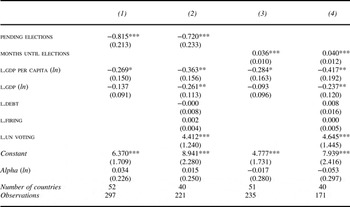
Table 1 reports the coefficient estimates for the negative binomial regressions of the stringency of labor conditions on pending election , months until elections, and key control variables.Footnote 53 The estimated coefficients on pending election are negative and statistically significant. Loans agreed within six months of an upcoming election have less-stringent labor conditions than loans agreed further away from an election, all else equal. More precisely, the labor conditions included in programs signed within six months of an upcoming election are, on average, 50 percent less stringent than those in loans agreed more than six months away from elections, holding all else constant.
Estimated effects of election proximity on labor conditionality

Notes: Negative binominal regression with robust standard errors clustered by country reported in parentheses. All estimated models include year fixed effects. *** p < .01; ** p < .05; * p < .1.
The positive and significant coefficients on months until elections indicate that loans negotiated further away from elections contain more stringent labor conditions, all else equal. This finding is consistent with many countries’ experiences with the IMF.Footnote 54 In Bulgaria, for example, new governments were generally willing to accept and implement painful adjustment measures during their initial months in office but as time went on and elections grew closer, governments became less willing to pay the political costs of reform.Footnote 55 The coefficients on months until elections quantify this “honeymoon” effect. An increase in months until elections by eight months (that is, one standard deviation) over its mean value increases the stringency of labor conditions by 31 percent, all else equal. This finding is consistent with suggestions that governments are more willing to assume the political risks of unpopular policies shortly after winning an election.Footnote 56
Firing costs are not a robust predictor of labor conditions. Countries with strict labor market regulations (that is, high firing costs) are no more likely to receive labor conditions than countries with flexible labor markets, all else equal. This null result suggests that labor conditions are not set exclusively, or even primarily, in response to economic realities.Footnote 57 Instead, labor conditions appear to be set with an eye toward the political realities in the borrowing country.
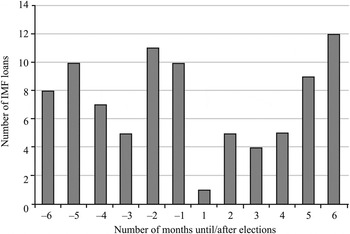
The sample in Table 1 includes all IMF loans to democratic countries during the period from 1980 to 2000. Selection into this sample is not random. Only some countries enter into IMF programs and these countries differ systematically from countries not under IMF programs. The nonrandom selection of countries into IMF programs may affect the relationship between elections and labor conditionality. It is possible, for example, that governments facing imminent elections choose not to sign a letter of intent that includes stringent labor conditions until after the election. We investigate this possibility in two ways. First, we calculate the number of loans agreed during each of the six months before and following national elections. These results are displayed in Figure 1. On the x axis, negative numbers report the months until an election; positive numbers report the months elapsed since an election. The y-axis reports the number of loans agreed. Fifty-two loans were signed within the six months before an upcoming election. Ten loans were concluded within thirty days before an election, including, for example, Estonia's 1995 Letter of Intent, which was signed just five days before regularly scheduled parliamentary elections. However, in the full sample, only 17 percent of loans were signed within six months prior to a pending election. In other words, a vast majority of loan programs signed by democratic governments are negotiated during nonelection, noncampaign periods. This suggests that most governments are not strategically timing their loan requests to take advantage of pending elections. Perhaps governments simply do not have the luxury of strategically timing a loan request given that they often need IMF financing as a matter of urgency.Footnote 58
The timing of IMF loans relative to national elections

Second, we estimate a two-step Heckman selection model to address the possibility that countries’ selection into an IMF program is not random.Footnote 59 In the selection equation, the dependent variable equals 1 for years in which a country is under an IMF program and 0 otherwise. Three variables enter only the selection equation. The first variable is total reserves in months of imports, which serves as a proxy for governments’ liquidity concerns.Footnote 60 Previous studies show that reserves are one of the best predictors of participation in an IMF program.Footnote 61 Although reserves are a good predictor of participation in loan programs, they are unlikely to influence the stringency of labor conditions because labor-related conditions typically do little to help countries overcome low foreign reserve levels. The second variable that enters only the selection equation is an indicator of whether a country was previously under an IMF program. Past participation in IMF programs is a strong predictor of present participation.Footnote 62 The selection equation also includes a variable, election year , which is coded 1 for election years and 0 otherwise.Footnote 63
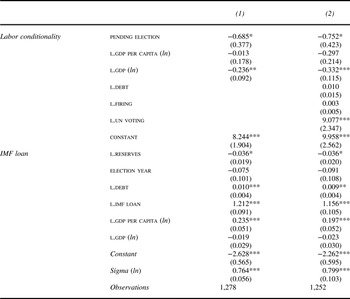
The results from the Heckman selection model appear in Table 2. Correcting for the nonrandom selection of countries into IMF programs increases the standard errors on pending election . A potential interpretation of this result is that some governments facing imminent elections refuse to sign loans with overly stringent labor conditions. This interpretation is fully consistent with the logic of our argument. If the Fund wants to lend to governments facing imminent elections, they have to make concessions on labor conditionality. Despite the slight increase in standard errors, the estimated coefficients on pending election remain statistically significant at conventional levels in the second-stage estimation. Loans negotiated within six months of a pending election have relatively less stringent labor conditions, controlling for the nonrandom selection of countries into IMF programs.
Two-stage Heckman selection model

Notes: Heckman selection model with standard errors reported in parentheses. The second stage model includes year fixed effects. *** p < .01; ** p < .05; * p < .1.
Up to this point, election dates have been treated as exogenous. However, election dates are not fixed in all democratic countries and governments may try to time an election to gain bargaining leverage in their loan negotiations. To address this possibility, we identify the elections in our sample that were held early relative to the date they were supposed to be held per established procedure.Footnote 64 Only six elections held within six months of IMF loan agreements were early elections. Various reasons exist for the paucity of early elections in this context. First, calling early elections trades the certainty of more time in office for the prospect of obtaining leverage in loan negotiations and being cast out of office prematurely. Few governments are likely willing to make such a trade-off. Second, snap elections may actually weaken a government's hand. The snap 1983 election in Jamaica unexpectedly resulted in a one-party parliament, which strengthened the prime minister's internal position, thereby weakening his bargaining position with the IMF.Footnote 65 Third, governments are reluctant to call early elections during loan negotiations because doing so effectively suspends talks.Footnote 66 The IMF routinely refuses to negotiate with caretaker governments since they have limited tenure and no guarantee of parliamentary support.Footnote 67 For example, IMF officials suspended talks with the Greek government in the months before the 17 June 2012 snap election.
No evidence exists to suggest that any of the six early elections in our sample were called in response to (or anticipation of) negotiations with the IMF.Footnote 68 Despite this, we exclude the early elections from our sample as a robustness check. Excluding the early elections does not meaningfully change the estimated coefficients on the key election variables.
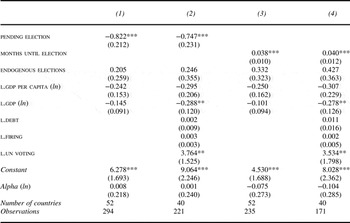
As a final robustness check, we add to the estimating equations a variable coded 1 if election dates are not fixed and 0 otherwise. More precisely, the variable endogenous elections , which equals 1 for parliamentary and semi-presidential systems and 0 for presidential democracies, is added. While the timing of elections could, in theory, be endogenous to IMF negotiations, the presence of the institutions allowing for early elections is not. Thus, if there is a systematic selection problem, one would see a difference in results. However, this is not the case. The estimated effects of pending election and months until elections on labor conditions are robust to the inclusion of endogenous elections , as reported in Table 3. endogenous elections is statistically insignificant across all four models. The institutional capacity to call early elections does not give governments a bargaining advantage. Perhaps this is because so few governments actually call snap elections during loan negotiations even when they have the institutional capacity to do so. These results help to minimize concerns about the potential endogenity of elections.
Estimated effects of endogenous elections on labor conditionality

Notes: Negative binominal regression with robust standard errors clustered by country reported in parentheses. All estimated models include year fixed effects. *** p < .01, ** p < .05, * p < .1.
Conclusion
Governments facing imminent elections receive more lenient terms from the IMF. Governments leverage upcoming elections in their negotiations with the IMF, we argue, to minimize labor conditions. Loans concluded within six months before an upcoming election have less-stringent labor market reform conditions than loans agreed further away from an election, all else equal. Labor-related conditions appear to be influenced more by politics than economics—a finding that defies the image of the IMF as a technocratic lender immune to national-level politics.
This finding has important implications for understanding both IMF lending and international negotiations more generally. First, critics of the IMF frequently allege that it imposes one-size-fits-all programs on borrowing countries. However, our original data illustrate that significant variation exists in the number and stringency of labor-related loan conditions. Variance exists because loan conditions are the outcome of negotiations between government executives and IMF staff and negotiations are influenced by domestic politics. Specifically, we find that loans concluded within six months before an upcoming election include less-stringent labor market reform conditions than loans agreed further away from an election, all else equal. This finding calls into question the characterization of the IMF as a rent-seeking bureaucracy intent on maximizing conditionality. Instead, our results suggest that the IMF is a strategic lender that adapts its lending decisions to countries’ individual circumstances by waiving or modifying loan conditions when political constraints are intense.Footnote 69
Second, this study brings new evidence to the debate over how domestic constraints influence international negotiations. Some argue that greater constraints at home increase governments’ bargaining leverage abroad.Footnote 70 Others contend that greater domestic constraints weaken governments’ international bargaining clout.Footnote 71 This debate has remained unresolved, in part, because of a paucity of empirical evidence. The current study addresses this oversight by collecting and analyzing original empirical evidence on the content of negotiated loan programs, an empirical innovation that may explain why previous studies failed to find robust election effects. Our results fall squarely on one side of the debate: constraints at home increase governments’ bargaining power abroad. Of course, ours will not be the final word in this debate and more work needs to be done to understand precisely which domestic constraints engender greater international bargaining power. Yet, by examining specific types of loan conditions, this study has advanced our understanding of the relationship between domestic political constraints and international negotiations. Examining specific types of loan conditions may help to resolve other enduring puzzles, such as the varied effects of IMF programs on public-sector reforms and why only some IMF loan programs engender political crises.Footnote 72
Our study also relates to the burgeoning literature on globalization and labor rights.Footnote 73 Several recent studies have demonstrated a positive correlation between labor rights and facets of economic globalization, such as international trade and trade agreements. Greenhill, Mosley, and Prakash find that labor standards in a country are influenced by the labor standards of its trading partners.Footnote 74 In this way, cross-border trade may help to improve labor rights. In contrast, the facet of globalization on which we focus, sovereign lending by the IMF, may hurt workers. The labor-related conditions in IMF loans typically make workers worse off in the short to medium term.Footnote 75 While some governments are able to resist such loan conditions, that is, those facing imminent democratic elections, others are less able to push back. Our findings, in light of previous studies, suggest that different aspects of globalization may have varied effects on labor rights. Furthermore, the effects of globalization on labor rights may be conditional on domestic political institutions. Democratically elected governments, for example, are more likely to represent workers’ interests at the international bargaining table.Footnote 76 Our results also suggest that the effects of globalization may vary across different types of labor rights. Many existing studies focus on collective labor rights. In contrast, we focus on labor market practices tied to individual labor rights dealing with the security of employment and wages. The IMF typically uses conditionality to undercut individual labor protections rather than to bolster collective labor rights.Footnote 77 Hence, different aspects of globalization may have varied effects on different types of labor rights. Untangling the relationship between globalization and labor rights is an important and productive area for future research—one in which the role of international institutions, such as the IMF, must not be neglected.
Finally, international institutions are often portrayed as bureaucracies run amok without any electoral connection to citizens. However, our results suggest that unelected international bureaucrats are not wholly unresponsive to voters. Citizens’ interests can be conveyed in international negotiations by democratically elected governments. Unelected international bureaucrats may make concessions to governments, and consequently voters, as demonstrated in this study. National elections may therefore go some way to help lessen the democratic deficit endemic to international institutions.
Appendix
Nine labor-related issue areas are identified and coded. If there are multiple actions at the same level of conditionality for a particular issue-conditionality pair in a Letter of Intent, then we count it only once:
-
• Public-sector wage levels
-
• Public-sector employment levels—includes capitalization and outsourcing/contracting of functions formerly within a public enterprise
-
• Privatization—includes reorganization, denationalization, divestiture
-
• Minimum wages—private sector
-
• Private-sector wage restraint other than minimum wages
-
• Social security—reducing social security provisions, including health care, disability provisions, unemployment insurance, and payroll taxes
-
• Public pension reforms—reducing costs and changing public pension system
-
• Labor market flexibility—includes facilitating layoffs, reducing severance pay, the easing of limitations on fixed-term contracts, the easing of conditions for labor supply/outsourcing, and rationalization, modernization, deregulation, or other “general labor reforms”
-
• Collective bargaining decentralization.
Supplementary material
Replication data available at http://dx.doi.org/10.1017/S0020818314000058.