Introduction
Bipolar disorder is a potentially disabling mental illness with a prevalence of 1–2% and a typical onset in the youth or early adulthood (Post et al., Reference Post, Altshuler, Kupka, McElroy, Frye, Rowe and Nolen2020). These formatting years are important in young people's lives, in the matter of attending school, obtaining an education, a job, creating long-lasting interpersonal relations and overall settling in life. Cross-sectional clinical studies show broad functional impairment according to clinical evaluations using scales or tests of psychosocial function (Chen, Fitzgerald, Madera, & Tohen, Reference Chen, Fitzgerald, Madera and Tohen2019) such as the Functional Assessment Short Test (Rosa et al., Reference Rosa, Sanchez-Moreno, Martinez-Aran, Salamero, Torrent, Reinares and Vieta2007) within occupation, cognition, autonomy, interpersonal relationships, leisure and financial issues in patients with bipolar disorder even during remission (Leda-Rego, Bezerra-Filho, & Miranda-Scippa, Reference Leda-Rego, Bezerra-Filho and Miranda-Scippa2020). After a diagnosis with bipolar disorder, the illness often develops and progresses through these young years in a patient's life (Kessing, Reference Kessing1998b) with potential detrimental effects on functioning and quality of life (Chen et al., Reference Chen, Fitzgerald, Madera and Tohen2019). Results from preliminary studies may suggest that early diagnosis and intervention may prevent some of the progression in illness burden (Vieta et al., Reference Vieta, Salagre, Grande, Carvalho, Fernandes, Berk and Suppes2018), potentially making it possible for patients to attend school, obtain an education and get a job in their early adulthood resulting in better socio-economic status.
The heritability of bipolar disorder is among the highest of psychiatric disorders (Lohoff & Berettini, Reference Lohoff, Berettini, Yatham and Maj2010). Up to 50% of first-degree relatives to patients with bipolar disorder will develop a mood disorder or another psychiatric illness (Mesman, Nolen, Reichart, Wals, & Hillegers, Reference Mesman, Nolen, Reichart, Wals and Hillegers2013; Rasic, Hajek, Alda, & Uher, Reference Rasic, Hajek, Alda and Uher2014; Vedel Kessing, Ziersen, Andersen, & Vinberg, Reference Vedel Kessing, Ziersen, Andersen and Vinberg2021) and first-degree relatives to patients with bipolar disorder have a 5- to 10-fold increased risk of developing bipolar disorder themselves (Mortensen, Pedersen, Melbye, Mors, & Ewald, Reference Mortensen, Pedersen, Melbye, Mors and Ewald2003). Meta-analyses show that unaffected first-degree relatives present with cognitive impairment compared with healthy control individuals without a familial predisposition to bipolar disorder (Arts, Jabben, Krabbendam, & van Os, Reference Arts, Jabben, Krabbendam and van Os2008; Bora, Reference Bora2017). However, unaffected siblings to patients with bipolar disorder have been poorly studied within other areas such as socio-economic status and educational achievements.
In summary, few studies have reported real-life data on functioning such as educational achievement, employment status, actual income, cohabitation and marital status in patients with bipolar disorder and in unaffected first-degree relatives. Furthermore, longitudinal data on functioning in bipolar and relatives are lacking. The overall aim of the current study was in a systematic nation-wide population-based study to provide real-life data on functioning in patients with bipolar disorder and their unaffected siblings at the time of the in- or outpatient hospital diagnosis and during long-term follow-up and to compare with data from the general population.
Specific aims
The five aims of this nation-wide population-based study were to estimate the level of functioning in patients with bipolar disorder and their unaffected siblings compared with matched control individuals within five socio-economic outcome measures: (1) educational achievement, (2) employment status, (3) income/year, (4) cohabitation status and (5) marital status.
Aims 1–5 were analyzed at the time of inclusion, aims 2 and 3 were further analyzed during follow-up using repeated measurements and aims 4 and 5 were further analyzed during follow-up using time-to-event models.
Hypotheses
Four hypotheses were posed a priori.
(1) The levels of educational achievement, employment status, income, cohabitation status and marital status are decreased in patients with bipolar disorder compared with control individuals.
(2) The levels of educational achievement, employment status, income, cohabitation and marital status are decreased in unaffected siblings to patients with bipolar disorder compared with control individuals.
(3) The ability to enhance employment status, income, cohabitation and engaging in marriage is decreased during follow-up in patients with bipolar disorder compared with control individuals.
(4) The ability to enhance employment status, income, cohabitation and engaging in marriage is decreased during follow-up in unaffected siblings to patients with bipolar disorder compared with control individuals.
‘Unaffected’ is defined as not having a diagnosis of severe mental disorder comprising a diagnosis with organic mental disorder, schizophrenia or bipolar disorder before the inclusion date.
Methods
Data sources
Data were obtained by linking Danish population-based registers using the unique personal identification number, which is assigned to all 5.7 million persons living in Denmark, thus ensuring accurate linkage of information between registers, irrespective of changes in name and demographics (Pedersen, Reference Pedersen2011). Each patient registered with a diagnosis of bipolar disorder in the Danish National Patient Register (Lynge, Sandegaard, & Rebolj, Reference Lynge, Sandegaard and Rebolj2011) was linked to the Danish Medical Birth Register (Bliddal, Broe, Pottegard, Olsen, & Langhoff-Roos, Reference Bliddal, Broe, Pottegard, Olsen and Langhoff-Roos2018) using the personal identification number to identify siblings based on shared parents. Data in The Danish Medical Birth Registry were complete from 1958, making the link possible between patients and siblings born after 1958. This technicality causes a difference in age between patients and siblings. Consequently, patients and their siblings were assigned each their own control cohort.
Demographic information on sex and date of birth was obtained on each individual from Statistics Denmark (Denmark, 2017) along with data on socio-economic measures; education, income, employment status, cohabitation and marital status.
Study population
The study was based on four cohorts.
Cohort 1 consisted of all patients with a main diagnose of bipolar disorder or a single manic episode (ICD-10 code: DF30-31.9 + 38.00) at a psychiatric contact as inpatients or outpatients in the period from 1995 to 2017. Patients were allocated to the cohort from the first contact registered with the diagnosis of bipolar disorder at any given contact registered.
Exclusion criteria were a diagnosis of organic mental disorders or schizophrenia prior to the index diagnosis of bipolar disorder, or a diagnosis of bipolar disorder before 1995.
Cohort 2 consisted of 10 randomly selected control individuals from the general population matched to the patients with bipolar disorder in cohort 1 on sex and year of birth and included at the date of diagnosis. Exclusion criteria were a diagnosis with organic mental disorder, schizophrenia or bipolar disorder before the inclusion date.
Cohort 3 consisted of unaffected full siblings to the patients from cohort 1. Siblings were included at the date of diagnosis if they could be linked to the same mother and father, making sure only full siblings were included. Exclusion criteria were a diagnosis of organic mental disorder, schizophrenia or bipolar disorder before the inclusion date.
Cohort 4 consisted of 10 randomly selected control individuals from the general population matched to the siblings in cohort 3 on sex and year of birth. Subjects were included at the same date as the sibling. Exclusion criteria were a diagnosis of organic mental disorder, schizophrenia or bipolar disorder before the inclusion date.
Statistical analyses
The five outcome measures were analyzed at the time of inclusion and aims 2–5 were further analyzed on data from the follow-up period..
All statistical analyses on repeated measurements were carried out with dynamic change of exposure status over time, i.e. control individuals in cohorts 2 and 4 and unaffected siblings in cohort 3 contributed with risk time in these cohorts until a potential diagnosis of bipolar disorder, and from that point of time they contributed to cohort 1. Furthermore, when Cox regression models were used, follow-up ended at date of a main diagnosis of schizophrenia, death, emigration or end of study (31 December 2017), whichever came first.
Socio-economic outcome measures
Analyses were carried out separately on each of the five outcome measures.
(1) Educational achievement
The highest educational achievement at the time of inclusion was assessed as a categorical variable with five ordered categories: ‘low’; primary education (0–9 years of education), ‘elementary’; high school (9–12 years), ‘intermediate’; (12–13 years), ‘high’; (13–14 years) and ‘academic’: polytechnics and university (>14 years of education). The analysis was carried out using an ordinal logistic regression model.
(2) Employment
Employment status at the time of inclusion was dichotomized as ‘unemployed or disability’ v. ‘employed’, ‘pension’, ‘student’ or ‘other’. The analysis was carried out using a logistic regression model.
For the follow-up data, the analysis was carried out using a marginal logistic regression model to account for repeated measurements.
(3) Income
Personal income at the time of inclusion was dichotomized as the 20% lowest v. the 80% highest income. The analysis was carried out using a logistic regression model.
For the follow-up data, the analysis was carried out using a marginal logistic regression model to account for repeated measurements.
(4) Cohabitation
Cohabitation status at the time of inclusion was measured in the categories ‘living with someone’ v. ‘living alone’. The probability of living with someone was estimated based on cohabitation status in the form of shared address and the analysis was carried out using a logistic regression model.
Changes in cohabitation status during follow-up were analyzed within the group of all individuals living alone at the time of inclusion. The analysis was carried out using a Cox regression model with the event being cohabitation and censoring being death, end of study or a diagnosis of severe mental illness, whichever came first. The model was adjusted for age, sex and calendar year at baseline.
(5) Marital status
Marital status at the time of inclusion was dichotomized as ‘not married’ v. ‘married’, ‘divorced’ or ‘widowed’. The analysis at baseline was carried out using a logistic regression model.
Changes in marital status during follow-up were analyzed within the group of individuals not married at inclusion. The analysis was carried out using a Cox regression model with the event being married and censoring at death, end of study and a diagnosis of organic mental disorder, schizophrenia or bipolar disorder in analyses of siblings, whichever came first. The model was adjusted for age, sex, calendar year and marital status at baseline.
Results
Table 1 presents the socio-economic outcomes from time of inclusion in 19 955 patients with bipolar disorder and 199 550 matched controls from the general population. The median age was 44.8 years (quartiles: 32.8–57.5) and 58% was female.
Socio-economic baseline characteristics in patients with bipolar disorder and control individuals from the general population, matched according to the date of the diagnosis of bipolar disorder, year of birth, sex and calendar year

a Personal income/year >20% of income/year in total population.
Educational level was lower in patients with bipolar disorder at the time of inclusion. A larger proportion of the patients have achieved a lower educational level (elementary school) compared to the matched controls (23% v. 18%) and a smaller proportion of the patients have achieved a higher academic education (>14 years) compared to the controls (45% v. 54%). Patients were more often unemployed than the controls (42% v. 12%) and a smaller proportion of patients got the highest category of personal income (55% v. 71%). Patients more often lived alone compared to controls (54% v. 36%) and a smaller proportion of patients were married compared to the controls (37% v. 49%).
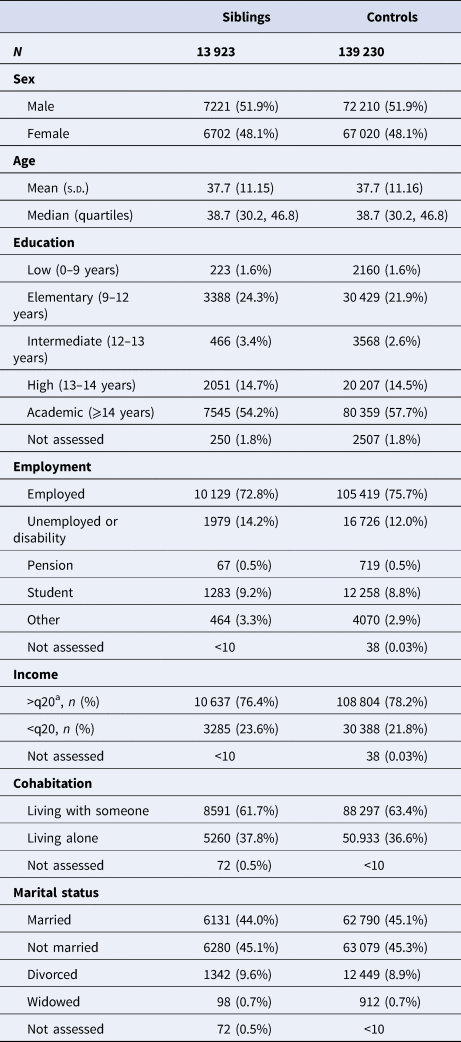
Table 2 presents the socio-economic outcomes from time of inclusion in 13 923 siblings to patients with bipolar disorder and 139 230 matched controls from the general population. The median age was 38.7 years (quartiles: 30.2–46.8) and 48% were female.
Socio-economic baseline characteristics in siblings to patients with bipolar disorder and control individuals from the general population, matched according to the date of the diagnosis of bipolar disorder, year of birth, sex and calendar year

a Personal income/year >20% of income/year in total population.
Educational level was slightly lower in siblings to patients with bipolar disorder at the time of inclusion. Compared to control individuals, more siblings presented with lower educational level (elementary school) (24% v. 22%) and a smaller proportion of siblings had achieved a higher academic education (>14 years) (54% v. 58%). The siblings were slightly more often unemployed than the controls (14% v. 12%) and a slightly smaller proportion got the highest category of personal income (76% v. 78%). The siblings did not live more alone (38% v. 37%) or were lesser married (44% v. 45%) compared with control individuals.
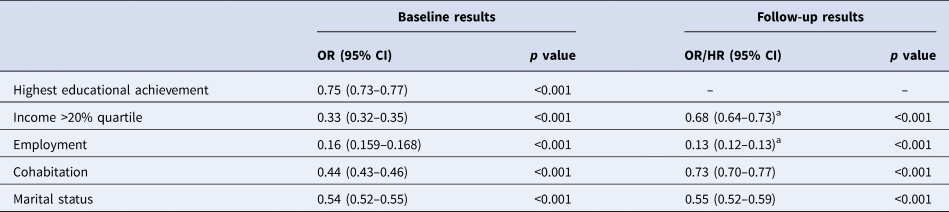
Table 3 presents the odds ratio (OR) and hazard ratio (HR) for the five outcome measures, education, employment, income, cohabitation and marital status in patients with bipolar disorder compared with control individuals. The results show a substantially impaired socio-economic functioning in patients with bipolar disorder compared to controls at baseline as well as during follow-up. The OR for the ‘highest income’ status during the up to 23 years follow-up period from 1995 to 2017 was 0.68 [95% confidence interval (CI) 0.64–0.74] for patients compared to controls when accounting for repeated measurements and, similarly the OR for the status ‘employed’ was 0.13 (95% CI 0.12–0.13) reflecting a 87% decreased odds of being employed during follow-up for patients with bipolar disorder compared to the controls.
ORs and HRs of socio-economic outcomes for patients with bipolar disorder compared with control individuals from the general population, matched according to the date of the diagnosis of bipolar disorder, year of birth, sex and calendar year

Baseline results from cross-sectional data at the time of inclusion. Follow-up results from repeated measurements during the 23 years follow-up period.
a Model fitted at baseline and as a marginal model to account for repeated measurements.
For individuals living alone at the time of inclusion the HR was 0.73 (95% CI 0.70–0.77) to change status to living with someone during the follow-up period for patients compared to controls. For individuals not married at the time of inclusion the HR was 0.55 (95% CI 0.52–0.59) of changing status to being married during follow-up for patients with bipolar disorder compared to controls.
Table 4 presents the OR and HR for the five outcome measures in siblings to patients with bipolar disorder compared with control individuals. The results show decreased functioning in the siblings compared to the controls within all five outcome measures at baseline. The results from the follow-up period show a decreased ability to enhance income and employment during the follow-up period for siblings compared with control individuals. The OR for the ‘highest income’ status was 0.88 (95% CI 0.85–0.92) and the OR was 0.81 (95% CI 0.77–0.85) the status ‘employed’ during follow-up for siblings compared with control individuals.
ORs and HRs of socio-economic outcomes for siblings to patients with bipolar disorder compared with control individuals from the general population, matched according to the date of the diagnosis of bipolar disorder, year of birth, sex and calendar year

Baseline results from cross-sectional data at the time of inclusion. Follow-up results from repeated measurements during the 23 years follow-up period.
a Model fitted at baseline and as a marginal model to account for repeated measurements.
For individuals living alone and individuals not married at the time of inclusion there were no statistically significant differences for siblings compared to control individuals in changing status to living with someone and getting married during follow-up.
Discussion
In this population-based nation-wide longitudinal study, we investigated real-life functioning in patients with bipolar disorder at the time of inclusion and for the first time also functioning in their siblings. Surprisingly, we confirmed all our four hypotheses except for the last part of hypothesis 4, as we did not find that siblings to patients with bipolar disorder decreased cohabitation and engaged less in marriage during follow-up compared with control individuals.
Main findings
Findings concerning patients with bipolar disorder
In accordance with our hypotheses, patients with bipolar disorder had a lower functioning than the control individuals from the general population matched according to the date of the diagnosis of bipolar disorder, year of birth, gender and calendar year. Nevertheless, we were surprised by the severity of the impairment within all five socio-economic outcome measures. Patients with a diagnosis of bipolar disorder had 0.75 (95% CI 0.73–0.77) lower odds of having achieved the highest educational level, 0.16 (95% CI 0.159–0.168) lower odds of being employed, 0.33 (95% CI 0.32–0.35) lower odds of having achieved the 80% highest quartile of income, 0.44 (95% CI 0.43–0.46) lower odds of cohabitating and 0.54 (95% CI 0.52–0.55) lower odds of being married at first contact to hospital psychiatry as inpatient or outpatient compared with control individuals form the general population (Table 3).
Even more alarming, patients with bipolar disorder showed substantially decreased probability of being employed or belonging to the highest income category during the 23 years follow-up after the initial hospital contact compared to controls (Table 3). Also, patients living alone or being unmarried at baseline had lower rates of changing cohabitation and marital status during follow-up than controls.
Findings concerning siblings to patients with bipolar disorder
In accordance with our hypotheses, siblings to patients with bipolar disorder had a lower functioning within all five socio-economic areas than the random control individuals from the general population matched according to the siblings on year of birth, gender and calendar year (Table 4). Concordantly, the siblings showed a decreased probability of being employed or belonging to the highest income category during the 23 years follow-up after the initial hospital contact compared to controls but did not differ from control individuals in their ability to enhance cohabitation and engaging in marriage during follow-up (Table 4).
Prior studies on socio-economic functioning in patients with bipolar disorder and relatives
Few studies have provided real-life data on socio-economic functioning in bipolar disorder. In accordance with our findings, a Dutch register-based study found that 813 patients with bipolar disorder had lower odds for completing the highest educational achievement than controls (Tempelaar, Termorshuizen, MacCabe, Boks, & Kahn, Reference Tempelaar, Termorshuizen, MacCabe, Boks and Kahn2017). A study from Taiwan found poorer employment outcomes for 502 patients with bipolar disorder than for controls based on claims data from the National Health Insurance Research Database of Taiwan between 1998 and 2001 finding cohort of Chang et al. (Reference Chang, Huang, Chiu, Huang, Tang and Su2016). We are not aware of any studies on education, income, cohabitation and marital status at the time of the diagnosis of bipolar disorder or during follow-up. The other way around, studies have investigated cognitive performance as a predictor of later onset of bipolar disorder with mixed results, finding that higher school performance predicts increased risk (MacCabe et al., Reference MacCabe, Lambe, Cnattingius, Sham, David, Reichenberg and Hultman2010) and decreased risk (Kendler, Ohlsson, Mezuk, Sundquist, & Sundquist, Reference Kendler, Ohlsson, Mezuk, Sundquist and Sundquist2016) of later onset of bipolar disorder.
Similarly, socio-economic status including educational achievements has been poorly studied in relatives to patients with bipolar disorder. We have in a clinical study including 234 twins shown that healthy twins with a co-twin with bipolar or unipolar disorder present with a lower education level and work position and tendency toward being more often unemployed and early retired compared with control twins without any first-degree relatives with severe mental illness (Christensen, Kyvik, & Kessing, Reference Christensen, Kyvik and Kessing2006). Furthermore, a recent small study of middle-aged patients with bipolar disorder (N = 33), their unaffected siblings (N = 35) and healthy controls (N = 43) showed that psychosocial functioning in unaffected offspring of patients with bipolar disorder was decreased compared with healthy control persons without psychiatric family history (Vasconcelos-Moreno et al., Reference Vasconcelos-Moreno, Bucker, Burke, Czepielewski, Santos, Fijtman and Kauer-Sant'Anna2016). Educational achievement in unaffected siblings to patients with bipolar disorder has been investigated in a single study, only. In this Dutch register-based study also mentioned above, siblings to patients with bipolar disorder showed no underachievement at primary or secondary school or after secondary school (Tempelaar et al., Reference Tempelaar, Termorshuizen, MacCabe, Boks and Kahn2017), which is not in line with the finding of cognitive impairment (Arts et al., Reference Arts, Jabben, Krabbendam and van Os2008; Bora, Reference Bora2017) or with our findings in this present study of 0.86 (95% CI 0.83–0.89) lower odds of achieving the highest educational level compared with control individuals from the general population. It should be noted that data on socio-economic data in the current study were complete for more than 95% in all four study cohorts in contrast to the Dutch study in which data on education were available for a third, corresponding to only 813 patients with bipolar disorder and only 1558 siblings (Tempelaar et al., Reference Tempelaar, Termorshuizen, MacCabe, Boks and Kahn2017). This may have resulted in selection bias in the Dutch study to a much larger extend than in this current study.
Measuring socio-economic functioning
Socio-economic functioning is a wide concept and is measurable in many ways. The measurable outcomes chosen in this study, education, employment, income, cohabitation and marital status are quantitative endpoints reflecting real life and are available from national registers on the entire Danish population.
Strengths
This registry-based study had large sample sizes and limited susceptibility to problems caused by recall, self-reporting or selection bias. Because data were available for the entire populations of patients with a bipolar diagnosis and their full siblings among the 5.7 million persons living in Denmark and 10 random control individuals from the general population matched according to the date of the diagnosis of bipolar disorder, year of birth, sex and calendar year, potential risk of selection bias was minimized. Since Danish citizens have free and equal access to health care, any effect related to the ability to afford private insurance or access to health care was substantially reduced. Nevertheless, as it is possible to get treatment at a few private clinics, patients with bipolar disorders having the highest income levels could be underrepresented in our cohort. It is mandatory in Denmark for all hospitals (but not the private clinics) to report discharge diagnoses to the central registries. Psychiatric diagnoses reported in Danish registers have been found to be generally valid for a range of mental disorders (Bock, Bukh, Vinberg, Gether, & Kessing, Reference Bock, Bukh, Vinberg, Gether and Kessing2009; Kessing, Reference Kessing1998a; Lauritsen et al., Reference Lauritsen, Jorgensen, Madsen, Lemcke, Toft, Grove and Thorsen2010).
Limitations
The study included in- and out-patients with a diagnosis of bipolar disorder at psychiatric hospital contact and did not include patients who had contact to the primary care sector, i.e. primary care or private psychiatrist, only, as such data are not available in the registers. The date of first diagnosis reported in the registers is generally later than the actual onset, making some delay in diagnoses. Nevertheless, a quarter of the sample had an age below 32.7 years of age (Table 1). The study did not include data on upbringing and familial environment including potential mental illness among parents and grandparents, which may have influenced later socio-economic functioning in patients with bipolar disorder and their siblings.
In relation to siblings, the aim of the study was to investigate the clinically crucial question often posed by relatives: as long as a relative does not develop bipolar disorder how are the chances of obtaining an education, getting a job and an income, cohabitating or being married. Siblings are at higher risk of developing other psychiatric disorders such as alcohol and drug abuse, unipolar depression, anxiety disorders, eating disorders, sleep disorders, etc. (Vedel Kessing et al., Reference Vedel Kessing, Ziersen, Andersen and Vinberg2021) which in the follow-up period of the current study may have influenced their socio-economic functioning. Furthermore, some siblings may have an important role as a caregiver that potentially could influence their socio-economic performances (Perlick et al., Reference Perlick, Rosenheck, Miklowitz, Kaczynski, Link and Ketter2008). We did not include analyses of the effects of such potential disorders as this would complicate the analyses and the clinical interpretations of the findings.
Notably, we matched two separate control groups from the general population, one for the analyses comparing patients with controls and another when comparing siblings with controls, as patients and siblings differ according age and sex (see Tables 1 and 2). In this way, ORs and HRs for patients and siblings cannot be directly compared. Finally, the comparison to other countries outside Denmark should be made with precaution and the overall generalizability may be limited due to different health care and socio-economic structures.
Due to the rather homogeneous Danish population we do not presume that the present results are biased due to race and ethnicity.
Conclusions and perspectives
First, socio-economic functioning was substantially impaired in patients with bipolar disorder and did not improve during long-term follow-up after the initial hospital contact. Second, socio-economic functioning was familial related as siblings to patients with bipolar disorder also presented with lower functioning and decreased ability to enhance employment status and income during follow-up compared with control individuals. These two observations reflect that the risk of developing bipolar disorder and the associated socio-economic functioning seems driven by shared familial factors reflecting that severe mental disorders are likely a result of shared gene × environmental factors. Additionally, siblings are at risk of developing other psychiatric disorders such as alcohol and drug abuse, unipolar depression, anxiety disorders, eating disorders, sleep disorders, etc. (Vedel Kessing et al., Reference Vedel Kessing, Ziersen, Andersen and Vinberg2021) which in the follow-up period of the current study may have influenced their socio-economic functioning. Childhood trauma and other shared environmental factors seem to be risk factors for worse cognition (Dauvermann & Donohoe, Reference Dauvermann and Donohoe2019), lower socio-economic status and the onset of severe mental illness (Devi et al., Reference Devi, Shahwan, Teh, Sambasivam, Zhang, Lau and Subramaniam2019; Petkus, Lenze, Butters, Twamley, & Wetherell, Reference Petkus, Lenze, Butters, Twamley and Wetherell2018). It is likely that patients with bipolar disorder and their siblings share some of the traumatic experiences (Heins et al., Reference Heins, Simons, Lataster, Pfeifer, Versmissen, Lardinois and Myin-Germeys2011). Based on findings from meta-analyses it well established that childhood trauma experiences are more prevalent in patients with bipolar disorder than in the general population (Agnew-Blais & Danese, Reference Agnew-Blais and Danese2016).
Overall, the results highlight a severe treatment gap in patients with bipolar disorder and their families emphasizing that current treatment and support does not result in socio-economic improvement in real life. Future studies should address the psychological and social obstacles and challenges in relation to socio-economic functioning such as education, employment, income, cohabitation and engaging in marriage for patients with bipolar disorder and their relatives and large-scale early intervention studies should be conducted including socio-economic variables such as education, employment and income as central outcome measures (Kessing et al., Reference Kessing, Hansen, Hvenegaard, Christensen, Dam, Gluud and Wetterslev2013, Reference Kessing, Hansen, Christensen, Dam, Gluud and Wetterslev2014; Vieta et al., Reference Vieta, Salagre, Grande, Carvalho, Fernandes, Berk and Suppes2018).
Data
Research data are not shared.
Author contributions
LVK achieved funding and designed the study together with KS, PKA, SCZ and MV. SCZ conducted the data analysis in cooperation with all authors. KS wrote the first draft of the manuscript that was revised by all authors. KS and LVK had full access to all data in the study and take responsibility for the integrity of the data and the accuracy of the data analysis.
Financial support
Funding was provided by The Mental Health Services, Capital Region of Denmark.
Conflict of interest
Lars Vedel Kessing has the last 3 years been a consultant for Lundbeck and TEVA. Maj Vinberg has the last 3 years been a consultant for Sunovion, Janssen and Lundbeck. Kimie Stefanie Ormstrup Sletved, Per Kragh Andersen and Simon Christoffer Ziersen report no financial disclosure and competing interests.
Ethical standards
Ethical approval of anonymous register studies is not needed according to Danish law. Data approval: The study was approved by the Data agency of the Capital Region of Denmark.