Introduction
It is now generally accepted that both the symptoms and impairments associated with attention deficit hyperactivity disorder (ADHD) often continue both into adolescence and adulthood. Rates of persistence into adolescence are around 85% (Biederman et al. Reference Biederman, Faraone, Milberger, Curtis, Chen, Marrs, Ouellette, Moore and Spencer1996a ). Depending on definition, between 30 and 80% continue into adulthood (Kessler et al. Reference Kessler, Adler, Barkley, Biederman, Conners, Demler, Faraone, Greenhill, Howes, Secnik, Spencer, Ustun, Walters and Zaslavsky2006; Fayyad et al. Reference Fayyad, de Graaf, Kessler, Alonso, Angermeyer, Demyttenaere, de Girolamo, Haro, Karam, Lara, Lépine, Ormel, Posada-Villa, Zaslavsky and Jin2007). Many of those who do not continue to meet full diagnostic criteria as adults still suffer from significant functional impairment (Faraone et al. Reference Faraone, Biederman and Mick2006). Accordingly, it has become increasingly important to identify the correlates and predictors of persistence and remission across development. Early research identified the number and severity of symptoms and the presence of conduct disorder as key predictors of persistence into adolescence (Gittelman et al. Reference Gittelman, Mannuzza, Shenker and Bonagura1985; Taylor et al. Reference Taylor, Sandberg, Thorley and Giles1991). Subsequent prospective clinic-based studies have suggested that a family history of ADHD, co-morbid mental health problems (especially conduct disorder) and a history of psychosocial adversity predict persistence into adolescence (Hart et al. Reference Hart, Lahey, Loeber, Applegate and Frick1995; Biederman et al. Reference Biederman, Faraone, Milberger, Guite, Mick, Chen, Mennin, Marrs, Ouellette, Moore, Spencer, Norman, Wilens, Kraus and Perrin1996b ). Population-based studies have focused on persistence into adulthood and identified higher symptom levels, co-morbid childhood disorders (especially major depressive disorder), parental antisocial personality disorder or paternal anxiety (Lara et al. Reference Lara, Fayyad, de Graff, Kessler, Aguilar-Gaxiola, Angermeyer, Demytteneare, de Girolamo, Haro, Jin, Karam, Lépine, Mora, Ormel, Posada-Villa and Sampson2009) and greater impairment as indicators of persistence (Weiss et al. Reference Weiss, Hechtman, Milroy and Perlman1985; Kessler et al. Reference Kessler, Adler, Barkley, Biederman, Conners, Faraone, Greenhill, Jaeger, Secnik, Spencer, Ustun and Zaslavsky2005). Interestingly, the community-based study of Lara et al. (Reference Lara, Fayyad, de Graff, Kessler, Aguilar-Gaxiola, Angermeyer, Demytteneare, de Girolamo, Haro, Jin, Karam, Lépine, Mora, Ormel, Posada-Villa and Sampson2009) found neither childhood disruptive behaviour disorders, nor childhood adversity, to be predictors of persistence.
Few studies have investigated potential biological predictors of persistence of ADHD. Li et al. (Reference Li, Kang, Zhang, Wang, Zhou, Wang, Guan, Yang and Faraone2007) reported that better adolescent outcomes were associated with possession of at least one C allele of the 1460C > T polymorphism of the monoamine oxidase A (MAO-A) gene. No evidence was found of an association between outcome and polymorphisms of monoamine oxidase B (MAO-B). These are intriguing findings as, whilst MAO-B is associated with dopamine metabolism, MAO-A is more specifically associated with serotonin.
In a longitudinal case–control neuroimaging study, Shaw et al. (Reference Shaw, Lerch, Greenstein, Sharp, Clasen, Evans, Giedd, Castellanos and Rapoport2006) demonstrated that ADHD is associated with cortical thinning in various regions important for attentional control, and that those with a poorer outcome in adolescence had ‘fixed’ thinning of the left medial prefrontal cortex, which may compromise the anterior attentional network. On the other hand, in those with better adolescent outcomes, right parietal cortex thickness normalized over time. Interestingly, possession of the dopamine receptor 4 (DRD4) 7-repeat allele, a gene variation consistently linked with ADHD, was associated with cortical thinning in the right orbitofrontal/inferior prefrontal and posterior parietal cortex, and with improved clinical outcome and normalization of the right parietal cortical region (Shaw et al. Reference Shaw, Gornick, Lerch, Addington, Seal, Greenstein, Sharp, Evans, Giedd, Castellanos and Rapoport2007b ). In the same sample, Mackie et al. (Reference Mackie, Shaw, Lenroot, Pierson, Greenstein, Nugent, Sharp, Giedd and Rapoport2007) identified loss of volume in the superior cerebellar vermis that persisted regardless of clinical outcome. Poorer clinical outcome was, however, associated with changes in the right and left inferior-posterior cerebellar lobes over time, which during adolescence became progressively smaller relative to both comparison and ADHD participants who had a better outcome.
Halperin & Schulz (Reference Halperin and Schulz2006) have proposed that the neural and cognitive mechanisms associated with cause and amelioration/‘recovery’ in ADHD are, at least partially, separable. They suggested that ADHD arises as a consequence of subcortical dysfunction which manifests early in life and is associated with abnormalities in lower-order cognitive functioning such as recognition memory. They also suggest that these aspects of functioning remain relatively temporally stable over time irrespective of current clinical status. They further propose that whilst dysfunction of the various cortical, primarily prefrontal, circuits associated with higher-order ‘executive functioning’ may partly explain the manifestation of ADHD symptoms, this relationship is not causal. In their model, when ADHD symptoms improve over time, this is due to the development of compensatory ‘top-down’ higher-order regulatory and executive control functions, such as planning, inhibitory control and executive aspects of working memory. From this position it would be predicted that functional measures of prefrontal cortical functioning (primarily inhibitory and executive measures) will be dimensionally related to ADHD symptoms, with continuing deficits on these tasks being more evident in those with persistent symptoms than those whose symptoms have reduced significantly. Furthermore, they propose that, irrespective of current symptom status, subcortical brain structure and lower-order cognitive functioning will remain relatively unchanged during this time.
There are some data to support these hypotheses (Halperin et al. Reference Halperin, Trampush, Miller, Marks and Newcorn2008; Bedard et al. Reference Bedard, Trampush, Newcorn and Halperin2010). Here, remission of ADHD was associated with good performance on tasks with a higher executive demand (e.g. inhibitory control and working memory), whilst both remitters and persisters demonstrated deficits on tasks with lower executive demands (e.g. perceptual sensitivity and response variability). Unfortunately, whilst the childhood clinical status was well characterized, neuropsychological measures were only available in adolescence. It is therefore possible that the two groups already differed on key neuropsychological measures at the baseline assessment. Whilst this model has been highly influential in the field, not all existing data are supportive of it. Van Lieshout et al. (Reference van Lieshout, Luman, Buitelaar, Rommelse and Oosterlaan2013) systematically reviewed the literature pertaining to cognitive predictors of persistence of ADHD. They concluded that, regardless of the type of cognitive function measured, cognitive impairments in early childhood appear to predict the development of ADHD a few years later. They did not, however, find evidence to support the hypothesis that either automatically controlled lower-order cognitive functions, or more consciously controlled higher-order executive functions, differentiate persistence of ADHD from remitters. Unfortunately, the studies investigating persistence from childhood to adolescence (or adulthood) had similar design problems to those of the Halperin and Bedard studies (Halperin et al. Reference Halperin, Trampush, Miller, Marks and Newcorn2008; Bedard et al. Reference Bedard, Trampush, Newcorn and Halperin2010) described above and were either cross-sectional in nature or, if longitudinal, did not measure cognitive functioning at both time points.
Using a battery of tasks with both high and low executive demand we have previously described that, for boys aged between 7 and 14 years of age with ongoing ADHD, neuropsychological development parallels that of healthy children with an average delay of around 2 years (Coghill, Reference Coghill2010). We have also identified several neuropsychological predictors of treatment outcome (Rhodes et al. Reference Rhodes, Coghill and Matthews2004, Reference Rhodes, Coghill and Matthews2006; Coghill et al. Reference Coghill, Rhodes and Matthews2007), but are unaware of any previous studies that have utilized baseline measures of both clinical and neuropsychological performance to investigate the ongoing relationship between these outcomes in ADHD.
The present study is, therefore, the first to examine prospectively the development of neuropsychological and clinical functioning over a 4-year period in children and adolescents with ADHD and healthy controls. We hypothesized that all participants would demonstrate improved neuropsychological functioning over time as a consequence of continuing development. Based on the developmental theories of Halperin & Schulz (Reference Halperin and Schulz2006) described above, we further hypothesized that, for the ADHD group, symptom reduction would be associated with improved performance on tasks with high but not low executive function demands.
Method
Participants
We conducted repeat testing comparing two groups of boys: boys with ADHD and typically developing (TYP) healthy control boys, who had previously participated in a neuropsychopharmacological study of ADHD. Detailed descriptions of the initial assessments and study have been published previously (Rhodes et al. Reference Rhodes, Coghill and Matthews2004, Reference Rhodes, Coghill and Matthews2006; Coghill et al. Reference Coghill, Rhodes and Matthews2007). Exclusion criteria for both groups were: history of neurological impairment; intellectual impairment (intelligence quotient < 80); chronic physical illness; sensory or motor impairment; current or previous exposure to stimulant medication; and abuse of any illegal drugs. Informed written consent to participate in the study was obtained from each child's parent(s)/ guardian at time 1 and again at time 2 from either the young person themselves (if aged ⩾16 years at this time) or their parent parent(s)/guardian.
ADHD group
Participants were 17 males who were initially recruited as part of a larger sample of 75 boys. This larger sample was recruited from consecutive male out-patient referrals aged between 7 and 15 years to the Tayside Child and Adolescent Psychiatry service. All participants were interviewed by an experienced child and adolescent psychiatrist using the Kiddie-Schedule for Affective Disorders and Schizophrenia Present and Lifetime (K-SADS-PL) interview schedule (Kaufman et al. Reference Kaufman, Birmaher, Brent, Rao, Flynn, Moreci, Williamson and Ryan1997) and met criteria for both hyperkinetic disorder (F90 International Statistical Classification of Diseases, tenth revision; ICD-10) and ADHD combined subtype (Diagnostic and Statistical Manual of Mental Disorders, fourth edition; DSM-IV). The presence of commonly co-morbid conditions (oppositional defiant disorder, conduct disorder and anxiety disorder) did not result in exclusion. At time 2, when a proportion of the participants was still receiving medication treatment for ADHD, the clinical assessment focused on days when medication was not taken and the return of symptoms when medication had worn off.
Controls
Control participants were 17 males, matched with respect to age and general intellectual ability to the ADHD group and who had participated as part of a larger control group (n = 70) in the original study. This group was recruited from local schools and screened using the same methods as for the ADHD group. Symptom-free [T score < 60 on all subscales of the 48-item Conners' Parent Rating Scale (CPRS-48), 28-item Connors' Teacher Rating Scale (CTRS-28) and Child Behavior Checklist (CBCL) subscale T scores < 60] participants and their parents were interviewed using the K-SADS-PL to confirm health. A previous or current history of any psychiatric disorder led to exclusion.
Design
The British Picture Vocabulary Scale, second edition (BPVS; Dunn et al. Reference Dunn, Dunn, Whetton and Burley1997) was used to estimate verbal ability at time 1. The BPVS was chosen for its ease of administration, applicability to children between 3 and 15 years, and because it is less heavily confounded with executive function abilities. At time 1, all participants were also tested on seven tasks selected from the three batteries (working memory and planning, visual memory, and attention) of the Cambridge Neuropsychological Test Automated Battery (CANTAB) (Morris et al. Reference Morris, Evendon, Sahakian, Robbins, Stahl, Iverson and Goodman1987). At this baseline testing session, all participants were naive to stimulant medications.
Participants in the present study were re-contacted approximately 4 years after their participation in the original study – time 2. They were re-consented, re-interviewed by an experienced psychiatrist using the K-SADS-PL and re-tested on an identical battery of tasks. Participants in the ADHD group who were taking medication at time 2 (n = 12, all immediate-release methylphenidate) had a 72-h medication washout period prior to interview and neuropsychological testing.
Neuropsychological assessment
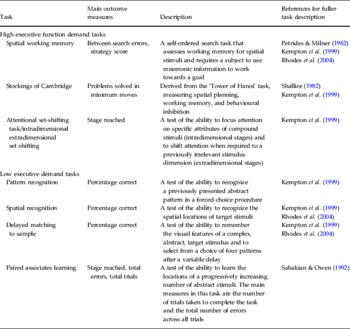
The same seven tasks and same order were used at both times 1 and 2. Each participant performed all tasks in the same order at both testing sessions. All tasks were presented on a high-resolution colour monitor with a touch-sensitive screen. A scheduled break of approximately 10 min was taken midway through the testing session and participants were informed that they could take further breaks as required. Tasks are described in Table 1.
Descriptions and order of presentation of CANTAB tasks

CANTAB, Cambridge Neuropsychological Test Automated Battery.
Data analysis
Analysis was conducted in three stages. First, we examined whether participants were representative of the original sample. Second, we investigated group differences in clinical and neuropsychological functioning and change between times 1 and 2. Lastly, we investigated the relationships between clinical and neuropsychological change. These relationships were investigated from three perspectives, i.e. was clinical change predicted by: neuropsychological performance at time 1; neuropsychological performance at time 2 (mirroring the analysis of Halperin et al. Reference Halperin, Trampush, Miller, Marks and Newcorn2008); change in neuropsychological performance between times 1 and 2. Specifically, analysis of variance (ANOVA) was used to examine the between-group differences across the two test periods (times 1 and 2) and also to examine within-group change in performance. For the neuropsychological performance data, repeated-measures ANOVA was conducted on key measures with time (time 1, time 2) as a within-subject factor and group (ADHD, TYP) as a between-subject factor. Measures with varying difficulty levels were conducted with an additional within-subject factor of difficulty.
Only significant main effects or interactions involving the factors of time or group were followed up with post-hoc analyses. Stepwise linear regression was used to explore the relationship between neuropsychological performance at times 1 and 2 and change in neuropsychological performance and ADHD symptoms between these two times. Power analyses conducted for the various tasks used in the study using our previously collected published and unpublished data indicated that with an α error level of 5% and a β error level of 80%, sample sizes of ⩾17 would be required.
Results
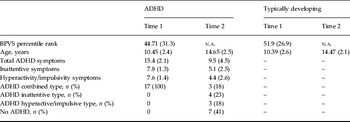
Participant characteristics (Table 2)
A total of 17 boys with ADHD and 17 TYP boys were recruited from the cohort that participated in the time 1 study (Rhodes et al. Reference Rhodes, Coghill and Matthews2004, Reference Rhodes, Coghill and Matthews2005) and reassessed approximately 4 years later – time 2 (mean 4.14 years, s.d. = 0.37 years). There were no differences between the groups with respect to BPVS at time 1, or age at times 1 or 2 (all p > 0.05), or between the two follow-up groups and the original study groups (75 ADHD, 70 TYP) in BPVS percentile rank, age or any of the key clinical and neuropsychological measures (all p > 0.05).
Demographic and clinical characteristics

ADHD, Attention deficit hyperactivity disorder; BPVS, British Picture Vocabulary Scale; n.a., not available.
Data are given as mean (standard deviation) unless otherwise indicated.
Clinical data (Table 2)
For the ADHD group, the total number of ADHD symptoms at time 1 was significantly reduced at time 2 (F 1,16 = 31.2, p < 0.001). Similar reductions were seen for hyperactive/impulsive (F 1,16 = 22.0, p < 0.001) and inattentive (F 1,16 = 19.9, p < 0.001) symptom scores. At time 2 the diagnoses for the ADHD group were: DSM IV combined type ADHD, three; inattentive type, four; hyperactive impulsive type, three. The remainder (seven participants) no longer met criteria for any form of ADHD. There was no statistically significant association between age at time 2 and degree of symptom reduction (r = 0.12, p > 0.05). None of the TYP group met diagnostic criteria for ADHD at either time.
Neuropsychological data at time 2
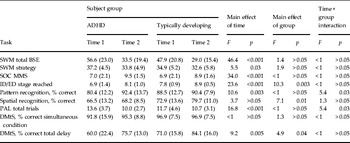
Of the participants, one ADHD boy did not complete the Stockings of Cambridge (SOC) task and four TYP boys did not complete the delayed matching-to-sample (DMtS) task at time 2. Therefore data are reported with 16 ADHD and 13 TYP participants for these tasks. All main effects of difficulty were significant in the anticipated direction and are, therefore, not reported. A summary of findings and means is presented in Table 3.
Neuropsychological performance across both testing sessions

ADHD, Attention deficit hyperactivity disorder; SWM, spatial working memory; BSE, between search errors; SOC, Stockings of Cambridge; MMS, minimum move solutions; ID/ED, intra-dimensional extra-dimensional; PAL, paired associates learning; DMtS, delayed matching to sample.
Data are given as mean (standard deviation).
Tasks with a high executive demand (Table 3)
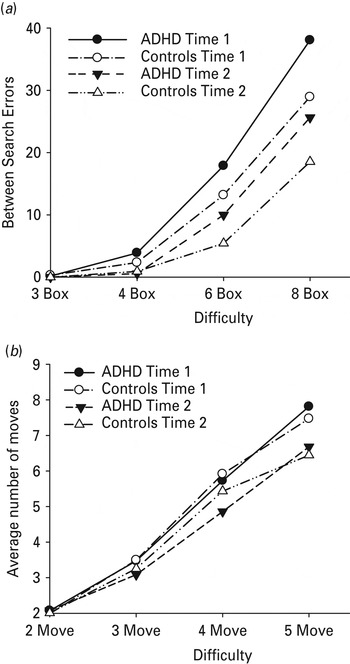
Spatial working memory (SWM) (Fig. 1a)
Repeated-measures ANOVA on between search errors on the SWM task revealed a main effect of time, with reduced errors at time 2. There was no significant main effect of group or significant interactions between time and group, or difficulty and group (F 3,96 = 1.29, p > 0.05). There was a significant interaction between time and difficulty (F 3,96 = 17.89, p < 0.001) but no significant three-way interaction between time, difficulty and group (F 3,96 < 1).
Interaction between performance and difficulty for attention deficit hyperactivity disorder (ADHD) and control groups at times 1 and 2 for (a) spatial working memory (between search errors) and (b) Stockings of Cambridge (average moves to solution).

Repeated-measures ANOVA on strategy score revealed a main effect of time, which reflected a greater use of a strategy at time 2. There was no effect of group, or any interaction between time and group.
SOC (Fig. 1b)
Repeated-measures ANOVA on the number of minimum move solutions (MMS) on the SOC task revealed a main effect of time, reflecting an improved efficiency of task completion at time 2. There was no effect of group or an interaction between time and group. Repeated-measures ANOVA on average number of moves on the SOC task revealed a significant effect of time (F 1,30 = 21.68, p < 0.001), but no significant effect of group (F 1,30 = 1.01, p > 0.05). There were no significant interactions between time and group (F 1,30 < 1), or difficulty and group (F 3,90 < 1). There was, however, a significant interaction between time and difficulty (F 3,90 = 4.77, p = 0.004). A follow-up ANOVA revealed that the interaction reflected significantly better performance on the 3-, 4- and 5-move problems at time 2 than at time 1. There was no significant three-way interaction between time, group and difficulty (F 3,90 < 1).
Attentional set shifting (intra-dimensional extra-dimensional; ID/ED)
Repeated-measures ANOVA on the stage reached score revealed a main effect of time, with improved performance at time 2. There was a significant main effect of group, which reflected poorer performance by the ADHD group across both time points. There was no significant interaction between time and group.
Tasks with a low executive demand
Pattern recognition memory
Repeated-measures ANOVA on percentage correct on the pattern recognition task revealed a significant effect of time, with better performance at time 2. There was no effect of group, but there was a time and group interaction. It was revealed by t tests that while the performance of TYP boys was superior to that of ADHD boys at time 1, they no longer differed at time 2.
Spatial recognition memory
Repeated-measures ANOVA on percentage correct on the spatial recognition memory task revealed no significant effect of time. There was a significant effect of group, which reflected poorer accuracy for the ADHD group. There was no time × group interaction.
Paired associates learning (PAL)
Repeated-measures ANOVA on the total number of trials revealed a main effect of time, with better performance at time 2. There was no main effect of group, but there was a significant time × group interaction. Post-hoc analyses revealed that while the groups differed at time 1, they did not at time 2.
DMtS
Repeated-measures ANOVA on percentage of correct responses for the simultaneous condition of the DMtS task revealed no significant main effects of time or group and no time × group interaction.
Repeated-measures ANOVA conducted on percentage correct for the delay conditions of the DMtS task revealed a main effect of time, with better performance at time 2, and a main effect for group, with poorer performance for ADHD boys. There was no time × group interaction. There were no significant interactions between group and difficulty (F 2,56 = 2.45, p > 0.05) or time and difficulty (F 2,56 < 1), nor was there a three-way interaction between group, time and difficulty (F 2,56 = 1.01, p > 0.05).
Relationship between neuropsychological functioning and clinical outcome in the ADHD group
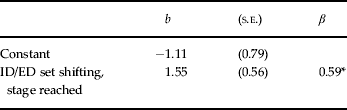
Multiple regression was performed with change in total ADHD symptoms between time 1 and 2 as the dependent measure and baseline neuropsychological performance adjusted for age and BPVS across the various tasks as the predictors [SWM (between search errors and strategy scores); SOC (MMS); ID/ED shift (stage reached), spatial recognition (percentage correct); pattern recognition (percentage correct); DMtS (percentage correct simultaneous condition and all delays); PAL (total trials)]. Only baseline performance in terms of stage reached on the ID/ED set-shifting task predicted clinical outcome, with better baseline performance predicting better clinical outcome (R 2 = 0.35) (Table 4).
Relationship between neuropsychological and clinical performance: stepwise linear regression investigating the effects of baseline (time 1) neuropsychological performance on clinical outcome (change in ADHD symptom count between times 1 and 2) a

ADHD, Attention deficit hyperactivity disorder; s.e., standard error; ID/ED, intra-dimensional extra-dimensional.
a R 2 = 0.35.
* p < 0.05.
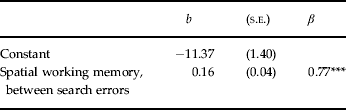
Mirroring the analysis of Halperin et al. (Reference Halperin, Trampush, Miller, Marks and Newcorn2008), a multiple regression was conducted with change in total ADHD symptoms as the dependent measure and time 2 neuropsychological performance across the various tasks as the predictors. Only time 2 performance on the SWM task predicted outcome, with superior performance on this task predicting a better clinical outcome (R 2 = 0.59) (Table 5).
Relationship between neuropsychological and clinical performance: stepwise linear regression investigating the effects of time 2 neuropsychological performance on clinical outcome (change in ADHD symptom count between times 1 and 2) a

ADHD, Attention deficit hyperactivity disorder; s.e., standard error.
a R 2 = 0.59.
*** p < 0.001.
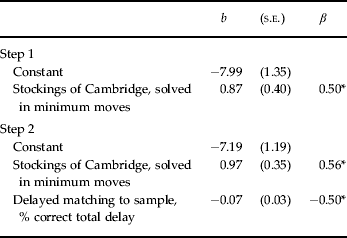
Multiple linear regression was conducted to assess whether change in neuropsychological performance predicted clinical symptom reduction. Change in total ADHD symptoms between times 1 and 2 was the dependent measure with change scores on the neuropsychological tasks as the predictors. The results are shown in Table 6.
Relationship between neuropsychological and clinical performance: stepwise linear regression investigating the effects of change in neuropsychological performance between times 1 and 2 on clinical outcome (change in ADHD symptom count between times 1 and 2) a

ADHD, Attention deficit hyperactivity disorder; s.e., standard error.
a R 2 = 0.25 for step 1; ΔR 2 = 0.25 for step 2 (p's < 0.05).
* p < 0.05.
Change in performance on SOC (MMS) and DMtS (% correct across all delays) predicted change in symptoms. Whilst greater improvement on DMtS predicted a greater symptom reduction (R 2 = 0.25), on the SOC (R 2 = 0.25) task a smaller enhancement in performance predicted increased reduction in symptoms between times 1 and 2. Further inspection of the SOC performance measures indicated that this association appeared to reflect a ceiling effect whereby those individuals who performed best on this task at baseline were performing near ceiling and therefore were able to make only small improvements in task performance. This group showed greater symptom reductions than those with poorer baseline SOC performance, and greater change in task performance. The results were similar when alternative measures of task performance for SOC were used (average moves on the 5-move problems, total moves). The result for DMtS remained significant when SOC was removed from the analysis.
Discussion
This is the first prospective description of changes in both clinical and neuropsychological presentation of ADHD over development. Based on previous studies, we addressed two main hypotheses. First, that over a 4-year period, all participants, irrespective of diagnosis, would demonstrate improved neuropsychological, as well as clinical functioning, over time. This hypothesis was supported by the data. Second, based on the developmental theories of Halperin & Schulz (Reference Halperin and Schulz2006), we hypothesized that, within the ADHD group, a greater reduction in symptoms would be associated with larger improvements in executive functions, but not in low executive demand neuropsychological tasks. This hypothesis was not supported.
The findings reported here should, however, be viewed with several limitations in mind. Despite a gap of 4 years between testing sessions, it is possible that some of the improvements noted across both groups were due to practice effects. Our sample size was limited and there were some missing data. Both factors may have reduced our ability to detect significant effects. However, both of the subsamples remained representative of the original samples at time 1. Due to the limited sample size we were unable to take into account inter-individual differences in medication history and changes in medication status between times 1 and 2. All participants were stimulant naive at time 1 and those with ADHD were all exposed to methylphenidate for at least 2 months during the initial study. Two-thirds of the ADHD group were taking methylphenidate just prior to their time 2 assessment. For these participants, successful medication treatment of symptoms and/or neuropsychological functioning may have made an impact on our findings. It is possible that successful treatment of ADHD symptoms would have reduced the clinical symptom ratings. However, all assessments were conducted by experienced clinicians who were skilled in making clinical assessments of individuals taking medications for ADHD and the assessment of continuing need for treatment in such patients. They were instructed to focus on days when medication was not taken (a very common occurrence in adolescents with ADHD) and times of the day when medication had worn off. It is also possible that these participants may have experienced withdrawal effects due to the stopping of treatment prior to their time 2 assessment. However, whilst there are no empirical data to determine the optimal gap between last dose and neuropsychological testing, the 72-h gap between discontinuation and assessment used in this study was equivalent to 24 half-lives for immediate-release methylphenidate and three times the usual length used in other similar studies. We believe that this should have been sufficient to permit the return of both clinical symptoms and neuropsychological difficulties and the resolution of any withdrawal/discontinuation effects. The limited sample size also meant that we were unable to directly compare ‘remitters’ with ‘persisters’. However, as ADHD is a dimensional rather than categorical disorder, any distinction between persistence and remission is essentially arbitrary and the use of a dimensional approach with continuous variables that we have followed here is, we believe, more appropriate.
Clearly the finding that, at a group level, ADHD symptoms improve over time is not new. Faraone et al. (Reference Faraone, Biederman and Mick2006) found consistent evidence for an age-dependent decline in symptoms over time. Whilst they found a relatively low rate of diagnostic persistence, this rate increases considerably if one focuses on continued impairment rather than diagnostic status. Our findings with respect to neuropsychological development were also expected. The ADHD boys improved over time on all tasks with the exception of the spatial recognition task and on this task many ADHD boys were already performing at ceiling at time 1. Our finding that, for most tasks, there was no interaction between group and time suggests that, at a group level, and similar to the evidence for brain maturation described by Shaw et al. (Reference Shaw, Eckstrand, Sharp, Blumenthal, Lerch, Greenstein, Clasen, Evans, Giedd and Rapoport2007a ), the development of neuropsychological functioning in ADHD parallels that of healthy children but with a developmental lag. The group and time interactions that were apparent for the pattern recognition and PAL tasks also seem likely to be explained by ceiling effects. The control group, but not the ADHD group, were performing near ceiling at time 1 with little room for further improvement. Future studies would benefit from the inclusion of recognition memory and learning tasks with higher levels of difficulty. Indeed, the more demanding DMtS task demonstrated the expected pattern of development over time, with parallel changes in performance between the two groups.
The lack of an association between symptom reduction and improved executive functions in the present study was somewhat, but not entirely, unexpected. Biederman et al. (Reference Biederman, Petty, Fried, Doyle, Spencer, Seidman, Gross, Poetzl and Faraone2007) found that the majority of subjects with an executive function deficit at baseline continued to have a deficit 7 years later (positive predictive value 69%), whilst the majority of those who did not have an executive function deficit at baseline also did not at follow-up (negative predictive value 75%). Unfortunately, they did not report the formal associations between changes in neuropsychological and clinical presentation. Halperin et al. (Reference Halperin, Trampush, Miller, Marks and Newcorn2008) are the only group to have reported an association between clinical change and neuropsychological functioning. They found that a good clinical outcome was associated with better executive functions at follow-up, whilst no such relationship was identified for low executive demand tasks. They concluded that, in line with their previously published theoretical position, ADHD is associated with early-appearing and enduring subcortical (and presumably low executive demand cognitive) dysfunction, whilst recovery over the course of development is associated with improvements in executive functioning. Unfortunately, whilst these participants had clinical assessments at two time points, their neuropsychological performance was only measured at follow-up. As ADHD is extremely heterogeneous with respect to neuropsychological functioning (Nigg et al. Reference Nigg, Willcutt, Doyle and Sonuga-Barke2005; Coghill et al. Reference Coghill, Rhodes and Matthews2007) it is possible that those with a good clinical outcome in the Halperin et al. (Reference Halperin, Trampush, Miller, Marks and Newcorn2008) sample had always demonstrated better executive functioning compared with those with a poorer outcome. Certainly, our data do not support the conclusions from the Halperin et al. (Reference Halperin, Trampush, Miller, Marks and Newcorn2008) study. Whilst we did find that better performance on the SWM task at time 2 predicted clinical response, we did not find any meaningful relationship between time 2 performance on the two other CANTAB tasks that have been traditionally looked upon as having a ‘prominent’ executive component (SOC and ID/ED set-shifting tasks). Importantly, there was no association between changes in clinical status and performance on any of the high executive function demand tasks. We did, however, find that superior baseline performance on the ID/ED set-shifting task predicted a better clinical outcome and, perhaps more importantly, that a bigger improvement in performance on the low executive demand DMtS task (a measure of short-term memory functioning) also predicted a better clinical outcome. These observations are striking in the context of our previous findings that this task was associated with the greatest effect size (ADHD versus controls) at baseline, was the task most improved by both acute and chronic methylphenidate challenge, and was the strongest predictor of clinical changes with methylphenidate (Rhodes et al. Reference Rhodes, Coghill and Matthews2004, Reference Rhodes, Coghill and Matthews2005, Reference Rhodes, Coghill and Matthews2006; Coghill et al. Reference Coghill, Rhodes and Matthews2007), emphasizing that low as well as high executive demand cognitive functions are likely to play an important role in ADHD. The recent systematic review of van Lieshout et al. (Reference van Lieshout, Luman, Buitelaar, Rommelse and Oosterlaan2013) identifies weaknesses in many of the previous studies in the field and also concludes that current evidence does not support the hypothesis put forward by Halperin & Schulz (Reference Halperin and Schulz2006).
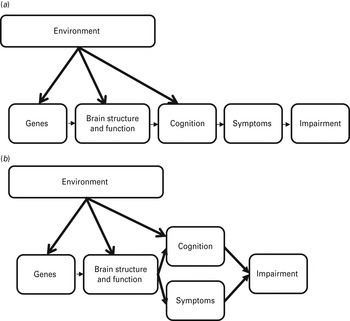
Our findings also suggest that the relationships between cognitive and symptomatic aspects of ADHD seem to be more complex than previously recognized. Most researchers and clinicians have assumed a linear relationship whereby cognitive deficits underpin symptoms (e.g. that an inhibitory deficit, or aversions to delay, will result in observable symptoms of impulsivity, or that a deficit in working memory will result in inattention) (Fig. 2 a). Our findings of a relative lack of association between clinical and cognitive changes over time, when considered alongside our previous findings of a lack of association between clinical and cognitive response to methylphenidate (Coghill et al. Reference Coghill, Rhodes and Matthews2007), challenge this notion. These data suggest instead that cognitive aspects of ADHD may sit alongside symptoms at the same level of analysis within the causal model with both, potentially, making independent contributions to overall impairment (Fig. 2 b). This interpretation is consistent with findings from other groups. For example, although working memory training has been shown to be effective at improving various aspects of memory functioning by several groups (Klingberg et al. Reference Klingberg, Fernell, Olesen, Johnson, Gustafsson, Dahlstrom, Gillberg, Forssberg and Westerberg2005; Holmes et al. Reference Holmes, Gathercole, Place, Dunning, Hilton and Elliott2010), the effects of this training on ADHD symptoms are much more modest (Sonuga-Barke et al. Reference Sonuga-Barke, Brandeis, Cortese, Daley, Ferrin, Holtmann, Stevenson, Danckaerts, van der Oord, Dopfner, Dittmann, Simonoff, Zuddas, Banaschewski, Buitelaar, Coghill, Hollis, Konofal, Lecendreux, Wong and Sergeant2013). Whilst it could be argued that these findings question the importance of the cognitive impairments in ADHD, there are other interpretations. It is possible that, whilst the symptoms of ADHD as presented within the various classification systems, appropriately distinguish those with ADHD from the general population and from those with other disorders, they do not fully describe the problems associated with ADHD. Indeed, the purpose of the classification systems is to distinguish between groups rather than fully describe these groups (Coghill & Sonuga-Barke, Reference Coghill and Sonuga-Barke2012). For ADHD, the symptoms retained in the current classification systems represent those that have been shown to respond to stimulant treatment and, as we have previously demonstrated, many of the cognitive deficits associated with ADHD do not show a strong response to methylphenidate (Coghill et al. Reference Coghill, Rhodes and Matthews2007). Whilst the inclusion of symptoms more closely associated with these cognitive deficits may not improve our ability to detect and diagnose ADHD, it may lead to a more complete description of the difficulties faced by these children and suggest a broader set of treatment targets. Further examination of these relationships between the cognitive and symptom levels of analysis and their relationship with impairment is required. To date many of the studies relevant to this question have been observational in nature. It is now time to focus on experimental studies that examine the relationships between cognitive deficits and impairment and the role of symptoms in this relationship. Should the hypotheses described above hold up to such testing, it will be necessary to rethink our approaches to managing ADHD and integrate both symptoms and cognition as important treatment targets. This would strengthen the rationale for treatments that focus on cognitive training which, as described above, have been demonstrated to be effective in improving cognition in those with ADHD but seem to have a much smaller effect on symptoms. Whilst it seems likely that different pharmacological and non-pharmacological approaches make an impact differently on different aspects of cognitive functioning, this has not been well studied. A better understanding of the strengths and weaknesses of the various treatment approaches may help to individualize treatment and would introduce a rationale for assessing the cognitive profile of those with ADHD. Currently testing for specific cognitive deficits does not add much to the assessment or clinical management of those with ADHD but if it is shown that specific cognitive deficits have an impact on clinical status independent of symptoms then this raises the possibility of treatment approaches being individualized according to a particular profile. It could also stimulate the development of new treatment approaches, both pharmacological and non-pharmacological, aimed at providing a more rational and comprehensive approach to treating ADHD.
Causal models for attention deficit hyperactivity disorder. (a) Traditional causal model. (b) Potential alternative causal model.

In conclusion, we now report that cognitive performance improves over time in boys with ADHD in a similar way, and at a similar rate, to healthy boys. However, as with cortical development, neuropsychological development in ADHD is associated with a developmental lag. Whilst we did not find evidence to support the notion that remission of ADHD symptoms is associated with improvements in executive functions, we did find that improvements in low executive demand short-term memory storage, an aspect of cognitive functioning that has previously been associated with a positive clinical response to methylphenidate, were associated with clinical improvement. These data highlight the importance of monitoring cognition, symptoms and cognitive aspects of treatment response over time in children and adolescents with ADHD.
Acknowledgements
We thank the patients and investigators who took part in this study. The original study was supported by a local trust through a TENOVUS-Scotland initiative and the follow-up study was funded by the Chief Scientist's Office, Scotland.
Declaration of Interest
The following authors have received compensation for serving as consultants or speakers, or they or the institutions they work for have received research support or royalties from the companies or organizations indicated: D.R.C. (Flynn, Janssen-Cilag, Lilly, Medice, Novartis, Otsuka, Oxford University Press, Pfizer, Schering-Plough, Shire, Vifor Pharma); S.M.R. (Lilly, Shire); and K.M. (Bristol-Myers-Squibb, Cyberonics Inc., GSK, Medtronic, Merck Serono, Reckitt Benckiser, Schering-Plough, St Jude Medical).