It is well-known that para-κ-casein is the hydrophobic part of κ-casein that participates in the paracasein matrix of cheese curd. Residual chymosin or rennet is a main proteolytic factor for the paracasein components and in particular for αs1- and β-caseins, whereas αs2- and para-κ-casein, which is the objective of the present study, are considered rather resistant to its action during cheese ripening. On the other hand, there are findings indicating that para-κ-casein is susceptible to proteolysis both ‘in vitro’ and during cheese ripening. Coolbear et al. (Reference Coolbear, Elgar, Coolbear and Ayers1996) have found that para-κ-casein produced by the action of chymosin on isolated κ-casein was hydrolysed into at least six fragments at pH 5·5 and 4·5 and Reid et al. (Reference Reid, Coolbear, Ayers and Coolbear1997) have identified 14 cleavage sites in para-κ-casein involving mainly hydrophobic and aromatic residues, which are susceptible to hydrolysis by chymosin ‘in vitro’.
Chymosin is associated with caseins and Larsson & Andrén (Reference Larsson and Andrén1997) propose that the positive net charge of para-κ-casein at pH <7·0 and the negative charge of chymosin at pH >4·6 promote their strong association within the pH range 5·2–7·2, while de Roos et al. (Reference de Roos, Geurts and Walstra2000) conclude that the retention of chymosin in curd during cheese making is due to the association of chymosin exclusively with para-κ-casein, whereas αs- and β-casein as well as para-κ-casein itself also associate with para-κ-casein. They suggest that competition between these caseins and chymosin determines the extent of association of the latter with the paracasein micelles.
Studies on para-κ-casein hydrolysis under actual conditions, ie in various cheese varieties, are limited. Ferranti et al. (Reference Ferranti, Itolli, Barone, Malorni, Garro, Laezza, Chianese, Migliaccio, Stingo and Addeo1997) report three para-κ-peptides out of a total of 92 peptides identified in Grana-Padano cheese and Michaelidou et al. (Reference Michaelidou, Alichanidis, Urlaub, Polychroniadou and Zerfiridis1998) report one peptide originated from para-κ-casein among ten major peptides in Feta cheese. Perna et al. (Reference Perna, Simonetti, Intaglietta and Gambacorta2014) have estimated high quantity of residual para-κ-casein for a pasta filata cheese and according to Juan et al. (Reference Juan, Zamora, Quevedo and Trujillo2016) the greatest part of para-κ-casein remains intact during the ripening of a semi-hard goat milk cheese.
The conclusion of de Roos et al. (Reference de Roos, Geurts and Walstra2000) is that the decrease of pH, the increase of the quantity of chymosin and the increase of water to protein ratio increase the association of chymosin with para-κ-casein. In relation to pH, para-κ-casein has been found relatively resistant to ‘in vitro’ hydrolysis by chymosin at pH 6·6 but its hydrolysis rate increases with decreasing pH from 4·6 to 3·6 (Reid et al. Reference Reid, Coolbear, Ayers and Coolbear1997). Therefore, the conditions in Feta curd and cheese, i.e. high moisture, lack of curd heating that could inactivate chymosin and low pH in the cheese mass favour both the retention of chymosin in the curd and its activity during ripening. Indeed, a considerable amount of residual chymosin activity has been detected in Feta cheese, much higher than that observed in other cheese varieties (Nega & Moatsou, Reference Nega and Moatsou2012). As a consequence of these various observations, para-κ-casein has been proposed as an index for the detection of the composition of cheese milk mixture or adulteration by means of isolectric focusing or chromatography (Addeo et al. Reference Addeo, Moio, Chianese and Stingo1990; Mayer et al. Reference Mayer, Heidler and Rockenbauer1997; Moatsou et al. Reference Moatsou, Hatzinaki, Psathas and Anifantakis2004; Mayer, Reference Mayer2005; Tsartsianidou et al. Reference Tsartsianidou, Triantafillidou, Karaiskou, Tarantili, Triantafillidis, Georgakis and Triantafyllidis2017).
The hypothesis of this research paper was that the physicochemical conditions in a low-pH, high-moisture, white brined cheese made from non-heat treated curd would make para-κ-casein vulnerable to residual chymosin activity during the ripening and storage. The use of para-κ-casein for the evaluation of the milk kind in the cheese milk mixture presupposes its stability during cheese ripening. Hence, whilst our main objective was the assessment of para-κ-casein during the ripening and storage of Feta cheese manufactured from different mixtures of sheep and goat milk, we also investigated the use of this paracasein fraction for the evaluation of the ratio of goat to sheep milk in the cheese milk.
Materials and methods
Preparation of sheep and goat para-κ-casein standards
Ten mg of crude κ-casein extracts of sheep and goat milk prepared as described by Moatsou et al. (Reference Moatsou, Hatzinaki, Psathas and Anifantakis2004) were diluted in one mL trisodium citrate buffer pH 6·6. The solutions were treated with bovine rennet (Naturen, Chr. Hansen, Denmark) under the conditions of cheesemaking, i.e. 40 µl of a 0·2% rennet solution in trisodium citrate buffer, pH 6·6, were added. After incubation at 37 °C for one h, centrifugation at 10 000 g for 10 min was carried out. The para-κ-casein sediment was collected and prepared for HPLC analysis as described below.
Cheesemaking and sampling
Five different cheeses from sheep milk and its mixtures with goat milk were manufactured as described by Moatsou & Govaris (Reference Moatsou and Govaris2011). Cheeses were symbolised according to the composition of cheesemilk, as follows. S100, sheep milk; S90G10, sheep to goat milk 9 : 1, S80G20, sheep to goat milk 8 : 2, S70G30, sheep to goat milk 7 : 3 and S60G40 sheep to goat milk 6 : 4. The mean gross composition of the sheep cheese milk estimated by means of Milkoscan apparatus was: fat 5·30 ± 0·03, protein 5·27 ± 0·08 and lactose 4·83 ± 0·07%. The respective values for goat milk were: 3·80 ± 0·26, 3·20 ± 0·23 and 4·42 ± 0·07%. Rennet was added at 38·5 ± 0·5 °C, rennet coagulation time was 8·5 ± 0·3 min and cutting was carried out 35·3 ± 0·80 min after coagulation. The first stage of ripening was carried out at 18 °C for two weeks and the second stage at 4 °C up to 60 d post manufacture. Cheeses were stored at 4 °C for another 60 d.
Three cheesemaking experiments (n = 3) were performed within three consecutive weeks. Samples were taken on day one, on day 15 that was the end of the first day of ripening, on day 60 at the end of ripening and on day 120 during storage.
Cheese analyses
Cheese moisture was determined by drying approximately 3 g at 102 ± 2 °C until constant weight and pH was estimated in a 10% aqueous dispersion of cheese. Cheese proteolysis was assessed by the trinitrobenzenesulphonic acid (TNBS) method reported by Polychroniadou (Reference Polychroniadou1988). In brief, the supernatant of a borax cheese solution, pH 9·5 was incubated with TNBS and after the termination of the reaction, the absorbance at 420 nm was estimated. A standard curve using glycine instead of cheese solution was used and the concentration of free amino groups (FAG) in cheese were expressed as mm glycine. Cheese analyses were performed in triplicate.
Isolation of paracasein from cheese
Five g cheese were diluted in 50 ml 0·1 M trisodium citrate buffer pH 6·6 under mild heating and continuous stirring. Then, the pH of dilution was adjusted to pH 4·6 by HCl and the casein sediment was collected after centrifugation at 10 000 g for 10 min.
Determination of para-κ-casein
Para-κ-casein in both standards and cheeses samples was determined by a cation exchange method, which was a substantial modification in terms of column, sample preparation and elution conditions of the method of Mayer et al. (Reference Mayer, Heidler and Rockenbauer1997) utilised also by Moatsou et al. (Reference Moatsou, Hatzinaki, Psathas and Anifantakis2004). The cation-exchange column Macrosphere WCX 7 µm, 150 × 4·6 mm (Alltech, Deerfield IL, USA) was used. Eluent buffer A was 5 M urea, 10 mm malic acid/NaOH, pH 6·0, buffer B was 5 M urea, 10 mm malic acid/NaOH, 0·5 M NaCl, pH 6·0, flow rate was 1 ml/min, the eluent was monitored at 280 nm and the elution conditions were: 100% A for 5 min, 0–80% B within 20 min, 80–100% B within 6 min, 100% B for 7 min, 0–100% A within one min and finally 100% A for 21 min.
The para-κ-casein sediment (standard) prepared as described above was diluted in one ml eluent buffer A and 2 g of the cheese sediment were diluted in 14 ml eluent buffer A. Both categories of samples were treated as follows. After vigorous stirring and mild heating, the pH of the paracasein solutions was adjusted to pH 6·0 by NaOH. Then centrifugation at 10 000 g for 10 min was carried out, the supernatants were filtered through 0·45 µm syringe filter (Whatman) and 130 µl of the filtrates were analysed. The elution profiles of sheep and goat para-κ-casein standards were used as reference. All samples were analysed in duplicate and the estimations were based on the chromatographic area of the para-κ-casein peaks.
Statistical analysis
The software Statgraphics Centurion XVI (Manugistics, Inc., Rockville, MA 20852, USA) was used to perform statistical analysis. Analysis of variance (ANOVA) was applied to test the effect of stage of ripening and of the cheesemilk mixture; differences were further analysed using the least significance method (LSD) at P < 0·05.
Results and discussion
The inclusion of goat milk induced statistically significant increase (P < 0·05) in the acidification of the curd during the first 24 h, which resulted in more intense draining (Table 1). It was evident that the inclusion of the goat milk in the Feta cheese milk mixture decreased, although not statistically significantly (>0·05), the moisture of cheese similarly to the findings of Mallatou & Pappa (Reference Mallatou and Pappa2005), who studied white brined cheeses made from sheep or goat milk or their mixtures. The decrease of pH decreases the negative charge of caseins enhancing thus their interactions that favour whey drainage (McSweeney, Reference McSweeney, Fox, McSweeney, Cogan and Guinee2004).
pH and moisture during the ripening of Feta cheese made from mixtures of sheep and goat milk; S100, sheep milk; S90G10, sheep to goat milk 9 : 1; S80G20, sheep to goat milk 8 : 2; S70G30, sheep to goat milk 7 : 3; S60G40, sheep to goat milk 6 : 4.

Values are means ± standard deviation of three independent cheesemakings; different letters indicate statistically significant differences within columns (LSD, P < 0·05).
The changes of the concentration of free amino groups (FAG) during the ripening and storage of five cheeses are presented in Table 2. Major and statistically significant increase (P < 0·05) took place during the first stage of ripening at 18 °C for 2 weeks. No significant changes were observed thereafter in accordance to typical proteolysis pattern for Feta cheese (Moatsou & Govaris, Reference Moatsou and Govaris2011). Fluctuations in FAG concentrations can be assigned to interchanges between brine and cheese mass and to the catabolism of free amino acids to volatile compounds (Zoidou et al. Reference Zoidou, Plakas, Giannopoulou, Kotoula and Moatsou2015). The concentration of FAGs and the rate of their accumulation decreased as the percentage of goat milk increased similarly to the findings of Mallatou et al. (Reference Mallatou, Pappa and Boumba2004) on the effect of goat cheese milk on the evolution of proteolysis of white brined cheese.
Free amino groups expressed as mM Gly during the ripening of Feta made from mixtures of sheep and goat milk; S100, sheep milk; S90G10, sheep to goat milk 9 : 1; S80G20, sheep to goat milk 8 : 2; S70G30, sheep to goat milk 7 : 3; S60G40, sheep to goat milk 6 : 4.

Values are means ± standard deviation of three independent cheesemakings; different letters indicate statistically significant differences within columns (LSD, P < 0·05).
The HPLC elution time of sheep and goat para-κ-casein was 18·726 ± 0·801 and 17·065 ± 0·410 min respectively. Therefore, they were efficiently separated onto the utilised column despite the similarity of their amino acid sequences. In fact, ovine and caprine para-κ-casein differ only in five amino acids at positions 2, 7, 8, 82 and 94 (Furet et al. Reference Furet, Mercier, Soulier, Gaye, Hue-Delahaie and Vilotte1990; Coll et al. Reference Coll, Folch and Sànchez1993).
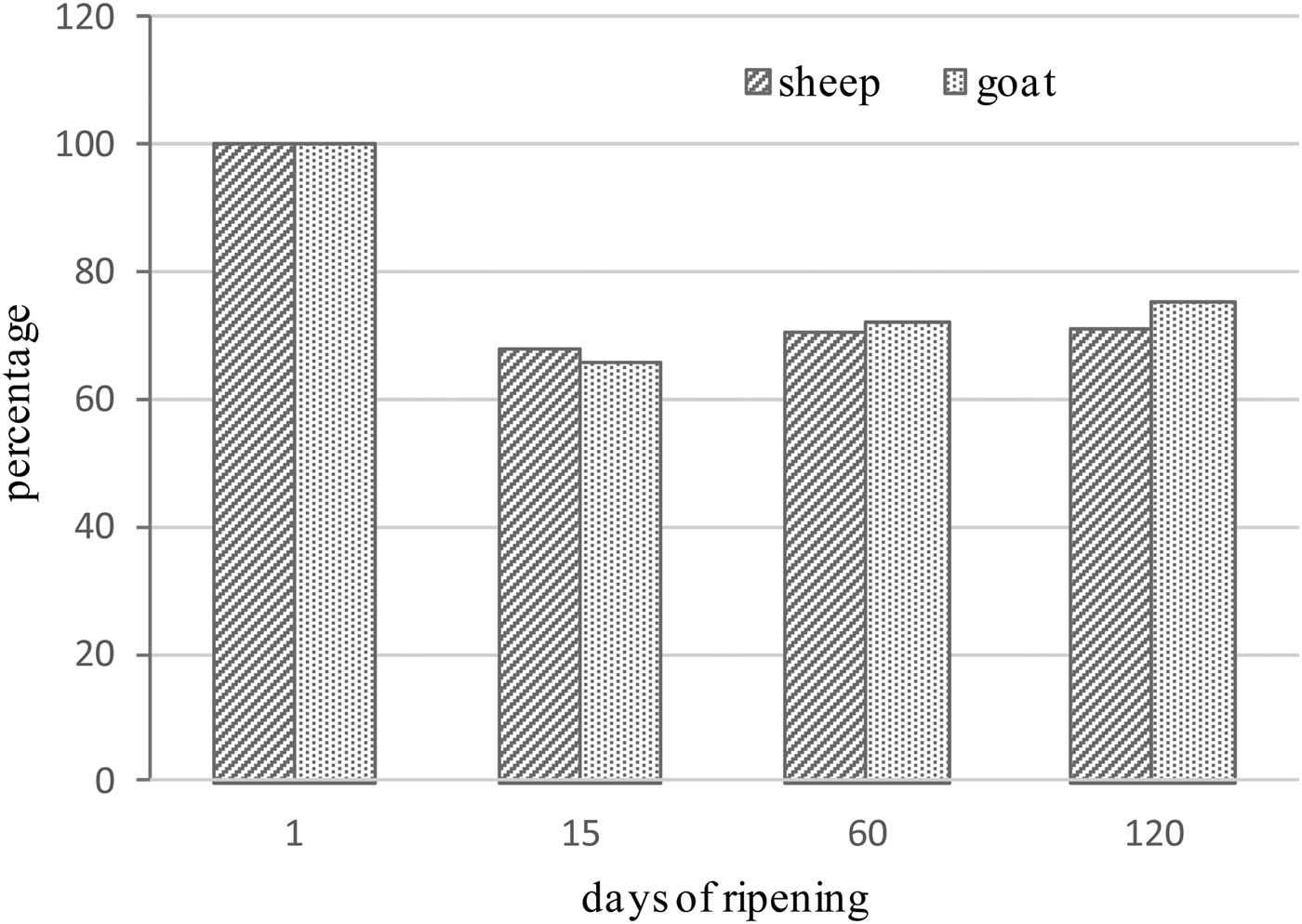
The area of sheep and goat para-κ-caseins during the ripening and storage of cheeses is shown in Table 3. The composition of cheese milk did not affect the rate of change (P > 0·05). Therefore, in Fig. 1 are presented the average changes of para-κ-casein in all cheeses expressed as percentage of the areas of the respective peaks on day one. Considerable hydrolysis took place during the first stage of ripening but the area of para-κ-caseins remained rather stable thereafter. This trend is consistent with the evolution of FAGs in Table 2 and with the reported degradation pattern for αs- and β-caseins in Feta (Moatsou & Govaris, Reference Moatsou and Govaris2011). Casein hydrolysis in this cheese type is attributed mainly to the action of residual chymosin due to the low pH, lack of curd heating and high moisture. However, the low temperature (4 °C) during the second stage of ripening is not expected to favour enzymatic activity. Moreover, low temperature affects the association of para-κ-casein with chymosin. Larsson & Andrén (Reference Larsson and Andrén1997) propose that hydrophobic and hydrophilic interactions along with the electrostatic forces are responsible for the association between para-κ-casein and chymosin. Since, (i) low temperatures weaken hydrophobic interactions, and (ii) Feta pH, which is lower than or close to the pI of chymosin, weakens the electrostatic attraction, it is expected that the conditions of the second stage of ripening do not favour the association of enzyme with the substrate. In addition, de Roos et al. (Reference de Roos, Geurts and Walstra2000) suggest that the immobilisation of chymosin onto para-κ-casein is not permanent because proteolysis destroys their contact sites. All these phenomena taken together explain the stability of para-κ-casein during the second stage of ripening and storage of Feta, despite its physicochemical composition.
Mean changes of para-κ-casein areas expressed as percentages of the respective areas on day one during the ripening of Feta cheese. Each bar is the mean of 15 values (3 independent cheesemakings × five Feta cheeses).

Chromatographic areas of sheep and goat para-κ-caseins, during the ripening of Feta made from mixtures of sheep and goat milk; S100, sheep milk; S90G10, sheep to goat milk 9 : 1; S80G20, sheep to goat milk 8 : 2; S70G30, sheep to goat milk 7 : 3; S60G40, sheep to goat milk 6 : 4.

Values are means ± standard deviation of three independent cheesemakings; different letters indicate statistically significant differences within columns (LSD, P < 0·05).
The present results do not contradict the scarce studies on para-κ-casein in actual cheese environment. Perna et al. (Reference Perna, Simonetti, Intaglietta and Gambacorta2014) report a high residual quantity for para-κ-casein in the Cacciocavallo pasta filata cheese with pH much higher than that of the cheeses of the present study, which is close to 5·80. In particular, after 90 d of ripening it is approximately 66% of the initial quantity and after 150 d it is >55% of the initial contrast to the <15% observed for αs1-casein. Juan et al. (Reference Juan, Zamora, Quevedo and Trujillo2016) have found that the intact para-κ-casein in low moisture goat milk cheese with pH <4·9 was ~92% and 94% of the initial after 30 and 60 d of ripening respectively; the respective moisture contents were 33% and 25% which are much lower than Feta.
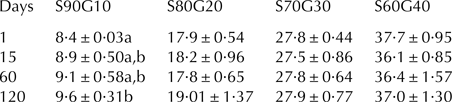
Based on the finding that the greatest part of para-κ-casein remained intact and stable during the ripening and storage of Feta, the same analytical procedure was used for the evaluation of the composition of cheese milk. The results shown in Table 4 are percentages of the area of goat on the total para-κ-casein of cheese, normalised by the ratio of sheep to goat milk protein content, which was 1·65. The percentage of goat milk in the cheese milk mixture was calculated as follows: goat milk (%) = (goat para-κ-casein area × 1·65) × 100/[(goat para-κ-casein area × 1·65) + sheep para-κ-casein area]. The actual (AG) and the estimated (EG) percentage of goat milk were strongly correlated (R = 0·997, n = 60), were related by the equation AG = 0·467 + 1·068 × EG and the standard error of estimation was 0·914.
Percentage of goat milk in the cheese milk mixture during the ripening of Feta made from mixtures of sheep and goat milk; S90G10, sheep to goat milk 9 : 1; S80G20, sheep to goat milk 8 : 2; S70G30, sheep to goat milk 7 : 3; S60G40, sheep to goat milk 6 : 4.

Values are means ± standard deviation of three independent cheesemakings; different letters indicate statistically significant differences within columns (LSD, P < 0·05).
As presented above, estimation of goat milk in the cheese milk mixture by means of cation-exchange HPLC has been reported for Camembert, Tilsit and Kashkaval cheese by Mayer et al. (Reference Mayer, Heidler and Rockenbauer1997) and Mayer (Reference Mayer2005) and for Halloumi by Moatsou et al. (Reference Moatsou, Hatzinaki, Psathas and Anifantakis2004). In this respect, the new element of the present study is the efficacy of a similar method during the actual ripening of a cheese variety favourable for the retention and action of chymosin. Moreover, previous publications focused on the limit of detection for goat milk. However, the mixing of two different milk kinds is allowed in certain cheese varieties provided that the composition of mixture is declared. Of particular importance in relation to the present results is the cheesemilk of Feta, which can be a mixture of sheep with goat milk but the latter must be lower than or equal to 30%.
Conclusion
The greatest part of para-κ-casein remained intact during ripening and storage of Feta, a low-pH, high-moisture cheese with high residual chymosin activity. These results are encouraging for the quantification of the composition of mixtures of sheep and goat cheese milk despite the great similarity of their para-κ-caseins. Moreover, they indicate that the composition of goat/sheep cheesemilk mixture can be assessed by means of a method that is based on an abundant constituent of any paracasein matrix, without laborious sample treatment and expensive consumables, using standard laboratory equipment.
This study was partially financed by the postgraduate Program ‘Food Science and Technology & Human Nutrition’ of the Agricultural University of Athens. The authors thank T. Paschos and E. Grammatikas for their excellent technical assistance in the cheesemakings.