The increase in money laundering across national borders is a challenge that requires both national and international response. The response, usually driven by the political commitment of states and the initiatives of international organizations, is regulated by legal instruments created with public policy, such as national laws, international treaties, resolutions, or recommendations. The proliferation of AML standards, their institutionalization, and their dispersion, have become attractive subjects in the scholarship of law and financial governance at both the national and international level. In their writings on international co-operation in AML, scholars employ various phrases to describe international AML standards, for instance, “international AML regime”,Footnote 3 “international AML policy”,Footnote 4 “international AML norms”,Footnote 5 or “international regulations”.Footnote 6 In this paper, the term “AML regime” that is used to describe both can be manifested in either the international and/or national dimension.
The theory behind international regimes—the concept, the components, and the procedures that make up such a regime—has come to the attention of many scholars.Footnote 7 For current purposes, this paper employs the concept of international regime:
A set of norms, rules, and decision-making procedures around which actors' expectations converge in a given area of international relations. Principles are beliefs of fact, causation, and rectitude. Norms are standards of behaviour defined in terms of rights and obligations. Rules are specific prescriptions or proscriptions for action. Decision-making procedures are prevailing practices for making and implementing collective choice.Footnote 8
This paper consists of four main parts. Part I examines the history of the international AML regime and its substantive components. Part II seeks the answers to these questions: (1) How does the international AML regime diffuse?; and (2) Why and how do developing countries engage and comply with the regime? Part III outlines the particularities of Vietnam that influence AML. And Part IV looks at the evolution of the AML regime of Vietnam.
I. Historical sketch of the international AML regime
A. Money Laundering and the Emergence of the International AML Regime
Money laundering is generally understood as the process of converting the proceeds derived from a wide range of underlying criminal offences, called predicate offences, to apparently legitimate property. Although the term “money laundering” is relatively new, some authors argue that the practice is not.Footnote 9 R.T. Naylor illustrates how money laundering processes were conducted in medieval Europe. One of these processes was aimed at disguising and giving a legal appearance to money generated from usury—unreasonably high interest charges on a loan, that was an act of immorality rather than a crime. Other forms of early money laundering include how merchants hid their profits from local authorities by, for example, exaggerating exchange rates to cover interest earned, and hiding a portion of stolen property before restoring its legitimacy.Footnote 10 In modern society, criminals may use more complex money laundering methods to disguise their illicit funds and make them appear legitimate. For example, money laundering can be carried out through: the banking sector;Footnote 11 the smuggling of currency, gold, precious metals and precious stones;Footnote 12 the Alternative Remittance System (ARS);Footnote 13 the stock market;Footnote 14 the property market;Footnote 15 and trade-based money laundering.Footnote 16
In the 1970s, the US government and US law-makers recognized that money laundering was widespread and that the immense wealth obtained by drug traffickers was laundered through financial institutions.Footnote 17 They also believed that money laundering was intimately connected with drug trafficking, and that the integrity of the financial system was threatened by launderers.Footnote 18 Hence, the step first taken to control money laundering in the US was the enactment of the Bank Secrecy Act of 1970 (BSA).Footnote 19
However, the US authorities realized that the BSA was insufficient to prevent criminals from laundering the proceeds of their crimes.Footnote 20 The law enforcement agencies needed more powerful legal instruments to prevent, detect, and prosecute launderers. Thus, the Money Laundering Control Act of 1986 was enacted to criminalize laundering-related activities.Footnote 21 This Act was an attempt to compensate for the shortcomings of the BSA.Footnote 22 The Money Laundering Control Act of 1986 was revolutionary in both its legal and practical aspects, because of the way in which it sought to deter, detect, and prosecute those who would engage in money laundering, while depriving them of their assets.Footnote 23 The criminalization of money laundering was believed to be a necessary weapon for law enforcement agencies not only to prosecute launderers directly, but also to take action against the proceeds of a number of organized crimes.
Furthermore, in the 1980s, the US found that a huge amount of drugs was being trafficked into the country. The enormous profits generated from drug trafficking were often transferred out of the country and laundered through sophisticated schemes to avoid seizure by the US authorities.Footnote 24 The US and other states developed the view that any effective anti-drug trafficking regime must include the criminalization of money laundering and the deprivation of drug traffickers’ illicit profits.Footnote 25 Additionally, “without cooperation among all nations affected by illegal drug-related activities, traffickers can defeat domestic forfeiture laws simply by removing their illicit wealth from the jurisdiction in which it is generated”.Footnote 26 This fact necessitated the international criminalization of money laundering to serve as a legal framework for international co-operation in the forfeiture of drug trafficking proceeds. Moreover, money laundering has become a crime of international concern because of its increasingly transnational character, which can cause transboundary harm, for example, harming the integrity of transnational financial institutions. As a result, the US AML regime emerged as an international regime that targeted both money laundering and drug trafficking. The US also motivated the development of similar AML law models in other countries, mainly through its “soft power”. One of the early international initiatives in AML was the Statement on Preventing Criminal Use of the Banking System for the Purpose of Money Laundering, adopted by the Basel Committee on Banking Regulation in 1988.Footnote 27 It encouraged banks to know their customers, to avoid suspicious transactions, and to co-operate with law enforcement agencies. This mirrored US concerns as reflected in its banking due diligence provisions. Further, the United Nations Convention Against Illicit Traffic in Narcotic Drugs and Psychotropic Substances (1988 Vienna Convention), which was signed by forty-three states, was a major breakthrough due to the effort of the US and the United Nations to urge international co-operation in combating illicit drug trafficking more effectively. What is more relevant to AML, however, is that this Convention was the first comprehensive international legal instrument that imposed a binding obligation on its Parties to criminalize the act of laundering the proceeds of drug-related crimes,Footnote 28 and to adopt confiscation measures.Footnote 29 Many provisions of this Convention reflect legal approaches and devices already found in US law.Footnote 30 The 1988 Vienna Convention became the cornerstone of the international AML regime and had substantial influence on subsequent related initiatives.
It is true that money laundering came to the attention of international society after other transnational illegal activities, such as piracy, human trafficking, or drug trafficking.Footnote 31 The international AML regime is a newly emerging regime, which is derived very much from the global campaign led by the US against drug crimes.
B. Other International AML Initiatives
Since the 1990s, the international AML regime has entered a new stage of astonishingly rapid evolution under the auspices of various international treaties and institutional initiatives. This section will outline the primary treaties and initiatives in chronological order.
1. The Financial Action Task Force (FATF) on money laundering
The FATF was established after the 1989 G-7 meeting in Paris.Footnote 32 The FATF intended to respond to the growing concern about drug abuse and the financial power of drug traffickers.Footnote 33 The FATF is an ad hoc intergovernmental institution with no treaty basis, but which has an ongoing and profound impact on the development of a multidimensional approach to the international AML regime. In 1990, the FATF published the first forty recommendations on AML which relied heavily on several provisions of the 1988 Vienna Convention.Footnote 34 The FATF recommendations were updated and revised in 1996,Footnote 35 2003,Footnote 36 2004,Footnote 37 and, most recently, in 2012.Footnote 38 The FATF also set out the basic framework for detecting, preventing, and suppressing the financing of terrorism and terrorist acts in its IX Special Recommendations.Footnote 39 The forty plus IX recommendations took the most comprehensive approach and provided a useful framework for national and international AML/CFT (Countering Financing of Terrorism) regimes. Although the recommendations are not legally binding, the FATF can suspend Member Countries which fail to comply, on a timely basis, with its recommendations, and can take counter-measures against non-compliant non-members.Footnote 40 The FATF recommendations consolidate the hard law of treaty obligation.
Recently, the FATF worked vigorously on the risk-based approach (RBP) to combating money laundering and terrorist financing. This approach aims to identify the existent risks, to evaluate those risks, and to develop strategies to manage and mitigate them at both the national and institutional level.Footnote 41
2. The European money laundering conventions and directives
The Council of Europe and the European Union have participated actively in and contributed significantly to the evolution of the international AML regime by adopting and updating regional money laundering counter-measures.
In 1990, the Council of Europe adopted the Convention on Laundering, Search, Seizure and Confiscation of the Proceeds from Crime.Footnote 42 In 1991, the Directive on Prevention of the Use of the Financial System for the Purpose of Money Laundering, a key international AML instrument, was introduced by the European Council.Footnote 43 The major development in this Directive beyond the 1988 Vienna Convention was that money laundering was no longer exclusively associated with drug-related crimes. Following and moving ahead of the 1990 FATF Recommendations, the 1991 European Money Laundering Directive also introduced a mandatory reporting obligation for credit and financial institutions, including suspicious transaction reporting.Footnote 44 This mandatory reporting obligation was taken up in the revised FATF Recommendations (1996). Further development in the 1996 and 2003 FATF Recommendations were included in the second European Money Laundering Directive which was adopted in December 2001,Footnote 45 in the third Directive published in November 2005,Footnote 46 and in the fourth Directive of 2008.Footnote 47
3. The International Criminal Police Organization (INTERPOL) Initiative
INTERPOL has become one of the most proactive international bodies in the policing of the AML regime.Footnote 48 INTERPOL has passed several resolutions calling on its Member Countries to co-operate in AML, such as the resolution on measures to deal firmly and effectively with the system of illegal international financial transactions (1991), which was then followed by the resolutions on money laundering legislation, money laundering investigation and international police co-operation, and money laundering statistics in 1997Footnote 49 (state resolution numbers and official names are given in the footnotes). The police of Member Countries can communicate with each other through the INTERPOL Global Communication System and access a comprehensive criminal database system.Footnote 50 INTERPOL had examined the major characteristics of money laundering in Asia, and comprehensively analyzed alternative remittance systems—the traditional and most popular money laundering method in the Asia Pacific region.Footnote 51 This examination is a useful reference for law enforcement authorities to respond to money laundering offences committed in the region.
4. The Egmont Group of Financial Intelligence Units
The implementation of reporting obligations by financial institutions, as noted above, necessitates the establishment of national agencies responsible for processing financial information. These agencies must be able to handle the rapid exchange of information between financial institutions and law enforcement agencies, as well as between different jurisdictions, for the purposes of the investigation and prosecution of money laundering offences. They must have adequate capacity to systematically analyze and cross-check such information with other sources of information.Footnote 52 Financial Intelligence Units (FIUs) were established in almost all national AML regimes to undertake these functions. FIUs play an integral part in identifying and tracing the movement of funds.
Recognizing the importance of FIUs, a group of FIUs gathered at the Egmont Arenberg Palace in Brussels in 1995 and established the Egmont Group of Financial Intelligence Units (the Egmont Group) to facilitate international co-operation.Footnote 53 The Egmont Group defines an FIU as: “a central, national agency responsible for receiving (and, as permitted, requesting), analyzing and disseminating to the competent authorities, disclosures of financial information: (1) concerning suspected proceeds of crime and potential financing of terrorism, or (2) required by national legislation or regulation, in order to counter money laundering and terrorism financing.”Footnote 54 These FIUs meet regularly to find ways to enhance mutual co-operation, especially in the exchange of information, training, and the sharing of expertise for the purposes of AML, and, more recently, the suppression of terrorist financing.Footnote 55 The Egmont Group serves as a network for the collation and analysis of suspicious transaction reports (STRs), and is one of the crucial bodies providing international assistance in AML.
5. The Wolfsberg Group
The Wolfsberg Group was established in 2000 as an association of eleven global private banks.Footnote 56 One of its key functions is to work on global AML guidelines for private banking. The Wolfsberg Anti-Money Laundering Principles for Private Banking, which were published in October 2000, revised in May 2002, and again most recently in June 2012, provide the core guidelines on the due diligence requirement for the clients of private banks and the beneficiaries of financial transactions.Footnote 57
6. The United Nations Convention Against Transnational Organized Crime (Palermo Convention)Footnote 58
The Palermo Convention represents an attempt by the international community to address transnational organized crime, including money laundering, on a global level. The signatory states committed to: criminalize the activities of organized criminal groups, including the laundering of the criminal proceeds of these activities;Footnote 59 adopt money laundering counter-measures;Footnote 60 and adopt measures to enable the confiscation and seizure of the criminal proceeds of organized crime at both the national and international level.Footnote 61
This Convention is believed to be a powerful weapon for fighting transnational organized crime by tackling its lifeblood—the proceeds. The Palermo Convention provides legal tools to allow law enforcement agencies to confiscate criminal assets and to crack down on money laundering globally.
7. The United Nations Convention Against Corruption (UNCAC)Footnote 62
The UNCAC is the first binding treaty to provide for a range of anti-corruption measures at an international level. This Convention complements the international AML regime in several dimensions.
The nexus between corruption and money laundering is obvious, with the presence of one reinforcing the other.Footnote 63 This link is acknowledged in the responses to both money laundering and corruption in the Convention. Measures to prevent money laundering are set out in Article 14 of the UNCAC. The UNCAC also entails other international AML standards, such as the criminalization of money laundering,Footnote 64 and the freezing, seizure, and confiscation of the proceeds of crime.Footnote 65 Complying with the UNCAC contributes to the international AML regime.
8. The Organization for Economic Cooperation and Development (OECD)
The OECD is concerned with tax-related crimes and money laundering.Footnote 66 The OECD's Committee on Fiscal Affairs established a dialogue with the FATF in order to improve co-operation between tax and AML authorities, and to strengthen existing AML counter-measures.Footnote 67 In 2010, the OECD adopted a new recommendation to facilitate co-operation between tax and other law enforcement authorities to combat serious crimes, including money laundering.Footnote 68
9. ASEAN's AML initiative
Since 1996–97, the Association of Southeast Asian Nations (ASEAN)Footnote 69 has acknowledged the diverse nature of transnational crime beyond drug trafficking, and has taken note of the expansion of this type of crime into Southeast Asia.Footnote 70 The growing problem of transnational crimes, such as terrorism, arms smuggling, money laundering, and piracy, has been perceived as a great threat to state security and regional stability. This threat attracts political attention at the highest diplomatic level. In 2004, the ASEAN Treaty on Mutual Legal Assistance in Criminal Matters, signed by all ASEAN Member Countries, was a crucial step for co-operation among ASEAN nations in response to transnational crime.Footnote 71 In order to move towards a prosperous and peaceful ASEAN community in 2015,Footnote 72 ASEAN has called for the intensification of co-operation among its members, and for co-operation between ASEAN and extra-regional bodies in the fight against transnational crime. In October 2011, the ASEAN Ministerial Meeting on Transnational Crime (AMMTC)Footnote 73 prioritized the fight against eight types of transnational crime: terrorism, trafficking in persons, drug trafficking, money laundering, sea piracy, arms smuggling, international economic crime, and cyber crime,Footnote 74 and noted that money laundering was considered the backbone of most transnational criminal activities.Footnote 75
In summary, a legal response to money laundering was initiated originally by the US and other powerful states with the aims of curtailing the drug trade and of eliminating threats to their financial systems. However, since the 1990s, international organizations and institutions, like the UN and the FATF, have largely provided leadership in the development of AML. Institutions may adopt provisions developed by other organizations, and then in turn have their own ideas adopted by other organizations. Western dominance of these organizations is undeniable. The regime has evolved rapidly through various international AML initiatives with the expectation that it will serve as a vehicle for: (1) suppressing predicate crimes, particularly organized crime; (2) protecting the integrity and supporting the good governance of financial systems; (3) combating corruption; and (4) countering the financing of terrorism.Footnote 76
C. Components of the AML Regime
The components of the AML regime can be categorized by its various approaches. For instance, according to some scholars, the AML regime contains two pillars:Footnote 77 (1) the pillar of prevention, which is shaped by measures of customer due diligence, reporting, regulation and supervision, and sanctions; and (2) the pillar of enforcement, which mainly involves the investigation, prosecution, and punishment of money launderers, and the confiscation of criminal proceeds. Others categorize the components of AML regime as consisting of four main prongs: (1) the criminalization of money laundering; (2) the strengthening of the methods of tracing, freezing, and confiscating the proceeds of money laundering and predicate offences, property laundered, and instrumentalities used in or intended for use in the commission of these offences; (3) the implementation of regulatory tools to prevent the use of financial systems and designated non-financial businesses or professions for the purpose of money laundering; and (4) the improvement of international co-operation against money laundering offences.Footnote 78 This paper will employ the former approach in the examination of Vietnam's AML regime evolution (in Part IVB).
II. Diffusion of the international AML regime and compliance of developing countries
The mechanisms by which norms and policies are disseminated and shared in a given community, or transferred from one party to another, have drawn increasing attention from social science researchers. A number of scholars have discussed the mechanisms of global governance,Footnote 79 policy transfer,Footnote 80 global diffusion of public policy,Footnote 81 norm diffusion in the globalization of combating transnational crime,Footnote 82 consensus and compliance in the human trafficking regime,Footnote 83 and diffusion of AML policy or regime.Footnote 84 From these discussions, hereafter, the theory of diffusion, an important social science construct conceptualized by a number of scholars,Footnote 85 is employed to explain the process of dissemination or dispersion of AML and its outcome. It will be argued that the international AML regime is diffused in developing countries through two major mechanisms: coercion and socialization.
A. Diffusion by Coercion
Coercion occurs when one state is intentionally forced to adopt the regimes, policies, and norms favoured by other states, international organizations, and/or private actors through the manipulation of economic costs or benefits and, less often, through physical force.Footnote 86 As reviewed in the last section, the development and diffusion of AML norms has been driven largely by the US, in alliance with some other European states. These states attempt to pressure others, mainly through economic pressure, to accept and adopt international AML norms to minimize potential harm to their economies. Furthermore, supranational institutions, such as the United Nations, the FATF, the International Monetary Fund (IMF), and the World Bank (WB) often play a crucial role in policy diffusion under economic coercion.
1. Treaty obligations
Since 1988, the United Nations has called for political effort in combating transnational crime, including the crime of money laundering. States are enlisted to become Parties to the UN conventions against transnational crime.Footnote 87 States ratify these conventions to show their commitment to counter transnational crime, or to gain political credit with policy activists. In turn, the conventions oblige their Parties to legislate for crimes related to money laundering (not necessarily new) and to provide for international co-operation in the suppression of these crimes.Footnote 88 The treaty obligations push states to harmonize their domestic criminal laws with the provisions set out in the conventions in order to remove friction caused by the differences between national criminal laws during interstate co-operation. Because the violation of treaty obligations often results in serious reputational damage,Footnote 89 most Parties steadily adjust their AML laws, for example, providing for the criminalization of money laundering, expanding the category of predicate offences, and providing for international co-operation in AML.
2. The FATF's pressure
The FATF is a centralized and unitary institution that sets global AML/CFT standards and puts multilateral political pressure on countries, especially developing countries, to secure the effective implementation of their standards.Footnote 90 Although the FATF frames its recommendations as non-binding and uses “should” rather than “shall”, it has established strong mechanisms to ensure compliance from both its members and non-members. The FATF developed three processes to measure state compliance with FATF recommendations:Footnote 91 (1) annual self-assessment, in which each member provides information about the implementation of specific recommendations, which the FATF then compiles and analyzes to evaluate the extent of compliance; (2) periodical mutual evaluation, in which each member's legislative and regulatory AML standards are subject to an on-site examination by an FATF team and is then assessed by the full membership; and (3) the process of publicly identifying “high-risk and non-cooperative jurisdictions”. The mutual evaluation reports provide an accurate technical assessment of the extent to which the evaluated country has implemented an effective AML/CFT system. The reports are also published and enforced through the peer pressure mechanism.Footnote 92 Since 2000, in addition to the supervision of its membership, the FATF has taken the further step of identifying “non-compliant non-members” that lack an effective AML/CFT regime and has added them to a “blacklist”. Between 2000 and 2006, the Non-Cooperative Countries and Territories (NCCTs) (also known as “naming and shaming”) campaign was highly successful. All of the twenty-three jurisdictions that had been identified as NCCTs in 2000 and 2001 subsequently made significant progress in their AML legislation. The last state was removed from the list in October 2006. Since 2007, the FATF, through the work of the International Co-operation Review Group (ICRG), has analyzed and identified “high-risk and non-cooperative jurisdictions”, and proposed specific rectification action. The FATF also provides technical assistance and explicitly encourages non-members to adopt its recommendations. States that retain certain strategic AML/CFT deficiencies and have not made sufficient progress in implementing the FATF standards are added to the “blacklist”. In addition, economic sanctions can be imposed against any identified non-co-operative non-members by requiring other states to apply specific counter-measures on the financial institutions of countries concerned with mitigating risks.Footnote 93
Furthermore, blacklisting can damage the reputation of listed states and their financial intermediaries in the international financial market, which may give rise to substantial economic losses to both government and private sectors.Footnote 94 For instance, blacklisting may constrict foreign investment, trigger capital flight, and affect a state's ability to access private financial sectors. Foreign financial institutions may withdraw their business from blacklisted states or cut ties with their counterparts in blacklisted states rather than suffer the taint of involvement with “high-risk” partners. Driven by the threat of being blacklisted, a large number of states have established AML regimes that meet international standards as adjudged by FATF or FATF-style regional bodies.
3. Other external coercion
FATF efforts are supplemented by a number of FATF-style regional bodies (such as the Asia Pacific Group on Money Laundering (APG),Footnote 95 the Caribbean Financial Action Task Force,Footnote 96 and the like) and by other international organizations (such as the IMF and the WB).
The FATF-style Regional Bodies (FSRBs), which are established from both FATF members and non-FATF members, interpret, promote, and implement FATF recommendations that suit their regional characteristics. The FATF-style regional bodies also conduct periodical mutual evaluation or review of every Member State to assess compliance with FATF recommendations. They also apply FATF assessment criteria to their members by their own mutual evaluation.
In addition, the FATF also induced the IMF and the WB to spread AML standards.Footnote 97 The IMF and the WB, of which almost all states are members, have devoted increased attention to the AML regime as part of their work on financial integrity. They apply similar assessments and means used by the FATF in examining the implementation of AML standards in a national financial system. A high degree of compliance with the international AML regime may be a condition for the granting of loans and aid to developing countries reliant on those entities.Footnote 98 Thus, incentives may be considered a tactic of coercion.
B. Diffusion by Socialization
“Socialization” or similar concepts under another name (e.g. transnational channels of communication)Footnote 99 appears to be one of the most accepted mechanisms for the diffusion of norms. Although the concept of socialization may vary when being applied in different contexts,Footnote 100 it usually works in a similar way. To illustrate how the AML regime diffuses by socialization, this paper adheres to the concept of socialization “as a process of inducting actors into the norms and rules of a given community. Its outcome is sustained compliance based on the internalization of these new norms.”Footnote 101 Diffusion of the AML regime by socialization has operated mainly through normative persuasion.Footnote 102
Normative persuasion often takes place through dynamic communication in international institutions when agents present arguments and try to convince each other of the rightness of their norms. Then, agents actively and reflectively internalize the new understanding of appropriateness.Footnote 103 This process can occur at sites of mutual evaluation, at the plenary meetings of the FATF and FATF-style regional bodies, and at conferences, workshops, and training sessions.Footnote 104
The procedure of mutual evaluation review, conducted by dedicated AML institutions (mainly the FATF and its regional affiliations), begins with a questionnaire sent to the country to be reviewed, which is to be completed and returned to the assessment team.Footnote 105 The assessment team, during their on-site visit, carries out interviews with a variety of public officials and private sector representatives about AML policy, legislation, and statistics. A draft report, that reflects both achievements and inadequacies accompanied with specific suggestions, is then presented to the host government. The draft report is then discussed in a general session of the plenary meeting. After the discussion, the country in question can receive feedback about the extent to which it satisfied the assessment. The country is expected to provide regular progress reports indicating its efforts to fulfil the inadequacies identified. By this procedure, the officials of the host government are engaged in the discussion and assessment of AML standards. They then can be persuaded to pass and update AML laws after each mutual evaluation review.
In addition, transnational learning via other channels facilitates normative persuasion. For example, government officials and employees of the private sector, especially from developing countries, are invited and encouraged to participate in AML conferences, seminars, and training courses organized by more developed countries, international organizations, or private actors. At these events, participants can learn and “draw lessons”Footnote 106 from experts, their counterparts, and other countries. They can develop a better understanding about the harm money laundering causes, AML standards, the need for active adoption and conformity with these standards, and, more importantly, about how to establish their own AML regimes.
It can be seen that the boundary of the mechanisms of coercion and socialization is blurred, and they may be commingled. In practice, they complement each other. The combination of international coercion and incentive may lead to superficial compliance with international norms, but it is insufficient to guarantee a successful legal change at the national level.Footnote 107 Society's acceptance of legal norms and a sense of civic virtue are indispensable preconditions for the success of national legal change.Footnote 108 These preconditions cannot be founded mainly on external coercion. Rather, they must be mainly adopted by socialization.Footnote 109
The rapid diffusion of AML has resulted from the functioning of both mechanisms. The fear of reputational damage, the fear of sanctions, and the international socialization of AML standards push developing countries to engage and comply with the international AML regime. Nonetheless, the extent to which a state complies with the international AML regime is a matter of state choice,Footnote 110 and depends on how compatible the regime is with national political, economic, and legal norms.Footnote 111 Further, the persuasiveness of AML norms and public consensus are the decisive factors for the success of national legal change.Footnote 112
III. The particularities of Vietnam related to the AML regime
A. Political Willingness
The Socialist Republic of Vietnam is a highly centralized state. Since the reunification of Vietnam in 1975, the Communist Party of Vietnam (CPV) has held a tight grip on most aspects of economic and political life in Vietnam. Supreme policy-making power resides in the CPV, more particularly, in its Politburo and Central Committee. Despite the demise of the Soviet Union and the collapse of socialist regimes in Central and Eastern Europe, Vietnam insists on retaining its socialist regime headed exclusively by the Communist Party. The role of the CPV is stipulated in the Constitution of the Socialist Republic of Vietnam,Footnote 113 and the Statute of the Communist Party of Vietnam as leader of the state and society.Footnote 114
The process of making, interpreting, and implementing national policies has to comply strictly with the CPV's initiatives, and is supervised closely by the CPV's bodies. On criminal matters, the CPV, based on actual and potential crimes in a certain period, usually updates and issues directives on preventing and combating crime.Footnote 115 In particular, the CPV has the prerogative to oversee the anti-corruption regime.Footnote 116 Hence, political willingness is undoubtedly one of the determining factors in the establishment and implementation of AML. The establishment of a National Anti-Money Laundering Steering Committee (2009), chaired by a Deputy Prime Minister, which assists the Prime Minister in instructing, enhancing, and supervising the co-ordination of the relevant ministerial agencies in AML, has shown political commitment to AML.Footnote 117
In spite of the political commitment, it appears that Vietnam has been reluctant to set out and implement the AML norms in practice. One of the main reasons could be that corruption in Vietnam is massive in both the public and private sectors. In 2012, Transparency International's Corruption Perceptions Index ranked Vietnam 123rd out of 174 nations (on a perceived level of public-sector corruption).Footnote 118 Corruption occurs systematically at almost all levels and in most sectors of society, including the administrative, political, judicial, and economic sectors.Footnote 119 Corruption and money laundering are related and self-reinforcing phenomena.Footnote 120 Corrupt officials often launder the proceeds of corruption through various methods.Footnote 121 They certainly do not want to implement and enforce AML counter-measures. Corruption in Vietnam's AML institutions, for example financial regulators, policy-makers, and law enforcement agencies, may hinder the implementation and enforcement of the AML regime.
B. Economic Background
In 1986, Vietnam launched a political and economic reform strategy (Doi Moi) that abandoned the centralized economy and encouraged a “socialist-oriented market economy”. Vietnam's economy has flourished since the launch of Doi Moi.Footnote 122 In addition, Vietnam has actively integrated into the regional and global economy to promote economic expansion. Vietnam has been a member of the Asia-Pacific Economic Cooperation (APEC) forum since 1998 and the World Trade Organization (WTO) since 2007. Its growing participation in international trade and international agreements encourages Vietnam to reform and develop its financial system in line with international standards. The reform is also a part of the country's move towards a more open and market-oriented economy.
1. Banking system
Vietnam's banking sector has been strengthened and modernized substantially in recent years. Key reforms include a restructuring of the banking system, a gradual opening up to foreign investment, the partial privatization of state-owned banks, and an increase in retail banking services. Vietnam's banking system currently consists of the State Bank of Vietnam (SBV—Central Bank), five state-owned commercial banks (SOCBs), thirty-four joint stock commercial banks (JSCBs), four joint venture banks (JVBs), and five wholly foreign-owned banks.Footnote 123 The SBV acts as the central bank of Vietnam and the inspectorate of credit institutions (including private commercial banks), as well as of gold and precious stones trading.Footnote 124 SOCBs are government-owned banks, which dominate the banking sector in Vietnam with their branches across the country. JSCBs have diverse shareholding structures, ranging from purely private organizations to being jointly owned by state-owned enterprises (SOEs), private companies, and individuals. JVBs, on the other hand, are established with capital contributed by a Vietnamese bank and one or more foreign banks under a joint venture contract. In addition, since 2006, an increasing number of wholly foreign-owned banks have been licensed and allowed to provide the same range of banking services as domestic banks in Vietnam. Almost all the commercial banks now offer a full range of banking products and services to satisfy the increasing demands of corporate and retail clients, such as personal loans and mortgages, credit/debit cards, automated teller machines (ATMs), remittances, and electronic payments. Nevertheless, banking infrastructure and services are still limited, especially in rural areas. For example, by the end of 2012, with a population of about 86 million people, there were still only around 70,000 point-of-sale (POS) devices and 12,000 ATMs, mainly installed in the big cities.Footnote 125 Roughly twenty percent of the Vietnamese population had a bank account, and non-cash payments accounted for an estimated fourteen percent of the total value of payments.Footnote 126 Many people keep the habit of using cash for payment due to psychological problems, such as fear of banking fraud or distrust of banking transactions. A high rate of inflation in Vietnam also encourages people to use gold and foreign currency for buying expensive goods, such as property.
2. Other financial institutions, designated non-financial businesses, and professions
Existing currency exchange centres, including banks and other financial institutions, are authorized to conduct currency exchange activities under an agency arrangement with banks. The money or currency changers operate under the SBV's supervision and the Ordinance on Foreign Exchange.Footnote 127 Additionally, there are a large number of illegal money changers, known as “black market operators” in Vietnam. Most gold retail shops offer money changing services. As of December 2012, there were around 3,000 licensed gold businesses and thousands of unlicensed gold shops.Footnote 128
Despite the significant fluctuations, the young and vibrant property,Footnote 129 securities,Footnote 130 and insuranceFootnote 131 markets have soared and attracted a great deal of both foreign and domestic investment after Vietnam's accession to the WTO (2007). Nevertheless, all these fast growing markets are in their infancy, are operating in a poor infrastructure, and are being governed by a lax and inadequate legal framework. For instance, the property market lacks professionalism and law to regulate the activities of brokerage agencies. The number of trained, licensed individuals and legal service providers is also relatively small. A large number of freelance brokers are self-appointed agents who use word-of-mouth and personal contacts to try to locate potential land or houses for buyers or tenants. Estate agents are normally not involved in accepting payments. Payment is often conducted directly between seller and buyer. Vietnam dong, gold, and US dollars are the preferred forms of payment between individuals.
How these features of financial institutions, or relevant non-financial businesses and professions, have hampered the implementation of AML preventive measures is discussed later in Part IV.
C. Vietnam's Legal System
Vietnam's legal system developed primarily under a process of legal borrowing and adaptation of foreign laws from China, France, the former Soviet Union, and more recently from some Western countries.Footnote 132 Under the expansion of Doi Moi in the last twenty years, Vietnam has undertaken a vigorous process of legal reform in response to emerging economic, political, and social phenomena. Nonetheless, thousands of legal documents, pragmatically enacted in such a short time, have created a complex and interwoven web of laws which is notorious for its vagueness, disorder, and inconsistency.
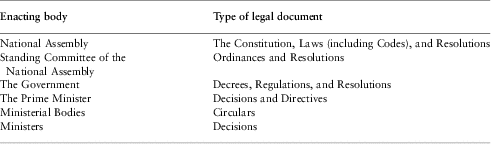
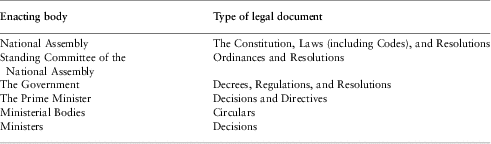
At first glance, Vietnam's contemporary legal system can be characterized as French civil law, in that its main source of law is written legislation, and that the hierarchy of legal norms are Hien phap (constitutional laws), lois—luat (laws), ordonnance—phap lenh (ordinances), reglement—nghi dinh (decrees or government regulations), and circulaires—thong tu (circulars).Footnote 133 Similarly to French law, Vietnam's legal system primarily consists of its Constitution, laws (enacted by the National Assembly), and sub-laws (e.g. decrees, regulations, or decisions issued by government, ministries, and various administrative bodies), which are generally referred to as “legal documents”.Footnote 134 The hierarchy of legal documents parallels the administrative hierarchy of the issuing bodies in the structure of the political system (see Table 1). In accordance with this hierarchy, a lower ranking legal document must conform to a higher one. Normally, while higher ranking legal documents set out more general norms, lower ones provide details or instructions for implementing the higher one. For example, thong tu (circulars) provide instructions issued by relevant ministerial bodies on how to interpret, apply, and enforce new laws.
The key types of Vietnamese legal documents in hierarchical order
The disparate pieces of Vietnamese written legislation have insufficient unity, and cannot be regarded as coherent bodies of codified law, like those in France. Further, the influence of socialist law makes the contemporary Vietnamese legal system distinct from the civil law tradition.Footnote 135 In essence, the contemporary Vietnamese legal system, especially criminal law and criminal procedure, still exhibits several persistent fundamentals of the “socialist legality”Footnote 136 which originated from the former Soviet Union, including, for example, the supremacy of the CPV over the process of making and enforcing laws. Unlike France, which has a strong doctrine of the separation of powers, Vietnam adopts the unitary state under the Soviet principle of democratic centralism (tap trung dan chu),Footnote 137 in which legislative, executive, and judicial functions are not separate. All state power is centralized in one supreme state organ—the unicameral National Assembly—which then delegates power to lower organs.Footnote 138 The government, supported by local People's Committees, performs executive functions but is accountable to the National Assembly.Footnote 139 The Supreme People's Court, the local People's Courts, the Military Tribunals, and other tribunals established by law are the judicial organs.Footnote 140 The People's Procuracy maintains obedience to the law executed by ministerial bodies, local organs of power, economic agencies, social organizations, people's armed units, and citizens; it also exercises the right of public prosecution and ensures a consistent implementation of the law.Footnote 141 Both the Supreme People's Court and the People's Procuracy are also accountable to the National Assembly.Footnote 142
These general characteristics of the Vietnamese legal system suggest that the Vietnamese legal framework for AML consists of scattered legal documents provided by different agencies. In addition, the AML-related laws enacted by the National Assembly can be implemented effectively only if instructive sub-laws (e.g. government decrees or circulars) are provided.
Furthermore, the status of international treaties in Vietnam's domestic legal system is that:Footnote 143 (1) when it comes to regulations on the same matter, if there is a difference between domestic legal documents and treaty provisions to which Vietnam is party, the treaty provisions shall prevail; (2) legislators of national legal documents must ensure that there shall be no obstruction to the implementation of treaties to which Vietnam is party; and (3) the authorized bodies, when deciding on the ratification (the National Assembly or the state President) or approval (the government) of a treaty, shall decide the extent of treaty implementation based on its compatibility with domestic legislation. They also decide or propose to amend and supplement domestic legal documents to facilitate the implementation of treaties. Thus, the formal ratification of AML-related treaties does not ensure that adequate implementation and effective enforcement follow.
D. Relevant Institutions in the AML Regime
Under the current political system, various government institutions are responsible for and have authority over AML. The pivotal ones are: the SBV's Anti-Money Laundering Department (AMLD), which functions as an FIU; and the Ministry of Public Security (MPS). Other related ministries, ministerial agencies, and local People's Committees are obliged to co-operate with these institutions in combating money laundering.Footnote 144
The SBV acts as the leading agency in co-operation with other relevant agencies against money laundering. It is responsible for reviewing the effectiveness of the AML system in Vietnam and making proposals to the government for strategic resolutions for AML. The AMLD has the function of receiving, processing, and disseminating information concerning money laundering. The AMLD has the right to request certain agencies to provide information and records for suspicious transactions.
The MPS, to which the police belong, is a powerful law enforcement agency which has an overarching responsibility to combat money laundering.Footnote 145 The MPS's main responsibilities for AML are to organize the investigation of money laundering related crimes, and to provide guidance for other agencies conducting the investigations of such crimes. It also works closely with the People's Procuracy and the People's Court in investigation, prosecution, and sentencing. The MPS has a complex structure which consists of a number of general departments and also departments responsible for various missions. Currently, there is no specialized department in charge of investigating money laundering crimes. Most departments involved in combating crime can undertake the investigation of money laundering crimes. The major ones are the Department of Economic Crimes Investigation, the Department of Drug Crimes Investigation, and the Department of Cyber Crimes Investigation.
IV. The AML regime of Vietnam
This Part will examine why and how Vietnam engages in and complies with international law on AML. The establishment of an AML regime in Vietnam is a striking case-study that illustrates the application of the mechanisms of the AML diffusion discussed above. The specific case of Vietnam will also show how domestic factors impact the establishment and implementation of AML.
A. Vietnam Under International Pressure and the Socialization of AML Standards
In recent years, Vietnam has taken action to respond to the call for international co-operation in fighting crimes of international concern. Vietnam is party to a number of crucial multilateral treaties against these crimes, and became a member of some international AML-related institutions. For instance, Vietnam has ratified the primary UN conventions against transnational crime: the 1988 Vienna Convention, UNCAC, and the Palermo Convention.Footnote 146 In 2005, Vietnam joined the ASEAN Treaty on Mutual Legal Assistance in Criminal Matters.Footnote 147 Being a party to these treaties, Vietnam is obliged to adopt numerous standards against transnational crime, with a focus on drug crimes, corruption, human trafficking, and money laundering.Footnote 148
Vietnam has been a member of the APG since 2007. An on-site evaluation by the APG in 2008 revealed substantial inadequacies in the AML legal framework of Vietnam. The APG's mutual evaluation and the FATF's blacklisting of Vietnam in 2012 intensified the pressure on Vietnam to establish a comprehensive AML regime.Footnote 149
Furthermore, in order to promote economic expansion, Vietnam has strengthened its relationship with various international financial organizations, such as the IMF and the WB. Vietnam's financial institutions are aware that they should meet international regulatory standards, including AML standards, to integrate into the international financial markets. For instance, the IMF and the WB have worked closely with the Vietnamese government, not only to provide loans and financial aid, but also to help establish strong policy and a legal framework in Vietnam's financial sector.Footnote 150 They are among the international organizations which have urged Vietnam to formulate AML legal instruments.Footnote 151 In fact, the lack of competent AML laws in the Vietnamese banking system may be a significant obstacle in doing business with counterparts in developed countries.
In addition, Vietnam has been an active member of ASEAN since 1995. The Vietnam police force has also actively participated in international and regional police organizations with a high degree of co-operative responsibility. The Vietnamese police force has been a member of INTERPOL since 1991 and a member of ASEANPOL since 1996.Footnote 152
The socialization of the AML standards has occurred through communication at various sites, such as APG plenary meetings, annual APG Typology Workshops, the ASEAN Ministerial Meeting on Transnational Crime (AMMTC), INTERPOL or ASEANPOL meetings, and other conferences and training courses.Footnote 153 Noticeably, from 2007 to 2011, the project VNMS65—Strengthening of the Legal and Law Enforcement Institutions in Preventing and Combating Money Laundering in Viet Nam—was funded and managed by the UN Office on Drugs and Crime (UNODC) in co-operation with Vietnamese agencies. This project significantly strengthened the capacity of Vietnam's law enforcement agencies, prosecutorial agencies, and other criminal justice institutions, as well as civil society, in response to money laundering.Footnote 154 The project organized international study visits to key countries and regions in the global AML regime, including the UK, the US, the Philippines, and Hong Kong.Footnote 155 Vietnamese officials also participated in regional exercises such as the APG's Typologies Workshop, its annual meeting, and regional training. Two thousand public officials participated in sixty training courses on AML, which were delivered by both international and domestic experts.Footnote 156 In addition, several other public officials were invited to participate in the regional and international AML-related workshops and conferences. The participants have a better understanding of money laundering typologies and the AML regime at the international level and in developed countries. Lessons drawn from these events have resulted in an increase in the number AML advocates, of which the SBV is the leading government agency. Consequently, more national AML regulations, laws, and policies in line with international standards have been promulgated.
B. Evolution of the AML Regime of Vietnam
1. The pillar of prevention
The pillar of prevention in Vietnam's AML regime mainly aims at uncovering opportunities which facilitate money laundering operations. The pillar is primarily shaped by national preventive measures imposed on financial institutions, designated non-financial businesses, and professions (DNFBPs), who are the most vulnerable to money laundering. The key measures include customer due diligence (CDD), record keeping, and the reporting of suspicious transactions. CDD is the requirement of customer identification and verification before financial services are provided. The obligation of record keeping requires financial institutions to keep customer identification and records of financial transactions. These records should be accessible by law enforcement authorities when required for the investigation and prosecution of money laundering offences. The reporting obligation mainly entails the duty of reporting unusual or suspicious transactions to the designated central authorities (normally FIUs).
The preventive measures have the purpose of deterring criminals from using these entities for laundering the proceeds of crime. Financial institutions, designated non-financial businesses, and professions are obliged to have these measures because: (1) criminals often make use of such entities as the intermediaries of money laundering; (2) the interaction with these entities is seen as a “weak point” in the stages of money laundering, at which law enforcement agencies can intervene for deterring and detecting money launderers; and (3) the integrity of the financial service providers and professions must be protected from money laundering involvement.
In Vietnam, the preventive obligations were first stipulated in Government Decree 74/2005/ND-CP.Footnote 157 Nevertheless, the APG pointed out numerous deficiencies in those provisions compared to international standards.Footnote 158 Then, some Circulars were issued to complement the provisions. For example, Circular 148/2010/TT-BTC refers to the specific preventive measures in insurance, securities, and games of chance;Footnote 159 and Circular 12/2011/TT-BXD provides for detailed preventive measures in the property sector.Footnote 160 Further, the Law on Prevention and Suppression of Money Laundering (PSML Law) has provided a comprehensive set of preventive measures consistent with the FATF recommendations.Footnote 161
Since the coming into force of Decree 74/2005/ND-CP, the number of STRs received by the AMLD has increased steadily.Footnote 162 Most STRs were reported by the banking sector. There has been no STR reported from DNFBPs. A few STRs received by the AMLD were then forwarded to the MPS for further investigation.Footnote 163
In practice, the lack of fundamental preconditions is a major hindrance to the implementation of AML preventive measures in Vietnam. Apart from an adequate legal framework, the application of the risk-based approach (RBA) and the issue of financial inclusion are other crucial preconditions.Footnote 164 Vietnamese authorities have not yet conducted any comprehensive research to identify, assess, and understand the risks money laundering poses to Vietnam. In addition, although Article 12 of the PSML Law provides the RBA for financial institutions and DNFBPs to categorize their clients, the method of assessing the risk level for financial institutions and DNFBPs is not provided for. Regarding financial inclusion, as noted above, most people living in rural areas do not have access to some financial services or products, such as banking, trading securities, or insurance products. The poor infrastructure of the banking system and the people's preference for cash payments contribute to financial exclusion. “Black market operators” for exchanging currencies and unlicensed retail gold shops are thriving due to money laundering.
It is noteworthy that sanctions are to be imposed on individuals and organizations which violate the CDD's record keeping and reporting obligations for the purposes of AML.Footnote 165 The sanctions may take the form of criminal liability, monetary fines, or administrative penalties. Nevertheless, in practice, these penalties have not been applied to any individuals or organizations.Footnote 166 This fact gives rise to doubt about the capacity of the supervisory authorities or their willingness to implement AML preventive measures.
2. The pillar of enforcement
In 1999, although the term “money laundering” (rua tien) was not used in formal legal documents, a number of activities, which are actually different ways of conducting money laundering, were criminalized in Articles 250 and 251 of the 1999 Penal Code.Footnote 167 In 2005, the term “money laundering” and a basic legal framework of AML were first stipulated in Government Decree 74/2005/ND-CP.Footnote 168 According to the APG's examination in 2008, Articles 250 and 251 provided an incomplete criminalization of money laundering compared to the international standard.Footnote 169 After the APG's on-site evaluation, and under increased external coercion and normative persuasion, the crime of money laundering (toi rua tien) has been provided for as an independent crime in the amended Article 251 of the Amendment to the 1999 Penal Code (2009) of Vietnam.Footnote 170 Two years after the publication/coming into force of the amended Article 251, an interagency Circular on the implementation of Article 250 and the amended Article 251 was issued.Footnote 171 This Circular was actually one of the outputs of project VNMS65 (described above).Footnote 172 However, up to March 2013, the prosecution of money laundering under the amended Article 251 was non-existent. Investigators and prosecutors tend to focus on the primary crime, which is the predicate crime, rather than the money laundering crime. They are generally not willing to investigate and prosecute money laundering as a separate charge. Vietnam's authorities are also reluctant to locate, seize, and confiscate the criminal proceeds.
In addition, the investigation, prosecution of money laundering, and confiscation of criminal proceeds have been impeded by inadequate legal interpretation and guidance on implementation.Footnote 173 As mentioned earlier, in the Vietnamese legal system, after a new crime is created in the Penal Code, it is necessary to have more detailed interpretation and guidance from relevant authorities on how to investigate and prosecute the crime. This legal interpretation and guidance on implementation is made by legislative, judicial, and executive authorities. They are normally the legislature (the Standing Committee of the National Assembly), the judiciary (the Supreme People's Court and its Judicial Council), or governmental ministries (the MPS), in the form of Decisions, Regulations, Circulars, or Directives. Judicial interpretation can be jointly issued by the Supreme People's Court, the Supreme People's Procuracy (SPP), and the MPS.
This examination of the AML regime of Vietnam reveals a substantial gap between the political commitment to pass the laws (law on the books) and the willingness of Vietnamese authorities to enforce the laws (law in action). Why is the AML regime not effectively enforced in Vietnam? Apart from the challenge of corruption as noted above (in Part III(A)), a possible reason would be the lack of persuasiveness in international AML standards and public consensus (national or international). The international AML standards appear not persuasive enough to gain a high degree of public consensus in Vietnam. Can the AML preventive measures, which are designed for well-equipped financial providers in developed countries, be applied effectively to the poor infrastructure of the Vietnamese financial system? Is it really necessary to criminalize money laundering?Footnote 174
V. Conclusion
Initiated by the US in the 1980s, the international AML regime has developed globally and has disseminated rapidly in the last two decades. More than 180 states with diverse economies have engaged with international AML law and formulated their own AML regimes consisting of a strikingly similar set of standards.Footnote 175 The multiple adoptions of similar norms and practices in terms of AML are seen as an outcome of the globally widespread AML regime diffusion under two key mechanisms: coercion (from the powerful economies and international institutions) and socialization (through tactical communication). However, the extent to which the international AML standards are internalized is decided by each state. It depends on numerous factors, such as the quality of standards and national particularities, such as political, economic, and legal differences. A national AML regime should be a convergence of domestic factors and international AML standards.
Although the mechanisms of coercion and socialization have worked in the Vietnamese context, its results have been affected significantly by a number of unique domestic factors. Vietnam has gradually developed its AML legal framework in compliance with international AML standards to avoid economic sanctions and reputational damage. But corruption undermines a willingness to implement AML counter-measures. The public also doubts the persuasiveness of AML norms. Other problems that hamper the pillar of prevention include the lack of application of the RBA and financial exclusion. Additionally, the vagueness of Vietnamese AML provisions, inadequate interpretive guidance on such provisions, a lack of specialized investigators, and the absence of a specialized authority to investigate money laundering have affected the investigation and prosecution of the specific crime. All these factors shape the situation in which Vietnam has formal compliance of the law in the books but feeble enforcement in practice. It will take time for Vietnam to address these problems and set up essential preconditions for an effective AML regime.