Introduction
The antisocial personality disorders [conduct disorder, antisocial personality disorder (ASPD) and psychopathy] are a group of overlapping disorders of personality that are associated with significant intra- and interpersonal dysfunction (Blair, Reference Blair2003). Rates of all these disorders are particularly high in forensic and correctional samples (Coid, Reference Coid1992; Hare, Reference Hare, Cooke, Forth and Hare1998; Singleton et al. Reference Singleton, Meltzer and Gatward1998). Social factors are known to contribute to their causation (Farrington, Reference Farrington1993), but there is increasing recognition that there may be a neurobiological basis for these disorders including genetic liability (McGuffin & Thapar, Reference McGuffin and Thapar1992; Bezdjian et al. Reference Bezdjian, Raine, Baker and Lynam2010), impaired serotonergic and executive function (Raine, Reference Raine1997, Reference Raine2002; Dolan et al. Reference Dolan, Anderson and Deakin2001, Reference Dolan, Deakin, Roberts and Anderson2002; Dolan & Anderson, Reference Dolan and Anderson2003), and structural and functional abnormalities in fronto-limbic regions in criminal samples (Dolan, Reference Dolan2002, Reference Dolan2010; Gao et al. Reference Gao, Glenn, Schug, Yang and Raine2009; Blair, Reference Blair2010; Gao & Raine, Reference Gao and Raine2010). Several neurobiological models of antisocial behaviour including psychopathy have emerged over the years. These include the response modulation hypothesis (Newman, Reference Newman, Cooke, Forth and Hare1998), the somatic marker hypothesis (Damasio, Reference Damasio1994), the general affective processing model (Hare, Reference Hare, Cooke, Forth and Hare1998) and, more recently, the integrated emotions system (IES) empathy-based model (Blair, Reference Blair2006).
To date, most recent work has focused on amygdala-based emotional information processing deficits in antisocial and psychopathic samples and the majority of studies suggest evidence of impaired processing of aversive (particularly sad and fearful) faces in these groups (e.g. Stevens et al. Reference Stevens, Charman and Blair2001; Dolan & Fullam, Reference Dolan and Fullam2006; Marsh & Blair, Reference Marsh and Blair2008). Although many of the above models highlight the significance of the prefrontal cortex in understanding the neural underpinnings of antisocial behaviour in general, there are only very few neuropsychological studies examining the nature and specificity of prefrontal functions in offenders meeting criteria for ASPD or psychopathy compared to healthy controls (HCs). Early executive function studies in antisocial samples, using traditional tasks, found that habitually violent offenders who are likely to have met criteria for conduct disorder or ASPD had deficits in a broad range of executive and memory functions compared with HCs (Kandel & Freed, Reference Kandel and Freed1989; Moffitt & Henry, Reference Moffitt and Henry1989, Reference Moffitt, Henry and Milner1991; Dolan, Reference Dolan1994; Morgan & Lilienfield, Reference Morgan and Lilienfield2000; Dolan et al. Reference Dolan, Deakin, Roberts and Anderson2002). In later work investigating the prefrontal substrates of antisocial behaviour (using computerized tasks designed to putatively differentiate the functions of specific prefrontal regions), Dolan & Park (Reference Dolan and Park2002) found evidence that male offenders with ASPD, compared to HCs, had impairments in the putative dorsolateral prefrontal cortex (DLPFC) functions of planning and set shifting and the putative ventromedial prefrontal cortex (VMPFC) functions of behavioural restraint.
The literature on executive function in psychopathy has been inconsistent because of variation in the measures of psychopathy used. Studies that used measures of psychopathy that focused primarily on impulsive aggressive traits (e.g. the Special Hospital Assessment of Personality and Socialisation, SHAPS; R. Blackburn, unpublished data) or antisocial traits and behaviours (e.g. the California socialization scale; Gough, Reference Gough1994) suggested that impulsive aggressive ‘psychopathic’ individuals had notable deficits in executive function compared with HCs (Gorenstein, Reference Gorenstein1982; Devonshire et al. Reference Devonshire, Howard and Sellars1988; Dolan et al. Reference Dolan, Deakin, Roberts and Anderson2002). However, studies that have assessed psychopathy using the Psychopathy Checklist – Revised (PCL-R; Hare, Reference Hare1991), which includes interpersonal and affective traits, failed to find consistent evidence to support an executive function (more specifically a DLPFC) deficit hypothesis for psychopathy (Hare, Reference Hare1984; Hoffman et al. Reference Hoffman, Hall and Bartsch1987; Sutker & Allain, Reference Sutker and Allain1987; Devonshire et al. Reference Devonshire, Howard and Sellars1988; Hart et al. Reference Hart, Forth and Hare1990; Lapierre et al. Reference Lapierre, Braun and Hodgins1995; Roussy & Toupin, Reference Roussy and Toupin2000; Mitchell et al. Reference Mitchell, Colledge, Leonard and Blair2002; Blair et al. Reference Blair, Newman, Mitchell, Richell, Leonard, Morton and Blair2006).
Although there is significant clinical overlap between the constructs of psychopathy and ASPD on the social deviance domains, Hare's (1988) construct of psychopathy is particularly associated with deficient affective regulation, which leads to callous unemotional traits. This observation led in part to Blair's (Reference Blair2006) IES theory, which suggests that psychopathy (which tends to be associated with instrumental aggression) may be associated primarily with amygdala and orbitofrontal cortex (OFC) dysfunction, whereas ASPD (which tends to be associated with reactive aggression) may be associated with a broader range of prefrontal executive (largely DLPFC) deficits. There are several studies suggesting that the PCL-R-based construct of psychopathy may be associated with a specific deficit in OFC function (Newman et al. Reference Newman, Patterson and Kosson1987; Lapierre et al. Reference Lapierre, Braun and Hodgins1995; Roussy & Toupin, Reference Roussy and Toupin2000; Mitchell et al. Reference Mitchell, Colledge, Leonard and Blair2002; Blair et al. Reference Blair, Newman, Mitchell, Richell, Leonard, Morton and Blair2006), but there are no studies looking at putative markers of DLPFC and VMPFC/OFC function in offenders with ASPD and varying degrees of psychopathy compared to HCs. We therefore compared the performance of a well-screened group of male offenders with ASPD assessed using the Psychopathy Checklist: Screening Version (PCL:SV; Hart et al. Reference Hart, Cox and Hare1995) and HCs on a series of computerized tasks thought to probe DLPFC and VMPFC/OFC function. We hypothesized that, whereas offenders with ASPD would show a broad range of DLPFC and VMPFC impairments compared to HCs, offenders with higher psychopathic trait scores would not show additive impairments in relation to planning and set-shifting ability, which are putative markers of DLPFC function.
Method
Participants
Ninety-six male offenders with ASPD (assessed using SCID-II; First et al. Reference First, Gibbon, Spitzer, Williams and Benjamin1997a ) were recruited from medium- and high-security forensic hospitals and local prisons in the North West of England. Participants were screened for current Axis I disorders including affective disorder and schizophrenia (using SCID-I; First et al. Reference First, Spitzer, Gibbon and Williams1997b ), learning disability, or significant head injury and substance dependence. Participants were detained for a mean of 6.93 (s.d.=6.71) years, and had a mean age of 37.18 (s.d.=10.48) years. As no participants had recent access to the community, the potential influence of drug or alcohol abuse was minimized. This resulted in no subjects meeting criteria for current substance misuse problems. None of the subjects were on psychotropic medication, which might have affected performance or reaction times on behavioural tasks. The mean PCL:SV score was 16.38 (s.d.=3.45).
Forty-nine male healthy volunteers were recruited from ancillary staff (porters) working in forensic hospitals and the University of Manchester. The mean age of the controls was 33.69 (s.d.=10.24) years. All control participants were screened for Axis I pathology (SCID-non-patient screen), a history of head trauma, drug or alcohol abuse and current medication use.
Procedure
After a complete description of the study, written informed consent was obtained from all participants. The National Adult Reading Test (NART; Nelson, Reference Nelson1982) was completed as a proxy measure of intellectual function and to ensure IQ matching across groups. Two subtests of the Cambridge Neuropsychological Test Automated Battery (CANTAB; Fray et al. Reference Fray, Robbins and Sahakian1997) and a Go/No-Go task were administered on an IBM-compatible computer fitted with a touch-sensitive monitor. The neuropsychological test battery was administered in a single session in a quiet interview room on an individual basis. Tests were administered in a set order to all subjects. Participants were asked to sit approximately 0.5 m away from the computer, and respond to instructions by touching the screen with the index finger of their dominant hand.
Psychometric and neuropsychological assessments
PCL:SV
Psychopathy was assessed using the PCL:SV (Hart et al. Reference Hart, Cox and Hare1995) in the ASPD group. Ratings were based on file review and interview with the participants. Factor 1 of the PCL:SV reflects affective and interpersonal facets and factor 2 reflects lifestyle/behavioural and social deviance facets of psychopathy. This instrument was selected because it was designed for use in forensic and civil psychiatric settings (Hart et al. Reference Hart, Cox and Hare1995) and it correlates highly with Hare's (Reference Hare1991) PCL-R. The offender sample was divided into low (⩽15), medium (16–19) and high psychopathy (>19) scorers using percentile thirds on the PCL:SV total score as there are no definitive cut-off scores for psychopathy in UK samples.
Stockings of Cambridge (SOC) planning task
The SOC planning task, a CANTAB computerized version of the Tower of London task (Shallice, Reference Shallice1982), was used to test the putative DLPFC marker of spatial planning (Veale et al. Reference Veale, Sahakian, Owen and Marks1996) and is described in detail elsewhere (Sahakian et al. Reference Sahakian, Morris, Evenden, Heald, Levy, Philpot and Robbins1988; Owen et al. Reference Owen, Downes, Sahakian, Polkey and Robbins1990). Participants were required to move coloured ‘balls’ in an arrangement on the bottom half of the screen to match a goal arrangement on the top half of the screen. Each problem had a specified minimum number of moves that increased with difficulty (from two to five moves). Subjects were instructed to examine the position of the balls at the beginning of each problem and encouraged not to make a move until they were confident that they could execute the entire sequence needed to solve the problem. For each planning trial a ‘yoked control’ condition was used, in which subjects were required to execute a sequence of single moves that replicated the moves made on the earlier planning trials. Test trials and yoked control trials were arranged in four blocks of six problems each. Initial planning latencies (recorded in centiseconds) were recorded during each of the trials to provide an estimation of cognitive speed. Initial thinking (planning) time was the time between the presentation of the problem and the first touch, minus the corresponding motor initiation time calculated from the yoked control task. Accuracy of performance was assessed by the percentage of problems completed in the minimum number of moves specified (perfect solutions), the average number of moves executed above the minimum at each difficulty level, the percentage of problems completed within the maximum number of moves allowed, and the initial planning time at each level.
Attentional set-shifting task
In the CANTAB intra-dimensional/extra-dimensional (ID/ED) set-shifting task, subjects were required to learn a series of visual discriminations, using feedback provided by the computer, in which one of two stimulus dimensions were relevant and the other was not. The task assessed the subject's ability to maintain attention to different examples within the same dimension (ID stages) and then to shift attention to a previously irrelevant dimension (ED stages). An intra-dimensional shift (IDS) occurred when a subject, trained to respond to a particular stimulus dimension (e.g. shape), was required to transfer the rule to a new set of examples of the same stimulus dimension. An extra-dimensional shift (EDS) occurred when a subject was required to shift the response set to an alternative previously irrelevant dimension (Owen et al. Reference Owen, Roberts, Polkey, Sahakian and Robbins1991). For each of the nine stages, subjects could proceed onto the next stage when a criterion of six consecutive correct responses had been attained. If this criterion was not reached after 50 trials, the computer automatically terminated the test. Performance was examined by the percentage of subjects reaching the criterion for each stage, the mean number of stages completed, and the number of errors made at each stage. The task has a learning (putative DLPFC function) and a response reversal (putative OFC function) component (Mitchell et al. Reference Mitchell, Colledge, Leonard and Blair2002).
Go/No-Go Task: response inhibition
The Go/No-Go Task, which assesses response selection/inhibition, was an adaptation of Schacher & Logan's (Reference Schacher and Logan1990) task developed by Rubia et al. (Reference Rubia, Russell, Overmeyer, Brammer, Bullmore, Simmons and Taylor2001) for use in attention deficit hyperactivity disorder (ADHD) samples. A motor response was either initiated (Go) or inhibited (No-Go) depending on whether an aeroplane (Go) or bomb (No-Go) stimulus appeared on a screen. Visual stimuli appeared in a random order for a duration of 200 ms, with an inter-trial interval of 800 ms. Seventy per cent of stimuli were aeroplanes (Go stimulus) and 30% bombs (No-Go stimulus). The task was administered as two blocks of 90 trials after an initial practice block to ensure adequate understanding of the task. Subjects were then instructed to press a response button as fast as they could to the Go stimuli, but not press when the No-Go stimuli appeared. The mean probability of inhibition and mean reaction time (MRT) were calculated across all trials and recorded. The task was administered after an initial practice block to ensure adequate understanding of the task. The number of correct inhibitions on the No-Go trials was recorded for each participant.
Statistical analyses
The data were analysed using SPSS version 18 (SPSS Inc., USA).
Performance on neuropsychological tasks was compared between the high (HP), medium (MP) and low (LP) psychopathy groups, and controls. In line with our previous report (Dolan & Park, Reference Dolan and Park2002), SOC data were analysed using a group×task difficulty repeated-measures ANOVA within a MANOVA design (Wilks' multivariate test of significance). One-way ANOVA and post-hoc tests with Bonferroni corrections were used to conduct a priori analysis of the SOC data and to compare groups on the ID/ED and Go/No-Go tasks. In a secondary analysis of the ID/ED task, error data were also examined using the data handling methods of Mitchell et al. (Reference Mitchell, Colledge, Leonard and Blair2002). Thus, the mean number of errors for each of the three core stages was calculated. These stages were learning (phase 1 simple discrimination+phase 6 IDS), reversal learning (phases 2, 5, 7 and 9) and EDS (phase 8).
The percentage data on the SOC were arcsine transformed prior to analysis (Winer, Reference Winer1971). The percentage of subjects in each group succeeding to reach the criterion (six consecutive correct responses) at each stage of the ID/ED was analysed using contingency tables and the likelihood ratio method, with the resulting statistic 2i being distributed as χ2. Spearman's correlations were used to examine the inter-relationship between neuropsychological tests and different components of the psychopathy complex. Not all participants completed all tasks, so degrees of freedom vary across the study.
Results
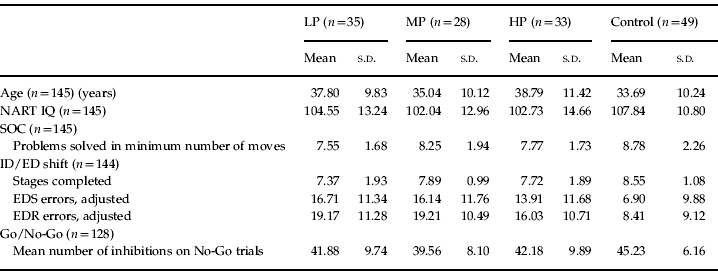
There were no significant group differences in mean age (F 3,141=2.0, p=0.11), or IQ (F 3,141=1.50, p=0.20). The group mean performance and statistical comparisons for each task are summarized in Table 1.
Characteristics of each group and mean scores on the neuropsychological tests

NART, National Adult Reading Test; SOC, Stockings of Cambridge task; ID/ED, intra-dimensional/extra-dimensional; EDS, extra-dimensional shift; EDR, extra-dimensional reversal; LP, low pathology; MP, medium pathology; HP, high pathology; s.d., standard deviation.
DLPFC: SOC planning task
Minimum number of moves
There was a significant group difference in the number of problems solved within the minimum number of moves (F 3,141=3.19, p<0.05). Post-hoc tests with Bonferroni corrections revealed that the LP group solved significantly fewer problems within the minimum number of moves than controls (mean difference 1.23, p<0.05). There were no significant differences between any of the other groups.
Perfect solutions
There was a significant main effect of group in the number of problems solved perfectly (F 3,141=2.84, p<0.05), a significant effect of task difficulty (λ=0.26, F 3,139=130.30, p<0.001), and a significant group×difficulty interaction (λ=0.89, F 9,338=1.93, p<0.05). Groups did not differ on any stages apart from stage 4 (F 3,141=4.24. p<0.01), where LPs (mean 52.14%, s.d.=21.33) had significantly fewer perfect solutions than controls (mean 69.39%, s.d.=27.13).
Excess moves
On the number of moves above the minimum, there was a significant effect of group (F 3,141=2.67, p<0.05), a significant effect of increasing task difficulty (λ=0.31, F 3,139=102.3, p<0.001), and a significant group×difficulty interaction (λ=0.87, F 9,338=2.13, p<0.05). Overall, the difficulties were on the four-move problem (F 3,141=4.73, p<0.01), with LPs (mean 1.78, s.d.=1.02) having a higher number of excess moves than HCs (mean 0.97, s.d.=0.96; mean difference 0.81, p<0.01).
Solutions completed within the maximum number of moves allowed
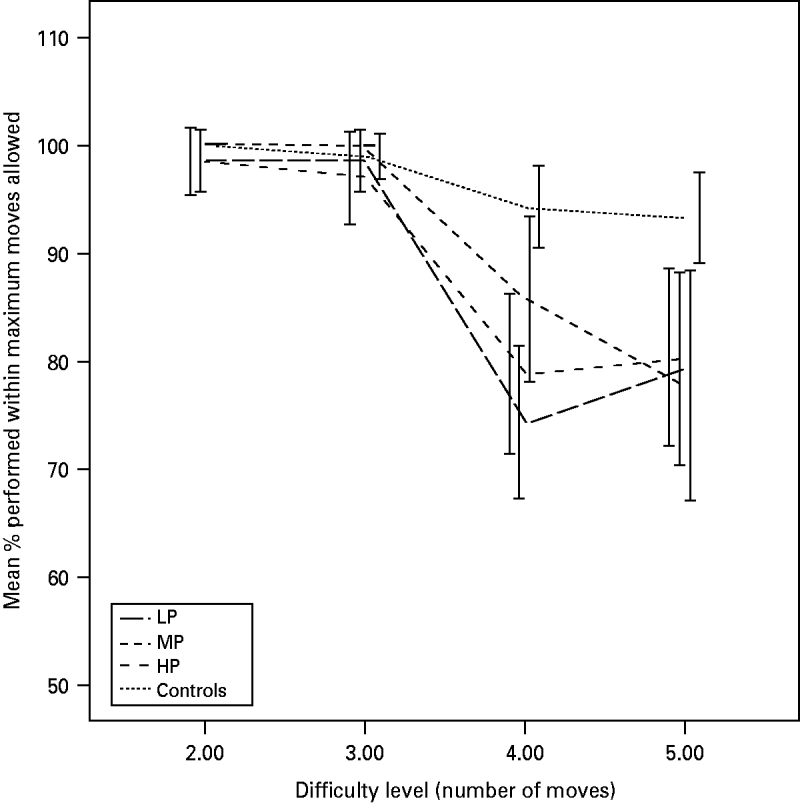
On the number of problems solved within the maximum, there was a significant effect of group (F 3,141=11.04, p<0.001), a significant effect of task difficulty (λ=0.47, F 3,139=53.35, p<0.001), and a significant group×task difficulty interaction (λ=0.79, F 9,338=3.81, p<0.001). There were significant group differences on the four (F 3,141=11.33, p<0.001) and five (F 3,141=5.80, p<0.01) moves. Post-hoc testing indicated that the differences were between HCs and all psychopathic groups.
For the four-move problem: LP (mean difference 0.37, p<001); MP (mean difference 0.20, p<0.05); HP (mean difference 0.27, p<0.01). For the five-move problem: LP (mean difference (0.25, p<0.05); MP (mean difference 0.31, p<0.01); HP (mean difference 0.23, p<0.05) (see Fig. 1).
The performance of high (HP), medium (MP) and low (LP) psychopathy groups and controls on the Stockings of Cambridge (SOC) planning task. Error bars, 95% confidence interval (CI).

Planning time
Having controlled for individual variation in movement times, there was no significant effect of group for initial planning time (F 3,140=1.11, p=0.30). There was a significant effect of task difficulty (λ=0.86, F 2,139=13.95, p<0.001) but no group×task difficulty interaction (λ=0.94, F 6,278=1.38, p=0.40).
Relationship between planning ability and psychopathy scores
There was no significant correlation between total psychopathy and facet scores and mean percentage perfect solutions, moves above the minimum, percentage completed within the maximum number of moves or initial thinking time.
Attentional set-shifting task: ID/ED
Attrition rates
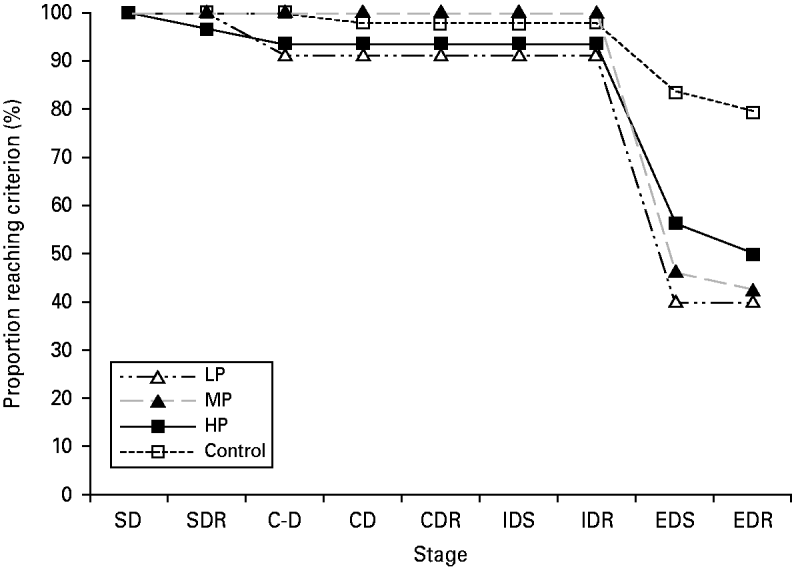
Significant group differences first emerged at the EDS stage with more controls reaching criterion than the LP (2i=17.54, p<0.001), MP (2i=11.62, p<0.001) and HP (2i=7.72, p<0.01) groups. Significantly more controls also reached the criterion at the extra-dimensional reversal (EDR) stage than participants in the LP (2i=13.91, p<0.001), MP (2i=10.65, p<0.001) and HP (7.72, p<0.01) groups (Fig. 2).
Cumulative percentage of each psychopathy group [high (HP), medium (MP) and low (LP) psychopathy] and controls reaching criterion at each stage of the intra-dimensional/extra-dimensional (ID/ED) set-shifting task. Stages: SD, simple discrimination; SDR, simple discrimination reversal; C-D, compound discrimination; CD, superimposed compound discrimination; CDR, superimposed compound discrimination reversal; IDS, intra-dimensional shift; IDR, intra-dimensional reversal; EDS, extra-dimensional shift; EDR, extra-dimensional reversal.

When the proportion of subjects passing each stage was examined non-cumulatively (i.e. only the data from those subjects attempting each stage were included), significant group differences were found only at the extra-dimensional stage of learning, with significantly more controls reaching the criterion than the LP (2i=15.63, p<0.001), MP (2i=11.24, p<0.001) and HP (2i=6.35, p<0.05) groups.
There were no significant differences in cumulative or non-cumulative proportion reaching the criterion between any of the psychopathy groups.
Number of stages completed
There was a significant effect of group for number of stages completed (F 3,140=4.56, p<0.001). Post-hoc testing indicated that the LP group completed significantly less stages than the control group (Table 1).
Errors
There was a significant effect of group at the EDS (F 3,140=10.26, p<0.001) and EDR stages (F 3,140=7.11, p<0.001). Post-hoc testing indicated that all psychopathic groups had a significantly greater number of errors than controls at the EDS and EDR stages (Table 1).
Looking at errors using the Mitchell et al. (Reference Mitchell, Colledge, Leonard and Blair2002) three-component model of the ID/ED, there were no significant differences between the groups in the mean number of errors made during the learning component (F 3,140=1.57, p=0.38).
A main effect of group was found for the number of errors made during the reversal-learning component (F 3,140=4.43, p<0.01) and during the EDS stage (F 3,140=10.26, p<0.001). Post-hoc testing revealed that the LP group made significantly more errors during the reversal component than controls (mean difference=3.13, p<0.01). For the EDS stage, all psychopathic groups made more errors than controls: LP (mean difference −10.76, p<0.001); MP (mean difference −10.81, p<0.001); and HP (mean difference −7.62, p<0.01). Excluding those who had failed to meet criteria, and using Mitchell et al's. (Reference Mitchell, Colledge, Leonard and Blair2002) three-component model of the ID/ED, there were no significant group differences in mean errors made during the learning (F 3,80=0.11, p=0.95) or reversal-learning component (F 3,80=0.38, p=0.76). There was a trend towards a significant main effect of group for the EDS stage (F 3,77=2.38, p=0.08), with all psychopathic groups showing a tendency towards more errors on the EDS stage than controls.
Relationship between psychopathy scores and ID/ED performance
There were no significant correlations between PCL:SV total or facet scores and the ID/ED measures.
Go/No-Go task
There was a significant group difference in the number of No-Go trials where a response was inhibited (F 3,1141=3.02, p<0.05). Post-hoc testing revealed that the MP group had a lower mean number of inhibitions on the No-Go trials than the control group (mean difference −5.66, p<0.01) and the LP group (mean difference −5.05, p<0.05). There were significant group differences in errors of commission (failure to inhibit a response to a No-Go trial; F 3,141=3.5, p<0.05) and in the probability of inhibition (% No-Go trials inhibited; F 1,141=2.88, p<0.05). Post-hoc testing revealed that key differences in the errors of commission lay between the MP group and HCs (mean difference −5.4, p<0.01) and between the MP group and LP group (mean difference −5.01, p<0.05).
Reaction time
Looking at MRT as a reflection of impulsive responding style, there were significant group differences (F 1,141=3.5, p<0.05), with the HP group showing longer MRT than HCs (mean difference −39.7, p<0.01). No other significant group differences were noted. There were no significant correlations between any of the indices of performance on the Go/No-Go task and total or facet-level psychopathy score.
Discussion
In this study we compared an age- and IQ-matched sample of offenders with ASPD and varying degrees of psychopathy and HCs on computerized measures of planning, set shifting and behavioural inhibition. To overcome criticisms about the use of traditional executive function tasks that have been developed for use in head injury samples, we used the CANTAB (Fray et al. Reference Fray, Robbins and Sahakian1997) computerized battery as it has been well standardized and validated in a range of clinical and non-clinical samples (Owen et al. Reference Owen, Roberts, Polkey, Sahakian and Robbins1991, Reference Owen, Roberts, Hodges, Summers, Polkey and Robbins1993; Robbins et al. Reference Robbins, Owen, Sahakian, McInnes and Rabbitt1994; Elliott et al. Reference Elliot, McKenna, Robbins and Sahakian1995; Kempton et al. Reference Kempton, Vance, Maruff, Luk, Costin and Pantelis1999; Pantelis et al. Reference Pantelis, Barber, Barnes, Nelson, Owen and Robbins1999; Sweeney et al. Reference Sweeney, Kmiec and Kupfer2000).
Planning and set shifting
On the putative DLPFC functions of planning, we found that all of our offenders with ASPD (regardless of psychopathy score) showed a reduction in the number of problems solved within the minimum; however, it was only the LP subgroup who differed from HCs at higher levels of task difficulty (stage 4) and this was reflected in the fact that the LP group had more excess moves and fewer perfect solutions. Of note, these group differences were not linked with planning time, which suggests that impulsive responding is not at the core of these impairments. Our finding that there were impairments in planning ability in offenders with ASPD as a whole compared to HCs fits with our previous report on planning ability in patients with ASPD compared to HCs (Dolan & Park, Reference Dolan and Park2002). The lack of an observed dimensional relationship between psychopathy score and planning ability and the lack of significant differences in planning ability between HP and LP offender groups fits with previous reports that there are no notable psychopathy-specific deficits in the DLPFC planning functions in offender samples (e.g. Hare, Reference Hare1984; Sutker & Allain, Reference Sutker and Allain1987; Lapierre et al. Reference Lapierre, Braun and Hodgins1995; Roussy & Toupin, Reference Roussy and Toupin2000; Mitchell et al. Reference Mitchell, Colledge, Leonard and Blair2002; Blair et al. Reference Blair, Newman, Mitchell, Richell, Leonard, Morton and Blair2006). Taken together, our findings suggest that, although offenders with ASPD show impairments in planning ability, this deficit is not related to psychopathy score and those at the higher end of the psychopathy scale performed very similar to controls. This generally reflects the clinical perception that those with high psychopathic traits have a good ability to premeditate and plan instrumental acts that are personally beneficial (Hare, Reference Hare, Cooke, Forth and Hare1998).
Significantly fewer of all the psychopathy groups within the offenders with ASPD reached criterion at the EDS stage, but not at the IDS stage, than controls. The latter fits with our previous study (Dolan & Park, Reference Dolan and Park2002). Success at the IDS stage suggests that, unlike chronic schizophrenics (Pantelis et al. Reference Pantelis, Barber, Barnes, Nelson, Owen and Robbins1999), our offenders with ASPD (regardless of their psychopathy score) are able to generalize a discrimination learned for a particular set of exemplars to a novel set from the same category (IDS). In line with Mitchell et al. (Reference Mitchell, Colledge, Leonard and Blair2002), this suggests no notable learning deficits on the ID/ED task in offender samples.
In this study, offenders with ASPD as a whole were significantly impaired in their ability to shift response set to a previously irrelevant dimension (EDS) compared to HCs. However, within the offenders with ASPD, this ability did not significantly vary as a function of psychopathy. The fact that response reversal and ED shifting require the inhibition of a previously rewarded response suggests that offenders with ASPD do have impairments in response modulation, as suggested by Newman (Reference Newman, Cooke, Forth and Hare1998). The findings also fits with the deficits reported in antisocial samples assessed using the Wisconsin Card Sort Test (Gorenstein, Reference Gorenstein1992; Dolan et al. Reference Dolan, Deakin, Roberts and Anderson2002) and with much of the published literature reporting executive function deficits in incarcerated violent offenders (Moffitt & Henry, Reference Moffitt, Henry and Milner1991) and offenders with antisocial behaviour (Morgan & Lilienfield, Reference Morgan and Lilienfield2000).
In this study there were no significant correlations between EDS score and any of the psychopathy facets. The lack of observed difference between psychopathy groups on the EDS attentional shift stage of the ID/ED task within the sample fits with previous reports that there are no specific psychopathy-related deficits in the EDS component of the ID/ED task (Mitchell et al. Reference Mitchell, Colledge, Leonard and Blair2002).
Taken together, our findings suggest that, compared to HCs, there is evidence of set-shifting impairments in antisocial samples, but among offenders this impairment is not associated with the extent of their psychopathic traits.
As the DLPFC has been implicated in set-shifting ability (Rezai et al. Reference Rezai, Andreason, Alliger, Cohen, Swayze and O'Leary1993; Berman et al. Reference Berman, Ostrem, Randolph, Gold, Goldberg, Coppola and Weinberger1995), the findings from this task provide some evidence of DLPFC impairment in ASPD but show no notable association with the severity of psychopathy. Dias et al. (Reference Dias, Robbins and Roberts1996) reported a double dissociation between the behavioural effects of DLPFC and OFC lesions in marmoset monkeys with lesions of the lateral PFC affecting attentional set-shifting ability (EDS) and OFC lesions affecting the reversal of stimulus–reward associations. In this study, deficits were only seen in the EDS stage, when only subjects who attempted the given stage were analysed. The high attrition rates, however, preclude definitive conclusions about reversal deficits so further studies are needed to test the specific hypothesis that psychopathy is associated with a selective OFC-mediated response reversal deficit.
Response reversal and behavioural inhibition
Looking at putative OFC functions on the ID/ED task (i.e. the reversal learning and EDR components), we found significant group differences between offenders with ASPD and HCs and that these differences were primarily between LP and control groups on the initial analyses. However, when we looked at these data in relation to those who in fact met criteria and completed the task, these differences were not significant. The latter finding is in accordance with our earlier findings (Dolan & Park, Reference Dolan and Park2002) but contrasts with Mitchell et al.'s (Reference Mitchell, Colledge, Leonard and Blair2002) report of a selective and specific response reversal deficit in high psychopathy offenders even when attrition rates have been considered. It is possible that differences in the sample characteristics account for the discrepant findings. However, as there is one report (Blair et al. Reference Blair, Newman, Mitchell, Richell, Leonard, Morton and Blair2006) to suggest psychopathy is associated with response reversal deficits on the object alternation tasks, which probe both OFC and DLPFC function (Zald et al. Reference Zald, Curtis, Foley and Prado2002), further studies using a range of DLPFC and OFC tasks are needed to clarify the specificity of psychopathy-related response reversal OFC deficits.
On the Go/No-Go task, which is a putative measure of VMPFC and DLPFC function, we found significant group differences in a range of indices of the ability to inhibit responses to No-Go trials. Of interest, post-hoc testing indicated that it was the MP scoring offenders with ASPD who showed the greatest impairments. There were no notable differences in the ability of the HP group to inhibit responses and they, in fact, showed longer MRTs than HCs, indicating a lack of an impulsive response style. From a clinical perspective this finding is of interest because most clinicians recognize that highly psychopathic individuals engage in more instrumental premeditated rather than impulsive reactive aggression (Hare, Reference Hare, Cooke, Forth and Hare1998). There is also evidence that most patients with ASPD are characterized by impulsive aggressive personality traits and these traits are associated with a broad range of executive deficits (Dolan et al. Reference Dolan, Anderson and Deakin2001, Reference Dolan, Deakin, Roberts and Anderson2002; Dolan & Park, Reference Dolan and Park2002). Previous studies have reported deficits on the Go/No-Go task in psychopathy (Lapierre et al. Reference Lapierre, Braun and Hodgins1995; Dinn & Harris, Reference Dinn and Harris2000). The Go/No-Go paradigm requires a response selection and also a response inhibition process. Although brain lesion studies have suggested that VMPFC injury is associated with deficits in performance on Go/No-Go tasks (Malloy et al. Reference Malloy, Bihrle, Duffy and Cimino1993), more recent neuroimaging studies indicate that Go/No-Go tasks also activate a neural network involving VMPFC and DLPFC and striatal regions (Casey et al. Reference Casey, Trainor, Orendi, Schubert, Nystrom, Gied and Rappoport1997; Rubia et al. Reference Rubia, Russell, Overmeyer, Brammer, Bullmore, Simmons and Taylor2001). The discrepant findings between the Go/No-Go task and the reversal stage of the ID/ED task may reflect a combination of factors, including differences in attrition rates, task design and difficulty, and motivational elements. However, they also highlight the fact that many of the tasks used in this study are non-specific in the brain areas they activate and that future work requires neurocognitive challenges in scanning environments so that we can clarify the nature of the deficits observed (Völlm et al. Reference Völlm, Richardson, Stirling, Elliott, Dolan, Chaudhry and Deakin2004).
Overall, our findings seem to add to the literature suggesting that psychopathic traits among offenders with ASPD are not associated with increased impairment in executive function (e.g. Lapierre et al. Reference Lapierre, Braun and Hodgins1995; Blair et al. Reference Blair, Newman, Mitchell, Richell, Leonard, Morton and Blair2006). This may be because PCL-R psychopathy places more emphasis on the interpersonal aspects of antisocial personality (i.e. callous-unemotional traits) than the behavioural components, which are the primary emphasis of the more common ASPD syndrome.
There are some limitations with the current study that warrant consideration. We assessed a well-screened incarcerated sample of offenders with ASPD to add to the rigour of the study but the findings may not be representative of community samples with ASPD, where co-morbidity is common. We selected tasks that are thought to be putative markers of VMPFC/OFC and DLPFC function, but acknowledge that neuroimaging studies increasingly indicate that several tasks activate a neural network involving the ventromedial, dorsolateral, temporo-limbic and other brain areas. We note that the deficits seen in our sample are similar to those observed in unmedicated children with ADHD (Kempton et al. Reference Kempton, Vance, Maruff, Luk, Costin and Pantelis1999). As co-morbid ADHD and conduct disorder are recognized as risk factors for the development of ASPD in adulthood, it is possible that the executive deficits in ASPD are related to childhood ADHD symptomatology. Future studies need to clarify the role of ADHD symptoms in explaining some of the observed executive deficits in ASPD.
Declaration of Interest
None.