INTRODUCTION
A common Japanese estuarine Foraminifera, Trochammina hadai Uchio, Reference Uchio1962, was first identified as an invasive along the western coast of the United States in 1995 when it was discovered in sediments of San Francisco Bay (McGann, Reference McGann, Sanginés, Andersen and Buising1995). Since then, the species has been found in recent sediments in 16 ports and estuaries along the western United States from Prince William Sound, Alaska to San Diego Bay, California (McGann et al., Reference McGann, Sloan and Cohen2000; McGann, unpublished data).
In an effort to determine the timing of T. hadai's first appearance in San Francisco Bay, a re-examination of the literature documenting past foraminiferal studies of the region as well as archived sediment samples was undertaken. The invasive species is not reported in 404 surface samples acquired throughout the bay from 1930 to 1981 (McDonald & Diediker, Reference McDonald and Diediker1930; Means, Reference Means1965; Slater, Reference Slater1965; Quinterno, Reference Quinterno1968; Locke, Reference Locke1971; Connor, Reference Connor1975; Wagner, Reference Wagner1978; McGann, unpublished data, 1979; Arnal et al., Reference Arnal, Quinterno, Conomos and Gram1980; Sloan, unpublished data, 1980–1981). In 1993, however, T. hadai was present in surface and near-surface sediments in a core collected in the southern portion of San Francisco Bay near San Francisco International Airport, comprising >50% of the core top assemblage (McGann, Reference McGann, Sanginés, Andersen and Buising1995). By the middle to late 1990s, T. hadai had proliferated in its new environment, spreading to nearly all of the marine and brackish areas of the bay and becoming one of the dominant Foraminifera in the estuary (McGann & Sloan, Reference McGann and Sloan1999; McGann et al., Reference McGann, Sloan and Cohen2000). Thus, four surface samples collected in 1983 in the southern portion of the bay were thought to have the potential to provide an opportunity to document the earliest appearance of the species in the region.
MATERIALS AND METHODS
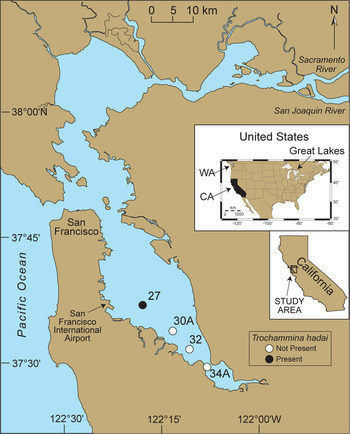
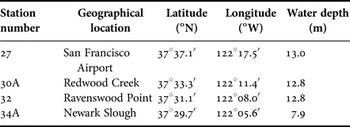
The upper 4 cm of surface sediment was obtained with a grab sampler by personnel of the former Water Resources Division of the US Geological Survey (USGS) at numerous sites throughout San Francisco Bay in April 1983 as part of their ongoing investigations of water and sediment quality in the bay. Most of these samples were pulverized in order to analyse the carbon content of the samples and the unused portion eventually archived. Only four of these, from sites 27, 30A, 32 and 34A (Figure 1; Table 1), were not processed and could be used for foraminiferal analysis.
Location map of San Francisco Bay, California, USA, showing the four sample sites collected in 1983 in the southern portion of the bay. Trochammina hadai was recovered only at site 27. WA, Washington; CA, California; Great Lakes, the Great Lakes of North America on the United States–Canada border, consisting of Lakes Superior, Michigan, Huron, Erie, and Ontario.

Station number, geographical location, latitude, longitude and water depth (m) of the sampling sites of the 1983 southern San Francisco Bay study.

The four sediment samples were wet-sieved through nested 0.063, 0.150 and 1.0 mm screens to remove the clays (<0.063 mm) and separate the size fractions. The sediment retained on the screens was transferred to filter paper and air-dried. Later, the samples were floated in sodium polytungstate at a solution density of 2.4 g/cm3 in order to concentrate the Foraminifera before picking. Foraminifera were then extracted from the >0.063 to <1.0 mm concentrated fraction. Samples were split with the aid of a microsplitter into an aliquot containing at least 300 benthic Foraminifera and all specimens were picked and identified. The slides and residues are on file in the Pacific Coastal and Marine Science Center Micropaleontology Laboratory at the USGS, Menlo Park, California, USA.
RESULTS
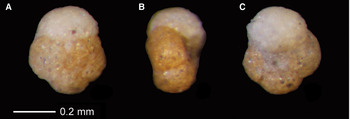
Thirteen species of agglutinated and calcareous benthic Foraminifera were identified in the samples collected in southern San Francisco Bay in 1983 (Table 2). Twelve of these are native to nearshore, shallow embayments, or estuaries along the Pacific coast of North America (Phleger, Reference Phleger1967; Scott et al., Reference Scott, Mudie and Bradshaw1976; Ingle, Reference Ingle1980; Jennings & Nelson, Reference Jennings and Nelson1992; McCormick et al., Reference McCormick, Severin and Lipps1994; McGann, Reference McGann and Carlton2007). The most common native species recovered were Ammonia tepida (Cushman, Reference Cushman1926) (44–92% of the assemblage) and Elphidium excavatum (Terquem, Reference Terquem1875) (6–49%). Three other native species occurred in low abundances: Haynesina germanica (Ehrenberg, Reference Ehrenberg1840) (<1–4%); Elphidiella hannai (Cushman & Grant, Reference Cushman and Grant IV1927) (<1–3%); and Bolivina striatula Cushman, Reference Cushman1922 (<1–2.3%). The remaining native species were rare (<1%). In addition, twelve specimens of the invasive species T. hadai (Figure 2) were present in only one of four samples (site 27), comprising 1.5% of the assemblage.
Trochammina hadai: (A) dorsal view; (B) lateral view; (C) ventral view. Scale bar = 0.2 mm.

Relative abundance of benthic foraminiferal species in the 1983 southern San Francisco Bay samples, given as a percentage of total foraminifera/sample.

DISCUSSION
A pattern of a first appearance followed by an explosive rise to dominance is commonly seen among invasive species. This is best illustrated by the historic record of Trochammina hadai in Padilla Bay, Washington, USA (McGann et al., Reference McGann, Grossman, Takesue, Penttila, Walsh and Corbett2012) or recent macrofaunal introductions such as the Asian clam (Potamocorbula amurensis (Schrenck, 1867)) in San Francisco Bay (Carlton et al., Reference Carlton, Thompson, Schemel and Nichols1990; Nichols et al., Reference Nichols, Thompson and Schemel1990) and the European zebra mussel (Dreissena polymorpha (Pallas, 1771)) in the Great Lakes of North America (Mills et al., Reference Mills, Leach, Carlton and Secor1993; Nalepa & Schloesser, Reference Nalepa and Schloesser1993) (Figure 1). A similar trend is seen with T. hadai in San Francisco Bay.
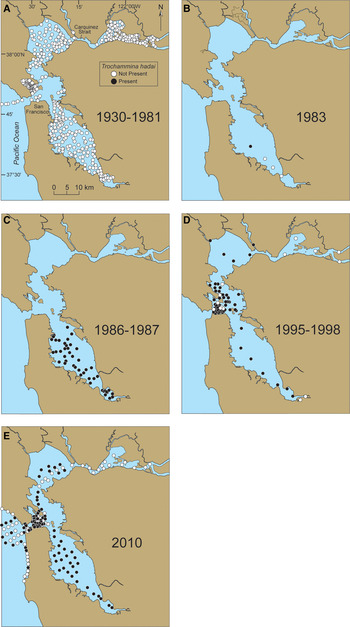
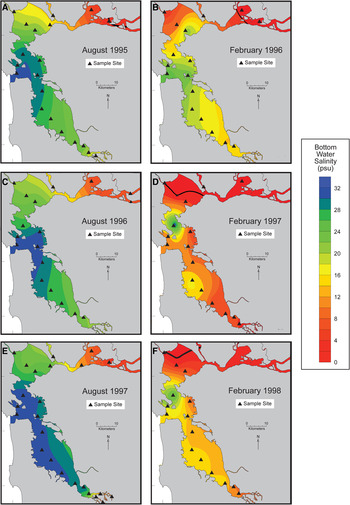
Trochammina hadai was not present in 404 samples collected between 1930 and 1981 throughout San Francisco Bay (Figure 3A). The species first appeared in 1983 in low abundance (1.5%) at a single location in the southern part of the bay (Figure 3B). It should be noted, however, that due to a lack of available archived samples representing this time period, it is impossible to know whether the invasive was also present elsewhere in the bay. In 1986–1987, T. hadai was found at all 46 sites throughout the southern bay (Figure 3C), including locations where it was absent three years earlier. By the middle to late 1990s, the species dominated the assemblages bay-wide (Figure 3D); after its first documented appearance in 1983 and up until 1998, T. hadai was recovered in 96% of the surface sediment samples collected for foraminiferal investigations in the bay, accounting for >50% of the foraminiferal fauna at most sites (McGann et al., Reference McGann, Sloan and Cohen2000). The only regions where the species was not recovered were east of the Carquinez Strait and in the extreme southern bay where conditions are often too fresh for Foraminifera to prevail (Figure 4; San Francisco Estuary Institute 1997, 1999, 2000), and in the central portion of the bay where currents are extreme (McGann et al., Reference McGann, Erikson, Wan, Powell II and Maddocks2013). In 2010, the species was still dominant, occurring at all of the sites investigated in the southern portion of the bay and in 78% of the samples collected bay-wide (Figure 3E; McGann et al., Reference McGann, Erikson, Wan, Powell II and Maddocks2013).
Distribution of Trochammina hadai in San Francisco Bay from 1930 to 2010: (A) 1930–1981; (B) 1983; (C) 1986–1987; (D) 1995–1998; (E) 2010.


Synthesizing decades of foraminiferal, sedimentological and oceanographic data in San Francisco Bay (McGann et al., Reference McGann, Erikson, Wan, Powell II and Maddocks2013), it is evident that living T. hadai do not reside in freshwater areas but are most abundant in the brackish to marine regions with sediment of finer grain sizes (clay to fine sand). Occasionally, the species may be found in areas characterized by strong currents (i.e. channels and the pathway to the open ocean) where sediment grain size increases substantially and less total organic carbon is present (McGann et al., Reference McGann, Erikson, Wan, Powell II and Maddocks2013), but its presence there is most likely due to sediment transport and is not a natural occurrence.
It is uncertain exactly how Trochammina hadai arrived in San Francisco Bay. The species appears to tolerate cold water temperatures, having been found as far north as Alaska (McGann et al., Reference McGann, Sloan and Cohen2000), so it could have moved naturally along the coast from Japan, Kamchatka, Alaska, Canada, and then into US waters. However, the earliest documented recovery of the species in US ports is not until 1971 in Padilla Bay, Washington (Figure 1), a minimum of ten years before it invaded San Francisco Bay (McGann et al., Reference McGann, Grossman, Takesue, Penttila, Walsh and Corbett2012). Were a ‘natural’ invasion to have taken place, it seems likely that it would have occurred prior to 1971. A more plausible explanation is that T. hadai was transported from Japan to western North America in ballast sediment, in anchor mud, or in sediment associated with baitworms, seaweed, or oysters, clams and mussels imported for mariculture. All of these are well documented invasion pathways for both micro- and macroorganisms (Kornicker Reference Kornicker1975; Carlton et al., Reference Carlton, Thompson, Schemel and Nichols1990; Mills et al., Reference Mills, Leach, Carlton and Secor1993; Nalepa & Schloesser, Reference Nalepa and Schloesser1993; McGann et al., Reference McGann, Sloan and Cohen2000, Reference McGann, Johengen, Reid, Ruiz and Hines2003, Reference McGann, Grossman, Takesue, Penttila, Walsh and Corbett2012). Additionally, invasions may occur once or through repeated inoculations by the same or a variety of vectors. Whatever the mechanism of introduction was in San Francisco Bay, this earliest record of T. hadai provides a baseline for chronological investigations of the species' invasion in the bay as well as in other ports along the north-eastern Pacific seaboard.
ACKNOWLEDGEMENTS
I thank Doris Sloan (University of California, Berkeley) for ongoing collaboration on invasive foraminiferal studies of the western United States. I also thank Chris Fuller (USGS) for offering the samples used in this study and Brian Reed for technical support. This manuscript greatly benefited from reviews kindly provided by Fabrizio Frontalini (University of Urbino, Italy), Eric Armynot du Châtelet (University of Lille, France), and Cynthia Brown and Philip Stoffer (both USGS). This research received no specific grant from any funding agency, commercial or not-for-profit sectors.