Introduction
Sensorineural hearing loss (SNHL) is the most common congenital sensory impairment. Approximately half of such cases are expected to have a genetic origin, and 70 per cent of these are non-syndromic cases. The inheritance pattern is autosomal recessive in 80 per cent of these non-syndromic cases, while it is autosomal dominant in 17 per cent, X-linked in 2–3 per cent and mitochondrial in less than 1 per cent.Reference Snoeckx, Huygen, Feldmann, Marlin, Denoyelle and Waligora 1
Mutations in the gap junction protein beta-2 gene, known as GJB2 and encoding the connexin 26 protein, represent a major cause of prelingual non-syndromic hearing loss and account for 50 per cent of non-syndromic autosomal recessive hearing loss cases.Reference Snoeckx, Huygen, Feldmann, Marlin, Denoyelle and Waligora 1 , Reference Kenneson, Van Naarden and Boyle 2 More than 100 GJB2 mutations are listed in the human gene mutation database (HGMD); they are responsible for mild to profound hearing loss, with cases of incomplete penetrance and delayed disease onset. In most cases, GJB2 mutations are inherited in an autosomal recessive manner, but some mutations are associated with dominantly inherited hearing loss.Reference Welch, Marin, Pandya and Arnos 3 More than 56 per cent of GJB2-related SNHL cases have hearing loss progression.Reference Kenna, Feldman, Neault, Frangulov, Wu and Fligor 4
Another connexin gene which has been characterised as a genetic cause of non-syndromic deafness is the gap junction protein beta-6 gene (known as GJB6), which encodes the connexin 30 protein and is located adjacent to the GJB2 gene on chromosome 13q12. Two large deletions, including most of the GJB6 gene coding region, are associated with hearing impairment in some populations.Reference del Castillo, Rodriguez-Ballesteros, Alvarez, Hutchin, Leonardi and de Oliveira 5 , Reference Del Castillo, Moreno-Pelayo, del Castillo, Brownstein, Marlin and Adina 6 Only seven GJB6 mutations responsible for non-syndromic hearing loss have been reported (and listed in the human gene mutation database (HGMD)); four are inherited in an autosomal recessive manner and two in an autosomal dominant manner.
Mitochondrial hearing loss is believed to be responsible for less than 1 per cent of non-syndromic SNHL.Reference Snoeckx, Huygen, Feldmann, Marlin, Denoyelle and Waligora 1 Nevertheless, the A1555G mutation in the 12S ribosomal RNA gene of the mitochondrial genome related to aminoglycoside ototoxicity has been reported to be important in the aetiology of SNHL in some populations,Reference Gallo-Teran, Morales-Angulo, Rodriguez-Ballesteros, Moreno-Pelayo, Del Castillo and Moreno 7 but its importance in progressive hearing loss is unknown.
This study aimed to investigate the molecular basis of progressive hearing loss and to compare it with that of non-progressive hearing loss.
Materials and methods
Patients
Seventy-two patients with progressive hearing loss, from 69 non-consanguineous Caucasian families, were recruited from the cochlear implant programme and from otorhinolaryngology and cervicofacial surgical out-patient clinics, between February 2003 and December 2010. All hearing tests and other evaluations were performed within the department.
The study protocol was approved by the Slovenian national medical ethics committee, and written, informed consent was obtained from all participants (or parents of minors) prior to the study.
The protocol for the evaluation of hearing-impaired patients comprised a detailed family history, a medical history focusing on potential causes of acquired hearing loss (i.e. acoustic trauma, intrauterine infections, perinatal complications,Reference Fakhim, Naderpoor, Shahidi, Basharhashemi, Nejati and Sakha 8 meningitis, mumps, and pre- and postnatal ototoxic drug exposure), and a complete audiological history (including the age of hearing loss onset, rate of progression, and other audiological symptoms). Patients with a history of daily occupational or recreational noise exposure were excluded.
All patients underwent a clinical otorhinolaryngological examination, including ear microscopy, with a systematic search for signs of syndromic hearing loss.
Each patient received a hearing test, prior to which a tympanogram was performed and middle-ear causes of hearing loss excluded. The air–bone gap was never greater than 5 dB.
Infants underwent ophthalmological and paediatric neurological examinations. Babies underwent transient otoacoustic emission testing, behavioural pure tone audiometry and auditory brainstem response testing.
Younger children underwent age-appropriate audiometry tests (i.e. visual reinforced audiometry and conditioned play audiometry) administered by speech and language pathologists experienced in paediatric audiometric testing.
Adults and children older than two to three years underwent conventional pure tone ‘hand-raising’ audiometry performed using a diagnostic audiometer in a sound-proof room (0.25–8 kHz for air conduction and 0.25–4 kHz for bone conduction).
Pure tone averages (PTA) for air conduction in the conversational frequencies (0.5, 1, 2 and 4 kHz) were calculated for each ear, and the severity of hearing loss was determined by using pure tone audiometry data. The severity of hearing loss was categorised as mild (21–40 dB), moderate (41–55 dB), moderately severe (56–70 dB), severe (71–90 dB) or profound (>90 dB), for each ear separately.Reference Kenna, Feldman, Neault, Frangulov, Wu and Fligor 4 Progressive hearing loss was diagnosed when thresholds worsened by 10 dB or more at two or more frequencies, or by 15 dB or more at one or more frequencies, in the same ear, on retest audiograms. The severity of hearing loss was followed for each ear separately.Reference Kenna, Feldman, Neault, Frangulov, Wu and Fligor 4 Hearing loss was considered asymmetrical when the difference between the ears was 15 dB or more in at least two frequencies, as per the definition of the European Workgroup on Genetics of Hearing Impairment (The European Concerted Action Project on Genetic Hearing Impairment; see http://hear.unife.it).
To establish the level and onset of hearing impairment in children under the age of two years, the results of notched noise brainstem audiometry were used.Reference Bartsch, Vatter, Zechner, Kohlschmidt, Wetzig and Baumgart 9 In children over two to three years of age, only conventional pure tone ‘hand-raising’ audiometry was used to calculate PTAs.
Morphological causes of deafness were excluded with high resolution computed tomography or, in selected cases, with magnetic resonance imaging of the temporal bone.
Adult patients with progressive hearing loss were also referred to a neurologist, an infectious diseases specialist and a rheumatologist, to exclude other, secondary causes of hearing loss.
Data were analysed for statistical significance by applying the t test, using the Statistical Package for the Social Sciences version 16 software program (IBM, Chicago, Illinois, USA). Differences were considered significant at a p value of less than 0.05.
Genetic analyses
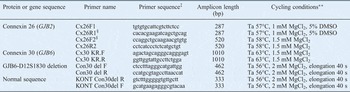
The GJB2 and GJB6 gene coding regions were amplified using polymerase chain reaction with primers, under conditions shown in Table I. Amplicons were sequenced using a BigDye Terminator version 1.1 sequencing kit and an ABI Prism 310 automated sequencer (Applied Biosystems, Norwalk, Connecticut, USA).
PCR primers and cycling conditions for GJB2 *, GJB6 * and GJB6-D12S1830 deletion † amplification

* Coding region amplification;
† sequence-specification amplification. ‡5′–3′. **Ta-annealing temperature. §Previously described primers.Reference Kelsell, Dunlop, Stevens, Lench, Liang and Parry 10 bp = base pairs; PCR = polymerase chain reaction; GJB2 = gap junction protein beta-2 gene; GJB6 = gap junction protein beta-6 gene; T = thymine; G = guanine; C = cytosine; A = adenine; DMSO = dimethylsulphoxide
Any novel mutations we detected were also sought in 100 unrelated, healthy control subjects.
Screening for the 309 kb GJB6-D12S1830 deletion was performed by sequence-specific duplex polymerase chain reaction, with one fragment amplifying the normal sequence and the other only the deletion-specific sequence. Sample DNA with the GJB6-D12S1830 deletion (kindly provided by Dr Ignacio del Castillo from the Unidad de Genetica Molecular, Hospital Ramon y Cajal, Madrid, Spain) was used as a positive control for the amplification. The primers and conditions used are presented in Table I.
Screening for the mitochondrial A1555G mutation was performed using the Custom TaqMan SNP Genotyping Assay and an ABI Prism 7000 HT sequence detection system (Applied Biosystems, Foster City, California, USA). Sample DNA with the A1555G mutation (kindly provided by Dr Chen-Chi Wu from the Department of Otolaryngology, National Taiwan University Hospital, Taiwan) was used as a positive control.
Results
Patient characteristics
The study included 72 patients with progressive hearing loss, aged between one and 65 years (mean age, 28 years). Pure tone audiometry documented the onset of hearing loss as occurring between two and 65 years of age (mean age, 18 years). Three patients were older than 60 years. The duration of documented hearing loss progression ranged from one to 39 years (mean duration, 10.5 years). The hearing loss (expressed as PTA loss) was between 15 and 100 dB (mean, 29.2 dB).
In the 56 patients without identified mutations, the documented mean age of hearing loss onset was 19 years, and the mean duration of documented hearing loss progression was 11.3 years.
In the 16 patients with pathological GJB2 or GJB6 variations, the documented mean age of hearing loss onset was 14 years, and the mean duration of documented progression was 10 years.
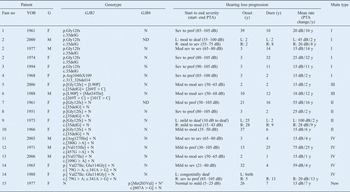
The clinical characteristics of individual patients with an established genotypic variation are summarised in Table II. No clinical differences were observed between the progressive hearing loss patients with and without an established pathological genotype. The mean documented duration of hearing loss progression was not significantly different (p = 0.67). Additionally, there was no significant difference in PTA loss between the two groups (p = 0.71); in patients with an established pathological genotype, PTA loss was 15–75 dB (mean, 27.6 dB), while in those without a pathological genotype it was 15–100 dB (mean, 29.7 dB).
Data for patients with established GJB2 or GJB6 variation

Mutations are described as copy DNA change of the open reading frame, and as affecting the protein coding sequence. Mutation (mutn) types: I = homozygous truncating; II = heterozygous truncating; III = compound heterozygous; IV = heterozygous non-truncating. *Met203Val was a novel mutation. GJB2=gap junction protein beta-2 gene; GJB6 = gap junction protein beta-6 gene; Fam no = family number; YOB = year of birth; G = gender; PTA = pure tone average; y = years; durn = duration; F = female; M = male; N = normal; ND = not done; sev = severe; prof = profound; mod = moderate; L = left; R = right
Genetic analyses
A pathological genotype was established in 16 of the 18 patients with identified GJB2 or GJB6 variations (Table II). Six different mutations and two possibly pathological variations of the GJB2 gene were detected: five patients had the common c.35delG mutation in a homozygous state, one patient had the c.313_326del14bp mutation in a homozygous state, two patients were compound heterozygotes for two different GJB2 mutations, and seven patients had a GJB2 mutation in a heterozygous state. Two controversial GJB2 variations, namely p.Arg127HisReference Matos, Simoes-Teixeira, Caria, Rosa, O'Neill and Fialho 11 and p.Val153Ile,Reference Marlin, Garabedian, Roger, Moatti, Matha and Lewin 12 which are believed to be potentially pathogenic, were detected in family 11 and 12 patients, respectively. Two patients, a mother (family 14, born 1965) and a daughter (family 14, born 1988), had two probably non-pathological variationsReference Marlin, Garabedian, Roger, Moatti, Matha and Lewin 12 , Reference Tsukada, Nishio and Usami 13 inherited on the same allele (Table II).
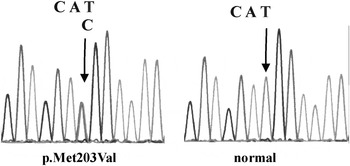
Additionally, one novel mutation in the GJB6 gene, changing methionine to valine in amino acid position 203 (p.Met203Val), was detected in a heterozygous state in the one patient from family 15 (Figure 1). This mutation was named starting the numbering from the AUG codon (GenBank Accession Number NM_001110219), as recommended by den Dunnen and Antonarakis.Reference Den Dunnen and Antonarakis 14 This novel mutation was not detected in 100 healthy control subjects.
Sequencing output for the novel connexin 30 gene mutation detected in patient 15, showing the sequence for the heterozygous p.Met203Val mutation compared with a normal sequence (sequences are shown in reverse). C = cytosine; A = adenine; T = thymine

In total, eight (11.1 per cent) patients had biallelic mutations and eight (11.1 per cent) had only one heterozygous mutation. The common c.del35G mutation was detected in 56 per cent of the mutated alleles (Table II). None of the patients studied had the mitochondrial A1555G mutation or the GJB6-D12S1830 deletion.
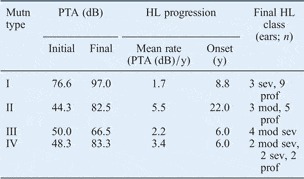
The audiological phenotypes of our patients (all with progressive hearing loss) roughly correlated with the severity of their mutations (Tables II and III). The starting and final PTA values were highest in patients with a homozygous truncating c.35delG mutation (group I in Table II), who thus had the lowest rate of average hearing loss progression. Hearing loss progression in patients with a homozygous truncating mutation started from a higher PTA level, compared with patients with heterozygous truncating mutations (p = 0.039), compound heterozygous mutations (p = 0.01) or single heterozygous non-truncating mutations (p = 0.03). There was a significant difference in the final PTA of patients with homozygous truncating mutations versus compound heterozygous mutations (p = 0.009).
Audiological phenotypes, by GJB2 mutation type

Mutation (mutn) types: I = homozygous truncating; II = heterozygous truncating; III = compound heterozygous; IV = heterozygous non-truncating. GJB2 = gap junction protein beta-2 gene; PTA = pure tone average; HL = hearing loss; y = years; sev = severe; prof = profound, mod = moderate
Discussion
Mutations of the GJB2 gene are known to be a cause of hearing loss which can range from mild to profound. They can be congenital or late-onset, and may be inherited in an autosomal recessive or dominant manner. As many as 56 per cent of patients with GJB2 gene mutations show some degree of progression of their hearing loss.Reference Kenna, Feldman, Neault, Frangulov, Wu and Fligor 4 Our study performed genetic analyses for 72 patients with progressive hearing loss, in whom causes of acquired hearing loss had been excluded. In 16 (22.2 per cent) of them, pathological GJB2 or GJB6 genotypes were established.
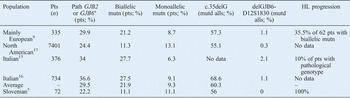
In several recent studies involving large cohorts of Caucasian patients with SNHL, a pathological GJB2 or GJB6 genotype was detected in 24.3 to 36.6 per cent of cases (mean, 29.5 per cent), and the common c.35delG mutation was present in 55.1 to 68.6 per cent of mutated alleles (mean, 60.3 per cent) (Table IV). In our group of patients with progressive hearing loss, a pathological GJB2 or GJB6 genotype was detected in 22.2 per cent, and the c.35delG mutation was present in 56 per cent of mutated alleles. Our results corroborate the finding that GJB2-related hearing loss is often progressive.Reference Kenna, Feldman, Neault, Frangulov, Wu and Fligor 4 , Reference Putcha, Bejjani, Bleoo, Booker, Carey and Carson 17 The c.35delG mutation accounted for a similar proportion of mutated alleles in all the above studies (Table IV). However, this is in contrast with the observation that progressive hearing loss is commonly related to non-truncating mutations.Reference Marlin, Feldmann, Blons, Loundon, Rouillon and Albert 18 In our study, the same GJB2 mutations, occurring with similar frequencies, were responsible for non-progressive hearing loss as are known to be responsible for progressive hearing loss; however, further studies on larger cohorts are needed to confirm this observation.
Previously reported GJB2 genotypes

*Pathological gap junction protein beta-2 gene (GJB2) or gap junction protein beta-6 gene (GJB6) genotype. †Current study.
Pts = patients; mutn = mutation; mutd alls = mutated alleles; HL = hearing loss
None of our patients carried the GJB6-D12S1830 deletion. This is in accordance with several study findings,Reference Bartsch, Vatter, Zechner, Kohlschmidt, Wetzig and Baumgart 9 including two performed in neighbouring populations, in CroatiaReference Sansovic, Knezevic, Musani, Seeman, Barisic and Pavelic 19 and Austria.Reference Frei, Ramsebner, Lucas, Baumgartner, Schoefer and Wachtler 20
It is generally believed that there is some degree of genotype–phenotype correlation in GJB2-related non-syndromic hearing loss. Indeed, in our study patients with hearing loss progression and a homozygous truncating mutation had a higher PTA level to begin with, compared with patients with hearing loss due to a heterozygous truncating mutation. However, there was no marked difference in the final hearing loss classifications of patients with different mutation types (Table III). Interestingly, an increasing number of exceptions show that the same mutation can be responsible for different hearing-loss phenotypes and, conversely, that different mutations might be responsible for the same phenotype. In family 2, our patient, born in 2000 and with a homozygous c.35delG mutation in the GJB2 gene and documented long-term progression of hearing loss, had parents with progressive hearing loss (born in 1977 and 1974) and a congenitally deaf sister, all with the same mutation.
-
• This study genotyped 72 progressive hearing loss patients and healthy controls
-
• Gap junction protein beta-2 and beta-6 gene mutation types were similar, and similarly frequent, compared with reported non-progressive hearing loss data
-
• A new gap junction protein beta-6 gene mutation (p.Met203Val) was found in a mild progressive hearing loss patient
In general, progression of hearing loss can be influenced by variations in modifying genes and/or environmental factors. An interesting proposed mechanism of connexin mutation related hearing loss comprises a defect of gap junction mediated intracellular transport of metabolically important molecules (e.g. glucose) as the central cochlear cell defect.Reference Chang, Tang, Ahmad, Stong, Leu and Lin 21 , Reference Chang, Tang, Ahmad, Zhou and Lin 22 It is therefore possible that any concomitant condition compromising glucose and/or oxygen supply to cochlear cells may additionally impede intracellular metabolism, causing cell death and thus promoting hearing loss progression. Such conditions may include environmental factors such as pollution (with noise or specific neurotoxic chemicals), behavioural factors (e.g. smoking) and other inherent defects of intracellular energy metabolism. Theories proposing novel mechanisms of connexin (or other) mutation related deafness may bring new insights to the understanding of the genotype–phenotype correlation. Larger studies are warranted to expand our knowledge in this field.
A novel GJB6 gene mutation, p.Met203Val, was detected in a heterozygous state in the one patient from family 15. This mutation was not detected in control subjects and was probably responsible for the progression of hearing loss in this patient. The p.Met203Val mutation is located in the fourth transmembrane helix of connexin 30, and causes a change from non-polar methionine to non-polar small aliphatic valine, resulting in an increase in Kyte–Doolittle hydrophobicity from 1.9 to 4.2.Reference Kyte and Doolittle 23 As it changes the hydrophobic methionine to the smaller but also hydrophobic valine, this mutation probably does not significantly destabilise the helix. Thus far, there have been no reported GJB6 mutations in amino acids 193 to 215, which form the fourth helix. Connexin 26 is similar in structure to connexin 30, and its fourth helix is also formed by amino acids 193 to 215. There is one known GJB2 mutation changing methionine to valine in this region (p.Met195Val), reported in a heterozygous state in a hearing-loss patient of Japanese origin.Reference Tsukada, Nishio and Usami 13 Therefore, a methionine to valine type mutation in the fourth helix of connexin 30 may also be pathogenic. Our family 15 patient had mild hearing loss with progression detected over a period of seven years; thus, we speculate that this mutation may have milder pathogenicity. A milder phenotypic effect is also supported by the fact that connexin 30 protein null mice have dramatically milder cochlear cell degeneration compared with connexin 26 protein null mice.Reference Sun, Tang, Chang, Wang, Kong and Lin 24 Our family 15 patient had no history of hearing loss in her family. An additional, undetected mutation or a dominant effect of p.Met195Val in GJB6 might also be speculated. One mis-sense GJB6 gene mutation (p.Thr5Met) has been reported to be responsible for non-syndromic, autosomal dominant, progressive hearing loss.Reference Grifa, Wagner, D'Ambrosio, Melchionda, Bernardi and Lopez-Bigas 25 It has also been reported that several GJB2 mutations with a dominant, negative effect, namely p.Thr44Cys,Reference Denoyelle, Lina-Granade, Plauchu, Bruzzone, Chaib and Levi-Acobas 26 , Reference Tekin, Arnos, Xia, Oelrich, Liu and Nance 27 R143QReference Loffler, Nekahm, Hirst-Stadlmann, Gunther, Menzel and Utermann 28 and p.Cys202Phe,Reference Morle, Bozon, Alloisio, Latour, Vandenberghe and Plauchu 29 are associated with progressive hearing loss.
Conclusion
In this study, genetic analyses of the GJB2 and GJB6 genes indicated that similar pathological genotypes, occurring with similar frequencies, may be responsible for both progressive and non-progressive hearing loss; therefore, genotyping cannot differentiate between these two types of hearing loss. A novel GJB6 gene mutation (p.Met203Val) was detected in a heterozygous state in a patient with mild progressive hearing loss. Patients both with and without an established pathological genotype had similar clinical courses.
Acknowledgements
We are sincerely grateful to Dr Ignacio del Castillo from the Unidad de Genetica Molecular, Hospital Ramon y Cajal, Madrid, who kindly provided the GJB6-D12S1830 deletion DNA sample, and to Dr Chen-Chi Wu from the Department of Otolaryngology, National Taiwan University Hospital, who kindly provided the mt.A1555G sample.
This work was partly supported by Slovenian Research Agency grants J3-2412 and P3-0343.