1. Introduction
InstitutionsFootnote 1 have been identified by scholars as a crucial organising structure in recent economic development (Amin, Reference Amin1991; Spohn, Reference Spohn2010). Polanyi and Finley further argue that present-day societies and institutions exhibit a social and economic preference for markets (Finley, Reference Finley1973; Polanyi, Reference Polanyi1944). At the same time, sociologists distinguish economic structures that emphasise broader ‘human over economic interests and the value of collective before self-interest’ (Whitehead and Crawshaw, Reference Whitehead and Crawshaw2014: 20). Given notions of economic freedom and the separation of economic and socio-political interests resplendent in the institutional literature (Graafland, Reference Graafland2020: 2), exploring the implications of this concern with social values and the effect on economic development in an ancient historical context is the overarching motivation for this paper. In particular, we agree that to ‘understand why people act as they do, we must first know what they value’ (Bruce, Reference Bruce2013: 37).
In one ancient society, the Mauryan Empire, institutions evolved with a focus on balancing wealth generation, social order, and individual wellbeing. Eventually, shaping a substantial part of what is present-day India in a period contemporaneous with the Macedonian polity of Alexander the Great, Mauryan institutions comprised of both market and public order control practices (Rahman et al., Reference Rahman, Byramjee and Karim2014: 654). At the same time, individual wealth creation was not just tolerated but actively encouraged within a formally prescribed ethical framework (Murthy and Rooney, Reference Murthy and Rooney2018). Furthermore, the range of market goods was extensive (Khanna, Reference Khanna2006: 10), supporting lifestyles that was seen as extending beyond subsistence (Mahapatra, Reference Mahapatra2012).
Mauryan society was founded on formal state institutions that exerted control though codified rules and processes over business and trade such that they were ‘the largest employer of labour … The state also entered the market as a trader’ (Rahman et al., Reference Rahman, Byramjee and Karim2014: 654). At the same time, however, private merchant and occupational guilds promoting trade and commerce also thrived. These institutions and their members were largely free from state interference to pursue economic outcomes as long as they operated within societal norms (Khanna, Reference Khanna2006: 35). As highlighted by noted guild historian Sheilagh Ogilvie (Reference Ogilvie2014: 170), ‘Debates about guilds are not just historical quibbles, but have wider implications for a very modern topic: the role of institutions in economic growth’. Here, arguments explored by Robson and Beadle (Reference Robson and Beadle2019) concerning moral agency within institutions are consequential.
This prompts the question germane to this paper, namely: within the constraints of an ancient economy, how did institutions facilitate functioning markets within a codified system of collective social values that were considered ancient and enduring even at that time? Here we agree with Fitzpatrick (Reference Fitzpatrick2011: 28) in that ‘Despite Finley's attempts to separate trade from economics and from Roman imperialism, it seems sensible to treat seriously not only the commercial endeavours of antiquity as a form of economics, but also to value their own reflections’.
In this academic endeavour, the claimed contribution of this paper in relation to ancient Mauryan institutions is to explain coexistence of economic success and social cohesion based on generalised trust generated by interactions between state and private institutions examined in relation to uncertainty and expectations. Although Mauryan economic activity and legal frameworks have been explored by historians and Sanskrit scholars, we believe that this is the first specific examination of the importance of socio-economic institutions in achieving this apparent co-existence of wealth and cohesion.
2. Mauryan polity and the Arthasastra
In existence from approximately 322 to 185 BCE, the Mauryan Empire is estimated to be comparable in size and population with the contemporaneous Macedonian kingdom of Alexander (Turchin et al., Reference Turchin, Adams and Hall2006: 223). Despite similarities in terms of the existence of urban societies (Chase et al., Reference Chase, Ajithprasad, Rajesh, Patel and Sharma2014; Kenoyer, Reference Kenoyer and Olivelle2006) and trade with other civilisations (Kenoyer et al., Reference Kenoyer, Price and Burton2013), the historical literature identifies the Mauryan polity as being distinct from the earlier Indus Valley or Harappan Civilisation. However, these characteristics of Harappan society may have persisted into Mauryan times (Kenoyer, Reference Kenoyer and Olivelle2006), beyond its decline in the presence of climatic and environmental change (Dutt et al., Reference Dutt, Gupta, Singh, Jaglan, Saravanan, Balachandiran and Singh2019). In terms of location, Harappan urban sites are identified largely with the West and North-Western political boundaries of present-day India and into Pakistan (Witzel, Reference Witzel2019), and in terms of political organisation (Trautmann and Sinopoli, Reference Trautmann and Sinopoli2002), Mauryan Empire is generally identified as being pan-Gangetic (Chakrabarti, Reference Chakrabarti and Hansen2000).
In terms of the Mauryan economic system, state institutions were instrumental to the promotion of agriculture, production, mining, tax collection, trade, commerce and maintaining socio-economic statistics. In particular, international trade in goods and services was recognised as a vehicle for increasing the sovereign's wealth and that of his subjects (Mukherjee, Reference Mukherjee1976). This system was described in a sutra (prose-poem) style treatise called the Arthasastra (trans: the science of wealth).
The importance of the Arthasastra derives from the fact that it is the only treatise devoted entirely to statecraft and wealth in ancient India to have survived (McClish and Olivelle, Reference McClish and Olivelle2012). As such, it is an invaluable resource for understanding how intellectuals and rulers of that time understood the project of running an ancient economy. The text contains details of business practices, including, for example, account keeping by government record keepers. It provides details of matters to be recorded, a system of examination of accounts, and details of punishments for non-compliance. Framed in terms of classical economic theory, Waldauer et al. (Reference Waldauer, Zahka and Pal1996: 106) found that the Arthasastra provides advice on how the wealth and wellbeing of the subjects could be advanced by a fair system of taxation. In addition, development economist Marinko Skare explored links between the Arthasastra and recent labour wage theory, noting the role assigned to labour productivity within the text (Skare, Reference Skare2013: 4–7 and 12).
The Arthasastra was initially translated to English in 1915 by Sanskrit scholar and librarian at the Oriental Research Institute of Mysore, Rudrapatna Shamasastry. Until this translation, the Arthasastra was known only through references in works by earlier Indian authors such as Dandit and Vishnusarma. Therefore, this work is the main reference for our study. Later translations, namely by R.P. Kangle and L.N. Rangarajan, are also cited in this paper to reflect the different motivations of these Sanskrit scholars. The Kangle translation includes a scholarly discussion of the text. The Rangarajan translation rearranged the original text by topics. Reference to these three translations was necessary to order to identify common themes.
Although written in Sanskrit (a sacred language that only the elite Brahman class used and taught), the literary style adopted in the Arthasastra was also aimed at society in general. As Sanskrit scholar Mark McClish identified, it was not explicitly influenced by orthodox Brahmanical ideology, lacking the pro-Brahmanical bias found in other Sanskrit works (McClish, Reference McClish2009). The Arthasastra emphasised that all individuals should follow moral standards demonstrating due respect to the happiness and prosperity of others, refraining from injury or perfidy (Bandyopadhyaya, Reference Bandyopadhyaya1982).
In this paper, we also refer to contemporaneous works by Greek and Roman historical figures such as Megasthenes and Strabo, as well as archaeological research to further mitigate potential differences in interpretation. We start with Mauryan archaeology and the Ashoka edicts.
Erected throughout the geographic range of the Mauryan Empire during the reign of its most noteworthy King, Ashoka,Footnote 2 a series of edicts carved in rocks (31 sites identified to date) or stone pillars (19 sites) ‘describe the social, religious, and political reforms he instituted, as well as details of his life’ (Sugandhi, Reference Sugandhi2012: 145). Of interest to this paper, they document ‘his attempts to spread his dhamma or “righteous rule” through his kingdom and beyondFootnote 3 … (where) … individual locations and edicts appear to have played varying roles, rather than just representing propaganda near subdued cities or marker stones at the edges of the empire’ (Coningham and Young, Reference Coningham, Young, Coningham and Young2015: 445). The later claim is contested (see, e.g. Cheatham, Reference Cheatham2012) given the many examples of ancient panegyric works such as the Res Gestae Divi Augusti, to use a Roman example (Parmar, Reference Parmar2016: 73). However, this form of epigraphic record has been noted as important in other South Asian empires. For example, in his study of the Kusana (or Kushana) Empire active between the first and third centuries CE, Skinner (Reference Skinner2017: 47) notes that ‘a pattern emerges that … the emergence of inscriptions … marked the transition from an emergent political entity to an entrenched power’.
Greek as well as Roman historians and geographers writing about India in or near this period also documented knowledge of the Mauryans and their institutions. Foremost amongst these historic figures is Megasthenes' and his treatise titled ‘Indika’. He was said to be present in the Mauryan court as a representative of far eastern Greek-speaking polities following the death of Alexander the Great. As Arora (Reference Arora1991: 308) identifies, ‘In the Graeco-Roman world, it was the main text through which India was understood’. Foremost among classical authors who quote from Megasthenes includes Strabo, Diodoros, Arríanos and Plinius.
With this background in mind, we next explore the culturally rich organisations articulated in this ancient manuscript and other contemporaneous texts.
3. Trade and commerce in the Mauryan Empire
Trade and commerce were important to Mauryan society and its economic success, the extent of which are ‘… revealed by widespread artifactual deposition of Indian material in the Gulf of Aden, Persian Gulf and Southeast Asian regions’ (Gupta, Reference Gupta2005: 140).Footnote 4 In the Arthasastra, trade is recognised to the extent that ‘The king shall promote trade and commerce by setting up market towns, ports and trade routes, both by land and water’ (2.1.19, Rangarajan, Reference Rangarajan1992: 155). Taking advantage of natural endowments, the Mauryan Empire intensified historical commercial activities within its borders as well as with other sovereign states (Lahiri, Reference Lahiri1992), including those beyond direct geopolitical control (Srivastava, Reference Srivastava1968).
Paralleling this development, Horace, the Augustan Roman poet and biographer who lived during the end of the Mauryan Empire, illustrates the perceived significance of the trade between Rome and India in concluding that ‘… most men are fools; as idle as they are (impiger), they are ready to sail as merchants to the end of the world (extremos Indos); in order to escape poverty (pauperiem fugiens), they are happy to face a number of perils at sea’ (Parmar, Reference Parmar2016: 62). Furthermore, ‘Augustan poets frequently associated India with a set of luxury items and there was a generalized feeling that the wealthy and ultimately the state were lavishing far too much money in purchasing such articles’ Parmar (Reference Parmar2016: 54). Summarising finds at excavation of an ancient port in present day Gujarat, Parmar (Reference Parmar2016: 63) lists some of the Mauryan luxury items traded with Rome such as ‘… spices (long pepper, costum, spikenard), medicines (lycium), textiles (cotton, silk and molochinon cloths, silk yarn), ivory, minerals (agate, onyx) and aromatics (bdellium)’. Fitzpatrick (Reference Fitzpatrick2011: 31) summarises the trade relationship:
Rome was said to have been running a trade deficit to the East of 100 million sesterces per year, half of which went to India. This should be seen against the backdrop of a recent estimate of Roman GDP of 10 billion sesterces in the first century C.E.
Given the importance of trade to the Mauryan Empire, understanding key institutional characteristics influencing that trade is pertinent: specifically, hierarchical state organisations, guilds and the caste system. Each is discussed in turn.
As described in the Arthasastra, there was a clear demarcation of roles for each state appointed administrator. For example, the Superintendent of the Marketplace was responsible for protecting consumers from ‘irresponsible’ actions by individual traders. He (the job was not open to female candidates) was charged with ensuring that goods were sold ‘so as to favour the subjects and avoid making profits that would be injurious to the subjects’ (2.16.5/6, Kangle, Reference Kangle1986: 146). This is consistent with the concept of dhamma found on the Ashokan Edicts which, as highlighted by Bloch (Reference Bloch1950: 31) include truthfulness and charity as well as social welfare.
The need for this institution is evidenced in Book Four of Arthasastra titled, ‘Keeping watch over traders’, whereby ‘Merchants … are all thieves, in effect, if not in name; they shall be prevented from oppressing the people’ (4.1.65, Rangarajan, Reference Rangarajan1992: 67). In particular, they are identified as tending to manipulate the prices of goods by joining together (8.4.36) in order to make excessive profits (4.2.28) or to trade lost and stolen articles (4.6.3). The expectations described in the Arthasastra appeared to be of economic exchange at fair prices, taking ‘into account the investment, the quantity to be delivered, duty, interest, rent and other expenses’ (4.2.36, Shamasastry, Reference Shamasastry1963: 303). Hence, the ‘profit margin allowed to merchants shall be 5% for locally produced goods and 10% for imported goods’ (4.2.28, Rangarajan, Reference Rangarajan1992: 207). In the Arthasastra, breaches of this controls were punishable with heavy fines.
However, despite this mistrust, the Arthasastra also envisaged protection for traders in the form of the provision of shelter and security for the goods of travelling merchants (4.13.7/8, Shamasastry, Reference Shamasastry1963: 334). Losses sustained by such merchants were ‘made good’ by local village leaders and government officials (4.13.9-12, Rangarajan, Reference Rangarajan1992: 206), as long as they stayed within the sanctuary of a village and let ‘the village officers know of the value of their merchandise’ (4.13.7/8, Shamasastry, Reference Shamasastry1963: 334).
Foreign trade was encouraged with imported goods ‘sold in as many places as possible [in order to make them readily available to people in the towns and the countryside]’ (2.16.4, Rangarajan, Reference Rangarajan1992: 207). Furthermore, financial incentives were provided in the form of tax concessions (2.16.12, Rangarajan, Reference Rangarajan1992: 207) such that ‘[local] merchants who bring in foreign goods by caravans or by water routes shall enjoy exemptions from taxes, so that they can make a profit …’.
Provision of transport routes for trade purposes was also a state activity. Long distance roads were constructed and maintained by the state, facilitating greater mobility and easy transportation of goods and surplus production from one region to another. The Mauryan state financed other infrastructure works such as agricultural irrigation, as indicated by Megasthenes, Stabo and the DharmaśaśtrasFootnote 5 (Singh, Reference Singh2017: 151). The state also provided separate areas in the towns for the operation of different trades and crafts.
In controlling trade, the Collector of Customs and Tolls was responsible for establishment and management of the customs house, appointing collectors who check merchants arriving into cities with their merchandise. Goods were not sold at the place of production but were to be brought to a local market as the State found it convenient to control the turnover of goods, prices and profits, and to help ensure that duties were not evaded (Kangle, Reference Kangle1986). Trade movements were recorded, along with merchant identification and merchandise quantities (2.20.1-5, Kangle, Reference Kangle1986: 162). Possible physical evidence of this trade control structure has been found in the Goayaya shipwreck of the coast of Sri Lanka where ‘two well-preserved clay sealings on which a lion is depicted … may have been used for merchandise, as described in Kautilya's Arthasastra’ (Dimucci, Reference Dimucci2015: 4). Although the lion has been identified as a representation of Ashoka on a number of the pillar edicts (Coningham and Young, Reference Coningham, Young, Coningham and Young2015: 444), caution is needed as it was also the symbol of a fourth century Sri Lankan king. Regardless, ‘… clay and lead sealings are well represented throughout the Mediterranean world’ (ibid.), pointing to persistent trade control practices.
Since all trade was under State control, there was limited scope for large scale individual traders or private industry. Instead, elites within the Mauryan Empire encouraged artisans and craftsmen to form private institutions known as sreni.Footnote 6 Sreni (or guilds) were a multi-faceted form of economic and social organisation that combined the functions of a professional association, political institution, trade union and a court of justice (Mahapatra, Reference Mahapatra2012). The srenis enabled individual occupational groups to specialise in particular trades and businesses.
Encouragement of srenis was built on examples of similar private institutions in earlier periods of Indian economic history. Ancient sources of Indian law frequently refer to the system of guilds which began prior to, and continued after, the Mauryan period (Thapar, Reference Thapar2015: 73). In his study of commercial activities in pre-Mauryan periods, historian Ramesh Majumdar found that co-operation among traders was likely to be a necessity forced upon them by physical dangers. In having long distances and insecure roads to traverse, they could, when united, physically resist these dangers (Majumdar, Reference Majumdar1969: 13). This included a form of local regulation for their occupation. For example, the Gautama Dharmasutra Footnote 7 stipulates that ‘Cultivators, traders, herdsmen, money-lenders and artisans (have authority to lay down rules) for their respective classes’.
Estimates vary between 18 and 150 sreni at various times in the Mauryan Empire, covering both trading and craft activities. Indicating a high level of occupational specialisation, sreni covered professions ranging from carpenters, ivory workers and bamboo workers to money-lenders, barbers, jewellers and weavers (Khanna, Reference Khanna2006: 10). Of particular interest to this paper, Mauryan guilds safeguarded the interests of traders and craftsmen against oppression by the King (Thaplyal, Reference Thaplyal and Pande2001). The chief concern of members of the sreni appears to have been to maintain a distinct identity, status and power within the operation of state legal systems, physical protection and societal norms (Thapar, Reference Thapar2015: 143). This is similar to the institutional aims of the Roman occupational guilds known as the Collegia Opificum, although the intent of the Roman king who first codified them, Numa Pompilius, appears to be more akin to the control of competing ethnic groups (Gabba, Reference Gabba1984: 81).
The internal processes of srenis were outside of direct State control, allowing producers organise a working system and assuring customary rights and obligations of the guild (Thapar, Reference Thapar2015: 72). For example, srenis prescribed punishment for violation of its institutional rules (Mahapatra, Reference Mahapatra2012) where aberrant behaviour by members was censured through a court within an individual sreni. They also maintained elements of societal and legal functions for their own group, eventually including marriage services where guilds become patrons of religious sects. Sreni intervened in the private lives of its members in other ways. For example, Thapar (Reference Thapar2015: 249) identified that if a married woman wished to join a Buddhist Order as a nun, she had to obtain permission not only from her husband but also from the sreni to which she belonged. Nevertheless, when problems with individual behaviour were not addressed by the sreni (such as damage to, or appropriation of, customer goods), state institutions took control (Kangle, Reference Kangle1986).
Srenis seem to perform an intermediate social and economic role between an occupational or business association and a caste with the scope of its influence dependent on the specific sreni. However, although caste is necessarily hereditary, guild membership was not always so. For example, continuation of a profession within a family was more common with members of craftsmen's guilds than with members of traders' guilds (Majumdar, Reference Majumdar1969). Despite the potential for work/caste conflict, an individual could be a member of only one caste but could be a member of more than one guild.
Hence, examination of Mauryan institutions also requires an understanding of the caste structure. The social practices variously known as caste, jaati or Varna is an institutionalised expression of social order (Majumdar, Reference Majumdar1969). Varnas prevailed in a form prescribed by the Vedas Footnote 8 and, as such, were considered divinely ordained and immutable. The State didn't create it, nor did it have the right to modify it. Access to its teachings was restricted to the Brahman caste, being transmitted in oral form at the time of the Mauryan Empire (Witzel, Reference Witzel and Flood2003: 68). However, the State did have the duty to preserve social order prescribed in the Vedas (Kangle, Reference Kangle1986). Its importance to social and economic control is confirmed in Greek and Roman texts on social layers in India (Bosworth, Reference Bosworth1996: 124).
For example, concepts of right and wrong (dharma and adharma) were based on Vedic principles. The Mauryan state expected every citizen to discharge their social obligations according to the dharma of their caste and punished individuals (danda) who interfered with the dharma of other communities (Dikshitar, Reference Dikshitar1993). Within the established Varnas, individuals were expected to keep to their assigned social roles, adhering to their respective duties and occupations (Ilaiah, Reference Ilaiah2001: 103).
The Arthasastra describes the specific duties of four Varnas, designated in terms of their occupation – Brahmans, Kshatriyas, Vaisyas and Shudras (Murthy and Rooney, Reference Murthy and Rooney2018). In contrast, prior to the Mauryan Empire the four Varnas were based on ethnicity (Verma, Reference Verma1959). Over time, occupations tended to become hereditary and, consequently, functional groups began to form into hereditary classes. The Dharmasutras Footnote 9 repeatedly advised people to earn their livelihood by performing their caste duties or Varnadharma (Srivastava, Reference Srivastava1968). Over time, caste-based allocation of occupation was accepted as a divine decree and was not regarded as a social injustice (ibid.).
Nevertheless, though the Dharmasutras laid down strict rules regarding the occupations to be followed by the four different castes, at the time of the Mauryan Empire, some individuals may not have adhered to them (Verma, Reference Verma1959). This can be attributed to three specific socially acceptable circumstances. First, during times of economic distress, a person belonging to a higher caste was permitted to perform the occupation of the lower caste. For example, Brahmanas could take up military duties, trade or agriculture and Kshatriyas could take up agriculture or trading (the usual occupation of a Vaisya). Second, the progeny of inter-caste marriages has a choice of occupations. Finally, traders (Vaisyas) could become prosperous, attracting both Brahmans and Kshatriyas to engage in trade and commerce.
Hence, the institutional practices of the sreni and castes first seen in earlier Vedic times worked in unison with other social practices to influence the trade structures and practice of the Mauryan Empire. In considering the distinction between castes and sreni, Thaplyal (Reference Thaplyal and Pande2001) identified that though similar in some respects, sreni were primarily occupational institutions whereas castes were primarily social groups. However, in populated areas where caste and sreni membership coincided, the head of the guild presided over the meetings of both sreni and caste (ibid.).
4. Discussion
Recognition of the concurrent existence of state-controlled alongside private institutions in the Mauryan Empire is consistent with a range of studies on ancient societies. Comparisons can be made, for example, with chronologically proximate ancient states such as the Persian Achaemenid Empire, where occupational structures operate within a hierarchical state (Farazmand, Reference Farazmand1998: 76).
Consistent with much of the orthodox literature on economic development (Castellani, Reference Castellani2019: 702), hierarchical state institutions may constrain potential economic outcomes available to private Mauryan institutions and individuals. However, recent studies on subjective well-being also indicate positive interactions between institutions, economic performance and cultural norms specifying good conduct towards other members of society (Algan and Cahuc, Reference Algan and Cahuc2010). Gorodnichenko and Roland (Reference Gorodnichenko and Roland2011) isolate these interactions to economic systems where static efficiency and coordination of relatively stable production technologies are paramount, suggesting lower levels of innovation. However, in considering lack of available historical records, investigation of rates of innovation in the Mauryan Empire would be necessarily problematic despite prior claims in areas such as metallurgy, agriculture and social developments such as increased urbanisation and the diffusion of religious practices (Kirk, Reference Kirk1975).
The interest here is in the role of the sreni in light of the importance of trade to the Mauryan economy. Accordingly, this section explores the significance of sreni as institutions within the ancient Mauryan Empire. In particular, Mauryan subjects associated safety from economic and social risk with membership of a specific Varna and, for the appropriate occupations, to srenis as institutions allowing members to claim rights recognised in Mauryan social symbols and rituals. An individual had no economic status without these organisations. If an individual ignores the boundaries and social constraints of these institutions, this may have dramatic consequences for them and society. Mauryan institutions emphasised that the ‘natural order’ of the society was expressed in the occupation boundaries of these institutions. At the same time, Mauryan subjects gained assurance in expert knowledge associated with the occupations supported by Varna symbols, rites and rituals exhibited within the institutional boundaries of the srenis.
Hence, Mauryan subjects working within the boundaries of both state and sreni institutions accept risk as long as decisions are justified either by state representatives or by occupational experts within the sreni. Here, although state expert elites were Brahmin, Brahmins did not directly control the operations of sreni. As a result, experts operated within the srenis on the basis of their occupational knowledge rather than the judgement and authority of Brahmins. For individuals within a sreni, behaviour consistent with sreni symbols, knowledge and processes, formed within societal norms, were rewarded by employment, remuneration and status.
Apart from institutional boundaries, another important difference between groups is the amount of control their members accept. More comprehensive regulation is likely to result in groups that are more hierarchical. Reaching across Mauryan society, formal processes enforced by state institutions provided a basis for market pricing by placing ethical and price constraints on market outcomes. The ethics of the Vedas were enshrined in market processes and institutions. This aspect of the Arthasastra as well as in the Ashoka Edicts reaches beyond impersonal market processes identified as ideal in modern capitalist economies to explicitly embrace social cohesion and fairness. Consistent with both available evidence, Mauryan state and private institutions aimed to manage social needs as well as measurable economic outcomes. This is simultaneously consistent with, as well as in contrast to, the development and operation of markets in medieval Europe and, to the extent at which guilds operated, in Greece (Tridimas, Reference Tridimas2019) or Rome (Temin, Reference Temin2001), as discussed below.
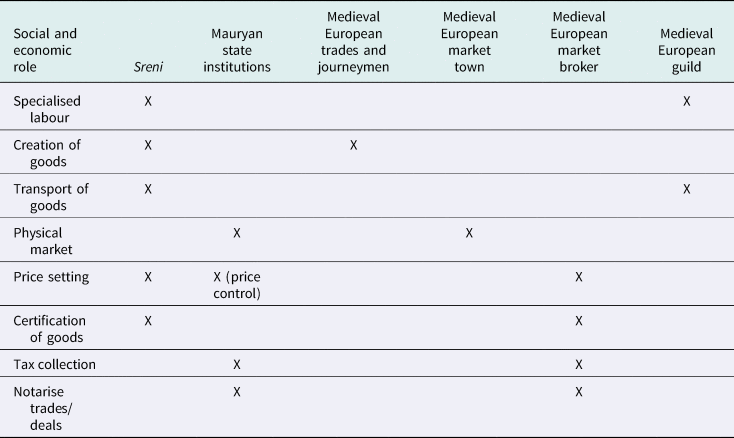
Corresponding to market matching institutions and processes described by Boerner and Quint (Reference Boerner and Quint2010), the Mauryan state established places for trade as well as regulation to control market activities in order to address risks inherent to trading and consumer relationships. Relevant market processes included the enabling of credit transactions and exchange, ‘a necessary precondition for the market-making activities’ (ibid.). In contrast to medieval European institutions, however, the economic processes of market matching involving buyers and sellers across long distances between the manufacture and consumption of goods was not facilitated by private brokers in Mauryan economy. This was a joint responsibility of the state and sreni. For example, the market space for suppliers of labour and goods was provided and regulated by the state. However, within social constraints monitored by state institutions, goods were provided and priced by relevant sreni. This contrasts with ancient Greece and Rome where price making was facilitated on basis of individual commercial contracts and the law; in Rome, being the legal concept of the notion of ‘just price’Footnote 10 or justum pretium (Maniatis, Reference Maniatis2003: 131) and in Greece being citizenship laws emphasising notions of individual responsibility (Tridimas, Reference Tridimas2019: 7).
Similar to medieval European market brokers, sreni were a ‘multifunctional institution which performed commercial intermediation certification of the quality of goods …’ (Boerner and Quint, Reference Boerner and Quint2010: 2). However, they were not responsible for ‘tax collection for the town, and the notarization of deals’ (ibid.). That, again, was a state responsibility. In addition, unlike medieval market brokers, they were also developers and providers of specialist industry labour, a role fulfilled by separate institutions in Europe (i.e. guilds). Furthermore, sreni fulfilled social and political roles consistent with the religious caste to which members of the sreni belonged. Although some European guilds also fulfilled these roles, unlike sreni, they were separate social organisations to the private market brokers of Europe.
A summary of the comparative roles of these institutions and the Mauryan state is provided in Table 1.
A comparison of Mauryan and Medieval European market institutions

In examining the multilayered social relations present in Mauryan society, we find a consistent theme of integration between institutions and societal norms in Mauryan society in comparison with ancient and medieval European societies. The importance of this distinction in understanding the values and risks promoted in a particular society can be seen in comparative studies. Here, we find substantive differences in the role of spirituality and social values in constructing the economic status of individuals. For example, in an examination of ‘defiled trades and social outcasts’ in German-speaking kingdoms of the 16th–18th centuries, social and cultural historian Kathy Stuart (Reference Stuart2006: 9) identifies the importance of understanding the role of societal norms on economic activity: ‘A striking difference between caste pollution in Japan and India or Polynesian mana/taboo and early modern German dishonor lies in the ideological legitimation and the effects of pollution. In India and Japan, pariah groups were described as religiously and spiritually defiled …’. In other words, for Mauryan institutions, cultural adherence explicitly included both an economic and spiritual or ethical dimension.
Furthermore, although the enforcement of Varna and sreni institutional constraints effected social and occupational status in Mauryan society, medieval European workers were not always bound to social institutions, leaving room for the slow development of individual character only loosely bound to institutional identity such as can be found in the European journeyman (Stuart, Reference Stuart2006: 15). Hence, private institutions such as the sreni were crucial within Mauryan society to the social status as well as the economic survival of individuals. Accordingly, we next contrast the social and economic plurality of sreni with the largely economic focus of guild institutions that developed in Europe.
The rationale for European guilds was as institutions that ‘arise and survive as a result of political conflicts over distribution’ (Ogilvie, Reference Ogilvie2014: 170). The notion here is largely one of economic rent seeking of the type referred to as ‘occupational licencing’ by labour economist Morris Kleiner (Reference Kleiner2015). This is seen as economically inefficient in both the neo-Marxist and neo-classical economic literature (ibid.). The suggestion is that European ‘guilds enabled their members and political elites to negotiate a way of extracting rents in the manufacturing and commercial sectors, rents that neither party could have extracted on its own’ (ibid.). Stuart (Reference Stuart2006: 16) identified the economic focus of European form of guilds in the similar terms, whereby ‘Artisans masterfully invoked the norms of honor and common weal in their effort to maintain areas of corporate autonomy against the encroachments of increasingly authoritarian governments’. Here, honour and fairness were largely defined in terms of the risks of failing to achieve economic rents rather than as a socially acceptable trade-off between wealth and social norms.
In contrast, sreni fostered behaviour that reinforced social as well as economic duties, being strongly associated with identities supported by the Varnas and found in the Arthasastra. In the Mauryan economy, guilds addressed risks associated with both wealth creation and social/religious duties. Hence, although we do agree with Ogilvie that guilds are ‘not a modern phenomenon’ (Ogilvie, Reference Ogilvie2014: 176), we argue that their characterisation as institutions for ‘occupational licensing’ (ibid.) is demonstratively less relevant to Mauryan guilds. As mentioned earlier, sreni were multi-faceted institutions that, with the support of formal state institutions and in contrast to European guilds, ‘encouraged a generalized trust across the wider economy’ (Ogilvie, Reference Ogilvie2014: 186) as long as they adhered to the social norms, values and ideology of Mauryan society. If they did not, Mauryan state institutions, through their direct involvement in economic activity, were able to monitor and sanction the particular sreni whose members had failed in their duties.
This is an important distinction as ‘economic growth requires a generalized trust that makes people willing to transact on an equal footing with everyone, even strangers …’ (ibid.). The distinction here is that European guilds exhibited ‘a particularized trust among its own members, as insiders in the closed and multiplex social network of that guild’ that ‘gave rise to rent-seeking, demarcation struggles, and hostility towards outsiders, diminishing rather than fostering the trust in strangers that might have made markets and states work better’ (ibid.). It was economic brokers under local licence who provided the generalised trust required to facilitate the functioning of local medieval European trade markets.
Emphasis on the differences in the role and scope of the State in relation to medieval European guilds and Mauryan sreni can be seen in empirical evidence cited by Ogilvie (Reference Ogilvie2014: 176) to the effect that ‘The most successful medieval and early modern trading locations – the Champagne fairs, Venice, Bruges, Antwerp, Amsterdam, London – were ones where the political authorities made such generalized security guarantees to all merchants rather than issuing particularized safe-conducts as privileges to members of favored guilds’. Here, Ogilvie was referring to individual city authorities. This distinction is instructive, as the co-founder of the Annales School, Marc Bloch, emphasised in Feudal Society. In medieval Europe, ‘despite the persistence of the idea of a public authority superimposed on the multitude of petty powers, feudalism coincided with a profound weakening of the State, particularly in its protective capacity’ such that ‘a considerable part of the political authority exercised by innumerable petty chiefs had the appearance of a usurpation of “regalian” rights’ (Bloch, Reference Bloch1961: 443). He asserts that feudalism resulted in ‘an unequal society, rather than a hierarchical one – with chiefs rather than nobles; and with serfs, not slaves’ (ibid.).
In contrast, security, protection and preferential price protection for foreign traders and Mauryan subjects engaged in trade was explicitly arranged, provided and enforced by national state institutions. Furthermore, we argue that a key explanation for the differences between medieval European guilds and Mauryan sreni is the social norms embedded in the rituals and symbols of respective social and private institutions. In particular, social outcomes were pursued alongside economic success, achieving trade through state and private market structures. This pluralism contrasts with medieval European markets where privileging ‘impersonal exchange’ practices is seen as economically efficient.
Similar arguments have been advanced in related studies of economic development and the role of legal systems in other ancient societies. For example, in a study of economic growth in ancient Greece, political economist George Tridimas (Reference Tridimas2019: 3) suggests that ‘contrary to the primitive view, farmers ran their business with the aim of improving yields and profits …’. However, he does go on to identify ‘cultural traits’ such as ideals of self-sufficiency, freedom and individual rather than collective rights as part of an ‘anti-development’ culture that limited the potential for capital intensive technology and economies of scale (Tridimas, Reference Tridimas2019: 21).
Consequently, we assert that human actions expressed and reinforced in the form of institutions were essential aspects of Mauryan economic success. Here, market integration is ‘an important mechanism by which institutions affect growth’ (Keller and Shiue, Reference Keller and Shiue2016: 2). In contrast to the European guild system, where market integration beyond particular city-states was considered to be low until the 19th century (ibid.), the pluralist institutional structures of the Mauryan state and the sreni provided sufficient market integration to expand trading routes and economic relations that had existed prior to the Mauryan Empire.
Hence, although academic writing on the Mauryan Empire is significant, past scholarship has tended to focus on the histography of economic, political, societal or legal constructs (e.g. Goyal, Reference Goyal1995; Gray, Reference Gray2014; Skare, Reference Skare2013), this paper has concentrated on an examination of Mauryan institutions as both economic and social phenomena. Accordingly, we argue that our findings have important implications for understanding of economic development in ancient societies. In particular, understanding of structural, processual and behavioural dynamics of economic action in ancient societies can be advanced by more nuanced analysis of the forms of collective action based on a range of human interests, rather than a singular form of economic self-interest (Carballo et al., Reference Carballo, Roscoe and Feinma2014: 110).Footnote 11
Echoing a recent call by Logue et al. (Reference Logue, Clegg and Gray2016: 18), further examination of the role of institutions and institutional processes in achieving economic outcomes in ancient societies needs to consider the multi-layered constitution of social and economic interaction effects. This includes consideration of the role of public order institutions identified in a review of research on the links between institutions and economic growth by Ogilvie and Carus (Reference Ogilvie, Carus, Olivelle and Davis2014: 428). In the case of the Mauryan polity, the importance of a ‘variegated social structure’ encouraging development of commerce and trade integrating but not completely dependent on private institutions known as sreni was reinforced by state-owned economic and public-order institutions (Ogilvie and Carus, Reference Ogilvie, Carus, Olivelle and Davis2014: 435).
Hence, Mauryan economic development is not explained simply in terms of the modern construct of market ideology shaped by the ‘degree of autonomy an individual has over the selection of their role(s) in society’ (Linsley and Shrives, Reference Linsley and Shrives2009: 499). This suggests the need for a pluralist definition of economic freedom that encourages scholars to explore social phenomenon beyond the privileging of economic outcomes derived from ‘conditions unique to modernity’ (Carugati et al., Reference Carugati, Hadfield and Weingast2015: 4).
Consistent with the empirical findings in this paper, Klein (Reference Klein2015: 329) notes that a focus on values and the ‘transubstantiation’ of these values ‘through domains of practice’ within organisations is a characteristic of the institutional logics perspective first articulated by Friedland and Alford. This focus highlights that ‘institutional rules thus provide for stability in a world of uncertainty’ (King, Reference King2012: 300). In particular, both state and private institutions have a key role in economic success that, overall, ‘helps convert uncertainty into calculable risk’ (King, Reference King2012: 303). Here, shared social values and economic expectations across Mauryan society were instrumental in helping to facilitate private institutions and economic activity. This is partly as a consequence of relationships between societal values, their expression within institutional symbols or rituals and their effect on Knightian uncertainty (Lavoie, Reference Lavoie2014: 74).
5. Conclusion
In summary, this paper highlights the role of social values in institutions found in an earlier time and place. It has examined the role of these institutions in the control of social and economic uncertainty within an economically successful ancient society. It has also examined the characteristics of social order that identify where state and private institutions support individual wealth creation within public order norms across society.
Given an absence of economic statistics we are unable to make any claims on the relative economic performance of Mauryan institutions.Footnote 12 Hence, the paper has focussed on understanding the structures and processes identified with Mauryan institutions to achieve a balance between wealth generation and ethical behaviour. Social structures have been shown to engage with ‘modern’ representations of economic markets that allow for individual wealth creation. Accordingly, we agree with classics scholar Sarah Morris (Reference Morris, Riva and Vella2006: 67) in that ‘we have outgrown the lame use of “trade” as a self-explanatory force, to capture instead patterns of production …’.
Accordingly, historical analysis can play a role in terms of understanding economic path dependencies (David, Reference David1994), such as those seen is an examination of the medieval antecedents of industrial clusters (Akoorie, Reference Akoorie2011). Historical studies examining perceived uncertainty and resulting values embedded in social processes and structures can also help improve theorisation of interaction between private institutions and broader societal values, symbols and rituals.
In considering the results of this paper, key limitations should be considered. First, the extent to which the translated script demonstrates the exact meaning of the original Sanskrit text may not be clear, despite the efforts of the learned Sanskrit scholars. Although mitigated through the use of three separate translations, the reliability of this translated work cannot be objectively guaranteed. Second, modern terminologies (such as social order and economic freedom) have been used in this paper to explain ancient Indian institutional practices. This is unavoidable but problematic, especially in light of the arguments regarding the assumptions of scholars adopting a pre-modern/modern dialectic in understanding ancient societies. Finally, readers should note that the Arthasastra was a book written for the King and is not a descriptive history. Although supported by contemporaneous inscriptions and archaeological finds, this paper largely projects an ideal society as depicted in the Arthasastra. Hence, although patterns of economic behaviour are supported by alternate sources, in reality, daily routines may have varied.