Introduction
Physical distress and stage of disease have been shown to be consistent predictors of depression in patients with cancer (Rodin et al. Reference Rodin, Zimmermann, Rydall, Jones, Shepherd, Moore, Fruh, Donner and Gagliese2007b), but the relationship between disease burden and psychological distress is shaped by several individual and social factors, including age (Ellis et al. Reference Ellis, Lin, Walsh, Lo, Shepherd, Moore, Li, Gagliese, Zimmermann and Rodin2009), attachment security (Rodin et al. Reference Rodin, Walsh, Zimmermann, Gagliese, Jones, Shepherd, Moore, Braun, Donner and Mikulincer2007a) and spiritual wellbeing (McClain, Rosenfeld and Breitbart Reference McClain, Rosenfeld and Breitbart2003). Older cancer patients tend to report less psychological distress than younger patients, an age-related pattern that has been attributed to differences in disease burden, social support and variations in circumstances across the lifecourse (Mosher and Danoff-Burg Reference Mosher and Danoff-Burg2005; Strong et al. Reference Strong, Waters, Hibberd, Rush, Cargill, Storey, Walker, Wall, Fallon and Sharpe2007). Distress may also be greater in young cancer patients because of the greater adaptive challenges at their life stage, including anticipated losses in their careers, family life and fertility (Mosher and Danoff-Burg Reference Mosher and Danoff-Burg2005; Strong et al. Reference Strong, Waters, Hibberd, Rush, Cargill, Storey, Walker, Wall, Fallon and Sharpe2007). Compared to older individuals, they may also have had fewer opportunities to develop the adaptive skills by which to manage stress and depressive affect (Gross et al. Reference Gross, Carstensen, Pasupathi, Tsai, Skorpen and Hsu1997; Jorm et al. Reference Jorm, Windsor, Dear, Anstey, Christensen and Rodgers2005) or to develop accommodative coping strategies to deal with uncontrollable losses (Brandtstadter and Greve Reference Brandtstadter and Greve1994).
Adult attachment theory provides a framework from which to understand the modulation of distress in cancer patients (Hunter, Davis and Tunstall Reference Hunter, Davis and Tunstall2006; Tan, Zimmermann and Rodin Reference Tan, Zimmermann and Rodin2005). Attachment security, the sense that the world is a safe place and that others will be available, responsive and helpful when needed, is associated with a greater capacity to rely on social support during times of distress (Mikulincer and Shaver Reference Mikulincer and Shaver2007). This characteristic has been assessed in adults on dimensions of attachment anxiety and avoidance. Anxious attachment represents the degree to which individuals worry about being rejected, abandoned or unloved by significant others, while avoidant attachment refers to the degree to which individuals are distrustful of others, and choose to rely upon only themselves (Mikulincer and Shaver Reference Mikulincer and Shaver2007). People who score low on these two dimensions are said to be securely attached. There is extensive evidence that secure attachment, particularly the dimension of attachment anxiety, associates with greater subjective wellbeing, self-esteem, psychological functioning and social adjustment, and that it can buffer the emotional effects of stressful and traumatic events (see Mikulincer and Shaver Reference Mikulincer and Shaver2007 for a review). Consistent with this hypothesis, attachment security in patients with end-stage cancer has been associated with greater perceived social support and, in turn, with less psychological distress (Hunter et al. Reference Hunter, Davis and Tunstall2006) and depression (Rodin et al. Reference Rodin, Walsh, Zimmermann, Gagliese, Jones, Shepherd, Moore, Braun, Donner and Mikulincer2007a).
Attachment security is a relatively stable individual characteristic that nevertheless may be shaped or modified by life experience, including traumatic events and the nature and quality of supportive relationships (Grossmann, Grossmann and Waters Reference Grossmann, Grossmann and Waters2005; Mikulincer and Shaver Reference Mikulincer and Shaver2007; Zhang and Labouvie-Vief Reference Zhang and Labouvie-Vief2004). Longitudinal studies have revealed a developmental trend in which adults become more securely attached with greater age (Grossmann, Grossmann and Waters Reference Grossmann, Grossmann and Waters2005; Zhang and Labouvie-Vief Reference Zhang and Labouvie-Vief2004), which has been attributed to the tendency to establish over time more stable and caring relationships, and to internalise ‘working models’ of attachment relationships in line with these relational experiences (Grossmann, Grossmann and Waters Reference Grossmann, Grossmann and Waters2005; Zhang and Labouvie-Vief Reference Zhang and Labouvie-Vief2004). Taken together, these findings raise the possibility that growth in attachment security over time may account for the inverse relationship among cancer patients between age and distress.
Spirituality has been defined as the capacity to understand the ultimate meaning, purpose and value of one's life (Muldoon and King Reference Muldoon and King1995). The term spirituality overlaps in the cancer research literature with spiritual wellbeing (Brady et al. Reference Brady, Peterman, Fitchett, Mo and Cella1999; McClain, Rosenfeld and Breitbart Reference McClain, Rosenfeld and Breitbart2003; Stefanek, McDonald and Hess Reference Stefanek, McDonald and Hess2005), with the latter term often used to refer to the perceived outcome that one's life has had meaning, purpose and value (Edmondson et al. Reference Edmondson, Park, Blank, Fenster and Mills2008). Longitudinal measurement may be necessary, however, to distinguish spirituality as a trait or characteristic from spiritual wellbeing as an outcome that may change. The measure of spiritual wellbeing most commonly used in cancer research, the Functional Assessment of Chronic Illness Therapy – Spiritual Well-being Scale (FACIT-Sp) was initially developed by asking cancer patients, psychotherapists and hospital chaplains to describe aspects of spirituality that contribute to quality of life. The moderate correlation of this measure with other measures of religiosity and spirituality has been used to demonstrate its convergent validity (Peterman et al. Reference Peterman, Fitchett, Brady, Hernandez and Cella2002). Spirituality may increase in response to negative life events in older adults (Wink and Dillon Reference Wink and Dillon2002), and greater spiritual wellbeing has been associated with less depression in individuals with advanced medical illnesses such as terminal cancer (McClain, Rosenfeld and Breitbart Reference McClain, Rosenfeld and Breitbart2003) and heart failure (Bekelman et al. Reference Bekelman, Dy, Becker, Wittstein, Hendricks, Yamashita and Gottlieb2007).
It has been postulated that spiritual wellbeing contributes to the capacity to maintain hope, equanimity and acceptance in the face of terminal disease (Breitbart Reference Breitbart2002; Chochinov and Cann Reference Chochinov and Cann2005). Longitudinal research (Wink and Dillon Reference Wink and Dillon2002) has found that spirituality tends to increase with age (see Dalby Reference Dalby2006 for a review), and has been associated with the developmental phenomenon termed ‘gerotranscendence’ (Torstam Reference Torstam1996). This phenomenon may be explained by the growing desire with the passage of time to reflect on life experience, by the increasing salience and acceptance of mortality, and by the expansion of self-knowledge with age and experience (Wink and Dillon Reference Wink and Dillon2002). In summary, the published evidence suggests that attachment security and spirituality tend to increase with age, and that both may mediate the inverse relationship between age and psychological distress among cancer patients. This hypothesis has not previously been tested. The study reported here examined whether greater age relates to greater attachment security and greater spiritual wellbeing among patients with metastatic lung or gastrointestinal cancer, and whether those factors mediate the protective effect of age on depression, controlling for the physical burden of disease.
Method
Participants and procedure
The study sample comprised 342 outpatients with a confirmed diagnosis of Stage III or IV lung or Stage IV gastrointestinal cancer who attended clinics at Princess Margaret Hospital, a comprehensive cancer treatment centre in Toronto, Canada, and who participated in a longitudinal study of the will to live among patients with advanced cancer (Rodin et al. 2007 b). Individuals at these disease stages have significantly short survival prospects. Among lung cancer patients, fewer than 15 per cent with Stage III and almost none with Stage IV disease will survive for five years following diagnosis (Shepherd Reference Shepherd and Hansen2000). The survival rates for Stage IV gastrointestinal cancer are more variable, although the five-year survival rate of patients with cancer of the colon and rectum is only 6–7 per cent (Ries et al. Reference Ries, Reichman, Lewis, Hankey and Edwards2003). All participants were aged 18 or more years and not cognitively impaired, as indicated by scoring 20 or more on the Short Orientation-Memory-Concentration Test at the time of recruitment (Katzman et al. Reference Katzman, Brown, Fuld, Peck, Schechter and Schimmel1983); and were sufficiently fluent in English to provide written, informed consent and to complete the self-report questionnaires. After fully explaining the study to the subjects, written informed consent was obtained. The Short Orientation-Memory-Concentration test was administered to the eligible participants and they were given a questionnaire pack to complete in the clinic or at home.Footnote 1
Materials and measures
Medical and socio-demographic data, including date of birth, gender, marital status and disease site, were obtained from medical charts. The Beck Depression Inventory-II (BDI-II) (Beck, Steer and Brown Reference Beck, Steer and Brown1996) is a 21-item self-report measure of the intensity of depressive symptoms that is widely used with cancer patients (Schneider Reference Schneider1998). Scores may range from ‘0’ to ‘63’, with higher scores representing increased depressive symptoms. The 36-item Modified Experiences in Close Relationships Scale (Lo et al. Reference Lo, Walsh, Mikulincer, Gagliese, Zimmermann and Rodin2009) was used to measure attachment anxiety (i.e. the fear of rejection and abandonment) and attachment avoidance (i.e. defensive independence) in relation to close others. Scores on both the attachment anxiety and avoidance subscales may range from ‘1’ to ‘7’, with higher scores representing greater attachment insecurity.
The FACIT-Sp (Peterman et al. Reference Peterman, Fitchett, Brady, Hernandez and Cella2002) is a 12-item self-report scale that measures feelings of spiritual faith, meaning and peace. Scores may range from ‘0’ to ‘4’, with higher scores representing greater spiritual wellbeing. The Memorial Symptom Assessment Scale (Portenoy et al. Reference Portenoy, Thaler, Kornblith, Lepore, Friedlander-Klar, Kiyasu, Sobel, Coyle, Kemeny, Norton and Scher1994) was used to assess the presence and frequency of 25 common physical symptoms of cancer. The symptom count variable may range from ‘0’ to ‘25’. The symptom frequency scores were averaged and could range from ‘0’ to ‘4’, with higher scores representing greater frequency. The Brief Pain Inventory-Short Form (Cleeland Reference Cleeland, Chapman and Loeser1989) is a self-report measure of the severity and impact of pain on daily functioning in patients suffering from cancer or chronic disease. It was used to measure the degree to which pain interferes with seven daily activities, including walking, work, and relations with others. Scores may range from ‘0’ to ‘10’, with higher scores representing greater pain interference.
Statistical analysis
The descriptive statistics for the variables of interest were calculated,Footnote 2 and a path analysis carried out with Preacher and Hayes' (Reference Preacher and Hayes2008) SAS multiple mediation macro, which uses ordinary least-squares regression to estimate path coefficients while controlling for covariates. The macro provides simultaneous estimates of the magnitude of the indirect effects (i.e. the age–mediator–depression pathways) along with boot-strapped confidence intervals (CI), which have the advantage of not assuming normal sampling distributions (Preacher and Hayes Reference Preacher and Hayes2008). The estimate for an indirect effect is simply the product of the standardised age to mediator path coefficient multiplied by the standardised mediator to depression path coefficient. The CI acts as a significance test of the indirect effect. If the CI does not encompass zero, then the indirect effect is statistically significant.
Results
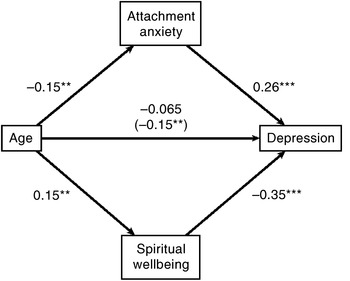
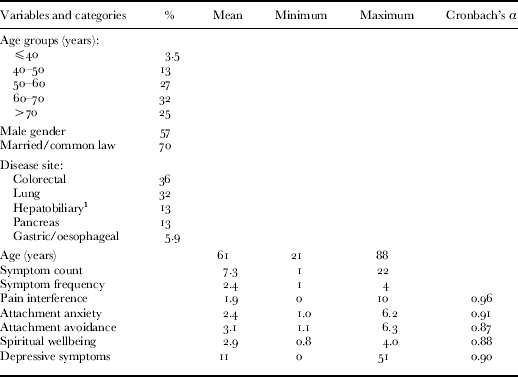
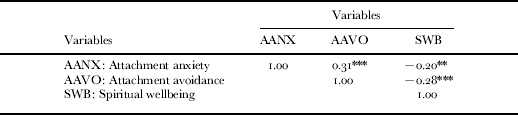
Table 1 presents the sample characteristics and scale reliabilities, and Table 2 the simple correlations between the potential mediating variables. Preliminary analyses indicated that gender and marital status were not statistically significant control variables, nor was attachment avoidance a significant mediator, so these variables were excluded from further analysis. Without any mediators in the model, the direct effect of age on depression was significant (see Figure 1 for the standardised path coefficient), controlling for symptom count, symptom frequency and pain interference. The strong age effect manifests in the prevalence of clinical depression: 36 per cent of the younger patients (aged no more than 60 years) had clinically significant levels of depression (a score of 15 or more on the BDI-II), compared to 22 per cent of older patients, a relative risk of 1.6 (95% CI 1.2–2.3).
Standardised path coefficients for the mediation of age on depression, controlling for disease burden.

Sample characteristics
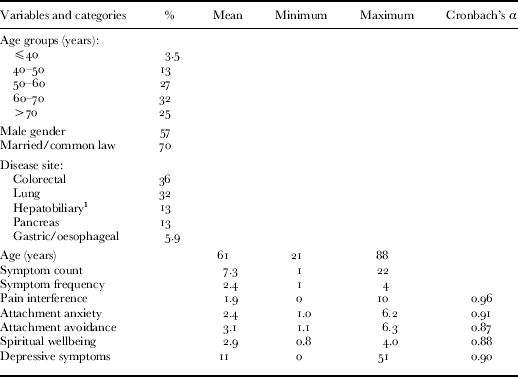
Notes: Sample size 342. Percentages within a category or means for continuous variables are presented as appropriate. Observed minimum and maximum values are presented for continuous variables. 1. Hepatobiliary: having to do with the liver plus the gallbladder and bile ducts.
Correlations between attachment variables and spiritual wellbeing
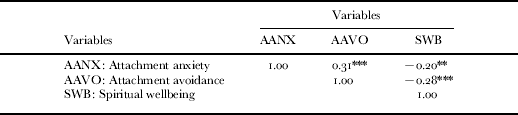
Significance levels: ** p<0.01, *** p<0.0001.
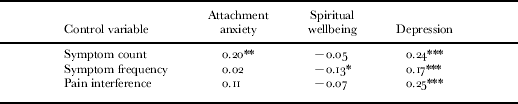
We then tested whether anxious attachment and spiritual wellbeing were mediators of this age to depression relationship. Figure 1 depicts the standardised path coefficients in the mediation model, controlling for symptom count, symptom frequency and pain interference. With the mediators included, age no longer significantly predicted depression, indicating that anxious attachment and spiritual wellbeing fully mediated the age to depression relationship. The indirect effect of age on depression as mediated through anxious attachment was −0.039 (95% CI −0.079 to −0.011). The indirect effect of age on depression as mediated through spiritual wellbeing was −0.050 (95% CI −0.091 to −0.017). Both indirect effects were therefore statistically significant. Lastly, Table 3 presents the standardised path coefficients between the control variables and the other variables in the mediation model. The three control variables were significantly associated with depression, but only symptom count was significantly associated with attachment anxiety, and only symptom frequency was significantly associated with spiritual wellbeing. Overall, the mediation model explained 56 per cent of the variance in depression.
Standardised path coefficients for control variables predicting attachment anxiety, spiritual wellbeing and depression among metastatic cancer patients
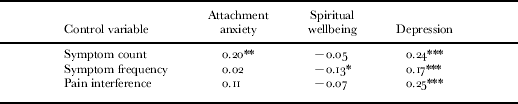
Significance levels: * p<0.05, ** p<0.01, *** p<0.0001.
Discussion
This study of metastatic cancer patients has found that greater age associated with less depression and that this age relationship was significantly accounted for by the positive associations between age and attachment security and spiritual wellbeing. These relationships were found while controlling for the effects of disease burden, as measured by number of physical symptoms, symptom frequency and pain interference, and were independent of gender and marital status. The findings raise the possibility that the relatively low level of depression among older cancer patients derives from their greater capacity to bear the distresses of the disease. Developmental growth in attachment security and spiritual wellbeing across the lifecycle would help explain this age-related pattern.
A number of factors may contribute to the age-related patterns in attachment anxiety and spiritual wellbeing. Younger patients may on average have had less opportunity to solidify and maintain secure close relationships and to internalise those experiences (Grossmann, Grossmann and Waters Reference Grossmann, Grossmann and Waters2005; Zhang and Labouvie-Vief Reference Zhang and Labouvie-Vief2004). Consistent with this hypothesis, a community survey of older adults (aged 60–64 years) reported fewer interpersonal conflicts with family and friends than among younger (aged 20–24 years) and midlife adults (aged 40–44 years) (Jorm et al. Reference Jorm, Windsor, Dear, Anstey, Christensen and Rodgers2005). Although the relationship between age and attachment security in our sample was independent of marital status, it might be influenced by the duration and quality of the patients' marriages. The duration of marital relationships may be age-related and such continuous partnerships have been shown to be linked to greater attachment security (Davila, Karney and Bradbury Reference Davila, Karney and Bradbury1999), although marital quality may moderate the relationship between marital duration and attachment security.
The present findings are consistent with the hypothesis that younger adults have had less time than older adults to achieve and to reflect on their life experience and to consolidate a sense of spiritual meaning, purpose and faith (Dalby Reference Dalby2006; Wink and Dillon Reference Wink and Dillon2002). It is also possible, however, that younger patients with incurable cancer experience a greater decline of spiritual wellbeing because the associated losses and disappointments are perceived as more traumatic (Exley and Letherby Reference Exley and Letherby2001). Further, older individuals may be more likely to respond to such negative life events with growth in their spirituality (Wink and Dillon Reference Wink and Dillon2002). Research is needed to evaluate the relative contribution of these competing explanations.
Some caution is advised with regard to the present findings. The tendency of older patients to experience less distress should not be taken to mean that they require less psychosocial care, for they may nevertheless have considerable unmet needs in this domain (Bouchardy et al. Reference Bouchardy, Rapiti, Blagojevic, Vlastos and Vlastos2007). In particular, older patients may have concerns about functional limitations in daily life, social isolation or a self-perceived burden that their care will place on others (Stanton Reference Stanton2006). Unfortunately, however, older cancer patients are less likely to be referred for specialist psychosocial care, even at similarly elevated levels of distress (Ellis et al. Reference Ellis, Lin, Walsh, Lo, Shepherd, Moore, Li, Gagliese, Zimmermann and Rodin2009).
It is important to note that cohort effects in the study population could confound the effect of age on depression. In that regard, it is unclear to what extent the increased acceptability of emotional expression and a decrease in the stigma associated with using support services over the past few decades (Holland Reference Holland2003) has influenced the level of self-reported distress among younger cancer patients. Other limitations of this study, which may affect the generalisability of its findings, include the cross-sectional design, the limitation of the sample to patients with metastatic disease, the under-representation of individuals aged less than 40 years, the selective recruitment of patients receiving outpatient care at a specialist cancer centre, and the exclusion of those who did not speak English or who were cognitively impaired.
In conclusion, the original contribution of this analysis is the suggested explanation of the protective effect of age against distress among cancer patients. The findings indicate that spiritual wellbeing and attachment security mediate the inverse relationship between age and depression among individuals with metastatic cancer. These results support the view that ageing is associated not only with increasing vulnerabilities and pathologies but also with the development of new, adaptive capacities (Brandtstadter and Greve Reference Brandtstadter and Greve1994). Paradoxically, older individuals may suffer from the tendency of others to under-estimate their adaptive strengths as well as their needs for support. More research is needed to identify how the age-related attitudes of patients and their medical care-givers may affect the referral for and benefit derived from different supportive interventions.
Acknowledgements
This study was supported by the Canadian Institutes of Health Research (grant CIHR #MOP-62861; GR) and the Edith Kirchmann Fellowship in Psychosocial Oncology and Palliative Care at Princess Margaret Hospital (CL). The authors gratefully acknowledge this support. Thanks also go to the Behavioural Sciences and Health Research Manuscript Review Seminar for their comments.